Wall Street Week with Louis Rukeyser; 1828
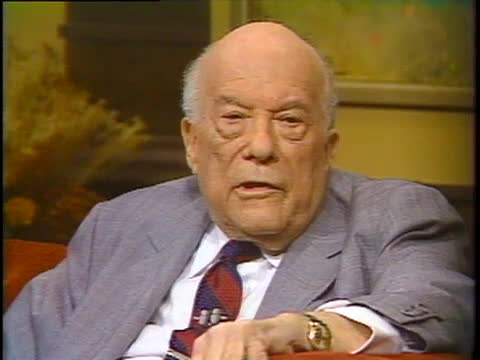
- Transcript
Oh. World. That. Was. Was. Right I guess. The on. Wall Street Week With Louis Rukeyser brought to you by a public television station by CSX the company that puts things in motion transportation energy properties and technology. And by Prudential based securities the investment firm with rock solid resources and
market wise thinking in the business of making money. Grow juiced Friday January 6. Our panelists are Mary Farrell Carter Randall and Martin's why. Tonight's special guest is John M. Templeton the founder and principal of the Templeton Funds. They've been on with the guys or this is Wall Street Week. Welcome back. As we begin this week what is so far turning out to be a remarkably happy new year. It seems appropriate to take as our theme tonight a virtue that is too often ignored by those who talk about finance and economics these days. The virtue is perspective. First we're going to be getting an extraordinary double dose of it on this program. My guest John Temple done has been an investment counselor for forty eight years during which time he has compiled quite simply the single best long time public record in investing in good times and bad
he has shared his wisdom and his unvarying the patient perspective with us here on Wall Street Week. And we're delighted to be having a chance to know what's on his uniquely discerning mind as 1989 begins and tonight's double dose of wisdom experience and perspective will also include later in this program. A brief retrospective of some of the last appearance on this program of the late Merrill Stanley Ruth Kaiser. Two men with much in common in that they never fell for the idea that you'd done well better be putting out the accepted truisms of the moment. As usual there's been too much of that conventional wisdom around of late on Wall Street for example when the market faulted on the opening day of the year sophomore at so called authorities raced to tell us that that meant an inevitable nosedive for the rest of the year. That would be profundity didn't even last 24 hours when the market then went up every other day this week
establishing a couple of new post-crash highs in the process. A fresh set of geniuses appeared to assure us that everything was suddenly beautiful in this best of all possible worlds. Well maybe though the broader market was still well behind the blue chips. Interest rates were nagging Lehi and the Dow itself ran out of gas every time it tried to close over 20 200. But remember that word perspective a mere two years ago the Dow had never in all its history closed over 2000. And when the big nervous breakdown occurred the following October don't forget all those gloomy gurus who panicked the media by announcing that the Dow would never again close over 2000. If we can't get a little perspective from those guys can we at least get a little apology. At the same panic pessimism has afflicted too much coverage of the overall
economy where most journalists have proceeded over the past year as if the only good story was a negative story how one wonders do they explain a week of news like this one two months after the votes have been counted a week in which construction spending rose factory orders continued to gain unemployment matched a 14 year low. And even the nation's big retailers who exploit phony concerns about the economic health of the middle class by crying wolf every Christmas came out and admitted that they had once again actually done much better than expected one of these days some folks may have to step back a pace or two look at what's happening to this world in this decade and admit it with a totally unfounded fashionable sense of perspective that just possibly It hasn't been all bad. But don't hold your breath. Meanwhile let's move from the world of long term perspective to the world of instant perspiration and see what did happen in Wall Street in the
first week of 1989. The Dow Jones Industrial Average did in January what it failed to do in December which was to reach a post-crash Recovery High overcoming the fashionable new fear that the economy may be just plain too strong. The blue chip index added more than 25 points to close at twenty one ninety four point two and on its best finish since the Friday before the crash of 87 when the Dow was about 50 points higher all the broader market indexes joined the continuing party with the American exchange celebrating its best week since June. And what do you know even our elves are cheering up with a mildly bullish plus two. That is the most positive reading in their technical market index in 17 weeks. There wasn't much champagne drinking in the hapless world of precious metals whose prices softened while the dollar and stocks rallied but there will be plenty of celebrating this year in more
cheerful precincts. For example Barbie the world's oldest teenager turns 30 this year. And so as it happens does Bullwinkle. Whether that event has any significance for the stock market we'll have to wait and see. We could ask our own all-American boy quite a rental. Well you know Mickey Mouse became 60 this year so that's the that's the hope for him saying there's hope for all of us and one day even you will need those agents someday somewhere. What do you think is a first week significant in any way. Well of course it's significant. And if you believe the lure of Wall Street the first five days will tell you what the month is going to do in the month we'll tell you what the year's going to do so a strong first five days means we're off to the races. I don't think we're off to the races Lou but I'm looking for a higher market in 1909. I don't see a recession and I don't see any decline in corporate earnings in fact I see an increase in them and I don't see interest rates soaring. They may go up a little bit short term but I think by the end of the year they'll be flat so
I think it's going to be a good year in the stock market. Flats compared to where they are now understood what to do compared to where they are now yes I think they'll be able to make a lot of the Hill want them down. They'll go up the hill as the Fed does tighten a little bit to slow down this rapid economy but I think by the end of the year we might even see the Fed trying to ease money a little bit will be the eighth straight year in which the S&P 500 advanced a few right. Well overdone that there's no reason why we can't have eight straight years. I don't see why we have to have a bad year just because we haven't had one recently. That's not a good reason. I'll buy that. I found you share the joyfulness not quite as optimistic as Carter. I do think we could end the year up you know in at 12 months hence but I think we're going to have some problems getting there. So short term rates that you alluded to earlier really I think are going to give the market a hard time and suggest a lot more longer ability in the short term. Does this suggest a recession. No. But a slowing economic growth and I think that's what we have to watch it doesn't take negative
economic growth to hurt corporate profits. In fact a slowing to under 3 percent really could lead to some kind of a sharp burning surprise on the S&P. Would you take money out of stocks. It depends on how what kind of a timeframe you want. I think we are in for a correction of 10 to 20 percent which would occur in the short to intermediate term but I think then you're going to see the factors in place that could get us back into a bull market 20 percent reproducibility would be friends and we're Yes yes. Why does one guy know that when people's cheerfulness is excessive in their confidence bounding we can look to you. What do you make of it he died along the lines that you were saying there is a lot of pessimism around right now people are not that optimistic and that's a plus because it infers that people have a lot of cash on the sidelines in various surveys do show that. And that's a positive. The negative though is that interest rates have gone up quite a bit about 300 basis points in the last year
or so and it's usually negative for stocks when rates go up so there's a tug of war is the interest rate environment now actively hostile to I would say it's semi hostile. What would make it really hostile is if short term interest rates rise above long term rates a so-called inverted yield curve we're getting close to that now but we're not quite there. So your sentiment indicators suggest there's too much pessimism which is good but your monetary indicators suggest that the interest rates are too high in money trouble. So you have one good set and one bad set but I wait the monetary more than the sentiment because the computer tells me that. So you're two thirds running two thirds friending Yeah but I think the market can rally for a little while before it goes down but we do think we're going to get through that pre-crash time. The big question closing in the 20 to 46 I guess well my high for the year in the show is about 100 points or so higher than we are now so I guess I think that's so I think there's going to be right. Well anything's possible. Did he make
it once in a while he was right. Well now before we meet tonight's special guest let me personally say a brief but heartfelt thank you to the hundreds of viewers who have written me letters of sympathy after my father passed away two weeks ago this week would have been his 90 second birthday. And many of us asked for a final look at him. We're very happy to oblige. The last of his three appearances as my guest occurred Thanksgiving week 1987 a month after the crash that so many were calling another 900 29. I asked him who had been a leading financial commentator then back in 29 to what extent the comparisons were valid. The only thing that's constant in comparison this year with 1929 is human nature and human psychology. And we still subject to the madness of crowds. Did the Christ cause the depression.
Absolutely not. The business remained reasonably good until the following June. After October. As a matter of fact those speculators who are on the wrong side of the market in October 1929 jumped out of the window prematurely. They didn't wait for the technical rally. You were quoted earlier this year in one magazine. With them it still sounds pretty good to me. You talk about constant she said There's no surer investment no chance of being right every time all you have to work with is careful selection. Persistent supervision and diversification to cushion your mistakes. Successful investors know themselves and do their own thinking. They don't react to each market fluctuation they find a good investment and let it pay off. Would you want to amend that at all now. No it was pretty clever of me I didn't remember this thing. You still hold of common stocks. I am.
But with the advice and consent of my AS and as signs. I took advantage of my age and bought a non refund annuity so I could afford the whole whole common stuff that only paid a small rate on the purchase market value. But when you are investing for your own account you still believe in the future the stock market. Yes and I believe that I was assuming certain risks. I didn't think I was making a risk of this adventure. You're obviously not a newsletter writer because they don't have any risk they just tell us they know the answer well if you subscribe for about 60 or 80 dollars a year you can have this risk was the venture. The only thing is that they run out of town after a big break. Your life covers a whole cycle in American life in terms of our international position. We were a debtor nation we became a creditor nation our debtor nation again how can we become more competitive in America. But a return to excellence. When I was writing a daily column I'd comment on the
crusade against excellence. Labor unions for example were telling people not to work too and not to produce too much. All kinds of negative things were going on. People who through seniority became chief executives were taking the perks and not producing. Are these politicians brighter or dumber than they used to be economically. I don't know we fluctuate. And. I don't. I don't know whether one should be a Democrat or Republican position change policies since I was a boy when I was a boy. The Democrats stood for a tariff for revenue lonely Republicans stood for protective type of nigga all through the policies. In those days it was. Very very popular to do deficit financing and it was a new invention and if you would if you didn't go far you want a liberal
in the ladle under Weber used to say a liberal is a fellow who is liberal with the truth and liberal with other people's money. And if you didn't think that deficit financing was a good for as a permanent policy you were considered a reactionary and a reactionary was a fellow could add. To be nonpartizan all my life I've never registered in either party. But I say to the American public if you want to return the United States to excellence into world leadership. Don't vote for anyone of either party or any party who hates business who thinks that finance is wicked and who wants the United States to have costs that are different higher than those of competing nations. The reason we were able to do it before I was going to say what I was interrupted was that we had a exclusive
use of technology of high technology and we were able to overcome high money wages with technology but in the connection with the postwar aid we not only gave them the money but we gave them the technology. We built them new plants and we tried to compete with obsolete plants and obsolete tools and then a new group of management came in sight of intellectual hippies and they were catering to analysts who were only looking at three months earnings and they didn't have the great days of General Motors when the sun was there for 40 years was trying to look down the road. Even of the end mill rule Kaiser was still looking down the road. How lucky we are that a new generation of Grand Old Man is coming down the pike. And now let's go over and meet one of the grandest tonight special guest John M. Templeton. John welcome back. Always a special pleasure to have you here right here with me.
Don Thompson who is the principal and founder of the Templeton Funds currently invest assets in excess of 12 billion dollars and as usual he is doing it worldwide. One of the first modern managers to discover and preach the value of international investing. The 76 year old Mr. Templeton is forever setting records. Tonight he adds one more. He's making an unprecedented ninth appearance as my guest on this program. John when you were here right after the crash and were correctly counseling patients and not panic. You said it was possible the bear market was already over was it. It looks more like it every day. We just had a new high since the crash 14 months after the crash. It would be hard to say that we have not already started a bear a bull market so that although we don't know how long this bull market will last I believe when economic history is written we will say that was one of the most dramatic but also the shortest bear markets which ended
14 months ago. People laughed at you early in this decade when you said on this program you thought we'd get to 3000 in this decade Well we got within 300 points of it you think we might still make it here. I doubt I have. I doubt it's an even chance that we will get there by the end of aged nine. But I would think it's still an even chance we'll reach 3000 by the end of 1900. And if as you just suggested we are embarking on a great new bull market how hard do you think it will go in the nineties. Higher than almost anyone expects. With the time the next bull market gets roaring earnings should be 40 percent higher than now that would justify share prices 40 percent higher than the previous peak. That would be over 4000 on the Dow. The last bull market Kerridge share prices to triple where they had been triple the low point for this one would carry them to five thousand one hundred. Also the the shortage of shares that has developed in this time might carry him higher than that.
So I would say that by the time that this bull market reaches its peak there's a 50/50 chance the Dow will be above 5000. Can hardly wait. Right John. Your friends have had a good year in part because of an accident. You pick stocks on the basis of value and then some of these takeover boys came in and took over a lot of your companies. Some people are worried that the takeover craze is going too far. Do you share that concern. Yes we do. We've always wanted to buy those things that have the lowest price in relation to what the corporation really worth. And of course the acquisition people are looking for the same thing. The fact that the acquisition people are paying 50 percent or higher premiums above market price proves that American shares are still selling for less than they're worth. The fact is 700 corporations are buying in their own stock proves they're selling for less than they're worth. The fact that the bear market didn't go any longer than it did it indicates the chairs are still in the bargain counter. But they have been so many of these acquisitions
that the prices now are getting above prove that you know people are paying more than they should. But the worst thing is that these huge acquisitions result in a great decrease in government tax revenue because they substitute for the common stocks. Debt on which the interest is deductible. And I think that should be corrected and probably before this year is out we will see some change in the tax law so that mergers will still be permitted acquisitions will still be permitted but not subsidized by the Treasury Department. Where are you finding legitimate bargains now. All over we are finding enormous numbers of bargains in America. We have over 65 percent of our investments in America. We don't usually have you when it is yes. Only once before did we have to have 50 over 50 percent in one nation and that was 25 years ago 20 years ago in Japan. But now with 65 percent of America that's the highest we've ever been in any single nation. We're also finding bargains in New Zealand. Hong Kong Canada
and England where in the U.S. you find bargains in those things are depressed. You don't get a bargain when Except when other people are selling the prices only go down with other people pushing them down by selling. So you have to buy those things that are unpopular. One of the areas it's unpopular now are the financial stocks all the financial stocks particularly companies that sponsor mutual funds are selling at remarkably low prices. Another area is life insurance such as Cigna insurance is selling at a remarkably low price. The bank stocks are selling at low prices now. National Bank of Canada is a very great bargain. So is Westpac banking. Also emerging growth stocks or very unpopular have been sent so July 1983. They are on the bargain counter now. Stocks like Standard Pacific which has a marvelous management growth record is selling only six times earnings with a K. shield of 12 percent. So I've got three kids I want to talk to you.
Starting with Carter Mandel. Thank you very much Lou. John as you've said you're a worldwide investor and you transfer money from country to country. Do you perceive a major nation emerging in the next century perhaps the way the United States did in the last century both economically and socially and so on. Very much so. Carter after the First World War America blossomed out as the world leader of an economy. And after the Second World War that happened to Japan when we began to invest in Japan the total market in Japan was smaller than the capitalization of International Business Machines. Now the Japanese market is so big 40 percent larger than the American market. In fact it's Japanese market is now larger than all the world's markets ever were until as recently as five years ago. It's been an extraordinary story but that shows the world is speeding up. We're going to get faster and faster progress. And if you had to pick one nation it is going to be well worth watching in the next 25 years. It's mainland China. I've just come from they are investigating opportunities and that
huge population of a billion people is doubling their standard of living every seven years. That's going to have a huge effect on the world and when Hong Kong becomes part of mainland China those business people in Hong Kong will speed up the progress of mainland China. It's a wonderful thing we worked for centuries to have every nation become prosperous and now all of the poor nations are becoming prosperous and we should all rejoice and be glad. John as all these other markets have become much more important the U.S. stock market which used to be the biggest game in town I think it's now less than a third of the global equity market. What does this mean for the future of the U.S. as an economic power. Oh it's wonderful Larry. America is is rapidly growing growing more rapidly than ever just in the last two years we've added five million new jobs in America. No major nation ever added to the 5 million jobs in two years in the last 20 years America's added 20 million new jobs. And that's process is speeding up the standard of living in America is likely to quadruple in all of the next 40 years.
That never happened in a major nation before. But compared to the rest of the world others will be growing even faster which we rejoice in many of the poorer nations are growing more rapidly than America and probably will continue to. And what a happy situation to have everyone more prosperous. It means America will be more prosperous if your neighbors are more prosperous. John give any particular outlook on inflation and given your outlook. What companies might benefit by it. Marty inflation is a problem. It's a problem because of human nature all over the world people spend too much and they they borrow too much. And Nations borrow too much and the net result in all history is going to be more inflation. You go in cycles However there will be some good years when we may have as little as one or two percent inflation on other years it may get above 15 percent as it did once in America. Over the long period it probably average out to doubling the cost of living about every 10 years. And that's the reason why you shouldn't hold too
much in cash because cash is sure to lose it purchasing power. Instead of that you should hold things that are likely to reflect the higher prices and such if you own a grocery store the same quantity of groceries cost twice as much you'll have twice as much profit. So the thing to buy for inflation are those stocks that are most depressed in price and have the greatest potential lead for to benefit from higher trading volume. So I'm going Ilya out of time. What do you think pessimism is so popular. Human nature people don't buy newspapers that announce the good news that it's some catastrophe attracts the public and because communication is so much more instantaneous than ever. We are flooded with pessimistic things from nations that we never would have heard of before. It's always a tonic to have your antidote then. Thanks very much John Templeton Thanks to our panelists. Hope you will be back live again next week. Then we'll check in on an industry that has provided more than that show bumps in recent months. The nation's airlines I guess will be a top airline analyst Michael
direction. And I'll be asking him what passengers and investors can expect on the next leg of the journey so buckle up and come fly with me. And while this event was Fleet Week I'm Louis Rukeyser. Tonight St. Louis group has been brought to you. Why a public television station five CSA a company that puts things in motion transportation energy properties and technology and a viper eventual based securities investment firm with rock solid resources and market wise thinking in the business of making money for printed transcript of this program. Send a $5 to transcript. Wall Street wait Owings Mills Maryland 2 1 1 1 7. That's $5 to transcripts. Wall Street which owns Mills Merrill to 1 1 1 7. Wall Street Week. Transcripts are also available to subscribers of the Dow Jones news retrieval service.
And. Wall Street Week With Louis real geyser is produced by Maryland Public Television which is soley responsible for its content.
- Episode Number
- 1828
- Producing Organization
- Maryland Public Television
- Contributing Organization
- Maryland Public Television (Owings Mills, Maryland)
- AAPB ID
- cpb-aacip/394-69z090cn
If you have more information about this item than what is given here, or if you have concerns about this record, we want to know! Contact us, indicating the AAPB ID (cpb-aacip/394-69z090cn).
- Description
- Episode Description
- #1828 - "Templeton on 1989--and Beyond" - The best long-term investor in history tells us what's ahead for 1989 and beyond. John Templeton, Templeton Funds Management, Inc. - Guest; Mary Farrell, Carter Randall, Martin Zweig - Panelists. (Betacam also available)
- Created Date
- 1989-01-06
- Asset type
- Episode
- Topics
- Business
- Media type
- Moving Image
- Credits
-
-
Copyright Holder:
MPT
Producing Organization: Maryland Public Television
- AAPB Contributor Holdings
-
Maryland Public Television
Identifier: 45619.0 (MPT)
Format: Betacam: SP
Generation: Master
Duration: 00:26:46
If you have a copy of this asset and would like us to add it to our catalog, please contact us.
- Citations
- Chicago: “Wall Street Week with Louis Rukeyser; 1828,” 1989-01-06, Maryland Public Television, American Archive of Public Broadcasting (GBH and the Library of Congress), Boston, MA and Washington, DC, accessed October 10, 2026, http://americanarchive.org/catalog/cpb-aacip-394-69z090cn.
- MLA: “Wall Street Week with Louis Rukeyser; 1828.” 1989-01-06. Maryland Public Television, American Archive of Public Broadcasting (GBH and the Library of Congress), Boston, MA and Washington, DC. Web. October 10, 2026. <http://americanarchive.org/catalog/cpb-aacip-394-69z090cn>.
- APA: Wall Street Week with Louis Rukeyser; 1828. Boston, MA: Maryland Public Television, American Archive of Public Broadcasting (GBH and the Library of Congress), Boston, MA and Washington, DC. Retrieved from http://americanarchive.org/catalog/cpb-aacip-394-69z090cn