Wall Street Week with Louis Rukeyser; 0833; The Profit Pioneer
- Transcript
You. You. From the Maryland Center for Public Broadcasting. This program is made possible by a grant from the Martin Marietta corporation and by this and other public television stations. Yeah. Wall Street Week With Louis to a geyser produced Friday Feb. 16.
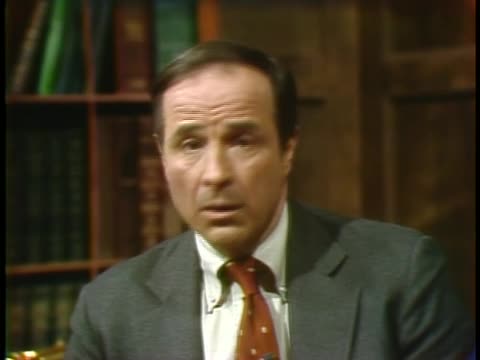
Guest host for Wall Street Week is Frank Caprio. Our panelists are Dan Dorfman Carter Randall and Julius Westheimer. Tonight's special guest is Philip they'll cover a president kurang and Company Incorporated. Good evening and welcome to Wall Street Week. I'm Frank happy Hello I'm your host tonight while Lou Kaiser takes a much deserved weeks vacation. Well we'll be talking about tonight falls for the most part under the general heading of growth. The big news this week was the growing disorder in Iran the growing oil shortage that resulted and the growing oil prices that are following the shortage. The president and energy secretary slashing are said we should all be growing more concerned about that. Though maybe not as alarmed as the secretary was last week. A lot of Americans were growing alarmed however about the president's performance in Mexico
and what he might do to our chances of getting a long term supply of oil and gas from that country. But this was the future. In the meantime the economy waited for no one. Industrial production housing starts and personal income figures all came out this week. They all pointed toward slower growth in the economy this quarter. Housing starts in fact were the lowest in two years and the chairman of the Federal Reserve Board said we'd better get used to slow economic growth because we'll need five to seven years of it if we're going to stop inflation. My guest tonight is an expert on the growth of money your money. He's the founder of the two highly successful pioneer funds a man who's been managing other people's money since 1928. And we'll be asking him where he thinks the best growth opportunities are this year. But first let's see what happened on Wall Street this week. And as the Dow Jones Industrial Average indicates the market wasn't sending out any Valentines this week though it managed a small
recovery from the thirty seven point loss of the previous two weeks. The Dow started falling back again on Wednesday to close the week at a twenty seven point one a gain of just over four and a half points on the lowest weekly volume since mid December. The broader New York Exchange composite index was even more diffident and though there were no red hearts from the blue chips the Amex index hit its highest level since October and the Nasdaq over-the-counter index also managed a gain. No boxes of candy for the Elves either. They've moved from a slightly standoffish minus one to a completely uninterested zero. The problems in Iran and Mexico though didn't have much effect on the price of gold or the dollar either. They both rose slightly. There is a major effect in the works though for options trading in this country. The long awaited SCC staff report released today and the news wasn't good for the backers of more options trading Carter. Could you tell us what that
report said in effect and what impact it will have on the options market and on the stock market. Yes well as of right now Frank the FCC has put a moratorium on additional options trading to conduct an investigation into the trading practices on the floor and on the practice of information being given to people as you know option trading can be highly speculative and the FCC wants to make sure that it's that everything's about Boyd keeping it honest. Absolutely that's right. OK Carter Julius what do you make of the decline in housing starts that were just reported this week. Is this the beginning of the consumer slowdown that we've been waiting for. I don't know if it signals the beginning of a real recession which technically is two downward quarters of real gross national product in a row but I think what it does signal is the effect of President Carter's raising of interest rates early in November. I think that that raising of interest rates which was really to prop up the dollar has caused housing to slow down and as you mentioned earlier personal income also and industrial production. So in that sense I think there is
something there. This is a case where slow is good fast is bad. That's right. OK. Dan Dorfman the Iranian situation they cut off of our oil supply for some undetermined period of time is serious. And yet the stock market has done rather well in most cases prices rising. Why. What's going on. Well first of all I want to just say the Iranian situation in my mind is a risky dangerous situation. I talked to the head of Exxon a few weeks ago and he told me that we have maybe three months more supply and then he'd be concerned. I think the reason stocks aren't going down for me. Is because the Basically that's the reason stocks are basically cheap. Well one of the values yeah. What about Mexico. Are we doing all right there is the president making some headway where untying outsource their I don't know I don't know what the when they spoke in private what precisely they came out of that. But what I can say is fund raise based on reading the papers you know I mean it was a fiasco.
You know I think maybe next time we should send hope or a card or two weeks ago when you were last on the program you seem to be growing cautious. Are you still cautious or are there some factors that have changed your mind or perhaps you're getting more cautious. Oh I think I said that and I say the same thing now. I am optimistic for the end of the year market. But really I'm taking a wait and see attitude for the next two or three months because. I want to see when this recession is going to hit and how long it's going to last and how deep it's going to be and I don't think we'll have a clue about that until early spring. But when uncertainty is cleared away it will not be too late to buy stocks. No I don't think so I'd like to be almost in the middle of the recession and then buy the stock and give it a little more time. I think so. OK Julius WESTHEIMER I even hate to ask you what stocks you're recommending to your clients in this market but I will. What stocks are you recommending to your
clients. Well the group hasn't changed although the names have suffered. I still think the best hedge against inflation including everything gold real estate everything are the big capitalization high powered growth stocks stocks such as IBM American Home Products Atlantic Richfield Merck Coca-Cola Texas Instrument if you had your I was one of those which one would you buy. Well I would put my chips on International Business Machines even as smart as an investor is Julius Westheimer can be wrong sometimes you take your risk as it happens frequently. OK. Dan Dorfman you have your ear to the ground in terms of large institutional investors in the New York area. What do they seem to be doing have they been buying in this market or a linebacker What have been lying about very very cautious very uncertain they want to see the impact when they see what's going to happen to the high oil prices and what's that going to do and what's that going to do to inflation if we start getting into high double digit inflation. You're going to see a lot of selling I think the word is cautious cautious as well that seems to be the entire tenor
here caution. All right now gentlemen that's Question Time for our viewers so let's see if we can do for those people out there. Carter Randall John Park Jr. Bedford Texas has a question about chemicals. He writes the chemical industry has been held down for several years by overexpansion. Do you feel the chemical stocks are ready for a conservative price appreciation over the next few years. I think over the next few months and years yes they are selling just about the average that the market is selling and they deserve so at a premium. But again I'm in no hurry to buy these stocks at the present time because I think they're going to have some shortage problems particular in the petrochemical industry. But a stock like Dow or Dupont or as a matter of fact Stauffer chemical can be bought today with a high heart if held for the long term. Carter I've never seen you so calm and unhurried something's happening out there. Julius Westheimer John apple of East Lansing Michigan wants to know what you think of Israeli
stocks and trust funds particularly his long term holdings for American investors can you help them. I'm glad you asked me that. I've spent a lot of time on the floor of the Tel Aviv Stock Exchange a very hectic turbulent exchange but a very efficient one. However when it comes to Israeli stocks I think we have to look at the Israeli economy which is be set by inflation. It also has very high military expenditures and Israel particularly since a new Iran's troubles is going to suffer from a terrible shortage of oil. I wouldn't want to be misunderstood on this but I think there are some better opportunities closer to home that we can follow and that are tested. There are some good Israel stocks but I think I'd rather work here first stay with the bargains that you know I think so yeah. OK join us Dan Dorfman Emerson Boyd of Salt Lake City is worried because a company in which he owns stocks says that it intends to liquidate. He wants to know just what exactly is a liquidation and what effect it would have on his stock. Basically Woods talking about a company selling all of the selling all of its assets and the
stock holders. Now one of the one of the interesting things is do they think that their stock prices are so won't they the companies many companies are worth more dead than the real life. Well they were aware of this sounds like some investment in this. That's what many of them have. Eventual August is the look at a company's book value which is this which is essentially the difference between assets and liabilities and of and of and of the company's book value is low lower than the stock price and the company is going to liquidate than Chance's chances of stockholders and come out all right. But you've got to look at that book value and make sure it's real. OK. Thank you Dan Dorfman. Now you've been considering liquidation for your portfolio or for your broker. Just saying your investment questions along to his here at Wall Street Week Owings Mills Maryland 2 1 1 1 7. That's Wall Street Week. Owings Mills Maryland 2 1 1 1 7. We'll try to water down your difficulties. In the last 10 years the
mutual fund industry has suffered from a bad case of liquidation too. So before we made tonight's special guest let's take a look at what has become his industry's biggest problem. Since 1972 investors have generally been cashing in or redeeming more mutual fund shares and they've been buying though the money market funds have been an exception to this trend in the last five years the drain on the assets of stock and bond funds has been substantial in 1074 funds sales excluding money market funds had fallen to 3 billion dollars less than half their 1968 peak and in response to falling stock prices. Investors cashed in 3.3 billion dollars worth of shares in that year. Sales rose slightly in 1975 but so did redemptions producing a three hundred eighty million dollar gap. And in 1976 another modest sales increase in the face of massive redemptions left a devastating two and a half billion dollar drain on
fund assets. The popularity of the new municipal bond funds stopped the outflow temporarily in 1977 and sales rose three hundred eighty million dollars above redemptions but last year though investors bought six point seven billion dollars worth of fun sales more than any other year since the record 6.8 billion in 1968. They also went back to cashing in shares in record numbers seven point two billion dollars worth. Clearly the feeling wasn't entirely mutual. The public's aversion to mutual fund shares in general has not however extended to every fund in particular. There are exceptions. Philip Correo has managed one of those exceptions since 1928. What makes his management so exceptional. To find out let's go over and meet him now. Blow Phil syndrome please.
You're full of career A is obviously doing something right. And one of the longest careers on Wall Street. He's organized two highly successful mutual funds and his own investment management firm. He still runs their combined half billion dollars in assets and runs them well in the last five years while the average mutual fund managed a gain of 34 percent. His Pioneer Fund rose 78 percent and his Pioneer to fund a hundred sixty five percent. Not bad for a grand old man. Phil what are all those other mutual funds doing wrong. Well I don't pay too much attention to what my competitors do because I have enough trouble trying to keep up with my own job. What are some of your basic rules of investing to keep straight and on the mark. We try to buy what we call basic values buy basic values we need a good company with a good past record good prospects for growth at a reasonable price and price is very important.
How do you identify what a reasonable price is. Are you having a yardsticks or any indications when the when the Dow are selling at 8 times earnings. We wouldn't want to pay more than that unless unless they were an extremely attractive prospect. You said that a clean balance sheet is a criteria that you use. Now some of us thought the debt. Isn't all bad for a company. Why is it bad in your estimation. Too much debt has to be paid back usually at an inconvenient time. Do. You have a size book value too. Why is that important. Would you go through the book value. Russia now. It depends of course on the type of company a cosmetics company books. You wouldn't mean a thing. It's a question of the sales organization. Advertising ability and that sort of thing. In the case of the ad in the case of a river or book value doesn't mean anything because every road in the country is worth far more dead than alive.
But in the case of the average industrial company book value is a reasonable basis on which to build a business. You can't you can't do a hundred million dollar business on a million dollars capital obviously. But if you add all of the assets on the balance sheet historical cost and deduct the liabilities what's left is book value. And even if you do get that at 50 cents on the dollar someone has to do something with that book value. You have to have good management. How do you develop good management. Well we'll look forward. It's very hard to identify except by the track record either of the company itself or of the individual before he was elected to his post. An example of. A possibility. Fire in the future I think. Nothing to be looked at for another two or three years as the great Atlantic comes as every TV company which is never a time never was specific and hasn't been great for a
long time. It has a new controlling interest which might be able to do something in two or three years we'll know whether the new controlling interest is going to succeed or not. They have a colossal job. Maybe they can do it. I see Carter Randall straining for a question here. Carter do you want to come in here. All right Phil you've been in this business for five decades and that's quite a record. The last decade the one of the 70s has been one of great disappointment to most stockholders except for yours. Can we look forward for future decades to be as discouraging as this in the stock market. There are always opportunities. So the problem was to identify them there are 5000 different companies in which one can buy stocks more easily than others. There are some real bargains out there at any time. Right. OK thank you Phil.. Frank asked me earlier what I thought of the growth stocks at this point. The hike capitalization traditional growth stocks.
Well you're an expert in investing and I'd like to hear your views on this. I don't really know how to define a growth stock growth stock is something that has been growing very fast and everybody thinks it's going to continue. I have my own criteria. As an example of what I consider a growth stock as a company that the average investor never heard of because a company does nothing to advertise or sell. A company called Price brothers cooperage which 25 years ago was doing about. 20 million business. And I was doing 250 million practically all financed internally. Always with a beautiful balance sheet and earnings warning. Mr. Gray there used to be an old saying on Wall Street buy good stock. Put it the way I do you'll do well. But the market's gotten so volatile these days people wonder if that rule is still in effect. What do you think. Well I think the rule is still in effect except that there are a cyclical industry a steel stock
is not something to be put away and forgotten because the steel industry is highly volatile. Phil you've been quoted as saying I don't follow crowds. If there are a half dozen research reports on a stock we throw in a wastebasket Now are you saying that most of Wall Street security research is worthless by the time you get it far from some of those very valuable. Why don't you follow it. I do follow but I don't necessarily follow the recommendation and if everybody is concentrating on a particular field and some of the report on the back burner grabs so by the time you see a report and you analyze it a lot of other people having the stocks reflected that in a price. You also have indicated that you don't spend much time on market trends you don't try to second guess the market. I've never known how to do it so I don't cry. If you're looking for the guy to do it but really this means you're 100 percent invested most times now it doesn't that cause you some problems when you go through a
73 and 74 when it didn't and 73 or 74 and I don't think it will the next time you think you're bargains with you buy a stock. Reasonably price that your cushion but your protection so to speak. Carter asked you a question regarding looking down the road in terms of your experience. And reflecting on the past and you came into the business in the early 1980s. There aren't many people that have been in that business as long as you have that are still active. Looking back what are the 1 2 or 3 mistakes that you've made that if you could do it over again you don't make. Well I can look at several blunders. Tell us about one or two. I. Have a partner in a small firm which was making a market in a company called Hayden Lloyd. This is the second time we've heard this story many years ago I had a partner who had a low boiling point and he had a
quarrel with the young president of Halo and all communication was cut and we sold our stock and forgot it. It was a Bush blunder. OK. Carter I think it's just about time for you to tell us what three or four stocks at the present time you really like in the marketplace really like now really about what you're buying. Well. I like management. There are two management which I feel extremely comfortable one of them is probably for the corporation which make very humdrum products. Many years ago they made wooden barrels and I was a dying business. There is little left but of the 250 million or so sales probably two or three million wooden barrels and they've gone into five aboard drum cartons and sophisticated packaging and build up a huge business. The chairman of the board who has run the company
is next. I think he's one of the ablest businessman certainly of whom I know. I asked him a few months ago he being probably 55 58. Jack how long do you intend to run the company. He said until I'm 90. I said that's great. I. Know exactly what I'm speaking of. Stocks like right. You also have a rather large position in insurance and bank stocks and I take it that you're still active in those stocks or still like them. You know which one or two at this point. One that I like and a bank stock feeling was Lincoln first banks which is a state why it was no longer a bank holding company because they consolidated all their subsidiaries into one bank outside of New York City to cover New York State. I suspect that they have less exposure to Iran and places like that than the
big New York banks. Big New York City banks the stock the common stock is selling at about a 45 percent discount from book value of the earnings are good. They have a convertible preferred which is selling at about a 10 percent premium over conversion parity and pays about 8 percent return for Experian tracked it to me. I might add in passing that even those great forecasters can be wrong sometimes you can buy it for her oh I just want explain to our viewers that Hey Lloyd went into Xerox. That's what I've turned into. Still I want to ask you this question a lot of people today are frightened of stocks because what happened to him in 73 74 and they're running toward bonds and putting all of their money into bonds. What is the outlook for their portfolio. This of this inflation that well should they not just go into bonds should they diversify. Personally I'm a great believer in diversification in my own portfolio conveying fan number of bonds. Mostly tax exempt not tax exempt.
Plus stocks ranging in price all the way from 25 cents a share to $200. Because of the energy situation and situation the market has become increasingly excited about. Energy stocks particularly the domestic oils. What's your feeling about energy investments at this time. We liken. Any particular. Union Oil was the largest single Alling and plan a foreign company that I think very well. For one thing they've done a little more innovative and imagination. Some of the other big oil companies they're quite heavily involved and geothermal. Power which has a great future all of it will never count filled more than a small or perhaps 5 percent of most of the source of energy in this country. What if some nonpolluting. Cheap source of energy and they're in it with both feet.
Phil let's talk about the economy for a moment. You said not too long ago it was probably a mistake to replace other birds as chairman of the Federal Reserve Board at that point in time. Now after a period with the new chairman Mr. Miller. How would you give Mr. Miller Marks do you think he's done a reasonably good job or B minus the minus. Not too bad. A lot better than you expected. Yeah. OK. All of this in the stock market. Look forward to the market going up because someone is going to put it up. Someone's going to buy stocks. The institutional investor appears to be on the sidelines. The individual investor may or may not come in. But we hear over much about foreign investors. In your view will foreign investors be a big factor in the stock market in 1079. I think going to increasing factor yet why why would they invest in American stocks. Well because we're a very cheap market. I've been to Europe twice this year the price of a hotel room or
breakfast for me or anything in Europe is roughly twice what it is here. And if this is the cheapest market in the world of the major countries which I think it is. The cheapest thing in the United States a common stock. So this is the time to buy and they will recognize that in short order. I don't know how short but they will recognize that. If you had a few rules to give an investor just starting out in the business trying to make a stay what would you tell him. Diversify and buy for the long haul. Be patient. Is there any one stock that you can start with that in your opinion would give them a head start in the operation of developing more money. Is there one by a certain course he should start with well-known stark big names of big names like X which is a great company and reasonably priced. OK Phil I have to stop you there. That's all the time we have. But thanks for
coming in thanks to our panel. It's always a pleasure. And I hope you'll join us again next week when Lou will be sitting in this chair once again and welcoming back a guest who was exactly right a year ago on the best performing stock group of 1978. He's Wolfgang diminish a top analyst of aerospace stocks and who will get a chance to earn his wings for this year. Try not to get bumped for this one. I'm Frank happy yellow til next week. Goodnight and Good Luck from all of us at Wall Street Week. If you would like to obtain a written transcript of tonight's program send $1 to transcripts Wall Street Week Owings Mills Maryland 2 1 1 1 7. That's $1 2 transcripts. Wall Street will Owings Mills Maryland 2
1 1 1 7. Residents of Maryland Please include five cents sales tax. Wall Street Week is produced by the Maryland Center for Public Broadcasting funding for this program is provided by a grant from the Martin Marietta corporation. And by this and other public television stations the Maryland Center for Public Broadcasting is soley responsible for the content of Wall Street we are.
- Episode Number
- 0833
- Episode
- The Profit Pioneer
- Producing Organization
- Maryland Public Television
- Contributing Organization
- Maryland Public Television (Owings Mills, Maryland)
- AAPB ID
- cpb-aacip/394-55m90hh0
If you have more information about this item than what is given here, or if you have concerns about this record, we want to know! Contact us, indicating the AAPB ID (cpb-aacip/394-55m90hh0).
- Description
- Episode Description
- Philip Carret, Carret & Company, Ltd. - Guest; Carter Randall, Dan Dorfman, Julius Westheimer - Panelists; Frank Cappiello - Guest Host
- Series Description
- "Wall Street Week is an educational talk show hosted by Louis Rukeyser, who provides viewers with information on finances and the economy and conducts discussions with experts. "
- Broadcast Date
- 1979-02-16
- Asset type
- Episode
- Genres
- Talk Show
- Media type
- Moving Image
- Duration
- 00:29:21
- Credits
-
-
Copyright Holder: MPT
Producing Organization: Maryland Public Television
- AAPB Contributor Holdings
-
Maryland Public Television
Identifier: 45533.0 (MPT)
Format: Betacam
Generation: Master
Duration: 00:26:46
If you have a copy of this asset and would like us to add it to our catalog, please contact us.
- Citations
- Chicago: “Wall Street Week with Louis Rukeyser; 0833; The Profit Pioneer,” 1979-02-16, Maryland Public Television, American Archive of Public Broadcasting (GBH and the Library of Congress), Boston, MA and Washington, DC, accessed April 1, 2026, http://americanarchive.org/catalog/cpb-aacip-394-55m90hh0.
- MLA: “Wall Street Week with Louis Rukeyser; 0833; The Profit Pioneer.” 1979-02-16. Maryland Public Television, American Archive of Public Broadcasting (GBH and the Library of Congress), Boston, MA and Washington, DC. Web. April 1, 2026. <http://americanarchive.org/catalog/cpb-aacip-394-55m90hh0>.
- APA: Wall Street Week with Louis Rukeyser; 0833; The Profit Pioneer. Boston, MA: Maryland Public Television, American Archive of Public Broadcasting (GBH and the Library of Congress), Boston, MA and Washington, DC. Retrieved from http://americanarchive.org/catalog/cpb-aacip-394-55m90hh0