Wall Street Week with Louis Rukeyser; 2321; Live from St. Louis
- Transcript
Thank. You. For. The. World. Record. On. Wall Street Week With Louis Rukeyser is made possible by the Corporation for Public Broadcasting. And by the annual financial support from viewers like you by the travelers over 30 million Americans benefit from our insurance investment services and managed health care. The travelers America's umbrella by M F S and FS helping neutral fund and institutional investors achieve their financial goals since 1924 and by Prudential Securities we believe the most important thing we earn is your trust.
Prudential Securities. Drugs are Betty's convention center at America's Center in St. Louis produce Friday November 19. Ladies and gentlemen Louis Rukeyser. Natasha thank you very much accept your nomination and I will campaign vigorously in all 50 states. Good evening ladies and gentlemen and welcome to the very first Wall Street Week from St. Louis. And boy is it about time. This weekend the great old river city has graciously helping us celebrate the start of our 24th year as America's most watched program about money. And we couldn't be more jazzed. Well we've often taken our show on the road to the Middle West indeed all over North America and Europe and Asia too. Somehow we went 23 foolish years without ever getting around to originating from the gateway to the
west. In short folks we've come a long way to St. Louis but baby we still have a long way to go. Our focus tonight will be on the economy of the entire Middle West. The nation's vibrant mid-section which having been spared many of the worst excesses of the past generation's boom times is now showing remarkable resiliency as it leads the nation out of recession. In the company of three eminent citizens of this region. We're going to try to say what it is in the Midwestern character or elsewhere that has caused so many one scornful would be sophisticates on the coasts. Let's start looking with increasing respect if not outright envy at the steadier economy that lies at America's heart. And since we've always been an equal opportunity and richer on this program we're also going to be looking for ways for our other viewers from Alaska to the Caribbean not just to learn all about the excitement here in the Middle West but possibly even make a buck or two out of
it. Sort of a Wall Street Week free trade agreement. We live to serve. And what a marvelous symbol of the Midwest efforts to remake itself for the 21st century. This warm hearted city on the Mississippi is half a century ago before the St. Louis Browns departed for Baltimore and eons before this town launched its present effort to recapture a National Football League franchise. The city was often amiably described as first in shoes first in blues and last in the American League. If St. Louis ins have their way that old line could be updated tonight. There no more shoes. Lots of booze. And next in the NFL. In two. We'll be showing you some pictures of all that later in this program. But first let me respond to all our St. Louis friends who wrote or called asking whether I plan to make any puns about their beloved city.
And the answer is absolutely not. But tonight in fact I've decided to avoid any arch remarks that might muddy the waters. And how appropriate that we should be in a city that is so consciously transforming itself to deal with an evolving world in a week whose national economic news was dominated by the approval of naphtha in the House of Representatives. A signal triumph of the White House proves if nothing else how much Bill Clinton can accomplish when he has a strong loyal ally like Newt Gingrich on his side. Final approval it should be noted came only after the White House had dispensed more pork than was produced this summer in all of Missouri. And after enough exceptions and side deals have been arranged to make the final agreement look less like its official name than the North American fiddled trade agreement. But the threat that everybody south of America would hate us for the next century even worse than they do now was averted. And the president could reasonably claim that he had helped move the country forward
for the international competitive realities of the next generation. We'll be looking into some of that and what it means for the Middle West and for America. But before we dig into the good earth of this nature blessed and this year nature tortured area let's see who was singing the St. Louis Blues in Wall Street in the week has passed. And the answer is just about everybody but the blue is chips. The Dow Jones Industrial Average not only twice closed above 30 700 for the first time ever but aided late on Friday by institutional computer games tied to options expirations managed to end the week with an eye to have point gain at thirty six ninety four point zero one. But most stocks were hit hard with the Amex and Nasdaq indexes losing ground every single day. Conspicuously unraveled though if not actually come Atos are elves. Not one of whom moved and whose technical consensus on the next six months remains a mildly bullish plus too. But the most
conspicuous victim of the week was the bond market which is fretting both about growing signs that this will be the year's strongest quarter and about next week's batch of new borrowings by Washington long term interest rate climb to their highest levels in more than three months. And there was no joy in monetary Mudville. Stan Musial where are you when we major. Now before we meet tonight's special guests let's take a closer look at the land that holds America together the land of the Middle West. And we begin fittingly with farmland. For America's heartland there's also America's breadbasket. Indeed most of the nation's wheat soy and corn grain is grown in seven states along the upper Mississippi and Missouri River Valley. But this year as the world watched in horror the mighty rivers grew angry and roared with ancient terror. Floodwaters rose so high they reached areas that have been dry for generations
8.7 million acres of grain. Well last Thurman gentleman and his son Chuck were half of the 550 of the eleven hundred acres they farm were swept away. But there's another half up in the hills yielded a generous crop. This is by the best I've seen this in the stills and we never write. No points on this at all. In fact the Agriculture Department reports a net loss of 2 billion bushels of corn. It confirms that yields were higher than usual on acreage not devastated by the flood. But that was scant consolation for the victims before the flood ruined nearly all his possessions. Seventy seven year old Alan Stahl Smith had owned this house on 100 acres of good farmland for 40 prosperous years. He never suspected that the Missouri River more than a mile and a half away would rise up and cover his land and home in 10 feet of water. You know more
than 50000 families were forced from their homes in the flood and the cost of federal relief efforts is approaching eight billion dollars. So the human suffering was painfully real. Yet overall the resilient Midwestern economy was barely rubble. It entered the national recession later than the rest of the country came out earlier and is now a notably better shape than either coast. The Midwestern economy is generally stable and diversified here in St. Louis. Companies like Anheuser-Busch provide a cool hedge against any serious downturn. We Americans like our beer. Whether or not the economy itself is getting ahead. And dealing with economic change is an old story in this part of the country. If you bought a pair of shoes in the 1950s chances are they were made right here in St. Louis. Yet over the years most light manufacturing jobs were taken
offshore so mid-westerners traded in their walking shoes and started building more sophisticated means of transportation. Skills improved and wages rose. At least for companies like McDonnell Douglas. The Cold War was a boom. The end of the Cold War sent a shudder through the defense industry but it didn't shut it down. The folks at McDonnell Douglas will still build you a fighter aircraft if you need one. This squadron of F A 18 Hornet was ordered by the kingdom of Saudi Arabia and while we're selling more aircraft over seas we're building more cars here at home. No other American city except Detroit builds more than St. Louis. And this Chrysler minivan plant is working three shifts a day to keep up with its backlog. But while the comeback of the American auto industry may alone be cause for celebration folks in these parts are never short of reasons. To have a good time.
Welcome to Branson Missouri a country music favorite with tourists from all over the globe. Affordable entertainment and hotels are bringing them in by the bus. And the Branson phenomenon is catching on. The city of St. Louis is spending millions to attract tourists and conventioneers in an effort to turn the gateway to the west into a major destination of its own. There's so much civic enthusiasm in St. Louis these days that the folks here started building this 265 million dollar 70000 seat football stadium. Even though they hadn't yet been promised a football team. Who said American optimism was dead. And the latest attraction along the Mississippi is really nothing new at all. Yes riverboat gambling as well. To the despair of moralists but the delight of players up and down the nation's greatest Audrie.
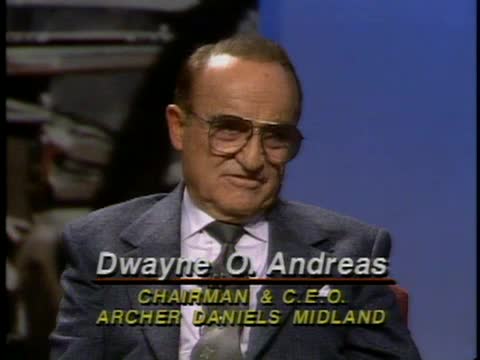
This is the casino clean three decks of floating gaming room for a $5 feat you can take a two hour trip and maybe if you get lucky. Even when you're five bucks for. J-Lo and Ravin on each your heart out. With me tonight are three Midwesterners whose reputations and influence extend far beyond their native region. At 75 Duane Owen Vegas is the number one Titan of agribusiness and has been chairman and CEO of Archer Daniels Midland since 1970. Mario Wheaton Baum was the first chairman of President Reagan's Council of Economic Advisors and is now director of the Center for the Study of American business at Washington University here in St. Louis. Goldman has a national following as director of technical market analysis at St. Louis based A.G. Edwards and sons where he has worked for the past 33 years and they make it a career if he gets to like it.
Why don't let's begin with you you've been an outspoken advocate of naphtha. Indeed you recently put former Canadian prime minister Brian Mulroney on your board. What would you say to American workers who think they may lose their job because of this pact. Lewis I feel very certain. That it's a great thing for our farmers and for our working people that the president had the courage to get that through Congress with the help of a hundred Republicans. And I'll tell you why. We have been going in the red importing a hundred billion more than we export every year for many years we're now. Cumulatively in the red. A trillion dollars. That has to change. My father once said if you're in the hole stop digging. We cannot keep doing this. We need a hundred billion dollars of new exports to make our economy viable viable and to be a superpower. Why are we in the red. There are two big trade areas and in the world that have shut us out. In Europe they have a free trade area of their very own and they have the highest tariffs and Smoot-Hawley against
us. In the Pacific the Japanese all the way down to Indonesia are forming a free trade area of their very own and they have barriers against us. Now we have this opportunity the backspins are the first people that ever came along and said hey we'll cut our tariffs from 20 percent down to nothing. It's a godsend to us and I hope it will be extended to the entire Western Hemisphere very rapidly because I am sure we can get that hundred billion dollars of exports right here in our own hemisphere. Turning closer to home how badly was the middle west in general and agriculture in particular hurt by the floods this summer. Well. It's a difference between a disaster and a catastrophe I'm a member a man said what's the difference between those two words and. He said if Joel there is pushed into the river that's a disaster but if he is the son of a gun gets pulled out that's a catastrophe. I want to tell you one thing that is a catastrophe. We have lost in this flood. Six hundred billion tons of topsoil. At a market
price that you'd pay to get that topsoil for your garden that's 15 billion dollars worth. That has taken the topsoil equivalent off of 500 million acres. Which would keep four and a half million people alive. Permanently perpetually. So the whole human race is going to suffer from this greatest disaster in hundreds of years. And it's largely due to the fact that. All the topsoil went down the rivers and streams into the Gulf of Mexico never to return. It's when we can do that now you'll never get it back. It's a permanent loss. You. Have just suggested that nothing was necessary because of what's going on among competitive groups. You also have been very active as a pioneer on trade with the Soviet Union as part of the solution to our problem over there. Well Soviet Union potentially is a huge market. For all I have two hundred and eighty million people. And they they have a very well educated
class they have some very modern industries unfortunately mostly build around the fence. Right now. They are in bad economic shape and they need credit. But. China is a huge market and Japan is a huge market. We need to get these markets open. But if you look here let me tell you what our study showed. Mexico bought 50 billion dollars worth of food last year at retail. If their standard of living came up just to the level of Puerto Rico which seems reasonable doesn't it. If it came just up to that level they would buy 100 billion or 50 billion dollars more it would be eggs and chickens and meat and milk and pork upgrading their diet. That's a huge amount of business for the Middle West for the farmers and it would create a million jobs in six or seven or eight years here and in Mexico. So I think we will see good results from now after. Rather quickly.
Let me turn to Mary for a moment. Mary when I first wrote How do you assess the damage done by the flood. I really think that. We have seen some real suffering real pain and suffering on the part of the relatively small portion of the Midwest population that has been directly affected. How. Many small businesses are going to have a hard time surviving. That's the micro effects. For the macro effects. Very frankly the Midwest economy and. The misery the St.Louis economy has continued uninterrupted. Is there a lesson for the nation in the steadier performance of the Midwest economy. A Yes indeed. The great diversification of our industry our industrial base both in this area and in the entire Midwest contrasts very substantially with the rest of the. Economy. And clearly.
A private sector oriented. Industrial economy. With a related private sector oriented service economy shows the ability to withstand a variety of shocks and blows to the economic system often delivered by our friends in Washington so that here in St. Louis we sing in a one third the Cline in defense employment already just the last three years. Frankly with more to come. But if you look at the overall employment picture you see that the expansion in service employment has fully offset the decline in manufacturing employment. I mentioned earlier in the program that this was looking like the strongest quarter of the year which terrifies the bond market which hates to see anything grow anywhere. I wonder whether what you see coming from 1994. In a sense more of the same. A slow growing 3 percent
rate of growth or shade less than that as well as low rate of inflation getting 3 percent or a shade less than that nothing for the Guinness Book of World Records. But that's sustainable given all of the blows imposed in terms of higher taxes higher regulation and the impending increases in government mandates unemployment costly mandates. I think it's a lot better than we deserve because the bond market in our market panicking too soon do you think interest rates will come back down. The one thing I learnt in my years in Treasury is never forecast interest rates in public. Seriously I'd never come out so now that we're not in public in just a couple of friends here. Well let me back that up by saying except for my distinguished colleague here I've never come across anyone who consistently forecast
interest rates worth a darn. Well let's turn to your distinguished colleague. Now Goldman first of all let's deal with the question that Maria so adroitly ducked. What do you think about interest rates. Oh it's very clear to me. There you go. I finally found the right guest. There you go. And you can say that as long as you change your mind next week. But our outlook for inflation is positive about 3 percent at our outlook for the economy is similar to Murray's. And in that environment we see no reason why interest rates which are in a blip up here a very normal correction after the dramatic really Olympic rally the bonds have had we look at this is a very normal correction. Bonds down interest rates up. But we do not think the bull market interest rates is over that rates are going to go lower because of a good inflation environment in 1994. You have been notably and consistently bullish on the stock market. A jittery week like this one shake you up at all.
No not at all. And I take a lesson from the Midwestern economy. The gentleman spoken about the world and the only recovery that we've had in the Midwest. And that's exactly the type of bull market we've had. And it's confuse most people. This is a 37 month old bull market and it is rolled from one group to another. It has kept the excesses down. And has created a lot of barriers. In fact you have to love the Bears 40 percent of all market letter writers are bears and I love it. Only 30 percent are bullish and I look for more of the same. A selective discriminating but upside biased bull market. Are you suggesting that you take court when you disagree with most of your colleagues. I love to say it's kind of like the cold. You want to avoid crowds in the winter. And I think you want to avoid crowds in the stock market since since you share the enthusiasm life of the Middle West economy other companies here whose stocks are attractive you know I think there are a lot in fact. Timing is everything and it's a pleasure to have Dwayne on my left but Archer Daniels Midland represents the type of company which I think ought to be bought for the long term. I like
to buy companies for the long term where you have strong fundamentals as well as shares which are starting to act well. Archer Daniels Midland has a record of consistent growth. The stock has been trading in the 22 area now for seven months. Anybody who wants to sell it has had plenty of opportunity and we have noticed a pickup in activity and volumes been going up as price goes up. St. Louis space for Austin Purina has spent a decade restructuring their sales mix. And we're looking for strong earnings to result from that and undervalued assets in our opinion. The stock has been under accumulation I like when you're moving and in the Midwest also in Newton Iowa the Maytag company lead the manufacture of appliances. I'll play on the recovery in housing starts and consumer spending. And this years have been acting better and it pays a little over 3 percent yield you're going to pay you for your patience. Good fundamentals combined with shares which are already under accumulation.
Sure your high regard for Duane but I thought you were a technician I thought you didn't care who heard of the company or what they measured. I am whatever seems to be working in the marketplace. The worst thing you can be in my opinion in any market place is a purist who sticks with one discipline forever. You're lucky if you'll be right half the time. I think our job as market analysts is try to understand what bouncing ball is. People are paying attention to now and go with that. But I always try think the ideal investment is one where you can combine a fundamentally sound company. That other people have already discovered and the shares are doing well. While we're at it want to tell some companies not necessarily in the Middle West who also like. Well there's a lot we're in a bull market. I didn't mention the over-the counter but. There are a number of I think the OTS C market MCI Communications which has been knocked down a bit lately in the telecommunication area. I like
what's going on in the restructuring of Kmart. Now. There was a negative article in The Wall Street Journal about a week and a half ago which knocked the shares down but I'm impressed with what they're doing and I think it's going to continue and I think there's also a turning a turnaround going on at Westinghouse. And the number is down how you think this market might go. I'm going to say something and I get a little trouble when I do this but I think the bull market is going to last forever and the market's going to go up forever until it stops. None of us here models none of us mere mortals can say that in advance. There are unfortunately we do have to stop here at least if not the whole market with special thanks to all of you who are nice enough to come meet me in St. Louis. Thanks to my distinguished guest Wayne and Ray as Murray we've been out for Goldman. And I hope you'll be back with us again next week and we'll be back home to launch the Christmas shopping season with a lady who likes to have fun. She's Jill Craddock and she's a top expert on companies that make the newest toys and other wild amusements from motorcycles to boats to bring smiles to your
faces and then goes to the nation's cash registers. Let's see what's making her grin now. Meanwhile it has been Wall Street Week. I'm Louis Rukeyser. Good night. Stay with Louis Rukeyser is a production of Maryland Public Television made possible by the Corporation for Public Broadcasting and by the annual financial support from viewers like you by the travelers providing American business with insurance investment services and managed health care the travelers America's umbrella by M F S and FS helping mutual fund and institutional investors achieve their financial goals since 1924 and vie for eventual securities we believe the most important thing we earn is your trust. Prudential Securities for a printed transcript of this program send $5 through transcripts Wall Street Week With those requests are always Mills Maryland 2 1 1 0 1 7. Transcripts are also available to subscribers of the Dow Jones news retrieval service.
Thank you. Thank you. Thank you. Thank. You thank. You for the concert thanks. This produced I don't feel that the. Groups are so responsible. For its costs. Thank. You.
- Episode Number
- 2321
- Episode
- Live from St. Louis
- Producing Organization
- Maryland Public Television
- Contributing Organization
- Maryland Public Television (Owings Mills, Maryland)
- AAPB ID
- cpb-aacip/394-20sqvk0z
If you have more information about this item than what is given here, or if you have concerns about this record, we want to know! Contact us, indicating the AAPB ID (cpb-aacip/394-20sqvk0z).
- Description
- Episode Description
- Live from St. Louis, we look at the economic realities of the MiddleWest--after the floods. Murray Weidenbaum, Ctr. For the Study of American Bus.; Alfred Goldman, A.G. Edwards & Sons, Inc.; Dwayne Andreas, Archer Daniels Midland - Guests
- Series Description
- "Wall Street Week is an educational talk show hosted by Louis Rukeyser, who provides viewers with information on finances and the economy and conducts discussions with experts. "
- Broadcast Date
- 1993-11-19
- Asset type
- Episode
- Genres
- Talk Show
- Media type
- Moving Image
- Duration
- 00:27:35
- Credits
-
-
Copyright Holder: MPT
Producing Organization: Maryland Public Television
- AAPB Contributor Holdings
-
Maryland Public Television
Identifier: 45729.0 (MPT)
Format: Betacam
Generation: Master
Duration: 00:26:46
If you have a copy of this asset and would like us to add it to our catalog, please contact us.
- Citations
- Chicago: “Wall Street Week with Louis Rukeyser; 2321; Live from St. Louis,” 1993-11-19, Maryland Public Television, American Archive of Public Broadcasting (GBH and the Library of Congress), Boston, MA and Washington, DC, accessed April 2, 2026, http://americanarchive.org/catalog/cpb-aacip-394-20sqvk0z.
- MLA: “Wall Street Week with Louis Rukeyser; 2321; Live from St. Louis.” 1993-11-19. Maryland Public Television, American Archive of Public Broadcasting (GBH and the Library of Congress), Boston, MA and Washington, DC. Web. April 2, 2026. <http://americanarchive.org/catalog/cpb-aacip-394-20sqvk0z>.
- APA: Wall Street Week with Louis Rukeyser; 2321; Live from St. Louis. Boston, MA: Maryland Public Television, American Archive of Public Broadcasting (GBH and the Library of Congress), Boston, MA and Washington, DC. Retrieved from http://americanarchive.org/catalog/cpb-aacip-394-20sqvk0z