Wall Street Week with Louis Rukeyser; 0715; The Man From Dreyfus
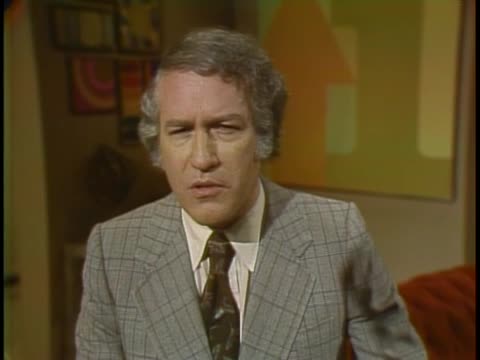
- Transcript
Oh. Public broadcasting. No. Wall Street and we produced Friday October 7. Your host for Wall Street Week is Louis Rukeyser. Our panelists
are Frank Caprio Carter Randall and Julius Westheimer. Tonight's special guest is Monte Jay Gordon director of research the Dreyfus Corporation. Good evening I'm Louis Rukeyser This is Wall Street Week. Welcome back. Well this was the week when as they used to say about the weather. Everybody talked about unemployment but nobody did anything about it. Anything helpful that is. The Senate did take a couple of actions that might actually contribute to the problem. But I suppose some might think that falls into the. So what else is new category of economic news. The facts on unemployment seem clear enough at least is clear is that changing social definition ever can be. The situation is getting a little better. But not much. The government announced today that the overall unemployment rate last month was six point nine percent. That's down two tenths of a point from August which was good. But all this rate was up that same two tenths of a point from July which was
bad whereas July's rate had been down two tenths of a point from June which had been up two tenths of a point. Well you get the idea. The official unemployment rate has been stuck within a tenth of 7 percent for six months and that scarcely represents the massive reduction of unemployment that at least some folks thought they heard Jimmy Carter promised a year ago. That was to be sure some tempering of this generally disappointing news. Black unemployment which had soared to a painfully high fourteen point five percent in August was down to thirteen point one percent in September. And most positive of all the figure for total employment which tells us without any if ands or buts how many Americans really did have jobs in the previous month leap to a new record. The U.S. economy last month provided more than 1 3 1 million jobs for the first time ever which suggests that sticky is that high unemployment figure may be the country remains far from anything truly resembling a recession. And what were those Senate actions
that might impact on unemployment. Well faced with a drastically high teenage unemployment the Sultan's decided in their wisdom to raise the minimum wage even more than the House wanted to and not to provide any exclusions for younger people looking unsuccessfully for work. That should be a big help. And the senators also voted to strengthen union organizing powers very substantially. Well the ultimate effect of this or the minimum wage legislation on the unemployment situation remains controversial. The other bills seem likely to help much. And both demonstrated that George made these complaints about being disappointed in Washington this year may have been a trifle premature. When all this really means for the economy and for investors is one of the things we'll be talking about tonight with one of the most widely followed of all financial analysts. My special guest Monte Gordon. But first let's look at an area of the economy that might as well have been unemployed this week. And I'm talking of course about the stock market. The Dow Jones Industrial Average set the dreary pace down
three days up to and on volume that never look convincing in today's New York Stock Exchange trading was the slowest in the ileum month. And the Dow for the week sagged to eight hundred forty point three five a loss of about six and three quarters points. This meandering performance was reflected too in the composite indexes of the New York and American stock exchanges both of which recorded small net losses. And the over-the-counter index which eked out a tiny gain and which is in fact a tie point since July indicating that the market in general is far from panic. Panic indeed is the farthest thing from the minds of the compiler technical market index. And those indicators have been stuck in the same rating for three weeks which is about what you can say for the market. The rest of the economic picture this week can be described simply. Most indicators are up. But that regrettably included interest rates and wholesale prices. The prime interest rate the one the banks charge their best business customers edged up to seven and a half percent as everybody had known it would. And
wholesale prices ended four months of relative restraint. The better news included higher factory orders and personal income. So it looks as if the economy is growing but without solving those problems on inflation and interest rates. Got to know could that be what's worrying the market. It's been worrying the market for months. Inflation and interest rates and there's another thing on the employment that Congress decided to do this week and that was a vote an even higher increase in Social Security taxes and that takes money out of the consumer's pocket out of the employer's pocket and it certainly discourages mass and Weimann because Social Security is not cheap by them it amounts to over 12 percent of salaries and wages. So I think the market is worried about all of these things I don't think it should be corporate earnings corporate dividends continue to rise the third and fourth quarter reports should be very good.
Well quite obviously the market is reacting skeptically to these and if you report it's not giving them the same premium it's not the price of stocks in relation to the earnings of the companies it's very low by historical standards. Is that really going to change until we get a handle on the inflation. I think it will change when we get some kind of a long term prognosis and people feel confident about the prognosis right now. They don't. You are always game for short term prediction which is a dangerous game and last time around you told us you didn't think that the market necessarily needed an explosive selling climax nor the stock going up. You think we're winding down now or is it too early to give us the answer on that one well all of you talked about soft bottoms last week I maybe will have a soft bottom maybe not. But but really the markets keep it ought to be turning up the last part of this year. What kind of bottoms do you like the kind that are over. Want to guess. I like soft bottoms where are we in relation to a bottom.
I think we're pretty close. There's a lot of compression in our market prices right now and I still would hang with with a 20 I think the 9 with a 20 I mean 20 on the Dow down to just yesterday as well. Yes right. I wouldn't want to put me with a mass hanging and Wall Street will be a mess and if it goes below a 20 I think we'll have an answer. But the market has been worried about inflation but it's the persistence of inflation at this stage of the economic cycle that has worried a lot of investors it's not earnings for this year or next year but what are the long term earnings trends in the face of higher inflation and inevitably wage and price controls which is the answer if we can't beat inflation. Do you think those are inevitable. I think they're inevitable unless we get the inflation rate down and I would say down to say four and a half to five and a half percent and then kind of maybe bad news for the market wage and price controls You bet. That's why are you so optimistic. Well I'm not optimistic about the possibility of wage and price controls at this point in the game I think we really do have a possibility of looking inflation but that means that the Federal
Reserve has to restrain monetary supply. And they've been a failure so far this year. M1 and M2. The two usual components of money supply have been outrageously high. They just come off this was in this pessimistic analysis followed by an optimistic conclusion why aren't you more gloomy about the market than a lot more gloomy about the market because everything I've said has been factored in the price of stocks and now the good news comes you bet. And the good news will be forthcoming very shortly I suppose of course we're going to hear from Joyce West Ham right now. So what's the good news. Well the good news is that I think stocks have become so statistically cheap particularly when compared to bombs it's in some institutions are going to look at them and decide that this is the place to put money. But you said something earlier Lou about the area of unemployment now being on Wall Street and I think that deserves a little comment. Absolutely. OK I have a few sales management functions in my brokerage firm and I think we brokers are at fault in one area. I think instead of staying in our offices we ought to get out and we ought to see our clients and we ought to go over their portfolios with them on a long term basis not just sit and watch the tape all day and phone
them and say nothing's happening get out there and plead. Get out there and do something. But I think if we go over portfolios and point out that there are various areas of opportunity in the market today like utilities which are yielding a good return and growth stocks which are more statistically cheap in a long time then they get cheaper stocks just reach their 90s great buying opportunity here. How many more we're going to have if we have a 90 fourth let's just mortgage our wives and our families and everything and buy them. Well thank you for your moderately optimistic forecast and for your call to action by brokers to get out there and work a lot but in any event it's time now to let our viewers asking questions. Kuranda let's make you our farm expert for tonight. How would you respond to Don Zoolander Gallup New Mexico writes as follows The federal government recently mandated a 20 percent farm acreage reduction for the 1978 growing season against this backdrop. How would you assess the potential for such essential agricultural suppliers as producers of sea farm equipment and agricultural chemicals and fertilisers.
I would be a little less optimistic short term than I am very optimistic long term I think the food industry still one of the great growth industries of this nation and the world. I think the food processing companies like Ralston Purina and CPC will do all right. But I think the farm equipment companies will suffer at least short term. So you don't think they'll be prime movers in the market in the next few would not expect so. Fair enough Frank Ginger Layton of Gainesville Florida I would like to know how you feel utility stocks are likely to perform of the next 10 years I've just been endorsed by Julius but don't let that influence you and what effect you believe solar energy and the oil crisis will have on them. Well 10 years is a long time low but makes it easier than six months and you bet better today. But utility utility industry and utility stocks are probably going to be a very viable investment over the next several years simply because we need them in our energy system. They're paying handsome yields in this kind of market. That's not bad to take. So I would say
that you can buy utility stocks that yield 70 percent and I would be a buyer for long term until certain things change inflation or higher long term interest rates. As to the effective solar use of solar energy I don't think it's going to be competitive with utilities and I don't think utilities be able to use it either way. So I don't think it's a factor to consider in the next 10 years. Finally the oil crisis if an oil crisis does occur or the price of oil goes up it will affect the price of energy. But it shouldn't affect the utility stocks that I would recommend because I'd be recommending stocks that are in coal and nuclear power as a primary source. So by them they're good. Since you have appointed yourself spokesman for a more aggressive brokerage community let's throw this one at you David Jacobs of Meriden Connecticut says he's often heard the words used in reference to relations between an investor and his broker. He's not sure exactly what the term means and whether indeed churning constitutes a violation of the Security and Exchange Commission's regulations. Would you tell us what the word means to you what the prohibitions against it may
be and how serious a problem you believe it to be in the brokerage business today. OK churning is a term that really means excessive activity in account a lot of turbulence in an account particularly when related to the objectives of an account. Generally it's frowned on but on the other hand there are certain types of accounts and the client might say he wants one an active trading account or an option account where a lot of generation of conditions is inevitable. However in the long term investment accounts just to move a client from utilities to oils to steels and back utilities again that's churning and it's not good. Yes the C does not comment on it specifically but the National Association of Securities Dealers is very much against it. At the moment it is not a serious problem they haven't had a case of it in about five years. Well we want a look at our mail them because we have a few complaints every week. Any event if you are worried about excessive turnover on your account or you just want to turn over a new leaf and start having an account for a change Send us your questions about investing to Wall Street Week Owings Mills Maryland 2 1 1 1 7. That's Wall Street Week Owings
Mills Maryland. 2 1 1 1 7. Now before we meet tonight's special guest let's take a look at what's been happening this year to the most closely watched stock index of all the Dow Jones industrial average and then break down that well-known figure to see why it's been happening. As of this week the Dow Jones industrial average this year was down nearly 17 percent since the start of the year that average tracks the performance of 30 stocks. Titans of American industry and finance but few people buy an average So let's see how each of those 30 did. To see why the Dow as a whole turned in this performance only four of the 30 managed to gain this year. General food led the list with an increase of nine and a half percent and the rest of the very brief on the list was completed by Allied Chemical Texaco and American can another six of the 30 industrials have lost less than 10 percent since 1977 began. They are Standard Oil of California Westinghouse American Telephone and Telegraph which is the most widely held stock of all American
brands General Electric and Johns Manville five stocks lost between 10 and 11 percent. Exxon. United Technologies Procter and Gamble General Motors and 3M. Three more stocks did slightly better than the average itself which means 18 out of 30 year in that mild distinction the ones that just made it were International Harvester as Mark and Sears while the next on THE LIST Dupont just missed the cutoff point. For stocks lost between 20 and 25 percent that is between a fifth and a fourth of the end of 76 selling prices. They were Chrysler Owens-Illinois Goodyear and Alcoa slightly worse hit where Woolworth Union Carbide nice Kodak each of which lost close to 30 percent. That leaves four stocks that this year have taken the real booby prizes. International Paper is down well over a third. U.S. Steel is given up more than 40 percent and Inco even more. But the single worst performer in the Dow this year has been Bethlehem Steel whose price is less than half what it was when the year began.
So it's been on balance a year when investors had to have nerves of steel especially if they had the misfortune to be investing in steel. Well these problems only melting away and if not is there any profitable place to hide. There's a mansard Let's go over now and meet tonight special guest Monte Jay Gordon. Welcome back. Pleased to see you. Monday Gordon is one of the most frequently quoted market commentators in the country today and it's nice to have him back for the last five years he has been vice president and director of research for the Dreyfus Corporation one of Wall Street's biggest mass money managers. Before that he did his analyzing for Sartorius and company M for 24 years for basin company. Monte as we've just seen the Dow was down close to 17 percent so far this year. Why do you think it's going to be by year's end. To year's end is pretty close. I'd say that in the light of all the events that
have transpired and expectation as to how those events would be. It's very unlikely that it would be significantly higher. Than where it is now. In all probability. Just to give it a kind of a ceiling at least at the below I would expect below 900. I think we do very well if we get up into the eight hundred and seventy five eight hundred eighty area because of what you see happening at the present time. Well let's talk about that what do you think of the most significant things that are happening. Well I think the most significant things that are happening actually below the surface in the sense that the words that are use the buzz words are the use of inflation interest rates tight money and things of that sort. I think what really the market is attempting to define is a great deal of concern with significant underlying fundamental change that has occurred in the U.S. in a very real sense. The U.S. ended 200 years of great history with super abundant inexpensive energy record inability to control inflation. And there's now an A
and a position in the world economy that literally was unmatched. You've now come into a totally different kind of world. I think the market sensitivity and its inability to really mount a sustained move is an expression of uncertainty as to how the U.S. is going to cope with those particular problems. Well you're raising very profound questions and questions to which we're not likely to get an answer in the next few months. Do you have or has several years of very market action. No not actually because I think there are. Trends underway that are in a sense exogamous or outside the market that could be significant one. I think the recognition that we have an energy problem is very significant. The fact that Mr Carter's program has been blown out of the water in the Senate is of course not an unusual thing in American politics. I think the fact that a tax reform proposal of obviously far reaching an innovative capacity is being considered is also significant. It means that we are tempting to restructure our institutions in order to deal with a different situation than we have had historically. I think that as these factors come into closer play
closer to reality the market will begin to react to them and I think in their context they carry the seeds for an improved equity market. What do you do as an investor given that scenario do you continue to buy stocks or do you hold back and wait. Well at this particular point essentially you do tend to hold back and wait. I think that in the end the aspect of where your return is where your safety is where your ability to conserve your principal is I think it has to lie at the moment in the bond and in the fixed income area. Also in those sectors of the common stock market that have had those characteristics over the years. But I think at the same time. You have to give the name of some of those sectors for us. Well that would be that is one area. There would be. Bank security area bank stock area you would get some of the energy areas that are in some of the areas that participate in the energy because you're going to need that kind of a fact that you would get it in those telephone companies distinguishing from electric utilities in the telephone sector. But primarily you would find it in your
fixed income area in the high quality reach but by the same token I think you have to be perceptive to what the meaning of these trends will be. For example under the tax reform proposal there would likely be a very substantial improvement in after tax you should the program go through as indications are in terms of what the proposal is and I don't know that kind of let me push you to another area. It's been close to four years and you are with us it's too long. One very. Back to a prediction you made at that time we talked about gold which was on at about 90 dollars an ounce. And so you weren't a traditional gold bug in the usual sense you thought the price then would rise it didn't go up to about $200 an ounce now. Then it bounced down to close to 100 pounds now around a hundred fifty but he's gone now. Well I think it will continue to bounce I think it will move higher. I think there's a very reasonable prospect that you'll get up somewhere around maybe a hundred seventy dollars an ounce. I think the reason why gold is moving is different than the reason why it moved when it was 90 dollars an ounce. Ninety dollars an ounce because of the inflation that was under way and the
indication I think if it moves now it's because of the uncertainty concerning the world structure monetary the monetary wealth structure and the precept as to what will happen to international trade. Well do you share that uncertainty do you think those Goodbye under those conditions I think that certain gold securities can be bought under those circumstances I thought I would always say to my son that you can go stocks for example. Well if you're prepared to take that measure of risk that is present in South Africa I would say yes one percent of an average portfolio you think might be in gold and gold stocks but again depending the more conservative the portfolio the lower the percentage the more willing someone is to take a risk. I think you could go as high as 4 or 5 percent. The money you used to answering questions from the AP and UPI. Let's try on the p a n e l study. Money you touched on a tax reform that may or may not go through and we don't know when it will go through. But you were talking mainly about dividend return. How about the counterpart of that heavy tax for lack of
preference on capital gains will that hurt the market. I frankly don't think so. I think the market will go in too as that precept comes forth go into a kind of a trauma as it begins to look at a very cherished institution and begins to wonder what will happen. But I think when you perceive that the capital gains preference could be eliminated with substantial loss provisions to go with it much better than anything we've experienced now. And couple that with the rest of the package. I think that the market will find that actually the elimination of the capital gains will be in a very real sense of the benefit and not of the time and money events in bank stocks. Why. What rationale do you have to buy bank stocks in this stage of the cycle and which ones would you buy. Well if the rationale is that because just as everyone has always said the market needs money to be fooled and if you're going to have the economy grow you have to have adequate supply and source of money right now you've got more than enough money that you need. Number two even as rates presumably will rise as they expect they will in the fairly near term here.
Bank spreads the threads on the on the on their own earnings factor is fairly encouraging. I think that that the stocks themselves are operating in relatively fair good low good levels its turn to price earnings multiples I don't think you're out of line. Which in terms of potential. Well the stocks would have to be essentially in the city. The money said to areas and in the regional areas. I'm avoiding a name. Is there any other area. Well in the regional area what I mean what I mean essentially in the Money Center areas I would go I think more at this particular stage with the consumer. So more oriented. But. I'd like to ask you a specific question. If you were a middle aged businessman with a wife and a family and a good job 25 $30000 a year in college and you inherited $100000 tonight. Where would you invest that money Monday or how would you deploy it for a long term hedge against inflation. For long term hedge against inflation. Well the presumption that I'm not dealing with excessive inflation
I would have to have at least a 75 percent position in equity. And I'm struck today on the basis of the definition you gave to me. My bond position. Would be the remaining 25 percent but it would be not more than in the immediate term because I would want to have those funds available to me to move out into the equity market. So I if I were looking for a long term capital gain I'd have to go into the side. And if there's anyone in the audience who doesn't have it on a thousand dollars this weekend let us know we have some ways you might spend it between now and Monday will help us celebrate our money there were some other convulsions within the financial community in recent days. Dean would have been mental security announced one of the biggest mergers the biggest merger in Wall Street history. This is the Securities and Exchange Commission appears to be postponing a decision affecting the future role of the New York Stock Exchange is one reason why the ordinary investor reading about these developments should care one way or another do they affect him I think they do but I don't think he has to necessarily be.
Of the opinion that he's looking at the demise of what I think is still a very vital and creative industry and I think that you know little to your own experience there's nothing quite so creative as the financial field and I'm not arguing that the reason I want to sell a bind even when it's when it is being pressed into the wall so to speak and being put under new pressures in the industry obviously is going through a convulsion has still not worked its way out of it but I think that the industry will find a way to live with it as it will be a different kind of a market in a sense that you know some of the major changes you see coming. Well if 390 does come off of course you could have a rule Friday night he would talk about which gives the New York Stock Exchange certain exclusive rights and trading stocks right if it does come off than what we have to consider is where will the flow of the waters be how will we traders be able to know where the last trade was taking place and at what price it took place. The reasoning is that most people go most of the fines will go into a deal a market that is they will deal themselves or deal upstairs and you'll be getting on a principle basis but I think that the exchanges essentially as points where the major part of exchange will take place will still remain vital. It will just be the
stuff the system in the way of doing it will have to own them. You mention that you thought we could look to some events that might significantly turn the market upward. What are some of those specific events and what are some that might turn it way down. Well some of the specific events in terms of the trend which is really what I'm talking about and you sense it already. The awareness on the part of administration in the part of Congress I believe that you have to have more incentive for business for capital expansion and for other purposes the recognition that the consumer is still a very vital sector of this economy and must be encouraged in order to spend and to help the economy work its way out. The third factor would be as I say an energy proposal and a tax reform proposal. Both of which are gated into that dimension. You mentioned you thought the capital gains tax might be helpful why. I said removal are going to be different than what I got against because I think that what we have here is that a lot of investment decisions have been made on the basis of what capital gains tax with an artificial holding period. And I think if you eliminate the capital gains preference tax and you limit the holding period with it you suddenly put
the investment decisions back to a basis on their own investment and that makes a great deal of difference people have tended to talk long term as really meaning six months in a day. Now it means 9 months and very shortly it will need a year. The capital gains tax preferences really lost a good deal of its like knowledge that we have to stop your money go and the man is cautious in the short term but a little more optimistic longer. Thank you to our panelists who are a little more optimistic a short time and I hope you'll be back with us next week when I'll be talking with the heir to a legend. Benjamin Graham was called the father of modern security analysis and when he died last year he was working on a new investment theory with James B Ray. I'll be asking re how the theory works and what it now concludes. And my theory is you'll be very interested. Meanwhile this has been Wall Street Week. I'm Louis Rukeyser. Good night. If you would like to obtain a written transcript of tonight's program send $1 to
transcripts Wall Street Week Owings Mills Maryland 2 1 1 1 7. That's one dot or two transcripts. Wall Street Week Owings Mills Maryland 2 1 1 1 7. Residents of Maryland Please include five cents sales tax. Wall Street Week was produced by the Maryland Center for Public Broadcasting which is solely responsible for its contents and was funded by this and other public television stations.
- Episode Number
- 0715
- Episode
- The Man From Dreyfus
- Producing Organization
- Maryland Public Television
- Contributing Organization
- Maryland Public Television (Owings Mills, Maryland)
- AAPB ID
- cpb-aacip/394-16pzgvkz
If you have more information about this item than what is given here, or if you have concerns about this record, we want to know! Contact us, indicating the AAPB ID (cpb-aacip/394-16pzgvkz).
- Description
- Episode Description
- Monte Gordon, The Dreyfus Corporation - Guest; Frank Cappiello, Carter Randall, Julius Westheimer - Panelists
- Series Description
- "Wall Street Week is an educational talk show hosted by Louis Rukeyser, who provides viewers with information on finances and the economy and conducts discussions with experts. "
- Broadcast Date
- 1977-10-07
- Asset type
- Episode
- Genres
- Talk Show
- Media type
- Moving Image
- Duration
- 00:29:28
- Credits
-
-
Copyright Holder: MPT
Producing Organization: Maryland Public Television
- AAPB Contributor Holdings
-
Maryland Public Television
Identifier: 45526.0 (MPT)
Format: Betacam
Generation: Master
Duration: 00:26:46
If you have a copy of this asset and would like us to add it to our catalog, please contact us.
- Citations
- Chicago: “Wall Street Week with Louis Rukeyser; 0715; The Man From Dreyfus,” 1977-10-07, Maryland Public Television, American Archive of Public Broadcasting (GBH and the Library of Congress), Boston, MA and Washington, DC, accessed April 1, 2026, http://americanarchive.org/catalog/cpb-aacip-394-16pzgvkz.
- MLA: “Wall Street Week with Louis Rukeyser; 0715; The Man From Dreyfus.” 1977-10-07. Maryland Public Television, American Archive of Public Broadcasting (GBH and the Library of Congress), Boston, MA and Washington, DC. Web. April 1, 2026. <http://americanarchive.org/catalog/cpb-aacip-394-16pzgvkz>.
- APA: Wall Street Week with Louis Rukeyser; 0715; The Man From Dreyfus. Boston, MA: Maryland Public Television, American Archive of Public Broadcasting (GBH and the Library of Congress), Boston, MA and Washington, DC. Retrieved from http://americanarchive.org/catalog/cpb-aacip-394-16pzgvkz