Illustrated Daily; 6071; Talavaya Center
- Transcript
Well, at least we're going to be able to do this, but we're going to be able to do this, and we're going to be able to do this. Well, at least we're going to be the last viable bank in Santa Fe. If the economy collapses, there's one bank left that people can come to and withdraw some life force that they can keep going with. These beans are direct descendants of beans which were grown by Anazasi farmers in this region over 500 years ago. We are
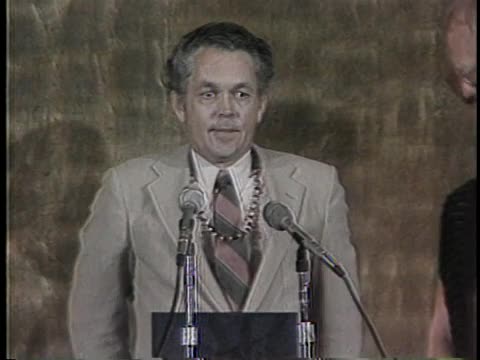
not dealing here with hybrids mind you but pure strains resistant to both drought and disease. They are in the possession now of the Talivaya Center in Santa Fe, a non -profit organization which last year was awarded the United Nations Environment Programs Medal of Merit for its pioneering work in cultivating and protecting native American seed strains. What the folks at Talivaya have in mind is nothing less than to make those ancient seeds available to third -world nations in similar climatic zones, where famine and hunger is often rampant. For John Kimmy, Talivaya Center Director and Educator and Cultural Anthropologist, it all adds up to the conviction that not only are the old ways often best, they are also often the most productive. I thank you for this honor to be here. Native peoples throughout this world have
achieved through longevity great formulas, systems for the perpetuation and the preservation of our environment. And it is the native farmer, the elder native farmer who passes it on to the youth of today that I would like to represent here. In hopes that in the future that this distinguished body of the United Nations and all policymakers throughout the world might re -evaluate the true values of the indigenous cultures of the world and struggle to preserve what remains of these cultures so that we might be able to transpose their knowledge and their wisdom into our modern culture and improve and survive for many many generations to come. The people of the native cultures, as far as their own policy making is concerned, I think it is something we could reflect upon. For one thing, when they make decisions that are going to affect their people,
they must consider seven generations prior to that time of their decision. What would the ancestors say? They must consider the people who are alive today and they must also consider seven generations' hands. If all of our policymakers throughout the world were able to do that, we might not have the environmental problems that we have today. Thank you very much. And this now is some music that I want to dedicate tonight to the Talivaya Center and to the Native Americans of the Southwest. But green corn is pretty old, old corn. I got this down
in Mexico and you don't find it anywhere in this country. In green corn, people think that's just a legend. This is a Hopi White corn that we are duplicating for the dry conditions in Africa. We planted a Hopi style which is to plant six or eight seeds per hole and plant them about ten inches deep. That's why you see such short corn. It's totally mature and making ears right at ground level. What we've done is we've put the Hopi technique of planting into practice here with corn and beans and squashes and melons. It's just that everything we get, we
label and enter, you know, when it's being set up to go on a computer now, even though we don't have the computer. And a lot of these samples that we've got, there aren't very many of them in the bottle. So we need gardeners that will grow out for us. We need people that will have little conservancy gardens here in the areas where we really need to have them. And we've sent maybe five to Africa. And at the time, they had garden growing in River Valley in Ethiopia where they were growing and experimenting with irritable crops and the army came through and wiped out the whole garden and the whole experiment. I mean the wife were talking about putting more corn this year. And so, I started talking about the seed. So hey, John, can we get the seed?
We're, again, we're extension agents. We're a branch of New Mexico State University. And our sole purpose is to extend the research and all of the different information that's generated through a land -grant university like NMSU. And so we provide all that information to growers, to farmers. We think that the seed -saving aspect of Tala Vias is a good thing. And like we would like to point out again that the genetic material in many of these crops and things that are here in the area are very unique and unique only to this part of the world. I think in that respect, I think they're really important for North Central New Mexico especially, which is what I work and I'm very interested in the growers in this area in the small farmers, a lot of them are Hispanics or Indian. So I think that in that respect, I think they're very interested in Tala Vias. I think Tala Vias has an interest in them and in saving some of the culture and some of the history involved with some of the seed crops. It's similar to, I guess, a conservation effort that we see people getting involved in in terms of wildlife. But they are seeing an economic benefit from it. Say, for instance, in the area of blue corn production or
possibly some of the introduced kinds of crops like amaranth or these other kinds of unusual things, they probably have what we consider to have maybe a high value in certain kinds of markets, specialty markets. This year I've played white corn, this year I've figured I'm going to play in blue corn. Yeah, and that's what I think in red beans. As it is now, it's a really big demand on this blue corn now. It came out and a friend of our centers, one seed, a newspaper from San Francisco Tribune. And it says that where they start feeding cancer patients now, blue corn. Yeah. Well, according to John Kimmy, director of the Tala Vias Center and Ed Romero, a member of the Tala Vias Board, ancient medicine is more than myth and ancient crop strains may be the stubs of stronger economies and better fed peoples. John, those
500 -year -old beans, what do they taste like? They're delicious. They taste a little like meat, actually. The first time I had them was out at Hopi for a ceremonial meal. They're used always for the ceremonies at Hopi. In fact, they are the bean that is sprouted during the bean dance ceremony, which is coming up this next month and is kind of like the equivalent of our Christmas to the Hopi people. It's a very ceremonial time when the Cachinas come back for the beginning of the Cachina cycle. And these beans are sprouted in the Kivas under conditions of 24 -hour prayer, song, and dance, and never see the light of day. And the sprouts get about three feet long. And on the morning of bean dance day, they are distributed to the homes and all of the women make a stew out of that bean sprout. And that's considered a sacred sacrament that everybody joins in at the same hour during the day and eats that stew. And
it's delicious. So many of the seeds are almost gym -like in their appearance. They're too pretty to be seeds. That's one of the fun things about jeans, you know? As a cultural anthropologist, I always like to say I've learned more about people from these plants than I ever did from people, because you get to see a generation every year. And you can study the generational changes if you will of a life form. And especially a life form that has been domesticated for such a long time. It has taken on certain aspects of the human beings who cultivated it. And so I feel that there's a very, very strong affinity. And it's why there has always been a great spiritual affinity between the farmer and his crops. Can we talk about trade -offs, hardiness, versus massive yields of high birth? I mean, what kind of trade -off is there here? Well, it's interesting, because some people say, well, those old crops were nice,
and they had a lot of good qualities, but they didn't get the yield. And we have a overpopulation problem in the world today, and we need to make as much food as possible. Well, I always tell people that just because these varieties only yield a certain amount right now does not mean that under conditions of selective breeding, we couldn't increase the yield of these varieties. In the old days, there wasn't a population problem, there wasn't a shrinking land -based problem. And so if you needed more food for your family or your village, you just planted another crop next to the one you already had. And so you'd make more food that way. And so we haven't really explored the possibilities of increasing yield of these old varieties, these open pollinated varieties. And as far as nutrition is concerned, often we find that the nutritional value of the old open pollinated varieties is two to five times that of its counterpart in the hybrid development. Ed Romero, tell me about
the business. Of this business, I understand, of course, that there's a lot of response in northern New Mexico to the idea of producing larger crops of these old strains. But where's the market? And what's the market for? Well, the market is worldwide. And I don't isolate it to just the needy. I would direct it to everyone on this planet. And in terms of our marketing, this particular idea, it's going to be the marketing of an idea more than anything. I think there's a new reality that has to be formulated. And in terms of generating the production in the northern part of New Mexico for these seed crops, this new reality will have to be that we all are entitled to abundance. And well, to make a point, I'd like to ask you a question. Visualize in your
mind the man that years back on the TV program would come and present the million dollar check to the unsuspecting person. Visualize in your mind that happening. Which of those two people would you like to be? The person presenting or the person receiving the check. I think I'd rather be the person presenting the check if you want to know the truth. Very good. Was that did I answer it right? Well, you answered it in terms of how I see things and what we have to develop in northern New Mexico. We have to develop this concept that we are giving what it is that we're producing. And in terms of that giving, we will be reaping abundance. Tell me the story of, is it amaranth? Amaranth, yeah. What is it? Why does it no longer exist in this region and why should we care? Well, there is something that is related to wild relative to it called pig weed, which is one of our most prevalent weeds, and is usually the bane of a gardener's existence, and he's always fighting it. But the
amaranth that we're re -growing in the area is a domesticated amaranth from central South America, Mexico areas, and we even have some from Asia from the Tibetan Plateau and various regions, very similar to our region here, in which this is a centipodia, or a grain crop that grows on a large stock, sometimes 14 or 15 feet high, and has a great seed head on it that may be maybe 40 inches long at the longest, and we'll plant the seeds within that. We'll plant two or three acres sometimes of more amaranth. It is one of the most high protein grains known to man, and about the only thing that lacks in the way of amino acids besides the proteins is the amino acid lysonin, which is in corn, and so for the ancient peoples, corn and amaranth was a
staple crop for thousands of years throughout the Americas. The reason we haven't heard much about it up until now is that when Cortez first came to the Americas and discovered the Aztec empire, he saw that the Aztecs were using a kind of a hablem out of this amaranth and mixing it with human blood because of the lack of available protein in their diets at that point in their own evolution and population explosion of the empire. There was use of human meat and blood to supplement their need for protein, and so when the Catholic priests that came with the first conquistadors saw this, they made a log against it, and in fact burned all the amaranth fields and made it illegal for anybody to grow it again. So there was a whole social stigma in Mexico about growing it, and it's only been in the last about 20 years that there has been experimentation in Mexico, and about the last eight or ten
years in the United States, mostly by Robert Rodel of the Organic Gardening Magazine. Have you tasted it? Oh yes, it's delicious, and you can grind it into flour and use it as a supplement to any baking flowers that you use, or you can just cook it up like rice two to one with water and add it to other recipes, and it's just delicious. Had you had any background add in botany? Since a child born and raised here in Santa Fe, fifth generation Santa Fe, my experience has been from the garden to the table. As a matter of fact, one of the concepts that we also have to get in touch with is what is it that we're going to do in the event of a world famine or a famine even here in our own neighborhood? It is a realistic view, I would say, that if there was an economic breakdown, which there are lots of people say that that potential is present at this point, if there was to
be a drought, a famine or whatever, which is also a potential because of the pollution situation, because of whatever situations could create a drought, who would you write today? If that was to occur, all the money was to be cut off, all the foods gone. What would you do? I'd go to Albertsons. There's no one to food in Albertsons. What you would do is you would come to Tel Avaya for lessons in how to continue growing these drought -resistant crops and what have you? You're absolutely right. That's the first place I'd come, but what I want to know is how you're going to make it go. You've got to make money. That's right. Where Santa Fe has increased its number of banks in the last 10 years, incredibly. I always when I'm frustrated about how we're going to pay the bills around here, sometimes I think about the scenario that Ed just laid out and think, well, at least we're going to be the last viable bank in Santa Fe. If the economy collapses, there's one bank left that people can come to and withdraw some life force that they can keep going with. I hope
that it doesn't come to that, and I hope that we can create a new reality in relation to our own food supply and our responsibility that we take for that for other reasons other than economic depression or collapse. But we do want to be able to educate people to the viability and the value of our practices here now because it's going to be too late when the economy collapses. If, in fact, we do not have money to train young people, to pay teachers who hear this afternoon, how you met a man who is 86 years old, who has been farming every year of his life. God willing, maybe he'll be with us a few more years. But those few years are precious to Talivaya because we would like to have the opportunity to pay him and to generate a student body around that man to have him share his life experience with
being an independent native farmer. And the great heritage that he has inherited as a Pueblo Indian, that future generations might be able to make good use of this in their daily lives and in their own educations. Of course, the techniques for how to grow these crops are all through oral tradition. You can't pick up a book at the library and find out how to grow blue corn. Should there be a book at the library to tell you that? I don't think so because it is experiential and when people say to us, oh, we would like to grow some blue corn, give us any old blue corn seed. Well, we have about six different varieties of blue corn here which are all grow under different conditions. So when you say blue corn, it's a generic term, but there's a lot of different blue corns and every one of them requires different technical knowledge in order to get a good crop. The hopeies have a way of growing their corn which is very different than the northern Pueblos of this area and then some areas out in Navajo land are quite different than either of these two areas. And so it's very specific to the strains, the
oral traditional knowledge that is necessary and that comes through experience. Yeah, you would like very much as I understand it to begin a process where in northern New Mexico, small farmers would be able to produce sufficient crops, produce these seeds, these seeds in Terrenton would be made accessible not only to other farmers in the United States but all around the world. Is that right? That's right. Somehow that tradition has to be communicated and cannot successfully have a thing be communicated orally all across the United States and around the world. Well, what we would like to be able to do is we become more familiar with each strain and grow it. We would like to be training young people in experiencing that so that at the time that that strain is determined to have potential value abroad that the young person can accompany that seed and there can be technical expertise available to train peoples in those regions the same way through oral tradition. All we're doing is
globalizing what used to be a regional tradition. And what is NCI native cultures international? Well, it is an organization that has been formed to establish the economic base by which this entire concept will work. A lot of the people in northern New Mexico and the entire Rio Grande area at this point have been put out of business by agribusiness. It's very difficult for them to grow cash crops. NCI, its aspect as far as I'm concerned, is to establish this economic relationship where we will develop the growers into these millionaires that will be handing out the million dollar check and I'm using that just as a figure to understand the metaphor. Well, what's the most promising cash crop seed crop
you have going for you right now? Well, there is a great national craze that's emerging right now for blue corn now. For one thing, it's very unique in appearance. Most people have no idea that nature made anything with yellow corn. A few people know about white corn but they don't know that corn comes in the four colors the same as the racist. You know, it's a black yellow white and red is the basic corn. Blue corn has a very high nutritional value and a very flavorful and has some wonderful applications that are traditional like the tortilla. Of course, the modern variety of the tortilla that's easy to eat and a lot of people like is the corn chips. So blue corn chips are quite popular but there are a lot of possibilities for utilization of corn flour and a lot of baking too and so the baking industry is interested in potential use of blue corn. Of course,
Amaranth is the second one that I've got a great deal of market potential and is being sold now and products developed from it for the natural foods industry. You've been invited to take your experiment to Kenya. Is there way briefly to tell us that story? Yes, we have been invited to Friendsworld College in Nairobi, Kenya to create a kind of duplicate Tala Vaya center if you will. Not only using incultivars that we're going to be taking over there in the form of seed but also to teach and train their young people and the importance of and the techniques and how to go out and gather samples of open pollinated traditional cultivars from Africa because this seems to be the greatest crisis that the African people are suffering as far as long -range development. It may have been a drought which caused their immediate suffering but now the biggest challenge of all is how to get people into a situation where they become independent farmers
again. If all you're handing them is hybrids that have to be repurchased every generation, every germination, then you have done them no good because they're not participating in a money economy, they're flat broke. And so what they need is the open pollinated traditional varieties that existed throughout their history up until very recently. In fact, what we call the green revolution replaced a lot of that with the hybrids and in some cases there are little caches of seed somewhere around in the various tribal villages that people have been told are inferior and they don't even use them anymore. So it's a reeducation process in bringing these things out, identifying them again, replanting them, making enough seed to be able to pass it out to the farmer one time, tell the farmer, this is good seed, you can plant this again next year and we don't have to be back here serving your needs in the future, you serve your own needs. It's a noble idea you're working with here, I move
by, it touches my spirit, but do you really think agribusiness, big agribusiness, is going to stand silently by and the organization like Tel Avaya, still what could be the thunder away from what has become the traditional way of handling agriculture in this country. I don't think that that's our goal, I think our goal is to identify those people in the world community who would like to resume some semblance of responsibility for their own basic survival and the more people who can demonstrate that integrity and responsibility and independence, the spirit of independence that it brings them, I think the more people over time, maybe it's going to take many generations, but over time people are going to learn that farming is not a hard job, it's a great privilege as a human being to take part in that kind of a
communion with nature and have as your product your own independence and sense of freedom about yourself. Let me ask you something in college, I spent a good deal of time in one point of my college education reading a lot of utopian literature. Are you guys utopian? Now I'd say we're traditional. I would say that we're very conservative and very traditional. Well we certainly wish you guys all the life in the world, thank you so much for sharing this time with us. Thank you, Hal. Thank you. And thank you for joining us, I'm Hal Rods, thank you
for joining us, I'm Hal Rods, I'm Hal Rods, I'm Hal Rods, I'm Hal Rods, I'm Hal Rods, I'm Hal Rods, I'm Hal Rods, I'm Hal Rods, I'm Hal Rods, I'm Hal Rods, I'm Hal Rods, I'm Hal Rods, I'm Hal Rods, I'm Hal Rods, I'm Hal Rods, I'm Hal Rods, I'm Hal Rods, I'm Hal Rods, I'm Hal Rods, I'm Hal Rods, I'm Hal Rods, I'm Hal Rods, I'm Hal Rods, I'm Hal Rods, I'm Hal Rods, I'm Hal Rods, I'm Hal Rods, I'm Hal Rods, I'm Hal Rods, I'm Hal Rods, I'm Hal Rods, I'm Hal Rods, I'm Hal Rods, I'm Hal Rods, I'm Hal Rods, I'm Hal Rods I'm Hal Rods, I'm Hal Rods, I'm Hal Rods, I'm Hal Rods, I'm Hal Rods, I'm Hal Rods, I'm Hal Rods, I'm Hal Rods, I'm Hal Rods, I'm Hal Rods, I'm Hal Rods, I'm Hal Rods, I'm Hal Rods, I'm Hal Rods, I'm Hal Rods, I'm Hal Rods, I'm Hal Rods, I'm Hal Rods, I'm Hal Rods, I'm Hal Rods, I'm Hal Rods, I'm Hal Rods, I'm Hal Rods, I'm Hal Rods, I'm Hal Rods, I'm Hal Rods, I'm Hal Rods, I'm Hal Rods, I'm Hal Rods, I'm Hal Rods, I'm Hal Rods, I'm Hal Rods, I'm Hal Rods, I'm Hal Rods, I'm Hal Rods, I'm Hal Rods, I'm Hal Rods
- Series
- Illustrated Daily
- Episode Number
- 6071
- Episode
- Talavaya Center
- Producing Organization
- KNME-TV (Television station : Albuquerque, N.M.)
- Contributing Organization
- New Mexico PBS (Albuquerque, New Mexico)
- AAPB ID
- cpb-aacip-33bc3099cd4
If you have more information about this item than what is given here, or if you have concerns about this record, we want to know! Contact us, indicating the AAPB ID (cpb-aacip-33bc3099cd4).
- Description
- Episode Description
- This episode of The Illustrated Daily with Hal Rhodes features a discussion about Santa Fe's Talavaya Center, a non-profit that was awarded last year the United Nation's Environmental Program's Medal of Merit for its pioneering work in cultivating and protecting Native American seed strains. Talavaya Center plans to utilize these seeds in third world countries with similar climates to help alleviate some world hunger. Guests: John Kimmey (Director, Talavaya Center), Gabriel Howearth (Agricultural Project Director), Carol Underhill (Seed Bank Manager), Jimmy Reyna (Taos Pueblo), Max Martinez (Rio Arriba, Co. Extension Agent), Gerald Chacon (Santa Fe Co, Extension Agent), Teles Reyna (Taos Pueblo), and Ed Romero (Talavaya Center Board).
- Created Date
- 1986-02-05
- Asset type
- Episode
- Genres
- Talk Show
- Media type
- Moving Image
- Duration
- 00:29:11.016
- Credits
-
-
Guest:
Romero, Ed
Guest: Howearth, Gabriel
Guest: Underhill, Carol
Guest: Kimmey, John
Guest: Reyna, Jimmy
Guest: Reyna, Teles
Guest: Martinez, Max
Guest: Chacon, Gerald
Host: Rhodes, Hal
Producer: Kernberger, Karl
Producing Organization: KNME-TV (Television station : Albuquerque, N.M.)
- AAPB Contributor Holdings
-
KNME
Identifier: cpb-aacip-4cf55868459 (Filename)
Format: U-matic
If you have a copy of this asset and would like us to add it to our catalog, please contact us.
- Citations
- Chicago: “Illustrated Daily; 6071; Talavaya Center,” 1986-02-05, New Mexico PBS, American Archive of Public Broadcasting (GBH and the Library of Congress), Boston, MA and Washington, DC, accessed May 6, 2026, http://americanarchive.org/catalog/cpb-aacip-33bc3099cd4.
- MLA: “Illustrated Daily; 6071; Talavaya Center.” 1986-02-05. New Mexico PBS, American Archive of Public Broadcasting (GBH and the Library of Congress), Boston, MA and Washington, DC. Web. May 6, 2026. <http://americanarchive.org/catalog/cpb-aacip-33bc3099cd4>.
- APA: Illustrated Daily; 6071; Talavaya Center. Boston, MA: New Mexico PBS, American Archive of Public Broadcasting (GBH and the Library of Congress), Boston, MA and Washington, DC. Retrieved from http://americanarchive.org/catalog/cpb-aacip-33bc3099cd4