¡Colores!; 1911; Artist Patrick Dougherty, Animators The Quay Brothers, Playwright Eve Ensler, Photographer Rhea Pappas
- Transcript
THIS TIME ON COLORES WORLD REKNOWN ARTIST PATRICK DOUGHERTY TURNS SIMPLE TWIGS INTO ARCHITECTURAL MASTERPIECES. "I think a good sculpture is one that causes a lot of associations in the viewer." AFTER THREE DECADES OF MAKING STOP-MOTION ANIMATED FILMS, THE QUAY BROTHERS ARE CELEBRATED AT THE MUSEUM OF MODERN ART. "People call them animators but it's really the interspace between animation and film. " PLAYWRIGHT EVE ENSLER TALKS ABOUT HER "VAGINA MONOLOGUES" LEGACY, HER ACTIVISM, AND HER NEW MUSICAL "EMOTIONAL CREATURE." "I think the piece is about girls but the girl in all of us." IN HER UNDERWATER SERIES, PHOTOGRAPHER RHEA PAPPAS EXPLORES FEMININE VULNERABILITY AND POWER. "When women are underwater they're comfortable, but when they reach the surface they have to deal with a whole
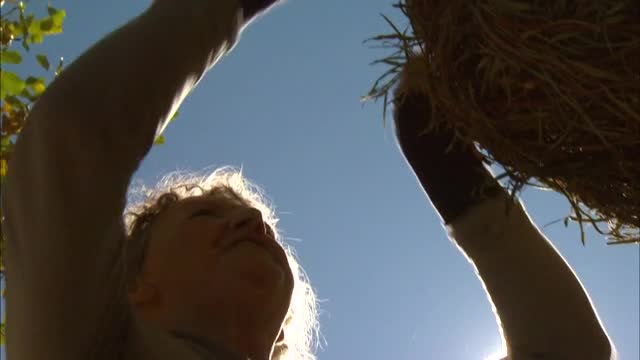
new level of reality." IT'S ALL AHEAD ON COLORES. THIS PROGRAM IS MADE POSSIBLE IN PART BY NEW MEXICO ARTS. A DIVISION OF THE DEPARTMENT OF CULTURAL AFFAIRS AND THE NATIONAL ENDOWNENT FOR THE ARTS. ARTIST PATRICK DOUGHERTY IS KNOWN AROUND THE WORLD FOR TURNING SIMPLE TWIGS INTO GRAND ARCHITECTURALMASTERPIECES. WATCH HIS LATEST PROJECT UNFOLD ON THE CAMPUS OF ALBUQUERQUE'S BOSQUE SCHOOL. Patrick Doherty - Artisode I am convinced that everyone knows about sticks, part of that knowledge is from out ancestry. Well don't
you think it's very childlike, it's magical out of our story books, it's like we're having a kid's dream here [laughs] Well, I think of myself as a sculptor and I used sticks and branches You know we have a deeper resonance with it. Almost everybody knows about sticks. Kids know about it. A lot of adults are closet stick collectors in other words we are hunter and gatherers and in kind of a shadow life and our ancestors sent with us the information on how to use these saplings. You know making primitive faces is just
part of all cultures. I was speaking about the "green man" and that mankind was born out of trees and that is kind of where our spirit is, roaming around in thewoods and it somehow is personified by a grouping of leaves and limbs in which we look in a see a reflection of ourselves. It's a bit like a certain kind of drawing style, there is a kind of a feeling of movement that is created in the surface. You know it welcomes the community. not all projects can you just walk in and start working on it. You know even if you make a little change or something, he really respects and values what you're doing. I think a good sculpture is one that causes a lot of associations
in the viewers or sometimes it is a childhood tree that you knew, or a bird nest that you've seen, or an indigenous tribe that you've been to see or read about, you want to capture people's imagination and these big trees you see behind me and they are kind of a source for certainly humanity and certainly our well being. THE MUSEUM OF MODERN ART'S EXHIBITION CALLED THE "QUAY BROTHERS: ON DECIPHERING THE PHARMACIST'S PRESCRIPTION FOR LIP-READING PUPPETS" TAKES A LOOK AT THE BROTHERS THREE DECADES OF MAKING SHORT Stephen and Timothy, born in Pennsylvania in 1947. They set up their own studio
in London in 1979, and ever since they've worked together of them. THYRZA NICHOLS GOODEVE: It's very important to think of them as these identical twins, because I feel like the space that they make, comes out of this kind of magical, impossible space that only they share. RM: Their first major influence turns out to be an American naturalist painter, Rudolf Freund. TNG: I think that one of the big influences is the town they grew up in, which was a factory town where things like screws and all the kinds of things that they animate were actually made. RM: They went to the Philadelphia College of Art. As they tell it, the first day they were at schoolthey stumbled upon this exhibition of Polish posters, which had a major impact on them. TNG: Even in America, all of their influences are European in aesthetic and intemperament and in their obsessiveness with literature like Bruno Schulz, Robert Walser, cek or Stockhausen. RM:
The "Blood, Sweat & Tears" album cover was their first professional job. They presented a cover which featured the band members without heads. The studio kind of unceremoniously pasted heads on. The Quays original design has a much more uncanny, surreal quality to it. On paper, my favorite work by the twins are the black drawings, about a dozen black drawings done inpencil they did in the mid-1970s when they were living in Pennsylvania. This is work that really brings them to the brink of the transition There are two qualities that
help me appreciate how a viewer should approach their work. One is their belief that expressive that unless the viewer goes through the process of deciphering meaning he's not really engaged in the work and the more viewers engage in that, give into that engagement, the more fun it is. Secondly is their notion of what I call musicalizing space, the way the camera moves throughout the sets a key to interpreting it. It's like watching a dance, almost all their films have that quality. TNG: It's sort of like you get taken over by the Quays as I call it the "Land of the Quay" that you kind of enter into. They do extraordinary things with light, especially in "In Absentia." It's a film that's inspired by the story of a woman who was
in an insane asylum. She would only write one sentence over and over again and it was "Sweetheart, come, sweetheart, come." It's very important that it associates with calligraphy, because they are calligraphers and that's actually another space to think about when people are thinking about their films. They talk about their work as being more in line with music than dramaturgy, because music is absolutely essential to their work. There's a music video they made called "Stille Nacht 2." What's exemplary about it is when they're shooting a space that's neither flat nor three-dimensional, but can only be made in the cinema. It'ssort of one of the great moments when they're able to affect that along with the music. People call them animators, but it's really the interspace between animation and film. it's also extraordinary because they're obviously pre-digital, and I think people sometimes
watching them now might forget they're working in these very delicate ways but then they're turning it into this incredible flow that can kind of go anywhere. RM: One the public will take away from the exhibition is not only a better knowledge of the range of the Quays work, but also I'm hoping that they'll be enticed to explore the same kind of music and literature that's interested the Quays. It's a real antidote to the kind of relentless pop culture that we live in. This takes us a little further away from commercial filmmaking, commercial animation and to really the avant-garde subjects. STEVE ADUBATO SITS DOWN WITH EVE ENSLER TO TALK ABOUT HER "MONOLOGUES" LEGACY, HER ACTIVISM AND HER NEW STEVE ADUBATO I want to introduce you to a fabulous, talented guest that we have. She is Eve Ensler. She's a playwright,
performer, artist. Her latest play off Broadway is called "Emotional Creature." You may have heard of the other play that she had called the "Vagina Monologues." So talk to us about "Emotional Creature." We have a clip EVE ENSLER I'm very excited. It's based on a book that I wrote - I always knew it would be a play, but I wantedto really spend some time writing the stories and getting the monologues down. And then we, we've had the most amazing process. We started this in South Africa with Jo Bonney, the wonderful director,and Charl-Johan Lingenfelder, a fantastic composer, and we thought we'd have some incidental music and we ended up writing songs and creating dance and video. And then we went from South Africa to Paris, where it became a little melancholy, and added some sad songs. And then we went to Berkeley andnow we're coming home to New York. I just have to say it's been, for me, one of the best artistic processes I've ever had. But these girls in the play are awesome. And they're just alive and passionate and talented
and fierce and I was just looking at dress rehearsal last night and said, to see sixgirls up on stage putting out that much talent and that much thought and that much heart, it's why we're in the theatre, it's why we do from play] SA Wow. That's what is giving you this passion and excitement. EE It is. SA Who are these young ladies. EE
Well they're all incredibly, wonderfully talented girls who auditioned for me in New York. They're all very young, they've all been with us in Berkeley and now they've come here where the show has actually changed a lot, it's gone into a new theater. And what I feel is happening with theatre is I think the piece is really about girls, the girl in all of us - the girl in you, the girl in me, the girl in all of us. SA What? EE Yes, you've got a girl inside of you, we all do. That part that's compassionate and alive and revolutionary and a big heart, big openness, feels for the world, and has the kind of zeal and desire to make change. And I think what's happening in the play is that I think it's about storytelling and hearing the stories of girls around the world - painful stories, beautiful stories, sad stories, triumphant stories. But in the end it's really about us all seizing our hearts and understanding that we need our hearts. And I think the heart's gotten a bad rap. I think we've all - SA Whoa, whoa, whoa, whoa,
whoa. I don't like to interrupt but when you say something that requires follow-up - the heart has gotten a bad rap. EE Well I think we live in a world where we believe that the brain and data and information and ideas are triumphant. And I think - of course I believe in ideas - but I think without the heart connection, it's very hard to mobilize change and hard to mobilize transformation. We're all inundated with facts and inundated with the data, and so we don't do anything because we feel paralyzed. But when theheart's engaged, when the emotions are engaged, then things change and you have the capacity to move things forward. I don't know about you, but I bet this is true because it happens to boys at a very early age, when I was a girl growing up - SA Where? EE I was born in Manhattan and I grew up in Scarsdale. But I was told from a very young age that I was too intense, too dramatic, too alive. They called me Sarah Bernhardt. I didn't even know who she wasbut I knew I wanted to be here. And what they were saying is that you're too much for the world, you're too big, you feel too much, you're
heart's too big. Why? Why weren't they bigger? Why didn't they rise to match my moreness and my bigness. And I think for boys, they open their mouths and they have a feeling or they cry and they're told from the instant get-go, shut it down. That's not what boys do. And I think the play is a call for something else, it's a call to be in our hearts, to be emotional. SA Now, you've taken this bigness, this passion, and you've really done some terrific things other thanentertaining and moving people and getting them to think. Let's talk about another issue in the time we have left. V-Day, the 14th of February, 2013, 1 Billion Rising - put it in perspective. EE Well V-Day's a global movement to stop violence against women and girls. This is our 15th year, we've raised 90 million dollars to end violence against women and girls to go to grassroots programs around the world. And this February we're doing the biggest action ever. On the planet right now one out of three women will be beaten or raped in their lifetime - that's one billion women. So we're calling on the one billion
women and all the men who love them to walk out of their jobs, their schools,their offices and to dance. SA Where do we sign up? EE You can sign up on onebillionrising.org. SA Onebillionrising.org. EE And I know you can be dancing right here in the street outside of this studio - SA Absolutely. EE Because it's really important, if you look at everything that's going on right now, if you look at the number of women being shot and raped and killed and abused in the world, and you think of how powerful and gorgeous and necessary women are to the human existence, it's really important that we stop the violence. And I'm very excited to say that already 10,000 groups have signed up, 172 countries. It is happening everywhere, from the Philippines to the mountains, the Himalayas, to Alabama. It'shappening throughout the planet. SA I want to wish you all the best. EE Thank you. SA And they were wrong when they said that you were too big and we find a way to catch up. EE Thank you. SA We need more people like you. Thank
you very much. WHETHER ON LAND OR IN THE WATER, PHOTOGRAPHER RHEA PAPPAS LOOKS TO CAPTURE THE STRENGTH AND BEAUTY IN HER SUBJECTS. IN HER UNDERWATER SERIES, PAPPAS EXPLORES FEMININE VULNERABILITY AND POWER. RHEA PAPPAS: Are you flattening those flowers? Assistant: Yeah. RP: Dude, that's so awesome. Assistant: I know it's going to look cool. I'm excited. RP: You're going to look like a lily. So this is my mom, Mary Jane. She is our model and my mother. I've never done anything like this before. I'm excited. I'm a little you know nervous about it. I don't know. We'll see how it goes. RP: Whether or not she likes how she looks in it, I think everybody else does. RP: I'm Rhea Pappas. This is my coffee. It's so good. Assistant: Drink that coffee, Rhea. Drink that coffee. RP: Coffee is really good. For you and in your tummy. I'm really a photographer, on set and off set. The time of day is very
early, so its 8:25 and the reason we have to shoot this early is because the sun comes up and makes- I use a pool that has all windows and so the sun comes in and hits the water at a very unnecessary, harsh and unfavorable light. I've been workingon this specific underwater project for a good year, year and a half. I have been moving away from just experimenting with the water and just having fun with it and like the awe of the first experience kind of lasted a while for me cause it's a really cool first experience and it doesn't really leave that fast. I think I'm moving now towards more interesting ideas and more conceptual ideas. My new body of work is more about releasing energy, how the body moves underwater, and exploring underwater and what that means to be a woman underwater and that's the way my project has been going. MP: I think it's kind of cool that you're using an older model anyway. I think that there aren't enough older models that too many people
focus on being youthful and our society is so oriented toward thin, and young and gorgeous. I'm a little ripe and older. RP: She is, oh man, the only thing that comes to mind is Greek. My mom is a Greek woman. It's a- my mom is a very playful, intelligent, talented Greek woman. MP: When she invited me to do it, I just thought- I was a little hesitant, you know. Being my age and being in the water and being filmed and everything and being a little self-conscious, but you knowI'm just going to throw that out the window and just let it all happen. RP: The main reason for the portrait is to talk about confidence and being a woman, how you deal with society. When women are underwater they are comfortable and they can feel free to be themselves, but when they reach the surface they have to deal with a whole new reality
and they have to be strongand hard and I think mainly I got a lot of that from you, [laughs] if you want to admit that one ornot. You own your own business and you had to go through a lot to do so. We come from a very strongwoman family. MP: Yeah, I think that's right RP: Where is your car? MP: Right in front of the ramp. RP: Ok. RP: I got the keys. MP: I'm glad you got the keys. [laughs] Oh, it smells like a pool. RP: Yes, it does. It's kind of fun to play with her and she's such a good portrait taker so I don't know it's just the start of the whole thing so.... "Do you want to get wet all the way up to here? Are you feeling warm enough, ok?" RP: For me, to put myself in my model's place is huge and I have to realize that they are very vulnerable from the minute you start shooting them. RP to MP: Let me help you get comfortable. You're going to kind of scoot
down. MP: Its hard for me to hear with my ears underwater. RP to MP: Don't hear... RP: You're asking them to do something that's out of their element that they don't generally do and you just need to let them know that they are in good hands, and that's my motto. RP to MP: The portrait I want you to do is exactly what we were talking about earlier. In your face and your eyes, I want you to talk about coming to the surface and being a strong, powerful woman. MP: Got it. RP: Whether that's hard or soft or beautiful. Make sure not to get water on your face. That's beautiful... RP: And I feel like they need to know that I'm there and the best intentions. RP: I think we're good. Let's go take those flowers out of your hair. MP: Really, you're done with that? RP: Mhmm. RP: I love the scarf, I love her hair, I love her facial expression, but you never know until you get it you're your computer. Really, you don't. RP: So this is my, uhh, AD700. Its aquatica camera housing. It basically houses my D700 from Nikon. It's like the most beautiful thing ever made. When I got this, I just put it on a pedestal for a while and was like 'all hail.' This
is the beautiful dome. I love this dome. RP: She's having a ball right now. I go underwater with my models, so that's the difficulty of timing. Like if I don't go down at the right time, am I going to catch them? Especially, if you have somesurface photographs like you know the one next to me here with the bubbles hitting the water. If I-she jumped in the water- and if I wasn't down there, and ready for her, and focused, I never would have caught it. RP: And we're going to start with simple moves, geometric. MP to RP: Alright.. RP to MP: You're so excited [laughs]. I'm ready now. RP: People aren't used to being underwater in clothing let alone being underwater with you know a dress that sticks to your legs. There are definitely some things about experimentation with that that's a little
nerve-wracking. RP: It's beautiful but your face looks like it was a little bit in pain. RP: If you are comfortable with water I think the bottom line is if the person is comfortable opening their eyes and going under it, it's a huge thing because if they are free to do that they are so much more free to let go of the way they work on the surface and start doing things they've never done underwater. RP: This too, you're holding some tension. MP: What? RP: You're holding some tension in your jaw. It's a little old school like 'I am upset' thing going on. MP: Like being a diva? RP: Maybe. MP: Let me see. RP: Hold on. Right here... MP: Oh neat. RP: Yeah, the reason we set up the shot is because I really wanted the bubbles. MP: I could do another one like that. RP: I bet you could. MP: Move the scarf and then dive underneath it. RP: I think initially why I started with clothing is because it's unusual underwater. MP: Okay, ready? Get set! RP: I'm really a woman photographer. I like
shooting women beautifully. For me, I thought dresses would be the first place to do it. They flow well, they're fun, they're expressive under water, especially if you've got all these crazy things going on. MP: It's just amazing what the fabric does underneath the water, how it restricts my movement. RP: What I'm afraid is that it's too scarf- oriented, that we don't talk about the movement. So maybe what we do is we literally put the scarf around you. RP: I think at the bottom of my photography soul, I want people to express an emotion, to use their emotions, and to work through them, and to feel them when they look at my work. RP: Is that hard to do? MP: This is a workout. RP: People used to come to me with my book and be like, 'thank you for doing this,' you know. And that was really wonderful. I hope that whether or not this is dramatic as that was, that they do, thatthey have that reaction and that they leave either feeling like they want that in their living roomor that they've actually MEXICO PHOTOGRAPHER WILLIAM
CLIFT HAS SPENT YEARS PHOTOGRAPHING THE BENEDICTINE ABBEY MONT-SAINT-MICHEL AND SHIPROCK. "...they're really something more than nature. They're something primordial, and at the same time, utterly as if they were built by a great feeling architect. PETE TOWNSHEND REVEALS WHAT'S BEHIND THE ACT OF DESTROYING GUITARS, AND HOW HIS ART SCHOOL EXPERIENCES HELPED HIM FORM ONE OF THE MOST INFLUENTIAL ROCK BANDS IN HISTORY. "If we'd have been four arty farty art students who all thought like I did it would have been a complete mess. " DID YOU KNOW OPERA STARTED IN PARLORS AND SMALL MUSIC HALLS BEFORE MOVING TO THE BIG STAGES? THIS GROUP, KNOWN AS "INTIMATE OPERA" PERFORMS BITE SIZED BITS OF THE MAGNUM OPUS. "When I sing opera, I'm
getting to the heart of who I really am." ARTIST DAVID GARIBALDI IS NOT ONLY A PAINTER. HIS PERFORMANCE WILL ENGAGE YOU AND HIS PRECISE TECHNIQUE AND MUSICAL RYTHMN WILL SURPRISE YOU. "I'm just dancing with my heart to the music and with paint in my hands." NEXT TIME ON COLORES! ?? ?? ?? ??
- Series
- ¡Colores!
- Episode Number
- 1911
- Producing Organization
- KNME-TV (Television station : Albuquerque, N.M.)
- Contributing Organization
- New Mexico PBS (Albuquerque, New Mexico)
- AAPB ID
- cpb-aacip-332b88a8244
If you have more information about this item than what is given here, or if you have concerns about this record, we want to know! Contact us, indicating the AAPB ID (cpb-aacip-332b88a8244).
- Description
- Episode Description
- World-renowned artist Patrick Dougherty turns simple twigs into architectural masterpieces. Dougherty works on a new sculptural piece at the Bosque School in Albuquerque, New Mexico. “I think a good sculpture is one that causes a lot of associations in the viewer.” After three decades of making stop-motion animated films, the Quay Brothers (Steven Quay and Timothy Quay) are celebrated at the Museum of Modern Art. “People call them animators but it’s really the interspace between animation and film." Playwright Eve Ensler talks about her “Vagina Monologues” legacy, her activism, and her new musical “Emotional Creature.” “I think the piece is about girls but the girl in all of us.” In her underwater series, photographer Rhea Pappas explores feminine vulnerability and power. "When women are underwater they’re comfortable, but when they reach the surface they have to deal with a whole new level of reality.”
- Broadcast Date
- 2013-04-05
- Asset type
- Episode
- Genres
- Magazine
- Media type
- Moving Image
- Duration
- 00:27:03.155
- Credits
-
-
Guest: Pappas, Rhea
Guest: Quay, Steven
Guest: Quay, Timothy
Guest: Dougherty, Patrick
Guest: Ensler, Eve
Producer: McClarin, Amber
Producer: Kamins, Michael
Producing Organization: KNME-TV (Television station : Albuquerque, N.M.)
- AAPB Contributor Holdings
-
KNME
Identifier: cpb-aacip-3355cc7b154 (Filename)
Format: XDCAM
If you have a copy of this asset and would like us to add it to our catalog, please contact us.
- Citations
- Chicago: “¡Colores!; 1911; Artist Patrick Dougherty, Animators The Quay Brothers, Playwright Eve Ensler, Photographer Rhea Pappas ,” 2013-04-05, New Mexico PBS, American Archive of Public Broadcasting (GBH and the Library of Congress), Boston, MA and Washington, DC, accessed April 4, 2026, http://americanarchive.org/catalog/cpb-aacip-332b88a8244.
- MLA: “¡Colores!; 1911; Artist Patrick Dougherty, Animators The Quay Brothers, Playwright Eve Ensler, Photographer Rhea Pappas .” 2013-04-05. New Mexico PBS, American Archive of Public Broadcasting (GBH and the Library of Congress), Boston, MA and Washington, DC. Web. April 4, 2026. <http://americanarchive.org/catalog/cpb-aacip-332b88a8244>.
- APA: ¡Colores!; 1911; Artist Patrick Dougherty, Animators The Quay Brothers, Playwright Eve Ensler, Photographer Rhea Pappas . Boston, MA: New Mexico PBS, American Archive of Public Broadcasting (GBH and the Library of Congress), Boston, MA and Washington, DC. Retrieved from http://americanarchive.org/catalog/cpb-aacip-332b88a8244