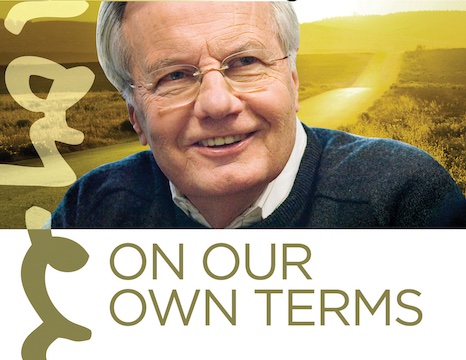
On Our Own Terms: Moyers on Dying; 101; Living with Dying
- Transcript
BILL BARTHOLOME: Discovering what it's like to live in-in the light of death-it-it just blew me away.
JOYCE KERR: Oh, they're lovely.
DR. DIANE MEIER: We will all die, but how we die, what happens before we die is under our control.
DR. DIANE MEIER: Fentanyl-400 micrograms.
BENITA RESNICK: We'll do it to the best we can for as long as we can.
MARY-KATHERINE MENIKHEIM: I'm not afraid of dying. I don't want to die anytime soon, but I'm not afraid of it.
GAIL HORVATH: Have you had enough breakfast?
DR. JOANNE LYNN: How we come to the end of life now is different. It takes different answers, new solutions.
JOE BROWN: He wants his life to end-
MARCIE BROWN: Peacefully-
JOE BROWN: -on his own terms.
EDWINA TAYLOR: You are doing a wonderful job. You're a wonderful sister.
BILL BARTHOLOME: Here's to family and friends and love and-
BILL MOYERS: Is it possible to achieve death on our own terms?
DR. DIANE MEIER: I've seen many people do it.
BILL MOYERS: I'm Bill Moyers. Like you, I don't want to think about death -- especially my own. But I have realized that death is pushing through the door we try to keep so firmly shut. Parents age before our eyes. AIDS and cancer take friends and loved ones. And baby boomers -- that most powerful generation in our culture -- face their own mortality even as they must care for their elderly parents. So like it or not, we cannot push death back through the door. That's one reason we did this series. The other is that there is a movement afoot driven by our hope for a better death. There are doctors, nurses, hospice and social workers -- and patients themselves -- pushing to improve care for the dying. What they're doing will affect us all. In these four programs we'll report on that movement through the intimate journeys of the dying, their families and their caregivers. All were remarkably generous in allowing us into their lives. They believed their stories would help all of us understand the importance of living with dying.
GARY TEGTMEIER: We've got the meadowlarks today.
BILL BARTHOLOME: I heard the meadowlarks. They were fun. What a day...what a day. I mean, I was totally exhausted when I got out here. But it feels really good to be here.
BILL BARTHOLOME: Discovering what it's like to live in the light of death, live in the last chapter of your life, was so incredible. It just blew me away.
BILL BARTHOLOME: This adventure is going to be...it's going to be good though. It's going to be hard, but it'll be good.
BILL MOYERS: For Bill Bartholome the prairie is familiar ground... The place where he has come often with old friends. This time, they are sharing the story of his dying.
GARY TEGTMEIER: Going through this process with you Bill...
BILL MOYERS: Five years ago, Bill learned he had cancer of the esophagus.
GARY TEGTMEIER: I don't think we've... we haven't hit the real skids yet.
BILL BARTHOLOME: No, no. Really I've had it relatively easy so far.
GARY TEGTMEIER: I hope there's a way that--
BILL BARTHOLOME: There'll be times you know you'll have to carry my ass out of here.
BILL BARTHOLOME: The lessons that I'm learning, it's all been why didn't I see this before? Why couldn't I have understood this about death before?
BILL MOYERS: Death is no stranger to Bill Bartholome. Much of his work as a doctor in Kansas City, a pediatrician, has been with dying children. Now death had turned on him. He began to record his thoughts about living with dying- A journal of life's last chapter from that moment when illness struck.
PAM ROFFOL DOBIES: We were engaged and I joked with him. I said, when was the last time you had a physical-being a physician you would expect - wrong. He said, oh it's been 15 years. So he agreed to go into the doctor and never said anything to me about what he suspected.
BILL BARTHOLOME: I was having some trouble swallowing, I particularly noticed that about bagels. That they wouldn't go down anymore. So when I went to see a physician, just to sort of humor me decided well we'll get him an x-ray study. I went in and had an upper GI test where you swallow barium and saw immediately while the test was going on that there was a mass in my esophagus.
BILL MOYERS: You knew this in effect, this was it?
BILL BARTHOLOME: Right. I knew I was terminal diagnosis at that time.
BILL MOYERS: Did you say why me? I'm too young.
BILL BARTHOLOME: Um, interestingly enough I never did. It seemed appropriate. I had been living my whole life sort of in preparation for it. Doing medical ethics, teaching death and dying, it almost seemed like if somebody has to get this damn thing, why not have it be somebody who can deal with it.
SHEILA KRAUS: I was totally shocked. I thought he was going to die that day. That's how it felt to me that well he's gone tomorrow and that's it, and he constantly had to tell me you know this is just today. It's not going to happen today. You have to just live with it.
BRIDGET BARTHOLOME: There's really no one in our family that has died. Just to think of the impact it would have not only on our lives and our little sister, who's just eighteen.
BRIDGET BARTHOLOME: Fishing.
BILL BARTHOLOME: Fishing. Claire caught-we still have some of the fish she caught. It's hard when you weigh 173, you realize that at one point you weighed 216.
BILL BARTHOLOME: What was clear at the beginning was that it was a terminal illness. I would die from it, but nobody was willing to really put numbers around it. I wanted to have about 6 months at least so that my fiancÈe and I could get married, and my daughter, my middle daughter, had recently gotten engaged too so I wanted to be able to pull off these two weddings.
BILL MOYERS: To gain precious months, Bill decided to undergo surgery to remove his esophagus-. His experience as a patient was devastating-
BILL BARTHOLOME: The pain of the surgery was like nothing I'd ever experienced before. At one point, I was wheeled down to x-ray for a study to look at how my healing was going in my esophagus. And I was left in a hallway all by myself, crying and trying to get people to, stopping people who walked by and say would you please ask these people when they're going to be able to take me. And call the nurse and get me back to my room. I had been without pain medication for several hours and nobody seemed to take that very seriously, and if you don't take pain in a full professor in your own medical school very seriously can you imagine how not seriously you take it for everybody else? The only solution that I really saw was getting the hell out of there.
BILL MOYERS: Out of?
BILL BARTHOLOME: The hospital. I knew I wasn't going to be okay until I got out of there. The chemotherapy was presented as there's no chemotherapy that will alter your prognosis. Well for me that was a great relief because I wanted nothing to do with chemotherapy or any anticancer treatment. I'd watched people go through that and seen them get caught up in it. So-
BILL MOYERS: What do you mean?
BILL BARTHOLOME: Well, most people in the United States who have stage four cancer die as cancer patients. They're actually undergoing anticancer treatment often times days before they die. It just sort of dawned on me and Pam that it was going to be up to us. That we had some time and that what we ought to do is cram as much living as we could into that time.
BILL MOYERS: Why did you want to get married knowing that you were under a death sentence?
BILL BARTHOLOME: From a purely pragmatic, practical sense the advantages of being a surviving spouse seriously outweigh the advantages of being a surviving fiancÈe that was the excuse I gave myself. The reality of it was that I could not believe it. That she would actually do it.
PAM ROFFOL DOBIES: I don't think it ever really crossed my mind to not get married. It was just it was something that I wanted to do before diagnosis and it didn't fit for me to stop thinking that way because in my logic of all of this we are all dying. None of us have a guarantee. I had thought about death in that context, the quality of what you are doing on earth. It better be good because you don't know how long you're going to be here.
BRIDGET BARTHOLOME: I've found it wonderful that despite all this training as a physician his reaction to his disease was to not be aggressive, no I'm not going to get a CAT scan. I don't want to know. I'd rather live on the other side of the mirror-very much different from his handbook of science.
BILL BARTHOLOME: I think I went through a process. There was a period of about six months after the diagnosis that I experienced a kind of grief that I had never known. I cried, you know, uncontrollably, bawling until you have no more tears. It was suffering that transcended pain. I mean it was I - I had a lot of pain during that time but it was not in the same league as the suffering. But that didn't really last very long. You do get the rewards of your grief work and those are that you move down the road to a place where it's okay and you can begin embracing that reality and discovering what it's like to live in what I've been calling the light of death, live as a terminal person. If you don't expect to see spring when fall comes and then you are around and you get to see spring. You don't experience it as spring. You experience it as an incredible miracle. I think death transforms our living in ways that we in this culture do not understand. I think we need to think of death as sugar, as something that gives life that pizzazz, makes it sweet.
BILL BARTHOLOME: Here's to family and friends and - and love and health and everything else.
BILL BARTHOLOME: Since November I lost the function of a vocal chord. I have seen the lesions growing on my lungs and in my trachea. And I'm beginning to sense that it may not be a year. I can now touch my cheekbone and I'm in contact with the skeleton that I'm becoming. One of the real advantages I've had is that I've not depended on anybody else to interpret the reality of my situation. It's very difficult for Americans to find the support they need for not getting caught up in rescue and the rescue fantasies of their providers. Prolongation of life is something that American medicine got caught up in but it's not what makes life valuable-how long life is.
DR. PAT CARALIS: This is high tech.
BILL MOYERS: Where you make decisions of life and death?
DR. PAT CARALIS: Absolutely, absolutely, unfortunately, yes.
BILL MOYERS: This is what all of us dread. I mean we want it if there is a chance of saving us, but if there's not a chance of saving us, I dread lying there unconscious or in pain.
DR. PAT CARALIS: I think that's what most people fear is that we are going to use all this technology and they will lose themselves in it.
DR. PAT CARALIS: Ms. Tandarich, I'm really glad that you came today so we can talk about-
BILL MOYERS: Dr. Pat Caralis is a specialist in end-of-life care at the university of Miami/Jackson Memorial Medical Center.
DR. PAT CARALIS: What I'd like to know are some specifics.
DAUGHTER: You want to be home with all your animals and your friends and your people.
DR. PAT CARALIS: Many surveys have shown that Americans feel that they want to die at home. The unfortunate thing is that they don't. All of us feel our home surrounded by all our family and the things that we are comfortable and familiar with is the way we all want to go. That's the good death we all envision. For the most part, if we have to deal with a lingering death, that can happen in an institution. All of the studies at this point have shown that Americans still die in pain. They still die unfortunately without the things and values that are important to them because people have not planned or systems are not available for them to be able to die peacefully and supported.
DR. PAT CARALIS: Nancy? Como se siente?
DR. PAT CARALIS: Are you having pain now?
SOCIAL WORKER: No.
DR. PAT CARALIS: Okay.
DR. PAT CARALIS: Is it hard for you to breathe on the machine?
BILL MOYERS: Nancy Martinez is paralyzed with Lou Gehrig's disease - ALS. For two years, the hospital has taken every measure to give her the care she wants.
DR. PAT CARALIS: She originally had resisted the intubation. She actually had to have discussions several times are you clear that you won't be able to live if you if don't get this. And she finally relented to have a ventilator. She currently is able to move her eyes about a millimeter or so to the left and the right, which allows us to continue to communicate with her. She can't talk.
BILL MOYERS: So you're literally keeping her alive.
DR. PAT CARALIS: Literally, if you stopped feeding through the tubes, took her off the ventilator, didn't turn her, she can't do anything for herself. She can only move her eyes.
BILL MOYERS: How often do you have to do this?
SOCIAL WORKER: Every 15 minutes.
BILL MOYERS: Every 15 minutes? Around the clock?
SOCIAL WORKER: Uh huh. They brush her teeth everyday.
DR. PAT CARALIS: Yeah she looks good.
NURSE 1: Perfect teeth.
BILL MOYERS: Do you feel like she's your family?
SOCIAL WORKER: Oh yes.
NURSE: Oh yes, number one! She's the queen of Central 6.
DR. PAT CARALIS: It's never easy for physicians to say we don't have the pill that will stop the dying. We don't have the surgery that will take the cancer out. I think that's always hard because we were always traditionally trained to cure. But it's just as important to care.
DR. PAT CARALIS: Good afternoon. The Ethics Committee of Jackson Memorial is meeting because we've been asked to review a case.
BILL MOYERS: The Martinez case poses a question for the hospital. Some doctors now wonder if their efforts are doing more harm than good. They've asked the ethics committee to meet because she faces yet another crisis.
DR. PAT CARALIS: She currently has an infection, it is to be considered a life-threatening infection if it doesn't receive antibiotics. The team would like us to assist them in deciding what would be the best course of treatment for this patient.
BILL MOYERS: The Question: Is it good care to give the antibiotics-or not good care?
DR. PAT CARALIS: Her condition is so severe and the fact that she now has resistant organisms, that provision of these antibiotics just was a manifestation of futile treatment.
KENNETH GOODMAN: Are they convinced that it won't work or that it's not worth it even if it does?
DR. PAT CARALIS: I would say probably the latter.
MALE DOCTOR 1: Do we have any evidence from her that she perceives her current condition as being one of suffering?
DR. PAT CARALIS: She's treated with narcotics at this point for pain, but I think there's also a concern on the part of the medical people that there will be suffering if there isn't already in view of invasive treatments.
DR. GINA D'AMATO: She's harboring disease. She's harboring infection-this one may be able to be treated. But the next infection is gonna be even more resistant.
MALE DOCTOR 1: Some people value being alive. We don't know what motivates a person to accept suffering in order to stay alive.
DR. PAT CARALIS: In talking with her the other day, she does believe in God and she believes that God-again, these are yes or no questions- It's very hard to structure more philosophy out of this, or value systems, but she believes that God is the only one who can take her.
KENNETH GOODMAN: When you say the treatment is futile, it's futile relative to particular kinds of ills. It seems like you've got opportunities to keep her going for awhile that has value to it. So on that axis it's not going to be futile intervention.
DR. PAT CARALIS: At the risk of being the devil's advocate in this committee, how much is enough? How many hurdles do we do? I know most of us don't think of antibiotics as extraordinary but, why prolong that by throwing on one more extraordinary technology that we have in medicine.
MALE DOCTOR 1: Because it's-
KENNETH GOODMAN: Because it's worth it to her and that's what we do here.
DR. PAT CARALIS: Again, devil's advocate, do we climb at the mountain every time somebody tells us to if it's inappropriate or do we follow the tenets of our profession which is to not provide treatments when clearly medicine is no longer of benefit?
DR. PAT CARALIS: I think we are all struggling with the definition of what's enough. What are the limits? But I think that the closer we come to it, the easier it will be to see it. There's no antibiotic in the world, there's no intensive care unit in the world, there's no technology we can do to stave off death and so that's truly futile treatment and to offer that to the patient is a false hope.
SOCIAL WORKER: [Speaking Spanish]
DR. PAT CARALIS: This is the daughter?
DR. PAT CARALIS: This country should expect not just the best and latest but really the most appropriate kind of care. And I think it's very appropriate to expect that when you die, you should not be in pain, you should be supported and you should be respected.
BILL MOYERS: The Ethics Committee recommended that Nancy Martinez continue to receive antibiotics. She lived another four months.
DR. PAT CARALIS: We need to try. We need to try harder to achieve a good death. We as health care providers are constantly on the edge. We don't always have the answers and the questions sometimes come very fast and furious. The key to any kind of approach is to respect people's experiences and that really requires you to understand your patients.
BILL MOYERS: Miami is a city of such multiple personalities. Does this make your job harder?
DR. PAT CARALIS: Absolutely, when you have cultural differences and diversities and beliefs and expectations it brings to the fore even more, the challenges involved dealing with death and dying. We have little Haiti, which has it's own belief systems and its own cultural diversity. We have an African American community that's rooted in the Deep South. We have not only a large Jewish community, but we have again the ethnic mix of the Jewish community. We have not only Cuban, Cuban Americans, but we also have from the Latino population from Central America and South America and even Spain. It takes I think vigilance on the part of all of us to respect difference and to incorporate that difference into the treatment plan. We found particularly in Latinos and recent immigrants and in Asian families that the consent process in telling bad news is something that perhaps isn't done the way it's done traditionally. Families have said ìdon't tell Poppy he has cancer,î that it's an expectation maybe particularly in Latino families that Poppy not know. And if they don't know what's happening then you've taken that important part of treatment choices away from them. And I don't think any family wants to do that.
BILL MOYERS: Patients who don't know how sick they are are also not likely to sign advanced directives stating their wishes for treatment should they lose the ability to communicate.
DR. PAT CARALIS: If we don't prepare our physicians for our values and choices and they don't prepare us for our options and opportunities then we're all not going to go through a good death, we're going to suffer and we'll do so needlessly. We found that African Americans particularly are reluctant to withhold and withdraw life-prolonging treatments, even if those treatments that are useless, they hang on to that. In our research Latinos were kind of in the middle. It was the non-Hispanic whites who were the most willing to withhold and withdraw life prolonging treatments to sign advance directives and to support euthanasia. What's behind those differences? One thing that's been proposed is that traditionally people who are of different cultures have felt biased, have felt discriminated against and indeed a lot of studies now show that that's true.
MARIAN
GRAY SECUNDY: If I come into an African American patient who's coming into the hospital and ask do you have an advanced directive and you explain: if you can't talk for yourself and have you indicated what you would like done? What do you mean if I can't talk for myself? I can talk for myself now. Well, in the event that while you're here in the hospital you can't talk for yourself. What do you mean if in the event? Well why would I not be able to talk for myself? Well that means that you just don't want to treat me because you don't value me or you think that I don't have the money.
DR. PAT CARALIS: It's important for me to know what are your values and preferences would you want me to keep you on a ventilator ëtil the very end. Because every minute counts to you and I would say to you there's gonna be a point when even a ventilator won't help you. So you've got to say to me, does every minute count to you regardless of what you might feel? Because helping you die in the way you want is something that we're going to have to work together to achieve.
DR. CARLOS SANDOVAL: Many Americans do die alone and in pain and in the hospital. Our American culture encourages us to be independent and we're going to do it. It's part of our fighting spirit.
BILL MOYERS: As a Miami psychiatrist who counsels cancer patients, Dr. Carlos Sandoval sees every day how culture and belief affect the dying process.
DR. CARLOS SANDOVAL: Many Americans I know have no support system and it's due to the fact that the American family has become fragmented. How many people have all the brothers and sisters living in the same city?
DR. CARLOS SANDOVAL: [Speaking in Spanish]
DR. CARLOS SANDOVAL: My experience as a Latino is that the difference is Latins die accompanied by their family.
DR. CARLOS SANDOVAL: She's sleeping well.
DAUGHTER: Yeah, she's sleeping real well. I'm not. But, she is. [laughs]
DR. CARLOS SANDOVAL: You're not sleeping. [laughs]
DR. CARLOS SANDOVAL: It's common for them to die at home.
DR. CARLOS SANDOVAL: It's important that you as a caregiver-that you sleep as well.
DAUGHTER: 24-hour duty.
DR. CARLOS SANDOVAL: It's common for them to die surrounded by their relatives.
DR. CARLOS SANDOVAL: [Speaking in Spanish]
DR. CARLOS SANDOVAL: I'm really lucky. My parents live here, my aunts and uncles, all my brothers and sisters live within 10 blocks of me, if I should become ill, I'm surrounded automatically by family.
BILL MOYERS: Dr. Sandoval's mother, born and raised in Cuba, knows the different ways of death from personal and professional experience. She's an anthropologist.
DR. CARLOS SANDOVAL: Psychotherapy. I can see she's really afraid.
MERCEDES SANDOVAL: Death is a serious thing in this culture or one that we live in. There is a great denial. They take to it like any event that you handle by paying for your funeral, dealing with your last testament, whatever it is, you know, and like as if could be dealt with in a materialistic fashion. And I really believe that we have dehumanized death as we have dehumanized other aspects of culture. At least I was raised in a town where the dead people were so important that they were more important than the living and I'm not kidding. They showed up at night under the mango tree.
DR. CARLOS SANDOVAL: Yeah, but American ghosts don't like to go to mango trees. They don't do very well in Miami, they like to spook old Victorian houses up North.
THOMAS LYNCH:We've put such a distance between ourselves and our death that when it occurs, when there is actually a death in the family there's an embarrassment about it. We love to go see frightening movies, we like death on that scale and we like death on the scale that we can laugh about it, you know, the sort of Halloween thing. But that normal ground where people love and grieve, we are uncomfortable with. And I'm-and that's the ground I'm really interested in. That's what I do.
BILL MOYERS: For most of his life, the poet Thomas Lynch has watched how his neighbors in Milford, Michigan meet death. He now runs the undertaking business founded by his father.
THOMAS LYNCH: Our lives were constantly being interrupted by the deaths of others, it seemed very natural. And when I think of it, I mean this is in our nature. It is the most natural thing we do. We will not all pay taxes, we will not all sleep with another member of our species, but all of us will cease to be. Our characterizations of death have always been based on the notion that life is good, death is bad. You know, don't go there. That said, we've always had this spiritual enterprise that says even though we appear to die, there is another kind of life, whether we do that as Buddhists or Christians or Jews or secular humanists, we try to make some sense of what happens when that body ceases to be. To the extent that language and symbol and metaphor and ritual and ceremony speak to these concerns, it's always been interesting to me.
GRAY SECUNDY: There are probably great universals there in terms of all faith traditions, but there is something that is unique about the African American faith traditions and the music. It's the words and the music that somehow come together to provide this capacity to assist people in coping and surviving when facing the dying experience, the dying process. It's joyful, it lifts you up.
BILL MOYERS: Philadelphia's Bright Hope Baptist church is the spiritual home to Marian Gray Secundy. Her brother preaches here, as did her father and grandfather.
WILLIAM GRAY: From the day we are born, we are on a one way street that leads to death. Some in the morning of life, some in the midday of life, some in the late afternoon of life or the twilight or the midnight, but all will die.
BILL MOYERS: As a scholar, Secundy has studied how people search for comfort in the face of death.
GRAY SECUNDY: The spiritual was a call to freedom. It was a coded message about release from the oppression of slavery. The songs of the church reflect the history of our people.
GRAY SECUNDY: The trials and tribulations of oppression, slavery.
GRAY SECUNDY: But they also tell us about overcoming and about coping and about survival.
GRAY SECUNDY: Earth has no sorrow that heaven cannot heal, earth has no sorrow that heaven cannot remove, so whatever comes it will be, it can be, it would be handled by faith, belief and by God.
BILL MOYERS: Including death?
GRAY SECUNDY: Including death.
GRAY SECUNDY: That we can make sense out of things that make no sense. We can create miracles out of things that do not appear to be possible.
DR. SUKIE MILLER: 3 out of 4 Americans believe in an after-death. George Gallup has done the statistics, God bless him, and the finding is that 74% of Americans believe in an after-death.
BILL MOYERS: Sukie Miller counsels terminally ill people and the doctors who treat them. She encourages Frank talk about what people believe at the point of death.
DR. SUKIE MILLER: They believe it will be a journey. They believe it will be spiritual in nature, they believe they will grow. 3 out of 4 Americans, it's here. It's in the culture, in the heart, it's in the body of these people, of all of us, of 3 out of 4 of us, but we don't talk about it.
BILL MOYERS: Rraveling the world, she explores cultures that do have an affinity with death. People not only talk about dying but embrace rituals that anticipate it.
DR. SUKIE MILLER: These are people who live with death, death around them, death is part of it. Very narrow division between life and death, very narrow. The Mexican Day of the Dead first of all it's a joyous occasion. The people gather at the cemetery. You gather around the grave of your loved one. And there are mariachi bands, it's a beautiful night and it's filled with color and filled with life. And then there's Day of the Dead art. It's in skeletal form. Now what the skeletons are doing is life. But they are still skeletons. In the Western culture death is - death is really a drag. It's sad, but it isn't as it is in other cultures the beginning of a voyage where you send people off.
THOMAS LYNCH: I think maybe we're into convenience and cost efficiency and all these other high value added items of our culture. This is really the first generation, certainly the first century, in which we've had a choice about these things. Up until not too many years ago, people didn't have a gold card and a cell phone by which they could have their dead disappeared from the planet through the offices of folks like me. If you pick up the obituaries, you'll read the obituaries-they'll say, don't send flowers or don't do this or don't do that, no letters. The emphasis is on don't stir, you know, don't let this bother anybody and yet when the Princess dies, millions of bouquets materialized overnight. It seems like these were all the flowers that should have been sent to the mothers and the fathers and the aunts and uncles and the grandparents whose obsequies were so tiny and ignored in the name of good taste. I would love to see people return to the kind of a normalcy where they sent their flowers to their own people, instead of the sort of icons.
BILL MOYERS: When your father died, you yourself prepared his body. Why did you do it?
THOMAS LYNCH: Well I was with - I remember thinking you know this is my father's body. This is my father, this is what my Dad will look like when he's dead. And then there was this realization that this is my father dead it really wasn't until I confronted his body that the whole business began to make sense. This is my father dead.
MARY-KATHERINE MENIKHEIM: I think my perspective on death changed when my mom died, I was 21. Since then I've had a different perspective than my peers. Perhaps I'm not afraid of dying- I don't want to die any time soon but I'm not afraid of it.
BILL MOYERS: Menikheim will spend this day with the dying. So will Alicia Rojas Wainer. They're new volunteers at a San Francisco hospice.
ALICIA ROJAS WAINER: I've never lost anybody and we've never really been touched in the inner circle of our family by death so it feels like a big unknown.
BILL MOYERS: Rojas Wainer plans to become a doctor.
ALICIA ROJAS WAINER: I know that I'm headed for five to nine years of serious brainwashing and what I'm beginning to understand is that Western medicine, for the most part, in the way it's taught and practiced is lacking this reverence for life and this understanding that death is so much part of it.
PHILIP MARCUS: I'm Philip Marcus. I used to work in a nursing home and so I was around death a lot. People talked about their feelings about dying. And it was really sad that a lot of time they wanted to be at a place where they weren't.
BILL MOYERS: In the heart of the city, they will learn a different way of caring for the dying.
FRANK OSTASESKI: Everything about this culture tells us to run in the other direction from death and for one reason or another you've come here to be part of this training to face death directly. And I think that takes some courage. We'll find out how much courage it takes.
BILL MOYERS: Frank Ostaseski is founding director of the Zen hospice, established thirteen years ago to help dying patients who cannot stay at home.
FRANK OSTASESKI: We take our elders and we shut them away in nursing homes and institutions so that we won't have to see their pain. We even put rouge on people in the coffin. Always to keep death at arms length. So I want to invite it into the room this death, so that we get to know it like an old friend.
BILL MOYERS: Although the Zen hospice is based on Buddhist philosophy - its resident-patients and the volunteers who help run it come from many different backgrounds.
MARY-KATHERINE MENIKHEIM: Nine years ago my sisters and my father took care of our mother in our home, I don't think I've ever lived as intensely and-and I miss that and I want to visit it again and in my mother's honor who helped us all in a really beautiful death.
BILL MOYERS: During a week of intensive preparation, the volunteers are asked to study pictures of hospice residents. And even to imagine their own dying.
ALICIA ROJAS WAINER: The hospice work teaches a sort of psychic resilience. The ability to absorb loss and fear and grief. It teaches you how to absorb those emotions and learn from them rather than hold them at bay.
FRANK OSTASESKI: First really we have to learn to listen to ourselves as we practice that then we can bring that to the bedside.
BRUNHILD HOWIND: What would you like? You want your headphones?
FRANK OSTASESKI: Bruni, just put one in - speculate.
FRANK OSTASESKI: To accompany someone is just to give them our attention.
BILL MOYERS: You would think the dying get a lot of attention because of the extremity of their situation.
FRANK OSTASESKI: I think sometimes we have to distinguish between what's getting the attention. Is the illness getting all the attention or is the individual, this human being that's there getting the attention?
FRANK OSTASESKI: Beau is a man who likes to be in control.
FRANK OSTASESKI: One guy in the house right now, Beau. He's kind of a tough cookie with a big soft heart, a little cantankerous on the surface, but kind as can be inside. He came to us from a small downtown hotel. Wasn't quite sure about us, tested us every day. Wanted to see if were we reliable and we just began to create a relationship with him, a friendship with him. Now he's very close to dying. He's a little scared. We'll see how this goes for him.
FRANK OSTASESKI: Can you see me Beau? Things are changing, Beau.
BEAU: I don't want to die young from the cancer ....I want to die old...
FRANK OSTASESKI: Suppose it doesn't go that way?
BEAU: I can handle it.
FRANK OSTASESKI: You can handle it? You got a whole bunch of people around you who really care for you-Diana, Martha, Bruni.
FRANK OSTASESKI: We've been doing this with each other for hundreds of years and we've just forgotten. In the last 50 years in our love of technology, we've forgotten what it was like to have grandma in the other room or grandpa laid out in the parlor.
BILL MOYERS: How would you compare what you do for Beau and your other patients and what kind of care they would get if they were in a regular hospital?
FRANK OSTASESKI: For one, the emphasis here is not on treatment but on palliative care on comfort care. So that's a big difference.
BRUNHILD HOWIND: You seriously want to get a cigarette now?
FRANK OSTASESKI: But also I think we will let him lead more. We will let him show us how he needs to do this. Each person's dying is unique and we have to follow them. They have to make the decisions, not the doctor, not the priest, not the insurance company.
BILL MOYERS: Do you try to deal with physical pain?
FRANK OSTASESKI: Sure. Addressing a patient's physical pain is extremely important and the hospice movement has developed this to the point of an art form. In most cases we can help to reduce 95 to 98% of an individual's pain.
BEAU: Can you bring me some Valium?
KEVIN MCKIE: I'll ask Diana.
FRANK OSTASESKI: However, suffering isn't relieved by morphine. Pain is relieved by morphine. But suffering is our relationship to pain and that sometimes requires something very different. That sometimes requires a different kind of healing touch.
PHILIP MARCUS: It's just amazing what you end up doing here. I was with one of our residents and she was looking at her nails and saying, oh these don't look good. This paint's chipping off. I said oh, you need a manicure. She said, yeah and you know, I thought, do anything you can. And when I was done, she looks at her nails and she said, you know, these look so good, I think I want to stick around for a while, but not too long, but I want to have nice nails when I go see my friends. And she was referring to when she dies. That was nice.
GAIL HORVATH: Coming, Julia. I left you stuck on the couch here.
JULIA KELLY: . . .being annoying.
GAIL HORVATH: You're not.
JULIA KELLY: What I would like is two pieces of toast so I can put this wonderful omelet in between.
GAIL HORVATH: Okay, do you want these lightly buttered?
JULIA KELLY: Oh well.
GAIL HORVATH: Or plain?
JULIA KELLY: Lightly buttered would be wonderful. I wasn't going to put you through extra trouble, but sure.
GAIL HORVATH: It's no trouble.
FRANK OSTASESKI: We change their beds, their soiled linens, we make soup, we hold their hand.
JULIA KELLY: Lightly buttered. How about marmalade?
GAIL HORVATH: Marmalade. The orange marmalade. You want that with the egg?
FRANK OSTASESKI: We listen to lifetimes of stories, nothing special really, just simple human kindness.
GAIL HORVATH: I want to be sure you like the whole combination. The butter, the marmalade, the egg.
JULIA KELLY: And the bacon.
GAIL HORVATH: Oh, bacon too.
SUSAN SPENCER:Who was the singing trumpet player in the film ìThe Glen Miller Story?î
RESIDENT: Louie Armstrong.
SUSAN SPENCER: Louie Armstrong, wow.
RESIDENT: That's who I said.
SUSAN SPENCER: You did. I know I'm just going oh wow, that's who it was. That was great.
FRANK OSTASESKI: Everything comes and goes, every relationship comes and goes. Each life comes and goes and when we allow ourselves to really see this, come into contact with it quite directly, we begin to see just how precarious this life is and so we don't want to waste a moment.
MARGUERITE LANGRIDGE: Boy, yesterday I thought, wow they're already there. All of a sudden I got this horrible pain and I thought ooh I'm dead. So I thought well, nothing you can do about it -you promised no crying.
MARY-KATHERINE MENIKHEIM: Every room, every person a different story to tell and a different experience. Even though it's all happening under one roof. Just moving from room to room is a very different reality.
MARGUERITE LANGRIDGE: I really did- I woke up, I thought wow, am I dead? So then I remembered some guy told me that always look at your big toes. I said why? They said well, the coroner tie them together so he'll be sure he gets a pair.
MARY-KATHERINE MENIKHEIM: Seriously?
MARGUERITE LANGRIDGE: So things like that came to me.
MARY-KATHERINE MENIKHEIM: To your mind, yeah, and you checked your toes and there was no string.
FRANK OSTASESKI: We have to remember that each of us has the resources within us to embrace someone else's suffering as our own. That's our work and that's what happens in hospice.
JULIA KELLY: Go ahead, spoil me.
GAIL HORVATH: I know Queen for a day.
JULIA KELLY: There you go.
GAIL HORVATH: Or at least more I hope it will be more than one day-as many as you want.
JULIA KELLY: I may be here longer than a day.
GAIL HORVATH: You are going to be here longer than a day.
FRANK OSTASESKI: We see that this person's suffering is also my suffering.
BILL MOYERS: This is- it's hard. It is a burden.
FRANK OSTASESKI: It's really hard work. Its hard work to be a parent too, but we do it and we do it with great love. And we are as parents, we grow in this experience as well. There's a labor to giving birth and there's a labor to death. We accompany that labor in hospice.
PATRICK KELLY: Do you remember the Quill and Scroll?
JULIA KELLY: Yes, it was a literary magazine.
PATRICK KELLY: A literary magazine. They've accepted four of my poems.
JULIA KELLY: Excellent.
PATRICK KELLY: Well three of my poems and a story.
BILL MOYERS: Patrick Kelly is 15 years old. He'd been caring for his mother, Julia, by himself at home until it became too difficult.
PATRICK KELLY: We didn't want to go into a nursing home or anywhere because that-no way I am going to let mom be poked and prodded with needles and all these things. I wanted her to be somewhere where it was nice. This is a house. There's flowers in the room.
FRANK OSTASESKI: Yeah, what do you think is going to happen to mom?
PATRICK KELLY: Well, I know what's going to happen. Slowly the tumor is going to grow. Eventually it's going to cut off the corpus callosum so that the left and right brains can't communicate anymore and then unfortunately when that happens the cancer will have taken hold. And then God will take her.
JULIA KELLY: That sounds very accepting. I had no idea you were that far along the road to acceptance. Further than I am, as a matter of fact.
PATRICK KELLY: Well, I hate to say it Mom, but I know it intellectually. I'm a student, I know things intellectually, but right now it sounds accepting but-
FRANK OSTASESKI: You're accepting it here, but maybe not so much here.
PATRICK KELLY: Yeah my mind knows it, my heart doesn't.
JULIA KELLY: Your gut probably doesn't either.
PATRICK KELLY: My gut doesn't know anything.
FRANK OSTASESKI: Yes but it takes time for that. You start with the information and you let it into your heart a little bit. We don't know when you will breathe your last breath. No one has that control over that.
JULIA KELLY: I know-just the Lord.
FRANK OSTASESKI: What do you want in that moment? Do you want your kids to be here?
JULIA KELLY: Yes.
FRANK OSTASESKI: To be in the room with you?
JULIA KELLY: Yes.
FRANK OSTASESKI: Even if it's hard?
JULIA KELLY: Yes, especially this kid, because I think it will be harder if he's not.
FRANK OSTASESKI: And how about you? What do you want?
PATRICK KELLY: I want to be here.
FRANK OSTASESKI: Part of our task here, part of our work here is to care not just for Julia but also for Patrick. I think sometimes when people are dying, what can happen is we can start to see them just as an object sometimes an object of our fear. So when I'm sitting with a patient you will notice that I'm sitting up very close to them. You'll see me touching the patient, and that gives the family members permission to touch, both before the person has died and even after they've died.
KEVIN MCKIE: Sometimes, like Beau for instance, when I'm feeling myself starting to think of him as this other person because he's dying. Like he's like crossed some line somewhere. And the truth is he's not. He's just the same as I am. He is in a different position. And I think that's what I'm learning here. I quit looking at them as this other kind of person. They're living just like I'm living.
FRANK OSTASESKI: So it's not just you are the caregiver and he is the care receiver.
KEVIN MCKIE: It's totally like a friendship. Most of his life I've had no part of and it's very different from mine, but for this time it's a really great close relationship.
KEVIN MCKIE: Do you want another pillow?
KEVIN MCKIE: And I mean how could I couldn't get that experience any other way? I don't do anything that equates to that.
FRANK OSTASESKI: For me, this is the great tragedy-that this experience is available to each of us and to the person who's dying and we pass this by in our life you know.
GAIL HORVATH: Every day.
FRANK OSTASESKI: Rilke has that wonderful line, one of his poems where he says love and death are the two great gifts that we pass on, and usually they are passed on unopened.
PAM ROFFOL DOBIES: His suffering is not just his suffering, it is our suffering. I don't have the physical part. I do have the empathy and the knowledge of his being, and with that empathy look at him and I ache. One thing that's become very clear to me, you cannot do this alone. The person who is dying cannot die alone, and the person who is the caregiver cannot do that alone. There must be some-some support somewhere.
BILL MOYERS: Bill Bartholome plans to arrange for hospice care to come to him.
BILL BARTHOLOME: Hospice to me is being surrounded by people who will have as their number one defining goal helping me have the best experience of my death that I can possibly have and supporting those who will be caring for me at the end. I hope to die at home. And I want to be the master of ceremonies at this thing. Lying in a hospital bed without control and predictability over your life, it's just -it's almost an impossible situation. It's just really hard to pull that off in that kind of environment.
BILL MOYERS: The emphasis is upon care and comfort not treatment and prolonging life.
BILL BARTHOLOME: Now it depends. There can be treatment involved. For example, I'm undergoing radiation therapy right now, for a tumor that's taking over the vertebrae in my neck and we were told that if we did nothing about that that the tumor would impact against my spinal cord and within 4 to 6 weeks cause me to become paralyzed from the neck down. I don't want that to be a dominant theme of my dying. That seems like it would be a major problem for my caretakers to have to have me be a quadriplegic before I die. So I said yes to radiation therapy for this lesion. Now I have scores of tumors in my lungs and chest and stuff that Iëm not treating. So it's clearly palliative treatment, not treatment to cure me of cancer. It's treatment to improve the quality of my living and dying with cancer.
BILL MOYERS: And this is what makes all of this so tricky, so....
BILL BARTHOLOME: It is tricky.
BILL MOYERS: Because each death is so particular, so unique it's hard to generalize.
BILL BARTHOLOME: Yeah. The other thing is that there's clearly tradeoffs. For example, I didn't take any pain medicine this morning and I'm having a huge amount of pain right now. But I wanted to be clear, I wanted to be sharp, I didn't want to have my thinking process muddled by pain medicines. I'm sure that as I get further into this illness there'll be a lot of tradeoff decisions like that.
NURSE: It's been a rough week?
BILL BARTHOLOME: Um I found out yesterday that the fatigue is not going to completely go away until 3 months. He told me yesterday.
NURSE: It might be.
BILL BARTHOLOME: That's ridiculous. Nobody said that up front.
PAM ROFFOL DOBIES: It's a struggle. As new symptoms, new experiences in this illness occur, it creates new pain issues such that the previous pain medication does not work as well.
NURSE: How's your pain level?
PAM ROFFOL DOBIES: We haven't quite hit upon it yet.
BILL BARTHOLOME: If I'm doing ibuprofen and Tylenol every 4 hours along with oxycon my pain level is like a 4.
NURSE: Where do you want it to be?
BILL BARTHOLOME: I would love to have short periods of time when it wasn't there, other than when I was asleep.
NURSE: Kind of like it was when you were at the thirty, right?
BILL BARTHOLOME: Yeah.
BILL MOYERS: Is it difficult to have all of this attention to be focused on the person who's dying? He's living in the light of death as he says, and you're living in the shadow of death.
PAM ROFFOL DOBIES: And I even said that to him at one point. That's what it felt like. It's pain for me too, but very few people will say to you and how are you doing?
BILL BARTHOLOME: If you open up your head right now and pull that tumor out, you'll see gross evidence of tumor. What? This didn't make sense to me.
PAM ROFFOL DOBIES: I want to know when I get my meds.
BILL BARTHOLOME: Yeah right. Oh well, it seems to be working a little better although the pain is still there all the time.
PAM ROFFOL DOBIES: But you're sleeping okay?
BILL BARTHOLOME: Yeah.
PAM ROFFOL DOBIES: You seem to be.
BILL BARTHOLOME: It's not like it's gone.
PAM ROFFOL DOBIES: Oh well.
BILL BARTHOLOME: Off to the races, the adventure continues.
BILL MOYERS: Should Bill lose the ability to make decisions for himself, Pam will have to make the choices about continuing or withdrawing treatment.
BILL BARTHOLOME: We originally completed a two-part document called an advanced treatment directive which laid out some wishes about mine in terms of how I want to be treated or not treated. I discovered there's a problem with that model and that is that the text could be interpreted in a way that differed from the way Pam would want things to happen and there would be a problem of interpretation of my wishes. So we changed that and have now what is called a naked durable power of attorney, which simply says when I lose capacity to behave as a patient in this partnership with healthcare providers in making decisions, there is a solution-it is called Pam. Do whatever she says is appropriate.
BILL MOYERS: You have the power to make the choices when the time comes. Do you think about that?
PAM ROFFOL DOBIES: Um hum. And that is scary.
BILL MOYERS: Why?
PAM ROFFOL DOBIES: One of the thoughts that crosses my mind is do I have what it takes to make the decision that needs to be made when it needs to be made and it's a hard thing. It's a hard thing decisions like that are never black and white, never.
BILL MOYERS: It's unfair too, isn't it?
PAM ROFFOL DOBIES: Unfair?
BILL MOYERS: To you. To have to make that decision?
PAM ROFFOL DOBIES: Well I don't know who would make them. I certainly think it's more fair than letting doctors who don't live lives with you make them.
BILL MOYERS: How do you imagine your last days?
BILL BARTHOLOME: Um, the scenario that I painted for myself is that I would be lying in a bed, in my home and to live out that last period of time whether it was 2 days or 5 days or whatever essentially in a meditative place, my reality would be my head. I would love to be able to go to death aware to experience what people are calling conscious dying. I think that would be really an important part of this mystery is to actually experience what it would be like to actually go through that process. It may be that this mystery of death and the mystery of God are intertwined mysteries and that one way of being open spiritually is to be open to death.
CHUCK HAINES: How are you doing Bill?
BILL BARTHOLOME: It's a real low point. Zapping me with this radiation stuff.
BILL BARTHOLOME: We started this little men's group looking at our growth as men, our spirituality. None of us had any clue about what this meant but this was something we were going to do. The most common thing we do is a pipe circle ceremony. Belief has always been a struggle for me. I think I actually believe that struggling is what you're supposed to do. If you're not struggling, you're probably not being serious about this belief business.
BILL MOYERS: Wrestling with God -
BILL BARTHOLOME: Yeah, wrestling.
BILL MOYERS: Wrestling with death.
BILL BARTHOLOME: Right. I think it is in the struggle that we discover what it means to be alive, in an existential sense, and spiritual.
THOMAS LYNCH: All religious speech is in a sense an effort to make sense out of this existential problem. I've always tried to imagine this first Neanderthal widow, you know, 40,000-some years ago waking up the dead lump of the guy next to her and thinking he's changed in a way he hasn't changed before. You know, he is - this is more than laziness, this is more than indolence, he's simply different, and sooner or later it would come to her that he had changed. I mean she would sense it, she would smell it, she knew she'd have to do something about this. And she could either at that point, dig a hole and shove him into it, find a cliff and push him over it, or build a fire and burn him in it- In doing that, in the large muscle activity of digging the hole or building the fire, I think she looked up or out or into it all and said what's next?
BILL BARTHOLOME: You think I'm going to make it uh? Keep me with you? Good.
FRANK OSTASESKI: Aren't they beautiful? You can never have enough flowers, right?
FRANK OSTASESKI: When someone is dying or when someone has died, we don't call 911. There's no emergency when this person has died. The first thing we do is just sit still and we start this old ancient process that we've been for hundreds of years with each other and that is bathing the body and then often time what will happen after this process is that we'll all sit around the bed quite naturally and just begin to tell stories.
KEVIN MCKIE: Thanks Beau. I'm going to very much miss Beau here-I'm going to miss you here. On my birthday, somehow he found out it was my birthday and I was volunteering that day. He had just had a cigarette and it had been kind of exhausting but he, he wanted to have a birthday cigarette which I thought was like- and that was the last time we had a cigarette together.
MARTHA BLACK: We'd talk about things and he'd say I love you Martha like a family. I said I love you too Beau as a family. One day he was sitting out on the porch and I went knocked on the door I said, how are you doing old man, get up and come out of that cold. He said, that's Mr. Old Man to you. [Laughter] So he's been Mr. Old Man ever since and I've been Miss Old Grandma ëcause I had my granddaughter over here and someway she said Grandma and he's called me Miss Old Grandma ever since. [Laughter] He really showed me respect and I loved him for it, so Mr. Old Man I'll feel your presence as long as I'm able to. I'll miss you. I will definitely miss him.
FRANK OSTASESKI: I actually think what we're doing is very ordinary. I think we're just ordinary people doing this very simple work. Hospice care is growing in leaps and bounds in this country. We have our baby boom generation sandwiched in between their aging parents and their young children and they're becoming aware of their own fragility as well and this populace of people will demand these kinds of services. Unfortunately, still in this culture it is a terribly difficult job to take care of someone who is dying. There are financial hardships. There's a lack of information about services, proper pain control and the like. People oftentimes have to leave their work or find other ways of caring for that loved one at home. It's very, very difficult.
MARY-KATHERINE MENIKHEIM: Do you need something to drink? Are you okay? Here you go.
PAM ROFFOL DOBIES: Come on sweetie let's go outside, be with Daddy.
BILL BARTHOLOME: I've been saying to die without the service of a hospice is like having surgery without anesthesia. It never crossed my mind to check my own health insurance. I just couldn't imagine that it wasn't there. But it turns out I have a hundred-percent coverage up to $5000, which doesn't cover the cost of my medication for a month. It doesn't cover the cost of care for most people for two weeks. It's totally inadequate. It's a joke. Now we may still be able to somehow tie into them for the last week or something. But how do you anticipate the last week?
BILL MOYERS: So four months after we first met them, Bill and Pam are still trying to manage alone.
BILL BARTHOLOME: I really see this not as the last chapter anymore, I see this as the end. And so it's been a matter of seeing myself locked as in to a sort of an irreversible course. There's no-I'm not going back to work. I'm not going to the office again, I'm never going to see any more children as a pediatrician.
BILL BARTHOLOME: 154. May 27th. Another 20 pounds in less than a month. Melting. Graduation was the first time I've ever gone anywhere in life in a wheelchair.
PAM ROFFOL DOBIES: But didn't I make a good wheelchair driver?
BILL BARTHOLOME: You did. A little scary but -
PAM ROFFOL DOBIES: I use the analogy of driving down a very steep narrow road, your brakes go out and you can't shut the car off. And you know what's going to happen and there's nothing you can do to stop it and that's how I feel. There's nothing I can do to stop it. And it's very frustrating at times. I've cried to him. I know no matter how wonderful my meals are, the effort that I make to give you good food I can't stop this weight loss- I can't, I can't -I'm powerless to do it. I can't stop the cancer. No matter what I do, how comfortable I make him, I can't make a difference in this illness. Now his words of reassurance back to me is that it's making a difference to me, and that it makes a big, big difference.
BILL BARTHOLOME: We're learning at the level of how death affects a human being physically and not just its existential sense or its spiritual sense or its cultural sense, but how do you actually get dead. How do you actually experience that in your body and in your everyday life? How does it affect the ability to brush your teeth? To have to struggle to take a shower is not something I imagined before we got to this point. It's not just being terminally ill, it's being locked in the trajectory of dying. The enemy pilot has locked onto you, and you know when you see that on your screen that you're dead meat and that changes everything. The hardest thing right now for us is each other, our relationship. ëCause there's-we can't understand how you manage to leave each other. How do you do that? Pam says we got to figure out that it's not leaving that it's some kind of transformation in our relationship, that it's gonna be very different, but that it'll still be there...still be a relationship. And I can buy that from her perspective. From my perspective I don't see how that works. I don't understand how Pam stays alive in my life and that I continue to have a relationship with her.
PAM ROFFOL DOBIES: I am convinced that he will reach a point, I've told him this, of where he will know what that transformation will look-I just really have that sense that he will know. He will know so much more than he knows now and it will be okay with him. And I think once it's okay with him, it will be okay with me too. He's asked me, will you let me go? And I told him, I will when it's time, but I won't do it happily. But I will because I will know I need to.
MARY-KATHERINE MENIKHEIM: Since I've been at the hospice there have been six deaths: Beau, Don, Tonya, Elizabeth, Joyce, and Julia. It seems like a lot in the last month. Moving a little faster than I am comfortable with and you would think that it's a hospice- this is what they're for. I'm still always surprised so.
PHILIP MARCUS: Everybody got close to Julia because part of it she required so much care we got to spend so much time with her and I got that she had really declined quite a bit. But she died before I got on my shift and it was really one of those times where expect the unexpected was, you really need to pay attention to that I was really sad. I was shocked.
FRANK OSTASESKI: Patrick was in Hawaii and so he got on a plane and came the very next morning and her other children came also.
PATRICK KELLY: It's not the death that's hard, it's the fact that the person isn't any longer living.
FRANK OSTASESKI: You don't just have this one loss like when you want to tell her something or show her something and she's not there for you.
PATRICK KELLY: You think you got it all together- pooh-no-no there's absolutely nothing you can do to truly prepare. I knew for basically three years that my mother was going to die from this tumor and I still wasn't ready for it.
THOMAS LYNCH: When there's a death in the community, when someone you love dies, it feels like an emergency. We get caught between the will to do whatever can be done and the will to do nothing at all. Anybody who's ever had someone they love die knows this feeling between being frozen and being frenzied-you know we got to do something.
BILL MOYERS: What do we owe the dying?
THOMAS LYNCH: Witness, being there, tending to it. Whether it's their dying or their death think we owe them witness say they are this is, they were.
PAM ROFFOL DOBIES: Bill died on a Monday morning. At 5:20 in the morning. He was quite at peace. That Sunday evening he was really becoming unresponsive. I had always heard that the last thing to go was the hearing and I continued to talk with him as though he was right there with me even though he was someplace else, I kept saying to him things like, thank you for letting me care for you. I used to tell him that it was probably the greatest thing I would ever do in my life and he would pooh-pooh it, but I believed it. And he - so I told him again, this time because maybe he wouldn't be able to fight with me. And I said thank you very much for letting me care for you, I love you so much and just talked about how much I have enjoyed my life with him even though we had this adventure to deal with that he had done so much for me-you know thinking like this might be the last thing you hear from me. And then I just sat there for a couple of minutes, and he said ëlove you, love you.' About two hours later he died. But he stayed with me though the whole thing, and came back from wherever to say one last time, ìI love you.î If you were to go back and read any of the meditations that he wrote, where he envisioned his dying, we were right on the money. He had hit a level of peace. There was no more struggle. It was gone. He would get awake very early in the morning just before the first bird chirped and stare out the window. And the lower part of the window had shutters closed, but the upper part had the shutters open. And he would just stare out that upper part, just stare. I just had a strong sense that he was already beginning the crossover to death. It gives me a good feeling to know that we continued a relationship to his death and in my heart and mind beyond.
JIM JENNINGS: Not much life here, there were things in bloom last time.
PAM ROFFOL DOBIES: The group that would visit the prairie with him from time to time they do feel very connected to him still. When Bill's best friend, Jim, visited him for the last time in his life, Bill conveyed to him ëstay in touch on the prairie.' So whenever these men go to the prairie I know, I know they have a sense of him. I trust that, I trust that.
CHUCK HAINES: Long journey home.
JIM JENNINGS: He got there all right.
GARY TEGTMEIER: I think we needed this.
JIM JENNINGS: Yeah.
THOMAS LYNCH: I think of grieving as simply and solely the tax on loving people, the tax on our attachments. If we want to avoid it, we can avoid each other. But to the extent that we're going to attach to one another it will hurt when we become absent to each other through death. This is, sort of, it seems to me, the intimate contract the guys who get the good death it has to do with the notion that the people we love know we love them and they also know, if they love us, they know that we knew it, you see. I've seen people, I've buried thousands of people. At the end of the day, that seems to be the big item.
BILL MOYERS: In Milford, Michigan, funeral processions pass through the community, straight to the graveyard. Once they had to take the long way around before a bridge was opened. Thomas Lynch wrote a poem, the opening of Oak Grove Cemetery bridge.
THOMAS LYNCH: This bridge allows a residential route, so now we take our dead by tidy homes with fresh bed linens hung in the backyards and lanky boys in driveways shooting hoops and gardens to turn and lawns for mowing and young girls sunning in their bright new bodies, first to Atlantic and down Mount Eagle to the marshy north bank of the Huron where blue heron nest, rock bass and blue gill bed in the shallows and life goes on. And on the other side the granite rows of Johnson, Jackson, Ruggles, Wilsons, Smiths. A river is a decent distance kept, a graveyard is an old agreement made between the living and the living who have died that says we keep their names and dates alive, this bridge connects our daily lives to them and makes them once our neighbors, neighbors once again.
ANNOUNCER: On Our Own Terms continues on the web. Explore the issues, share your stories and hear from others. Find resources for help at pbs.org.
ANNOUNCER: In our next episode, pioneering caregivers, who are changing the way we care for the dying.
HAROLD RESNICK: In my opinion, right now I'm dealing with a good-an A team.
ALICE ROSENTHAL: The pain service saved my spirit and salvaged my life.
DR. RICHARD PAYNE:You have a lot of people thinking about one patient.
DR. DIANE MEIER: That there's always hope, there's hope to live with physical comfort, there's hope to accomplish important things.
- Episode Number
- 101
- Episode
- Living with Dying
- Contributing Organization
- Public Affairs Television & Doctoroff Media Group (New York, New York)
- AAPB ID
- cpb-aacip-31386e1a6b8
If you have more information about this item than what is given here, or if you have concerns about this record, we want to know! Contact us, indicating the AAPB ID (cpb-aacip-31386e1a6b8).
- Description
- Episode Description
- Death, which sooner or later comes to all, is a strangely taboo subject in America. In this program, Bill Moyers unravels the complexities underlying the many choices at the end of life, including the bitter debate over physician-assisted suicide.
- Episode Description
- Award(s) won: TV Critics Association-Nomination for Outstanding Achievement in News & Information, EMMY Nomination for Outstanding Informational or Cultural Programming
- Series Description
- ON OUR OWN TERMS follows intimate end-of-life journeys of more than a dozen individuals, their families and their caregivers as they struggle to infuse the end of life with compassion and caring.
- Broadcast Date
- 2000-09-10
- Asset type
- Episode
- Genres
- Documentary
- Rights
- Copyright holder: Doctoroff Media Group, LLC
- Media type
- Moving Image
- Duration
- 01:28:02;19
- Credits
-
-
Editor:
Moyers, Judith Davidson
Editor: Marino Donna
Editor: Moyers, Bill
Executive Producer: Moyers, Judith Davidson
Executive Producer: Doctoroff O'Neill, Judy
Producer: Brangham, William
Producer: Ablow, Gail
- AAPB Contributor Holdings
-
Public Affairs Television & Doctoroff Media Group
Identifier: cpb-aacip-40faf32e652 (Filename)
Format: LTO-5
If you have a copy of this asset and would like us to add it to our catalog, please contact us.
- Citations
- Chicago: “On Our Own Terms: Moyers on Dying; 101; Living with Dying,” 2000-09-10, Public Affairs Television & Doctoroff Media Group, American Archive of Public Broadcasting (GBH and the Library of Congress), Boston, MA and Washington, DC, accessed May 15, 2026, http://americanarchive.org/catalog/cpb-aacip-31386e1a6b8.
- MLA: “On Our Own Terms: Moyers on Dying; 101; Living with Dying.” 2000-09-10. Public Affairs Television & Doctoroff Media Group, American Archive of Public Broadcasting (GBH and the Library of Congress), Boston, MA and Washington, DC. Web. May 15, 2026. <http://americanarchive.org/catalog/cpb-aacip-31386e1a6b8>.
- APA: On Our Own Terms: Moyers on Dying; 101; Living with Dying. Boston, MA: Public Affairs Television & Doctoroff Media Group, American Archive of Public Broadcasting (GBH and the Library of Congress), Boston, MA and Washington, DC. Retrieved from http://americanarchive.org/catalog/cpb-aacip-31386e1a6b8