Bill Moyers Journal; 134; This Neighborhood is Obsolete
- Transcript
A
BILL MOYERS' JOURNAL
"THIS NEIGHBORHOOD IS OBSOLETE
December 5, 1973
BILL MOYERS: The skyline of Chicago thrusts a handsome profile above the shores of Lake Michigan, suggesting the serene, self-assurance of a city proud of its architecture, its wealth and its power and its tolerance for new ideas in urban living. But opulent skylines point up and away from the reality in their shadows. And in Chicago, as in every large American city, the grand vista is misleading.
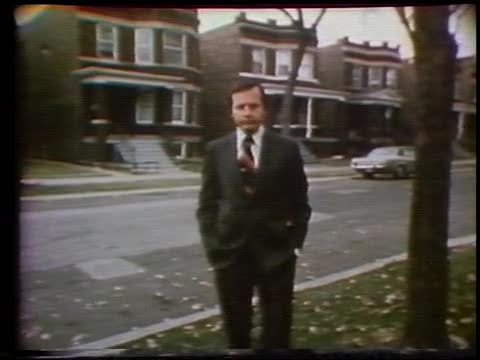
Out beyond the soaring, secular temples of commerce, before you reach the shopping centers of suburbia, the future of Chicago is being decided every day in less spectacular surroundings: in neighborhoods where drugstores and delicatessens, taverns, laundromats, barbershops, and small churches on tree-lined corners express a lifestyle in danger of extinction.
For the way the economic game is played these days, these neighborhoods hardly have a chance. There's a profit in moving people out and hang the human cost.
In the next half hour, we'll look at two Chicago neighborhoods where the neighbors are fighting back.
I'm Bill Moyers.
This neighborhood is obsolete.
The people who live here don't think so, but some of the banks and savings and loan associations do. They stopped lending money because they believe the community's deteriorating and the risk is too great. But without money to improve people's homes or to give them a chance to buy another, the decay speeds up and the fear becomes a self-fulfilling prophecy.
In this and similar neighborhoods in Chicago, people accuse the savings and loan associations and the banks of redlining. Redlining means an entire geographic area can be declared unsuitable for conventional loans and mortgages. A redline in effect is drawn like a noose around a neighborhood until for want of good housing the working and middle classes are driven to the suburbs and the neighborhood is left to the very poor.
A side effect of redlining is something called disinvestment.
You probably haven't heard of that term before. I hadn't until I came here. Disinvestment is a process of collecting deposits in one neighborhood and investing them somewhere else. The lending agents say it's necessary to spread the risk, but it leaves a neighborhood like this shorn of capital and hope. Gasping for its very life.
The people who could afford to, move on. And that's what the savings and loan associations would like to do. After they've helped to build up the suburbs and make them affluent and attractive, they want to move there, too, or at least to open a suburban branch. Only then does an old neighborhood like this discover where its money has gone, but by then it's too late.
MARY LOU WOLFF: This federal savings and loan is the largest savings institution in the state of Illinois. It's got over a billion dollars in assets. But it's the leading savings and loan that sets the tone for the rest of savings and loans that will not give us money for our neighborhoods. Okay? The savings and loan industry has get to take us seriously. We are not kidding around. It's a matter of life and death for our neighborhoods. We are through kidding around. This is war.
MOYERS: Mary Lou Wolff is the leader of CAP--The Citizens Action Program, coalition of Chicago neighborhood groups. Each concerned about redlining. Each determined to change investment policies of banks and savings and loan associations.
Bank officials are prepared for almost anything CAP will do but aren't prepared to meet them in public.
WOLFF: Therefore, the directors and their leaders at this savings and loan have decided that they're going to redline all of Chicago. Well, they're going to have to change their position, because we're going to be at their annual meeting in January to see that they do change their policy.
Now, to get our tickets to that annual meeting, we've got to open accounts today. Don't sign away your proxy. That is your ticket into the annual meeting.
What is your title, sir?
KENNEDY: I'm an assistant vice president.
WOLFF: Mr. Kennedy here is an assistant vice president, and he indicates that Mr. Fitzmorris, who I understand is another vice president....
KENNEDY: Senior vice president in charge of lending.
WOLFF: A senior vice president in charge of lending will meet with any three of us. I would suggest that we would like Mr. Fitzmorris to come down here and meet with all of us? (CROWD ASSENTS)
Would you go and get Mr. Fitzmorris?
MOYERS: It hasn't been easy to get a bank's attention, but the community people refuse to give up. They've even prevented one savings and loan from moving out of the area it was chartered to serve. This happened in the neighborhood of North Austin, where Jeanine Stump heads the local Citizens Action Group.
JEANINE STUMP: First time we went to Austin Federal, we had got a--kind of a suspicion that they had asked to move out of the community. Well, their main office also has an office in Bloomingdale. We went over there and met with the President, and he said, "Oh, no, I'm not moving. So we said, "Well, gee, that's funny. Where did we get that impression?
So we went down to the federal Home Loan Bank Board and got out the public records, and it said right in there they were going to move their main office to Bloomingdale.
So we started to have... (CROWD NOISES OVERWHELM)...going in and opening, you know, opening accounts, and you know, asking all sorts of nonsense... (CROWD NOISES OVERWHELM)...finally, it was announced that the federal Home Loan Bank Board had denied their application to move. They did put a branch in Bloomingdale. But their main office had better remain on North Avenue.
We're still going to keep up the pressure to say: We want to know where our money's going.
MOYERS: Gale Cincotta has lived in this South Austin house for the past eight years and in the area for twenty-two years. She's seen her block change from white to black, and she's watched the conventional money lenders flee with the middle class.
But Gale Cincotta has no intention of moving.
In Chicago, she is a key figure in a loose coalition of organizations, fighting to preserve the stability of their inner city neighborhood.
GALE CINCOTTA: Well, this is one of the FHA abandoned homes that, you know, you see that we're going to lose this one. We lost two down the block. We lost another two flats a couple of doors down from where I live, just like the one I live in.
MOYERS: Well, how did this happen?
CINCOTTA: The people buy the homes; they think that it's a good home because it says FHA, government-insured. But it only protects the money interests. So the people with lower down-payment buy a home; it could be in bad shape; therefore, you don't have enough money to keep it up; they lose their home; they lose their credit reference; we lose the home on the block, and the mortgage banker makes a lot of money, and the regular banker he couldn't care less, he just redlines the whole area.
It doesn't do anything.
MOYERS: Is this whole block here FHA?
CINCOTTA: The whole community; all of it is FHA. There's no conventional money for their mortgages, rehabilitation loans on the business strips; you can't get business loans.
MOYERS: And Gale Cincotta believes that's why communities die. She's seen it happen in the neighborhood where she grew up--Garfield Park, where this once fashionable hotel stands like an oversized gravestone among decaying houses and apartments.
Well, surely it died for reasons more than the indifference of savings and loans and the fact that a bank moved out?
CINCOTTA: The banks make a decision way ahead of time. They redline and cut off money to communities, and they make the thing happen. It's a longer process. It isn't like instantly overnight. They maybe make the decision ten, fifteen years ago to slow down on how many loans they give, but they still take money in from the community. And then they move out.
Now it's a funeral home.
This used to be a savings and loan association. We're at 5300 West. Madison Street is the east and dividing line in the city. We lost one--a bank, a big bank at Kinzie and Madison, 3200. We lost the bank at 4800 Madison. We lost the bank at 4000 Madison. We lost a savings and loan at 4200 Madison. We lost this one at 5300 Madison, and we don't have another one down Madison Street till you get to Oak Park.
MOYERS: The funeral home is rather..
CINCOTTA: Symbolic.
MOYERS: Symbolic.
CINCOTTA: Yes. Right. Right.
MOYERS: Without money for conventional mortgages and banks to provide it, a community is branded FHA. Only low income families can qualify. They may get housing, but the fate of the neighborhood as far as the money lenders are concerned is sealed.
CINCOTTA: This is almost all new. This was all empty land less than twenty years ago. They're all new one-family and two-family homes. The only difference in this neighborhood. This is--there's no conventional money; it's all FHA, you know, which is like insanity. It's a beautiful neighborhood. New homes. The whole area around here is new homes.
MOYERS: How does your neighborhood of Austin differ from what's happening in East Rogers Park?
CINCOTTA: Here you can see. Everything is FHA nonconventional. You can see the institutions that have physically moved. There is--the symptoms--the beginning.
MOYERS: What would you say to the people of East Rogers Park?
CINCOTTA: Fight like hell.
MOYERS: This is Clark Street in Rogers Park on Chicago's North Shore. the corner, Rogers Park Savings and Loan. A block away First Commercial Bank. Across the street, Mr. C.K. Restaurant. Both lending institutions denied the owner of the restaurant, Chris Karlos, the money he needed to remodel and open. Finally, he got a loan from a bank outside Rogers Park.
WAITRESS: And I'm ordering a cheeseburger deluxe and a bowl of soup.
KARLOS: All right. You got it.
MOYERS: Inside the restaurant I talked with a housewife who's co-chairman of the local Citizens Action Program, an accounting professor from Northwestern University, and a mother of four who went to seventeen savings and loan associations in trying to get a mortgage on a home within East Rogers Park.
:
WOMAN:
Eventually two out of seventeen did give us the mortgage on the house.
What did those who turned you down say?
Out of the rest of the group, one of them came out and said they weren't interested. And I had no objection. Because he came out, looked at the place and said he didn't want to mortgage it. I have no fight with that particular savings and loan.
The rest of the remaining fourteen asked you first the standard questions. told them that they were--that we had been homeowners, had owned and improved a home, that we had a good credit rating, the whole thing, and everything was going fine, until they said: Where is the house located. I told them East Rogers Park. And they said: We are not interested. Period.
MAN: I had the same experience. I was asking for twenty thousand dollars on a building that I could sell today for thirty-five. There doesn't appear to be any threat to the area in terms of continued stability. I think it was a policy.
MOYERS: A policy of not believing in Rogers Park.
ASSORTED VOICES: Hm hm.
MAN: Right. And that's when I didn't know the term, "redlining." The idea being to draw a red line around a section..
MOYERS: You know, I've heard that term a lot since I got to Chicago, but nobody can give me any evidence that it actually occurs.
MAN: One of the problems is that a lot of people never get into it. If they go through a real estate person, the real estate person will get the mortgage for them, and he'll contact the different savings and loans that are giving mortgages, and he might go, for example, to a part of the city that's very deteriorated, and to them, East Rogers Park....
WOMAN: Looks better.
MAN: ...is beautiful. So what you have, if you approach the problem just from the local perspective, Rogers Park can get mortgage money by going into uptown, Ravenswood, some of the other parts of the city where they'll give the money to Rogers Park, but we're getting it at the expense of the local people there.
WOMAN: Housing is critical in Chicago for families. So where do they go? They go out in the suburbs. And what's left back in the neighborhood are homes that people can't sell when they need to. If they need improvement, they can't get the money to. So then the area starts going down.
MAN: Rogers Park, it should be pointed out, was built for quality life style. And when it went up, the houses reflect good construction, adequate living space, six and seven room apartments, single-family homes that are nice, big, single- family homes, with yards, attention to the development of community life, churches, synagogues related to neighborhoods, parks....
WOMAN: Beaches. Parks.
...beaches, universities.
MOYERS: What the devil's happened?
MAN: Disposable housing. Throw away the old housing, and then we'll write it off, and we'll go to a new section, and then maybe we'll rediscover, like has happened in Lincoln Park.
this?
WOMAN: Come back in and rebuild. Urban renewal.
MOYERS: But how do you change things? How do you save a neighborhood like
MAN: Wait a minute; we don't have to save our neighborhood. We just have to keep our neighborhood. Our neighborhood hasn't gotten to the point where we have some severe problems. I think Rogers Park has identified the problem and is trying to prevent the consequences if a change isn't made.
WOMAN: We had a forum in May in Rogers Park of over three hundred people, and close to fifty stood up and said, yes, I had had that thing happen to me. I couldn't get a mortgage or I couldn't get a loan because I live in East Rogers Park.
So we want to reverse the trend. You do it through organizing in your neighborhood.
MOYERS: Pressure?
WOMAN: Pressure is what we had to use.
MOYERS: Last summer CAP demonstrated against Rogers Park Savings and Loan. part, because its presidents, J.N. Langworthy, was then also president of the Illinois Savings and Loan League. His son, Jim Langworthy, is vice president of Rogers Park Savings and Loan.
What about the complaints that your father doesn't believe in the community, doesn't really think it has a future, and that he's simply written off Rogers Park?
JIM LANGWORTHY: Well, I hope that was just rhetoric, to grab attention, because that is untrue. This institution has a substantial investment in Rogers Park. We can't live without Rogers Park. If the community goes down, we can't continue to exist that I see.
He cares about Rogers Park a great deal because this is the community in which we operate. I think I probably spend more time here than I do at home.
But, on the other hand, you cannot make any loan that in good conscience you don't think is a good loan.
MOYERS: What percentage of loans you make are made right here in Rogers Park?
LANGWORTHY: We have not completely broken it all down. It would be a long job.
MOYERS: But could you estimate so that....
LANGWORTHY:
It's probably about twenty percent in general.
MOYERS: Does that mean that eighty percent of the loans you make go outside of the area?
LANGWORTHY: The local community?
MOYERS: Yes.
LANGWORTHY:
You'd say that, yes.
MOYERS: How much of the money that goes outside of the local community is, in fact, deposits from the local community?
LANGWORTHY: I'd say, probably eighty percent of our deposits come from an area within five miles around our office.
MOYERS: Well, isn't that why they call it disinvestment? That is, you're taking the deposits of this community and helping to build up other communities while this community continues to decline?
LANGWORTHY: Well, hopefully, it will work in reverse from another institution, you know, within three, four miles of us.
I'd have to say that one of the elements of good mortgage underwriting is to spread the risk. If we were located in a northern suburb in a new community, a new suburb, we still couldn't put all of our eggs into the one basket.
MOYERS: Doesn't redlining take place in some parts of the city? Aren't there financial investors who simply decide this isn't where the future is and we'd better get out to the suburbs?
LANGWORTHY: Well, I can't answer that. I would just guess, though, that if that's their decision, rather than just kissing off that area, they have got to put some effort into a plan for providing adequate financing for the people who want to continue to make that area their home.
MOYERS: Ridge Avenue is the dividing line in Rogers Park. To the east new families are moving in. But old money is moving out. Low-income families, usually black, make moneylenders nervous. To them, such change equals lower property values-equals higher lending risks.
John Cullnan needed three thousand dollars to convert an existing front porch into an extra bedroom. Rogers Park Savings and Loan told him he could get a home improvement loan only if he remortgaged his house at a higher rate of interest.
JOHN CULLNAN:
I asked to see the president of the bank, who is J.N. Langworthy. He was not there. I was told that I could see his son, who is the vice president of the Savings and Loan Association. So his son came out, and I talked to him, and he told me that they were not making home improvement loans in this area.
And I've had my mortgage with this savings and loan for twelve years. It's not a matter of economics. I've never been late on a payment in my life. I was sick to my stomach. I just couldn't believe it, that this man is operating a savings and loan association in this neighborhood and that he doesn't feel that this neighborhood is worth being a community.
MOYERS: Do you feel this neighborhood is going down?
CULLNAN: No, sir. Not at all. I've heard people say that it is a changing neighborhood. I've lived here thirty-five years. I was born and raised in this neighborhood. I hear people say the word, "changing neighborhood, and that doesn't mean anything to me. I think a changing neighborhood can be good, and I think it is in this case.
MOYERS: Well, have you seen any changes?
CULLNAN: Yes.
But all for the better. I see different people moving into the neighborhood, and I like this. I like this. I think a community can be--can profit from different types of people being in a neighborhood.
MOYERS: You don't feel threatened at all?
CULLNAN:
Threatened? No, sir.
MOYERS: You don't mind your children growing up here?
CULLNAN: No. No. Not at all.
MOYERS: Martin and Marbry Realtors have an office in West Rogers Park that's headed by Vice President Sol Brownstein. He's privy to the attitudes of money lenders who refuse to give mortgages on the older properties in East Rogers Park. Is there any doubt in your mind that redlining exists?
SOL BROWNSTEIN: No question whatsoever about the business. They themselves will use expressions, such as: East Rogers Park is going down the drain and they don't wish to go down the drain with them.
A good example of that is a property that we had for sale north of Howard Street and there were twelve lending institutions who turned down a very, very qualified purchaser who wished to buy a very, very lovely three-room flat until finally the attorney for the purchaser said, look, don't buy it, because if they don't want it, you shouldn't want it, and this was a very qualified purchaser who was willing to make a fifty percent down payment and pay the highest rate of interest that was allowable by law. And they still couldn't do anything about it.
MOYERS: If you reached over to that telephone and called a local bank or a savings institution that you know of and ask for a loan in East Rogers Park, what would be the result?
BROWNSTEIN: Hysterical laughter. They can justify it....
MOYERS: Don't they have a stake in the community?
BROWNSTEIN: Obviously not. Their stake in the community is only the dollars that are coming in. What stake would you say they had in the community? They might own the--they might own the building that they're in, but other than that, they're not concerned financially with the community.
MOYERS: If a community dies around them?
BROWNSTEIN: So they take themselves up and move somewhere else. Just like automobile dealers do.
MOYERS: Irving Katz is a druggist who's been doing business in Rogers Park for twenty-three years. He bought and is renovating this apartment building because he has faith in the future of the area. He soon found out that some local banks didn't share his faith.
IRVING KATZ: I went through the bank that I was doing business with, that I had my store business with and who I had my personal accounts with.
MOYERS: What happened?
KATZ: They offered me a token amount of what I needed.
So I went over to the Devon Northtown Bank, and I have an account there with my parents. They told me that they would not invest in Rogers Park.
MOYERS: Would not?
KATZ: Would not. They had no interest in East Rogers Park. As far as they were concerned, it was off the book.
MOYERS: Well, if you could gather all of the bankers from Rogers Park in this little courtyard and speak to them, in a word, what would you say to them about it?
KATZ: I'd tell them to have faith in the neighborhood that they were doing business with because this is what--exactly what I had. I had faith in the neighborhood, and then I felt that I wanted to return to the--to the neighborhood what I'd taken out of it. For twenty-three years.
MOYERS: Seventy-first Street in South Shore was the fashionable shopping strip outside downtown Chicago. But that was twenty-five years ago.
Now it's proof of a modern truism. When small businessmen lose faith in an area, its deterioration is hastened. When lending institutions lose faith, its decay is virtually assured.
In August 1973, the South Shore Bank was sold after an attempt to move out of the community was denied by the comptroller of the currency.
The new owners want to operate South Shore Bank as a force for neighborhood redevelopment.
To carry out their detailed plans, they'll need approval of the Federal Reserve Board. But already the bank has become more aware of community needs through President Milt Davis and Chairman Ron Grzywinski.
GRZYWINSKI: As we all know, we live in a democracy and that banks and savings and loans are the custodians of the people's money and, as they're the custodians of the people's money, they should not be embarrassed, they should not be bashful about telling the people where they are investing those funds. If they have a good reason for investing them outside of that neighborhood, then they should be able to document that reason and they should be able to convince their depositors that that's good judgment on their part.
One of the things that we've all forgotten is that banks and savings and loans in America are chartered for the need and convenience of the neighborhood and that the bankers, the people who manage banks, the people who manage savings and loans, should find ways in which they can put those resources to work.
MILT DAVIS: We still feel that being a commercial bank working in conjunction with other groups, associations in the community who have the resources, can perhaps turn these things around.
GRZYWINSKI: We do not feel that we can wait for the government to take the initiative. We feel that we are the managers of a major institution in South Shore and that the people expect this of us. They expect us to work in their best interest. They not only expect us to maintain the safety of their deposits and to earn good interest on those deposits but they also want us to work to improve their neighborhoods.
MOYERS: Inner city neighborhoods need all the help they can get in order to compete with the growing suburbs. The big money lenders in America are backing suburbia. Not only do they follow the market; they help to make the market.
The world's largest shopping center--Woodfield Mall--is still expanding in the far northwest suburb of Schaumburg, Illinois.
As sure as housing developments will replace corn fields, the middle class will leave the inner city to move here.
This is the new home office of First Federal of Schaumburg, still under construction, but sure of its future.
It used to be known as Laramie Federal Savings and Loan. In order to move to Schaumburg, it had to agree to keep a branch at its old location in Austin on Chicago's West Side.
It obtained permission for its move and name change from the Federal Home Loan Bank of Chicago, which regulates federally chartered savings and loan institutions.
John Stipp is president of that agency; the vice president and counsel is Albion Fenderson.
One thing that the community groups tell me that they want is disclosure. They want to know how much of a savings and loans company's investments are being made in that particular neighborhood.
ALBION FENDERSON: The only deterrent, as far as we here are concerned in the Federal Home Loan Bank and as agents for the Federal Home Loan Bank Board, is that, number one, that associations are not required by law to make those disclosures. And secondly....
MOYERS: Would it hurt them if they were?
STIPP: I don't know that it would. I don't know that it would. I don't know that it wouldn't. The only thing that I know is that neither the Federal Home Loan Bank Board or this bank has the legal authority to require the institutions to do it.
Now, I think you probably know that we have asked them on a purely voluntary basis to give us the information.
MOYERS: Are they willing to make disclosure?
STIPP: They're willing to make disclosure as a group but not on an individual association basis.
And I would not expect associations ever to voluntarily on an individual, institutional basis say, we have so much deposits from this zip code area, and we've made so many loans in here.
MOYERS: Now, what's your objection to that?
STIPP: Because then some other association over here that happened to have more money or more loans in that same zip code could be held up as a great example of this one and there would be pressures that there may be very many other reasons why this association didn't have as much of one or the other as this one. A good valid reason.
FENDERSON: I don't believe there's been any conscious decision in any given area to draw a line around it and to say that we just will not even consider a loan in that area.
MOYERS: You don't think there is something called redlining?
FENDERSON: There's something called redlining, but it depends on your definition of redlining. If your definition is that you have made a judgment based on economic factors, on the normal factors of why you make a loan or you don't make a loan, and then you make an intelligent and sound decision on that, I would not call that redlining.
MOYERS: What is it that causes a neighborhood not to be premium?
STIPP: Well, it would be that the general character, credit character of the neighborhood itself--and over a period of very few years an experienced loan officer will have a feel as to the probable ability of most people in that neighborhood to repay a loan commitment.
MOYERS: Isn't that redlining by another name?
STIPP: You have to define the term redlining.
FENDERSON: I don't think these catchphrases help us any. You know, we have to get--to the factual.
MOYERS: The economic reasons for the deterioration of our cities are so complex that even Congressmen who write the federal housing and banking laws barely. comprehend them.
But the banking, real estate, and lending lobbies understand and so do the men they work for, who, from the safety of distance declare a neighborhood like this obsolete.
So it happens that laws intended to solve problems wind up helping the people who profit from those problems.
So it is that while we Americans yearn for stability in our community and family lives, we pursue investment policies that destroy the traditional values we publicly venerate. The price tag for this hypocrisy is high.
Everyone blames someone else. But about the only people who are really trying to do something about it are the victims themselves, people who've been labeled poor or minority or ethnic or who have simply been ignored.
They're tired of being kicked around.
Some of them who live in this neighborhood recently dedicated this mural, to commemorate their success in breaking the grip of the slum landlord. The message is clear.
As Gale Cincotta put it: "Fight like hell.
I'm Bill Moyers.
- Series
- Bill Moyers Journal
- Episode Number
- 134
- Episode
- This Neighborhood is Obsolete
- Contributing Organization
- Public Affairs Television & Doctoroff Media Group (New York, New York)
- AAPB ID
- cpb-aacip-2969b4e1cb3
If you have more information about this item than what is given here, or if you have concerns about this record, we want to know! Contact us, indicating the AAPB ID (cpb-aacip-2969b4e1cb3).
- Description
- Episode Description
- An examination of two Chicago communities locked in a struggle with their local savings and loan associations. Though the citizens of Austin and Rogers Park were determined to make their declining neighborhoods viable once more, they were encountering stiff resistance from the banking community. Bill Moyers examined banking policies which, he said, contribute wittingly and unwittingly to neighborhood decay in Chicago and throughout the rest of the country.
- Series Description
- BILL MOYERS JOURNAL, a weekly current affairs program that covers a diverse range of topic including economics, history, literature, religion, philosophy, science, and politics.
- Broadcast Date
- 1973-12-05
- Asset type
- Episode
- Genres
- Talk Show
- Rights
- Copyright Holder: WNET
- Media type
- Moving Image
- Duration
- 00:28:55;29
- Credits
-
-
Campbell, Marrie
Varas, Larry
McCarthy, Betsy
Karnes, Beth
Editor: Moyers, Bill
Editor: Dietch, Edward
Executive Producer: Toobin, Jerome
Producer: Weinberg, Howard
Production Manager: Hill, Randall
- AAPB Contributor Holdings
-
Public Affairs Television & Doctoroff Media Group
Identifier: cpb-aacip-1ae9bb0c9e3 (Filename)
Format: LTO-5
-
Public Affairs Television
Identifier: cpb-aacip-e798de9fae8 (Filename)
Format: U-matic
If you have a copy of this asset and would like us to add it to our catalog, please contact us.
- Citations
- Chicago: “Bill Moyers Journal; 134; This Neighborhood is Obsolete,” 1973-12-05, Public Affairs Television & Doctoroff Media Group, American Archive of Public Broadcasting (GBH and the Library of Congress), Boston, MA and Washington, DC, accessed April 16, 2026, http://americanarchive.org/catalog/cpb-aacip-2969b4e1cb3.
- MLA: “Bill Moyers Journal; 134; This Neighborhood is Obsolete.” 1973-12-05. Public Affairs Television & Doctoroff Media Group, American Archive of Public Broadcasting (GBH and the Library of Congress), Boston, MA and Washington, DC. Web. April 16, 2026. <http://americanarchive.org/catalog/cpb-aacip-2969b4e1cb3>.
- APA: Bill Moyers Journal; 134; This Neighborhood is Obsolete. Boston, MA: Public Affairs Television & Doctoroff Media Group, American Archive of Public Broadcasting (GBH and the Library of Congress), Boston, MA and Washington, DC. Retrieved from http://americanarchive.org/catalog/cpb-aacip-2969b4e1cb3
- Supplemental Materials