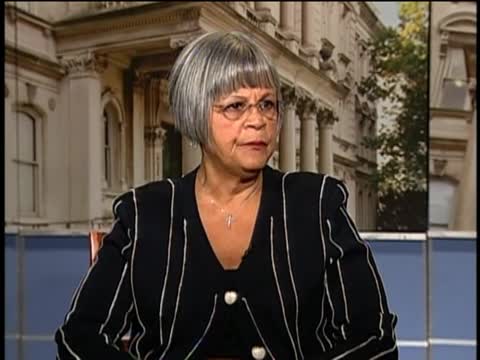
On the Record; #2627; 2627: Bonnie Watson Coleman/ Kean Byrne
- Transcript
From your funding for on the record is provided by KSC and GE, committed to serving customers strengthening the business community and investing in New Jersey's future. With major funding provided by, the Fuel Merchants Association of New Jersey and the National Oil Heat Research Alliance, committed to saving energy and the environment. Today's oil heat, intelligent warmth for your home. Promotional support provided by New Jersey Business Magazine, the Magazine of the New Jersey Business and Industry Association. Reporting business news from more than 50 years, reaching over 28,000 businesses statewide. Every year in New Jersey, 14,000 adult inmates and 1600 juvenile offenders are released from state correctional facilities. For many of them, it wasn't their first incarceration and it won't be their last.
As many as two-thirds of those released adults and a third of the juveniles will be incarcerated again within just two years. And as if the human toll weren't high enough, the toll on taxpayer dollars is also steep. More than a billion dollars is spent each year on confinement. Leading the charge to address the issue with a package of proposed reforms that themselves come with a price tag, some see us too high in these hard times, is the outgoing assembly majority leader, Bonnie Watson-Colman, who's had some wrenching personal experience with the criminal justice system herself, and who is our guest this week, and assemblywoman, thanks for coming in. Thank you for having me. And Bonnie, I made reference there to your own wrenching and I might add heart-rending experience with the system involving your two sons, William Watson and Jared Coleman, now in their late 20s. They served five and a half years for an armed robbery committed at a Mercer County toy. Kids are us back in 2001. Now on parole, they're both moving on with their lives in positive directions, yes? Absolutely.
How did your experience there as a mother inform your work on these reforms? Well, to some degree, having seen some of the conditions, having listened to some of their concerns, having answered their telephone calls, that had surcharges on them. So obviously, some of it informed me so that when I took on some of this work, I had some personal knowledge. But my interest in the area actually happened before either one of my sons got into any trouble. When I first entered into the legislature, I tried to restore the voting rights for individuals who were on parole and probation. Were you successful? Nope. Nope. Why not? Because I think that people are very reluctant to do anything that appears to them to be soft on people who have broken the law, and they are, I believe, very parochial, very pennywise and pound foolish, very uneducated.
Just like to say this to some of our viewers who may not know you or know your history, because I knew your father before I knew you. Your father was chairman of the Assembly Appropriations Committee if I'm not mistaken. Yes. John Watson. So a long time, upstanding family in this area, if you will, something that Judge Charles Deli, he mentioned when he sentenced your sons. I remember reading it in the paper at the time. He gave them a tongue lashing for hurting the name of your, the good name of your family. And so this is, you're not the kind of family that people would typically figure would be in this kind of situation. Well, apparently I am representative of families that go through this situation. And you're absolutely right, my sons came from a very strong family background. My sons were just lost in making the wrong decisions at that time. And there are other people that are incarcerated who are good people who've made the wrong decision along the way, some of whom deserve to be incarcerated, others of whom need to be treated, monitored, and held accountable in a different setting.
And so this body of work that I have engaged in over the last year and a half or so addresses some of those issues. And why don't you tell you, tell us how it does that. And also I'll note that you had a year or so of hearings on this, right? Public hearings throughout the state before you put the package in or? Yeah. We started out with a listening session with stakeholders, members of the ACLU, the Institute for Social Justice, the John Swats and Institute of Public Policy, associated with Thomas Edison College, volunteers of America, the drug policy alliance, a whole host of organizations and entities that had a stake in this, had frontline experience. And we listened to the kinds of things that we should be listening to and trying to find out about as we were going to engage in the statewide hearing tour. So then we engaged in seven hearings across the state of New Jersey, generally speaking in the evening and the afternoon so that anybody could come.
We heard from academics, from nonprofits, providers, families of incarcerated individuals, formerly incarcerated individuals, clergy, any host of people who are trying to respond to the system, make the system more responsive to the needs of not only those who are incarcerated or who encounter the criminal justice system, but even the taxpayers and the citizens who are also impacted. And this was an assembly committee that had this set of hearings or an ad hoc committee that you chaired or what was it? It wasn't ad hoc committee. I called it counting the costs. Republicans and Democrats. I chaired it every legislator in both houses was invited to participate. Counting the costs, you called it. Counting the costs, because I thought that it was important that we focus not just so much on the social justice aspects of reform here, but look at the costs associated with the services that are delivered with the incarceration and with the impact on both the state revenues and family structures and consumer ability and all that kind of thing.
One way, and I also heard it called second chance, or was that the legislation? Is it dubbed like a second chance like this? Well, the whole notion of looking at these reforms and recognizing that just about 95% of those going into prison come out of prison, the notion of second chance just means that we need to address that host of people that are exiting the system. All right. And one way to get to people is by talking about the pocketbook. I'm sure you're aware of that. I read an op-editor's in the star ledger last week, I think it was, and you talk almost primarily about the pocketbook, although you do talk about the toll on families. So tell us what this package of reforms would do and how, in your mind or estimations, it would lead to some savings, what those would be. Well, first of all, the goal would be, as Tuprong, it's first of all to ensure that people who go through this system go through it in such a way that when they come out, because
they are going to come out, they're ready to enter society, find a job, become a part of a family, become a part of the community and not recidivate, not go back into the system as 65 to 70% of those who are being released do. The other part of this reform initiative is to look at who's actually going into prison, whether or not there are alternatives to incarceration that costs somewhere between $40,000 and $50,000 per individual, that has the individual health accountable, that if there is a mental health issue, has that issue addressed. If it is a substance abuse issue, has that issue addressed and provides the individual, the opportunity to still work, to still participate in his family or her family structure and be a part of the community. So on the one hand, you try to keep folks out of prison by doing other things to rehabilitate people and pay their debts. And on the other hand, you're ready to get to- Try to prepare people to come out by ensuring that they're being educated and trained and
that behavior modification won't bother in so that when they do come out, they can find gainful employment, they have marketable skills, they have the right behavioral situations so that they can rejoin their families, that they can become a part of a productive part of a community and citizens who then have jobs, pay taxes, and are consumers. I read in some of the legislation here, I think you said people shouldn't be allowed, inmates shouldn't be allowed to say, I'm not going to get a GED, I'm not going to do this, I'm not going to do that, force these folks to ten classes to prepare themselves. And the corrections department needs to be more engaged in that area and commit resources there. Over the last ten or so years, the Department of Corrections has consistently reduced this education budget, less than 2% of the money that is spent from the Department of Corrections is used for education or vocational. Which is your age, just told us, $1.2 billion on a budget, less than 2% of that is education
of vocational. Exactly. So there are individuals who, A, want to have access to education or GED or some kind of vocation but can't because they're not enough courses offered, or B, their individuals say, no, I'm just going to set it out through my time and then when I get out, I get out. And those are the individuals that get out and come back. So we believe that if you provide greater opportunities for education, greater opportunities through job skills, greater opportunities through counseling, behavioral modification, all kinds of rebuilding, rebuilding, who you are and what you are in your role in society, that the end of the day, we send people out into the communities that are ready to join the community. And we save the state of New Jersey. If we just reduced the recidivism rate, 1%, that's 23,000 or so people in the system, it's just reducing that recidivism rate, which is 65% of those coming out.
By 1%, we're saving like 1.3 million dollars the first year alone. And also you, well, I'll just state for the record because I don't want time to run out before I get to ask you some of the oppositional questions. So I'll stay for the record that, and we maybe have moments to get to some of this. You also would allow inmates to have food stamps, there would be job application rights where they wouldn't have to say what their crime was in certain areas of government and things like that. You can maybe get to those when we have time, but I also want to get to the cost thing from the other side. The minority statement on one of these bills from Assumament, Brahminic and Rival, both through publicans, quote, this bill falls into the category of legislation with worthwhile public policy intentions on the part of the sponsor, you, but one which will create additional costs for the state budget at a time when the state simply cannot afford additional spending. They go on to say, for this reason, we cannot support the advancement of this legislation
at this time due to its budgetary impact. Well, the budgetary impact, right now the bills are being adjusted. We're being revised to get as budget neutral as possible. But originally speaking, the budgetary impact was nominal. We're talking about, if we eliminated the surcharges, those unconscionable taxes on poor people, minorities and women. There's collect calls out of prison. Collect calls out of prison. That the state reaps how much we have. We've the benefit from somewhere about $4 million. If we eliminated the surcharges, that's $4 million. If we went to the lowest responsive bidder, that saving money, that's not money the state should have had in the first place. That's unconscionable. It is the tax on the poorest of people and mostly minorities and mostly women. If we educated and required these individuals to be educated, it would have been a nominal cost, maybe $12 million at the most.
Couple. So we're talking about a $1.3 billion budget for corrections. We're talking about a $33 billion budget for the state of New Jersey. But recognizing that people will use this as an excuse. We're trying very hard to ensure that when people leave prison, they don't just max out and go out because those are the ones that generally come back in. So we're trying to require community residences as a transition back into the community. When you do that, let me just finish this point. When you do that, you save thousands and thousands of dollars per inmate. Well, we want to take that money that you save and dedicate that to the education and vocational training of those that are inmates in the system. It makes it budget neutral and it eliminates the excuses that people have for not supporting this legislation. And you know the incoming governor, Chris Christie, has said he used this package of bills. In fact, as an example, several weeks ago when he was blasting the Democratic control legislature for advancing things that would cost money, he used this package of bills as
an example. And he said basically that this was against the will, moving against the will of the voters. So sort of a two-part question on the one hand, what do you say to that? And why wait until the waning days anyway? Why couldn't you, four years, majority leader? Why couldn't you do that? Let me just issue the statement with regard to the first part. If in fact the research holds out that we are incarcerating people longer. We are incarcerating people in New Jersey like unlike other states. And we are not in any way impacting in a positive way public safety. So public safety is costing us more as well as incarceration is costing us more. I don't know how the governor-elect could have led to that conclusion that this is a reckless spending. But in fact, it saves not only money for the state of New Jersey, but it saves community. We've heard that from you. We're running out of time. I just want to get from you. Four years, majority leader, why wait until the lame duck in 30 seconds? Well, I was working on this legislation.
I was working on this information for over a year. We had nine months worth of hearings. We had to get legislation together. We had experts in, like Nicholas, cats and back, and doctors and people from outside of other countries. What does that look like? Might you get a pass, do you think, in these last days? I'm very hopeful that we will get a pass if people recognize that it saves money and it is the right thing to do. All right. It's something a majority leader. Thank you for coming on. We do appreciate it. May you have a happy new year. Thank you. Thank you. And now to take us for a look back at the year 2009 in New Jersey government and politics through the impressions of former governor's Tom Kane and Brendan Byrne is Kent Manahan, former senior anchor of NJN News, current chair of the New Jersey Public Broadcasting Authority, and a voluntary contributing reporter here can't recently sat down with the two governors to get their take on the past year, as well as the upcoming transition to the Christie administration in Trenton. Some pretty exciting times ahead in New Jersey in the year 2010, a governor's leaving office after one term, a new governor will be inaugurated.
Governor Byrne, your thoughts on John Corzine's legacy in New Jersey? Well, a lot of us like to say is that you can't really buy happiness. And I think he bought elections and he's suffering from both the ends of having bought an election. He probably wasn't cut out to be a governor. And I don't know what it takes. You don't? And suddenly it doesn't take much. But I don't think it really had it. Governor Kane, your thoughts on John Corzine and where he sits in your estimation in the pantheon of New Jersey governors and New Jersey governors since the 1947 Constitution, which greatly extended the powers of the Office of Governor. He's a very nice man who never seemed to connect with the people of New Jersey, no matter what he did.
His signature program was that big thing to try and sell the New Jersey 10 pike and use the revenues to help with the deficit. Now they've got a single vote in the legislature, including one single member of the leadership. That was his major effort, I think. So he didn't get a lot done, but that's a shame because he's a nice man, wishing well. But to the warning here, I think, for the future, because the legislature today, compared to my time, is much more sophisticated, they have much more information available to them. They do much more of their own research. And so you're going to find that no matter what a governor proposes, it's going to be a gamut carefully by the legislature, and it's going to be a policy if the legislature doesn't completely agree to it. Well, I got a huge staff in the legislature, I mean, really, it's a one thing hasn't been cut, and in fact, it's been increased.
And so they can compete right with the governor on the budget research on any program he comes up with. They have specialists in various areas, they have a full partisan staff for both parties. So, you know, Governor Christie's going to be cutting staff, I'm not sure the legislature will. Governor Christie will be inaugurated on January 19th, and certainly he's a governor coming in to office with a very different philosophy than the current governor. Your thoughts on where he'll get started? What can we expect from Chris Christie? Well, first of all, Chris Christie has this huge, you know, elephant in the hallway, which is, which is the deficit, ironically, elephant. I think he's going to have so much trouble with that, if he was, if he's going to handle it right.
I mean, Christie can do one of two things. He can try to dodge it by minimizing and papering over, or he can face it ahead on. I think he's going to face it ahead on. I think he kind of guy really wants to, he went out to get this job. You got it. I think he wants to make his mark. So, where will he start, Governor King? He's got a real problem because what people don't recognize is his coming budget isn't his budget. The budget starts being formed in April, really, and goes right through it. So, it's John Cozine's budget, so he's really stuck with John Cozine's budget for the next year. And an anticipated gap of up to a billion dollars in the current fiscal year. And the current fiscal year. So, he's got to make cuts in areas in somebody else's work, which is more difficult. If he can start from nothing, as he will next year, you can do the budget. It's difficult, but you can do it. But you need to start with somebody else's budget, and I have to start cutting it apart when you want the ones to make the decisions to begin with.
That's very, very difficult, but he's got to do that. I mean, he's got, you know, he's constitutionally required to bring this thing into balance, and Brendan's right, past governors, not just Cozine, but past governors, last number of years, have paped it over. And that's why we've gotten into this real problem. They've paped it over. They borrowed money when they should have done ongoing resources, and he's got to, all this comes down on him. And I think he's going to be courageous, and I just hope the legislature will go along with it. Well, the governor-elect says that if he can't accomplish what he says he'd like to do in two years, and he talks, namely, about changing the rules with public employee agreements and hikes and teacher salaries and tax reform, he says he'll call a constitutional convention in two years to change things in New Jersey. Is that likely to happen, Governor Byrne, and is it a good idea? Well, I don't know, I can't do it. Constitutional convention isn't going to do much. I mean, we need money.
We need money. That's the bottom line, and to say I'm going to call a constitution to do what, to raise money, to raise taxes. He's got a job to do, and he's got to do it, and he's going to take some consequences, and I think he's going to have the courage to do it. Okay. Can he change the system with a constitutional convention, a good idea? I've never been. The constitutional convention is just going to fight with each other. You're going to point a lot of people, and they're going to start getting into them. Be like another legislature. We don't need that right now. Now I think, like a family, it's just overexpended its budget, and it's not enough income coming in, and you borrowed, and borrowed, and borrowed, and now the banks won't give you any more money. So what do you do? Do you sell a house, and move into a smaller house? Do you take your kids out of private school, put them in public school, what do you do? Do you really get, you're not going to eat as well, you're going to do everything you can to get that family back in shape, and that's the job New Jersey has, and it's not only
the New Governor's, it's the legislatures, and they're the ones really who voted for all this stuff to begin with, so they're going to have to start cutting back, too, and hopefully I think go along with the New Governor, and some of these things, which are going to be tough politically. Well, you mentioned the legislature. And there's no point in just blaming Corson and trying to get out from there. Do you think he'll do that? Well, he just did it. I didn't. You said that this is not his budget, this is... That's right. That's true. Oh, that's blaming Corson. I had your budget, I never blamed you. Maybe. Maybe perfectly accurate to blame him. But that's not going to get you any more. No, there's a lot to blame Corson for, but that's not your right. He's got the move on from here, but the first thing the state's got to realize is how bad the situation is. It is. And I think we all realize it, like the political class, realize that I'm not sure the people who have New Jersey realized it yet. And the first thing he's got to do is spell that out. I also think that Democrats behave better with Republicans than Republicans behave with
Democrats. Well, I've heard both of you say that, that a governor of one party with a legislature of another is often an easier way to do things, and certainly you were faced with that. No, no, no, no. No, no, no, no. Democratic, it's a Democratic, legislative gets along with a Republican governor. Is that the way it is? Okay, let's see the way it is. We go along very well with you. Yeah, because I didn't need you. Well, that answers that. Yeah. Let's get back to the legislature, though, because the lame-duck legislature meets again in early January after the holidays, and one of the issues that could be taking taken up, gay marriage, how likely is that to happen in your estimation? Yeah, I suspect it's not going to happen. Because there are the votes among the Democrats. What we're seeing, what we're seeing is just reading newspapers and so on, is that there's
a reluctance to move that bill. And if there's a reluctance to move it, it's not going to be more than if it's not moved in the lame dark. It's not going to be more. Period. Would you agree? That's a shame because, look, this is something the gay community feels very, very strongly about. They were promised it four years ago. You know, the Democratic legislature and the legislature as a whole and the governor just never wrote it up until now. You don't bring things up at the end of a term in a lame dark session. This or anything else. You know, the lame dark should crack and go home. I mean, the voters have spoken again. There's a new day coming. And they shouldn't be doing all this stuff in lame dark. It's just not in a public interest. You know, trying to put through a whole bunch of appointments. They've got three or four other major bills they're trying to get through. And, look, let's wait until January and do it then. Can I ask you each for a prediction in 2010, Governor Burn? I think 2010 is going to be a turnaround year. I think it's going to be an encouraging year.
I think this governor is determined to do the right thing. I think he's going to do it. Governor Burn? This is a crisis. And that gives us what chance to do some unusual things, to really restructure things, to look again at ways in which you could really put the state on a different path. And so, I'm encouraged. I'm encouraged by the kind of things the new governor has set up to this point. If he can carry out with some of those things he's talking about. And if the legislature will go along with him, I think we could have a very good year. And a year this will go down in New Jersey history. Governor Burn and Kane, we enter a new decade in the 21st century. And we've been doing these meetings to ask for your predictions for the new year for about the last 15 years or so. So, very happy new year to you and your family. And to you. And to you, very much so. And to those of us. Thank you. Former governor is Brendan Burn and Tom Kane sharing their thoughts with Kent Manahan. And that's it for this week's edition of On The Record.
For more on New Jersey politics and government, be sure to watch reporters round table with Michael Aaron. That's Friday nights at 7 and Sunday mornings at 10 or on the web at NJN.net. And that's it for us here. I'm Jim Hooker. Thanks for watching. And from all of us here at NJN, we extend our best wishes to all of you for a happy 2010. Premier funding for On The Record is provided by PSE and GE, committed to serving customers strengthening the business community and investing in New Jersey's future. With major funding provided by the Fuel Merchants Association of New Jersey and the National Oil Heat Research Alliance, committed to saving energy and the environment. Today's oil heat, intelligent warmth for your home. Promotional support provided by New Jersey Business Magazine, the Magazine of the New Jersey Business and Industry Association. Reporting business news for more than 50 years, reaching over 28,000 businesses statewide. Thank you.
You You You
You You You
You You
You
- Series
- On the Record
- Episode Number
- #2627
- Producing Organization
- New Jersey Network
- Contributing Organization
- New Jersey Network (Trenton, New Jersey)
- AAPB ID
- cpb-aacip-259-qv3c325d
If you have more information about this item than what is given here, or if you have concerns about this record, we want to know! Contact us, indicating the AAPB ID (cpb-aacip-259-qv3c325d).
- Description
- Episode Description
- No Description
- Series Description
- No Description Available
- Broadcast Date
- 2009-12-30
- Created Date
- 2010-01-03
- Media type
- Moving Image
- Duration
- 00:32:01.820
- Credits
-
-
Producing Organization: New Jersey Network
- AAPB Contributor Holdings
-
New Jersey Network
Identifier: cpb-aacip-fc2a7c226c6 (Filename)
Format: MPEG IMX
Duration: 0:27:00
-
New Jersey Network
Identifier: cpb-aacip-38135f398ab (Filename)
Format: MPEG IMX
Duration: 0:27:00
If you have a copy of this asset and would like us to add it to our catalog, please contact us.
- Citations
- Chicago: “On the Record; #2627; 2627: Bonnie Watson Coleman/ Kean Byrne,” 2009-12-30, New Jersey Network, American Archive of Public Broadcasting (GBH and the Library of Congress), Boston, MA and Washington, DC, accessed April 4, 2026, http://americanarchive.org/catalog/cpb-aacip-259-qv3c325d.
- MLA: “On the Record; #2627; 2627: Bonnie Watson Coleman/ Kean Byrne.” 2009-12-30. New Jersey Network, American Archive of Public Broadcasting (GBH and the Library of Congress), Boston, MA and Washington, DC. Web. April 4, 2026. <http://americanarchive.org/catalog/cpb-aacip-259-qv3c325d>.
- APA: On the Record; #2627; 2627: Bonnie Watson Coleman/ Kean Byrne. Boston, MA: New Jersey Network, American Archive of Public Broadcasting (GBH and the Library of Congress), Boston, MA and Washington, DC. Retrieved from http://americanarchive.org/catalog/cpb-aacip-259-qv3c325d