Judicial Retirement Claude Coleman; Jud. Retirement Claude Coleman
- Transcript
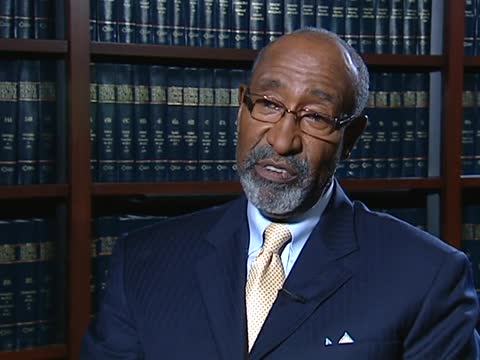
Judge Coleman, you are not only do you look good but you feel well and you are sharp as ever and obviously able to continue to work and yet you have been in a sense, we know you're coming back on recall but in a sense put out to pasture by an arbitrary number. How do you feel about that? Well let's say I don't feel bad about it, first thank you for the compliments but I've always worried about going too long as whether you would be able to really enjoy your retirement and of course I realize now that we are living longer, we are much healthier than we were previously and there's been a lot of discussion about raising a retirement age, I think there's even a bill pending, they're talking about raising the retirement age and they're talking
about doing it in social security and other pensions so I see nothing wrong with that. With raising the age? With raising the age, I think perhaps it should be raised but I would still caution those who are talking about that, I would say really we should keep a mandatory physical check up, physical and mental check up that goes along with that, I mean if a person really did want to go on after 70, I would suggest that he'd be allowed to do so if he so chooses but at the same time I would say that that person should have a physical check up, I just went through one of those myself and I found it would be very rewarding and you do find some things about yourself, not all of us who are 70, you say I look well, I'm healthy, I'm lucky in that respect but not all of us who are 70 are doing well and we sometimes we don't know it, we start to lose our hearing, our memory starts to slip and these things
start to happen to us, we're not ready to admit it because we want to keep working and so I think we should be allowed to do that up to a certain point given what I've said before, people are living longer and they are healthy and they were previously and I think it's important too that we extend the retirement age but I think there should be something to be sure that the person who's going to stay on after they're a 70 is capable of doing so. So would you have an annual check up? No, I would have a check up at 70, at 70, now the retirement age and if he chooses to go beyond that, well no I would move it up to 72 or 75, I wouldn't extend it beyond that. So the legislation that's pending now would be to change it to 75. Okay, I would agree with that, I mean you would not just allow someone to continue to 75 without that check up at 70. Without a check up at 70, I wouldn't allow that to happen. I think it's important because as I said before, although in general we all are healthy
and we're living longer, it's not without some problems, we have it back problems, we have it arthritis, we have it mental problems and hearing problems and these things can be brought out, at least it's said that they can be corrected, you know, you may be having a hearing loss that can be corrected with a hearing aid but you won't realize it. Until you get the check up, you know, and there may be other problems that you don't realize until you get that check up. So I think that check up is very important to be sure and it's important too, from the public's point of view too, in a sense that they know that this judge, even though he's allowed to continue, he's capable of doing that. He doesn't suffer from any mental problems or any physical problems that we keep him from performing his job because some of us would stay on that job, you know, for a very long time. And we would never reach out. As we see on the federal bench. Exactly.
On the U.S. Supreme Court. That's exactly right. I mean, we would say there, as long as we could, coming to work until the very last minute. So I think there should be some check yet, just to be sure that the public is getting this money's worth. Even you weren't ready to go entirely. I wasn't ready to go, but I didn't, I said, I didn't hate the possibility. But when offered recall, I came back on recall, yeah, I did come back on recall. Well I was, I was really talked into it. I hadn't considered it before then, but I was talking to it and then the incident that wanted me to come back on recall, they missed a lot of judges and right now, whatever the political landscape is, they're not appointing a lot of judges to fulfill those vacancies because we're doing bad down there. And so, given an opportunity to come back, and since I hadn't decided on what I really wanted to do, I really had thought about teaching at some of the colleges or getting more
active in some of the boards that I'm involved with. But since I hadn't decided on that, and the conversation geared towards me coming back on recall, I said, well, yeah, okay, I'll do that. But it's only for two years. I'm coming back on recall for two years, and after that, I have to make another decision. And could theoretically be on recall till 80? I could theoretically. But I'm not. I don't know. No. No. No, I'm not. I'm not going to be a recall until 80. No. 72, you think you're going to be ready to stop? I think I will be. To stop judging, yes. Yeah, I think I want to try something new, and by that time, this will give me just enough time to kind of ease out of the judiciary. When you're on recall, this is not a full-time job. No, it's not a full-time job. It's the best part-time job you have, as I said before. Being a judge is the best style of work you'd have.
It'd be a part-time job. You see, if it better, you know, you work more or less when you want to. You take your vacations more or less when you want to. And so it's a great deal of freedom. It allows you to do what you love knowing, but at a reduced pace. So recall is more time for tennis. More time for tennis. And the gym. And the gym? Bike. Golf. And of doing the golf thing, so. What about the argument that I think I'd even heard from you about the need to bring in new blood, and that if you don't force people to retire, they will stay longer. And then you won't have as much new blood coming in. Well, that's a good argument. You're right. I have made that argument. I think there is a need to bring in new persons, give other people, younger people a chance of becoming a judge. It's a good job. And that's why I said, I'm not opposed to extended it, but I would like to have that physical check-up there, the physical and mental check-up just to be sure that the judges
capable of doing it. And I wouldn't do it beyond the 75. You wouldn't favor the federal system. No. No. I don't like that. I would not favor that at all. Because you're right, give it a chance, and the opportunity a lot of us would work right up until we were no longer able to. And I mean, no longer do we knew that we were able to, I mean, others may think we should have retired a long time ago. But, you know, that's the tendency to stay a long time, and it is a job that we like doing. Most judges I've talked to, they love the job they're doing, and they would continue to do that job. If given an opportunity for as long as they were capable of doing it, as long as they thought they were capable of doing it, which might be long-passed when they were- Which be long-passed, they were actually capable of. That's exactly right. Going to a new visionage, being on the bench, but in a recall position, how's that going
to be for you? Well, I've already met the people over there. I think it's going to be great. I'm certain I can, of course, I'm going to miss my old colleagues in Essex. But it's going to be nice. I've met the people over there at Hudson, and they were a group of nice people. And one of the presiding judges I'm working for is a very nice person I've known her before. And we've taught. And everyone over there, the other day, just to take some books and some of my personal things over there into my courtroom. And the group of the guys already took me out to lunch. We had nice together. We taught. But it won't be at hobbies. It won't be at hobbies. That's the unfortunate part about that. We are long ways with hobbies. Long ways with hobbies. Yes. All right. I think we're all set. Let me just one more thing. At the dinner, did this question, I think I raised it, from the podium. But when people were talking to you that night at your retirement event, did this question
of whether somebody, of your vitality and youthful demeanor and activity, did this question of whether it made sense for you to be pushed off the bench, did it come up? It came up. Well, a couple of the judges themselves raised it. And most of the persons, like yourself, thankfully, we say, you don't look 70, you don't look like you're 70, you don't act like you're 70, why should you have to leave? And I think that is complement, but I am 70. And I do know that things just change when you become older. You don't move around as much as you like to. And there are problems sometimes. And as I stated before, I think there should be an opportunity for younger persons to come on the bench. 70 is, I don't say you're old at 70, but it's way past 65. And it's beyond the time when most jobs you're required to retire, with the exception of
the federal bench. I mean, so if they wanted to extend it, I know they're great reasons for extending it. For the reasons that I gave before, but at the same time, let's hope they don't extend it too far or let's keep a check there just to be sure that those who choose to serve, that they're capable towards. Well, I think you should have been allowed to serve until I was able to beat you on the court. Okay. Thank you. As president and director counsel of the NAACP Legal Defense and Education Fund, Elaine, thank you. And also Jacqueline Berry and the Associate Director Council of the Legal Defense and Education Fund. Thank you for being here. Just a secretary of wealth did I want to welcome all of you here this morning for this very special dedication of the Department of Education building to bear the name of the Honorable Robert L. Carter.
We are so sorry that Judge Carter could not be with us this morning. He is ill and in his place, his son's David and John are here to receive this honor on his behalf. Are you both up here? Here they are. I want to stand for this second. David and John Carter. Robert L. Carter was born on March 11th, 1917 and carried the Florida while still in infant, his mother moved to Newark, New Jersey where he was raised. Over the course of his 24-year tenure as an attorney at the NAACP Legal Defense and Education Fund Judge Carter argued or co-argued and won an astounding 21 out of 22 cases before the United States Supreme Court. He left the NAACP in 1968, worked in a private law firm until 1972, when then President Nixon appointed him to the bench in the U.S. District Court for the Southern District of New York.
It is indeed fitting for us to have our building, the building that houses the New Jersey Department of Education, dedicated to Judge Carter, who was one of the chief architects of the landmark decision that is familiar to all of us brown versus the Board of Education of Topeka, Kansas. In the Supreme Court opinion, Chief Justice Earl Warren stressed the importance of education. He wrote today, education is perhaps the most important function of state and local governments. Compulsory school attendance laws and the great expenditures for education both demonstrate our recognition of the importance to education to our democratic society. In these days, it is doubtful that any child may reasonably be expected to succeed in life. If he or she is denied the opportunity of an education, such an opportunity where the state has undertaken to provide it is a right that must be available to all on equal terms. The Brown versus Board of Education decision was a crowning achievement in Judge Carter's
illustrious career with the NAACP. From 1944 to 1968, he played a leading role in crafting and litigating many major civil rights cases, and it was particularly influential in his efforts to conceptualize legal strategy and supervision of the preparation of legal briefs for the NAACP's attack on segregation. We certainly thank him for his efforts and those of all civil rights pioneers who worked to set forth a still unfolding series of steps in the direction of equal rights and equal protection for all. And we have several people who are here this morning to join us and to offer some remarks. And the first person that I will call on is our United States Representative Donald M. Payne. Thank you very much, Commissioner, to Governor Korzai, to our Secretary of State, Madam Wells, to the day's guest here, Judge Coleman, to the persons who have fought so hard for
civil rights, Elaine Jones, who just year in and year out, was right there on the fire and line, and now Ted Shaw here, and our own brother Harris, and NAACP. It's really great to come together at such a beautiful ceremony as this. This morning, the Governor and I and Southern M. Payne and others was at a high school in Newark, sort of connected. It was the new Science Park High School, which was just completed, and the students went in there today for the first time. And it's really a high school state of the art. I mean, solar energy, thermal energy, labs, just an ideal learning laboratory, right,
near New Jersey Institute of Technology, and UMDMJ, and Newark Rutgers and Seaton Hall and Rutgers Law Schools, and S.S. County College, and we see the future of these young people, but had it not been for people like Brother Carter, we would still be in the shackles of racial discrimination, which took away the initiative of many, many people. And so it is so important that, even last week, on the moral of near the United States capital, the land was dedicated for Dr. Martin Luther King Memorial that will go near Jefferson and where you could see the Washington and Lincoln memorials, and so people like Judge
Carter had so much to do with where we are today, and all of those folks. And it was a great time, I think, to grow up in this country. I was just a college student. I was president of the NAACP Youth Council in college chapters in 1956, a year or two after the decision was made, but that's during the time that the bus boycott was going on with Ms. Rosa Parks just coming to its end, and Dr. King was ready to receive the Spingon Award in Detroit in 1957, when my brother and I and a couple of others found someone who had a car that could make it, and we drove out to Detroit. And just to be there to see Dr. King received the Spingon Award, and Bill had been president of the state and NAACP preceding me in the early 50s. And so all of this civil rights activity is so personal to us because now we see people
like Nine of Wells and Secretary of State and Ted Wells, anyone who's really wrong, they need him. So it's really, I don't want to lose any customers, but my long-time friend. But it is a pleasure to be here, and we know how great Judge Carter was. He was a brilliant masterful, had a brilliant masterful mind, passionate heart, and he certainly helped to change the American educational landscape by challenging the theory of separate but equal that ran rampant in the South. But as he and I both know from his experience, it was in the North as well. At a time when speaking out of turn, or looking at the wrong person in the wrong way, was
justified justification for lynching in some instances. He had the courage to question the institution of racism and inequality at a time when he fought in our country's military while he was denied himself. But he made the sacrifice so that future generations would not have to suffer the same indignations that he did. He knocked down the barriers of inequality and opened doors of opportunity by beating the system at its own gain. He successfully challenged the legality and the constitutionality of discrimination in such cases as NAACP versus Alabama, which ensured the First Amendment rights for sole rights organizations, Gommillion versus Lifefoot, which he stated, the deliberate germandering of voting districts with the sole aim of disenfranchising Black voters violated their 15th Amendment rights, and of course, his landmark Brown v. the Board of Education, the watershed case,
which indicated that Plessy versus Ferguson and a subsequent Jim Crow laws were unconstitutional. As he argued, such cases as Brown 1 and Brown 2, he not only facilitated the dismantling of segregation in public facilities, he also became a paradigm of truth, justice, integrity and hope for Blacks around the country. His achievements, along with other civil rights leaders, taught us that everyone told all of us that everyone has the right to accede at the table, and that every child has a right to embark upon life's journey with a level playing field. While Judge Robert Carter is our unsung hero of the civil rights movement, let us dedicate this edifice and his honor and praise his accomplishments. Let us also use this opportunity to remember that the battle for equal education for all of our children is not over, and that we must rededicate ourselves to the spirit of Brown
and the fight that Judge Carter helped to engineer. Thank you again to everyone who made this day possible, and thank you Judge Carter for your tireless work that has not only benefited the people of color, but it has made this great nation even stronger. Thank you. Thank you, Congressman Payne, and thank you for being here with us. Our next speaker is Dr. Arnold Heinman, who is the president of the New Jersey State Board of Education. Dr. Heinman? Thank you. Governor Corzine, Secretary Wells, Commissioner Davey, Congressman Payne, distinguished guests on behalf of the State Board of Education.
It is indeed my privilege to be here with my colleague Dr. Napoleon Smith to join in this important time, and this is an important time because the naming of a building is an important symbolic event, particularly this building. This building, as Commissioner Davey has indicated, houses the Department of Education and is also the place where the State Board of Education conducts the majority of its work. drafting the education policy that influences the work of over 100,000 professionals and influences the education of more than 1 million of New Jersey's youth are future. I believe it is both fitting and proper that an individual whose life work influenced hundreds of thousands of professionals and who created educational opportunities for untold millions be honored by having this building dedicated in his name.
This dedication should serve to inspire an entire new generation of professionals, those of us who have an obligation to ensure that our state provide the highest possible educational experience for every child in the State of New Jersey, regardless of their family background or their zip code. Growing up in Newark, Ronald L. Carter began to distinguish himself in his early school years, graduating from high school at the age of 16 having skipped two grades. I want to share that for our students gathered together, a life well-lived begins when you are in the classroom, the things that you do each and every day are essential to charting a course for your future contributions in our State. As you know, Judge Carter continued his academic excellence attending the Lincoln University
in Pennsylvania where he graduated with a bachelor's degree in political science and then receiving law degrees both from Howard University and Columbia Law School. All of this led to an outstanding and influential legal career in the pursuit of a more just American society. It is one of our finest examples of civic leadership at its best. A life well-lived, taking one's expertise in the classroom and using it for the betterment of the lives of the American citizens. Like my colleague, Secretary Wells, as one who entered the public school system in 1957, I also want to thank Judge Ronald Carter for, Robert, excuse me, Robert Carter for his life of service, I too stand as a fruit of his labor.
And it is my hope that all of those from this day forward who will enter this building will remember the work of Robert L. Carter. Let us not only remember his legacy, but let us use it to inspire the work that we are currently doing. Each of us should know that somewhere in the State of New Jersey right now, whether it is in Newark or Newton, Patterson, our pleasant veil, our young men and women with the same potential to change American life for the better. And it is our responsibility, yes, it is our obligation to help them to gather all of the intellectual potential that is before them so that they too can be involved in transforming our society just like Ronald L. Carter did. We owe it not only to Judge Carter's legacy, but also to our future.
He gave us in his life his very best. It is up to us now to give our very best to the young men and women for whom this building is dedicated, the work that we do to ensure the highest possible quality of education for every young man and woman in the State of New Jersey. And so as we work, let us work with that in mind. Thank you. Thank you, Dr. Hyman. We have a few other individuals we'd like to recognize before moving forward. First of all, we have two assemblymen here, Assemblyman William Payne from Essex County, Assemblyman Reed, UCL from Rosar County.
Thank you for joining us. Mayor Bazar from East Orange, would you stand up and recognize. And also we're thrilled to have Essex County prosecutor Paula Dow here with us. Paula, thank you for doing here. Our next speaker is the State President of the New Jersey and double ACP, and that is James Harris. James. Good morning. Given thanks and praise to the Almighty for the privilege and opportunity of being here, this is indeed an honor to be a part of this program to Governor Cozine, Secretary Wells, Commissioner Davies, Dr. Hyman, Congressman Payne, and other day's guests, and most certainly it's an honor to be in the presence of Judge Coleman. This is a great day for New Jersey to have a building named in honor of a person who brought
distinction not only to New Jersey, but for this country. And I would like to speak to Judge Carter through David and John, and hope that the messages share that the NAACP is extremely proud of the accomplishments that he brought to this country. Every student in the state should be required to read his book. It's called The Matter of Law. And in reading this, I thought that Judge Carter gave us not only a historical perspective, but he also gave us a prescription for the future. I quote, Brown remains the pivotal movement in the struggle for racial justice. It launched the movement that overturned Jim Crow and the South and sparked the revolution in black consciousness and race relations, one that transformed America's social and political landscape and continues to resonate to this day.
However, the ultimate failure of the court and of the society at large to remedy the deep structural inequities that crippled the educational opportunities of black children north and south were written into the dismal state of public education. Separate and unequal schools continue to circumscribe the opportunities of large numbers of black children and other children of color. The crisis facing public education demands the kind of vision, fortitude, creativity, and unseacing efforts that ultimately dismantle lead and mandate segregation a half century ago. The struggle to make equality for all people a fundamental tender of our society continues. The meaning and dynamic of the legacy of Brown provide the foundation for activists and scholars committed to fulfilling its promise.
And I'm reminded that as we hear the biography of Judge Carter, Judge Carter graduated from high school in Abbott school districts. And I suspect that there are other Judge Carter's still residing in the Abbott school districts. And I hope that in dedicating this building to Judge Carter that the administration is dedicating itself to the full implementation of our own Brown decision known as Abbott. The significance of Judge Carter's presentation should not be lost on the other people who were part of that decision. Some of you may know the name of Kenneth B. Claw, the renowned social educational sociologist who really compel the decision of the nine white men who sat and heard those discussions
after the experiment in which black children were confronted or offered the choice of white dolls versus black dolls. And the judges were appalled as we all should have been that the black children chose the white dolls of preference. And clearly the judge is under.
- Raw Footage
- Judicial Retirement Claude Coleman
- Producing Organization
- New Jersey Network
- Contributing Organization
- New Jersey Network (Trenton, New Jersey)
- AAPB ID
- cpb-aacip-259-mw28dm76
If you have more information about this item than what is given here, or if you have concerns about this record, we want to know! Contact us, indicating the AAPB ID (cpb-aacip-259-mw28dm76).
- Description
- Description
- No Description
- Raw Footage Description
- Raw interview with retiring New Jersey Superior Court judge Claude Coleman
- Broadcast Date
- 2010-11-24
- Media type
- Moving Image
- Duration
- 00:34:51.590
- Credits
-
-
Producing Organization: New Jersey Network
- AAPB Contributor Holdings
-
New Jersey Network
Identifier: cpb-aacip-ba91c174880 (Filename)
Format: Betacam SX
Duration: 0:30:00
-
New Jersey Network
Identifier: cpb-aacip-fe0e8bd0870 (Filename)
Format: Betacam SX
Duration: 0:30:00
If you have a copy of this asset and would like us to add it to our catalog, please contact us.
- Citations
- Chicago: “Judicial Retirement Claude Coleman; Jud. Retirement Claude Coleman,” 2010-11-24, New Jersey Network, American Archive of Public Broadcasting (GBH and the Library of Congress), Boston, MA and Washington, DC, accessed April 3, 2026, http://americanarchive.org/catalog/cpb-aacip-259-mw28dm76.
- MLA: “Judicial Retirement Claude Coleman; Jud. Retirement Claude Coleman.” 2010-11-24. New Jersey Network, American Archive of Public Broadcasting (GBH and the Library of Congress), Boston, MA and Washington, DC. Web. April 3, 2026. <http://americanarchive.org/catalog/cpb-aacip-259-mw28dm76>.
- APA: Judicial Retirement Claude Coleman; Jud. Retirement Claude Coleman. Boston, MA: New Jersey Network, American Archive of Public Broadcasting (GBH and the Library of Congress), Boston, MA and Washington, DC. Retrieved from http://americanarchive.org/catalog/cpb-aacip-259-mw28dm76