JP Morgan Chase Lincoln Douglas Debates 2002
- Transcript
You You One person one vote the electoral college is a weighted system this
continued disenfranchisement is caused by a number of flaws within our system the national government and the state government are there to check each other clearly when states rights are given primacy there's this room for local discrimination that's not effectively counted by the national government this program is made possible by a grant from JP Morgan Chase it's now been over a year and a half since our last presidential election and the analysis is still going on no matter who you voted for though you probably also have an opinion about how our system worked or didn't work that's why this year's topic is especially relevant does the need for a uniform
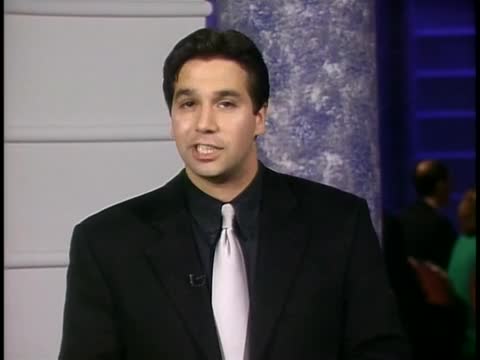
national electoral system outweigh states rights to conduct elections this isn't just a debate about whether to do away with the electoral college it's a subtler more nuanced topic I'm Zachary Finck and in the next exciting hour you'll see the teams and hear both sides has four New Jersey high schools compete to take home the trophy and the title and the reputation as the best and brightest debaters in our state this year in the inexperienced here West Essex regional squares off against Tom's River East and in the experienced here Ridgewood takes on freehold dividing the competition into inexperienced and experienced here's makes debating more accessible to all students the ideas to foster participation as well as to generally support debating as a great activity now here's Michael Feller from JP Morgan Chase Chase has been supporting the Lincoln Douglas debates for at least 20 years in New York and a decade in New Jersey I'm Michael Feller head of corporate social responsibility for JP Morgan Chase and it's my pleasure to welcome you to the final round in
our 2002 Lincoln Douglas debates this is our 11th year sponsoring values debates for public high school students in New Jersey of the hundreds of students who took part in the early days of the Lincoln Douglas debates most have graduated from high school in college started careers perhaps become parents themselves in some small way I hope that their experiences helped shape them helped to give them a firmer footing perhaps even helped to make them better stronger citizens during the past 11 years students have debated propositions about hate speech on campuses about uncensored internet access and many other questions that don't have easy answers tonight is no different as we focus on our responsibilities as citizens and the election process all of us at JP Morgan Chase are proud of their accomplishments and proud to have been able to provide this program for them whatever the outcome tonight every participant is truly a
winner now it's time to begin good luck and thank you thank you Michael how we got here the road to tonight's finals began in March with the announcement of this year's topic teams then had two months to prepare for the competition which took place on the Douglas campus of Rutgers University in New Brunswick on May 8th 60 schools turned out to match with in four preliminary rounds then eight schools from each tier were chosen by judges to continue on to the quarter finals for his will debate West Essex Regional of the 16 teams eight were then selected to continue on to the semi finals in addition to Tom's River East and West Essex Manisquan and Vineland North were semi-finalists in the inexperienced tier full taxes were instituted to keep last and poor white especially white women out of voting with any park and Westfield with the other experienced here contenders each and every one of these debaters received a one hundred fifty dollar check from JP Morgan Chase in recognition of their valiant
effort and so 60 schools have been whittled down to the final four you'll see here tonight I know everyone is eager to get started but before we launch our first debate let's give the uninitiated some background on the format the rules three members of each team and one alternate each team must be prepared to debate both sides of the issue yes yes yes yes that's what I said but they will not be notified which side they'll present until the time of the debate we have just four minutes to prepare no insults there are strict time constraints the terminology affirmative constructive what is that the first affirmative constructive is when a person on the affirmative team sets out arguments to uphold the
resolution then the opposing team gets to cross examine the speaker they are going to have to ask very tough questions of their opponents first negative constructive to lay the groundwork the negative case and then to find the chink or the floor in the affirmative resolution and case then the affirmative side gets to cross examine the negative side second affirmative debate gets to then continue the case to take the information from the cross examination and use it in the second affirmative speech to try and rebuild the affirmative case which has been knocked down by the negative and try to expand the affirmative case in order to go and make the affirmative the winning case second negative constructive the negative now has to rebuild his position and explain why the negative is still valid the second job is to re-attack the affirmative last but by no means least the
rebuttal their response for taking all the issues in the round and narrowing them down in those final two minutes to ensure their team a victory and remember the judges decisions are final now let's meet our honorable judges who will be ruling on how well our debaters meet those criteria Jonathan Austin is debate coach and teacher at Newark science high Newark science high won these debates in 1997 Abdul Baratay assistant debate coach at Bergenfield high school is also no stranger to these debates he was cross-examiner rebuttalists on his team in 1996 and 1997 Judy Breck author and education consultant Catherine Zizek professor of communications at Seton Hall University Catherine was one of the original judges for this debate 11 years ago Vasyl Zook vice president at J.P. Morgan Chase has been shepherding these debates now for at least seven years and
finally meet our debate coordinator and timekeeper Bill Bartholomey chairman of the New Jersey district of the National Forensic League this is Bill's ninth year of service he'll be making sure that our teams follow all the rules and stick to the designated times now by toss of the coin Tom's River East will take the affirmative side and West Essex senior high school will counter with the opposing stand before we begin our inexperienced here debate let's meet the teams from Tom's River East first affirmative constructive Ed Hohenstein on the other side Alexis Burke first negative constructive for West Essex back to the affirmative side Robert sales holds the second affirmative constructive position while Candice Savino takes the spot for the West Essex team finally our two cross-examiner rebuttalists Thomas sales for Tom's River East and Joshua Berman for West Essex once again our topic for debate resolved that the need for a uniform national electoral system outweighs states rights to conduct elections Tom's River East are you ready to begin West Essex are you ready
then starting with the first affirmative constructive Ed Hohenstein let's debate one person one vote a uniform national electoral system for federal officials within the numerous different ballots and voting methods used between the different states if we as a society can spend three billion dollars on the presidential election why can't we spend a fraction of that to make sure the votes are actually counted the method by which we choose our chief executive should be it by direct vote and uniform throughout the 50 states our current system of electing the chief executive is a system that was created out of this trust for the common man the electoral college disenfranchises the common man that the electoral college is a system that's based on population in certain areas so is the House of Representatives there are two identical structures set up in the same way the House of Representatives is designed to make our laws the electoral college was set up the House of Representatives is established to protect the people in different areas based on their needs I would think that the electoral college would want to
do the same correct the electoral college in effect all does is disenfranchise his people how does it disenfranchise the people it does if has a winner take all systems correct I would think the electoral college will protect the individuals in that state based on the things that are good for those people in that state if you do not vote for the for the person that takes the state your vote does not what if you were disenfranchised each state would support and promote time we uphold the values of balance stability and protection of the people's rights which have been the instrumental device in the 215 year success of the constitution thus we seek to negate that the need for a national electoral system outweighs states rights to conduct elections the electoral college is a weighted system if not for that then why would a candidate campaign in North Dakota why would a candidate campaign in Iowa he campaigns in those states because of their value because of their value in the electoral college system which protects the rights of the people in the smaller states the states support and protect the people within their boundaries did not
states in the south previously do whatever was within their power to prevent African-Americans from registering to vote correct so you're saying that the states do not always protect so you would see that in that instance the states did not do what was right to protect the rights of their people I don't see what you're driving at that the states do not inherently protect the rights of their people that states have in the past selectively and intentionally disenfranchised and changed the states can change but they change the federal government has the federal instances the protect they put they changed to protect the people in their states the federal government had agreed the federal government's hat can and has forced changes upon the states to better protect the rights of their people yes or no every other country in the world that has our a formal government similar to ours has uniform national electoral systems the consensus of the world is that the need for uniform national electoral system does outweigh states rights to conduct elections American history has been an inexorable trend towards greater fairness at
uniformity and inclusiveness in our democracy we need time we streamline the patchwork and confusing system that undermines voters faith in the government we need to make sure that across the country every person's vote counts and counts the same all the things you stated the problems in Florida this is all policy how did they relate to your popularism because the problem arms with different places have disenfranchised people so what do you think on your mining one person so what do you think of it's Florida's problem and Florida's a state Florida should take care of it Florida's part of this nation right but Florida is a state with individual state rights that have to protect the people in the states correct it's also the job of the United States of America to put the federal government to protect those right you talk about a direct election but that destroys the balance that our founding fathers have strived for for example if we had a direct election politicians would want to get the majority of the vote therefore they would campaign in the places with a majority of the population lies such as metropolitan areas therefore people in rural areas and their needs would be ignored this would destroy the
diversity of opinions police and goals that have served our country well and provided balance in our nation for two hundred and fifteen years you said that for the elections in Florida was Florida's problem yes did that not cause a further national problem well what if we were to have a handful of the election of the president what if we were ready or did it not what if we had a uniform system with a butterfly ballot in the entire nation that would cause more chaos than was caused in Florida can you name me a country other than the United States America that has a federal form of government that does not have a uniform national election system the only countries with the direct election are France and Russia that's not true Germany has a uniform national election system with a direct election and yet it still has federalism and it still has states rights intervening in the individual state rights you inherently intervene intervene in the rights of the people by intervening in the rights of the people it negates what our country is based upon equality the electoral college the system in place in
our nation has been working for two hundred and fifteen years promoting stability and balance for the citizens this stability has allowed for the numerous changes from political party republican to democrat and vice versa over the course of our nation's history and to change it now is completely ludicrous the needs of the many outweigh the needs of the few this is somewhat harsh but it is true the rights and preservation of a hundred people are more important than the rights preservation of one a uniform national government is in better position to protect the entire country rather than self-serving interests of of the several states they talk about stability and whatnot and that the civil war has no reference but it does in that our country cannot remain stable in its current system it is brought on war and frequent instances of rebellion such as shades rebellion or the whiskey rebellion in which people felt that they were being denied access to their federal government the the most important right the paramount right in any democracy is
the right of suffrage the ability to vote time and that wraps up our first debate how about a round of applause for both of our teams that was excellent now all bill Bartholomey is adding up the scores let's pay a visit to ocean and Essex counties to find out about the two schools that have fielded such great teams welcome to Tom's River high school east home of the raiders our school is home to over 1,850 students in a short community of Tom's River in Ocean County athletic and scholarly endeavors illustrate the ideals of our initials TRE tolerance respect and excellence in all areas of student participation our academic programs continue to grow our performing arts curriculum offers opportunity and our athletic programs foster sportsmanship
along with outstanding records post graduates attend prestigious schools such as Princeton and Harvard high school east promotes an environment where abilities are cultivated intellects are challenged in the unique characteristics of each student is identified and enriched we are proud to be high school east raiders welcome to west Essex high school in North Caldwell recognize as one of the top academic schools in the state west Essex offers a variety of opportunities for all its students to pursue any avenue any skill and any interest well 96% of its seniors plan to continue their education after graduation west Essex also offers many courses in the practical arts child development and woodworking in order to further students essential life skills west Essex provides access for a multitude of extracurricular activities including sports the yearbook and the schools newspaper as well as the 42 clubs that compete around the state and the country west Essex guarantees students academic experiences which serve as the foundation for a successful
future in the 21st century now to keep the suspense going we're not going to announce who the winner is until the end of the show but we are going to tell you a little bit about the original Lincoln Douglas debates in 1858 the state of Illinois population about a million and a half held a Senate race the candidates were Abraham Lincoln and Democratic Senator Stephen A. Douglas Lincoln carried the banner for the new Republican Party just two years old in those days the people the voters did not elect senators the senators were elected by the state legislature Stephen Douglas running for reelection was a national figure Abraham Lincoln was much less well known and so having nothing to lose he challenged the senator to an unprecedented series of seven debates these debates took place all over the state the northern part of the state which was kind of pro-Republican and the southern part of which was pro-Democratic and in the central part of the state which was sort of
evenly contested the debates were radically different from the contests we know today they took place in the open air without benefit of microphones before thousands of people farmers drove in from the countryside townspeople who turned out they were at the mercy of the weather and let that didn't stop the people from staying and listening the debates lasted for three hours the first speaker spoke for an hour then his opponent responded for an hour and a half and finally the first speaker had another half hour to close that the owners cared nothing about the property that was declared to be theirs the property that the decision said was ours both of them spoke only from a few notes it was almost entirely extemporaneous and in fact the audiences in these debates played a direct part in it there would be shouted questions from the crowd there would be booze his cat balls cheers Lincoln at six foot four towered over his opponent nicknamed the little giant who measured just five foot four Lincoln had a kind of high-pitched
tender voice Douglas was accounted the better orator he could roll off a long melodia sentence that could sway his followers the issue at all seven debates was slavery Lincoln said over and over again that slavery was a social moral and political evil Douglas on the other hand said that he cared not whether slavery was voted up or down that his principle was that the people local self-government for the territory or a state should have the right to sign on this for themselves in the end although Lincoln won the popular vote Douglas was reelected by the legislature the debates though propelled Lincoln to national prominence which set the stage for his presidential nomination just two years later when Lincoln was elected president in 1860 on an anti-slavery platform the south took that as the handwriting on the wall did so they see it and so the Lincoln Douglas debates took their place in
history they were an essential link in a chain of events that led to the civil war six hundred thousand lost their lives during that war but the house our nation undivided still stands Lincoln and Senator Douglas ran against each other again in the presidential election of 1860 it was a four-way race Douglas got the second largest number of votes but as we know Lincoln became president the south seceded now let's see how our experienced debaters handle the resolution by coin toss freehold will take the affirmative side while Ridgewood will be against the resolution and four states rights let's meet our team members first affirmative constructive Joshua Schifrinson first negative constructive Luke Kim second affirmative constructive Michael Hornby who must present a reputation of the negative position on the other side our second negative constructive Doug Swanson from which would must refute the affirmative
and rebuild and extend the negative sides position and finally our two very important you might say the lynch pins of the team cross-examiner rebuttalists Prem Travedi from freehold and Zachary Hirschman from Ridgewood our topic for debate once again resolved that the need for a uniform national electoral system outweighs states rights to conduct elections Ridgewood are you ready to begin freehold are you ready then let's debate first affirmative constructive highly decentralized non-uniform antiquated confusing error prone under budgeted poorly staffed arbitrary and politicized this unflattering list used by Thomas Mantis grabbed the current state-run elections exemplifies why we must affirm today's resolution resolved that the need for a uniform national electoral system outweigh states rights to conduct elections let's look at the following definitions uniform national electoral system a single voting system applied to all states for national elections a state's right to
conduct elections the right of the state to implement its own electoral policies our value premises democracy a political system where sovereign power lies with the people or their elected representatives our value criteria for today is the uniform protection of liberty which ensures that all individuals have an equal right to vote and maximizes the efficiency of the electoral process thus the underpains of democracy are pelt our first contention states are under the current system of voting they do process an equal protection clauses of the four to the amendment are denied to citizens the four to the amendment reads quote nor shall any state deny to any person when they're jurisdiction equal protection of the laws and quote nor shall any state deprive any person of life liberty or property without due process of law thus citizens mostly granted equal rights in every way shape and form as liberty can be taken to constitute the measure of of equal rights and since liberty also encompasses the right to vote all citizens must therefore be given an equal opportunity to vote unfortunately as the Florida election in the as the Florida vote in the 2000 election demonstrates the Nile of due
process is still excellent studies have shown the Florida had a high little disenfranchisement that was disproportionately large among African-Americans who were in fact ten times more likely to be than others to have their ballots rejected discrimination is not only the only method of disenfranchisement as diverse voting systems and states vary from touching computers and some to mechanically devices and others these systems are not all equally equally comprehensible to all individuals and could lead to mistakes mistakes in casting ones vote for example a touching computer system may not be comprehensible to certain individuals setting minimum nationwide standards will provide voters with equal protection and due process restoring a credibility to the American electoral system and minimizing the disenfranchisement present today our second contention states that historically enlargement the electorate to include all members of society has come through the action of the national government in contrast with decentralization states have been the instruments for the restriction of the electorate this is exemplified by the necessary intervention of the federal government in the south after the passage of the voting rights act of 1965 federal marshals had to be sent to
force the southern states to recognize the African-American vote thereby expanding the electorate it was a national government for example that produced the 26th amendment the right to vote at age 18 the 19th amendment extending the woman the right to vote and at 15th amendment extending franchise to all citizens even now state laws dampened voting rates by making the registration process inconvenient the residency requirements early closing dates and so on restricting the scope of the electorate our third condition states that therefore the federal government is the universal guarantor of rights in the democracy and must be the mediator of justice in national elections we have demonstrated that throughout American history state are the entities that deny equal rights including the right to vote to citizens during the same period there's been an assumption of power by the national government to the point where federal authority outweighs the concept of the state's rights as noted earlier prior to the voting rights act of 1965 and enforcement by the federal government through armed men southern states denied African-Americans the right to vote in court direct contradiction to the 14th and 15th amendments the federal government in actively actively
unfortunate amendments acted as the sole guarantor of rights and media or justice in today's situation where there is a similar the more subtle violation the aforementioned amendments the federal government is likewise step in this false the federal government to create a unit from national electoral system as a means to further guarantee such an outcome and now it's ready for cross examination time third negative cross-examiner all right looking at your second third contention you provide very strong historical examples reference to the United States correct correct and you provide equal opportunity legislature in reference to the United States correct could you explain my equal opportunity and you talked about that in your first contention if you're referring to equal right to vote yet then yes right now could you please reread the resolution for us that the need for uniform national electoral system outweigh states rise to conduct elections right now does the resolution actually use the phrase the United States or any of its variations no but in a debate such as they link in Douglas debate we have to live into the United States as we
defined or rather as was implied by our resolution now why is that implied by the resolution why can't it be as is usually the standard for these debates a theoretical state again in in such a cases today we have to take a current system and look at how we can reform or possibly change it therefore you have to just one has to assume that I ask you where is the current system implied in the resolution can't we use the theoretical idea as is most often used if you're asking for implied then you see what you see implied and we see what we see implied all right let's move on now looking again at your second and third contensions where you provide historical examples of why the federal government guarantees rights and enfranchisement correct yes now do you provide any logical backing rather than just historical examples for those can you explain what you mean any actual logical arguments instead of references to things in the past if you take that if you take the concept that all in all citizens have equal rights to vote and so on so forth then logically enough if one entity denies such rights then another entity has to step in that is what the federal
government maintain this place that's the logical flow all right thank you time Ridgewood first negative constructive America's Democratic founder Thomas Jefferson once said that government is best which governs the least because we believe that the checks in place against the government are necessary and that the votes of the people must have meaning we negate the resolution that the need for national electoral system outweighs states rights to conduct elections our value premise for the round will be that of democracy a democratic government is not is only successful for the people vote and their votes matter our value criterion for the round will be that of governmental legitimacy by retaining a fair interactive and sovereign electoral process a government remains legitimate contention one democracy is achieved when the votes of the people have their meaning firstly localized elections give more power to each vote one vote matters more simply one in a thousand counts more than one in a million this results in greater participation on a local level leading to greater voter turnout and a more fair election this is how democracy
could be achieved secondly localized elections are more interactive and informative at a local level there is more familiarity and discussion of the issues thus more informed choices are made and better voter turnout resulting in even more democracy contention three state-run elections are a necessary check on national power this check cannot be taken away from the states as it is one of the most important components of a balanced democracy the states right to conduct elections serves as a necessary on the check on the power of the government and prevents election corruption on a national level state elections prevent the possibility of total tyranny and election fraud such as what occurred in Peru and Zimbabwe where the government only allowed one candidate to run and can counter the votes itself state elections are necessary to preserve the legitimacy of a government now I'm going to be moving on to the neck on the affirmative side they provide the value premise of justice fine we both agree on the values let's look at the value criterion however the protection of liberty criterion is not fitting to
this resolution only with governmental obligations by fulfilling government legitimacy will you be able to uphold the resolution to the fullest extent essentially liberty is a bad standard to use because of the fact that one it's not we're not talking about just about the United States here and two with full liberty absolute liberty there'll be most chaos only a government consenction this that's why you look towards our value criterion now their first contention talks about the 14th amendment and due process and whatnot but what they are failing to understand is that this resolution does not restrict it to the United States so essentially if we do not restrict this resolution to the United States this first contention doesn't have any bearing on the round so you can drop it right now but even if you don't agree with that this contention doesn't make any sense because of the fact that the states are there to place checks on the national government I give you the examples of Peru and Zimbabwe where there are no states that have a check against national government in these situations you need the state to make sure that this national government isn't having corruption is isn't isn't acting in corrupt ways moreover in this contention they talk about Florida but
realize that one vote in a thousand means a lot more than one vote in a million yes this can this can happen in Florida but think about what would happen if it were on a national scale a thousand votes in 27 million doesn't mean that much so more votes will be lost anyway their second contention is based on historical background realize that historical background has absolutely no impact on the issue and the debate about values moreover they talk about how federal government needs to intervene but I'll give you the example again states need to check their power on the national government because if you have a national government that is too powerful there's nothing that can be that can have checks against them they also talk about how a state around elections are inconvenient and more on what not but I give you the example again more votes are simply lost in national elections simply because 27 a thousand and 27 million is far as far less of a ratio also the third contention talks about the mediation of justice and how states deny rights to vote first of all they base the sun empirical grounds again again I can
establish that they don't really mean time thing and with that said I think I refuted the affirmative case and I'll stand up for cross-examination okay free whole third affirmative cross-examiner what was the tag of your second contention the tag of my second contention was that state-run elections are necessary check on national okay so two contensions right yes all right you you talk about this one in one thousand one in one million votes saying that the one in one thousand comes you know has to take precedence accounts more right yes okay when we're talking about a national election we're talking about the entire population right yes all right so all individual votes are on the same plane right sure so where's this difference between one and one thousand and one and one million coming into place essentially what I'm trying to say is that let's take let's take for example if I live in a state such as Wisconsin and they're only there are only a couple a couple million people in my state right essentially they're all right I'm gonna give you a little preface about this okay without what I'm asking you is what if we're talking about a national election where does this disparity numbers come into play for all voting for a national election all right the disparity comes into play let's take for example all right I live in
states such as New Jersey there are a lot of people in New Jersey candidates will be more focused on a state such as New Jersey because it's highly it's more high it's it's more popular and popular okay so you're talking about the electoral college I'm not talking about these central electoral college the largest thing that certain areas are going to be ignored what do you think will tend to campaign in areas that are more highly populated just because okay I understand what you're saying okay so there is Wisconsin I understand right thank you you talk about state-run elections being a check on national power where's the check under the negative against local misappropriations of power at state level where's the check on the where's the check on local appropriations with the with the national government it's a wash what can you answer my question yes what's your question my question is where's the check against local misappropriate power on the state level on the state level correct the state I guess the national government it works we're saying in hand National government is a check so the national government has to be the universal orbiter here I'm not saying that I'm just saying that it kind of works together. With the national government itself, you're not going to have a universal power checks
and balances. You need the state. So the national government is only stepping in after the fact you're saying. Well, you could say that. OK. Thank you. Freehold. Second affirmative constructive. All right. I'll start by attacking my opponent's case and then move on to my own. First of all, they offer a value premise of democracy the same as ours. So obviously, I'm going to have to agree with this. However, their value criterion of governmental legitimacy, they are not able to uphold this value criterion of governmental legitimacy because there's no uniform distribution of liberty. So if there's not going to be this liberty, they're not going to be able to make a legitimate government, which I'll talk about again in another minute. Regarding their first contention, they mention how votes basically have no meaning. And they mention things about localized interaction. I don't agree that votes have more meaning on the state level. I think that they have equal meaning on a national level. They're still going to be the same people voting. They're still going to have a say in what's going to happen. They don't prove how these votes are going to have more meaning on the state level
and not going to have meaning on a national level. As far as having localized interaction, there's actually going to be, because of this localized interaction, there's going to be localized bias. Things are going to be broken down into a smaller level. There's going to be a lot easier for the people who are running these elections for the states or even smaller than the states who are running the elections to be able to cause bias against certain people. For example, by having a poll tax, they're going to be able to do this easier on a state level than they are going to on a national level, moving on to their second contention. They mention how there are checks on power on the negative side and how this is an important thing. I agree that this is an important thing, but they fail to realize one thing. There are also checks in the affirmative. You have the Supreme Court, who individuals can go to or even states can go to to challenge the way the process is running. There are going to be a lot of checks to make sure that corruption is not going to happen in the affirmative and actually corruption is going to be even more rampant, as I stated before, in the negative situation, because of this localized bias, because things aren't being watched, or things aren't being watched,
as much as they are going to be in the affirmative. Now moving on to the defense of our case. We offer a value criterion of uniform protection of liberty. They say that this is not fit into the resolution. However, this does fit into the resolution because that's exactly what we're trying to do. We're trying to protect the liberty of the citizens. We're trying to make sure that everyone gets an equal right to vote. They say that this is not just about the U.S. Yes, it's true that this is not about the U.S. But we use specific examples about the U.S. to prove how it's been a problem when the states are running the elections, and how it is going to be better if the federal government is running elections, how this uniform protection of liberty is going to be upheld. Moving on to the first contention, we talk about the due process in the 14th Amendment. They argue this by citing examples such as Peru and how Peru places checks. In actuality, Peru has federally run elections, and these federally run elections have actually proven to be run better than the United States. Carter ran a test to see how the error rate of in Peru compared to the error rate in the United States. Peru actually had a lower error rate
in the voting than the United States. The United States has this system where the states are running the elections. Peru has it where the federal government is running the elections and they actually had lower error. Moving on to the second contention, we talk about how the states have checks against the power, and you can't have too powerful of a national government. And this is in response to us citing examples of, for example, the federal government going into the South. Yes, you can't have too powerful of a national government. However, the national government has, as we've shown to these examples, has had the step in before and has had to fix problems in the voting process. Again, this can be done through the Supreme Court. This is the check on the affirmative side, the Supreme Court, and individual petitioning to stop any kind of corruption that's going on. On the localized level, on the state level, you don't have these checks. Moving on to the third contention, where we talk about how the federal government is the universal guarantor of rights. They argue against this by saying that you're going to have more votes lost than a national election, which they fail to properly explain.
I really don't see how more votes are going to be lost in a national election. And I actually believe that you're going to ensure that you're going to lose less votes because of this uniformity. You're going to have the government coming together and to make sure that you're going to have the best voting system possible. Time. Ridgewood, third negative cross-examiner. Just to clarify something, in the beginning, you did admit that we are not only talking about the United States, correct? All right. Now, let's move on from there. If, on your second and third contensions, we have discussions on corruption, correct? Correct. And what was your check against corruption in the national government, if the federal government is running the elections? Yes. The Supreme Court, correct? The Supreme Court, correct. Now, isn't the Supreme Court part of the national government? Yes. Now, if the national government is corrupt, because it causes this corruption, then wouldn't the Supreme Court being part of it also be subject to the Supreme Court? The Supreme Court is separate branch. It's not the same people who are running the elections. The FEC is running the election. The question I'm asking you is, can any government be trusted
to check itself? That depends on what you mean. If they have a separate court to be doing this, yes. If it's a separate part, then who's running the election? All right. Now, under your first contention, you talk about due process, correct? Correct. And where does due process exist in terms of legislature and the federal government? In the United States of America, right? Yes. Are we talking about the United States of America? The examples that we use to apply to the United States of America, if you want to take it on to a larger level, you're talking about due process, correct? Correct. And that's only in terms of the United States of America, correct? It can be used in terms of anyone, but the examples we use were only in terms of. But it's only a legislative law, like you were talking about in the United States. It can exist in other countries, too. There's nothing stopping it. All right. Ridgewood, second negative constructive. OK, I'm just going to start with our opponent's arguments and then move on to address our own. Now, our opponent's value premise was democracy, as was our own. So what I'm going to try and show you is that through our value criterion of governmental legitimacy,
our side, the negative side, best upholds this democratic government that we are going for here. So onto their own value criterion, they talk about the uniform protection of liberty. Well, first of all, in order to actually uphold liberty, we need to let people make their own individual choices. And in order to actually have people make their own choices, that requires a state election. Only the states and the people in the states can actually decide how they will feel on a local level, what they actually need. This should be a state decision. So they don't really uphold liberty. Second of all, our own criterion of governmental legitimacy. My colleagues said earlier, actually showed why our criterion is higher with respect to this resolution. Because what we're talking about is elections. We're talking about how we can achieve democracy through elections. Fair, informed, democratic elections. And the way to do that is through allowing people to make choices and having their votes. Their democratic votes have meaning. And what we show is that that can only
be done through the negative side. And that is the paramount burden in this round. And so our value criterion is higher. Moving on to their own first contention. They say that due process and equal protection are denied under our system. First of all, I have two attacks on this. First of all, it only addresses the United States. As we've said throughout the round, this does not apply to any democracy. And so it cannot apply to any portion of the resolution. They need to find a general rule. They need to show why a national government is always better. Second of all, they don't actually achieve due process and equal protection, because, for example, they say that federal elections are better. And they cite the example of Peru, which was our example originally. Obviously, there is not a lower error rate in Peru, because although people's choices were, they say that the choices were not erroneous. There was only one candidate to choose from. How could they be erroneous? What they need to see is that we show, through our first contention, how democracy is achieved when the votes of the people have meaning on a local level, people's voices are heard better,
because they can make more choices. They can talk about the issues. Their votes are heard. They never actually address this. And what we need to see is that this due process is only achieved under the negative. They say that more votes are lost under the negative. However, this is not true. What they need to see is that in a national electoral system that they're upholding, there are more votes. They're simply more room to lose more votes. 200,000 votes means more in a state election than in a national one, and we can lose these 200,000 votes. Under the affirmative side, their voices might not count. This is not true under the negative side. Against their second and third contention, again, they set only a historical precedent, which has no impact on the resolution. It only talks about the United States, and it only talks about United States history. They never actually show you why you need a national government always for enfranchisement. Moving on to our own side of the flow. I already addressed our values, so I'll move on to our contensions. We say that democracy has achieved
when the votes of the people have meaning. They say the same level of meaning occurs on the national, and we give no proof. However, as I showed, as my colleague showed, under a localized election, there is more discussion of the issues, there is more familiarity, and thus people always will have more meaning in their votes. One in 1,000 simply counts more by the numbers. They talk about localized bias. Essentially, what this is is this is corruption. This is corruption on a local level. And as we say, there is corruption on a national level also, and that's why we need the states to check that power. This is a main point throughout the round. I'm just going to address it now. The national government and the state government are there to check each other. Under our system, the national government and the state governments can check each other. And this is basically what they say against our second contention, so you can just cross apply it. What we have to see is we need the negative side, which allows for the affirmative, national system, and the state system to function as checks against each other. And that's that ready for cross examination. Freehold, third affirmative cross-examina.
OK. You talk about discussion of issues in local elections, right? Yes. How does this apply to the resolution? Well, what I'm saying is that with this more familiarity and this more local discussion, it'll provide better voter turnout, better information, and thus more democracy. We're talking about a negative. We're talking about a voting system, correct? Since when does a voting system which is the means by which people cares votes supposed to foster discussion? Well, what I'm saying is that our voting system fosters democracy, because it fosters discussion, which through discussion and familiarity, will present greater voter turnout, will present greater forms of democracy. Wait a minute. What's the link? You're just saying that we have more discussion. I'm asking you, how does discussion relate to the negative side? Where's the benefit of this discussion? What I just said was that this discussion will lead to people better understanding the issues, people making more informed decisions, greater voter turnout, because of the ways we can achieve democracy. We're talking about people making their own choices, right? When you make this broad statement, are you talking about people making their own choices on what the means is by which they should vote? I'm sorry. Are you talking about how people should make choices on the means by which they should vote? What are you talking about when you say people make
their own choices? Well, what I'm saying is that people, through elections, people make choices about who will run their government. Are you limiting their elections on the affirmative? I'm sorry. Are you eliminating elections under the affirmative? Of course not. OK. Now, you talk about the national and state governments being able to check one another, correct? Yes. All right. Now, I refer to an example of discrimination in the Russian forward election. When a policeman turned away an African-American voter taking senior citizens to the vote by saying that he couldn't do that unless he had a particular permit. Now, is that an example of localized discrimination? Well, what I tried to say was that that discrimination will occur actually more under the affirmative, because there's more room for those local votes to get lost. OK. Do you agree that discrimination and bias, though, can occur more on local levels that there are certain pockets where there's more discrimination than in others? I don't think so, because on a national scale, there will be more votes. So discrimination is a uniform or conditional? There aren't areas that have more discrimination than in others. Even if there are under the affirmative side, those votes will be lost, because they'll simply be lost in the mess of all of the national votes. Are we having local officials implementing the elections under the affirmative? Are we having the federal government do that? I don't understand the question. Isn't the federal government implementing
the elections under the affirmative? Not the local officials, correct? Yes. OK. Ridgewood, third negative, rebuttalist. I'm going to begin with the opponent's case and then move on to our own. Since we agree with our value premise of democracy, we have to see who upholds democracy better and by what means. Let's look at our criterion. My side's criterion is government legitimacy, while there's a uniform protection of liberty. On the first level, government legitimacy encompasses liberty, because we provide for liberty, equality, and all such things that democracy should stand for. Secondly, our opponents do not provide for this liberty, because they promote a corrupt system, as will be shown through all our contentions, as well as their own. Let's look at them. First, our opponents first contention. They talk about due process, and a lot of things that relate solely to the United States. And while this would be a good argument, this debate isn't about only the United States, and thus they need to provide a large example that encompasses the idea of democracy, not just our democracy. They don't do this, and they don't refute this point. Thus, you can drop the entire contention from the round.
But if you look on, you see that they're talking about allowing all citizens the equal opportunity to vote. Now, what allows equal opportunity to vote? A lack of corruption. We need to stop corruption here if we want to allow people the equal opportunity to vote. Now, what do we do against corruption? We put up checks. The national government is a check against state government, and the state government is a check against a national government. When you remove state elections, you remove that part of the check against the national government. Equal opportunity can be denied just as easily by both sides. But with a check in place, under the negative, there's a less likelihood that that will happen. Let's look at their second and third contensions. They both talk about the positive aspects of a national government system, why they need a national government to provide for the enfranchisement, and the guaranteed rights of their people. Rights can be destroyed on both sides. There can be corruption on both sides. But we need to ask ourselves who provides a check against this corruption. Now, they talk about the Supreme Court as they're only check against this corruption. Now, the Supreme Court, as we established,
is a branch of the national government. He says his only argument against this is that there are different people in the Supreme Court than say the executive branch. That's not the point. There are different people in parts of the executive branch than from other parts. The point is, we can't trust a national government to check itself. That is why we have state elections. There are no checks on the affirmative side against corruption. And thus, there's no reason why they would ever promote the enfranchisement of their voters. Let's look at our case. Our first contention talks about the votes of the people and whether they have meaning. Now, we talk about the interactive and informative elections, where people's votes have meaning when they're close to home. When these elections are brought to the people, then the issues are brought to the people. This is not refuted. If you look at some point, a of that contention, we talk about when people's votes have meaning. Now, when you run a state-run system as Doug established, you have less votes to count by different sections. Thus, less votes are lost. That gives votes meaning. If you look at our third contention, you need to establish a check on national power. That check only exists on the negative side,
through state elections. When you're talking about elections, you need national and state systems to work with each other and prevent corruption in each other. When they remove the state elections, they remove the check and thus corruption. Thank you. Freehold, third, affirmative, revitalist. OK. It's time now to just take a look at the broad issues in this round and narrow them down and crystallize and present some voting issues. Our opponents make this argument throughout the case that we have to look at the scope of the world. We can't simply look to the United States as a democratic nation. We have to look at universal standards. So if we look to the world, first of all, let's take a look at the example that we bring up a Peru. We counter with the example that Peru had democratic elections. Democratic elections, which, by the way, Carter and Ford, in the National Commission on Federal Election Reform, stated were more desirable than those in the United States. Why? Because they were nationalized elections. Let's keep looking at the scope of the world when we see that all other than the other democratic nations that follow nationalized elections have also been praised by Carter and Ford as more efficient, as better, as better able to produce in-friend chisement. So our opponents talk about making every vote count. But yet, they ignore this data. They ignore the fact that nationalized elections have proven to be more effective and therefore
have been able to get the vote out and been able to get the vote to count. This is crucial. If they want to extend to the scope of the world, then they have to look at the success that has been present in these nationalized elections. They ignore this. If we look to the values in this round, we provide for a value criterion of protection of liberty. And our opponents talk about governmental legitimacy. We both want to achieve the higher value of democracy. Now, protection of liberty is a standard by which we define governmental legitimacy. A democratic government is called legitimate only if it provides for the uniform protection of liberty. And as we stated throughout the case, the national government must be the universal guarantor of rights simply because a state can't make sweeping laws or regulations about what can occur in a nation. So therefore, they can't be the universal guarantor of rights in a nation. The practical agent that enforces these rights and that guarantees these rights is indeed the national government. So let's look now to the first major voting issue, the fact that the vote must count. So they're saying that enfranchisement is a positive thing. But the negative allows for an engender's local bias. The negative creates an isolated situation where the example like I brought up and cross examination about the policeman turning away the black college student and the senior citizens can occur. They don't provide for a check on that.
They said that we have the national government stepping in as a check, but if the national government is a check, then why wasn't it effective in these particular situations? Why is this discrimination occurring if the national government isn't effective check? Clearly, when states' rights are given primacy, there's this room for local discrimination that's not effectively counted by the national government. And that's why there's the need for a proactive solution where the national government is there in the first place. They say that the states need to know how that people feel on a local level. But obviously, if there's this discrimination occurring where certain minorities are being disenfranchised, they're not listening to what the people want. Forget needing to know how the people feel. They're not giving the people the due process and the right to vote effectively. So they're not extending these franchise at all. And the importance that they talk about, the right to vote. And the fact that every individual have must have a vote that counts falls. They can't provide for this. And they don't provide any existing examples in any nation as to how there's a check on local governments. In fact, when they talk about the world, they support us. They support our arguments by looking to nationalize the elections. So therefore, we come to the question of checks. Who better provides for checks and who better provides for democracy in the end? We talk about the checks on the Supreme Court, the ability of a state and an individual to petition the Supreme Court. That's the way the democratic system of the United States has been set up, because the Supreme Court
is supposed to mandate, is supposed to oversee conflict between the state and the individual and the federal government. So it's by definition not just, you know, it's not a crony of the federal government, and we can't look at it in that regard. So there is a check here, but they don't provide for how these checks actually work under the negative side, because they'll give you the example of the fact that the states and national government come together, but they never actually establish this. And that concludes the debate. Audience, how about a show of appreciation? APPLAUSE And while Bill Bartholomey collects the judges' sheets and the points are tallied, let's take a field trip to Ridgewood and Gurgon County and freehold in Monmouth County. Ridgewood High School, founded in 1892, is a comprehensive high school, braids not through 12, which attempts to meet the needs of all students. It is also an institution with a longstanding tradition
of providing a sound and challenging academic program for college bound students. The present school population is 1,469. The high school is the largest in Gurgon County. Our new addition includes a science wing with 15 new labs and a third gymnasium, a fitness center, and a student campus center. Ridgewood students excel in many AP courses, including Calculus CD, the equivalent of a third-year college course. There are a variety of areas such as theater, band, and sports where the interest and needs of students are met. Ridgewood students are well-rounded and well-prepared for a college environment. 96% go on to higher education with acceptance to the most selective colleges and universities in the country. Welcome to Freehold High School, home to over 800 students. Located in historic Freehold, New Jersey, we are pleased to be celebrating our 75th anniversary this year. One of our distinguishing features is our Medical Sciences Learning Center, an advanced learning program emphasizing the sciences for a select group of students drawn from the entire district. We are also home to the award-winning five-star cafe, an entirely student-run restaurant open to the public.
Our Innovative Human Relations Program provides a forum for students and faculty to openly discuss important issues facing society today. With a dynamic faculty and a diverse and driven student body, the past 75 years are just a prelude to Freehold High School's bright future. And now here with me are our inexperienced teams and their coaches, Nels Luthmann from Tom's River East and Alan Woodworth from West Essex. Also on the set, Alternates John Dumpet and James Mills. Christine Flora, Vice President at JPMorgan Chase has collected the final decision, and Michael Feller, will you tell us which team is the victor? Tom's River East. APPLAUSE Congratulations. Our champions each receive a check for $500, a debates jacket, and of course, ownership of the trophy for a year.
Finalists take home $250 each, a jacket, and a finalist plaque. OK, coaches Kate Monroe and alternate Graham Morrison from Ridgewood and Michael Kushner from Freehold have joined us now for the final decision. Michael, the suspense is killing us. Freehold, 3-2. APPLAUSE Inexperienced and the experienced tier debates were close, each being decided by a margin of 3-2. Congratulations to all of our teams and especially to the winners for a truly inspiring debate. We also want to thank the New Jersey Department of Education, Rutgers University, and the New Jersey Forensic League for supporting this program, which recognizes the mental athletes in New Jersey's high schools. For the JPMorgan Chase, Lincoln Douglas Debates, and New Jersey Network, I'm Zachary Finck. APPLAUSE APPLAUSE
APPLAUSE APPLAUSE APPLAUSE APPLAUSE APPLAUSE
APPLAUSE APPLAUSE APPLAUSE APPLAUSE
APPLAUSE APPLAUSE APPLAUSE APPLAUSE APPLAUSE
APPLAUSE APPLAUSE APPLAUSE APPLAUSE
APPLAUSE APPLAUSE APPLAUSE APPLAUSE
APPLAUSE
- Raw Footage
- JP Morgan Chase Lincoln Douglas Debates 2002
- Producing Organization
- New Jersey Network
- Contributing Organization
- New Jersey Network (Trenton, New Jersey)
- AAPB ID
- cpb-aacip-259-k9315j0t
If you have more information about this item than what is given here, or if you have concerns about this record, we want to know! Contact us, indicating the AAPB ID (cpb-aacip-259-k9315j0t).
- Description
- Description
- No Description
- Broadcast Date
- 2002-05-30
- Created Date
- 2002-06-22
- Media type
- Moving Image
- Duration
- 01:03:59.275
- Credits
-
-
Producing Organization: New Jersey Network
- AAPB Contributor Holdings
-
New Jersey Network
Identifier: cpb-aacip-31489bb5ad0 (Filename)
Format: Betacam: SP
Generation: Master
Duration: 0:57:00
-
New Jersey Network
Identifier: cpb-aacip-ba48a4d2e5f (Filename)
Format: Betacam: SP
Generation: Master
Duration: 0:57:00
If you have a copy of this asset and would like us to add it to our catalog, please contact us.
- Citations
- Chicago: “JP Morgan Chase Lincoln Douglas Debates 2002,” 2002-05-30, New Jersey Network, American Archive of Public Broadcasting (GBH and the Library of Congress), Boston, MA and Washington, DC, accessed April 1, 2026, http://americanarchive.org/catalog/cpb-aacip-259-k9315j0t.
- MLA: “JP Morgan Chase Lincoln Douglas Debates 2002.” 2002-05-30. New Jersey Network, American Archive of Public Broadcasting (GBH and the Library of Congress), Boston, MA and Washington, DC. Web. April 1, 2026. <http://americanarchive.org/catalog/cpb-aacip-259-k9315j0t>.
- APA: JP Morgan Chase Lincoln Douglas Debates 2002. Boston, MA: New Jersey Network, American Archive of Public Broadcasting (GBH and the Library of Congress), Boston, MA and Washington, DC. Retrieved from http://americanarchive.org/catalog/cpb-aacip-259-k9315j0t