Report from Santa Fe; Tom Turney
- Transcript
Report from Santa Fe is made possible in part by grants from the members of the National Education Association of New Mexico, an organization of professionals who believe that investing in public education is an investment in our state's economic future. I'm Ernie Mills, this is report from Santa Fe, our guest today, Tom Turner, who is the state engineer for the state of New Mexico. Tom, in this last legislative session, you know, and you and I have agreed that water has always been up front or should have been up front as a major issue. This time they opened the flood gates on water issues. I have never heard so much concern about New Mexico's water. What's your feeling about that? Ernie, I don't know exactly what has happened, but certainly it's been gradually every year escalating it. We had some issues basically under delivery potential, on the PAKOS River.
I talked about administering something called a priority call. I believe that this got people's attention. Certainly, you talked about opening up the flood gates. There were some monies that were provided for water projects far beyond anything I could ever have envisioned. Yeah, it was a surprise that wasn't it, didn't it all come through ahead during this session? It was a total surprise. I never anticipated the level that my office received. We went back to the last 60-day session and I remember at the time you had a couple of appearances before the lawmakers and it was much of it was educational, in a sense. Because water affects all of them, you know, no matter there's no part of the state that isn't affected by water concerns. But I think that laid a groundwork for people to understand more what the problems are and to be able to address them.
In a 30-day session, that's very interesting to me. If we look at the whole in New Mexico, and I have a tendency to look at districts, like the old highway districts, you look at northern New Mexico, look at the northeast corner, look at the southeast corner, look at the area down near Las Cruces, where the, you know, their additional waters have been found down in that area, and it's saying we move over to sober city area. Can you give us a rundown, briefly on the various districts, and then we can get into some specifics. But what I really am looking at is that water board now, that whole concept, fill us in the background right now. Ernie, the water truss board was set up by this legislature this last year. I was appointed as chairman of the water truss board. The water truss board has three primary functions. First it's to develop regional water supply systems, very, very large scale ones.
Then it is to address endangered species mitigation projects, and finally to do watershed management and flood control projects. Now if you wanted me to, I could walk you around the state and describe sort of some of the different projects. Let's take a walk around the state. Let's, why don't we start with the northeast corner of the state, that's at area up near Ratton and Clayton, and we'll move down the side of these, because then you're moving into the Pecos situation, and then we'll move over to Las Cruces, which should be pretty interesting. Okay, starting on the eastern part of New Mexico, there is a need for a large regional water supply system for, like, let's say, Clovis, Portalis, Tukum Carey. They have an underground aquifer called the Uglala that they have been depleting for many, many years. It's dropping.
And we have constructed what is called Ute Reservoir. It sits on the Canadian River. Every year it fills up depending on the snowpack and the mountains. This is a very, very large project to provide a drinking water for those towns, probably over $200 million as it's cost. And so this would be a project that the water trust board would undertake. A lot of these projects, we will have to also get money from the federal government to help participate in this. What kind of matching help do you get in a project like that? We're going to try and get as much as we possibly could. When I get into the Northwest part of New Mexico, for instance, I would like to get 100% federal funding. But we've got on the Canadian, we also have some endangered species issues. As you up in the Clayton area, we do have rainfall enhancement programs. That's going up and seeding the clouds with airplanes flying into these big, under clouds that show up in the summer.
It's interesting for the last three years, we've been doing some pilot work on this cloud seeding. And we found out that there's almost two inches of additional precipitation that has come into the areas that we have cloud seeded, and that's in some of the counties that we have worked over on the eastern part of the state. So a lot of this research will be done up in the Clayton area as far as this rainfall enhancement. We've been a little human there where you talk about a pilot program for seeding, seeding the cloud. Let's move a little bit something. Have we got ways like in the Pratava area and Clovis and Tukum Kary when we do get a heavy rainfall? A pretty well collecting that water as it happens so seldom it just goes to like a sieve. Now that is a part of the Prat Program that we're talking about, Water Trust Board, is there are a number of dams up in that area that you're talking about, actually the spread out all over the state, but a lot of these dams are over 50 years old.
They're getting to the point that they may become an unsafe structure. The remedy is either you fix them up or you order them to be breached. And we would like to begin to renovate these older dams and the legislature did appropriate to about $5 million to begin renovating these dams. I think we're hoping for about 60% to federal match on those particular programs. Who handles the renovation when we're looking at the dam renovation? That'll probably be a natural resource conservation service that will do those primarily. There are some other federal agencies that get involved in these, but these flood control dams have to be renovated. They're also some down in the Karlsbad area, Las Cruces area, and there's even one just north of Santa Fe that needs to be fixed up. Now we have a, you know, you have the big water group that meets, and I understand that they're going to be, or they have looked at the issue of problems, where I guess it would
be the beer reclamation has not kept up certain areas. When you fill us in on that, what brought it up and what's the prospect for it? Bernie, we learned at a recent, this is, we called, a compact meeting of the engineer advisers to the Rio Grande Compact, that there were certain issues dealing with maintenance activities of the levees along the Rio Grande. And the federal agencies have not been keeping up with their required maintenance on some of these structures. Some of this is due to what we call section 7 consultation due to Endangered Species Act. The end result is that there is 25 sites that have been identified up and down the Pecos River that breaches could occur on the levees. The natural flow of the river is actually higher now than in the adjacent surrounding lands.
If those levees are breached, they will jump out of the river bed, probably flow into a adjacent farmland. There are some communities up and down the river. We are concerned about that may receive some of this water. These could be triggered by a single large thunderstorm event, and what we call the mean annual event. We are very concerned about these. We are also very concerned because we may lose some of these Endangered Species, the Silvery Mino. For instance, if it jumps down below Santa Casi or in the Sequoinal Region, if it jumps the channel there because of a levee breach, this is where the highest population of the Silvery Mino is. It's sort of ironic that the reason it's being slowed down is because of section 7 consultations for the Silvery Mino, and we may end up taking a number of these species because of not doing the proper maintenance on these levees.
It is an issue that we are concerned about. We have traveled to Washington last week, and we are requesting that the federal agencies look into it and secure the necessary funding to begin maintenance of these. So levees up and down the Rio Grande. How did you refer today again as the mean annual event? That's right. I thought that was a legislative event. Let's take a look and move down the Karlsbett and the South East corner of the state. Of course, we are looking then at Lee County as well, the Roswell area. Walk us through there, and their problems are quite different sometimes than elsewhere. Yes, on the Lee County area, there are a number of issues. They turned in numerous applications to my office. This was about a year, year and a half ago for about 50,000 acre feet of water.
I will be meeting with the Lee County delegation, I guess, in about two weeks. We are going to be talking about what can Lee County do to go out and monitor the groundwater levels. That area has taken a very new acute interest in water supply issues. They have also requested me to close the basin to all new appropriations. So we will be meeting with Lee County in the next couple of weeks to discuss those issues. As you move into the Karlsbad issues, this is where priority call would actually begin to occur. If we don't make our delivery line obligation to the state of Texas, that's just below Karlsbad, we do have to deliver wet water to Texas within a very short time frame. My intention, prior to the legislature, was to go into priority enforcement. In other words, everybody that was issued a water right after the signing of the PAKERS
River Compact, which was in 1948, I would begin to curtail or cut them off. If you, for instance, if you have a headgate on the river, I would go in and lock your headgate. If you had a well, I wouldn't let you pump it anymore. The results of this would have been absolutely devastating, probably in over $200 million in economic consequences, not to consider all the emotional consequences that would result from this. Doesn't it make you the most popular guy in the world? No, it would have been very, very serious. The legislature reacted to this. There was certain cities that had what we call junior water rights that would have been impacted by this, and the legislature provided extensive funding to address this particular issue. Now, can we move from Carlsbad over to Las Cruz? Yes, and there's some interesting developments there because it seems that the border issues there are bigger than we've seen elsewhere. Yes.
Fill us in on that area because that's the lower Rio Grande. We, in the lower Rio Grande, we do have Senator Esa that is starting to develop, and it has been for the last 20 years. The question is, where are they going to get a future water supply from? We also have threatened litigation from the state of Texas, who haven't fully identified what they really want, but I suspect they want a better quality water and they want more water. You mentioned a few minutes ago, they wanted to get wet water. Yes. Is there such a thing as dry water, or? Well, we have what we call a dry water, water rights, or paper water rights. We have lots of those out here. So Texas, I'm sure, would like to get more water. Down in the Santa Teresa area, we are concerned about where are they going to get their water supply in their future. They have a very junior water right down in that area, somewhere around 1970, and I suspect when we finally go into administration of that area, people that have junior water rights
won't have an adequate water supply. They will have to go out and acquire senior water rights from somebody else, and there are some senior water rights that are available through the irrigation districts, through some of the city, the state, university, and they're also looking at importing water from other basins down into that area. But for economic development to occur down in the Santa Teresa area, water rights are an issue that is going to have to be addressed. Where are they going to get the future water supplies from? Las Cruces is growing. It's one of the largest growing cities in the West, or excuse me, in the state. I think in the last decade, they'd had about 10,000, 11, 12,000 people that have moved in down there. He gave the city of Las Cruces a very large water right from an isolated basin, it's called the Hornada Demertel, about 10,000 acre feet of water that they can pump annually from
this basin. Is that the one that was sort of down there and no one knew it was there? I mean, this is really ironical. My grandfather ranched out of the Hornada Demertel. He had a thousand-section ranch. And the reason they finally had to abandon that is because of lack of water for the ranching activities. Now, they've come in and they've discovered that there's this vast, vast underground water supply. But I suspect my grandfather owned it, they had no way, electricity hadn't really been invented. And they didn't have any way of pumping water out of those deep aquifers. Now that water supply has no, that's near, that's near Las Cruces. And, but that has no ties with anything else, isn't it? It's a sort of, it appears to be a facelate little basin of water. And as a result, it won't impact the flows of the Rio Grande. And so it's a great solution for the city of Las Cruces to get water for many, many decades
to come. Is there the possibility of other basins like that around the state that they're just sitting there waiting to be discovered? Something that has come into my attention in the last six months year is something called the Salt Basin, down below Almagordo. There's been a number of filings that have been made on that, in my office, within the last two or three months. People that are wanting to market that water out of the basin, either to the city of El Paso or to communities within the state. And there may be other ones out around the state that we are just, that are waiting to be discovered. How about over in the Hila area now, that's over near Grant County, Lloydsburg, Deming? What's the situation on what it looked like over there? On the Hila, the state does have a water right. And it's sort of tied into the Colorado River system.
It's water right that we've had for many, many years. It's never been utilized, those cities are growing, Silver City, Deming, and this would be a future water supply for them. So we are working with the regions down there to discuss ways to try and develop this water supply for the future for those cities and let it become their future water supply. You know, the next show we do, I'd like to be, we have a more or less of a map of what the water trust board gets you. And it will be interesting to try to pinpoint the areas, you know, to get the kind of help that they need. What are they looking like in a time frame? How long is the trust board projecting, or can they see down the road? Well, I would say, ultimately, I'd like to make sure that we have a water supply for the state for at least a hundred years out into the future.
Some of these, of course, will be much longer than that. They're, certainly they're spread out all over the state. I'm glad to bring some, some maps next time I come. For instance, along the Rio Grande for endangered species issues, that's over a hundred million dollars worth of capital improvement projects just on the Rio Grande to address endangered species issues. On a statewide basis, we have over two billion dollars worth of projects or water projects that we have identified that need to be constructed. That's billion with the B. B? That's right. Let's move up now to the Pramington area. Yes. And I've got a couple of questions there. But first, how does the water, the water board planning, you know, how does that affect them? And then I want to take a look also at the role of the Navajo Nation there and what your relationship is there. Okay, the water transport, of course, is looking at things along the San Juan River, Farmington Aztec, Bloomfield.
There is the Animus Laplata project. There are some smaller regional water systems within that area. For instance, Laplata Valley needs a water system. There will be, I'm sure, certain types of infrastructure improvements are constructed for Bloomfield Aztec, Farmington. We haven't quite identified them yet. But they will, so they can begin to utilize this Animus Laplata project water. As far as the Navajo is, how they work is that there is a, it's been in the discussion stage for maybe 30, 40 years, was how to bring a water supply into Gallup. And as part of the ongoing Navajo negotiations, trying to settle all their claims were within the San Juan Basin, there would be a very large regional water supply system that would be built, which would provide water for the Indians along the front range of the Chuska Mountains.
And that basically goes from Shiprock down to Gallup. And also, discussion about how to supply water to the city of Gallup. And if we are to bring closure to the water-right settlements with the Navajo Nation, this particular project would become an integral part of the final settlement. And that kind of a project might be an excess of $400 million. What are you looking at on a project like that from a time frame? Certainly, within 10 to 15 years, it would be an operation and maybe quicker than that. If my memory is correct shortly after the late 1950s or early 60s, the water table out there started dropping in that Gallup area in the top of the world area. I don't know how that specifically affected the places like Gallup, Camerco, and others. But every once in a while you can see this significant drops as you look around the
state. That's an exciting area, let's take a look now at North Central in Mexico. That's always, it's exciting even when nothing happens. Well, certainly if you look at North Central, you've got water supplies, a regional water system that is needed for the city of Santa Fe and the county. And that's been in discussion for the last year or so. The Pawaki Nambay area needs a regional water supply. They have septic tanks that are potentially contaminating the domestic wells up in that area. That area needs a regional water supply. If you go up into the Espanola area, you need regional water supplies there. And it's interesting what we're trying to do with regional water supply for Pawaki, we'd like to use that as a final tool to bring closure to the Amant adjudication suit, which is now 30 years old, but that would be providing a wet supply for the Indians and the non-Indians and the Valley.
And so there we would expect a lot of federal funds of reason being is that they would, that would be for the closure of the Indian settlement, but the state would also have to participate because there are many, many Indians and non-Indians who would benefit from the project. I know you have Native Americans on your staff. And what's your, how do you actually negotiate this? We had this suit like for 30 years and now obviously there's a giant step being proposed. How is that negotiation handled? They're in confidential negotiations. We have brought in a person who the court has appointed somebody out of Arizona who was leading those discussions. And certainly I can't talk about the specifics of the settlement, but I believe that the underlying regional water system is going to be a very key pivotal tool to use, to bring closure to that, to that Amant lawsuit.
And I believe it is distinctly possible for that closure to be brought. When you got through this session and again sort of overwhelming, but again not in a negative sense. All seems to say, let's get with this and let's start making giant steps. I heard several times during a session talk about the possibility of making a cabinet post, her water secretary. The concerns I know that people would have would be with the continuity, when we were sitting up there now and looking at a lot of people sitting there under Governor Gary Johnson. He knows that they know it. Their term is up. He can't run for re-election, and their term will be up within the next eight months. And I can see where there would be a problem if there was a water cabinet secretary when they're looking at suits that go back 30 years or so. And he's strong feelings about this, sir.
Yes, there is. I don't believe that it should be a cabinet secretary post. I don't think it serves the state to replace the state engineer every four years. You do need continuity in this state. So many of these water issues go on for year after year after year. It takes a tremendous amount of time to understand how all these issues fit together. My statute actually appoints me, yes, I am appointed by the governor, but it has a funny cork in it, I am confirmed by the Senate and I will have to stay on the job until the Senate actually confirms my successor. And this does provide the state with some level of continuity. Certainly if they wanted to replace you, it could happen. But I don't think it's in the state's best interest to trying to change horses in the middle of a stream right now, this state is faced with major water issues and I believe
continuity is extremely important for this state in its future. We've had some, I think, very competent people get involved in water, people like Al Atten, the laid out, they knew what it was about and most of them in private practice. They moved from the public sector to the private sector. How do you get the education to draw upon staff in these days? The legislature has given me a lot of additional funds and staffing is a problem. Certainly their universities are not geared up to train the kinds of people that I need in my shop. They are starting to do it, but it's been very, very hard to get qualified people. That has certainly changed in the last couple of years. We're finding more people are interested in water, but I believe part of the key is to make sure that there are funds expended at the state university's training people in the kind
of water work that I do. And I know that I am working with, for instance, the School of Mines in Sicoral, and in the last two or three years, we've started a brand new, not brand new, but a new working relationship. We're getting them very, very heavily involved in our work as far as underground water. We're hopeful that the new director at the Water Resource Institute will be able to work with him and he will get all three universities involved and train graduate students as well as undergraduate students through research projects and types of water problems facing New Mexico. Well, one thing from an education standpoint, I learned today what wet water is. I'd like to thank our guest today, Tom Tourney, who is the state engineer for the state of New Mexico. I'm Ernie Mills, and thank you for being with us on report from Santa Fe. Report from Santa Fe is made possible in part by a grant from the members of the National
Education Association of New Mexico, an organization of professionals who believe that investing in public education is an investment in our state's economic future.
- Series
- Report from Santa Fe
- Episode
- Tom Turney
- Producing Organization
- KENW-TV, Eastern New Mexico University, Portales, New Mexico
- Contributing Organization
- KENW-TV (Portales, New Mexico)
- AAPB ID
- cpb-aacip-1fb39f3220e
If you have more information about this item than what is given here, or if you have concerns about this record, we want to know! Contact us, indicating the AAPB ID (cpb-aacip-1fb39f3220e).
- Description
- Episode Description
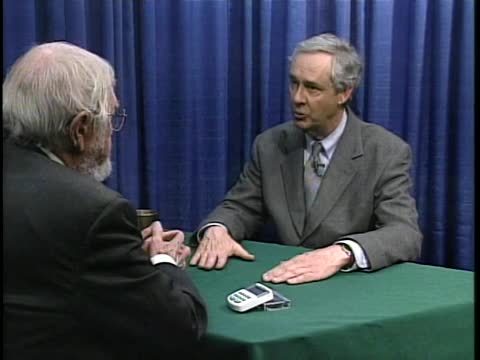
- Tom Turney, state engineer for the state of New Mexico, sits down with host Ernie Mills to discuss water issues and different projects they are working on across the state including rainfall enhancement programs and water supply development.
- Series Description
- Hosted by veteran journalist and interviewer, Ernie Mills, Report from Santa Fe brings the very best of the esteemed, beloved, controversial, famous, and emergent minds and voices of the day to a weekly audience that spans the state of New Mexico.
- Broadcast Date
- 2002-03-30
- Asset type
- Episode
- Genres
- Interview
- Media type
- Moving Image
- Duration
- 00:29:35.095
- Credits
-
-
Guest:
Turney, Thomas C.
Host: Mills, Ernie
Producer: Ryan, Duane W.
Producing Organization: KENW-TV, Eastern New Mexico University, Portales, New Mexico
- AAPB Contributor Holdings
-
KENW-TV
Identifier: cpb-aacip-0e72c8fc18c (Filename)
Format: Betacam: SP
Generation: Master
Duration: 00:28:06
If you have a copy of this asset and would like us to add it to our catalog, please contact us.
- Citations
- Chicago: “Report from Santa Fe; Tom Turney,” 2002-03-30, KENW-TV, American Archive of Public Broadcasting (GBH and the Library of Congress), Boston, MA and Washington, DC, accessed May 28, 2026, http://americanarchive.org/catalog/cpb-aacip-1fb39f3220e.
- MLA: “Report from Santa Fe; Tom Turney.” 2002-03-30. KENW-TV, American Archive of Public Broadcasting (GBH and the Library of Congress), Boston, MA and Washington, DC. Web. May 28, 2026. <http://americanarchive.org/catalog/cpb-aacip-1fb39f3220e>.
- APA: Report from Santa Fe; Tom Turney. Boston, MA: KENW-TV, American Archive of Public Broadcasting (GBH and the Library of Congress), Boston, MA and Washington, DC. Retrieved from http://americanarchive.org/catalog/cpb-aacip-1fb39f3220e