At Week's End; 904; Anne Frank Exhibit
- Transcript
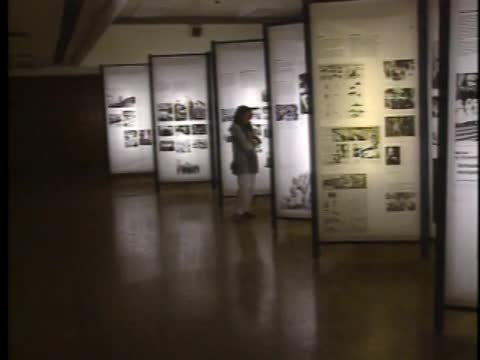
A world renowned exhibition probes the causes of fascism and hatred and asks us to face their persistence today, next at Weeksend. Welcome to Weeksend. I'm Dan Vukulich. This is the world renowned exhibition and Frank in the World, 1929 to 1945. It is an exhibition which examines the terrible causes and consequences of Nazi fascism 50 years ago, causes and consequences which are all too relevant today. And Frank was 15 years old when she died in the Bergen-Belsen concentration camp.
The Frank family had done everything they thought possible to flee Nazi persecution. They fled their home in Germany, emigrated to Amsterdam, hid from the Nazis for two years before they were turned over by Nazi sympathizers and finally were sent to the camps. Throughout her ordeal, Anne maintained a sense of hope and tried to make sense of the madness surrounding her by composing her now famous diary. Anne Frank in the World, 1929 to 1945, is an exhibition which chronicles the events that led to Anne's fate. It poses fundamental questions about the nature of human behavior, questions such as how can moral people tolerate discrimination? How do people convince themselves that scapegoats deserve their unjust fate? How do we take responsibility for these ultimately very personal decisions? This remarkable exhibition incorporates the Frank family photo archive to portray the
events that led to Anne's and her families suffering a death. It challenges viewers to grapple with the racism her family was forced to endure and to recognize the persistence of discrimination and even genocide in our world today. With this is Regina Turner, project director of the Anne Frank exhibit. I appreciate you being here Regina. You worked for three years to bring this exhibit to Albuquerque. My question to you is why Albuquerque, why now? What do we need to learn from the Anne Frank experience? We need to learn and what this exhibit does teach is the dangers of discrimination and that we must be vigilant about our own human rights. We need to learn how to look at this exhibit. Here the people that are scheduled to talk in conjunction with this exhibit and for students we have mostly after every tour we have individuals, survivors, hidden children, individuals
that lived in Europe at this time or escaped from Europe who can personalize this for the students. Germany in 1933, 1945, that's far different world from Albuquerque to Mexico in 1995 or is it? Well, really it worked. Yeah, I mean the question I always ask in many survivors as well is what have we learned? What have we learned from what went on in Germany at that time? What have we learned from the Holocaust and I don't feel we've learned that much. I think that there was always, for generations, kind of an underlying current and Jews certainly did experience good times in Europe and again bad times and at that time in 1929, well 1933 when Hitler actually came to power and Jewish people really believed this was just another
bad time and that it would pass. And so I don't think it was something that just came on overnight, it was an underlying current. There were good people in Germany as well, but I guess my point is how the good people came to allow this to happen, I mean to not speak up, to not step up, what goes on in the minds of somebody. I think the good people, we're all the good people and I think what happened there and what can happen here and is that people get brainwashed in a very subtle way. I don't even think that people realize that these things are actually happening. It's such a subtle thing, one day there are a few rights taken away and then the next
day, okay, in Anne Frank's time, the next day they couldn't write, the kids couldn't write their bicycles and the next day they couldn't shop after three o'clock in the afternoon and it was all a very gradual thing and I think the masses, it's such a psychological kind of brainwashing that everyone was exposed to and everybody fell into that somehow. There were a few that didn't. What proof did Hitler offer that the Jews were the problem, I mean as far as I can tell, Germany had a horrible economy, they were devastated by the Allies after World War 1, I mean how is it that we can pick on one group? Well, again it's the stereotyping, the stereotyping that's gone on for generations about, let's say, Jewish people, I think all of us, you, I, all of these guys here that are filming us right now, I think we all are looking for some kind of escape goat, we're all looking
for someone that we can blame our own personal problems on. Is that part of humanity or is that part of all society? I would, you know, I'm not an expert in this but I would say unfortunately yes and I think that we must all strive to take some personal responsibility for how we deal with people. We need to deal with people the way they, the way we would like to have them deal with us with compassion, tolerance and understanding. Let me take you back to one last question and that is in the family, the family is where values are set, family is where family tradition, ethnic pride is developed but at the same time it seems like in the family is also where some of the very problems develop.
I was just wondering if you have any hope at all that the children can get the message if the adults don't. We perpetuate this, we perpetuate and that's what's so tragic about it and all I can say as, you know, as just an individual who feels so strongly about this and an individual who has, you know, brought this exhibit not only here to Albuquerque but a smaller one to eight cities throughout this state, that this will serve as the vehicle, as the catalyst to discuss these kinds of issues so that students will come and individuals will come to make up their own mind about these things, if they will personalize things and that they will do, they will do the right thing. We're back at the KNME studios with us are three guests to advance the discussion. Our guests are Tanya Covington, Executive Director of Peace Makers Consulting, Dr. Anita
Frank, a Holocaust survivor and behavioral scientist at the University of New Mexico Medical School and Dr. Victor Padilla, psychologist with Sequoia Adolescent Treatment Center. Welcome all of you, appreciate you being here. Dr. Frank, the first question I'll pose to you, you're a Holocaust survivor, you lived in Holland during the war, you were a Jewish girl who was taken into hiding, poses a Christian child to escape Nazi persecution to survive the war. Tell us about your experience and how it shaped your perception of ethnic and racial discrimination in the modern world. Well, my experience was basically the first message to me was that it was terrible to be who I was, that being Jewish was so bad that you deserve to be killed for it. And the first real lesson that I got from that was that I should be perfect, while I
wasn't hiding the first lesson that I received or that I integrated, was that I should be perfect, that I shouldn't draw any attention to myself, that I should become invisible, that I should not do anything wrong, that in any way could betray me. I didn't know that people who had me knew that we were Jewish, but I was so terrified that if I would do anything wrong, that they would betray me to the Nazis. So, but the worst message that I took with me was the feeling of being a worthless creature so bad. And that feeling was intensified even after the war in Holland, even after we were liberated. We were still called Christchewers by children, we were still called dirty Jews. By some, I need to stress, not by many, and it used to be children, but there was a lot of anti-Semitism in Holland, there was absolutely no debriefing of us, and it wasn't that I started looking at the world, oh what a horrible world this was, but much more my goodness, what's wrong with me?
Well, as I understand it, even after the Nazis were beaten and the Dutch celebrated the lifting of the Nazi occupation that they remained a sense of denial, even afterwards, I mean, after the war, that the Dutch did not face up to the fact that what had occurred within their country. Now, it was almost as if what happened to us, the Jews, the few of us who survived, they mean the Nazis killed the 110 out of 140,000 Jews, so Dutch Jews, so the Jewish population of Holland was decimated. And it was those of the few of us who survived, and all of us people, my age, I mean it was a child, the four of them, the war started, the eight of them, I was liberated. We all survived, and hiding, none of us survived the concentration camps, because they killed us right away. And those of us who survived, basically we came back to a country, or we lived in a country where there was absolutely no acknowledgement that anything different had happened to us, and we were not to talk about it.
Well, what were the forces that worked? How did it come to be that the Dutch people or the Germans or the French were allowed to offer up the Jews to be sent off to concentration camps to essentially pick up, pick out one group for scapegoating as a behavior scientist? How is it that this can be done? How do people convince themselves it's okay? I'm afraid I'm less generous than Regina Turner, who was a saint at heart. I'm not. I think that for most people, they can rationalize it, because it isn't happening to them. And in Holland, and I really learned this from Cornelius, who is the international director of the Anne Frank exhibit, and he clarified some issues for me, and one of the issues he clarified was that in Holland has a very calvanistic kind of orientation. And so you were taught that if you obey and you do everything right, then good things will happen to you.
So if bad things happen to you, you deserve it. So there was a sense of the Jews deserved what they got, and he said that even non-Jews are come to the Anne Frank exhibit, say, you know, what did the Jews do to deserve this? So there's that kind of philosophy. The other one is that if you do everything right, then you do everything the way I do it, there is this lack of tolerance for differences. And so it was those philosophies that I think made it possible to ignore what was happening to the Jews they deserved it. Well, Victor, New Mexico is pride itself in its diversity and its tolerance. But is it fair to say that prejudice is alive and well in New Mexico today? Yeah, I think so. You don't have to look too much further than the term illegal alien. If you want to hear about dehumanizing somebody or making them into an object, the term illegal alien is used daily. The term Cleveland Indians, Cincinnati Braves, those are dehumanizing concepts and use
of language. So you can turn off your world series if you want to really use your voice to make a difference in New Mexico today. Well, I'm wondering if Mexican-Americans are the modern scapegoats. I actually attended a fellowship at the University of Texas at Austin and was surprised to learn that 50% of the illegal aliens, if there is such a term, in this country today are from Western Europe. They're essentially Irish and German and Dutch tourists and students who just decided not to go back. But it seems like Mexican-Americans are being blamed for so many ails in this country. And not just Mexican-Americans, but Guatemalans and people seeking a better life in this country. We're here present on a daily basis to trigger the fears in white America, by, for example, of Lando Español cuando nos conviene a nosotros. As soon as we change languages, I often see fear in the eyes of white people around me. And so I think we represent, in a sense, in a psychological sense, a more immediate threat
in that if somebody switches languages on me, I feel a little anxiety right away. And people sometimes cope with that anxiety by somehow demonizing those people or thinking well, gee, if they triggered my fear, then maybe they are a fearful stimulus. When, in fact, they're not. They're people seeking opportunity. Certainly, we haven't deployed any—Generino has not deployed any agents to protect us from the Irish or the Europeans. At this point that I know of along the eastern coastline, Dr. Frank in the Southwest. Dr. Frank talked about her feeling of loss of self-worth, that to be a Jew in Holland, during the Nazi occupation, you've just lost your sense of identity and worth. I was wondering, your work with adolescents, do you feel the effects or see the effects of the dominant culture on the teens you work with, the—I'm a spanic. What is my self-worth?
Do I fit the image of what a proper child should be? A lot of these teenagers—Mexican American teenagers today, or some like to call themselves a spanic or spanish—are at the end of 600-year history of being colonized by Europeans, trying to hold on to this little thread, which is their Spanish language usage, and it's like a tiny flame and it daily gets discouraged. People who work with them project on them that they're trying to get away with something or sneak if they change languages, and that makes it very hard for those young people to keep that one little thread of their origins, which is their use of their language, with each other. Because often, the providers, so-called providers of care, are monolingual and are handicapped by their monolingualism and tend to squelch that attempt by the young people to promote their own positive self-esteem through their language. Tanya, you're an expert in conflict resolution, a mediator.
You must see the—occasionally, the results of just embedded racism or difference of opinion, the inability to understand the other person's point of view. I'll just flat out ask you, what is this formula that somehow lets people marginalize or dehumanize others, whether it's racial or ethnic or religious difference? I think that so much of it comes from fear, and I think if there is a formula, and I do believe that there is, if we study the Holocaust, we can certainly see that there were a number of events that led up to it, and the beginnings of it are always the marginalizing, dehumanizing, demoralizing of any group of individuals. Once you begin to do that, you begin to render those individuals invisible and make them that much easier to scapegoat, and once you have a group of individuals that are effectively scapegoated, basically people begin to stop caring about whether or not that group disappears,
and that leads on the road to genocide. How is it—how is it that it occurs in a modern society, not in Nazi Germany, but in Albuquerque, New Mexico today, how might that occur? Well, actually, we have lots of it going on in modern society, and unfortunately, even in Albuquerque, we have a situation here with several groups who have decided that there are certain groups who don't deserve equal rights. First of mine—the first thing that comes to mind for me is the stance by many of the so-called religious moral majority who have decided that homosexuals do not deserve their human rights and their civil rights. So as a result, they are trying to pass legislation to take that away. People are not allowed to come into the school systems and talk about alternative lifestyles,
and anyone who condones that is again helping to demoralize and dehumanize that group of people. Well, let's get at the solutions. What's the way out of this? What is the formula for reversing the trend, fixing the problem, besides just talking to each other? How do we understand that? Well, talking to each other should not be devalued. It's one of the most important things that you can do, getting people to a position where they can hear each other's experience and talk about the differences in life and talk about the things that—knowing that different people perceive things differently. Education is one of our most valuable tools, but by education I don't mean just sitting down looking at a history book. Talking to people like Anita who actually lived through something, there was a great event in history that was very—I mean, a very important event.
Listening to people, educating, talking about how those things happened in the past and how they're beginning to happen in present time. The more we do of that, the more tolerance we then begin to have for each other, once we begin to hear each other's stories. Well, let me throw something out here, and it may be shocking to folks here as well as the people at home, but in my 42 years on this planet, I've just sat down today and tried to list as many ethnic epithets—racial epithets I have ever heard in the list as phenomenal, and I've just run through a few. I mean, we've all heard these. These are all words that are in common use, and perhaps it's my point. Wap Polak, Wetback, Gook, Faggot, Mahado, Rag Head, Blue Hair, Nigger, Honky, and the list just goes on and on. I probably have offended. A thousand of people in the process, but my point is Dr. Frank in discussion with the producer of this show I saw from his notes that you said at one point that it is not people's
nature to be good, that we all seek others like ourselves to feel comfortable with. And I was wondering if you could elaborate on that, because it seems to be what's driving this, whether it's the American experience, or is it human nature? Well, perhaps I would like to rephrase the word good. I don't know what good is, but I don't believe that people are basically geared towards accepting others as equals. I think our basic preferences is to find others who are just like us, who look like us, who think like us, who have the same values that we have. So we tend to connect, I feel most connected to those people. I truly believe that what we need to do and what at the very core of much of the racism is, you need to be very secure and not to be a racist.
And I think that comes from a family life where you're nurtured. I think it's one of, to me, the greatest thing is that many of us who feel victimized and become victims, later become victimizers ourselves. Victor, is that what's driving the English only movement here, the whole idea of putting up a steel wall between us in Mexico, that somehow we, if we could point out one group, then solve our problems by keeping those people out or down? Well, it may make you feel less insecurity, which is the point that Dr. Frank was making that. If we're not giving a basic fundamental security, then we seek places to project our insecurity or our fear, and the difference of language is one place, and the English only movement is certainly one place where the United States white population is in some ways rallying around. Although I see a lot of exceptions to that. I see a lot of white people, for example, in the Southwest, working very hard to take on a second language, and I think that's a step in the right direction, and something concrete that people can do is say, yeah, I want bilingual education in my kindergarten
because my children are there, and yeah, I'm a white Anglo or German American or whatever and I want bilingual education in my kindergarten. Tony, what do you think of the angry white male syndrome? It seems like there's a reaction. There certainly is. I think that's part of what goes on in sort of the cycle of oppression, is that you get to a point where the people who have been the abusers for a very long time begin to internalize things that are going on, and they begin to then feel like they are the victims. The problem again is once they begin to sit down and talk to people who are different from themselves. They usually realize that not only are they not victimizing, but that we all play a part in the oppression, and that until you can get to the point where you start blaming someone, you're never going to get to the place where you make your own life any better. Victor, I guess I need to bring up a recent events.
There were some charges in Los Lunas about racism down there in the high school. I was wondering if it's basically coming home to New Mexico in the sense that we are going to see more discussion. Well, the thing that's unusual about that is that a marginalized group, the immigrant Mexican American, stood up and took his voice back and said this exists. When I was a junior in high school, a senior in high school, I worked for 14 weeks at a job being told by the Santa Fe Railroad, which was the employer, that that was a training position and there wouldn't be any pay for it after the 14 weeks. This was in 1964 or five. I found out through the grapefine that the other young people that were angled that were working next to me had been paid for the entire tenure while they were training and continue to be paid afterwards, but I had to do the apprenticeship unpaid. That's a live, what's remarkable about Los Lunas is that the immigrant group. It's the personal stories that Tony was talking about.
We run out of time. I really appreciate all being here. Tonya Cubington, Dr. Anita Frank, and Victor Padilla, I appreciate your time. Next week, I hope you'll join us when Kate Nelson explores the future of affirmative action in New Mexico for weeks and I'm Dan Boca-Lich.
- Series
- At Week's End
- Episode Number
- 904
- Episode
- Anne Frank Exhibit
- Producing Organization
- KNME-TV (Television station : Albuquerque, N.M.)
- Contributing Organization
- New Mexico PBS (Albuquerque, New Mexico)
- AAPB ID
- cpb-aacip-191-9995xhgc
If you have more information about this item than what is given here, or if you have concerns about this record, we want to know! Contact us, indicating the AAPB ID (cpb-aacip-191-9995xhgc).
- Description
- Episode Description
- This episode of At Week's End with Dan Vukelich features a look at an exhibition called, Anne Frank in the World, 1929–1945. Guests: Regina Turner (Project director, Anne Frank Exhibit), Dr. Anita Frank (Medical School, University of New Mexico), Victor Padilla (Sequoyah Adolescent Treatment Center), and Tonya Covington (Peacemakers Consulting).
- Broadcast Date
- 1995-10-29
- Created Date
- 1995-10-27
- Asset type
- Episode
- Genres
- Talk Show
- Media type
- Moving Image
- Duration
- 00:27:29.737
- Credits
-
-
Guest:
Frank, Anita
Guest: Covington, Tonya
Guest: Padilla, Victor
Guest: Turner, Regina
Host: Vukelich, Dan
Producer: Sneddon, Matthew
Producing Organization: KNME-TV (Television station : Albuquerque, N.M.)
- AAPB Contributor Holdings
-
KNME
Identifier: cpb-aacip-a5f0b230778 (Filename)
Format: U-matic
Generation: Original
Duration: 00:26:40
If you have a copy of this asset and would like us to add it to our catalog, please contact us.
- Citations
- Chicago: “At Week's End; 904; Anne Frank Exhibit,” 1995-10-29, New Mexico PBS, American Archive of Public Broadcasting (GBH and the Library of Congress), Boston, MA and Washington, DC, accessed May 20, 2026, http://americanarchive.org/catalog/cpb-aacip-191-9995xhgc.
- MLA: “At Week's End; 904; Anne Frank Exhibit.” 1995-10-29. New Mexico PBS, American Archive of Public Broadcasting (GBH and the Library of Congress), Boston, MA and Washington, DC. Web. May 20, 2026. <http://americanarchive.org/catalog/cpb-aacip-191-9995xhgc>.
- APA: At Week's End; 904; Anne Frank Exhibit. Boston, MA: New Mexico PBS, American Archive of Public Broadcasting (GBH and the Library of Congress), Boston, MA and Washington, DC. Retrieved from http://americanarchive.org/catalog/cpb-aacip-191-9995xhgc