¡Colores!; 802; Spanning the High Desert: New Mexico's Historic Highway Bridges; Elmo INT #1
- Transcript
You have all the questions? What would you say? Yeah. I'm all going to count to ten for me. You have the deep plastic? Oh, let me go. Pretty high. All right. I don't know. I don't know if that's going to be enough to see how much. Okay, we're home. I'll just fish a little bit with you and say, you're pretty familiar with the porco area. Tell me a little bit about the porco bridge. Well, I remember a real porco
river in bridge and everything else was a long time ago. My brothers were used to... They were older than I was and they used to go jackrabbit hunting on the east of the real porco there. And then we've seen the bridge and sometimes we'd go across it on the other side. But most of the times we hunted jackrabbits. Of course, the jackrabbits were pretty scary, smoky things and they stay out of range pretty well. Once in a while they shoot one, but most of the times the jackrabbits would be way out. And then they would shoot cotton tails and bring them home to eat. But we never ate the jackrabbits. So, we're bringing any girls out there? No, not too many girls out there. Tell me, have you been out there before the bridge was seen?
Yes, I'm pretty sure we've been out there a long time before the bridge was built. We went up the side and there was a village up there on the east side of the real porco bar. About three miles from where the president bridges that and we used to go up there. My dad used to haul supplies over there to sheep camps and everything else. One time we would haul a load of Bob wire over there and some fence posts. Of course, that place over there didn't have no fence posts around anywhere close. And they'd make corrals and things like that for the sheep. And there were two different outfits that had cheaper inches back in there. And we'd sometimes had the haul water to them in the summer time. And when we first went over there, it was just a kind of a wagon trail
over there. It was pretty rough on the trucks and everything. Because the bumps and ruts were not the right size for a car and nothing to go on. So was it pretty hard to get through? Well, it was a little bit hard, but of course that was kind of a sandy hill and everything else. And it wears down pretty fast and everything. So you remember going out there and bringing some bar wire and fence posts out there? No, we'd take some out there, yes. See, I was only 18 years old there at the time, but I was riding a logger. I wouldn't carry none of the Bob wire bishops either just to go for the ride. I had older brothers, I had two or three older brothers drove their trucks. And I'll pick up things and things like that.
Sometimes we'd haul wool back, but most of the times they brought it in on the wagons. Because it was pretty slow going then. They would cheer them and they wouldn't have too much. So when was this? Right around the 1930, 28, 29 and 30. And what kind of business did your dad have? My dad had trucks, most all of his life ever since. See, I'd come from my way, but I could tell the story. When I got to New Mexico, I couldn't even walk. And everybody wants to know why. I thought I was too dead young. I was ordered by six months old when my dad had come here to New Mexico. I was born in 1917, and I was just about six months old when we come to Las Vegas, New Mexico. My dad
shipped all of his furniture on the train, and then he had a big car, a marine handling car, which is a big car. It's something like the study vehicle I have nowadays. Seven passenger and everything. And we come in that. At La Hanna, it broke down. It's something about the culture, the transmission that broke down. And so we changed over and come in on the train into Las Vegas. Then later he went back and picked up the car. When he picked up the car, there was trucking outfit moving in from an oil company. They was moving in to Las Vegas until he came in with them and helped them along and everything. My dad was
a mechanic and just all kinds, you know. Jack of all trades, they called him nowadays. So he'd work on the trucks and they got in to Las Vegas. One had a rubber tire missing from the truck. It was pretty bad shape. So they sent him down with it down here to Albuquerque to the Santa Fe shops. The rubber tires had to be pressed off the rim. They pressed them off and then they pressed them back on, the new one back on. And so he run the press down here and press those off and press the new ones back on. And went on back to Las Vegas with it. And 30 or 40 years later
I worked for the railroad. And at that time, when I was working for him and about 1953 or four, I run the same press that my dad had in 1917. They still had the same press operating here at the shops. Well, you need to tell me and so everybody else understands too that what exactly did your job dad do? You said he had a trucking business? Yes, he had trucks and he also had a lot of team of horses and everything else. Up there by Las Vegas, the story damn. Oh, I'm sorry. Oh, you did one over here. It's going to be so short we really need to kind of deal with just the work going on. It's trying to get a feel for work. We kind of business your dad did brought him across the work. Well, we had trucks and he delivered oil well stuff over to
seven lakes. That's the other side of grants back on to the left there. And so he'd take oil drilling rods and everything else pipe and everything or hold them over there. And then one time he had a big job. They moved. They're drilling out that moved and they had a lot of cable just laying on the ground. They had miles of, you know, when they drill a hole, they have miles of cable. So he brought that cable, he hauled that cable in and sold it to the conservancy here. And they made jetties up and down the river to control the water a little bit. So tell me. I'm sorry. No, I was just going to say I want you to say something so I really understand it. And that is if you could tell me my dad had a trucking business and he hauled
freight or something like that. You could say that to me. That would be very helpful. Well, my dad had a trucking business and he'd haul freight or anything. I don't know. He would go downtown. My dad would go downtown and talk to people and he'd get a job of hauling this or that one way or the other. And that's where he picked up his jobs. But we don't know how he got him or nothing else, but he talked to different people. And that's the way he run the business and he would haul anything they want to haul. We'd haul lumber off a top of Mount Taylor and then we'd haul ties down to from the sawmill up on top of Mount Taylor down to the railroad tracks. And then after three or four days, they'd bring a load of lumber into Albuquerque for somebody. So he was going back to fourth? Back and
forth across the bridge all the time. Kevin, let's change shots. We'll take a break in. Yeah, I'm not sure. Okay, I'm rolling. Yeah, so I wanted to talk to you about your earliest memories, say in the 1920s of going out with your brothers or your dad. And say if you were taking a load from Albuquerque out west of the Puerto Rico, what way would you go? Well, in the 20s, we always went to Los Lunas and then back that way into Laguna from Los Lunas to Laguna. And often that way, they call this other, when they put this central avenue bridge in and the road up over the hill there, they call it the Laguna cutoff, which cut off about 35 miles or something like that. It seemed like cut off quite a bit because for a long time, it was a gravel road up until about 33 when they paved it, when they put a better bridge
in and paved it. Or then we could go cross there. It seemed like we could go cross there quicker than we could go down to Los Lunas and back up that way. What were the roads like? What were the surfaces? How fast did you ride on that? Well, gravel road, you know, it's mostly corrugated, corrugated by that deep. But if you go about 50 mile an hour, you're just hitting the top of it. And it's not so bad, but boy, you slow up and it will worry you out. Did you ever see a flash flood in the Royal coming down? Once we did, once we stopped there and seen a big, about 8 or 10, of course you can't tell about how deep it was, but we just, by our gauge unit, it would
be about 10 or 12 feet deep. Was that in the parko? Right inside the parko, or Royal, and it'd be raining up above some place, raining farther north. Could you describe that again and use the word flash floods so we don't have to use my question? Your thing can be all one piece. Well, flash floods, we had a lot of flash floods at that time, and they would be three or four inches of rain in an area, and it'd run off and run into the real parko there and have raised it up pretty high. It seemed like it'd wash everything down that got in the ditch there. It was from bank to bank a lot of times. Of course, the banks are pretty
steep, you know, they're 30, 40 feet deep, and the banks are straight up and down, and it would wash everything in there. Did you happen to see any of the bridges washed out from? No, I never did. The only bridge I've ever seen washed out is the Bernal -Lewel bridge up there. It didn't wash it out. It had a big rain up above, and it just washed out there out on the side of the bridge in Buckman. And then I've seen the river be up, so high up over here on that boulevard on that bridge. They would have people over there trying to push the brush down in. The river would be so high. It has a lot of water, a lot of rain up above, and it had flash floods and everything.
And then we'd used to go across some of Roy's up above, or send a mingle back in there. There used to be a Roy there. We used to have to cross it, and that would run into the rear grand, of course, but that would get four or five feet deep, and it was a half a mile across it, seemed like. So, did you happen to see any of the construction of that porco bridge? Were you out in that territory when they were building it? Well, we see them holding the steel out there one time. We see them holding that out there. We didn't know where they were going to go with it at the time, but we were on another job. And my father, or after they got the bridge in, while they were building the road on the west side of the bridge, he all graveled for the road there for
about a month or so on the road, going to the bridge. What about the construction crews? Do you know anything about where they came from? No, I sure don't. The construction crews, I guess, they were out of Albuquerque here on Canada's closest place. That's all steel bridge, and it must be hot rivets, and they were the gas put in it. And so, but I never seen them do it, but I've seen them. Let's see, another bridge, I've seen them do it. It's on place. I don't know just where it was at, but I've seen them on. I'm from Iowa myself, and I was just thinking back how much I can remember from being ten years old or so. You're doing a real good job here. What about once the bridge got finished and the road got
improved on both sides? Did a lot of the traffic start coming down when they made that route successful? All the traffic changed. All the traffic, whenever they put the road in and paved it, all the traffic changed over to there. They just forgot about it. They were going into Los Lootons, and everything. There was a pretty bad hill out of the Los Lootons. They were going up, and it was pretty steep, and everything. Of course, he's here driving up the real percol, or with a truckload of lumber after that bridge. And those old trucks didn't have the horse power. These noons have wheeling. They only had about 60 horse power. Those first V8s we had only had 60 horse power, and we'd pull up out of the real percol. There it takes about 15 minutes to get over the hill and a lot of water in the summertime. It bore radios and
everything. But still better than going into Los Lootons in back that way. Could you compare what it was like, say in the late 20s, all in the load out to that oil rig, versus what it was like after the bridge got built, and after the highway was improved, how long it would take, how fast it could drive going out there? Well, if you'd hold it, load down to Los Lootons, and back out there. Of course, we only had turn to half trucks, and we'd hold about four turn on them. We'd go down to Los Lootons, and then go up that hill there. It was a pretty steep hill to end the Laguna, and back off in there. It took us quite a while, but this other going this way over the real percol bridge, it was
a lot shorter, and everything seemed to be a lot better, because we never went that way anymore. We stopped to go in that way. That's about 10 states. You
- Series
- ¡Colores!
- Episode Number
- 802
- Raw Footage
- Elmo INT #1
- Producing Organization
- KNME-TV (Television station : Albuquerque, N.M.)
- Contributing Organization
- New Mexico PBS (Albuquerque, New Mexico)
- AAPB ID
- cpb-aacip-191-94hmh0t7
If you have more information about this item than what is given here, or if you have concerns about this record, we want to know! Contact us, indicating the AAPB ID (cpb-aacip-191-94hmh0t7).
- Description
- Episode Description
- This is raw footage for ¡Colores! #802 "Spanning the High Desert: New Mexico's Historic Highway Bridges." From conquering the flash floods of the Rio Puerco to the beauty of the Rio Grande Gorge Bridge, New Mexico's historic highway bridges have one thing in common--they played an important role in linking the state together. This ¡Colores! celebrates how these bridges were built in the spirit of efficiency and progress, are artistic structures in their own right, and have become manifestations of our state's unique history. This program is produced with local historians David Kammer and Chris Wilson, with major funding provided by the New Mexico Highway and Transportation Department. Additional Funding provided by the New Mexico State Highway and Transportation Department.
- Description
- No description available
- Raw Footage Description
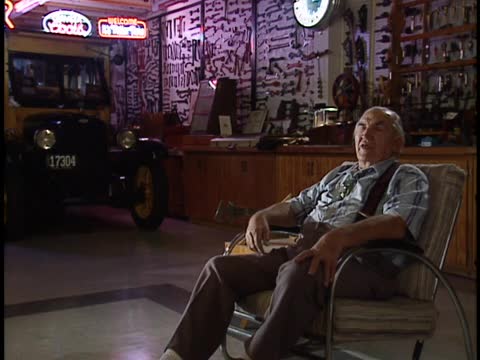
- This raw footage contains the first part of an interview with Elmo Rinehart. In this interview, Elmo discusses his childhood in New Mexico and how his father started his business. His father had a trucking business and hauled freight, and Elmo discusses how changes to infrastructure on bridges and roads improved the trucking business.
- Asset type
- Raw Footage
- Genres
- Unedited
- Media type
- Moving Image
- Duration
- 00:20:52.506
- Credits
-
-
Producer:
Kamins, Michael
Producing Organization: KNME-TV (Television station : Albuquerque, N.M.)
- AAPB Contributor Holdings
-
KNME
Identifier: cpb-aacip-af5878e6493 (Filename)
Format: Betacam
Generation: Original
Duration: 00:30:00
-
KNME
Identifier: cpb-aacip-b8894abd3e5 (Filename)
Format: Betacam
Generation: Original
Duration: 00:30:00
If you have a copy of this asset and would like us to add it to our catalog, please contact us.
- Citations
- Chicago: “¡Colores!; 802; Spanning the High Desert: New Mexico's Historic Highway Bridges; Elmo INT #1,” New Mexico PBS, American Archive of Public Broadcasting (GBH and the Library of Congress), Boston, MA and Washington, DC, accessed September 22, 2026, http://americanarchive.org/catalog/cpb-aacip-191-94hmh0t7.
- MLA: “¡Colores!; 802; Spanning the High Desert: New Mexico's Historic Highway Bridges; Elmo INT #1.” New Mexico PBS, American Archive of Public Broadcasting (GBH and the Library of Congress), Boston, MA and Washington, DC. Web. September 22, 2026. <http://americanarchive.org/catalog/cpb-aacip-191-94hmh0t7>.
- APA: ¡Colores!; 802; Spanning the High Desert: New Mexico's Historic Highway Bridges; Elmo INT #1. Boston, MA: New Mexico PBS, American Archive of Public Broadcasting (GBH and the Library of Congress), Boston, MA and Washington, DC. Retrieved from http://americanarchive.org/catalog/cpb-aacip-191-94hmh0t7