At Week's End; 518; AWE #518 Legislative Wrap
- Transcript
The 1992 New Mexico Legislature is history, but did they make any history for better or for worse next on it weeks in? The state legislature left Santa Fe this week after a 30 -day session with a decidedly mixed record, we'll have an unvarnished box score for you this week, but first a background report by Matt Snitten. The heats off for now for the New Mexico Legislature, yet many of the 112 lawmakers go home after one of the most acrimonious and tainted sessions in recent memory, not so sure of what to tell their constituents. Surely they'll mention that they met Governor King's request to increase funding for his big three, health and human services, public education, and the state's university system without raising taxes. Surely they'll mention their support for New Mexico workers by passing the collective bargaining bill, and surely they'll mention their support for the underprivileged
by appropriating money to cover shortfalls in Medicaid funding. Once again, they dodged a budget bullet and kept New Mexico chugging along, if not wheezing along, as it has since the energy crash of the early 1980s. But what else can they tell the voters back home? If Pennsylvania and New Hampshire are any indication, voters are sick and tired of incumbents who they believe are more interested in personal profit than serving their communities, and in New Mexico it turned out voters had good reason to wonder. An investigation by the state attorney general's office led to the censure of Democratic representative Ron Olguin for unethical conduct, and a series published by the Albuquerque Tribune investigating the unethical conduct of state lawmakers raised the specter of more improprieties committed by other House and Senate members. The accusations clearly put legislators on the defensive, leading Senate pro -10 money out of going to blame the problem on what he called the blood frenzy of the media. So what actions can lawmakers tell the folks back home they took to disprove those media -inspired allegations?
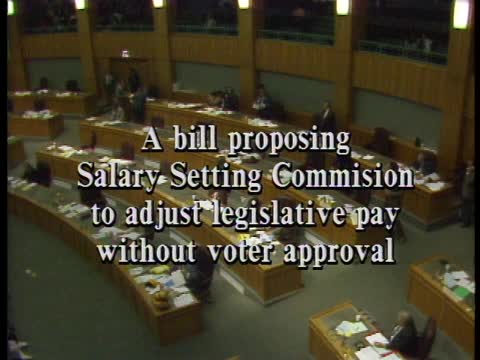
First and foremost, PAS, a $2 billion $137 million state budget, which includes increases in health and human services and public and higher education. PAS, a collective bargaining measure for the state's 90 ,000 public employees. PAS, a bill creating an ethics and campaign finance reform task force. PAS, a proposal to go before voters to create a salary -setting commission comprised of gubernatorial appointees and legislative leaders, which would have the power to adjust legislative pay without further voter approval. And a number of bills outlining campaign finance reform and designed to end what many call unethical legislative practices. Killed, a local option county liquor excise tax to raise funds to be used for the education and rehabilitation of drunk drivers, a measure disdain by powerful liquor lobbyists who argue liquor is expensive enough. Killed, video gambling and lottery proposals which would increase tourism and generate
badly needed revenues for the state's general fund. Killed, and interestingly enough a bill to allow lawmakers and their staffs enrollment in a health benefits plan which could provide access to better benefits at a lower cost than those available to most of the public, intelligently killed. On paper, the 40th legislative session looks like many others. Lawmakers doing a lot with a little, but with ongoing accusations of powerful lobbyists holding heavy influence over state lawmakers, they might have a hard -sell convincing skeptical voters at home that they did a good, honest job. Moreover, if anti - incumbent sentiment continues to grow as it has in recent months, many of those same lawmakers may find themselves sitting at home during the winter of 1993. Joining me now with a view of this session from the King Administration's Upper echelons is Secretary of Finance and Administration K. Mar. Welcome. We appreciate your coming after the fatigue of these last 30 days. You're a survivor of the battleground here. K
gave us some sense of the box score, the wins and the losses from the point of view of the governor and his people. Well, Roger, I think the governor was pleased that his priorities were addressed and funded. Principally, as you've already suggested in the preamble here, namely, monies for welfare and health, human service programs, monies for education, and for the universities. In addition, as you know, the governor had proposed a cabinet for children, youth, and families. He got that. He proposed a number of major pieces of legislation for our environmental, increasing penalties in certain areas, bringing up standards to federal standards and other areas, and he got most of those bills. So with respect, let me say, to the capital budget, there again, we had $142 million that we could authorize in bonds. Of the 92 million authorized in Geo bonds, 80 of the 90 million went to the public schools and the universities, and that's,
I think, pretty good. And of the remainder, the 50 million in Searns tax bonds, the governor was particularly interested in getting money for the dilapidated buildings of the state, particularly the hospitals, and he was successful in getting $14 million for those along. Many and none as good as shape as the legislature itself. And that wonderful new building they've got there. What were the losses here, the drawbacks? What defeats did you suffer in fiscal terms? Well, actually, I would characterize those as very small. As you know, there were some proposals to have major tax cuts, and those were defeated by very small margins in two instances. The lieutenant governor had to break a tie. There were a few tax cuts just totaling from what looks at the initial rack up to be about $6 million. So it's hard, really, to say that we suffered that many losses.
There were some special bills that the governor was interested in that he didn't get, but in this business, you know, Roger. You take what you can get. Well, you have to compromise. And as I say, on the big items, we feel very pleased to have gotten what we wanted from the legislature, and we were happy they supported his request. You dodged a bullet at one point. Brand Whitlock from Curlsbad almost lifted $100 million out of your budget to restore back to the cities, the municipalities of the state, some money that you had had transferred earlier. Demonstrated, did it not? The sort of precarious nature of this whole game. You're still walking on eggs, aren't you? It is precarious. As you know, the last two years, we've been on a very sharp ration, so to speak with respect to new revenues. Last year, we authorized appropriations of just under 6 % over the previous year. This time, the authorized level right now, this is prior, of course, to the governors taking any veto action, is 4 .7%. So
we are on a very tight leash, and most of the money, frankly, went for basic services, and that's as it had to be in our opinion. Okay, what are the policy consequences of all of this? We're in an era of the politics of scarcity. We've lowered our expectations. There's going to be a human impact, isn't there? Even of these successes, which just hold the line for the governor in terms of human services, healthcare, even in education, which got the bulk of what money you could ring out of them. That's correct. We didn't get everything we would like to have gotten for the human services department, and we are looking at potentially some program cuts. I say potentially because we're waiting to see what the impact is going to be of House Bill 441. That is the bill you know, which will allow the state to accept voluntary contributions from county indigency funds, and we could use those monies to match with federal monies, and therefore reduce the program cuts, which we would have to initiate. But I believe that Dick Heim, who's
head of the human services department, intends to go ahead and announce some program cuts by the first of March, because he can't count on that money. Nothing has come in yet. So we have to live within the budget that we have, and we're fortunate because of the new money that was generated. There was about 96 .5 million in new dollars. Human services and health between them took almost 40 percent of them. Are we more than ever hostage to what happens in the national economy? We've got presidential candidates coming in here for a June primary. He'll be talking about the destiny and future of the nation. But I take it that what happens in the rest of America is going to affect us a great deal over the next few months and a couple of years at least. Absolutely. And practically, I think it's a real opportunity for New Mexico to be heard by the presidential candidates. Because when they come in here, perhaps no one will have sought up the nomination in some instances. And I think it'll be an opportunity for us to present to them some of our primary concerns principally in the areas
of health and human services. Because that's where we have a growth, which is very difficult to control principally because it is generated or driven by federal mandates. Let me ask you a question, which was making the rounds in the legislature even during this 30 -day session, which we know is by statute somewhat limited in terms of what can be introduced and what can be considered. But a lot of people in both the House and the Senate were asking why wasn't the governor introducing more innovative, more creative legislation to save money here and there, more management programs, more cutting of waste, more general cost -effective measures that could have pulled back some of the money that's being spent now without doing harm to anybody. And why not more innovative approaches in some of these areas like health care, welfare reform, juvenile justice areas where other states have been able to save a great deal of money? Well, we're
trying to do some of that, Roger. It's not as easy as it sounds. This whole effort to create a new children and youth department is an attempt, frankly, to incorporate some efficiencies into the program. Right now, we've discovered that there are many as five to eight case managers for one family. Well, the objective by pulling all of these programs under that one agency is to see that every family has one case manager. So the problem is, even once you initiate these programs, it takes a while to feel the impact. In addition to that, there were some initiatives, for example, in this sounds a sort of mundane, but nonetheless, it's important. There was quite a bit of money sought and obtained from the legislature for new computer systems for the tax department. So we'll have more efficient collection. For my agency and the accounting side, for the all conservation people, for the general services department in terms of the mainframe. So there will be some impact, but unfortunately, it's hard to see now. They've got to be
designed and implemented, and there's probably at least a year lead time on most of those systems. In addition to that, in the environmental area, there was the bill that passed that will change the fleet, the motor pool fleet of the state to natural gas over a period of several years. Which several people found encouraging, I know, that was a rather hopeful initiative. Long term here. That's true. And so I think that there are a number of initiatives. We can't see the results of them just yet, but we will eventually. How do we break out of this cycle that we seem to be in? Legislature comes to town and they struggle with these revenue projections. They struggle to find a few million here, a few million there. They sometimes pull back what they give with one hand. You, in the executive, and it was true of your predecessors, the Republican administration, struggle with these numbers. Is there any way where are we going to have to bite this bullet of taxation and tax reforms sooner or later? Well, tax reform, I would say yes. In fact, I think the governor in ten shortly to announce the formation
of a task force on taxes to look at the whole tax structure of the state looking toward coming to the next session with some recommendations. But as for taxes, frankly, we're still hoping to avoid that bullet by introducing some efficiencies into the current operation of government. And let me just give one caveat there, Roger. The governor has a lot to do with respect to controlling spending over about a third of the budget, which is the general government. But with, and even there, we have the federal mandates in the human services and healthcare area. But aside from that, you have almost 50 % of the budget going to the schools and another 17 % going to the universities over which he does not exercise a lot of control once we release the funds to the universities and to the schools. So that's much discretion there? That's right. So that makes it more difficult. Of course, we are trying to take a number of initiatives in the economic development area. And I noticed that some of the amendments that were put back, were put in, I should say, in the House in the Senate, were to give more money
to the economic development in the tourism department. Because there, again, people feel that if we can just stimulate the economy, maybe we can generate additional money. Which, which like education is a long -term investment? Well, K -MAR, come back, come back again soon and tell us we've got more revenues and more new programs here. Thank you for joining us. Join us next for the views of two journalists who look at this legislature. Joining me now are two distinguished reporters who have watched closely the performance of this 1992 legislature. Kate Nelson is political reporter for the Albuquerque Tribune and Kathy Robbins is an independent reporter based in Albuquerque. Welcome to both of you, Kate. How would you, would you put a cap or a headline on this, in this rather motley session, dominated by the fiscal crisis and yet seemed to be absorbed in this endless dispute over how to handle ethics? Indeed, Roger.
I would put two headlines on it. There was some good and there was some bad. In terms of what they did with the budget, there are certainly questions to be raised about where this new money came from and whether it's wise and whether it will even actually show up these new tax revenues and so forth. On the other hand, what happened on the ethics front, what happened between the media and the press, what was happening in the Senate itself among different lawmakers was very painful to watch and at times to be a part of. However, I think that it was a crucible session. It's clear now that something is changing and we're going to go into an election now and trusting the public will raise these same issues with the candidates as they come up and I think next year we're going to see to some degree a different legislature. Kathy Robbins, they could pull some of the wall it seems to me over this budget, over these fiscal issues. They could juggle things back and forth but they can't really
juggle the ethics issue. Can they dodge that? They created this task force and they want to study it some more as if we didn't know what was ethical behavior in legislatures. I don't know how much longer they can avoid this issue. This is not the first time this has come up and I think this year it was a much sharper debate in part because the press has been speeding up its coverage and putting the pressure on. But I think voters too are looking at those issues whether it's here in New Mexico or or nationally and we've seen that just in the past couple of weeks. I think the task force is going to be unfortunately unless voters really put the screws on these guys is going to be another inch thick report that comes in in time for the next session and just sits there. Does anybody seriously think the voters are going to approve in November this commission with discretion to raise legislative salaries without voter review of any kind? I can't imagine that they would. I can't imagine that they would
not retain some kind of of control over it but I think that Kate wrote off a point that I think is really critical. Kate Mara when she was here talked about these increases in expenditures whereas coming from I think that is an important issue as any because I have not seen in this legislative session any effort to take a look ahead. Wednesday's Wall Street Journal had a fascinating nugget on the front page. The Federation of Tax Administrators which is a state group has been looking at the impact on various proposals for taxing taxation reform in Washington. The impact of that on state revenues and just in a really quick phone call it looks like New Mexico could be a net loser if the Bush capital gains tax goes through depending on which IRA plan goes through. New Mexico could be losing out on revenues three years hands two or three years hands and not only is there no sense of where the money is coming from this year but what happens. Kate
we know from your newspapers very distinguished series Dan Vocalich's work on conflict of interest in ethics or lack of it in legislature. Not a lot of honesty in that place when it comes to money and the handling of of campaign finance and all the rest. Were they also in a sense fundamentally dishonest about these fiscal questions because you're both suggesting that there was some slight of hand here in terms of these budget projections. It seems to me Bruce King is going to have some line item vetoes to be done here. Definitely there will be line item vetoes because there's also questionable expenditures within that budget. You can take two sides in looking at where this new money is coming from to a degree there's some voodoo involved that voodoo is based on economic projections that the Republicans themselves and their president are embracing this economy will turn around. They're spending money that they're not sure they've got yet. They're spending it on the promise that if we put this program in place we will get more money on this. Which they would advise any individual or family not to
do. Is this a reflection of a kind of economic inability in the legislature as a whole. I don't think these people have ever really come to grips with economic development questions with taxation with fiscal reform. They seem for all their their interest in making money on the side which involves them in these conflicts of interest. They seem largely illiterate in economic terms. I wouldn't call them illiterate. I'd give them far more credit than that. But they're dealing with a very complex issue when they when the economy is down and they don't have a lot of money to spend that is accompanied by a serious problem in social services because the economy is down. You have more poor people coming in for free stamps and so forth. And so with with with shrinking revenues and let's let's keep in mind that that our budget is still growing and we're far better off than most other states that are they're laying off employees and so forth. We have a lot more needs to take care of. And and in a way it's it's forcing them into coming up with these creative financing solutions.
But they haven't really touched this business of investment. Have they no creative financing in in severance fund investments. No fiddling around at all with that that huge permanent fund which amounts to a kind of endowment doesn't it. From the 70s and 80s and sitting there. What you just talked about in terms of this fiscal slides fiscal slides of hand. I mean that last minute list of highway projects that many of them are going sent to the highway department on his own you know voluntarily without the highway department knowing it was coming. The other question is these geo bonds. Look what happened to bonds last time around. They're talking about all these jobs that are create with these bonds but they haven't been approved by voters. General obligation bonds and it's and it's a risky business. I mean they're making again projections on that basis. Were there any political casualties in this legislative session. I'm thinking specifically of Ray Sanchez who may have gubernatorial ambitions even to run against a sitting democratic governor. Others who may have seen themselves emerging in the next four to eight years
but the legislature is has acquired a kind of taint hasn't it in terms of this ethics issue and and again it's inability to come up with creative new solutions. They'll have a lot of questions to answer in this campaign and yes you will see some changes next year. The leadership is always a touchy question. There's a lot that's going to happen before the next session to shore up support to look for coups and so forth. The Senate has always been a rather ambunctious group and the majorities are shaky there and if any volatility is going to happen in leadership I would suspect that's where it's going to happen. But again many things will intervene before then. Is there a partisan edge to this? I mean are we looking at a democratic republican dichotomy? It seems to me those those distinctions have blurred a lot here. I think a key issue in terms of this leadership and what's happening and how weak and how strong are they. It's going to be this South Valley county question. They've gotten it
through with one vote but everybody's on the phone from Washington or wherever you can't do this because we're going to lose the Air Force support the space systems. It's going to be interesting to see if that decision will hold or whether the governor is going to say to this leadership we can't do it. Well the constant tug and pull of local issues and what would be I guess term that the general welfare of the state came I referred to that. They almost took away a hundred million dollars in the dark night. Brand Whitlock almost got an amendment through. Only say to the last minute by Casey Luna casting the tie -breaking vote. I'm wondering if we have to live indefinitely with this what we called with K the politics of scarcity here. Anybody in either house likely to come up with with any escape hatches any reform plans anything that will take us out of this cycle. I think one of the things that disturbed me is when you ask K this question about innovation and creativity and she did mention I thought with some very good programs but I think particularly
in public education below the university level there's tremendous room for reform and savings and just looking at the big school systems in this state the huge bureaucracy that are costing so much money which is really a savings. And K sort of washed the governor's hands of any attempt to reform there even though we saw during the session representative Coddell from Albuquerque talking about the unresponsiveness of the Albuquerque public school system. There I don't know constitutionally there is room for the executive branch to move in and ask for reforms and say you have to do this. We can't afford to go on like this. Today he's done nothing. Kate if you could appoint a two or three nice positive things to say about this this sometimes unsavory session they did get some environmental legislation through collective bargaining for public officials here. Anything else? The thing is in children department I would say was the crowning jewel and
as far as innovation goes during the session I called a lot of states and tried to find out what are you doing that's innovative and to deal with welfare caseloads and so on and so forth but they're very little is out there. What most of the states are talking about is thinking about consolidating departments reducing duplication the very thing we're doing. On that end if it works and everyone's neck is on the line now to make it work that program could be in the long run of very very good program. On the other hand a high ticket item in this new department of children families and youth juvenile justice no real policy reforms there several states have saved it you think it's coming genuine. It's coming there there there there are people now who are going to be looking at those codes in and so on and so forth. This is not just rearranging the deck chairs on the titan. One hopes that yeah yeah is there any sense at all of of the impact of this legislature on the next one are we passing along to the big session in 1993 a lot of these unresolved issues or will a lot of the interim committees and the interim business which is increasingly important in Santa Fe inherit this. What's your projection for the the non legislative session? I think some of the issues are going to continue after all how many times if we had a a
bill come up or a discussion of this tax on liquor how many how many more times are going to it will next time. So there's a whole and the budget's always that issue's always going to be there and I think that inability to look beyond fiscally to look beyond the current session is going to plague the state forever. Just a few seconds Kate Nelson are the voters going to accept this this legislature it's in a sense it's obsession with the status quo it's being on dead center. I I'm hoping that I we asked in our our series whose legislature is it the answer is obviously that it is the public's legislature. I I simply hope that the public is paying attention and this is their time to do so. We hope we can contribute to that. Thank you very much Kate Nelson of the Aberdeen Tribune and thank you Kathy Robbins and thank you for joining us for it weeks in. I'm Roger Morris.
for a video cassette copy of this program send $29 .95 plus $3 for shipping and handling at weeks end K NME TV 1130 University Boulevard Northeast Albuquerque New Mexico 8 7102 or call 1 800 328 5663 visa and mastercard are accepted. Please indicate the date that program aired.
- Series
- At Week's End
- Episode Number
- 518
- Episode
- AWE #518 Legislative Wrap
- Contributing Organization
- New Mexico PBS (Albuquerque, New Mexico)
- AAPB ID
- cpb-aacip-191-870vtd3w
If you have more information about this item than what is given here, or if you have concerns about this record, we want to know! Contact us, indicating the AAPB ID (cpb-aacip-191-870vtd3w).
- Description
- Description
- No description available
- Media type
- Moving Image
- Duration
- 00:27:52.238
- Credits
-
-
Guest:
Marr, Kay
Guest: Nelson, Kate
Guest: Robbins, Cathy
Host: Morris, Roger
Producer: Sneddon, Matthew
- AAPB Contributor Holdings
-
KNME
Identifier: cpb-aacip-1e668256c47 (Filename)
Format: Betacam
Generation: Original
Duration: 00:27:40
-
KNME
Identifier: cpb-aacip-148b38a1286 (Filename)
Format: Betacam
Generation: Original
Duration: 00:27:40
If you have a copy of this asset and would like us to add it to our catalog, please contact us.
- Citations
- Chicago: “At Week's End; 518; AWE #518 Legislative Wrap,” New Mexico PBS, American Archive of Public Broadcasting (GBH and the Library of Congress), Boston, MA and Washington, DC, accessed September 13, 2026, http://americanarchive.org/catalog/cpb-aacip-191-870vtd3w.
- MLA: “At Week's End; 518; AWE #518 Legislative Wrap.” New Mexico PBS, American Archive of Public Broadcasting (GBH and the Library of Congress), Boston, MA and Washington, DC. Web. September 13, 2026. <http://americanarchive.org/catalog/cpb-aacip-191-870vtd3w>.
- APA: At Week's End; 518; AWE #518 Legislative Wrap. Boston, MA: New Mexico PBS, American Archive of Public Broadcasting (GBH and the Library of Congress), Boston, MA and Washington, DC. Retrieved from http://americanarchive.org/catalog/cpb-aacip-191-870vtd3w