Surviving Columbus: The Story of the Pueblo People; Interview with Edmund J. Ladd
- Transcript
It's still on the end of the mill, and we're getting funded for it, I think. We introduced this past, more of the legislature, so it's already a sanctioned project. Why don't you sit? I always want to say this. Okay. We got close, we got close. Okay, we'd left off at Black Rock. Okay, instead of sending the children far away, they established a school at a place called Black Rock. There's just about four miles off the east of the village, and the school was operated on a sickly military base.
All the boys and girls were separated into dormitories, and they marched to school, marched to dinners, marched to meals, and they were punished by marching the parade grounds. The boys were forced to march on with a sick foot log on their shoulder if there was any punishment. But they were not allowed to go home, nor were their parents allowed to visit the school, except on Christmas New Year's and Thanksgiving. Howly or, I'm sorry, cut that part out, please. Okay, just pick up and continue. Angle holidays. But they could see the village from where they were, and I know, because a couple of the people that I knew when I was growing up were always talking about the Black Rock school. Now the other schools that were established for boarding schools for the Indians was in Albuquerque, the Albuquerque Indian School.
The Santa Fe Indian School, Riverside, Phoenix, Haskell, and of course, Colorado closed down a little bit earlier. But those were all the schools that were established for educating the Indians of the Southwest. Black Rock was ours, and it was an operation until about 19, who were probably the 1920s. And it was a vocational training school, and interestingly enough, the government day school where I went to was also a partly vocational school where we try to learn woodwork and that sort of thing. But the missionaries that came really tried to change the complete culture of the people. They tried to change the language, they tried to eradicate the language, they tried to eradicate the religious beliefs of the people and the earlier Spanish and the Mexican period.
They didn't try to change that, but they tried to change the value system. And so the educational system was such that when I was growing up and going to school, they were saying that we were doing things like adding two and two, saying yes ma'am learning how to say yes ma'am, no ma'am. And I never knew that while I knew that Columbus discovered America from school, that's the first time I've learned about Columbus. And I know that Abraham Lincoln freed the slaves, and also the George Washington was the father of our country. And I always thought we had four fathers, because they said four fathers are four fathers and four school, whatever it was that they were saying in Constitution. And I thought we had four fathers and I said on which floor they are. And I never realized until I went to college that that was the part of the Constitution.
And so education in the early days was very poor, but we have a very, very good educational system now. We have not only a good educational system, we have almost all the children are in school. The elders that we spoke to earlier said one part of one part of his little statement was that he had gone to school one day. And my grandfather, my stepfather's father went to school one day because he wanted a pretty card that they were giving out a Christian card with a cross and a lot of bright colors on it. But they wouldn't give it to him because they wanted to give him a ration card for water. And he got mad and he never went back to school. I think that's about it. That's about it. That's it folks. It's a wrap. Cut. Wrap. Wrap. Wrap.
Wrap. Wrap. Wrap. Wrap. Wrap. Wrap. Wrap. Wrap. Wrap. wrap. Wrap. Wrap. Wrap. Wrap. Wrap. Wrap. Wrap. Wrap. Wrap. Wrap. Wrap. Wrap. Wrap. Wrap. Wrap. Wrap. Wrap. Wrap. Wrap. Wrap. Wrap. Wrap. Wrap. Wrap. Wrap. Wrap.
Wrap. Wrap. Wrap. Wrap. Wrap. Wrap. wrap. Wrap. Wrap. Wrap. Wrap. Wrap. Wrap. Wrap. Wrap. Wrap. Wrap. Wrap.
Wrap. Wrap. Wrap. Wrap. Wrap. Wrap. Wrap. Wrap. Wrap. Wrap. Wrap. Wrap. Wrap.
Wrap. Wrap. Wrap. Wrap. Wrap. Wrap. Wrap. Wrap. Wrap. Wrap. Wrap. Wrap. Wrap.
Wrap. Wrap. Wrap. Wrap. Wrap. Wrap. Wrap. Wrap. Wrap. Wrap. Wrap. Wrap. Wrap.
Wrap. Wrap. Wrap. Wrap. Wrap. Wrap. Wrap. Wrap. Wrap. Wrap. Wrap. Wrap. Wrap.
Wrap. Wrap. Wrap. Wrap. Wrap. Wrap. Wrap. Wrap. Wrap. Wrap. Wrap. Wrap. Wrap.
Wrap. Wrap. Wrap. Wrap. Wrap. Wrap. Wrap. Wrap. Wrap. Wrap. Wrap. Wrap. Wrap.
Wrap. Wrap. Wrap. Wrap. Wrap. Wrap. Wrap. Wrap. Wrap. Wrap. Wrap. Wrap.
Wrap. Wrap. Wrap. Wrap. Wrap. Wrap. Wrap. Wrap. Wrap. Wrap. Wrap. Wrap.
Wrap. Wrap. Wrap. Wrap. Wrap. Wrap. Wrap. Wrap. Wrap. Wrap. Wrap. Wrap. Wrap.
Wrap. Wrap. Wrap. Wrap. Wrap. Wrap. Wrap. Wrap. Wrap. Wrap. Wrap. Wrap.
Wrap. Wrap. Wrap. Wrap. Wrap. Wrap. Wrap. Wrap. Wrap. Wrap. Wrap. Wrap.
Wrap. Wrap. Wrap. Wrap. Wrap. Wrap. Wrap. Wrap. Wrap. Wrap. Wrap. Wrap.
Wrap. Wrap. Wrap. Wrap. Wrap. Wrap. Wrap. Wrap. Wrap. Wrap. Wrap. Wrap. Wrap.
Wrap. Wrap. Wrap. Wrap. Wrap. Wrap. Wrap. Wrap. Wrap. Wrap. Wrap. Wrap.
Wrap. Wrap. Wrap. Wrap. Wrap. Wrap. Wrap. Wrap. Wrap. Wrap. Wrap. Wrap.
Wrap. How do you like living in Zuni? You know, I was in Italy, you know. She wasn't an avocric daqui hospital. She had that accident, you know. On her late. But she walks around around. Now, you know. You know, she wasn't an hospital. We got married. I was ill-seated. Oh, by mail? This is a wristwatch band. Mmm. I don't know what this is. It's beautiful. Look at that. I've got another one. Roughly set, you know.
Check, you're running off this right now. Okay, I'm running off this right now. I don't know what it is. Uh-huh. Uh-huh. Uh-huh. She was beautiful out here in the sun. Yeah. Uh-huh.
Uh-huh. Uh-huh. Uh-huh.
Uh-huh. Uh-huh. Uh-huh. Uh-huh. Uh-huh. What's your grandfather doing there? It's going to be it. Do you help him with that? It's going to be it. Uh-huh. What's your grandfather doing there? Uh-huh. What's your grandfather doing there? Uh-huh. Good morning. Uh-huh. Uh-huh. Uh-huh. Uh-huh. Oh, you cut that. And 10 PBS. Yeah. What's your cousin? We all get 10. Yeah.
And the evening they get the school. What are you going to do with that? When you finish making those? Uh-huh. It's a two-hour documentary on the last 500 years of Pueblo, of the Pueblo's in New Mexico. And we've been working quite a bit with Ed Layard. Oh, that one. He's not a son. And the Institute of American Indian Arts out of Santa Fe. He's granddaughter. We know he's our granddaughters, and that's how we see him. He's trying to go to school, you know, go to college. We've got two kids on that side of the boy and a girl. We know them pretty well. Are you from Sydney?
I'm right. That's great. Yeah, but I'm not only living in it so far, I can get the money out of it. Do we know that that? No, well, he's been with me, you know. One different maiden, you know? And she's her not better than I think. I let her. Now, when he put a leg first, you know, he won't blame me, you know, that time. I used to be a chapter second. ST crisp two times. I learned a lot of things on that side. And on this side, he shouldn't compare to that on that side. You learn a lot more on that side than here. We don't have that kind of a good set up here. Who put the lower one? Just go ahead and eat what you can find. My grandkids.
How many grandkids do you have? A lot of them, I can't call you no. If you didn't, good that high, you know. I can't call you no. He's a nice little boy, you know. What's up, lad? Yesterday, he just kicked them one at a time. Walked back and forth. He took all the wood in there. All right. A big help. You know, these kids are trained better, I think. It's going to be up to the parents to train them. As they grow up, they get their home to do what they want. But some of these people don't have that kind of ideas. They think we can raise them and keep on helping them. As they grow older. And also, we don't feel that much. They get to help themselves. They can make their living.
So that's where I've been brought up. All my folks on this Delta Village are religious leaders. So that's where I'm taking the good steps. Thank you.
- Raw Footage
- Interview with Edmund J. Ladd
- Producing Organization
- KNME-TV (Television station : Albuquerque, N.M.)
- Contributing Organization
- New Mexico PBS (Albuquerque, New Mexico)
- AAPB ID
- cpb-aacip-191-805x6jq6
If you have more information about this item than what is given here, or if you have concerns about this record, we want to know! Contact us, indicating the AAPB ID (cpb-aacip-191-805x6jq6).
- Description
- Program Description
- The documentary‚ "Surviving Columbus: The Story of the Pueblo People‚" explores the Pueblo Indians' 450-year struggle to preserve their culture, land, and religion despite European contact. The program uses stories from Pueblo elders, interviews with Pueblo scholars and leaders, archival photographs and historical accounts to tell a full account of Pueblo Indians that is not normally found in history books. This documentary is an excellent teaching tool and essential introduction to the history and resilience of the Pueblo people of New Mexico.
- Description
- Cover Zuni Village
- Raw Footage Description
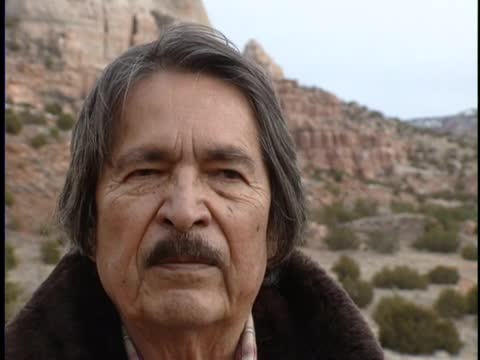
- This file contains raw footage of an interview with Edmund J. Ladd (Zuni Pueblo) about Indian Day Schools and education today. Additional footage includes shots of Zuni Pueblo and interviews with Vera and Grover Bellson.
- Created Date
- 1992
- Asset type
- Raw Footage
- Genres
- Unedited
- Media type
- Moving Image
- Duration
- 00:31:33.013
- Credits
-
-
Executive Producer: Kruzic, Dale
Executive Producer: Burdeau, George
Interviewee: Ladd, Edmund J.
Producing Organization: KNME-TV (Television station : Albuquerque, N.M.)
- AAPB Contributor Holdings
-
KNME
Identifier: cpb-aacip-3060fe0c9a0 (Filename)
Format: Betacam: SP
Generation: Master
Duration: 00:30:00
If you have a copy of this asset and would like us to add it to our catalog, please contact us.
- Citations
- Chicago: “Surviving Columbus: The Story of the Pueblo People; Interview with Edmund J. Ladd,” 1992, New Mexico PBS, American Archive of Public Broadcasting (GBH and the Library of Congress), Boston, MA and Washington, DC, accessed April 3, 2026, http://americanarchive.org/catalog/cpb-aacip-191-805x6jq6.
- MLA: “Surviving Columbus: The Story of the Pueblo People; Interview with Edmund J. Ladd.” 1992. New Mexico PBS, American Archive of Public Broadcasting (GBH and the Library of Congress), Boston, MA and Washington, DC. Web. April 3, 2026. <http://americanarchive.org/catalog/cpb-aacip-191-805x6jq6>.
- APA: Surviving Columbus: The Story of the Pueblo People; Interview with Edmund J. Ladd. Boston, MA: New Mexico PBS, American Archive of Public Broadcasting (GBH and the Library of Congress), Boston, MA and Washington, DC. Retrieved from http://americanarchive.org/catalog/cpb-aacip-191-805x6jq6