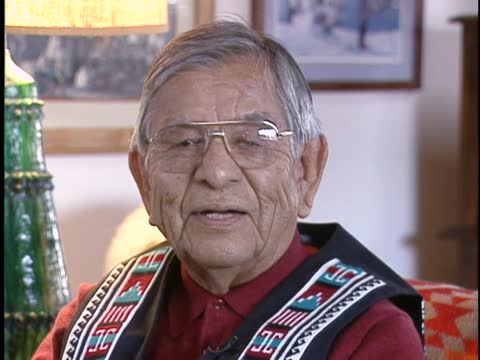
Joe Sando - Writer
- Transcript
Okay, so what is going to happen? I'll ask the questions and what we do in the editing process is we edit out me asking the question so what I need you to do is to paraphrase the question in the beginning of your answer so we have a complete thought so I don't get an answer like yes that's exactly right so for instance the first one when you first know you could write something like well I first noticed I could write when something along that you don't have to use the exact words just so we can have a complete overall fantastic check my voice it changes that's pretty good for them yes but I'll follow it through you've got many years okay Joe here's the first one you want me to repeat the question well
either repeat the question you're sort of paraphrasing oh yeah like when and if you forget I'll remember I'll remind you yes okay all right the first question is when did you first know you could write I was a senior at Eastern Mexico University about 1939 no 49 and I took a course under a professor named Thelma Mallory and one time of course that I was taking she assigned us a assignment we said we should write about an incident in our life that was exciting well I had spent two years aboard ship just before that after I was discharged I went to college anyway so I had many to choose from so I selected an incident that happened to my ship during
the Marshall Island invasion about December 1944 or something like that anyway that incident has been inscribed in my head for eternity anyway I wrote about it just the way it happened as she was quite impressed so but a week later Dr. Mallory called me to give me a note saying I want to see after class but that scared me as maybe she says English teacher didn't write it properly anyway as we met she said did you know you could write I don't believe it I would be good news for the English 101 instructor you know but that was when she told me that I could write I didn't believe it but later on when I was in my first job in Arizona I met a girl who became my wife who was writing an article for a lady radio magazine and I used to tell her that
this professor told me I could write and she said why don't you try writing so after we came back to New Mexico I wrote for a magazine and some trails published it and later on I wrote a few articles for New Mexico magazine but I didn't continue because the internal revenue or somebody kept writing me letters every month asking if I wrote anything they wanted to pay my attacks or something on it you know so I quit writing until about 1970 or something like that I was working as a counselor at the Albuquerque Indian School with a Navajo program when the Navajo education director came with a book called Navajo Biographies I read it and said they have we have to have one for the public so I started researching and published my first book called Public Indian Biographies so with that confidence built and my wife pushing me I started looking around and 1976
I came out I first book called Public Indians published by the Indian Historian Press in California so I built up a little confidence to begin writing articles for different magazines different places and that book made me I guess popular enough that I began to be called to speak all over the place and I kept on working along those lines writing articles making speeches all over the place until later on I ended up with my second book called a third book called Public Nations and I'm really proud of with it because well that was published I had why publicity in the New York Times and Los Angeles Times I don't think Albuquerque Journal published anything about it because nobody
knows me in New Mexico as well as out of state and I got many calls across the ocean to speak I've been to Spain three times and oh Switzerland and Germany and I've been to Switzerland twice and later on I was invited to come to Brazil to talk at a university and naturally I've been to New Zealand also all because of my publicity on that book Public Nations and later on I decided I would write another one about outstanding plural people because people never know anything about public English it's always about these warriors who protected their lands against invasions you know never anything about public although we were not warriors more just peaceful speakers so I wrote my last book that I had written called the purple profiles outstanding purple people from every 19
purple village so that was my last one but since then I've had contributions to other encyclopedias many magazines and also five other books that I worked with somebody and I currently am waiting for my memoirs to be published it's a publisher has it at their place their editor is working on it and then I'm working on another book on Popeye and that will be out this fall I hope by September should be out so people will learn about Popeye fantastic and have the letters from the IRS stopped as long as you write them every year with a check okay great answer here's the second well you know what you already answered it because the second question is what motivated you to do
to write your first book you already answered fantastic let's go to number three we've read that you have said Popeye was your hero that without Popeye there would be no purple culture can you explain why Popeye is important and most of the purple children knew about Popeye they will understand why the purple culture is the last of American Indian cultures that still alive new Mexico is very popular today because the Indian culture is alive here many people come to retire here many Indians come to school at the university because they know that the purple culture is alive here and it is alive because of this one man Popeye who acted in 1680 to expel the Spanish who were trying to displace our culture with what they brought so the 1980 census first came up with
the fact that in New Mexico the purple Indians were the last of the Indian tribes to retain a greater majority of their culture so since 1980 it's been known that we have our culture alive and we practice our culture all year round we have our language and we have our native religion and you have your ancestral homeland ancestral homelands we were never moved and we have our land protected by the Guadalupe Hidalgo Treaty when I have visitors come to visit and I talk to them about New Mexico and tell them what's unique about this place I tell them that this is the only place that I can think of where native people are on their ancestral land yes all the rest have been moved right and that's a major difference a major difference all right here's number four you've traveled internationally to talk about your work from your travels what was one of the most
interesting experiences you can remember the most interesting experience I can remember is my trip to Brazil we went to a Indian land Indian area they don't have reservations but we went to an Indian occupied area near Rio de Janeiro and the people they're I guess recognized me or realized that I was like like them so they gave me a kitchen doll set up there in the show looks like a kitchen doll and also a rattle that they handed to me I couldn't speak to them because they didn't they didn't speak but only their own language there were a couple of guys that spoke Portuguese but they were busy talking to somebody in our group that spoke Portuguese so there was nothing I could tell because I didn't know anything about their language and they didn't speak anything about their language but that was
the most interesting because other places that I've been the native spoke English like New Zealand so Portuguese I mean not Portuguese but Brazil was the most interesting place in my memory that I visited Indian tribe Aboriginal tribe and you didn't even need to be able to speak verbally to communicate communicated besides that in spite of that problem right fantastic all right here's the tough question I'm sure and the final one of the books you've written which is your favorite I would have to say my favorite book that I've written is The Public Nations because it's self-explanatory about the public people and I tried to oh correct many of the things that have been written because I realized today that much that has been written before the people didn't ask the local people they just guessed and that
they made our history which is often not true but my book comes out with two facts coming from the Indian people themselves because I learn about it to my uncle who learned it from my grandfather my grandfather died when I was still young but my uncle was so old enough to learn what my grandfather said so he let me understand what my grandfather used to say and not of it is history so that's why I began to appreciate history and started researching about history gee that was quick I know that's great that's all five point or similarly I would say that the biggest enemy for Indian tribes gold yep that is it's the biggest
enemy for human beings I guess all in Georgia they discovered gold the lannaka means something like gold to the people who need the dinner there's something like that the only gold that we have here is water that's right and that's you can actually eat it the yellow something you can't do anything but wear it fight over it don't shut up this name yeah I will do these and then we'll move into your studio again so
you go in. a chord or is it ceramic You want a picture of that? Cachino doll? Absolutely. But I can get it from up there if you don't want to move it. Yeah, we can just shoot there. Oh, in the rattle, too. Let's move this out a little bit. Oh. Oh. Oh. Oh. Oh. Oh. Oh. Oh. Oh. Oh. Oh. Oh. Oh. Oh. Oh. Oh. Oh. Oh. Oh. Oh. Oh. Oh. Oh. Oh. Oh. Oh. Ah. Oh. Oh. Ah. Oh. Oh. The book is coming out. That's one? Yes. I just wrote the forward on that book he gave me now. I'll just give it out.
So, some company here in town is writing the book. Those ranches, LPD press, those ranches to help it could be. Close. Have they even finished this series yet? I don't know. This was one of the very first ones. Oh, my love is always that kind of the running joke that George used to read the obituaries in the morning. And if her name wasn't in there she'd go on for the rest of the day. She was doing that joke for 30 years now. Do you get free dental work? No, friend of mine is ahead of it. He was the first public dentist.
His brother was the first physician. Both of them, those are good trades. Did you take a step to your left area? See, take a half step to your right. Open one. Make a better door than a window. What's exactly what we need right now? No. Somebody spends a lot of time cleaning your house with spotlets.
There's no way to get my picture of a board ship. Oh, yeah, that was my office. Were you a clerk? Oh, that's a few. It's like Cedar. Yes. Of course, Pipestone. I've done some carving of Pipestone. We bought some from a place in South Dakota. Oh, yeah, pieces about this big. And there's a lot of striations in it where you can chip off the pieces about that thing. The next stuff is the black. That's a very sacred item.
Go ahead and have on the keys a bit. You can start a ribbon factory here. It's all there for the violets, of course. We used to live in a regranny boulevard when we got those blue ones.
We had to have a big garden there. Okay, well, a little bit more, please. Okay, well, a little bit more. I mean, one more wipe out from this side.
Okay, well, a little bit more. Okay, well, a little bit more. Okay, well, a little bit more. Okay, well, a little bit more.
Okay, well, a little bit more. Okay, well, a little bit more. Okay, well, a little bit more.
- Raw Footage
- Joe Sando - Writer
- Producing Organization
- KNME-TV (Television station : Albuquerque, N.M.)
- AAPB ID
- cpb-aacip-191-784j175m
If you have more information about this item than what is given here, or if you have concerns about this record, we want to know! Contact us, indicating the AAPB ID (cpb-aacip-191-784j175m).
- Description
- Description
- Joe Sando - Writer
- Raw Footage Description
- Joe Sando, writer, answers interviewer's questions.
- Asset type
- Raw Footage
- Genres
- Unedited
- Media type
- Moving Image
- Duration
- 00:23:06.018
- Credits
-
-
Interviewee: Sando, Joe
Producing Organization: KNME-TV (Television station : Albuquerque, N.M.)
- AAPB Contributor Holdings
If you have a copy of this asset and would like us to add it to our catalog, please contact us.
- Citations
- Chicago: “Joe Sando - Writer,” American Archive of Public Broadcasting (GBH and the Library of Congress), Boston, MA and Washington, DC, accessed April 5, 2026, http://americanarchive.org/catalog/cpb-aacip-191-784j175m.
- MLA: “Joe Sando - Writer.” American Archive of Public Broadcasting (GBH and the Library of Congress), Boston, MA and Washington, DC. Web. April 5, 2026. <http://americanarchive.org/catalog/cpb-aacip-191-784j175m>.
- APA: Joe Sando - Writer. Boston, MA: American Archive of Public Broadcasting (GBH and the Library of Congress), Boston, MA and Washington, DC. Retrieved from http://americanarchive.org/catalog/cpb-aacip-191-784j175m