Notable New Mexicans: Glenna Goodacre; 4; Glenna Goodacre Scuplture in Washington D.C.
- Transcript
He was behind it. We say, we help say, well good, I'm ready to make it home. Look at the chair of your face, but we didn't do it perfectly, damn it. Well, hey, you know, I can't refill every cup in here. You know what? I get to rebuild every cup in here. Do you really? I'm going to have to take a cup. He could get a face lift to get away with it. And like, you're like the guy that he was, he was a shirt guy. And he lost both of his legs, both of them. I'm below the knee. And when he got his new legs, he told him he wanted to be tall. Sure. We went from 5-8 to 6-foot-1. Oh, they gave him long legs. Okay. So he became a tall guy. He said, I'm so glad I lost my legs in here. No, I got to be tall out of it. I was with a tanker at a multi-wonderful year and a half. Dave Samowski didn't want the same color eyes. He wanted, he wanted, what's the name of the book? Yeah. And his mother had a kitten. What?
Totally fine. His mother was a World War II Army nurse. Oh, was she really? Oh my gosh. That must have been hard on her when you went to Vietnam and were wounded. Oh, it was. I could hear you. Oh, it must have killed her. His sister was how? When the word came. And she said the mother went all the way around the house. Took every picture down that she had of him. And we found him all in the bottom of her head and chest. She would never put them out again. She said after she read, how he did shot. She knew he wouldn't be the same. Oh my gosh. Yeah, but look at you're still handsome. You're still handsome. I know that I survived. Yeah. And who was that? I have no idea. I know that I finally took off like my bandages. And I could see on my left. So you were at the 24th of back in Long Bend? Yeah. We were not long before they sent the headcases. We were in consciousness for the seventh. And a couple days later, they took this big pumpkin head. Banded your head off. And she had her pretty eyes.
Oh. I'm glad you remembered the eyes. If your story matches, I should give you one. You probably relate to that wounded soldier right there with the dressings of the eyes, huh? Yeah. 24th of back, what month year? Oh, 68. That's easy to remember. Yeah. Valentine's Day. He doesn't do real well for Valentine's Day. It took me years to understand why he didn't do real well. It shouldn't be that hard to find the people who took care of him. If we knew it was Valentine's Day, we knew it was Ted 1968, 24th of back. Yeah. For those who were in the OR at the time or in the ER, I would think we could find these people. Wow. Because if you remember the day, the time, the place. Yeah. He found the medic that worked on him in the field. Oh, no. And we spent time with the two guys that dragged him off the field. So they're starting to put the story back together.
It's so awesome when the nurses spend the patients find each other or the docs, you know, to find the doc who offered. Yeah. It's really, it's really, it comes full circle. No, not to the big ones. I also got another one. Okay. You got my, your name is on here, Terry. No, no, no, no, no, no. And you live where, Oh, you're not so far away. No, I'm not. Yeah. He helps veterans find out what kind of help they can get. So I have to tell the nurse, you were the handsome guy who had brown eyes. They were all handsome, they all had brown eyes. Thank you, sir. Thank you. We can probably, we know that, that's fine. Okay, but yeah, I'm here. I'm glad you made it. And you're looking great. You're looking great. We got it. Good to see you. Oh, okay, yeah. And we'll be in touch. We'll be in touch. Thanks for. Yes. Yes. Yes. Hey, this is my friend, Miko. Why can't we have Diane Carlson ever? Miko's going to seek at 11.
Oh, good. You're our speaker at 11. It's awesome. That's great. She's stationed with me at a fourth left. Now how did we find her to speak? Because we were one. Was that for you? Yeah. Okay. I knew she was here in town and I knew she had some issues that she came back and thought maybe this would be a good opportunity for me to meet some people who walked the path before her and talked a little bit about her experiences. We're really happy you're here. Thank you. We're just think it's so important to connect you. I just hope I can connect you with us. We can get the combat action. I can. There's some bitterness. I should have the combat medic back. Yeah. But by just because I wasn't attached to a combat brigade or lower that have knocked out half of my company, half of my company received the CMB, but the other half didn't. Just by sheer, we didn't have official attachment orders to a BCT. Okay.
Okay. Okay. All right. So some have it. Some have it. Some don't. Of course, none of us got a combat. Anything. We got combat paid. $65 a month. Hi. I'm dying it. A giant Nicholson. Yeah. Good to see you. Good to be here. Thank you for coming. I have something for you. Oh, I want to give you. Oh, thank you. I have this program called Heart to Heart. Okay. And it's a two-fold purpose. The first purpose is I have red, white, and blue heart pins that I give to families. Okay. Okay. From Afghanistan. Afghanistan. Okay. The other is to recognize women as yourself. Oh. Who do thanks for that event? So I would like to present you with Heart to Heart. Oh, thank you, Diane. Oh. That's my husband. Thank you. You are one special woman. Oh.
This means so much. I love it. Thank you. Yeah. A friend of mine makes these. And she rides the poetry for me. And I decided I wanted you to have one because you can impact them so many times. Oh, I can't. I can't put this in. Oh, thank you so much, Diane. That is so sweet. Beautiful. Thank you. You're welcome. I'm going to put this pin. Somebody gave me right in there. And I don't want it to. Okay. Thank you. Thank you so much. Thank you. Thank you. Thank you. You have a wonderful wife. Well, that's a good program. A great program. Thank you. I'll send that. Okay. All right. Thank you. Thank you. Thank you so much. Thank you. Thank you. Okay. All right. Thank you. You want me to move away? No. North Dakota. Oh, North Dakota. Of course, Montana. Well, I grew up in Minnesota. I live in Montana. And my mother's family is all in North Dakota. Are they?
And every time I drive the home for a month, I went out to another. And you survived for three years. I stayed a whole other family. So you were down in the rice chatters for a while? No. Everything was North Coast I got. Okay. Like Benoit. I mean, that's where our base camp was one lock. We got over in and saw like 18 to me a 69, we had I got 14 friends on the wall. Oh, man. We killed 240 from them. Thanks to the Colbert. Do you know the gun? Yeah, we've had that way when it just started to charge us out. Yep, it's it. It's powder. Yep. So were you on the Colbert? Were you on the Colbert? No, no. 155 artillery. Okay. But I said thank you then. I'm still here. Yeah, they saved her, but I'm not to Colbert pilots since I've been here. They're somewhere around. They don't talk much. No, they don't. They're crazy. They don't talk much. Do they? No, they don't. They do not. They can barely get it out of them that they food Colbert. I got you. I got you. I got you. But their heads down. Don't they? Exactly. They're killing machine. They're killing machine. Exactly. They saved so many lives. That's the part. They don't understand. Right. Yeah. That's
they don't understand what part. That they saved so many lives. That they saved lives. But they all they think about is all the lives they took. Yeah, for the whole state or your chapter. That's great. That's great. Good. Good. Good. That's low. Lie below the radar when I retired. I mean, I'm in a tone of 7,800 and they said you're going to be our next mayor. We've been mayor for a couple of years. I love that. Well, tell me your name. So, next time I see your name. Yeah. Standvolder. Hey, give me your card. Yeah. Standvolder. Let me see how you spell that. Yeah, I'm going to see. Standvold, you're good. Scandinavian. Just I'm Norwegian too. Yeah, what's your name? Carlson. Well, okay. But my dad's family came from Sweden and homesteaded the farm that I grew up on. And so, no, I grew up in Minnesota. But my dad was a doctor. He grew up. And so I called dad and I said, Dad, I should come home to tell you this, but I'm so excited. I have to tell you on a phone, but I found your family. And he was just like,
oh my god. And I said, I know I found where your mother's buried. His mother had abandoned him. She was buried 35 miles from the farm he grew up on. And where he was left on the Swedish farm. I said, that's the good news. The bad news is we're in our way. They're poor. Standvold. That's what you're here today for storytelling. That's weird. And while they did that stuff, he didn't want you to know what we can do for so many folks. Just change their patterns, change their kind of long. And then listen to the story. The woman, she was a nurse in that. Her friends probably had one too many tears. Nice talking to you. Yeah, you too. Multiple cases to laugh. And it was not really nice to get each other long embraces and hugs. And so I'm going to stand on the side. I'm going to stand on the side for a moment. This memorial was dedicated 14 years ago. So we hope that we're back with us again. Our next memorial, when we celebrate, we're just going to kick in here. I have a kink in my back. I want to be in the sun. Say, oh my goodness, you look exactly the same.
We are so honored to both have these women and men and women that are close and feeling and wellness and bravely. But they also remind us that marriage is so important. Give me your card card. And I think one of the things that's beautiful about this memorial is the pants to see their eyes. I think we, if you ever see a little children around us in the world, they love the kneeling world. I didn't know you would have a potential for eyes. And so this is the first time I go down here with my wife in a wheelchair, and I'm sorry. Is she? I remember those little papers. I am. That's too bad. It's heart and blood and blood. It's a great opportunity for things to be clear. Every Memorial Day and Veterans Day, we do storytelling. In an effort to make sure we never lose sight of the stories of wonderful men and women. People are going to get on the air out of both the civilian and military. And so we are honored to have those stories told.
But we also think it's really important that we get to that. And there's a lot of stuff like that that happens in the community all the time. So I think it's better to come to a place to tell this story in a human way. But we never want to lose sight of the fact that the sacrifice of some of these people made in Vietnam is the sacrifice that people are making today in the law that they can take around the world. So it is our honor to have younger sisters and brothers that can join us as well. We're joined today, but we'll have two of those for one second in the morning. But before we make sure people watch this year, we call it a member of the U.S. Army North Corps. And we see you serve in Iraq in 2000 this way. And we will continue to offer a warm welcome to you. Thank you. I just love to know I tried to prepare for this and I started that point down.
And what I realized is that I was just making a lot of news of events that would be difficult to see. But it was a lot longer than it would be this time. So I decided to do what I was going to do. And one of my friends was writing. So I thought I would start off with an ex-weather or something like that. My un-published, un-punished, great American novel, that was playing a little bit of my thing that he did. So it was very easy. So there I was writing my book and a half-hand check often in a book to go over to him on 24 March to 17th. Because I was writing to the dentist and I read it. I kept thinking to myself, I don't recall the thing in my nursing hours, because I really don't remember my R.O.C.S. account, I was saying that I would do something that most of the years would be a graduate,
like you can have some type or Iraqi civilians. Now I would have read that somewhere in the point of my oath of office or my endorsement process. But I know it wasn't there, at least not written. Although I heard that something was amplified in the Army, well I guess this is one of those times. Some things that helped me to get through my claim is the right off-time intervention in medical companies to apply for the one level 2 medical care is probably based on 28 years of hospital code. Good spot. Good spot. But when I was there, I was part of the WND Squad and then the other, my tent stayed behind in the Division of the Rear. And we were attached to the third infantry division. So in the sense I was, or my company was one of the medical companies for the 3ID, an interesting note that at that particular time,
as soon as the war began, they were very limited RNs on the battlefield. They didn't really set up the caches at that point, especially during all the initial entry. And so knowing that, the third ID folks knew that that I was one of the only RNs available and most of those medical companies, unfortunately did not have an RN. So they would send patients to me and then just to let you all know that I didn't, I expected to take me from my mission throughout the, throughout our crime there. So I could have gone through to discuss with you today of all of my hardships and trials and tribulations of my deployment. And there are a lot. So I don't want to bore you with all that. But the interesting part that I wanted to shed light on is, and I think that you'll hear it here, and not only that, but on all data, even though I write, it's something that brings us up and makes us
do remarkable things that you didn't think you could do. And I can say that now, because prior to going over there, I was scared, my biggest fear wasn't necessarily, I would die. I think I made a, or it came to terms with that before then. But my greatest fear, as a nurse, was would I know what to do when that patient came through my patient's hope? And I struggled with that during that full time frame. And I struggled with it now thinking, did I do the right thing? Or do I really do know what I'm doing? And what's remarkable is, my company was unique. My netics, unfortunately, they didn't. They weren't trying to take care of the time because that we had. And again, the level 1, level 2, there's limited that they could actually do. So because of our situation, we took care of fresh surgical patients, fresh amputated, our amputated limbs. My netics didn't know what to do as far as caring for them.
They knew how to pet people up, but they didn't understand the other concept of it. Patient hold is like a mini hospital, so they didn't understand that concept of it. So that was very difficult for them. But for my greatest fear was, again, I didn't think I knew what to do. And I was afraid that I would agree. And then, now, how much training I've had, I just thought that I wouldn't know what to do. I went to a nursing school and did well, and they probably thought, what am I going to do? So I'm going to fall asleep and fall asleep, well, but you just never know. I mean, I can't explain it. It was just a fear that I had. And I had a nurse mentor who said, that's fine. We all have that fear. And it doesn't have anything to combat. So it can happen in the ER or the OR. Somehow, you just pull through. So something comes out of you. And so I think that my history is not unique in that sense,
because we all have that inside of us. And I wanted to share two more things. Oh, thank you. I wrote thank you to my excerpts after I arrived trying to make light of my situation. And the best part of being able to share some of you is it's very difficult for me to do this normally, because I don't. My friends don't understand. And it is hard for me to explain it now, because I'm still dealing with my own issues, too. But there are two things I want to read to you. One is the, because I'm not finished with my book yet, is the last paragraph, and then a poem. And this was written after my deployment, and the poem was written right before the actual Brown War. So just bear with me. Maybe it would have been OK if I had someone to rely on, someone to talk to. But like always, like always, I kept myself hitting.
I kept to myself and didn't really discuss my feelings with anyone. I don't think that was the most healthy thing to do now having the opportunity to look back. I think because I cut myself off from the rest of the world, especially when I needed them the most, I am forever scarred by it. It takes more effort for me to get back what I lost to the war. No, I didn't. It wasn't on. A leg, or my life, like some of my compadres. But I lost a part of my life that I will never be able to get back. What is it exactly? I don't know. My sanity, perhaps, my innocence, something. But I do agree. Every day, I agree. And I say that because I think that part of my biggest problem was I didn't get, I didn't share it. I waited. I didn't talk to my peers and the medical company. We were all going through our own little issues there anyway. When I came back and settled back into Fort Hood, I went straight to grad school. So I didn't have to deal with the Army. Life, I was a civilian for two years.
And I didn't talk about it. It was too hard to talk to my friends because they didn't understand. And then when I came to El Paso, I thought, OK, well, this is time for me to talk. And then by then, it had already, I mean, three years had already passed. So there were residual issues that I'm still working through. And I think some of you all feel the same. And I think the hardest part for me is just being able to speak it and let you all know if not to feel so bad and you're in pain. And that's the hardest part for me, because, you know, I'm a reserved person. I'm a private. I don't want to share my feeling because I was supposed to be tough. But really, probably it's I was supposed to be fine. So the poem that I wrote, and mostly I write, or my own therapy. And I write, grows, but my heart has been poetry. That's how I do my own therapy.
And I say, I'm my own greatest strength because of that. And I wrote this poem, and it's kind of like my little medical statement. But it's called, when war is unfurl, fear floats across the sky. I stand just long enough to take pause and contemplate in the sea of sand my cause. My purpose seems so vague now. Much more so than days pass. Trying to make reason for the events happening so fast. But I can't seem to make sense out of anything. No matter how hard I try, the strength I want to stop days, all I can do is cry. And what is it that I'm crying for? I wonder. It can't be just for me. It might not selfish to only concerned about my own mortality. When there are hundreds, thousands, we'll give the ultimate sacrifice for God, country, and all they believe in. Yet let us not forget there's so much more than just that victorious wind. Lives are and will be disrupted in so many ways. How can we go back to our mundane world when war is unfurl? How can we go back?
How can I? Will it be that simple after the fall? And it's more worth it, after all. And I leave you with that thought. For me, I can say that it wasn't worth it, but in the end, I look back. And the good that came out of it is the good that I did. And like I said, I cared for the direct patients. And I look at them as the enemy. I look at them as patients. So as a nurse, I cared for those patients. So for me, it was worth it, because I learned that my greatest fear wasn't really that great. And I survived that, and I'm here. Thank you. Thank you. Thank you. Thank you. You are here, though. It's hard. Does it change? Does it? Who gives me cold?
Welcome home. Welcome home, my show. Thank you. Welcome home to this day. Thank you. Thank you. I want to start. Anytime. Really? Sure. I want to get it back to somebody. I want to start. Anytime. Yeah. I want to start. Yeah. I want to start. Anytime. Really? Sure. I want to start. Yeah. I want to start. Yeah. Right. Right. sister in propose before I started. Sprinkle tea. Sprinkle. Tribute to Admiral William J. We have Michael J. Martin here. Where are you Mikael? Where is Michael? Right behind me. us, and you all know of Michael J. Martin, I'm sure, and his songwriting and his old buddy who has passed away, and I'm sure Michael will be talking about him, and they've been
singing for us for many, many years, but Admiral Crowe was the chairman of the Joint Chief of Staff 2 terms in the late 80s, where he was Navy, he was an extraordinary man, and an extraordinary man, and he was the manager of the Joint Chief of Staff 4 terms in the late 80s, and he was the chairman of the Joint Chief of Staff 3 terms, and he was the chairman of the Joint Chief of Staff 4 terms in the late 80s. You You
You You You
You You You
You You You
You You You
You You You
You You You
You You You
You You You
You You You
You You You
You You You
You You You
You You You
You You You
You You You You You You You You You You You You
You You You
You You You
You You You
You You You You You You You You You You
You You You And ours appeared in the form of a former grunt who then the war, he'd been wounded, he'd seen but he's died. And when he came home, he believed that the amount of veterans needed something substances, something permanent to honor those who died, to honor and comfort those who served, those who waited. And he sang his song loud and clear and persistently to any of all who would listen and to a whole bunch of people who didn't want to. And that resulted in this incredible memorial. Ladies and gentlemen, he still sings our song because it's not over yet. It doesn't concern others because we know that what we're going to do is have a very special pioneer, because everyone's going to get a chance to say, if you were in a particular
branch of the military, we're going to go basically an alphabetical or whatever one here who is in the U.S. Air Force do the Puyah thing. Okay. The United States Army. It was in the United Army yesterday. Next, U.S. Coast Guard. Okay. Good. That's more than we've ever had. Statistical process. Now, how many people were in the United States Navy? No! Statistically, the number of Marines would be far fewer than any of the other servicemen, but can the Marines collectively give a hurrah, whatever you guys do, that would exceed that of the other branch of the military? Other than the United States Army! That was actually quite nice. Please stand while the military district of Washington's Army forces, polar guard, prison sculler, then remain standing.
Okay. Here to lead us in the alleged religion are three individuals who really know the meaning of service, sacrifice, they represent the families of those individuals whose names are engraved on this solemn grant wall, a high name, they are the sons and daughters in touch, chairman, Tony Cradero's father, Air Force, a major William Cradero's remembered on panel
Tunis, Katherine Upturich, president of the Gold Star-Wise of America. This has been reinforced seconded in James Lynn Upturich, the member of the Imperial panel 28 of the Memorial of America's Gold Star-Wise of America. Another Army group, Robert Lane, told myerson, one of the favorite suits you have, is that you can get done that even more than once you were here. When I had a story, I realized I could trust him. I went to him and said, I can't believe it. Ladies and gentlemen, please remove your hats. Those are uniform, please. I'm going to the flight of the United States of America and to the Republic for which it stands, one nation, under God, indivisible, with liberty and justice for all.
The United States Army course will now sing our national anthem. Oh, say, and you sing, by the dawn's early light, what so proudly we hailed at the twilight's last gleaming? Whose broad stripes and bright stars to the perilous sky, for the remedy watch, where so gallantly streaming? And the rocket's red glare, the bombs bursting in air, deep through the night, ever paying for silver.
Oh, sing, by the dawn's early light, o'er the land of the sea, and the home of the brave? Oh, sing, by the dawn's early light, please return the colors. Oh, sing, by the dawn's early light,
o'er the land of the sea, and the home of the brave? Oh, sing, by the dawn's early light, o'er the land of the sea, and the home of the brave? Oh, sing, by the dawn's early light, o'er the land of the sea, and the home of the brave?
Oh, sing, by the dawn's early light, o'er the land of the sea, and the home of the brave? Oh, sing, by the dawn's early light,
o'er the land of the sea, and the home of the brave? Oh, sing, by the dawn's early light, o'er the land of the sea, and the home of the brave? Oh, sing, by the dawn's early light,
o'er the land of the sea, and the home of the brave? Oh, sing, by the dawn's early light, o'er the land of the brave? Oh, sing, by the dawn's early light,
o'er the land of the brave? Oh, sing, by the dawn's early light,
- Episode Number
- 4
- Raw Footage
- Glenna Goodacre Scuplture in Washington D.C.
- Producing Organization
- KNME-TV (Television station : Albuquerque, N.M.)
- Contributing Organization
- New Mexico PBS (Albuquerque, New Mexico)
- AAPB ID
- cpb-aacip-191-73bzkqgg
If you have more information about this item than what is given here, or if you have concerns about this record, we want to know! Contact us, indicating the AAPB ID (cpb-aacip-191-73bzkqgg).
- Description
- Raw Footage Description
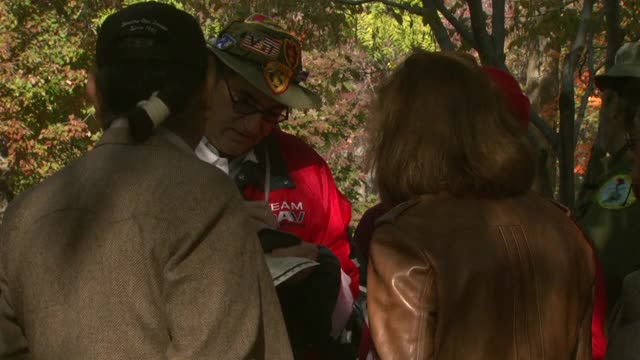
- Veteran's Day in Washington D.C., more storytelling at women's memorial, ceremony at the wall (25th Anniv.).
- Created Date
- 2007-11-11
- Asset type
- Raw Footage
- Genres
- Event Coverage
- Unedited
- Media type
- Moving Image
- Duration
- 01:05:49.300
- Credits
-
-
Producing Organization: KNME-TV (Television station : Albuquerque, N.M.)
- AAPB Contributor Holdings
-
KNME
Identifier: cpb-aacip-430d2a4a9e1 (Filename)
Format: XDCAM
Generation: Original
Duration: 01:00:00
If you have a copy of this asset and would like us to add it to our catalog, please contact us.
- Citations
- Chicago: “Notable New Mexicans: Glenna Goodacre; 4; Glenna Goodacre Scuplture in Washington D.C.,” 2007-11-11, New Mexico PBS, American Archive of Public Broadcasting (GBH and the Library of Congress), Boston, MA and Washington, DC, accessed April 4, 2026, http://americanarchive.org/catalog/cpb-aacip-191-73bzkqgg.
- MLA: “Notable New Mexicans: Glenna Goodacre; 4; Glenna Goodacre Scuplture in Washington D.C..” 2007-11-11. New Mexico PBS, American Archive of Public Broadcasting (GBH and the Library of Congress), Boston, MA and Washington, DC. Web. April 4, 2026. <http://americanarchive.org/catalog/cpb-aacip-191-73bzkqgg>.
- APA: Notable New Mexicans: Glenna Goodacre; 4; Glenna Goodacre Scuplture in Washington D.C.. Boston, MA: New Mexico PBS, American Archive of Public Broadcasting (GBH and the Library of Congress), Boston, MA and Washington, DC. Retrieved from http://americanarchive.org/catalog/cpb-aacip-191-73bzkqgg