New Mexico in Focus; 252; Drop-Out Summit Update
- Transcript
. .. .. .. .. .. .. .. .. A high dropout rate leads to a less qualified workforce and more crime for starters. It's a major concern with the Albuquerque Public School System dropout rate is reported to be at 56%. I had this week how to drop the dropout rate for all New Mexico high school students.
Plus the vote to ban the release of torture photos in the Senate opting out of a morning ritual and a controversial guest slugger here in Albuquerque. It's a financial home run for the isotopes. All this and more coming up on a show that's informed, involved, and in-depth, New Mexico focus starts right now. .. The robbery of a daddy is at restaurant on the Albuquerque's west side and the murder of one of their employees has left awake about rage and fear throughout the city. Coming up on New Mexico focus, we take a look at what more can be done and how Albuquerque needs to crack down on crime. Also coming up a possible opt-out clause for the Pledge of Allegiance at Berlio County bailout and what to do on our summer vacations. But first, look at what's being done to lower the dropout rate throughout Albuquerque Public Schools and beyond. I'm joined by two experts in the field for a discussion on how to raise a graduation rate for our students. A two-day community summit that was held in Albuquerque at the end of May to look at how to lower the dropout rate for all students took place.
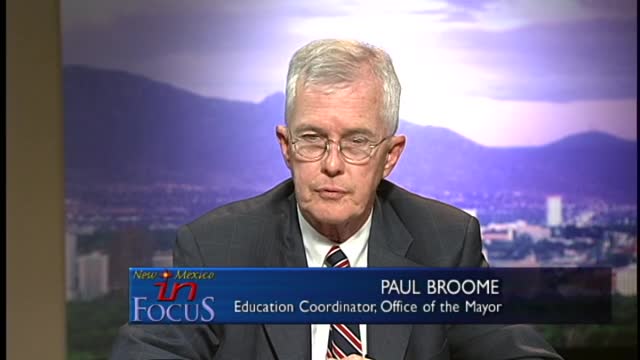
We'll get into that in a little bit. That was just the start of a plan to use the next 60 days following the summit to flush out ways to put solutions into action here in New Mexico. To talk about all that, with me today is Paul Broome. He's the Education Coordinator for the Office of the Mayor here in Albuquerque and across the table, Franklin Shargle. He is the educator, author, and president of the Shargle Consulting Group. Thank you both for joining me. Maybe Paul, we can start briefly. There's been a lot of news lately in terms of dropout rates. There was a summit last month that you attended. What was accomplished at that summit? Well, first of all, the attendance at the summit was really very gratifying and it was really rather exciting. We had 250 people here for a Friday night in a Saturday summit. We valued everybody from students to parents, to educators, to businessmen and women, politicians, school board members, superintendents of schools. Mayor Travis was there as well.
What we did at this summit is actually we brought together various solutions to the dropout problem that were generated by the community, by the community, and about 40 or 50 many summits that we conducted during the previous six months. We brought them into this summit, actually added more solutions when we were there, and we're right into the middle of mid to late afternoon and actually voted on the solutions that the citizens, the community, want to actually have implemented. That will now go to an action committee during the next 60 days as you mentioned. Paul, sticking with you before we get into more detail about the problem and of course those solutions. On the City of Albuquerque's website it describes your office this way. The Education Office works with parents, students, school officials, business community and community organizations to ensure that Albuquerque kids are getting the best education possible. Sounds great. What does it mean? What does it mean? What do you do? Well the basic you mean is just this. Mayor Travis is just giving me the charge and the autonomy to go out there and work with the community to try to solve the many education problems we actually face in this community.
We're cooperatively bringing the people together, bringing our community together to work together on these problems. He said three different major initiatives, one of which was the dropout prevention and the graduation rate problem because he has recognized this as one of the most serious problems we've had. So I go out and I meet with community people every single day to try to actually bring them all together to try to solve some of these problems. Franklin, you were involved in the planning for this summit, you have a ton of experience in this area. How important was a summit like that in terms of addressing this dropout problem? Well it's critical and Paul has done a superb job of bringing together all of these constituencies that need to be brought together to solve the problem. It's critical because no child left behind has designated that we need to handle the dropout situation which is a major problem, not just in the city and the state but in the nation as well. That of course is the federal law that aims to improve education in a more robust federal role, more money, not enough money some people say.
Right. We may get back to that in a second. Let me, Franklin sticking with you, the stats that have come out recently are alarming. And maybe we need to provide some context but there was an education week report that I think both of you gentlemen have here that right in New Mexico, 48 in graduation rates. Only the District of Columbia and Georgia and I believe Nevada were worse, Albuquerque and even lower graduation rate 44%. What do those numbers mean? How are they calculated? Basically it's self-reported data that comes from Albuquerque Public Schools, APS and is reported to the state. The state then reports it to the federal government so that there's money that comes from the feds in terms of title one money for poverty students and other additional title funding. ESL students get additional funding from the federal government so that it's inherent that the data be reported to the federal government.
But it is self-reported data. Now maybe Franklin sticking with you one, follow up on that. As I understand it sometimes there's a whole lot of devils in these details in terms of how you calculate a graduation rate or dropout rate. What happens if kids transfer? Are those kids considered dropouts? What if kids go and get a GED later? Are they not counted as graduates? It depends on the state. Some states count children who are in prison as poor indicated earlier as not having dropped out of school. So each state has its own definition and what no child was designed to do and Margaret Spelling's the former U.S. Department of Ed Secretary said we were going to have a national criteria for what a dropout is, what a high school graduate is. Because at age 24 is where the federal government continues to count. So students who are retrieved recovered accounted in that statistic as well.
As a matter of context Paul the national graduation rate I believe is 70%. So we're considerably lower. Can you shed some light on that question of how these numbers are calculated? I somewhat, a first of all Albuquerque is using what we call a cohort method. And again we've discussed this before. The cohort method basically means that they take these youngsters for four years. Okay, freshmen, sophomore, junior, junior, junior. So here's the number of kids who started in ninth grade and then here's the number of kids who graduated four years later. And then what they try to do is catch each of those kids as to what happened to them. If they transfer to another school, they try to catch those youngsters and make sure they're not counted as dropouts. If they transfer to another school district, they try to catch those kids and make sure that they're not counted. But it's a much better approach than we've had in the past because there were times a very short time ago when school districts were reporting dropout rates of 5%. And then when we dug into that we found out that 5% was actually 5% of the youngsters who started a senior year dropped out during their senior year. Well that's not a dropout.
Well we haven't done quite frankly yet. There are a number of things but one of them we're finding that dropouts are starting actually not in ninth grade. They're starting at eighth and seventh grade. We're seeing a number of dropouts there. That's not counted in there. Exactly how we count special education students in these programs is another area that we need to look at as well. So APS has made a great strides forward and quite frankly they probably are being discriminated against somewhat because we don't know what's exactly happening in any other school districts and how they're reporting. But APS has begun a drive toward more transparency in terms of trying. So to your mind Paul, 56% graduation rate for New Mexico, 44% graduation rate for Albuquerque. Those are good numbers. So I think they're good numbers especially to start from and the good news about that. The good news is that no one's making excuses about it. Everybody is recognizing that we have a real serious problem out here.
Even if the youngsters are taking a fifth year to graduate, why are they taking a fifth year to graduate? That's going to be computed beginning next year. And the other good news is that the Governor's Association has actually passed legislation, their own legislation to make sure that all of the states that are participating in the Governor's Association will become using the same formula in the next year or two to actually calculate these. So that when we look at these statistics in comparison states by state, we'll have much more confidence hopefully that the data is not only accurate, but the data is consistent from one state to another. Now, Franklin, you've studied this state for a long time across the country. Earlier today, I spoke with Representative Mimi Stewart, who's works for the school district is, I think, widely known as an expert in education policy. She's watching, I hope she's doing better because she recently is a little bit under the weather. She said the main issue to her mind, among other things, is it's an urban problem in New Mexico. The graduation rate is a problem in Albuquerque, but if you look at these small school districts that have smaller schools, lower student to teacher ratios, the problem's not as big there. Would you agree with her that this is really a city problem?
The problem is greater in the cities, in urban areas than it is in suburban areas. But the problem exists, of course, the country. There were 15 states that are producing almost 80% of all school dropouts. And if we look at the states, what are the commonalities? Well, one, they're board of states. Two, they're predominantly rural states. Three, they're spending less money on education than the high-performing states in the United States. So there are certain common factors that we need to identify among those 50 states. And again, you've identified Georgia, Nevada, Arizona, Florida, California, are all producing more dropouts. But there is a rural problem as well that is exacerbated by lower-teaches salaries for rural teachers, because the cost of living is less, and therefore many teachers are leaving rural areas and moving into cities to earn more money. Paul Franklin raises the issue of cost. And another issue that seems particularly like a big problem here in New Mexico is how much funding our schools have. I mean, you need money to pay for intervention and the variety of other things to help keep kids in school.
At this this earlier this year, there were across the board cuts in public education here in New Mexico. I think a $25 or so on the unit value per student. That's correct. It's a statewide formula. Is it fair to say that was a step in the wrong direction? Well, I've spent approximately 35 years of my life fighting for more money for public schools. There's no question. It's a move in the wrong direction, but it's also one that's caused by an economy that is unprecedentedly bad. If we are going to quite frankly rely on more money to solve this dropout problem and increase graduation rate and only on more money. We are going to be in a heap of trouble. There are problems here in our society that actually go deeper than money that you cannot buy. We are going to have to raise the consciousness of our community to the need for an education for our youngsters. We can no longer accept youngsters dropping out of our schools.
It's a we. I don't mean just the politicians. I don't mean just the teachers. I don't mean just Mayor Chavez and Paul Barum or Winston Brooks. I'm talking about the business community. I'm talking about the parents. I'm talking about the faith base community. Everybody is going to have to establish as a priority in this community, graduation and not only graduation, but also proficiency in the areas that they're studying prior to graduating because they're going to have to compete on a global basis. The issue that is actually going far, far, far beyond money. When we sit down as an action committee, we're going to address that with the people and say if you're just looking for more money, you're probably not going to see it in the next year or two, especially the way the state is running. We've got to be much more creative in dealing with this. I would like to add to what Paul has said and we're here to what you have said. It's not only about money because Washington, D.C. spends more money than any state. That's the ultimate solution, creating the awareness that there is a problem, creating the awareness that there are strategies that will lead to solutions. Is a key role in this instead of beating individual people and students and parents on top of the head, we need to create an awareness that we can get out of this situation.
Let's drill down just a tiny bit more on the problem. We'll turn to solutions here in a second. I know you're chomping a bit to talk about that. But one of the striking facts or set of facts that came out of this education week study, diploma's count, the name of the study, was the achievement gap, which is probably not news to folks who follow this, the fact that Hispanic and African Americans who's Native American students here in the state perform less well than their Anglo counterparts. I think the actual statistics were 68% of Anglo's here in New Mexico, graduate in 2006, while only 51% of Hispanics, 49% of Native Americans. There's also a gender gap. Girls seem to be doing a lot better or boys a lot worse in terms of graduation rates. What do you make of those two demographic breakouts of this problem?
Well, everyone doesn't start to race at the same starting point. Some of them are coming from families which are having greater problems prior to the recession. And so they're coming in with problems in terms of family. There are four factors that cause kids, in my opinion, to drop out. One is the child themselves. They're making decisions of joining gangs, getting pregnant, getting involved with drugs and alcohol, and we can go on and on. Second is the family they come from. There are direct correlations between children who come from families where parents have dropped out and that likelihood of them dropping out. The community they come from that born on the wrong side of the tracks and four is the kind of school that they're going to. And so that's part of the problem. Girls, based on the research, see a way up, a step up by getting more education. Why is that? I don't know. I really would like to give a call.
I think I have some idea on that. First of all, the opportunities for females in our society has actually increased tremendously in the last 20, 30 years. So that and that alone actually raises the spectrum and raises the opportunity for the girls to actually achieve and actually not only achieve, but actually gets rewarded for their achievement. This was not the case back when Franklin and I were teenagers that was not definitely not the case at all. The problem with the male in our society, the young male in our society is extraordinary, is just extraordinary. 75% of all of the folks in our prisons are dropouts. And the large percentage of those happen to be males. We are actually facing a real serious crisis with that because quite frankly, we are not competing at the education system. It's not able to compete with the distractions and quite frankly the temptations and the other opportunities if you want to call them that. That the males are facing that they're choosing, whether they be drugs, whether they be gangs, whether they be actually limited amounts of responsibility in terms of familial responsibilities.
Any of this, your child support problems, we actually have the teenage pregnancy problems, the fact that we have boys who are fathering children far too young and not able to handle the responsibilities. All of these problems are facing these kids now that we're not facing Franklin and myself when we were actually younger. And that is what we're going to have to do. That's when I say it's not, money's not going to get us out of that bag. We are going to have to change our value structure in order to actually improve the lot for those youngsters. And we have to tell those youngsters that this is what the expectations are going to be in our society. And this is how you're going to have to live in our society and we're going to have to force the issue. Now, one way to force the issue, Franklin, I imagine, will basically be to implement some of the strategies you pointed out. I'm looking at them right here in front of me. Early childhood education, I'm just pulling out a few average school opportunities. Education, technology, individualized instruction. I hate to keep beating on this, but it sounds like those things take money to pay for it, right?
The answer is yes and no. Some of those strategies involve, for example, family involvement. We need to get more families involved in families to understand what their role is in improving education. They need to provide space for their children to study. They need to go over homework. They need to just provide the questioning of students. What did you do in school today? How do we get that to happen? I mean, how do you make parents sit with their kids and read or help them with their homework? Well, they need to see, and we need to create the awareness of the improvement in life that comes with increased education. The reason the three of us is sitting at this table now is not because we were superb athletes, at least I don't think so. Although Paul was okay. Or that we're celebrities, although take exception. But we were able to thrive in the educational community. I was born in a poverty situation.
My family lived. Education was our way out of the ghetto in poverty. We need to do that. We need to convince early childhood educators that they have a role in drop out prevention. There is no such thing as high school drop out. No child wakes up in the morning and says, I'm in high school. It's time for me to drop out. It's a process. Arizona State University produced a report last June that says they have a longitudinal study that shows that children in kindergarten have already started making decisions about dropping out. If I may add to that, cooperation is one of the keys that we're going to have to have. This is one of the bright spots. You mentioned early childhood education. The city of Albuquerque named me through the mayor's office and also through the city council. And the county. And the county. And APS. I have come together through what we call the ABC community schools partnership.
And we actually applied for grant money to actually improve and expand our early childhood program. Now, this is money that is not coming from taxpayers in Albuquerque, not coming from taxpayers in New Mexico. It's coming from grant money out of the Kellogg Foundation. We won that grant. But they came to this city and they said the reason why we're giving you this money is because you folks work together. But this is just the beginning of what we're trying to do, just the beginning. The drop out problem has the same solution. We all have to operate together. And we all have to be surrounding those youngsters and letting them know one where they're to help them. But also we're there to make sure that they actually comply with what we expect those youngsters to do in our society. I met with literally hundreds upon hundreds of these students drop out to a package getting GEDs. We're not back at all who are in gangs or drugs prior to our summit and talk with them about this and explain to them the three imperatives that we actually have here. One is an economic development one. I told them the average dropout makes $9,000 less a year every year for the rest of his life than somebody with a high school diploma.
We talked about the incarceration rates as well. We talked about the societal problem. How are we going to actually be attracting high-tech industry here and hiring youngsters from China, Indonesia, Spain to come over here and take the jobs while you're cutting the grass around the company. How is that going to affect our society here? It's going to be dynamite. Then there's a civil rights issue. Then with the achievement gap that you point out, how can this society continue to actually simply be oblivious to the fact that we have African-Americans, Native Americans and Hispanics that are performing at rates far less than Asians and angles. We need to address that problem and it needs to be a community. We're addressing it here with a little time we have left. Maybe Frank was starting with you. Where do we go from here? The summit took place last month, schools after the summer. What needs to happen? What one or two things need to happen going forward?
We need to develop action plans. Everyone in our community needs to. Parents need to develop an action plan on what role parents can do and how they can get involved. The business community needs to be involved and we're setting up subcommittees of businesses that attended the summit so that they can say what role the business community, that's the Hispanic chamber and the African-American chamber. The political we've had four representatives from our political community attending. The students need to develop an action plan on what students can do and it needs to be, in my opinion, divided into two parts. One, those things that cost money and those things that don't cost money. I would actually agree with what Frank Korn is saying. I think what we should try to do is take all the solutions that came out of the summit and to try to concentrate on one or two global objectives and then put all of our resources around those global objectives to actually include some of the other solutions that were actually made in there. Because we have so many people that are contacting us on this and saying I want a part of this action.
I want to help. Not by simply going out and asking for more money. We want to get into the community just like you started to do and get out there and get the people to the point where they prioritize education for their children. And making sure that this city is seen actually as an education community and somebody who or somebody will want to come here with their companies will want to come here with their families and actually be proud of our community. There's a lot of excitement out there and I think if we can come up with that global objective or two, I think that's going to be very, very important. I hope that we can have both of you again back at this table to see if we made any progress. Paul Broome with the city of Albuquerque, Franklin, Sharkel with his own consulting. Thank you gentlemen for joining us. Thank you for having us. Now it's time to turn to Jean and the line panels to look at some of the other issues this week and on the education front. Jean, take it away. Thanks, David. Now before we further that discussion, let's introduce our panel for this week. Whitney, wait, Cheshire, regular, a long time political consultant and strategicist.
Jim Scarrantino, radio host, Albuquerque General columnist, and radio guy these days. We'll talk about that at some point. I'm sure. Teresa Cordova, former Bernalier County Commissioner and Director of Community and Regional Planning in the School of Architecture at UNM. Montoya, who still holds the Haywood Burns chair in civil rights for the SUNY-C-UNY law school. And who this summer is at the UNM Health Sciences Center serving as senior advisor to Executive Vice President Paul Roth. Thank you all for being here now. First up, we just want to discussion about the dropout rate. Not looking good. We've had a report come out saying we're 48th in the country. And I want to talk about a lot of other things that are going on in education, but let's talk about dropout. But to solve exactly what no one's really quite sure yet, but it is a problem, however. Not to be made light off. Particularly on the crime issue. I found the stat very interesting that 75% of those incarcerated are dropouts. And this makes the point how fundamentally important this is to keep kids in school. Well, the dropout rate affects social indicators across the board.
Because you get people who do make so much less, they don't fit into society. They don't feel that they're of equal worth of people around them. They were involved sometimes in gangs before they dropped out, but many of them drift that way because there's no other options. I'm glad that the city is devoting this much attention to it. It's way past time to do that. I don't know if this summit is going to be the answer, frankly. I didn't hear many really innovative suggestions there. What I would like to see someday is when the National Media does a story on an innovative model here in Albuquerque. Like we see these schools in LA and some of the other towns where you have these entrepreneurs, these visionaries, they step up and they change it. The system lets them come in and do something different and it works. I think that's what it's going to take. To receive an educator along with Margaret for a long time, interesting point there. You know that this idea that if you really want to have systemic change and really do something, you can't just nibble at the edges. You've got to really get in there and do something. But it's problematic.
We've got disinterested community of ones to believe that angle of it. But we've got these other things going on too that we've got charter schools. I want to talk about that too. A very interesting report that charter schools are not necessarily the be all end-all it seems. That there are some problems when it comes to comparing them to regular public schools and having results. Is an interesting study. They use an interesting methodology. But their outcome that they looked at were the test scores. They had to know child left behind test scores. They didn't look at graduation rates. They didn't look at ACT scores. They didn't look at other indicators. Even given that though, one of the things I think was interesting is they did show, though, however, that charter schools are effective for children of poverty, of poverty background. And so even though when you look at blacks or Hispanics, for example, it wasn't effective and as effective, and I couldn't quite tell. I didn't seem like I could have read the whole study whether or not they actually ever control for poverty with respect to Hispanic black population. But anyway, on the issue of poverty, it does show that there is some effectiveness of charter schools. I think there are good charter schools, there are bad charter schools, or they're not such good charter schools.
And I think that's one of the things that the study reaffirms. The question is, what do we learn about what works and how can we adapt what works to other charter schools? At the same time, I think what we don't want to do is follow Duncan's lead on the Secretary of Education and think that charter schools are the panacea for education. Because really, there are so many variables, so many factors that are effective in education. And that's why this study, Margaret, is probably going to be very instrumental moving forward. This was what people needed to see and feel emotionally, because it's been this thing out there that charter schools aren't the be-all end-all. And in 73 of them in the state, there's a ton of them, but not all are equal. Well, let me take perhaps a dissenting voice with some of the terminology. We know that students are pushed out as often as they drop out. And I think that that's an important distinction that students decide the schools are not working for them. And the problem is that when students leave, they leave and the conclusion that they reach is that schools are a failure.
And that message then gets communicated to the next generation. And it is very important that we intervene to make sure that we can say to those parents, your children can have a different experience. Even if it was a failure for you, we have to do something to ensure that they stay in school. I think that that's part of it. The other part of it is that I think that when we're looking at charter schools, and I thought that this methodology was interesting, what they used was a virtual twinning, so that they actually used people in the school system, and then they used software to come up with a virtual twin in order to do the comparisons. So problems with the methodology, but still, I thought they were really trying to see if they could adjust for the multiple variables. There is no denying that charter schools take money out of the school system.
And I think that we're seeing that in different places. The three-level licensure system, which is also on the table this week, because we got a report from the state legislature, $280 million were taken out of the reserves in order to put into teacher salaries. And yet, what we are now learning is that there was an expectation that it would translate into better student performance, and it didn't. Let me get Whitney in on that subject, too, about money, teacher salary, and a result. How did you look at the LLC study with you? Well, I think that I would have to remember when they put the three-tier licensure program in, it was to start rewarding teachers fairly for a job that they were already doing. I think that teachers in the state were already underpaid at that point. If anybody really thought that it was going to result in additional student performance, I think that they were misguided at that point. It wasn't ever going to be that way. But the problem with dropout rates is that there are so many different answers for what we lump into being one big problem.
In some cases, charter schools do help kids who aren't good at doing the basic structure that's already in place. They do help. Maybe it's more vocational programs for students who aren't going to go to college. You know, talking about the subject is so difficult because there are so many different answers to what we call one big problem. Dropout rate. We've got math and science charter schools. We've got creative arts. There's a lot of different missions among students. And one of the things that the study showed actually is that a large percentage of the schools are charter schools are not providing the, they're not seeing the outcomes with respect to math. Well, but maybe they were students who are already really challenged at math to begin with. And at least they were graduating, even though their test scores aren't going to improve down where they would have been in dropout rates at charter schools. What say that study exam? No, no, they didn't. What I've seen is that it's quite low in the South Valley Academy, for instance, which serves basically a lower income population. I think it's 90% Spanish speaking. It's a wonderful school.
The children are alive. They're engaged. They're connected to the community. Exactly. So there's a lot of ways to measure this. The students who are blowing doors on standardized tests are not the ones that go seeking charter schools. For the most part, I mean, unless they want the additional experience in like a technical side. What did you guys make of the results that for lower grades that turned out charter schools are actually a little more effective for as opposed to high schools? Would this something else underneath that, anybody could surmise? Well, no, but I think that probably they're just going to have to make more adjustments to reach that high school student. I mean, I also have the right honor of speaking at a charter school graduation recently, Robert F. Kennedy. And it was so exciting and so wonderful to see these young people overcome so many obstacles and to be able to get up there and receive their diplomas. It was really exciting. I think the charter schools gave them that opportunity. There are things that we know. We know that smaller classrooms work and they work particularly for the youngest students. So I think that that's part of it. But the other thing that we know is that we can peg student performance to family income.
The most important variable in all of this. And I really take issue with what you said about the lack of interest in schools. These are parents that are working two or three jobs frequently. They don't understand the school system. And schools have not done enough to really send the message that parents are welcome and are partners. And one way to really make a parent feel comfortable is to have teachers that actually come from their neighborhood. I remember when I first went, did an interview at Polk when I first started teaching. And here I was, you know, this fresh kid out and 90 percent like you said are Spanish speaking kids. And you think a parent of a child that barely speaks Spanish themselves is going to feel comfortable with a teacher who looks like me that's untried and untested. No, it doesn't make anybody feel comfortable. So what do we do that to me? And you had mentioned this earlier, what do we do about getting the right teachers and the right classrooms? Because we've got the inexperienced teachers that are just coming out for the first time that are taking the lowest paid jobs.
And the farthest reaches of the city and driving the furthest, and it's not benefiting the kids. I think we do make a great point. And I think that also the point that markets making really is very central to this conversation. Because one of the biggest problems we have facing our education system is the issue of poverty. And the impact of poverty has on these kids. So to the extent that we need more resources is the resource to help counter some of them whether they social workers, mentors, other kinds of things. But we've got to address that. Let me finish this where Jim was coming from about hearing about innovative ideas. In the kind of nuance you guys are talking about about family involvement, I did not hear terribly much in that interview with David with his two guests. And overall, in the discussion here in Albuquerque, there's not that nuance about how to bring the family. Well, but we have programs that are working, the in-lawship program, which is now statewide. It's really a program that has now been supported by the legislature. We need to expand it. It is one of the main programs is parental involvement. They know how to do it.
One other idea of bubbling out there that got some traction this last legislative session is not just smaller schools. Instead of building these schools, particularly we're seeing in the west side that just want to achieve economies of scale and educating children. There is no such thing. What the study show is that smaller schools children learn better. They graduate better and they're safer schools. Yes, that's right. Now, a new subject, a torture photo secrecy amendment was deleted from the worst supplemental bill by the House Senate Conference Committee before the bill passed or wherever the amendment banning the release of the photos. Then it passed quietly on Wednesday and unanimously in the Senate when it was voted on as a standalone measure. Now, President Obama has publicly opposed the release of these photos and many do agree saying the two release of a put our troops in harm's way. Let me add this. It's a very interesting subject to me because the President has just been very clear on this. He does not want to do this. Why do we have so many in the House and some of the Senate it seemed before we had a little bit of a flip there at the end?
That just flat out want to do this. What is the deal here? Well, I think that there is an element in this country that wants to embarrass our troops in our military at every turn that they find. Do you think that's what it is? I think that's absolutely true. Yes, absolutely. Because I think that anybody who crossed the line and did anything illegal is going through the system. This is about photos. This is about hyping it up. This is about damaging our troops. To me, though, the worst part about this was the disingenuous message that we got out of Barack Obama's administration. He didn't want to take the political hit for having to sign the executive order to protect those photos. He didn't want the political hit. He wanted Harry Reid to do it for him. And that's exactly what happened. And so to me, he ought to have just stood up and signed the executive order instead of making everybody in the Senate on members of his own party take the hit. I want the truth to come out about what happened in Iraq and Afghanistan and other third countries during the past eight years. But not when our troops will pay the price for that. But every commander in Iraq said that if you unleash these photos now, it's going to be taken out on our men and women on the streets. Some Iraqi is going to lose their head and hurt one of us.
And that's why these, particularly the people in the House and young freshman congressman, like Martin Heinrich, who voted to release these. Why they disregarded the advice of the commanders in the field. Forget the politicians. Forget George Bush. But these are the ones looking out for their constituents or in harm's way. When we are out of Iraq, I hope at that point in time we can examine exactly what happened and get to the truth of what occurred. But not when it may very well result in the harming of America. But Margaret, was there a bigger point that some who wanted to release the photos were trying to make? Was there a bigger overarching? Yeah, I think that this is about core values in a democratic order. That's what I think that this is about. This is about the fact that one of the ways that we maintain our Constitution is by making sure that when there are violations that the public have full information about it. And I am vehemently opposed to several of the positions that Barack Obama has taken that are consistent with the Bush administration.
This being only one of them. I think that unlimited, you know, detentions, the military tribunals, these are against the core values that we are after all losing blood and treasure to defend. I do not think that we, I mean, in the same way that this country had to come to terms with the internment of the Japanese. The same way that the Senate had to issue an apology for slavery. We are going to have to do an accounting and then really come to terms internally. I mean, it's also why do you think that Barack Obama ran on this message of change and said that he was going to do everything in this regard. Why is he not releasing these photos? I think that when you get in opposition, I think he's getting access to information that he didn't have before. And I think that this isn't about embarrassing the troops. It is about the issue of accountability and do we accept these kinds of values?
And people want to say people want the people who are responsible for this to somehow be made accountable. But I think the points that Jim makes and I think are really interesting, though, because it's unacceptable. I think it's clear that there were a lot of really horrible things that have been done over the last eight years. We want that accountability, but at what cost right now. And so the argument that's being made by the commanders is that it's going to put our troops in jeopardy. It's going to fuel the anti-American sentiment. And so Mike, you know, I think that he didn't want him, you know, he wasn't that he was passing off. He said, look, this is an important enough decision that more people need to be involved in making it. And I think that the accountability isn't going to be there. I mean, I guess that's the question is, do you believe that there is not going to be accountability because there are no photographs released to the general public? Well, I think that's what I'm saying. I don't think that I think it's two separate things. I think that there will be accountability. There just will not be photos to go along with this. I think of the DWI pictures that are ever setter in the paper. I've said before, I don't like those either. You know, why do you think that they're not going to be held accountable?
Did anybody else find it interesting that Jim referenced Martin Heinrich's phone? I listened to an interesting segment with Jim Belenuecie following that vote. And Jim asked it, really, she's the question, is Martin Heinrich too liberal for this district? And Martin won't ask you, it was an interesting vote for him to take when you consider he's got an armed forces committee seat with a couple of subcommittee seats dealing with preparedness and other things that are very directly tied to the troops in what they do. Well, I mean, it has been house Democrats that have been pushing on any number of issues. So, I really tip my hat to Heinrich and the other Democrats. They, in fact, are supporting the agenda, both internal and external, that Barack Obama was elected to implement. I mean, and right now, that bill is still before the house. That, you know, it hasn't passed. I mean, what happened was it was stripped out of the supplemental in order to get that appropriations passed. And now it's sitting before. But we can't experience what happened when the Abu Ghraib,
I still can't pronounce it after all these years, photos were released, was that Iraqis did take it out on Americans. I mean, what was, it was terrible what happened there, but the ones who paid the price weren't the ones in the prison or the people in the line of command who ordered it. There were the soldiers walking the beat who were being shot from windows, you know, people just distraught about what happened blowing themselves up. And that's why I'm rather appalled at people on the armed services committee who completely disregarded the advice as to the harm of the soldiers. And I think this is for political reasons. You know, one, I don't think to embarrass the troops, but to continue to beat up on the previous administration. And two, defend the flames of the left that wants to just stir this up in a regardless. And I think Barack Obama is doing the right thing on this. He is commander-in-chief. I think he was presented with the briefings. They may have even been given a number that said, if you release these in such and such district, we anticipate this many more Americans killed. And if you're a parent of that,
if you're a parent of that, of that, of that soldier, I mean, you know, if you're a parent of that soldier, I mean, you're thinking about the safety, the safety. So I mean, as this starts to get down to sort of that. I mean, the fact of the matter is this is evidence of torture, which is a violation of international knowledge. And we have not yet had the conversation in this country about who is accountable. But we do need to stop it. We do need to stop that torture. And I think that's what Barack Obama has stepped up to the plate. He's made sure that we're not doing that. He's in a tough spot on this. I would agree with the guys that say he's doing the right thing as commander-in-chief and try to get forward to this. If we get to a place of some accountability down the road, then it's all going to work out. Now, a new subject. The recent robbery and murder of an employee at a Denny's restaurant in the West Side has made even more horrific by the knowledge of at least one of the suspects, excuse me, may have been a member of one of the world's most dangerous gangs, the MS-13 gang from El Salvador. Also, the same suspects could be related to at least 10 other robberies gym, a lot of different issues here to me.
I wonder about our readiness to fight stuff like this. And I'm not trying to be an alarmist here, certainly. But our sheriff, Darren White here in the county, has been saying for months, months that there is strong evidence of other elements that we are now having to deal with. And it takes a tragedy like this. But we've also got a mayor who has promised to have a thousand cops on the street going back a long time ago. And we don't have them. Well, first is a ground rule. I will not say the names of any of these gangs. The men and women who I know that work in the gang, you see the last thing you want to do is give them free publicity. I will take that to heart. So you won't hear those letters or numbers pass my lips. This is a serious issue. This one particular group out of Central America has 10,000 soldiers in this country. These are not kids. These are not the little turf gang wars of East San Jose. This is a different phenomena than we've seen before. And they are spread around this country. They are criminal enterprise. Our law enforcement does the very best job they can with it. And our gang unit, though, I mean, they took on certain gangs
from a west coast city that invaded Albuquerque. But what they're facing now, they've told me. They have never seen anything like this. I do not think we are prepared to face this yet. Sure. Quickly, please. Well, I think probably, first off, one of the things you need to talk about is how quick the APD response was to what happened out at the Denny's on the west side. And the fact that they were able to catch them so quickly, and I believe today they talked about having... Excellent work by APD on that. Absolutely. So I mean, I think that that's the first thing. I mean, I think that the police officers on the street understand the challenges and probably know where a lot of these guys are that are going to be problematic. The question is, what kind of tools do they have to be able to apprehend them? And once they get in jail for a particular crime, how do we keep them in jail? Or how do we get them deported if they are criminal elements from another country who are here illegally? Right now, we've got a problem with a combination of laws. A lot of the Republicans are talking about it. The combination of allowing driver's licenses for people who are in the country illegally is a huge issue, as well as the differing and varying policies
from the different police departments in terms of what they are willing or allowed to do in order to determine immigration status when they pill somebody over for a routine stop or for a more criminal stop. I will tell you that in my experience, working with as many candidates and politicians as I have over the years and talking with law enforcement over the years, there is a clear difference between individuals who are in the state and in this country, maybe not here legally or with their papers in order who are just trying to work hard and make a living, versus one who are here who are criminal elements who are trying to do everything that they can to hurt us and to take as much money from us and to sell drugs from us and the cops know the difference between those people. And Marga, we said that the young man in question had self-deported and then self-brought himself back. How do we tackle this idea of the immigration side of this? Well, I think that the conversation very quickly laughs us over to over-broad categories, where it begins sounding as if though people who are undocumented commit more crimes than those who are documented.
And in fact, how do we frame this conversation? Well, but let me go on. Because all of this then laughs us over into Latino youth and Brown youth, and that we know that they get targeted for extra policing. We know that in fact, their lives are made pretty miserable in New Mexico, and particularly in Albuquerque because of something called racial profiling. And this conversation is made difficult by the fact that when we start talking about licenses to illegals to use that language makes it seem as if though that category commits crimes. And we know that they commit crimes at lower levels. Everything shows that they are not a criminal element. So I ask again, however, I ask again with due respect, if there's an issue with being able to obtain licenses and other documentation.
Policing is always about behaviors. That is what probable cause is. That we are not going to focus on these categories, such as the undocumented. We're going to look for people who are, and certainly I agree here that the police know what suspicious behavior is. Let me get our friend in here, sorry about that. Well, it's related to the conversation we had a couple of weeks ago and we talked about the Mexican drug cartels and I think the point that Margaret's making about the response as we deal with this very serious issue. We don't want it to add to what we already know of being very prevalent, which is the racial profiling and the targeting, particularly of our young men of color. We don't want that and we don't want this to begin this sort of anti-immigrant sentiment as well. The headline the other day, I think, sort of fueled that. Having said that, and I think we have to say that. We can't forget that. It has to be part of our understanding here. You made the point earlier. They know the difference between who's a gang member and who's not. And the thing is, do they? And if they do, are they really making sure
that they're targeting the gangs and not just the youth maybe? Well, I would say, can you mention the headline? That's a very good point, because we have to remember the newspapers like to sell newspapers. The way the headlines come out are not necessarily the way the politicians and candidates are necessarily talking about this issue. Anytime somebody on the Republican side starts talking about the driver's license issue or starts talking about the policy that's in place at APD because of Marty Chavez, everybody starts yelling, well, those candidates or the GOP is anti-immigrant, as absolutely ridiculous. And I mean, it's tiresome from people on the Republican side who don't believe we should be issuing New Mexico State driver's licenses to people who are here that are undocumented and then to turn around and basically be called the racist. And I mean, it's something that goes through. Well, one of the things we do need to remember is we need to remember that the economy in the United States is that immigrant labor is really critical to the economy in the United States. And we know that the ebbs and flows of immigrant entry and exit is very directly related to the flow and the needs of labor. So having said all of that, though, I think the points that Jim makes about the seriousness
of what we're dealing with, it's a very different phenomenon. It's not the morals and the ethics of old time sort of mafia, for example, which I'm not surprising. You know what I'm saying? I mean, there's a different kind of ruthlessness and randomness and it's a threat to us here. I do have a question. We need to move on, but I do have a question. I'm curious if there's a merchants association out in that part of town. And I would like to know if that merchant's association was alerted to the fact of this trend of robberies that was happening in the very tight footprint area over time. I don't know the answer to that. I'm not inferring by tone or even asking the question that something did or did not happen. I'm just curious because perhaps part of the puzzle to further our understanding about how to combat crime is to have a better information cycle and those kind of things. So people can put that kind of information together. But your point is directly on point
because it is usually the Latino community that bears the burden of those criminals. I mean, I mean, I'm not exclusively certainly, but they live in fear of under policing and the fact that these guys are, they're pretty ruthless. And I would love to see some enterprise and reporter dig out if somebody was underserved here on that very issue. I have a funny gut. Well, they were in something was not. There were police digouts up and down. Of course. It's a huge area. Okay. So they were there within minutes. They just can't have a police cruiser outside every restaurant. There's got to be something, though. And I wasn't saying the mafia was more. No, no, no. I didn't hear it that way at all. Now it's time to put our panelists to the test by putting them on the clock. You know how it works. They've got a minute as a group to tackle each of the following topics. So the rule, keep it quick. First up, Mayor Ramirez is in town. He owned this town all this week. Amazing. He's a cheat. He's a savant. He can hit a baseball. He's also a hero to some gym. I went on, let's see. What did I go? Wednesday night in the rain, it was amazing.
It was an $80 night for me and the kids and all that kind of see. See a guy this big. Who is in essence a cheater? Why do people get so crazy about this guy? What's going on here? I don't know. I'm going to offend people and say, I could care less about many Ramirez. A disgrace. You wouldn't be alone. A long millionaire who's been knocked down to the minor leagues. Yeah. Big deal. Yeah. Margaret? I really think that brought a lot of attention to Albuquerque. He was on national news all week long. Brian joked about it. You know, this is what celebrity is in our culture today. Sure. I remember when Roger Maris hit that home run, sixty-first home run. And then when Mark McQuire did it, it was to me a real, it was a kind of a real dip in baseball. Because you knew he had done it on steroids. You know, this whole issue of steroids, I think, has really changed sort of. I saw a feeling, I think it was about a seven-year-old boy had a main Ramirez, a rookie card from the Cleveland. And he was just so happy to be there with me. It was amazing. Well, I find it what's interesting is that he's basically blowing off all of our local media.
I mean, every night I watch on television. They're probably trying to get a comment. You didn't want to be here. You didn't get a comment. No, but we do list ourselves. It's true. If we don't think of, you know, it's of that importance, but look at what the television is. That's right. There's 15,000 people. What can you say? Now, Burlio County is taking the lead from the federal government and it's bail out to save some cow solar deal. Are they doing this? The county will have to spend 4.5 million to acquire land for the proposed site of solar array ventures, Inc. Because some cow could not meet the deadline the acquisition to rest. Let me start with you on this. It always seems like when the government is at the table with a deal, and it's three people, if one of those three people falls out, it's automatically the taxpayer who's going to pick up the foot the bill for this thing. And the other part of this is somewhere just the magic industry right now. Just hang out your shingle. Well, they did it in the name of jobs. So the first thing they need to go back and do is look at the other deals that Burlio County has made in the name of jobs. There's been no follow-up, no monitoring. And these IRB deals, for example, and all these tax incentive deals, for example, the promise of jobs.
Was there any monitoring? Has there been any expectation or demand for the reports that these companies promised? Do we know that they're delivering the jobs that they said they were going to deliver? Burlio County is not following up on that. We're doing this. Everything's on the horizon mark. Everything we do is like the symmetrical place down the road. And I completely agree with Teresa that we need more monitoring. We need data. But on the other hand, these are new sectors of the economy. And it isn't crazy for the government to be entrepreneurial with energy. And with that comes risk. It's not always going to work out, right? Burlio County got played. Suncowl got all these deals because they were going to buy this land and get this water line. And then they didn't do it. And Burlio County stepped up and wrote the check. My question is, our friend Mario Burgos, I think, has the headline. Will this be a quote, unquote, solar eclipse? Oh, interesting. Oh, that is fantastic. I hadn't seen that. That's very nice, Mario. Now, the public education department has a rule that the Pledge of Allegiance shall be recited each school day in the
We all know how that works. Although school policy states that students can choose to opt out of that pledge, the PD wants to make that choice official. Is this a good idea? I don't think so. The one thing that we all have in common when we get up in the morning, we go to school, we've got our lunches. No matter where we come from, we're all Americans when we walk into the classroom. And we should be saying something together as a community, it's a part of civic responsibilities. We are pledging allegiance, Jim. The wording is just very direct here. If you and those students have different first amendment rights in general population, there is a first amendment issue here. And the parents who at home tell their kids this and that about the country, they're not going to pledge allegiance anyway. The case that this comes out of the Barnett case is really beautifully written about the fact that the government cannot coerce thought. It cannot coerce loyalty. And to go back and read what people like Frankfurter, people like Black, these justices who were firmly committed
this notion of maintaining dissent, but still understanding the importance of patriotism. I think it's the right decision. It's the right outcome. We don't want people to be forced to stifle their dissent if in fact they feel that they can't. I hold you up on that one trust of my fault. Now, every kid has the, let's see, it has had to do this at least once, right? A bank to school and say about what they did over the summer. Oh my gosh, do you still, you don't do this at college. I hope not. You got any big plans? You know, I've got, I do. I have some travel plans, family and friends. But I've got to tell you, the thing I love most about summer is the smells, the sounds, the air, the cloud formations. You know, just waking up in the morning is just a really important change. Yeah. Absolutely. Tomorrow night where my husband and I are going to go see Linda Ronstad at the same mighty action music. So that's a fun thing. We have some travel. That's fine. My husband's just returned from Italy. No, wait a minute.
I'd like to stay home. That would be a different ride. My wife and I really love the farmer's markets. Our favorite one is down at Robinson Park downtown. And we're going to be heading up to do some backpacking in the wilderness area. Let's hear wilderness, which is outside the quest. Yeah, interesting. Travel? My major plan. Well, a little travel at the end of the summer, but my major plans have to do with scraping out two layers of rock and scaping paper in my front yard. Oh, my. Yeah. I'm going to do some camping for the first time. Oh, fine. It's been a long time. Get my old 1990 fall vote busting it down the street. It should be interesting. Now, there are topics you'd like to suggest for the line panelists. Send us an email at info. It can be canemy.org or drop us a line at our blog. New Mexico and focus dot org. And we'll see you next time. If you missed any of this week's show or want to get caught up on past episodes, just head to New Mexico and focus dot org and click on the link in the top left corner of the screen. Yeah, you still have a chance to vote in our online poll, which asks for your opinion on being branded, quote unquote. Yeah, by politicians on social networking sites like MySpace
and Facebook. Next week, we interview the president and CEO of the Spanish language network, VEME and walk around the National Hispanic Cultural Center here in Albuquerque with its incoming executive director and the line panelists will have a special discussion to celebrate the fourth of July. So until next time, thanks for watching and have a great week. Thank you. Thank you.
- Series
- New Mexico in Focus
- Episode Number
- 252
- Episode
- Drop-Out Summit Update
- Producing Organization
- KNME-TV (Television station : Albuquerque, N.M.)
- Contributing Organization
- New Mexico PBS (Albuquerque, New Mexico)
- AAPB ID
- cpb-aacip-191-62s4n35h
If you have more information about this item than what is given here, or if you have concerns about this record, we want to know! Contact us, indicating the AAPB ID (cpb-aacip-191-62s4n35h).
- Description
- Episode Description
- It's the summer, and the thought of school is far from the minds of many. But a summit that was held in May to address Albuquerque's high drop-out rate was just the start of the discussion for area education professionals. Host David Alire Garcia sits down with some of them to do a follow-up on the Drop-Out Summit. Then, it's Gene Grant and The Line panelists to further the discussion. Plus, a look at a vote to ban the release of torture photos, a crackdown on crime, and a controversial guest slugger hits it for the Isotopes. Hosts: Gene Grant, Weekly Alibi Columnist and David Alire Garcia, Managing Editor, NewMexicoIndependent.com. Guests: Paul Broome, Education Coordinator, Office of the Mayor; Franklin Schargel, Educator, Author, and President of The Schargel Consulting Group. Panelists: Whitney Cheshire, Political Consultant; Teresa Cordova, UNM Architecture & Planning Dept./ Former Bernalillo County Commissioner; Margaret Montoya, UNM Health Sciences Center/CUNY Law School; Jim Scarantino, Albuquerque Journal Columnist.
- Broadcast Date
- 2009-06-26
- Asset type
- Episode
- Genres
- Talk Show
- Media type
- Moving Image
- Duration
- 00:59:56.782
- Credits
-
-
Guest: Broome, Paul
Guest: Schargel, Franklin
Host: Garcia, David Alire
Host: Grant, Gene
Panelist: Montoya, Margaret
Panelist: Cheshire, Whitney
Panelist: Cordova, Teresa
Panelist: Scarantino, Jim
Producer: McDonald, Kevin
Producing Organization: KNME-TV (Television station : Albuquerque, N.M.)
- AAPB Contributor Holdings
-
KNME
Identifier: cpb-aacip-160e3af6fb8 (Filename)
Format: XDCAM
Generation: Original
Duration: 01:00:00
If you have a copy of this asset and would like us to add it to our catalog, please contact us.
- Citations
- Chicago: “New Mexico in Focus; 252; Drop-Out Summit Update,” 2009-06-26, New Mexico PBS, American Archive of Public Broadcasting (GBH and the Library of Congress), Boston, MA and Washington, DC, accessed April 5, 2026, http://americanarchive.org/catalog/cpb-aacip-191-62s4n35h.
- MLA: “New Mexico in Focus; 252; Drop-Out Summit Update.” 2009-06-26. New Mexico PBS, American Archive of Public Broadcasting (GBH and the Library of Congress), Boston, MA and Washington, DC. Web. April 5, 2026. <http://americanarchive.org/catalog/cpb-aacip-191-62s4n35h>.
- APA: New Mexico in Focus; 252; Drop-Out Summit Update. Boston, MA: New Mexico PBS, American Archive of Public Broadcasting (GBH and the Library of Congress), Boston, MA and Washington, DC. Retrieved from http://americanarchive.org/catalog/cpb-aacip-191-62s4n35h