¡Colores!; 122; Violinista de Nuevo México: Cleofes Ortiz; Kate Krasin
- Transcript
Yes, I asked the grandfather, one whoboat and some othercondos, 다 All right, let's start our meeting All right, then I really have to meet meetings Yes, thank you Everybody come out All right, hello a week, an old fashioned violin with legendary fiddle player Cleopus Ortiz. And I tell him that I have six fingers on this end, and when I try to play on the barbed wire strings, I head my finger and cut them off. See, and I still have five anyway. And the silk screen prints of Sir Rigorfer, K-Crazon. If you can help someone evoke their own feelings, if you can bring one mom's joy to anybody, you know, all of this is, to me, is the real stuff of life.
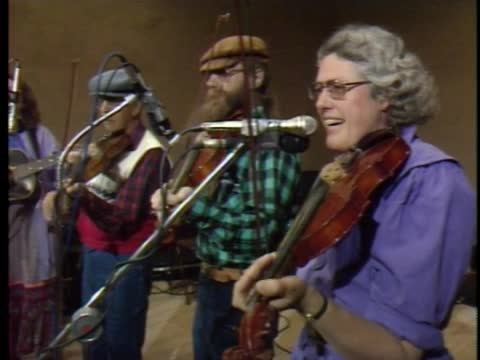
Next, Ancolores. Hi, and welcome to Colores. I'm Esther Reyes. This week, we present the delightful folk tunes of 80-year-old Cleopus Ortiz. Winning the Governor's Award for Excellence in Arts in 1986, Cleopus has become something of a state treasure. In a style that is wonderfully raw and perhaps a bit out of tune for some years, Cleopus plays the songs he learns as a child. Rachel Moore, I have National Public Radio, visited with Cleopus and his fiddling friends, Jeannie McCleary, and Ken Kepler of Bayouseco. During a recent old-time dance, here at the old San Lucidro Church in Corralis.
All right, and now we're going to do La Valsa de Escoba. We have Cleopus Ortiz on the violin here in the middle. There's my stroke all the way from Bernal, New Mexico. Here we go with La Valsa de Escoba, the broom dance. Okay, Cleopus. Okay, dance, broom dancers. And it over. Everybody get a partner now. Dance with a partner. Right up again. Born in 1910 at the foot of starvation peak near Bernal, New Mexico, Cleopus Ortiz
started fiddling at the ripe age of eight. Cleop, as he's known by his friends, learned most of his tunes from his older cousin, Emiliano. And by the time he was 14, Cleop was a regular fiddling at the by-less or local dance. During the depression, Cleop laid aside his fiddle and chose farming and construction to support his family of nine. Forty years later, his children grown, Cleop returned to his fiddle. Before my cousin died, I come to his house and play with him a little bit, and then I go back home. But he died, and I keep on going on myself. So, when you visited Emiliano, he started you playing the fiddle again? Yeah, yeah, I started him again. How long ago was that? Oh, but 15 years ago, I saved myself now that I lost my time, you know. If I keep on going on the field, when I start, when I'm a kid, maybe I do better now, but I quit.
In 1984, folk musicians, Genie McLarian, King Kepler, heard Cleoplaying at a local fair. So we went out there to work the people's fair, and there was Cleop was playing, and it was just like, we couldn't believe it. We just said, look at each other, it says, what, where is this person Vinny, such a great fiddle player? So we went up to talk to him, we met after he got through playing, and I think I said after noon, we went out to visit him at his house. We didn't waste any time, we were just really excited about hearing this wonderful music that he played. His tone and the feeling he puts into the instrument, and he's got these big hands that he's built big stone houses with, and he's lifted hundreds of pounds of rock for years, you know, 40, 50 years of building, and that these fingers just fly over the fiddle neck and come down and just make these birds sound. Sometimes it's like a twittering bird, some of the tunes, and it's just like unlike any fiddle
player I ever heard, it's beautiful. And namored by his music, Jeannie and Ken persuaded Cleo to teach them his tunes. Now, the trio travel the state playing together. Also Cleo and Jeannie participate in the New Mexico Artist in Residence Program, teaching the traditional music and dance of Northern New Mexico. With the children, Cleo is fond of telling the story of his first violin. I made my first feel out of a soft bucket. And then I put my bridge, I put my team here, and I put my keys here, and I used for strings, I used a screen wire, you know, I built it
one by one and put these two here, two first ones, and then the other two, I used them wire wire. You know what he said, bar wire? Cleo, what's with this picture? Well, this is my hand. That's what your hand looks like. Yeah, look there, boys. I have six fingers on that hand before. And when I started to play my fiddle on the bar wire strings, I used one, and I used to have five. See, there is a six fingers hand. Where did you learn your tunes? Well, I know the tunes already, I can sing them, you know, but I think I
don't feel to play, and when I get my fiddle, I start to play my tunes. Not this one, maybe La Vajera, I remember that, Albolito, and, oh, another two or three more. You're a cousin of Miliano, right? Did you learn any tunes from him? Yeah, that's Baltimore, Miliano, Quadrilla, or Quadrilla, or... Cleo's music is unique because he plays very well in tune. He uses a lot of slides and
things and stylistic elements to his playing that are a lot different than you hear in any other kind of music. Oh, no, play that for me. The music is really delicate in a way that other music aren't and seem to encompass a large amount of influence. You can hear bits of Italy and sweet, at least I can. Poland, Eastern
Europe, just lots of places sort of come together in this music that's here in New Mexico. The music came from Europe to Mexico. A lot of the Mexican Indians basically played their versions of Mexican Spanish or European tunes that they learned and were taught to play
for dances or whatever. They heard them and they liked them. But they also put their own influence in it. It's the same when some people came up here a long time ago. They were more isolated from Mexico and some of the more popular styles and tunes came along. They didn't totally take over the music up here that had been going. They all blended together. So, there's all these different tunes. So, there's all these different tunes. So, there's all these different tunes and all these things from everywhere. People dance,
dance what they like and they play tunes they like. And when a musician hears people play, like Janie said before, they'll take these tunes and they say, I like this tune, I'll fix it. And sometimes other people hear it, other Spanish musicians hear, we'll hear it. A tune that Cleo plays that is basically even an Anglo tune and they think of it as a Spanish tune. Our favorite folk of this way, Gra, Prieta, is both us. My mother-in-law has made my music. So,
there's all these different tunes. You can't really preserve somebody else's music or anything. What you can do is you can play it, hope other people learn it. But people preserve whatever music, music will either be preserved or won't be. It might be stuck on tape somewhere in the Library of Congress.
Because nothing ever stops, nothing static, everything that's always moving. And I think it's the same with music. Because the music that he plays isn't an exact preservation of what his grandfather heard. It isn't exactly what that is. It just moves on and on. You can't really preserve somebody else's music or anything. You can't really preserve somebody else's music or anything. You can't really preserve somebody else's music or anything. You can't really preserve somebody else's music or anything.
You can't really preserve somebody else's music or anything. You can't really preserve somebody else's music or anything. We can't preserve Old Town a little village life in northern New Mexico by playing these tunes. And we'd be silly as musicians just to play tunes because they want to preserve them.
We play them because we love them. How many tunes do you think you know? No, three and a half dollars a night. That was not bad money. It's good money on the time, yeah. You can buy more things with three and a half dollars and then now with the hundred dollars. If you're going to buy a pair of shoes, cost me hundred dollars. And if you're on that time, if you're going to buy a pair of shoes, cost me eighteen eight cents. And if you're going to buy expensive shoes, don't you?
Isn't there a story about you had to share a pair of shoes with a cousin? Tell me that story. You know, I am about sixteen, seventeen years old then. And me and my nephew go to the dances and we have only one pair of shoes. And we go outside and stand on the window. And he put my shoes on and got it down the tune. And then he come back and I put my shoes back and I go and dance. He waited for me outside. Clio is a state treasure to us, a national treasure actually, because his whole music, his life and everything encompass so much of the history and beauty of our state. He's like this wellspring of the spirit of the Southwest to me and in his music and everything.
And not only because he's a great player, but because he's a great person. And in his whole life, he has lived, like almost lived the legend of New Mexico, the hard work, the working with your hands, the living with nature. And I think his music and everything reflects all of that. It's like New Mexico coming out of his heart and through his fingers. Clio, will you play me a tune? Sure I do. Will you play me about the Emiliana? You've got it. You've got it. You've got it.
Ren. Next, we visit the West Side Body Oce of Santa Fe, where surrograph her cake craze and practices her craft. There she makes the most of the landscape around her, with silk screen prints that celebrate the details of the world.
The silk screen printing or surrograph or screen printing, which is all the same thing, is basically stencil printing. And all it consists of is making a stencil, attaching that to a frame, and then pressing paint into the stencil. That's simple. What I'm cutting out here, this stencil will be one color on the print. So each time you put a different color on the print, you cut a different stencil.
To attach this lacquer stencil to the frame here, what we're going to do is dissolve the lacquer into the fabric. And then what you've got then is where it is orange, no ink will go through, but where it's yellow, this is fabric, and the ink will go through the mesh. So that's the stencil there. This is what we'll print. The way the printing works, the actual process is you put ink on the screen here, and this is a squeegee. It's a wooden handle with a rubber blade, and you pull this ink across the stencil. And that'll be my prints.
Basically, my prints are a diary for me. They're my own journal. I can look at my prints, and I can know exactly the day and the feeling, and what went on when I did that particular print. And then my major motivation, really, is just to record what I see for myself. Secondarily, doing prints is a challenge just in terms of the technique. Everyone I do is an experiment to see if I can pull it off.
If you take just the phenomena of nature, say seasons the time of day, whether you're at a close range or at a far distance, there is no chance you will ever run out of subject matter. And we happen to live in a spectacular and beautiful area, northern to Mexico, and there's a lot of riot to hear. There's desert as well as mountain as well as if you wanted to do city scenes or gardens. It's always there, and it's actually one of the reasons I think that I have never considered going doing anything besides landscape. I won't live long enough to say all there is to say about just the landscape around Santa Fe. It's not possible. You do art and you are helping people. I mean, if your art is good and if it's sincere, if you can help someone evoke their own feelings, if you can help someone validate something they saw or felt,
it's very important if you can bring one mom's joy to anybody. All of this is, to me, is the real stuff of life. For a copy of this colores program sent $35, which includes shipping and handling to KNME TV, 1130 University Boulevard Northeast, for Kirkini, Mexico, 8-7-102, or call 1-800-328-566-3 or 505-277-1227.
- Series
- ¡Colores!
- Episode Number
- 122
- Producing Organization
- KNME-TV (Television station : Albuquerque, N.M.)
- Contributing Organization
- New Mexico PBS (Albuquerque, New Mexico)
- AAPB ID
- cpb-aacip-191-40ksn3m2
If you have more information about this item than what is given here, or if you have concerns about this record, we want to know! Contact us, indicating the AAPB ID (cpb-aacip-191-40ksn3m2).
- Description
- Episode Description
- Fiddle player, Cleofes Ortiz, is a well-known and loved artist of northern New Mexico. The Violinista is the star this week as ¡Colores! attends an "old time" dance at the San Ysidro church in Corrales. Cleo, as he's best known likes to tell the stories of how he first learned to play the fiddle as a youngster in Mexico at the turn of the century. He often tells the tale of losing his sixth finger to a fiddle whose strings were made from a barbed wire fence. Accompanied by Bayou Seco's Ken Keppler and Jeanie McLerie, Ortiz can be found playing in the traditional Mexican style at "bailes" around New Mexico. Ortiz is interviewed by Rachel Maurer. Profile: Serigraph printmaker Kate Krasin specializes in an uncommon but very specific art... silk-screen printing. Her art encompasses the many landscapes of our state in a way that is unique to serigraphy. She develops the image through a pattern that is stained and re-stained to form the different hues that make the final product beautiful. Host: Ester Reyes.
- Broadcast Date
- 1990-03-21
- Created Date
- 1990-03-19
- Asset type
- Episode
- Genres
- Talk Show
- Media type
- Moving Image
- Duration
- 00:27:35.788
- Credits
-
-
Guest:
Ortiz, Cleofes, 1910-
Host: Reyes, Esther
Producer: Kamins, Michael
Producer: Lyster, Sherri
Producing Organization: KNME-TV (Television station : Albuquerque, N.M.)
- AAPB Contributor Holdings
-
KNME
Identifier: cpb-aacip-25cc90611a0 (Filename)
Format: XDCAM
Generation: Master
Duration: 00:26:33
If you have a copy of this asset and would like us to add it to our catalog, please contact us.
- Citations
- Chicago: “¡Colores!; 122; Violinista de Nuevo México: Cleofes Ortiz; Kate Krasin,” 1990-03-21, New Mexico PBS, American Archive of Public Broadcasting (GBH and the Library of Congress), Boston, MA and Washington, DC, accessed June 4, 2026, http://americanarchive.org/catalog/cpb-aacip-191-40ksn3m2.
- MLA: “¡Colores!; 122; Violinista de Nuevo México: Cleofes Ortiz; Kate Krasin.” 1990-03-21. New Mexico PBS, American Archive of Public Broadcasting (GBH and the Library of Congress), Boston, MA and Washington, DC. Web. June 4, 2026. <http://americanarchive.org/catalog/cpb-aacip-191-40ksn3m2>.
- APA: ¡Colores!; 122; Violinista de Nuevo México: Cleofes Ortiz; Kate Krasin. Boston, MA: New Mexico PBS, American Archive of Public Broadcasting (GBH and the Library of Congress), Boston, MA and Washington, DC. Retrieved from http://americanarchive.org/catalog/cpb-aacip-191-40ksn3m2