At Week's End; 522; AWE #522 Native American Testimony
- Transcript
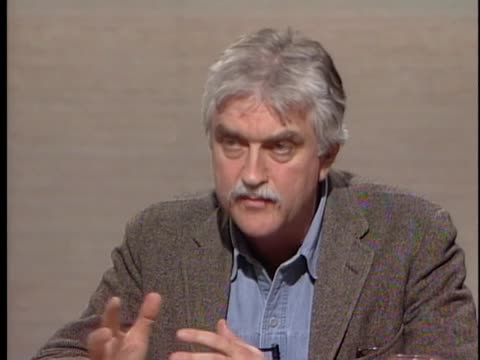
Now, along the silent voices out of the past and present, they shame, haunt, and teaches. Next on at Weeksend. In this 500th anniversary year of Columbus's landing in the Western Hemisphere, there have been and will be searching reinterpretations of the American experience. But all of those in its sense speak to the past out of the present. We devote this edition of at Weeksend to an extraordinarily different new book, Native American testimony, a chronicle of five centuries of Indian white relations seen through Indian eyes in Indian voices. It is nothing less than a fresh alternate history of North America. Joining us now is the distinguished editor and author of this book, Peter Nabokov, who is an assistant professor of anthropology and American Indian studies at the University of Wisconsin. He is the co -author of Native American Architecture and
author of Indian Running, two leggings, the making of a pro -war and architecture of Akima Pueblo. And also, Glenaba Martinez, a U .S. history educator at Rio Grande High School in Albuquerque, a native of the Taoist Pueblo. She's a member of the National Assessment of Educational Progress, a congressionally mandated Educational Assessment Program. Thank you both for joining us. This is an extraordinary book and an extraordinary addition to this 500th celebration of the Columbus discovery, not really a discovery, as we know. Tell us, Peter Nabokov, what this collection is in essence and what scope it covers. I tried to, I got interested about 20 years ago, this began, in farating out from the archives, from the body of American Indian autobiographies, from works that friends of mine who were historians, our historians were discovering in their own research opportunities where Indians describe their interactions with
non -Indian cultures. I tried to bracket the book with prophecy, the first chapter deals with prophecies of the coming of non -Indians, perhaps retroactive prophecies in some cases, prophecies which attempt to make sense of the arrival of these coercive, oftentimes aggressive, astonishingly different newcomers. And I end the book also with a chapter on prophecies. In between those two chapters, I tried to provide Indian experiences. It was extremely important for me to get experiential accounts, not simply polemics or propaganda, but times when American Indian men and women from different regions describe what it felt like to undergo a multitude of types of encounters, some of which reached, of course, historical importance, some of which simply were a community's history that never would reach the wider world. And this is an extraordinary collection of sources, isn't it? A lot of long buried
archives, testimonies, treaty negotiations, sometimes testimony in court rooms, but not the normal stuff from which American history is ordinarily constructed, certainly not in native American voices. One of the things that I found is that, for example, linguists would go to a given people, cows perhaps, or another community, and collect texts. What they're interested in is grammatical construction. In an appendix, they will have some texts that illustrate grammatical construction and action. I'm not interested in Indian grammar. I'm interested in the meaning of those stories, and quite often, some of the richest, most personalized accounts were exactly from sources that you would never expect, such as that. Glen, about how does this affect education in America in your view? This is a new perspective on the history of North America. What ought it to teach us? Well, I grew up in a family in which my grandmother told us great deal, a number of stories, and told us about our history, my grandfather and my grandmother, so I was very fortunate to learn the history of my people through them. But as
an educator, when you work with students who live in an urban setting and don't have contact with their grandparents or anybody else, this is very important. It's very critical. It's also critical in developing a sense of a perspective, in a sense, trying to understand why people felt so deeply about being removed from one piece of land to a totally different environment. It's also important for the students to understand why it was, what it meant to see your traditions being torn down or being torn apart because of the Westward movement. And this is, I use this book in my classroom, and my students are well aware of this book. We use this book in the classroom, and we use it throughout history to try to get that Indian voice from various cultures and understand why they react to so many different ways. Because if you rely only on a textbook, you only get political and economic history. There's very little emphasis on social history. And if there is social history, it is all from a white man or white woman's perspective rather than from people of color. You know, this is a gloriously eloquent book in
so many different voices, so much different eloquence across so many cultures in North America. But it has, as you well know, certain depressing consistencies about it. There's a consistency in the experience of this encounter, whether it's in the east or in the south or in the far west, the southwest, and some of those consistencies are quite shocking. A consistency of betrayal, a consistency of lying and of mendacity, and a consistency of astonishment on the part of the Native American culture, whatever it may be in whatever section of the country, a kind of common puzzlement at the mistreatment, which becomes the very common experience of Native American cultures. I chose the word testimony advisedly and fought for that word through the first edition, which is published in 78, and then the second volume, which was ultimately added to it, which is which can, can, can, can, surprises this book. And
one of the things that I think happens when people are speaking out of the urgency of personal experience is a kind of eloquence of the sort you talk about. As far as the repetition factor, I'm reminded of last year walking in Pomo country with a woman near the coast in Mendocino County in California and walking up to a fence that prevented them from going to harvest seaweed, which they, which they fry there. The fence had been put up but a few weeks before. This is something that her family had done since they could remember for generations and generations. Well, there's an account in that book called Suddenly a Gate in which a shoe swap Indian from interior British Columbia describes collecting berries with his grandparents, and suddenly there is a fence. And when they come back for the first time in his memory, they are no longer singing because they know the following year, they are not going to go back. And I do find this repetition. And I do find this astonishment, the word I
used before coercion, I think that Native American people, again and again, were aghast at the lack of proper manners to put it mildly of the visitors. At this, this aggressiveness, at this unwillingness to to accept any obstacle, especially obstacles, which were well -made arguments from the cosmological point of view of these Indian peoples about why such actions should not be done. Glenn about why have these voices been silent for so long? Why are we hearing them in a sense for the first time? And Peter's brought them together in this wonderful collection and anthology, but why weren't they more heard in the past? You as an educator, what reason do we have for keeping them silent? I think one of the reasons is just fear among fear by many people who are in power, fear by people in power that if you learn the history of your community, the history of your people, see that there are
some definite patterns of conquest, some definite patterns of colonialism, that there could be this sudden people saying, well, wait a minute, what happened years ago? You mean this happened to your people years ago and this possibility that these people might get together and try to make some more demands and try to make some changes and try to correct some of the things that has occurred in history. I also think it's racism. I think that there's a great deal of racism. Well, you can see the bias in any textbook when you go back as a decades go back in their portrayal Native Americans and not just Native Americans, but African Americans, clumping all Hispanics into one group without recognizing the differences among the various Hispanic and Mexican -American groups. So I see it. I'm glad that there's a, we're in an age of enlightenment, but I'd like to see more. I would also to go further. I would like to see Native Native Americans see as right our own histories, but not as people who are reacting to the political developments that occurred throughout history, but as active people and developing our own history with our own timelines and our own
perspective of the way we saw things. Well, that's one of the main, it seems to be one of the main assets of this book. It not only humanizes people. It also gives you all of the richness of cultural identity that Native Americana deserves. It reminded me so often, frankly, of some of the testimony left from the Holocaust, some of the testimony left from the great trials of genocide in European and in other aspects of American history, which in a sense brings Native American into the mainstream of the history of Western civilization in the larger view. Peter, what does it have to teach us about the present? I mean, there are a lot of people I'm sure who would think this is abstract, this is in the past, bigotry is dead in America. Haven't we gone beyond all of this so what if there is this testimony? Well, one of the things I tried to do, and this kind of cuts across the historical time depth, and it's sort of a timeless, I hope, lesson of this
book to the non -Indian, and that is that Indians have a right to have multiple points of view about where they've been, where they are, and where they're going. I think that's what you were also saying. Factionalism is too often used to denigrate the chorus of voices. There are mixed bloods, there are urban Indians, there are full bloods, there are rural Indians, there are suburban Indians, there are a multiplicity of viewpoints now about many issues. Why shouldn't Indians have the democratic right to disagree to argue? And rather than the accusation made that Indians can't get it together, why don't they realize what they want is to see this richness and to see what it is they are struggling over when they decide how white to become. Well, that's again, and if I sound unduly impressed with this book, it's because I am. I think it is so authentic in its sense. We deal in the non -Indian world so much in stereotypes, the stereotype of the drunken Indian, the wild Indian, the Indian who can't be civilized in
non -Indian terms. These are people who love their children, these are people who mourn loss, these are people who feel pain, these are people, I think, for the non -Indian reader, like you and me. And that's an incredible gift in this book. Well, that's what I was trying to put together, but of course, as we just heard, the book is not is not finished and let there be many more anthologies and let they come from specific tribes, if there's thousand others. What does it teach us, Glennabe, and again, in educational terms, or maybe even in policy terms, about public issues of the 1990s? There's a great deal in here about cherishing the environment. There's a lot in here about the sacredness of land. Isn't there a message here for public policy, Indian and non -Indian in the United States? Oh, yes. The Indians, Native Americans, throughout the Western Hemisphere, we've always been environmentalists and I think it's only because of the limitation of the amount of land we have, our access to natural resources that we've changed somewhat where you see mining on some
reservations and you see different groups of people perceiving their environment different, but we are basically, we are environmentalists. We do see ourselves one with the earth and we do see ourselves as living in harmony rather than trying to exploit and destroy. Is there any chance that this book will really get into the curriculum of not only in Mexico schools, but schools all over the United States? It seems to me it ought to be among the required readings for school children in this country. Well, I personally would like to see it as requires a reading along with a number of other books in the curriculum. Presently, however, I'm working on a national committee to create this standardized national history test for grades 4, 8 and 12, and I was speaking to Peter about this about how frustrating it is to work with 23 other educators and historians in which they don't really see people of color as active people within the people within the United States history. We see again this East Coast, nothing existing in the West until the 1900s, and it's all focused on the colonial history of the Eastern
Seaboard. And it's really sad because what we're doing in a sense is we're writing a test which some people will pass off is no big deal, but to others it's dictating curriculum and I feel that at this point we should integrate things like excerpts from the United American testimony, but when it goes up to when you present it to 22 other educators and historians, they say veto. We don't think that's as important. You know, you could make a book report on this book mandatory for holding public office in the United States at almost any level. I think serves something. Peter, are we really out of the tunnel here in terms of bigotry and prejudice toward the American Indian? Have we learned the lessons that are so explicit in this book? Well, one would like to think so. I've been looking at the campaign to assimilate the Indian in the 1890s and as a part concomitant to that campaign where cartoons and newspapers and magazines of the period plus photographs in magazines and reports put out by the reform movement, former abolitionists who are anxious to
assimilate Indian society, putting down traditional Indians, and it's blatantly defamatory. But then I want to tell you what happened to me last weekend when I flew to Santa for a meeting that a group of 15 advisors were having about a series of films that PBS is planning on putting out. First, I found on my on my plane in the American Way magazine a piece cover story called Vision Quest in which medicine men are described as as all being illiterate. It's a new age piece which are trickier to critique, of course, because these are people who are using Indians on which to project the screen of their own yearnings for a pure America. So the Indian has to be pure. The Indian can't be a changing person. The Indian can't be a suburban Indian. The Indian can't be urban. The Indian can't be well educated from the new age point of you. You've got to be primitive and illiterate. Primitive, illiterate and pure with the
rhythm of the universe humming in every form. It's the airline magazine that the American business elite will be reading between Dyson and Los Angeles. I also had got a copy of Rolling Stone magazine. And here was an ad for Nike's new Rorachi sandals. And it goes, in ancient Mayan civilization, basketball was a game played to the death by crazed savage warriors who grabbed and scratched and kicked and clawed each other to the delight of thousands of delirious bloodthirsty spectators. Although the game hasn't changed, the shoes have. Okay. Sounds like a session of the US Congress, but I, but this is that's not that's really no joke. That reaches a large element of American young people. Current issue. Nirvana on the cover. Next I get given something which I guess has been a bit of a cozy elaborate here in the Southwest. The issue of super pro. It's a Marvel comic in which the demonic forces are personified by evil Cachinas. Now the Cachinas, of course, are the rain bringing spirits of the Hopi sacred as sacred as the saints of Catholics as if you as sacred as the disciples of
Christianity. It's as if you had Martin Mark Luke and John suddenly appearing with cha with with chainsaws. And here we have the killer Cachinas, the ogres and the like. For this, because of this comic book, non -Indians are understandably going, I gather to be banned from certain ceremonies and the rights to be guests at Hopi country. It's a current comic book. Just out. Just out. It's being purchased and read by kids all over America. I just bought three copies and Madison was gone some the other day after I learned it about it. I returned from this trip last weekend to my class in American Indian folklore. And one of my students gives me this selection from an Andy Rooney column from the Chicago Tribune. They did 31492. It's interesting that for all the problems they've had with white Americans, American Indians were never subjected to the same kind of racial bias that blacks were. While American Indians have a grand pass, the impact of their culture on the world has been slight, despite two books, recent popular books, which have problems
by Jack Weatherford, but are exactly about the immense contributions of American Indian culture, agriculture, and the like throughout the world. There are no great Indian novels for getting Scott Mama Day's a poet's surprise winning book. And the new work by Leslie Silco, Louise Airdrick, many others, no poetry. There's no memorable Indian music. Their totem polls do not rank with the Statuary of Greece and there's no Indian art except for some good craftwork and wool pottery and silver. They hang on to remnants of their religion and superstitions that may have been useful to savages 500 years ago, but which are meaningless in 1992 should Indians be preserved on reservations like the Redwoods and the American Eagle or should they join the mainstream. This is Andy Rooney in the Chicago Tribune. In 1992. Correct, two weeks ago. Gleniba, what crosses your mind as you see and hear that sort of thing? I mean you're you're a Native American woman teaching in an American school system in 1992. From a traditional society. Yeah. Well I'm actually not really surprised that there's still people people are still
writing and for you know writing things like this in newspapers. All it shows me is ignorance and I think that if he were in my class and it would be a different it would be a different situation. My students would have you know would have a good time with him. That would be remedial ed. Yeah well not even remedial I don't know where he would be but I'm not surprised but I think that we should see things like this in education to tell people that there are people who are very ignorant out there in society and would like to see Indian society or Indian cultures reduced to something like this. So again that there would be no sense of pride in one's heritage and something like this is also very bad in the sense that it could lower someone's one self esteem. An Indian child self esteem possibly an urban Indian child who's growing up in Chicago who doesn't have roots maybe somebody who's lost any type of ties to a cultural heritage and when you read this you could feel worse about yourself. It doesn't make me feel bad because I feel very proud of what I am and where I'm going but to someone who doesn't know Indian person or somebody who is not have any contact or has no experience in dealing with Indian
history it's really sad. What's at the root of this? What's at the root of this European bigotry and fear and ignorance of non -European peoples because it isn't just Native Americans. It's we know the experience in Africa the experience in Latin America to some extent in Asia other indigenous peoples who've been treated in much the same way. What's at the root of this? I see it's as a justification for imperialistic for imperialism it's a justification we can go back into 1898 the white man's burden saying yes we need to civilize these people they're inferior. I see the same thing it's it's justifying territorial acquisition it's justifying exploitation of natural resources it's justifying exploitation of mineral resources it's justifying taking away items that should be on reservations or should be at Pueblos and in the communities and putting them in the Smithsonian it's it's a justification but haven't we Peter regressed in a sense I mean it's been almost 20 years
since very my heart at Wounded Knee a little big man a lot of writing even popular films a lot of of entering of tolerance and understanding into the mainstream of American life one would have thought that we now would have sired a generation of Americans educated a generation of Americans who know better than this. This may be the deepest cycle in the American psyche the adoram de plurum cycle related to the American Indian find a lawyer says it happens every 20 years he says the adoram de plurum you either you either love them to death which is the new age option or you hate them which is essentially the Rooney option I think one point that should be made about the Rooney thing we are not only objecting to the tone to the self -righteousness to the superiority of this statement every sentence is erroneous on the face of it it is wrong each one could be a lesson plan for a marvellous course of study in American
Indian civilizations clanola was right to emphasize plurality we are talking about 300 different American Indian societies multiple languages different subsistence bases different situations now different regional habitats and and and and I think that vine says that non -Indian America is searching for an authenticity on this continent that can never that it can never acquire and he says this is the reason why there is this nut in the American psyche which is represented by the American Indian that will not go away and this is not simply a matter of wearing a hair shirt or assuming guilt is it in the non -Indian population this is a matter of understanding where we've been who we are and therefore where we're going I mean I it seems to me our future stability and and very integrity as a society is it is it's take here not just in our relations with the with the Indian population but with all this multiplicity of the world that's coming into America from Asia from Latin
America from everywhere well I would argue and the richness of North America only benefits once we appreciate the multiple braided histories that constitute this continent apart from the lessons that can be learned I mean this is the I've spent my professional and adult life studying Indian societies and I feel I mean the second grade Linda but do you see any any particular signs of hope here in New Mexico any any greater sensibility any real awareness of of some of this regression that's gone on obviously in the last few years well I'd like to be more positive but I'd like to see more Native American people learn their histories if they can't learn it from their grandmothers and grandfathers to go back and do research through the archives I would also like to see more Native Americans get into the humanities and go out and work in the public schools if I'm not mistaken with APS there's only maybe 10 high school teachers who are Native Americans some of them are teacher aides and bilingual aides but we don't have very many U .S. history teachers who are Native Americans I like to see more people go out and maybe not so much that they're Native American that's that's good but I think we
need to have people who no matter what race or what ethnic background you are that you bring this history out and I I think a lot of people are afraid many educators traditional educators from a different generation are afraid to bring this type of information out because it it changes all of what they've taught and all of what they've learned and all of what they've believed up to this point. Isn't this 500th anniversary of Columbus's landing a wonderful opportunity though to come to grips with this history and in a sense to reconcile ourselves with with the truth and and hopefully with some new model for the future. Well it's again arbitrarily imposed on Indians it happens to fit this 20 year cycle we were talking about a moment ago I think Indians are much more concerned about the backlash that's going to take place possibly in 1994 and 1995 I admire those Native American groups that are kind of looking the other way that are staging this peace and dignity run for example from Alaska South and Tiradil Fuego north to meet in Mexico
as a way to bind the indigenous spirits of two continents together I think it's a false it a false time personally I mean it's not for me to say I'm not Native American. Peter how do we get their attention I mean Americans are notoriously prone to observe events like this I mean isn't this an opportunity to say something that needs to be said. It's an opportunity to say something that needs to be said but I've been dealing in the last six months with the number of media types that have the intention span of a termite when it comes to this material and they know that Indians are hot dances with wolves ushered in but I will bet that in the film sweepstakes that are now starting up two or three series are going to merge triumph and the other are going to be on the cutting are not going to be shot and I just wonder what the story is I think we can answer your question in 1995. So Indians may go rapidly out of vogue here as they as they come into vote. I've seen it happen three or four times. Glyna but just a few seconds give us a hopeful note about the kids
are our kids understanding what we're talking about here your kids. My kids do my kids understand and I think that well I can only speak at my school we have done the high school at our school we're a very a very fortunate school in the sense that we are a multicultural multi -ethnic and so they see American Indian students on campus urban and those from Isleta Pueblo they see a teacher who is Native American who's proud to be Native American and they see that we're in not only me but there's several other teachers there and they see us integrating this in the regular school curriculum. Well that's that's at least a hopeful note thank you very much Peter Nabokov for being here and for doing this book and thank you Glyna Bob Martinez and thank you for joining us for weeks in. I'm Roger Morris for a video cassette copy of this program send 29
.95 plus three dollars for shipping and handling at weeks end KNME TV 1130 University Boulevard Northeast Albuquerque, New Mexico 87102 or call 1 -800 -328 -5663 visa and mastercard are accepted please indicate the date that program aired
- Series
- At Week's End
- Episode Number
- 522
- Contributing Organization
- New Mexico PBS (Albuquerque, New Mexico)
- AAPB ID
- cpb-aacip-191-36h18dsn
If you have more information about this item than what is given here, or if you have concerns about this record, we want to know! Contact us, indicating the AAPB ID (cpb-aacip-191-36h18dsn).
- Description
- Description
- No description available
- Media type
- Moving Image
- Duration
- 00:28:23.323
- Credits
-
-
Guest: Nobokov, Peter
Guest: Martinez, Glenabah
Host: Morris, Roger
Producer: Sneddon, Matthew
- AAPB Contributor Holdings
-
KNME
Identifier: cpb-aacip-77824d0043f (Filename)
Format: Betacam
Generation: Original
Duration: 00:27:40
-
KNME
Identifier: cpb-aacip-6d28712da5e (Filename)
Format: Betacam
Generation: Original
Duration: 00:27:40
If you have a copy of this asset and would like us to add it to our catalog, please contact us.
- Citations
- Chicago: “At Week's End; 522; AWE #522 Native American Testimony,” New Mexico PBS, American Archive of Public Broadcasting (GBH and the Library of Congress), Boston, MA and Washington, DC, accessed April 4, 2026, http://americanarchive.org/catalog/cpb-aacip-191-36h18dsn.
- MLA: “At Week's End; 522; AWE #522 Native American Testimony.” New Mexico PBS, American Archive of Public Broadcasting (GBH and the Library of Congress), Boston, MA and Washington, DC. Web. April 4, 2026. <http://americanarchive.org/catalog/cpb-aacip-191-36h18dsn>.
- APA: At Week's End; 522; AWE #522 Native American Testimony. Boston, MA: New Mexico PBS, American Archive of Public Broadcasting (GBH and the Library of Congress), Boston, MA and Washington, DC. Retrieved from http://americanarchive.org/catalog/cpb-aacip-191-36h18dsn