Project Echo; Project Echo Master
- Transcript
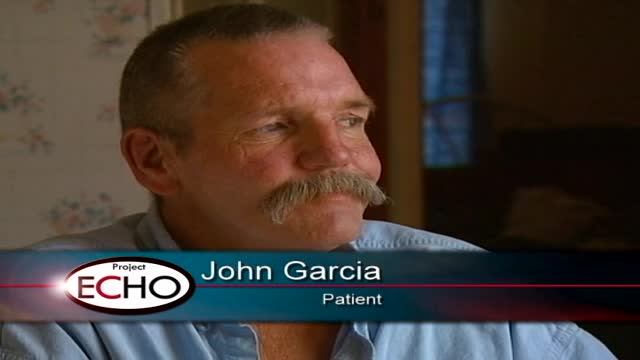
John Garcia lives alone. About a year ago, John began to miss work at his job as a trucker in Espanola, New Mexico. He had a bad case of the flu that he just couldn't shake. Two months later, he was out of sick days and feared he would soon be out of a job. He went to his assistant April Grisetti Nail, care for 50 to 70 patients a week at their rural health clinic. They see local towns people presenting everything from common colds to advanced diabetes. Espanola is unique in a lot of ways. It's got a very strong sense of its history and a way in a family. It's a predominantly Hispanic community. There's a lot of drug addiction here and unfortunately some of this is quellate of drug addiction in particular a lot of hepatitis C. A lot of people aren't knowledgeable of how they are getting exposed and it continues to be transmitted. Dr. Hayes ran some tests and delivered the news to John. It was hepatitis C, a chronic disease of the liver that if left untreated could lead to
cirrhosis or even death. I wasn't shocked. I couldn't believe it. I think I spent three days in bed. I cried. I remember my older sister coming over telling me that I was tough enough to to get through it, you know. John Garcia is not alone. Espanola is at the heart of New Mexico's hepatitis C epidemic where the estimated number of cases is 32 ,000 and increasing each year. Well, the challenges of health care in New Mexico are reflective of the kind of state New Mexico is. New Mexico is a combination of some urban areas, some suburban areas, some very, very, very rural areas. Health care providers in rural New Mexico find themselves battling a rising tide. Hepatitis C is a particularly horrible disease because often what happens is people in
their 20s may have used IV drugs for a period of time. They've gotten clean. They've got a family. They've got their life on track. They're working and all of a sudden in middle age, they discover that they've got this virus. While many health care providers feel isolated from specialty care available in larger communities, their patients also feel alone in seeking treatment in major urban centers. Far from home, forced to leave behind the support network of family and friends. This is my home. This is where I've lived. I've lived here since the 60s. Albuquerque is a big city. It's scary to me. I'm comfortable where I'm at. My family's here. My kids and my grandchildren. I don't have financial resources to travel to Albuquerque for treatment. But there is an answer. The University of New Mexico's extension for community health care outcomes or project echo at the UNM Health Sciences Center is now making it possible for
John and other New Mexican suffering from Hepatitis C to access the best health care in the state right in their own hometown through a cutting edge telemedicine program. Here's how it works. The University of New Mexico School of Medicine in partnership with the New Mexico Department of Corrections. The New Mexico Department of Health and Indian Health Services connect community health providers each week through video conferencing technology. Here, providers, nurses and pharmacists from around the state come together to learn about Hepatitis C treatment and to share best practices amongst a circle of peers treating the epidemic on New Mexico's rural frontiers. Most importantly, providers engage in direct case -based learning as they treat their individual patients with a remote team of specialists in the fields of hepatology, psychiatry, infectious diseases, pharmacy
and addiction. Now providers like April can treat patients like John Garcia in consultation with the leading Hepatitis C experts in the state without ever leaving town. The best thing about something like project echo is that we have these specialists and all sorts of different fields who are in Albuquerque at UNM who can dial into our clinics every Wednesday and we have phone clinics on other days of the week where there's always access to that specialist. So that patient just has to make it to their home -based clinic here in Espinula and then we do the rest of the work by contacting each other in the project echo network to bring specialty care to those patients who might otherwise not ever get there. We have the ability to treat hepatitis C here in the community and for most of my patients with hepatitis C, if they can't be treated here in the community, they're not going to get treatment at all. Project Echo is in the process of developing its own innovative electronic disease management tool,
iHealth, to further monitor outcomes and ensure patient safety. In 2007, Project Echo won the award, Disruptive Innovations in Health and Healthcare, Solutions People Want, a collaborative competition sponsored by Ashoka Changemakers and the Robert Wood Johnson Foundation. One of three recognized programs among 307 entries worldwide, this prestigious award acknowledges Project Echo's potential to systematically transform healthcare delivery worldwide. Other awards include the Computer World Honors Program award, honoring those who use information technology to benefit society, and an award from the foundation for eHealth initiatives, transforming care delivery at the point of care through health information technology. In 2009, Dr. Aurora was recognized for outstanding leadership by an individual
in the field of distance learning by the United States Distance Learning Association and awarded an Ashoka Fellowship. The Ashoka Fellowship Program recognizes leading social entrepreneurs who have innovative solutions to social problems and the potential to change patterns across society. Now the people of Espanola are receiving the finest hepatitis treatment under the guidance of the best specialist in the state. The success of UNM's Project Echo's hepatitis C model has opened the door to treating other complex chronic illnesses in the same way. There are now 16 teleclinics. All of these diseases are being addressed using the same successful model, and in 2009, Project Echo began training community health workers and peer educators in prisons throughout the state. Over 40 percent of inmates entering prisons have HCV. For those providing care to New Mexico's most disadvantaged, the Echo Program offers a
much needed forum to learn from peers and continue to become better doctors and better serve the community. The Echo Program gives the UNM School of Medicine a way to integrate these providers into the larger medical community. It is a way to provide doctors and rural areas with the knowledge and professional interaction necessary to make them feel less isolated and improve retention rates. Project Echo's use of the telehealth model uses a small number of specialists to train a large number of rural clinicians. We call this force multiplication. And while the Echo Program brings health care providers the gift of knowledge to John Garcia, it brings the invaluable gift of life. If it wasn't for the girls at the clinic here, Dr. Hayes in April and the Echo Program, I don't know what to do. The Echo Program is improving lives and building a healthier community in Espanola and across New Mexico.
At Echo, we're using today's technology. Join with the latest medical knowledge and a wide array of specialists to bring the very best in treatment to each individual patient.
- Program
- Project Echo
- Raw Footage
- Project Echo Master
- Contributing Organization
- New Mexico PBS (Albuquerque, New Mexico)
- AAPB ID
- cpb-aacip-191-22v41r2r
If you have more information about this item than what is given here, or if you have concerns about this record, we want to know! Contact us, indicating the AAPB ID (cpb-aacip-191-22v41r2r).
- Description
- Description
- Clip 1 Short SD (4-12-10)Clip 2 Long SD (11-16-10)
- Media type
- Moving Image
- Duration
- 00:10:12.579
- Credits
-
- AAPB Contributor Holdings
-
KNME
Identifier: cpb-aacip-7d57e20fcbe (Filename)
Format: XDCAM
Generation: Master
Duration: 01:00:00
-
KNME
Identifier: cpb-aacip-4d5bc6c431a (Filename)
Format: XDCAM
Generation: Master
Duration: 01:00:00
If you have a copy of this asset and would like us to add it to our catalog, please contact us.
- Citations
- Chicago: “Project Echo; Project Echo Master,” New Mexico PBS, American Archive of Public Broadcasting (GBH and the Library of Congress), Boston, MA and Washington, DC, accessed April 2, 2026, http://americanarchive.org/catalog/cpb-aacip-191-22v41r2r.
- MLA: “Project Echo; Project Echo Master.” New Mexico PBS, American Archive of Public Broadcasting (GBH and the Library of Congress), Boston, MA and Washington, DC. Web. April 2, 2026. <http://americanarchive.org/catalog/cpb-aacip-191-22v41r2r>.
- APA: Project Echo; Project Echo Master. Boston, MA: New Mexico PBS, American Archive of Public Broadcasting (GBH and the Library of Congress), Boston, MA and Washington, DC. Retrieved from http://americanarchive.org/catalog/cpb-aacip-191-22v41r2r