Surviving Columbus: The Story of the Pueblo People; Simon Ortiz/At Home
- Transcript
Okay. Got some paint by? hahahah hahahah One more much Yes Let's go drive the heat Let's get it some shots you type it away. Let's get a few shots here.
Then we'll get out of here for a while. Let's get a finish up. We can go outside of it. He wants to be an action. Is that your basketball up there? Uh huh. Looks nice bike. Yeah, you want to let me lay it. I tell you, I would look your right line on it yet. Get it? I left him more than one. That's how much he could be. I'll probably be too strong for the... That's what came, so I just hit it again.
That was very tight. Good. Good. Good. Great. Good. Good. That's it. Good. Good. Good. Good. Good. Good. Good. Good. Good. Good. Good. This is what she included, a lot of stations, and so do you think we've been seeing all this
time. I do a city of Albuquerque in Santa Fe, and I'll pass it on my scuses, using that one, it might crazy. I think it's bubbling. Lakers. What happened during this year, they went dambling it, and that's what it is. No, because they set the data half more low than nothing, because it's going to get
to make them open for that. Are you there? Did you go grill in yesterday? Yes. One day? Yes. One day? Uh-huh. I'm still a lot of people. They're not coming. Yeah. They're not going to do it. Did you... Um... Um... Was there a rooster before? I don't know. We didn't see it. Uh-huh. Uh-huh. There is Italian. It's row sandwich. Chicken fight. Chicken fight. Chicken fight. Chicken fight. Chicken fight. Chicken fight. Chicken fight. Chicken fight.
Chicken fight. Chicken fight. Chicken fight. Chicken fight. Chicken fight. Chicken fight. On the same stage. It's a, it's a mourished tradition. Mourished or brove or by the Spanish Spanish. It's going to be from Mexico on an upward. It gives all the foot, and on strength and also with the horses. They're in the last one or something. What's that? Was that Saint Peter and Paul? Yeah, Saint Peter Paul. Who's that Monday? Yeah. The sacrifice and poetry. It's just not even doing so barbaric. It's nothing. It's really just ritual. It's combined. What would you say?
Adaptive? Or synthesize? Maybe. From the... Well, a more Spanish Moorish to the Native American, which is still... It's still... It's a credit for... It's still... I'm very glad you're interested. It's not... Years ago, they'll say... A friend of mine who helped the Senate, let me go put the right for a proposal. For some kind of community project. Community project. And so the proposal was being considered by a foundation in New York City. This is a savage for very Indians. Well, the person... One of the foundation people came out to make a visit, official on site, visit, to send it in. And so my friend was an anthropologist from the UAM.
She's not there. And picked them up at the airport in Albuquerque. And took this person, a woman, to send it a name. Just on one of these days, I guess it was the St. John, so... Really Peter and Paul. On that day... And it was the St. State. On the St. State. There's other than just the chicken fight. You know, there's people who throw... You know, around here they call it grand. They give away. You know, from the throughstops. You know, fruit and cookies and bread. And household items. And so my friend Shirley was... And Gondego was in the proposal that sent a mingle wrote, you know, about how it was such a very nice, well-mannered, peaceful photos, like the whole piece and other things on. Well, they arrived there just at the moment when they had taken the chicken down.
You know, to go through this literature of this chicken fight. And the person was just a cause. Because they had torn the chicken apart. And it's a live chicken, a rooster. His feathers and his head all turned bloody. So what says about the peaceful kilometers? You know, they didn't listen to the poor chicken. But it's since it's done in religious sense. Even though it's from the moors and Spanish, in that kind of savage ritual. But that chicken, that rooster, is raised by the... by the Zátóhojin, which is the chief. For a whole year and four. It's all prepared in order to make it significant. Special. It's hard to kind of describe or give it a Native American or Indian meaning to it. Because only real animal sacrifice that there is among the brothers.
There's no... If there's any sacrifice sense of that remotely, it's, you know, like when you... When you kill a deer or a rabbit or something, it's not really killing it. It's like bringing it home. You know, making it a part of your family, or your home. I think some parts of that are also the rooster pool or the chicken family. People try to have it like that. It's really... It's pretty different from going deer hunting and bringing the deer. It's like the coy 18, coy 18. Well, I know it's really a sense of spirituality and then spirituality expressed as an art form.
It's like living in a way so that there's not a real distinction between art that's separate, but from you, but rather it's one and the same. It's like Governor B. Hill was saying up at the opening of the A.I.A.A. museum. But for Indian people, it is life. And that's what our culture... Our culture is. That art and that life. And that's not that that was real. And... Right. It's your focus to where everybody is. It's sort of... I'm trying to do have a note on this. Is he vividly captured and expressive someone or portrayed on camera? Is he or she's telling a story to someone? Perhaps a younger person or a person's kind of like that old zoomie man in a pilot video film. This is that show that's going to show on Columbus Day.
This guy's telling me. It's very close. It's on October 12th. Okay. Did you... You want to say when? Well, I'm going to read the whole thing and then you can use whatever you have. This is that story that I wrote that's been put on film. Oh, no. Surviving Columbus. Living the Pueblo story of land, culture, and community. Our Pueblo story is... has to deal with hearts and hearts. It's the end, culture, and community. It's a hundred-time mission. In my hand, the art, the world, the survival Columbus, deep. This morning, I was telling my nephew, because in... Oh, about an old, I come home site.
If you know where it is, it's up here by the... If you go by the Mesa, it's a ruin. And such places are commonly called a couple miles south, if you... Near where... Let's try it. He said he and his wife... Well, you're having problems. The audio's not... Want to ask you better. You want to get it better? Closer. Yeah. Okay. So... Okay. This morning, I was telling my nephew, your cousin... Oh, about an old, I come home site. A ruin. Such places are commonly called a couple miles south of here. Near where he and his wife and children want to ask for land from the... The oldest, the Kursique. The Kursique. Not too far from there. Just below Gokaya.
That hill. That's what the name of the hill is. There's an old place right there. Come outside of here. Come outside from here. It's got old ruins, buildings that used to be there. When I was just a boy, this small... Grandpa and Grandma and me and others would go in a wagon up to... Aquaman, to our corn and bean fields to take care of them. Every time we went by that old place, Grandma, my mom would say, that's where the Minakoya lives. And we had to give cornmeal to the old, soft woman, Minakoya, who lives at that old place. You give her cornmeal and ask her to not let the wind blow so hard. That's what you do. She's the one who takes care of the wind. Grandma would say. I guess people have not been giving her cornmeal too much anymore, because he's been blowing like crazy in the past few days. As I told that to...
Oh, I remembered that boy I was. Who was that small writing in the back of a wagon? Telling that story is re-knowing that experience back then, and also sharing the experience of recalling that time for my nephew, who is looking for a home site to build a house for him and his wife and their children. This is what telling the story is. And then there's more. Go, what's your acumen name? Um, her stock? I wish... I wish... Oh, uh, wish Jack. You mean like a boat? Yeah. Oh, okay. Wish Jack. That's a nice name. But you have games.
And so every time he would come, he would always ask. Okay. Of course, I feel more hee-steerly. And so your mom would go look for. His brother, he's still more. The era flint era here. He's dear. I was like that name. Earth. Look. The traditional homes of stone, and I don't mean. Look, the red, yellow, and white Mesa cliffs. And sandstone canons into which they blend. From the beginning of creation, until the present, in completeness, it cannot be any other way. This is how creation is sustained, and kept always and forever in motion. To believe that creation is present always in every action, and moment is necessary,
in order to be responsible to it. Me, Shamidar, Aetir. You now can't just hide this sea kai challenge. From the beginning, when it started until now. Okay. I'm ready. Okay. Good. We're rolling. Okay. Anytime. Oh, this is something that came from work, Marshall. You might doesn't think that much came in here. This link that's in the stories, in the culture, in form, are put away by the essence of this
is a belief that the earth is alive. It is a living body from which everything is born. It is a living and intricate community, therefore, to which our pueblos and all things are connected. But the core of this belief is the idea of sacredness of the universe. And therefore, our traditional pueblo way of life re-actualizes the mythic origin from the earth and our connection to the universe. Me, Sohama, Aetir, you go. Saitika, Aetrani.
Always in every action and moment is necessary in order to be responsible to it. That's all right. Be responsible to creation. And so it was done, the goal of rendering obedience and vassalage to king and governor and acceptance of the true faith and revering the Christian God in heaven. Since Akkomo was the most well-defended of the pueblos, its harsh deliberate defeat was to show all the others it must
know use to hold out against the armed might of the Spaniards. It was no doubt about how the conquistador was going to achieve pueblo submission and conquest by church and crown. And then Alfonso Ortiz says that it was simply an overreaction. That's bullshit. It was deliberately destroyed. I hope you're listening, Larry. I'm listening. Thank you. I hope you're listening, Larry. I'm listening. Thank you. Thank you. There's a TV and see.
I know the carries speakers call themselves. I know Sata. The speakers of Fable, Teewa, Toa, Zuni and Hopi also say the same in their languages, affirming their existence and relationship to the creators of all life. From the beginning to the present, this knowledge of ourselves and the world is at the core of the pueblo spirit. In this spirit we have shared with all things of which we are apart. The earth at our feet, the sky above our heads, the world all around. All things we've been one with the plants, animals, the waters of the universe. All the elements are part of our living in our vision.
Without them, it is not possible to revere and sustain creation. In respect, love, reciprocity, songs, dances, prayers, meditations, and stories evoke a celebration of the world. And in enduring belief in it, without this belief, there will be no way for this sacred knowledge to be passed on from the present, from the past to the present. Just kind of flipping around. Cultural sovereignty and land, that's what the pueblos want. To be who we are and do what we want to do as pueblos. That's what we mean. This land we have always lived on.
We want to always know as ours. Just like the creators of all things meant for it to be. This land which gives us life, which gives all plants and animals life, belongs to those who help it, protect it, enhance it. That is what our grandmothers and grandfathers meant when they told us to be responsible for life. The meaning of our lives comes from the responsibility and the relationship we have to all things. Community, culture and land cannot be separated. Our people and our way of life in living with and taking care of the land. And all that it provides, that is the meaning. No more, no less. In, in 1540, and invaded how equal, if there still needs, immediately there was fear and dread.
This caused the people to turn away from the center a little even then. And then later when Anyaate came and brought more Spanish people. His soldiers destroyed agua and many of its people. And there was more fear of the terribly driven ways of the foreigners. Finally, our people could not stand the oppression any longer. It was wrong. And many of our people were being forced away from our own way of life. Finally, because our people were brutally enslaved by the Encomienda and repartiento. And because our traditional religion was forbidden by the Kastura, our people revolted, we took up arms against the oppressors in 1680 and we drove them away from our lands. There is hope nonetheless, and it is in what past generations of our people have always said,
as long as we keep believing in and living by the ways of our people we will continue. As long as the story of our struggles, which is like the story of all people who deeply love and respect themselves and their culture, community and land is told we the people will continue. This story then will always have the mythic power of the legend that is the present. When this story has that power, all life will continue and all life will have existence be in. Not quite. It's the end.
- Raw Footage
- Simon Ortiz/At Home
- Producing Organization
- KNME-TV (Television station : Albuquerque, N.M.)
- Contributing Organization
- New Mexico PBS (Albuquerque, New Mexico)
- AAPB ID
- cpb-aacip-191-20fttgth
If you have more information about this item than what is given here, or if you have concerns about this record, we want to know! Contact us, indicating the AAPB ID (cpb-aacip-191-20fttgth).
- Description
- Program Description
- The documentary' "Surviving Columbus: The Story of the Pueblo People'" explores the Pueblo Indians' 450-year struggle to preserve their culture, land, and religion despite European contact. The program uses stories from Pueblo elders, interviews with Pueblo scholars and leaders, archival photographs and historical accounts to tell a full account of Pueblo Indians that is not normally found in history books. This documentary is an excellent teaching tool and essential introduction to the history and resilience of the Pueblo people of New Mexico.
- Description
- McCarty's; #233; Dale Sound
- Raw Footage Description
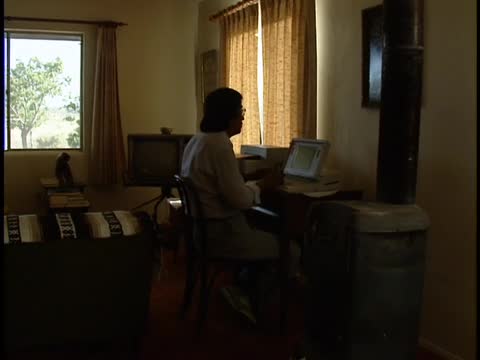
- This file contains raw footage of Simon Ortiz (Acoma Pueblo) typing at his home computer. Ortiz briefly talks as he busily prepares mail at his kitchen table. Later, Ortiz convenes at his computer with a young boy to read a few passages of unidentified literary material.
- Created Date
- 1992
- Asset type
- Raw Footage
- Genres
- Unedited
- Media type
- Moving Image
- Duration
- 00:30:28.415
- Credits
-
-
Executive Producer: Burdeau, George
Executive Producer: Kruzic, Dale
Producing Organization: KNME-TV (Television station : Albuquerque, N.M.)
Speaker: Ortiz, Simon
- AAPB Contributor Holdings
-
KNME
Identifier: cpb-aacip-2b88a28bb5d (Filename)
Format: Betacam: SP
Generation: Master
Duration: 00:30:00
If you have a copy of this asset and would like us to add it to our catalog, please contact us.
- Citations
- Chicago: “Surviving Columbus: The Story of the Pueblo People; Simon Ortiz/At Home,” 1992, New Mexico PBS, American Archive of Public Broadcasting (GBH and the Library of Congress), Boston, MA and Washington, DC, accessed April 4, 2026, http://americanarchive.org/catalog/cpb-aacip-191-20fttgth.
- MLA: “Surviving Columbus: The Story of the Pueblo People; Simon Ortiz/At Home.” 1992. New Mexico PBS, American Archive of Public Broadcasting (GBH and the Library of Congress), Boston, MA and Washington, DC. Web. April 4, 2026. <http://americanarchive.org/catalog/cpb-aacip-191-20fttgth>.
- APA: Surviving Columbus: The Story of the Pueblo People; Simon Ortiz/At Home. Boston, MA: New Mexico PBS, American Archive of Public Broadcasting (GBH and the Library of Congress), Boston, MA and Washington, DC. Retrieved from http://americanarchive.org/catalog/cpb-aacip-191-20fttgth