Illustrated Daily; 5002; Hans Bethe 2
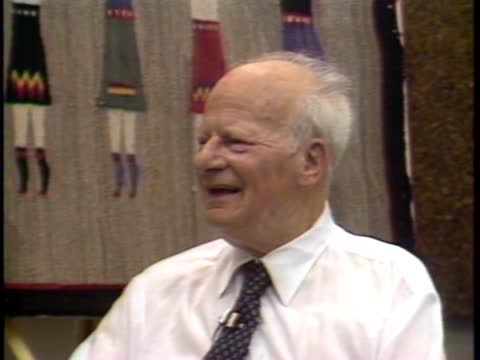
- Transcript
Imputing. Fundament. Fundament. Fundament. I'm sorry
sorry. The Illustrated Daily, Managing Editor Hal Roads. Hello. Last night here at the Los Alamos National Laboratories, we premiered the fifth season of the Illustrated Daily with a timely visit with one of America's most respected physicists, 78 -year -old Hans Beta. Tonight, we conclude that conversation. Hans Beta, along with Robert Oppenheimer, Edward Teller, and a handful of other American scientists, has placed his signature clearly upon some of the most significant and troublesome aspects of our recent history. From the development of the world's first atomic device to the current controversy over President
Reagan's proposed strategic defense system, the so -called Star Wars proposal, Hans Beta's extraordinary talents and strong convictions have figured prominently in this nation's scientific and defense affairs. I've got to ask you something. You and Edward Teller came to Los Alamos in April as I recall of 1943 on a train actually you landed in Lamey, you were the closest of friends. And over the years, there have been strains and tensions in that relationship, somebody called you intimate adversaries. Right. That's a very good discussion. Where does that relationship stand after all these years? It must be some tension there. We are intimate adversaries. However, we agree on some things. We agree on the problem of energy supply for this country. We agree that it is essential for this country to worry about future
energy supply of all kinds. And we even are members of a small committee, which is devoted to that. And on that, we agree very well. And we disagree with lots of other people who forget about energy as soon as there's enough gasoline at the pump. Sure. That won't last forever. Sure. So on this, we agree that on foreign policy and especially on weapons policy, we are... Polls apart. I started to ask you a sidebar question. You and others have expressed concern about the consequences of research and development into the Star Wars project. Notably, with reference to the Anti
-Velistic Missiles Treaty signed by the Soviet Union of the United States in 1972. Now, even some of the critics of Star Wars admit that certain kinds of research at certain levels can take place without... a potential of a violation here between research and development of Star Wars. Where is that point? We reach that point where, indeed, we are in violation of the ABM treaty. I think the day we test one of these gadgets in space will be in violation. Researchers alone, and I think one important matter is that there should be, if you want that whole concept at all, which I don't. Then, the important thing is to do research and see how various
gadgets, how various lasers, or particle beams, or x -ray lasers, or homing vehicles, how they work. Before you even decide what you want to do in reality, before you decide what to develop. There is... people like to mix up a lot of different things. We have talked about Star Wars, and I think I made it clear that I think this is a bad thing. Yes, you have reservations, we would say. But there is another anti -ballistic missile possibility, the kind that the Russians have been pursuing. And we could, according to the treaty, use the old -fashioned ground -based anti -ballistic missile defense around
one of our minute -man sides. That's allowed. We haven't done it because we concluded in doing the research back in the early 70s that it would not be worthwhile. Now, there matters may have changed. It may now be worthwhile. I think it is totally possible, perfectly possible, that we could defend a missile field. Are you saying the Soviet Union may have a better sense of how best to defend itself than the United States? No, I'm not saying that. The contrary, I think, is the case. We have a much better stance because most of our eggs are on submarines. I see. I met as concerns the anti -ballistic research pursuits. The anti -ballistic
research of the old -fashioned kind, they probably have done more than we. Whether we should adopt their system, I'm very doubtful, we could probably do it better. But we surely could, if we wanted to, put up a defense around one of our missile fields. And that would be good enough so that we could be sure that substantial number of our intercontinental ballistic missiles would survive if the Russians were ever crazy enough to make a first strike. Let me return to the question of the ABM treaty recently, two or three weeks ago, defense secretary Casper Weinberger and the National Televised Network Program on Star Wars. Said in the fact that the ABM treaty might be a small price to pay
for a more secure national defense and that to the extent Star Wars ever collides with the ABM treaty, the ABM treaty would have to go not Star Wars. I'm not sure what to make of that. Well, I am quite sure what to make of that. I disagree entirely for, in the first place, there will not be a secure defense. In the second place, the ABM treaty is extremely valuable. It is the cornerstone of our treaty system. Once the ABM treaty goes, then our best defense, namely the submarine -based ballistic missiles, will be much degraded
because they might have a hard time penetrating the ABM defenses which the Russians might then erect around lots of valuable areas. So, our second strike capability, which is great and marvelous in the submarines, far superior to the corresponding Russian one, would be depreciated. It would essentially, where it would not disappear, but it would be far less reliable than it is today. But secondly, once the ABM treaty goes, so does side one. Once side one goes, the Russians will be permitted to deploy far more. Are you saying we're about to unravel a lot of essential arms
agreements? All of them. We might keep a few, partly the treaty keeping the moon unarmed and keeping the Antarctic with our weapons, those might remain. But the important treaties will not. The ABM treaty is a very important treaty by itself, and the side treaties are still more important because what the Russians really can do very well is to build missiles. We know that. The side treaties limit the number of missiles both for the Russians and for ourselves. And in particular, the Russians are up to push the limit. Once the side treaty goes, one thing they will surely do is to
go beyond the side limits to dig a lot of new holes in the ground, put in a lot more missiles. And the shortest way to defeat the Star Wars defensive system is to have more missiles. That would overtax it, basically. That would overtax it precisely. The Star Wars defensive system, if it ever works at all, could probably deal quite well with an accidental launch. If some mad lieutenant in some bunker lets loose a few missiles at the United States, that the Star Wars system could probably defeat. In fact, I would even undertake to make such a system. But to defeat a thousand missiles launched simultaneously, and they
can do that within a few seconds. That, I think, is beyond the possibilities of anybody's imagination who has any technical knowledge. And then if the side treaty goes, it won't be one thousand, it will be two thousand, three thousand. Some of them will be fakes, that is, there will be just holes in the ground, and they will launch a booster which does not carry on. So what you're saying, basically, is salt protects us from a no -holes barred situation? Absolutely. Do you mind if we step back and help me if you don't mind, get some kind of historical perspective on this? I've heard your arguments, I think they're quite clear. But way back in 1939, you had reservations initially about a nuclear device. You
had then subsequently some reservations about the hydrogen bomb, but when it became apparent that it was possible, you even made some contributions to its development. Now Star Wars, are there any, is Star Wars an inevitable part of our future, just as the atomic bomb and the hydrogen bomb were? No, I do not think so. And I am not sure whether the hydrogen bomb was inevitable, the atomic bomb was, but the Star Wars surely is not an unavoidable thing in our future for many reasons, for one thing because it won't work. The hydrogen, in the hydrogen bomb case, I was very much against it and I still would be much happier if we had never
developed it, and I know now of a way how we could have avoided it. But once Edward Taylor invented the way to do it, this was so persuasive and fundamentally so simple that I had to conclude like many others, that the Soviets could do it too. And therefore we had to do it and we were propelled by the fear that the Russians would do it. That is a very vicious thing, most of the weapons of mass destruction, which in a serious case would ruin civilization as we now know it. Most of these weapons of mass
destruction were invented from fear, from the fear that the Russians would do it, could do it. Now in our case of the Star Wars, I am in much more comfortable position because as I explained earlier, I am firmly convinced that the Russians cannot do it. All right, let's talk about your apprehensions here. I've heard you say, you doubt its technical feasibility. I've heard you say, you question its political wisdom, I think I've heard you say, you have some moral qualms about a defense system of the Star Wars sort. In order of priority, where do these fit together? Or did I misunderstand your
moral qualms? I do not have any moral qualms. In fact, from the moral point of view, I would be wholeheartedly behind President Reagan. It would be wonderful if there were a really leak -proof defensive system. It would be wonderful if we didn't have to worry about nuclear missiles landing on the United States. Many things would be wonderful. If the gates of paradise were to open, that might be wonderful, but it is just as unlikely. So, I have no moral qualms. My first priority is that it will start an arms race as we have never seen before. It will aggravate the arms race. Those are your political apprehensions.
These are my political apprehensions. I think the President is totally wrong in believing that the Star Wars defense will lead to people reducing armaments. The opposite will be the case, and Martin Ogarkov, whom I mentioned before, has given us notice that this is exactly how the Russians look at it. It will intensify the arms race. It will, as Secretary Weinberger has proudly announced, scrap the ABM Treaty, scrap the Salt Treaty. So, it will end the agreements. It will end arms controlling once and forever. That is my political misgiving. That is why I fight it. I think the
way to remove the threat to the world, both to us and to the Russians, and to Europe, and possibly to other countries, due to the so -called nuclear winter. The way to do that is by patient negotiations, trying to understand the needs of the other side while you negotiate, and trying to come to some accommodation. I know it hasn't been given us peace, but I also know that it has prevented the free fall so far. So, I think there is a possibility of getting to a safer world, but it is not technical. It is a political possibility. It is your business, and it is the President's business. And it is the business of the negotiators that he appoints the negotiators
of arms control, have to be devoted to finding a solution while at the same time. What you have defined here is fascinating situation, of course. If the United States is prepared to scrap and already negotiate an arms agreement, what reason is there to assume that the United States is willing to pursue other arms agreements through negotiations? That depends on the political situation. A hope is, it is a distant hope, I am sorry to say, that President Reagan has been sufficiently impressed by the popular feeling in favor of such matters as the freeze in favor of arms control. That he will change some of his stuff,
and that in the second term there will be different negotiators and a different director of the arms control agency. Are you holding your breath? Yes. But anyway, politics change, and some years from now things will be different, will be different. And when that happens, then I think we may come to the correct conclusion, namely that we have to negotiate in good faith. You are a part of a generation of American scientists of enormous gifts, and you have taken us right to this point where we must talk about this. We have also played an important role
in America's political affairs. Scientists, politicians in a way, your generation, people who knew how to gain access to power, who knew how to retain access to power, who knew how to use that access to power for scientific and technological ends, Edward Teller fits this portrait almost to a T, it is often seemed to me. Is there something unique here, are we talking about something unique about your generation of American scientists? I think we were very fortunate in a way, in that we established our credentials by doing something for the defense of the country. And having established our credentials, we could then speak our mind. The man I
hold in the highest esteem is Ayah Rabi, and he has probably had more influence than any of the rest of us. He said, on the 40th anniversary of the Los Alamos laboratory, he gave a talk entitled, how well we meant in making the atomic bomb. We meant very well, and our generation, many of our generation, tried to pursue that. I read a lively and wonderful exchange on science and ethics in which you engaged. I believe it was at the University of California at Santa Barbara, at which physics professor Charles Schwartz was a participant, as I understand it. And in that Schwartz talked about the moral responsibility of physicists today,
he told the tale of trying to get his colleagues in the Department of Physics, the University of California at Santa Barbara, to take a simple oath, to do physics only for the good and not for the harm of society, and his colleagues refused. I'm just quieted by that somehow. Should I be? No. I am consulting for Los Alamos, and many things that Los Alamos does, could harm society. The trouble with the oath he proposed is who is the judge of what is good and what is bad. I am presently reading a book by Peter Wyden, which is an alternative selection of the book of the month, and describes the history of the atomic bomb and the politics afterwards.
One of the figures there is Klaus Fuchs, who probably was the most successful spy of modern history. He is also a good physicist, and also a good physicist. His opinion was that it was good for the world for him to betray our secrets to the Russians. I very much disagree, and I disagree fundamentally on the other side with Edward Teller what is good for society. These are things on which individuals have different opinions. So the individual conscience is the test? The individual conscience is the test. I believe that I am doing more good for society by keeping
in contact with the defense work, and at the same time advocating my opinion in public. And only if you know what is going on, can you have a judgment, even personal judgment, what is good and what is bad. So I think you cannot leave to the individual conscience the question of what the country should do that can only be left to debate, as long as it is not secret, public debate. When it is secret, a debate between a number of well -informed people of opposite opinion on these matters. Well, Hans Beta, you have contributed to debate quite clearly here in these past two evenings of the illustrated daily. I am eternally in your debt. I have wanted to talk to you for just years. Thank you so very
much. Thank you very much indeed. I enjoyed it. I think what we did was important, and I would love to do it again. We will have to do that. Thank you for joining us. I am Hal Rhodes. Good night. I would love to talk about the things you do mentioned to at the end, namely responsibility. Responsibility during the Second World War. What should we do? What should we not do? Then responsibility for the age bomb. From what I now know, I think what we should have done is develop it. And then announce publicly to our countries, but
to Russia in particular, we have this weapon.
- Series
- Illustrated Daily
- Episode Number
- 5002
- Episode
- Hans Bethe 2
- Producing Organization
- KNME-TV (Television station : Albuquerque, N.M.)
- Contributing Organization
- New Mexico PBS (Albuquerque, New Mexico)
- AAPB ID
- cpb-aacip-191-149p8fk4
If you have more information about this item than what is given here, or if you have concerns about this record, we want to know! Contact us, indicating the AAPB ID (cpb-aacip-191-149p8fk4).
- Description
- Episode Description
- Dr. Hans Bethe interview. Bethe is a physicst who helped research critical aspects of the atom bomb. (Part 1 of 2)
- Created Date
- 1984-10-02
- Asset type
- Episode
- Genres
- Talk Show
- Media type
- Moving Image
- Duration
- 00:28:58.737
- Credits
-
-
Interviewee: Bethe, Hans
Producer: Louise Maffitt
Producing Organization: KNME-TV (Television station : Albuquerque, N.M.)
- AAPB Contributor Holdings
-
KNME
Identifier: cpb-aacip-54ce2858eaa (Filename)
Format: U-matic
Generation: Master
Duration: 00:30:00
-
KNME
Identifier: cpb-aacip-172f3c1ef0d (Filename)
Format: U-matic
Generation: Master
Duration: 00:30:00
If you have a copy of this asset and would like us to add it to our catalog, please contact us.
- Citations
- Chicago: “Illustrated Daily; 5002; Hans Bethe 2,” 1984-10-02, New Mexico PBS, American Archive of Public Broadcasting (GBH and the Library of Congress), Boston, MA and Washington, DC, accessed April 1, 2026, http://americanarchive.org/catalog/cpb-aacip-191-149p8fk4.
- MLA: “Illustrated Daily; 5002; Hans Bethe 2.” 1984-10-02. New Mexico PBS, American Archive of Public Broadcasting (GBH and the Library of Congress), Boston, MA and Washington, DC. Web. April 1, 2026. <http://americanarchive.org/catalog/cpb-aacip-191-149p8fk4>.
- APA: Illustrated Daily; 5002; Hans Bethe 2. Boston, MA: New Mexico PBS, American Archive of Public Broadcasting (GBH and the Library of Congress), Boston, MA and Washington, DC. Retrieved from http://americanarchive.org/catalog/cpb-aacip-191-149p8fk4