Clinton Adams; Part 3
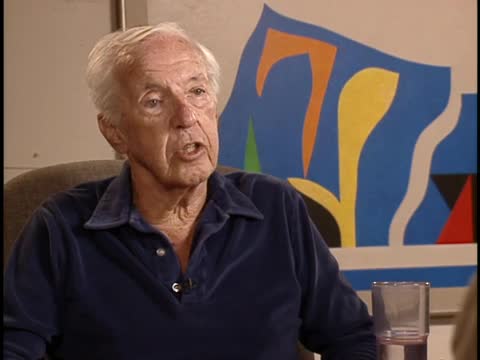
- Transcript
That same 1985 trip that took you and Mary out to the goat pasture in the Greek Isles. Also you were in the Western Mediterranean and Matisse country. We were in France, we were in Spain. I retired from teaching at 1985 and I was also retiring as director of Tamron and one of the favors that I wanted to do for my successor Marge Devon at Tamron was to get out of her way. That was a fine rationale for going to Europe for three months. We went on a boat trip in the Yugoslavian islands. We went to the Greek islands.
We went from Athens to Madrid and rented a car and drove down through Sevilla and up along the Costa Brava and in central France having stopped in Nice to see the Matisse chapel in Bonds and the gallery marked. It was a really grand tour but it was immensely productive to me in terms of ideas for paintings and of course it was also three months of concentrating upon these ideas that I might collect. Not entirely concentrating on them because we spend a lot of time on beaches but nonetheless accumulating ideas. When I came back I found I had accumulated enough
to keep my work really moving steadily through the remainder of 85 and 86 and 87 and 88 and 89. It was a long, long source reinforced by other trips to Europe almost every summer. That sense of gloriously optimistic color brought back with you seems to me still here 16 years later. Yes, still the same ideas. I'm a Mediterranean artist. California is a branch of the Mediterranean or at least it was when I was a child. Glendale, California when I was born had 18,000 people. Los Angeles was half the size that Phoenix is now. There were stretches between Hollywood and UCLA where you drove through Orange groves. There were sections between UCLA and the beach where
you drove through bean fields and that light, that color which I also find here in New Mexico although without the sea unfortunately has been influential in my work from the beginning to the end. That's why some of the New York paintings are such aberrations. It was so gray. Something I was recently writing caused me to read an essay that Saul Bello wrote about his experience in Paris and he spoke of the gray stringent light. That's a different kind of light than I feel comfortable with. It's a different kind of light than the impressionist and post-impressionist
felt comfortable with. They all headed out to the codessure. It's specifically for me difficult to imagine that these recent works are studio works. I mean they seem so full of that out of doors and that supersaturated light-filled color but sometimes you do these greezy, black, white, gray studies as preparatory. They're studies as preparatory. They're not too common but sometimes where I'm concerned is not just with the color but with the forums that the colors will occupy. The shapes the colors will occupy. I find that a black and white drawing is a good way to solve the shape problem separately from the color problem and although it's the color problem
that is the heart of what I'm up to, one is always putting colors in shapes and it's the way the color behaves in the shape and how large that shape wants to be and how what the color can be within that shape that detects the produces the psychological qualities that one hopes to have in the painting, the feeling tone of the painting. Feeling tone as a hyphenated word is an almost necessary word. I'm feeling in German but we don't have a good word for it in English. So working out these value relationships, the light and dark and the shapes in this instance, this came first. Yes, where I do a black and white drawing which is always in watercolor not
in pen for the color shapes. The black and white is earlier and in most cases I don't preserve them. Not when I'm rather light and I did but in most cases I don't preserve them. The process of doing this when I discovered that the image had to be narrower than I originally thought. You notice this gray which is not really part of the image. If this were presented in a frame I would frame it to the image. I see I see how I met to some such dimensions. And then the color is added and the shapes are adjusted. Oh, very much so you can see in many cases here that the forms are not at all the same. This area here for example has only a big relationship to what's in the drawing and behaves entirely differently because of the interplay among the colors.
This shape here is totally different from that one because that one just didn't seem like it was going to hold. So no, this is a created object of which that is a preparatory study. And once you put the color in the shape it may take on a different kind of spatial relationship of which is also true of the painting on the wall. If a critic were writing about you now, I suppose we bring back Jules Langsner to review the most recent work. And in summing up what you're doing, he or she could choose between Adams's the greatest craftsman of his generation or Adams's the greatest colorist of his generation. Which would give you more pleasure from Christ?
Oh, by all means I think of it as colorist. I mean most people can learn how to draw. What about Adams even when he is at his most realistic is essentially an abstractionist or Adams when even when he is at his most abstract is essentially a realist? Which do you think would be more accurate summing up? The first is more accurate because there is always an abstract element in the realist work. There's not always a realist element in the abstract work. Requiem for example had no representational reference. Oh, but even there you mentioned the road through Mexico, yes, but you could find that's sort of an abstract principle in nature rather than a depiction of
something in nature. Fair enough, fair enough. Robert Motherwell, you mentioned as having been involved with an exhibition in Los Angeles of New York school artists. And there was a quote that he supplied or an essay that he supplied for that catalog. Yes, he wrote the catalog essay, Frank Pearls, the gallery owner had actually assembled the exhibition. But Motherwell's essay is one that I have referred to over and over again in my teaching. And I live with it in my work too as a kind of principle. The whole statement is worth reading in his in the book of Motherwell's collective writings,
which is very much worth reading for any art student. But the means of the painter by which he means the structure, the rhythm, the color the impasto that you talked about, the spatial intervals, all of this. He speaks with these few means abstracted from the complex relations that constitute the external world, extracted from the relations that constitute the external world. The way one thing relates to another. Modern painters have succeeded in their task to create a painting that is rich, felt deeply felt. He uses it in other place and pure. So we have here in this room many of the fruits of 55 years of you as an artist. If there's a short circuit in camera number two and smoke begins to fill the place,
what are you going to grab and run away with or ask us to grab for you and evacuate as the single work which will stand for your career? A question I cannot possibly answer Peter. Of all of the people you've known, of all of your best friends or perhaps of all of your lovers, I don't know how many they may have been. Which one is the only one you would have saved from the fire? But you can't choose among different objects of different qualities at different times. There are some that I'm particularly attached to. Some I'm attached to for a relevant, statistically irrelevant reasons in that I value the experience that they meant for me. The little Genesis painting that we looked at was important because it was the kind of an epiphany
that started a whole series of work and it was a good series of work. The experience of looking out that window and making those was such that any one of the drawings conserved to remember, cause me to remember, that as a kind of wonderful experience. The morning that we woke up in the hotel Jules Cesar in Arla and I opened the shudders wide and Van Gogh's landscape was outside the window. So paintings can remind me of experiences of that sort of night treasure of them for that or I can simply treasure a painting because I feel one in which I didn't do anything that I wouldn't do again. No regrets. No regrets. It's the best I can do. Which is all an artist can really hope to do, the best he can do.
Let me try another tag. It's the same question as you'll recognize, but you're invited to submit one work to a group exhibition, like the group exhibition that was out in Los Angeles in which your little realism painting stood out in your view like a sore thumb amidst all the big splashy canvases. But this is this is a more congenial group show and 50 artists, one from each state. You're the New Mexico representative. You can send a single work to that exhibition. Well, let me answer it in another way. I have a large number of paintings. Many of which of course have been sold are not available to me now. But I still have several hundred things here that I could send.
The two that I have chosen to put on my wall and leave there all the time are the painting here on the wall now that the camera is looking at and the painting metamorphosis. And one of the collours paintings, the red one that is on the far wall over your shoulder, beside the bookcase, a series of paintings done in the little fishing village of collours which I visited largely because of its historic importance to the artists, Matisse and DeRan, Brock, all work there and Blaming. And I guess I keep those on the wall because I particularly regard highly of them. It isn't I guess that I wouldn't sell them, but I've been happy that I haven't. But if someone of the television audience, all of a sudden thinks that these are absolutely fabulous paintings and remember, remember that all of
three of those are promised gifts to the museum. They're promised gifts, but the A-list has a flexibility. Yes, yes, yes. Thanks, Clint. Let's stop for a second. Will this follow up on the genesis? Because in the genesis, Clint talks about how that shape has a almost ideographic or something. Yeah, but I don't see it as related to this idea of the Mediterranean color. Mediterranean color. Okay, yeah, okay. We're rolling. Have you in your art ever responded to the New Mexico landscape? Oh, yes, many, many times. One of the great advantages to my work, I think, was the decision to move from Florida to New Mexico. I was on leave of absence from the University of Florida.
There's no landscape in Florida. There's no landscape. There's nothing that just lots and lots of trees and lots and lots of flatness and lots and lots of mosquitoes, so I couldn't work out of doors. And I did a series of very dark gloomy paintings all the time I was in Florida, the darkest, gloomiest paintings I've ever painted in my life. So when Tom Pope joyphone me up and asked me to come to New Mexico and we were at a cocktail party and I sort of sat across the room and Mary said, yes, and we moved here happily because the Southwest, although it's not exactly the same as California, not with that hazy Mediterranean light, here we have a hard crisp bulletproof light. But the land forms of the Southwest have always intrigued me.
And I first did a series, a small series of several paintings of the volcanoes on the West Mesa, which were called evening sequence, winter sequence, dark sequence. The Albuquerque Museum has one of them, the Museum of the Mexico and Santa Fe as another. And I of course went on summer trips into the Red Rock country. Mary and I became River rats. I went down the Colorado six times raft trips. And on Lake Powell quite a few times, Lake Powell, which never should have happened, which gives access to some visions of the West, which although they are totally artificial, nonetheless are important. And I became aware of not only the rock forms, but of the way one found
the human figure in the rock forms and did an entire suite of paintings and lithographs called Venus and Cibola, using the imaginary or fantastic terms both for the woman Venus. Any time. And I did this series of a number of paintings and a suite of lithographs, brilliant, brilliant color, in which the most characteristic and earliest of the paintings was simply called blue sky and rock forms, but in which the shapes of the sky as revealed by the rock forms were essentially in the form of women's breasts, which one sees physically in the
landscape looking at it from Lake Powell. Took a photograph just to jog my memory. And that series expanded into ideas. For example, when you go down the Grand Canyon, there are these occasional very green spots where all of a sudden there's a bank of flowers and ferns and bright green foliage, whereas a spring is coming out of the rock or something of that sort. So here was a bright green which crept into one of the paintings. And we were fortunate not on several occasions to go down when the little Colorado was not muddy. You had this strange azure water. And it was a wonderful experience. So this suite attempted to summarize all of those various experiences with the Southwestern landscape. And it was a principal motivation to me for
over six or eight years.
- Raw Footage
- Clinton Adams
- Segment
- Part 3
- Producing Organization
- KNME-TV (Television station : Albuquerque, N.M.)
- Contributing Organization
- New Mexico PBS (Albuquerque, New Mexico)
- AAPB ID
- cpb-aacip-191-0644j1x2
If you have more information about this item than what is given here, or if you have concerns about this record, we want to know! Contact us, indicating the AAPB ID (cpb-aacip-191-0644j1x2).
- Description
- Credits
-
-
Interviewee:
Adams, Clinton
Interviewer: Walsh, Peter
Producing Organization: KNME-TV (Television station : Albuquerque, N.M.)
- AAPB Contributor Holdings
-
KNME
Identifier: cpb-aacip-1f8b3365de0 (Filename)
Format: Betacam: SP
Generation: Dub
Duration: 00:20:41
If you have a copy of this asset and would like us to add it to our catalog, please contact us.
- Citations
- Chicago: “Clinton Adams; Part 3,” New Mexico PBS, American Archive of Public Broadcasting (GBH and the Library of Congress), Boston, MA and Washington, DC, accessed June 5, 2026, http://americanarchive.org/catalog/cpb-aacip-191-0644j1x2.
- MLA: “Clinton Adams; Part 3.” New Mexico PBS, American Archive of Public Broadcasting (GBH and the Library of Congress), Boston, MA and Washington, DC. Web. June 5, 2026. <http://americanarchive.org/catalog/cpb-aacip-191-0644j1x2>.
- APA: Clinton Adams; Part 3. Boston, MA: New Mexico PBS, American Archive of Public Broadcasting (GBH and the Library of Congress), Boston, MA and Washington, DC. Retrieved from http://americanarchive.org/catalog/cpb-aacip-191-0644j1x2