New Mexico in Focus; 301; Carmen DiRienzo, Estevan Rael-Galvez, and Patriotism
- Transcript
You start of July and time to celebrate a holiday that's very special for a lot of families living here in the United States. Independent State is celebrated this weekend and we have two celebrated guests and one notable New Mexican featured on today's show.
Plus the line panelists carry on a tradition that started last year with an informed in-depth and interesting discussion on patriotism. So stay tuned. New Mexican Focus starts right now. Fireworks and parties, barbecues and picnics. July 4th is the day Americans commemorate the adoption of the Declaration of Independence. It's also a day to celebrate freedom. Later on New Mexico and focus, the line panelists exercise their rights to free speech by taking on a topic of patriotism and we show a special video biography of New Mexico's most recent notable New Mexican Honorary Flamenco dancer, Maria Bonitas. Before that though, it's a tour around the National Hispanic Cultural Center here in Albuquerque with its incoming director, Dr. Stephen Gralvas and a sneak preview to an amazing work in progress of Fresco by artist Federico Villal. I love that Fresco, but first I had the pleasure of sitting down with Carmen D. Rienzo.
She is president and CEO of the PBS Partner Network, Veme, senior in Albuquerque on channel 5.2. She was hosted here at K&M last week and she spent some time in our studio to share her vision of the network with us. I'm here with Carmen D. Rienzo. She is the president and CEO of Veme, seen here on channel 5.2 digital channel. The Hispanic Network and partnership with public television stations, PBS. Now, since its launch in March of 2007, Veme has become the fastest growing Spanish network in history. Carmen, thank you for being here and congratulations on a very interesting position you have on top of this thing that has just become a cultural phenomenon across the United States. We're very proud here in Albuquerque that we're one of the flagship cities for you guys. Let's back up a little bit. Let's talk about Veme and what your mission is in the overall that we're getting to some of the details of what you're trying to do with programming. First, thank you so much for having me. I'm delighted to be here and your right, K&M was one of 15 Charter Affiliated Public Television stations when Veme launched in March of 2007. And we are now, we were at that time 15 stations reaching fewer than 20 million households in the United States.
We are today nearly 40 stations and we're reaching over 60 million households. And one of the things that's important to note since the channel is in Spanish and we're very focused on Hispanic TV households, there are in the United States about 12 and a half million Hispanic TV households. And we are reaching just under 70 percent of those today. And we hope to grow to at least 80 percent by the end of the year. And what that means is that this digital network, all of this made possible by the digital transition, will be second in size only to Univision and Telemundo. Now what do you tribut that kind of growth to because clearly Univision and Telemundo has been around legacy stations been around for a long time. We've certainly got our affiliates here in Albuquerque. Right. But something has touched a nerve in someone with Veme. What do you attribute this expression off to? Well, I think it's a combination of things.
I think first of all that the affiliation with public television is a very special thing. The network actually grew out of the desire on the part of WNET, which was the public television station where I was an officer, to use its digital spectrum, the new digital spectrum, which would be coming with the digital transition to serve the better serve the Hispanic community. And essentially the idea was that if we could develop a program strategy that general managers in all of the markets with significant Hispanic populations felt would be a good service in their markets, that we would have the over-the-air coverage, as well as the cable carriers that cable carriers have committed to public television. So for example, Veme here in Albuquerque in Santa Fe is on digital 5.2, and it's also on Comcast 203. That situation is repeated throughout the country because of a commitment by cable to carry the digital channels of public television.
There is no such arrangement for the carriage of the digital channels of commercial television. So that's really underlying the phenomenal growth that we've enjoyed. And I think also in terms of having carriage on dish network and direct TV, I think their recognition of the quality of the programming and of the gap in Spanish language programming, in Spanish language TV for programming of the genres that we present, convinced them that this was a worthwhile basic service to offer their Hispanic subscribers. So it's a combination of access, quality programming, it all adds up to filling a need. That's right. And one of the things that's always interesting, you can tell you're on the right track in a media project, is when partners show up and just want to be with you because they just sort of get it. And the partner list that you guys have put together in just a short period of time is pretty staggering.
It's not just here in the U.S. or Spanish language, but overseas. Talk a bit about that and how you've been able to absorb some of that. Well, you know, it was very critical that since there never was a network like this, we really, really, really had to work hard to do it right. We did a significant amount of research to look for what was missing in the Hispanic media landscape. And there were some very obvious gaps that needed to be filled. First and foremost was the children's programming. We are the only network in the country that presents a daily six hour block of educational preschool children's programming. And that really serves a need for Spanish dominant households so that children can learn their first language well and so that moms and other caregivers can interact with the kids. And it also, we have found listening to our viewers, serves a tremendous need in homes of anglos or much later generation Hispanics where Spanish hasn't been spoken, but where there's a desire for the children to be bilingual.
So that's a great example of some of those gaps. So let's look at the gap and answer your question about how is it that we get to partner with the Henson company and the BBC and Sesame Workshop and Alliance Entertainment and Head Entertainment? Well, there isn't another channel that presents that programming in Spanish. So all of a sudden we become an outlet for their content in the United States in Hispanic households and general market households also that want to be able to speak Spanish. So they see it as an opportunity too because none of that program has been here. So that's the example in kids and then you look at and repeat the same rationale with science programming for example. We have science programming from PBS, from Nat Geo, from the BBC. Nobody else wants it. There's nobody else who's showing it that can reach the distribution that we reach. There are cable nets that exist on satellite and cable in Spanish, for example,
discovering us by no, certainly has some nature programming. But that channel doesn't even reach more than 30% of Hispanic households. You know, we reach more than double that. So to a program supplier like a Nat Geo, of course they want to be with us. Sure, and I have to imagine over time that pool will widen and deepen because people obviously see there's an outlet for quality original programming in Spanish that has a significant household penetration. Exactly. That's what brings more quality to the surface. Exactly, and that's what happens with current affairs programming. We provide lots of in-depth current affairs analysis, we have a co-production which is the only effort in Spanish of the New York Times, which is Pahinás, New York Times, which is presented on Friday evenings. It's true of the Latin films. Now, if you look at the major Spanish language broadcasters like Univision and Telemundo, they have fabulous films. And by the way, we don't quarrel with the excellence of what they present.
It's just something different than what we present. And we consider ourselves more as complimentary than competitive. Because we're not out to make a better game show or make a better novella or beat them to some sports rights. They do that and they do it well. But we respect the diversity of the Hispanic audience. We know that they want more and that they deserve more, and so that's what we're about providing. And so you wouldn't believe it, but that desire to achieve the distribution also applies in cinema. I mean, there's tons of fabulous Latin cinema from Spain, from Mexico, from Latin America, that has no outlet other than Venezuela. And so we're able to present some movies that we're very proud of and that we think are also appealing to an English speaking audience. Or a non-spatish speaking audience, I should say. And so what we do with the films is provide English language translation in the closed caption line so that a more general audience can enjoy those films. Can I personally say thank you for that?
I'm a film buff, and it's interesting you mentioned that. Last night, there was an event you were at with the National Spanic Cultural Center. They've run a film series with films from Spain and other places with translation to be able to be read in. It's been a marvel and to have that as an option on VMA for me has been a great thing. And then I want to go back to the news and public affairs commitment you guys have made. One of the things VMA has done for me personally is I've lived here for 20 years from New England, and I am not a Spanish speaker. And VMA is about to change that because I am telling you as the truth. I cruise by the news and public affairs, and I am so frustrated to not know what's going on. And this happened during the presidential race. Right. The immigration rallies back a little while ago. The commitment you can just tell from body English and just having a radar for news and public affairs is very solid. So VMA, it seems to me, is feeling very much a need on that end of the spectrum. Now, we're very committed to news and public affairs. The Hispanic community, as I said before, is so diverse.
Right. But one thing that most of the community nationally has in common is that whether it was recently or a long time ago, the community arrived here and grows here and thrives here because they had dreams that are bigger than the places they came from. Or the circumstances they came from. And the only way to thrive in this country and to create what has become the Latino American is to really understand what's happening with public affairs, whether it's national or international. And I think there's a great demand for that in the community. And so we take very seriously our responsibility to respond to that demand. Also part of the planning for VMA is to partner with local affiliates to do some local program that fits in the Bayley Wic of that. Every local station affiliate has, first of all, time each hour for their own promotion and underwriting. And we're very, very hopeful that the two charter sponsors of KNME's presentation of VMA, which are Blue Cross Blue Shield. And also the New Mexico Employees Federal Credit Union, we hope that there are many corporations that will follow their lead.
Because in order for this service to be really meaningful in the community, local programming will be fantastic. But just like any other programming, it needs sponsorship, it needs funding. And I really encourage your viewers to be a part of making that happen. Each station, in addition to the time it has every hour for underwriting and promotion, also has four hours each week in which it can provide local programming. And I think that, gosh, Albuquerque, Santa Fe, New Mexico as a whole is so rich in the kind of content that I think would be thrilling for the audience. And some of it would be most appealing also to a national audience. We need to energize the partners so that that content can be created both for the local, to serve the local community and also to bring a little bit of New Mexico to the national community. I can tell you for a fact, I know documentary filmmakers here who would love to make docs in Spanish.
Yeah. But they have no outlet for it. They want to be able to tell stories in the Spanish language to do it. Exactly. And I think that, you know, Veme is and will continue to be a tremendous opportunity to work with those filmmakers, both for television distribution, and also for internet distribution of shorts and other. I mean, we hope to have an internet film festival in the near future. And as you said, I mean, in every major Hispanic market, there are Latin film festivals that are just chock full of fabulous work that's being done, both in English and in Spanish. And we hope very much to be a part of bringing those films to a nationwide Hispanic community. I have a curious question. When I think about Telemundo and I think about Univision, they're trying to serve different audiences in two vastly different places, meaning some of the content emanates from Mexico or South America or other places or some from Miami for Univision. But it seems this is strictly a US viewer venture for Veme. Am I accurate with that?
Yes, fundamentally make a difference in approach. Yes, definitely. Our programming comes from around the world. Okay. When the programming is not originally in Spanish, we do a process of language customization that includes script review and changes, dubbing, possibly lower third translations. But our program philosophy is that the presentation of programs needs to be based on the quality of the content. We feel that our audience is, the network is about where they are and where they're going. It celebrates where they came from, but it's really about they're here. They're part of this country in a big way. They're part of the international focus of this country in a big way. And so we choose the programming based on that fact. We do not, as you say, some of the other Spanish language broadcasters, the majority of their content comes from Mexico or is designed in furtherance of types of programs that are common in Mexico. And so that, you know, our strategy is quite different from that because our mission really is to be a complement.
In other words, to provide the programming that's not otherwise broadly available and to respect the intellectual curiosity of this audience, which doesn't mean to respect only the educated among the audience. It means what I said, to respect intellectual curiosity, to celebrate the incredible drive and energy and high aspiration that this audience tends to have. And that's what we're answering to. We're not about answering the question of you saw it when you lived in Mexico. We're going to present some of it here so you could see it while you're here. They can do that other places. Carmen D. Rianzo, thank you very much and congratulations. Thank you. It's a wonderful project and we're very proud to be associated with here in Albuquerque. And now it's time for my cohort, David Lerigarci to tell us about the trip he took to the National Hispanic Cultural Center and his interview with their new incoming executive director.
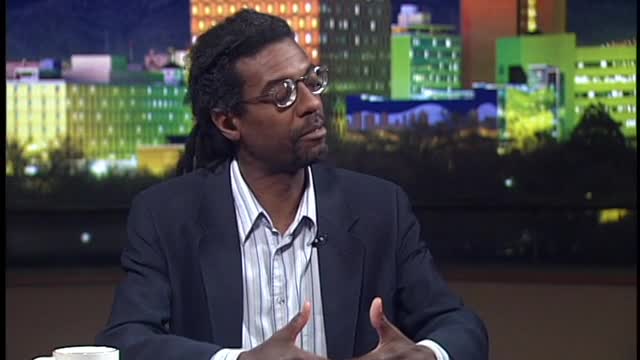
Thank you, Gene. New Mexico's current but outgoing state historian, Dr. Stefan Rial Galbus, has been chosen as the new executive director of the National Hispanic Cultural Center here in Albuquerque. He'll assume his new position on July 25th, but he took some time out of his schedule this past week to talk about his vision for the center and take us on a tour. First stop was a view of an amazing epic fresco that is being created by artist, Federico Vihil, inside the center of Torreón. We are here with Stefan Rial Galbus, the incoming executive director of the National Hispanic Cultural Center. Thanks so much, Stefan, for meeting us here. What are we looking at here? You are looking at a magnificent work in progress, the creative vision of a lot of people, but especially its artists, Federico Vihil. It's a fresco in the Torreón at the entrance of the National Hispanic Cultural Center.
It's been a work in progress, I believe, for eight years. And as you can see, if you look around, it remains in process. I think he's hoping to finish it within the year. Now, the shorthand is Stefan that I've heard in terms of describing this epic fresco is that it tries to tell the story, the history of the Hispanic world, kind of written large. Is that a fair description of what we're saying? Yes, I believe. It gives us glimpses at pieces of that history, thousands of years of history. In a way, it's quite I enjoy starting at this point as the currently sitting state historian. It has been an honor to touch the depth of history in New Mexico in this place, but to walk into this particular art piece really allows us to start imagining not just New Mexico history, which is largely, as I've tried to examine, global, but here you see it in the glimpses.
In the different, we see Roman, Arabic, Jewish, behind the Guadalupe, just little glimpses at thousands of years of history, so it's amazing. This building, the Thoreon, it was a defensive structure. It's part of the legacy of New Mexico drawn from the Arabic cultures, from the Roman cultures, as a defensive structure that was a watch tower. But what happened is this art piece was not imagined originally to be here. It was imagined in another building. But I think we really start to see what creativity can do to a place. It can transform it. In a way, I think of this sort of symbolically, while we draw upon the legacy as a watch tower, teaching us about vigilance, what this creativity does is teach us to look inward, not outward. There are certain parts of our history that we haven't fully acknowledged. In New Mexico, or globally, and so what this piece does is really draw upon the different layers.
It's not just a breadth of history, but a depth, and so we start to see different layers come out of this fresco, out of the paint that it's been placed on. I love it because it makes me think of something that I've probably quoted with you before. One of my favorite writers, who is from Urawa, Eduardo Galiano, has written, and identity is no museum piece sitting stock still under a piece of glass. It is instead the astonishing synthesis of the contradictions of everyday life. And even though this will be a museum piece, I think it points to all of those contradictions. We are Africa. We are Native America. We are all of these migrations, the science, the development. We are all of these things, all at once. I think of contradictions, and I think Galiano is using the word to talk about Contra Diceed, what it means to have a contest of stories.
We don't emerge just from single tap roots. We emerge from many different stories. So what this amazing fresco, and I think other stories that we have the potential to tell at the National Hispanic Cultural Center, do, is allow us to ask harder questions about who we are, where we come from. And so it's not just the priests or the governor of government officials telling those stories. It forces us to ask, what does that event mean to women? What does it mean to counter stories? Gondra Diceed. Do you think it's fair or maybe unfair to think of a place like this as a bit of a rebuke to those folks, maybe even a few in my own family, who will say many Hispanics here in New Mexico essentially parachute it down directly from Spain. And there wasn't the intervening history or places.
I think it's an invitation for all of us to ask more difficult questions about who we are. I think it's an invitation to touch a depth of the history, not just in this place, global history that brings us together that allows us to understand the amazing contributions that we're calling Hispanic today. So they've been acquiring several different modern and now historical works. So this is Ray Martin Avaita, a very modern piece, drawing from the past. But it's a growing collection. We are in a process of becoming a people, right? We are not static pieces, right? Even though we have very traditional pieces that end up becoming something else, but we're also a modern people who are in the process of developing that creativity based on these amazing ideas. It's about informing, but it's also about inspiring. It's about the imaginative potential. There's something amazing. You see dice and forks and flowers and drawing from the past, but also being informed by the present.
We checked out part of the permanent collection. There's a de la torre, two brothers from California, and then I believe there's an exhibit tracing the connection between Mexico and the Philippines. Can you talk about either of those? Manila Gallian Trade is something that was put together by the History and Literary Arts Program Director, and that really opens up a discussion of larger trade routes that help shape the Hispanic world. As far as the way is the Philippines, so really when we're talking Hispanic, we're talking about a global phenomena of migration, of movement, and commerce, and so that's what that exhibit is about. It's a small exhibit, but it's an amazing exhibit that I think showcases that international focus. The same thing with the de la torre brothers, imaginative creativity of brothers who are thinking of issues of identity, immigration, and bringing that to bear on their imaginative endeavors in their art.
We're standing just outside the Education Center. I understand it's the newest part of the campus. How does this fit into the overall mission of the center? The education has been part of the center for inception, and now we have space for Dr. Sanchez and her staff, as well as other collaborators in Stituto Cervantes, Spanish Resource Center, to actually make education a viable part of the center so that they're not all crammed into other parts of visual arts or history and literary arts. It's a place that we can bring kids into K through 12 and just showcase the amazing work that we're doing here. The Roy Disney Performing Center for Performing Arts is the entire building, and there are three theaters in here. There's a performing arts program, and the way it fits in is it's about movement. If the visual arts is a museum, literary and history arts is about research and history work, and literature, education department is about outreach.
This is also about outreach. It's about supporting the performing arts on stage. There's a theater that's dedicated to film, and so there are different theaters here that become part of the center's initiatives that are about statewide outreach. You were offered the position back a couple in mid-June. Why were you interested? Why did you take this job? I have had the honor of serving as a state historian for eight years now, and I am very proud of the program. It's a scholars program, an internship program, and an amazing digital history project. I think the challenge here was an open opportunity, and I'm excited about that possibility. It shifts also the stage, right, whereas I was looking at the state and the depth of history there. Right now, we are the National Hispanic Cultural Center with a global presence and potential as well, and so it's a different stage.
It's well known as the one that you're a historian, and historians tend to be very, very good at looking backwards. Here in this new position, I imagine you're going to have to be looking forwards, right, in terms of what the future holds for this amazing center. What is your vision for this center? Almost every lecture that I gave, I quoted at Warlar Galiano who says, I'm not a historian. I'm a writer, I'm an educator who would like to contribute to the rescue of the kidnapped memory of my land and my people. I think I have always brought that sense of a living presence, of people who are becoming themselves, of a land, of a changing landscape, dealing with contemporary issues. When I applied for this position, it was not just about understanding the present conditions that we're living in and how those affect our communities, Latino, or otherwise, but it's also about imagining this place in 10 years from now.
When I shared that vision, I imagined this place, where would we be in 10 years? And so I imagined an art institute, which is a thriving arts community educational center, which places art and culture at the center. I imagined a policy institute. I imagined so many other things, but really that was my vision at a distance, and until I have the opportunity to spend a little bit more time here, really working with the amazing staff that is here, working with all of the stakeholders in this, the foundation, the board members. I see it as an opportunity to build that shared mission, and so that's what I intend to do. You've mentioned ideas for the future. I'm wondering if one of the confining factors that you have to deal with is that this is a public institution. Times are tough. There's, I believe, 40 full-time employees here at the center now. Budgets are stressed, certainly at the state level. Is that one thing that may limit your vision?
Sure, times are tough, but we've been there before. This is where I can draw upon the strength and the lessons of being a historian, right? We have to find a way to support that vision. Keep our eye on the vision. Maybe we have to build that in stages. Maybe we build that creative vision in stages, but certainly we can't lose sight of it, right? And certainly there are going to be times where we have to be realistic, understanding that there may be cracks in the mortar, and there may be problems that we have to address on a day-to-day basis. I'm not daunted by that. In fact, the challenge is very exciting to me, but I cannot lose sight of the grander vision. We're sitting here next to the Disney Center. Obviously there's been a lot of private fundraising. Is there any pressure for the center at some point to be self-sustaining? I think the foundation actually already brings in a great deal of the funding for the programs. And so I see it as one of my tasks to find a way to see where that sustaining measure comes from, whether it's from private endeavors, from the state, from national.
Just to see that each of the staff members have the resources and the ability to do their jobs so that we're accountable to the public. For me, that's what's very important. I know in the bio that is there on the website, you come from a small town here in New Mexico working with animals as a young boy. How did you get from there to here? I'm glad you asked the question. I think personal stories are helped shape our greater understanding of not just state, national, regional, narrative, but also shape the institutions. When I actually shared my vision statement with the Board of Directors and the entire national and Hispanic cultural center community, I started with where my grandmother always told me to start a story, always introduce what people, what place you belong to. I had the privilege of growing up in a small town, two small towns, Castilla, and Cuesta, in Northern Tows County, being raised by my parents, my father who was a sheep farmer, still out there to this day, irrigating the alfalfas, and hurting sheep, and my mother who was a school teacher.
In many ways, those core values shaped me to who I am today. I learned how the stories matter, how the stories of my ancestry matter, of Native American captivity, all the different layers of who we are in these small villages is much more than the single reflections that we understand. So understanding that generational connection becomes an amazing way of understanding the vision that I bring to this cultural center. In many ways, I was a bad farmer. That's what brought me to this point here. I was a much better historian, I think. My father encouraged me to understand words and stories and read. I loved education, and I laughed for school, but New Mexico draws you back, and that's why I'm here.
But I think, again, of those core values, I think of metaphors like the Resolana. Resolana is the sunny side of the house. It's a metaphor that's been used by many villagers in northern New Mexico. It's where wisdom gathered. It's where the elders shared stories about contemporary happenings around them, what it meant dealing with the loss of land or sharing the waters of the Asekia, or the new birth of the child down the road. But it also meant reflecting back and also looking forward. This place is an amazing Resolana, and so it's where wisdom can gather. It's where knowledge and performance and creativity can gather. Here at Canomy, we wish Dr. Dreyol galvis all the best for his new position, and now it's time to get Jean Grant and the line panelists and their thoughts on this Independence Day special. Hey, welcome to our special segment of the line this week. We're going to carry on a tradition. We started last year in order of Independence Day. We're going to talk about patriotism.
But before we do that, let's introduce our panelists for this week. Whitney Weight Cheshire, longtime political consultant and strategist, Jim Scarentino, radio host and Albuquerque journal columnist, Teresa Cordova, former Bernalio County Commissioner, director of community and regional planning at the School of Architecture at UNM. That's that groovy building across from the frontier. And Margaret Montoya, of course, she still holds Heywood Burns Chair of Civil Rights for the CUNY Law School. And who this summer is at the UNM Health Sciences Center serving as Senior Advisor to Executive President Paul Roth. Thank you all for being here. Patriotism. This is a very interesting idea. Just the idea of democracy. The idea of how this country was founded, how we've struggled to get to this imperfect place and where we're going from here. I love this subject so much. So thank you for indulging this craziness on Fourth of July. But let me start with a simple question. In your family growing up, how did you celebrate the Fourth of July? You know, we were usually all over the place. It was summertime. My father traveled a lot. He was a college professor. So in the summertime, we tended to go take trips that had something to do with some other university. So I've got, you know, great memories of fireworks outside of Boston and North Carolina.
Probably my favorite one, though, was the thing when we go visit my grandmother, they would do at her little development that she lived in. They would put together all these Fourth of July races for kids in the swimming pool. You fill the canoe half up and paddle it out. You know, so to me, it was always a family time, a fun play day. One of my favorite holidays. Jim, how about your family and inside were there lessons taught inside the family festivities for Fourth of July? Because you have, you know, my grandfather came here from Sicily, Dirk Poor. I mean, no money at all. And didn't never had much money his life. But his son got through college and his grandson got to law school. So we very much appreciate this country. And that lesson was never lost. I mean, my father remained extremely proud of being American. I remember my memory from a child is going to the football stadium in Allentown, Pennsylvania. And I think we still had the best fireworks display I've ever seen. It would probably look really dinky now. But, you know, to a child growing up, it was just wonderful. And the whole town was in the football stadium. It was a great event.
Yeah. Margaret, what did your family do for the four? Well, I think that that within Latino families. And, you know, I mean, my family is in Northern New Mexico. We're in Las Vegas when I'm when I'm little. But I think discussing something like Fourth of July is about the patterns of assimilation of families that are after all both in and out of the mainstream. And for us, I mean, I know that there were different ways of celebrating Fourth of July across our extended family. So there were some that really didn't connect with the holiday. But our family did. We used to have cookouts. Although there wasn't a barbecue the way that we now think of barbecues, right? I mean, my mom would make hot dogs inside and we'd take them outside and have potato chips and whatever.
But to me, the more interesting question was the unspoken narrative because this was after all, after World War II. And my father was a veteran. All of his brothers were veterans, his sisters and had been very much active in the defense industry. So there was already a very strong allegiance to the fatherland, which is really the root of patriotism, right? This allegiance to the nation state. And I think that exploring that would find that both in Native communities of New Mexico and Latino communities that there is a patchwork of celebrations. I want to come back to that. That's a very interesting point. How did you family? Firework displayed in Central Park, picnic, and now family reunions. Let me see what that for a second because New York is a very interesting situation where you've got obviously for years it was the focal point of all folks coming here from somewhere else in some ways.
And the fourth is always interesting in those kind of cities and how people accommodate, like Margaret's saying, their own ideal of what this country is and how it's celebrated on the fourth and Puerto Rican, Puerto Ricans. I mean, in any way, which way do you want to cut it? Where does it stand now? How do we approach this fourth of July Independence Day thing if you're a recent person to this country? How do you make that connection somehow? Well, I think people like an opportunity or excuse to celebrate. I mean, that's one of the values of holiday. It's like, yay, right? So I think people come out for that. But the point that Jim was making, I think, was really interesting and it's related, I think, to Margaret was saying that as you make it, not just assimilate, but as you're able to go from one generation to the next. I mean, a generation, one generation, you know, toils really hard so the next generation can do a little better and so on. So I think there's that with that comes also a growing allegiance alliance identity identification with. And so I think most immigrants who are coming here, I think are coming here again to work.
And I think are often very appreciative of that opportunity to work and so not only is it opportunity to to celebrate, but it's an opportunity, I think it also to gather. You still have this phenomenon in the country of not people coming here not just seeking a better material life, but there are still people coming to our shores seeking freedom. I mean, compared to the rest of the world, we are still a blessed place. We are still despite all our faults, despite, you know, our self-castigation and we do fall down a lot. But to the rest of the world, we are still that beacon of hope and freedom. And we have people clamor to get into this country from countries where there is no freedom of religion or speech. There is no hope that you will ever be a person of individual worth and dignity. And I have met many first generation. My grandfather was very proud to be an American, even though he was a dirt poor coal miner because compared to what he'd come from, you know, or he was pressed into the army at bayonet point at age 16. I mean, this was a wonderful country and you find people from Arab countries in particular that love America because we have so many more freedoms than they have found in their homeland.
Let me tell you guys a story that happened to me about a month ago. I was on my way to North Carolina for a wedding, had stopped in DC for a couple days of business and friends. And it was walking down by the White House and now everything's changed where you can only see that one side, that west side of the White House, huge crowd, huge throng. The people that you could see were from somewhere else, as Jim just said. We're having a moment. I mean, really, really, really having a moment. Looking at the White House, I'm talking entire families, I'm a Middle Eastern family, I can see my mind's eye particularly. Looking through the gates at that White House, dead silent, they didn't move for 10 minutes. I stood behind them just kind of watching the crowd. And what made it an amazing thing, when you come from somewhere else, it seems like there are things that you just sort of get about what this country does and what it symbolizes and what it can do. Maybe the rest of us kind of take it all for granted at some point.
I think we do, but I also think we all have moments that draws us back to it. I mean, the last time you said DC and I remember the last time I was there was right after Barack Obama's inauguration. And we stopped in one of the stores. It wasn't far from the White House and the parade route. And the shopkeeper was telling us about the day of the inauguration and how silent and respectful and peaceful and reverent so many people were that came to that city for that inauguration. And they were there just to see his inauguration. And I think it was probably a lot of disenfranchised people from our government for so long that made it not only knows how long it took to DC to see him. So I think it comes back to us at moments when we become very, very proud. I mean, 9-11 was one of those times where we really came together as a country. You know, we all pulled together and did everything that we could. You know, we sent everything, you know, we could do the families and the firefighters. You name it. So we have moments in, you know, in our history where we do put everything aside and we remember what it is that's so great about this country. And then there's times like the rest of the time, you know, we don't feel good. Well, this country was founded on an argument basically.
Well, I spend a lot of my time in descent. And what I mean by that is that I think that an expression of patriotism, of loyalty, of love for a country, for the Padria is to try and work to make it better. So when Barack Obama talks about a more perfect union, and we remember who the people have been, who have struggled for that, the people who have been poor, the disenfranchised, some of the real outcasts of society have been the ones who have changed the Constitution so that we are a more perfect union. And I think that that function of descent is frequently mischaracterized as being disloyalty or really being, you know, fragmenting us or disintegrating this compact that we represent. And yet teaching constitutional rights, really trying to sensitize law students to the function that the profession plays in maintaining that fragile compromise, which in many ways I think was vindicated by the election of Barack Obama.
I think that I speak for many people when I say that I had lost faith partly because of the Bush administration, but partly because I thought that many parts of our government had gotten away from some fundamental values. And that it takes that sort of crawling back to that social compact. And I'm thinking, Theresa, particularly, I just got finished reading John Adams and a fascinating session on his decision for the Alien and Sedition Act, which really was very interesting to me because the echo bounce marker to today was just profound. You know, when descent was considered just too much, they couldn't deal with it anymore.
Exactly. And I'm sure they already read it late. I mean, I've read up so long here, but this is a great point. Descent is patriotism. Because I came of age during the time when the cry was America, love it or leave it. And it's like if you were engaged in any form of descent, you were being anti-pray tracks. If you don't like it then believe it. And I remember our response to that was love it enough to change it. And so the idea was that you engaged in trying to make it a better place. This was also the time when I was reading on civil disobedience by Henry Thoreau, something I think a lot of people in my generation read. And the whole point there was that you were constantly taking the risk, having the courage to stand up forward and say this can be better. This needs to be better and we must do what it takes to make it better. And when descent comes in many different forms, you can be conservative and you can descend and have a real issue with other forms of government and power at the time. Still a patriot, correct?
Absolutely. I mean I think about the tea parties that we had this last go around protesting the Barack Obama administration and the tax hikes and everything or the coming tax hikes I realized. So yes, I mean it depends on who has power at what particular time and who feels the only voice is the one that they have with their feet and with their signs and with their phone calls to the afternoon radio shows. No, it absolutely is patriotic. I do get nervous the same way when it feels like people are stomping on your ability to have the discussion. I mean we feel it I think probably on the show a lot of times. I have people you know they all run into that have strong statements about some of the things that I say as if I shouldn't be able to say them. And I know that you all feel the same thing too but that's what's so great about the show is that the point is we get to you know and that's what's great about this country. You bring up John Adams and the swing in the pendulum but what I think is fascinating about the history of this nation is we have gone this way in that way and yet we're always being pulled back I think to the miracle of what happened in Philadelphia of men like John Adams who we talked about. How could those men have settled on such fundamental truths that through generations we continue to fight over them and I think this is important.
It is very much a part of being an American but as much a part of being American is also informing yourself about what this country was founded on and keeping close to our heart and our mind. Those very basic freedoms the distrust of centralized power the recognition of the worth of the individual the checks and balances and all the various articles of genius that were put into our constitution. And I'd like to add one more to that the list of values that you gave because I think those are those are really important values but the other one is the right for due process. And I think that we that we've really to a large extent moved away from that is that now it's sort of instead of being innocent to proving guilty it's guilty guilty someone can just make an accusation is guilty to prove an innocent right and oftentimes opportunity isn't even there to prove the innocence. I think that the more important narrative is the counter narrative to that we were a country that was established through colonialism. Through conquest in slavery and that history is enshrined in our organic documents and much of that is silenced and we have from from our from the birth of the nation had populations that were excluded from the political family.
And you know I really like Martin Luther King Jr's statement that the arc of history is long but it bends towards justice. And what that means to me is that that's what all of these outcasts and people at the margins have really been arguing for is to push us towards what is aspirational in the document. It is not what was actually there. It's what we have given meaning to through political organizing and struggle. That's what to me is the essence of the Fourth of July. It is not that we were this miraculous document at our inception. It's that we are emerging in that direction that we have brought more people people without property. People women have been brought into the political family.
Slaves and their families. But those values that you talk about were there at the very beginning. Yes they were the compromises and all those sorts of things but Martin Luther King also wrote about the check. There was written to future generations of American that he was calling on now when it was coming back non-sufficient funds. And that's because in the promise of the miracle at Philadelphia was this hope for all the future generations for the inclusion of all the outcasts. For the struggle never given up to make African Americans fully recognized human beings in our country. Because there was that compromise at the time and all these things came to fruition because the groundwork was laid then. Those values that were the best of mankind. I think are embodied in that document and when we fight over it, when we say our countries lost our way, I think we're heartening back to that dream that drove those men in Philadelphia at that time. I think a statement of values and a statement of ideals that have vision become, they become a beacon. I mean those organizations I've been part of and we've been in the early stages will develop the preamble.
And it's something that you can go back to and you can say let's remember these ideals, these values, these things that we're supposed to guide the development. And so I think they're both right because without those ideals we don't have that to go back to. Compare yourselves to Russia which now has some sort of democracy but they don't have that sense within themselves that we are a people of laws, of due process, of fundamental rights, of a distrust of central power. I think that's very much a part of the American psyche. And we're going to have to, we're going to have to leave it there. I apologize. We can do this. All the time we have for this segment of the line. Send us your ideas for a topic you'd like to see us tackle or about democracy. Email address in focus at canemy.org or go to our website canemy.org forward slash in Mexico and have a great holiday weekend. Each year the Albuquerque Museum Foundation selects a notable New Mexican to be honored for their achievements, strong ties to New Mexico and contributions to the public good.
Our online focus this week is producer Kelly Kowalski's profile of this year's celebrated honoree Maria Benitez, an internationally recognized expert in the field of Spanish dance and all that it embraces. 6, 7, 8, 12, 1, 2, 3, 4, 5, 6, 7, 8, 10, 11, 12, 1, 2, 3, 5, 6, 7, 8, 9, 9, 10, 10, 12, 1, 2, 3, 5, 6, 6, 7, 8, 9, 8, 9, 10, 11, 12. I like drama, I like tension. I feel very comfortable with quietness. Simplicity is very, very important and strength.
I started with ballet and I wanted to be a ballet dancer. When I was around 14 I realized that I wasn't... I didn't have the ballet type. The legs weren't straight enough, the hips weren't open enough. Also I didn't have the temperament. I like to be a little bit gutsy. I like to be earthy. That's what I love about flamenco.
It's the coquettishness, the flirtatiousness, it's strength, it's power, it's mean, it's angry, it's sexy. The important thing is the power, because you want to transmit a power of what you are saying from the heart and it has to come from the heart. Flamenco has been compared to jazz many times because it was born out of a persecuted people and it started with the song as the blues did. Later the guitar was introduced and last was the dance. But it's also variations on a theme. There are approximately 12, 13 rhythms of flamenco and most of them are in 12 count, like most of the blues are in 12 count.
Whereas the blues developed into quite a complicated musical form, jazz, when you get a group of jazz musicians together they introduce the theme. And then one by one they improvise on that theme. That's exactly what happens in flamenco. What I like is when I watch someone is that I don't know what they're going to do next. You've got to surprise me. So if instead of turning this way I go that way, you know I was going to do that.
We used to say before everybody told us before we went on stage, every performance since I can remember for 13 years, four to ten years. That's fire and passion. That's what dances, you know. She always tells us fire and passion. I'm sure that a lot. She says that she can't teach us that. We have to find that within ourselves.
I mean I was thinking a long time ago that you can't dance forever. Then what do you do? I perpetuate what I have spent so many years doing. And that's what our mission is to perpetuate and disseminate and take it out there, introduce people to it, train people, give young emerging artists opportunities that I didn't have. What I love about someone is just the passion. It just enchants you and draws you in and you can never get out of it once you start. It's very expressive in some cases kind of harsh. She can definitely out dance all of us even at her age now. She's still amazing.
Thank you very much. One of our loyal viewers, Marlon Templeton, call us last week and ask that we give a special shout out to our troop serving overseas. He's a veteran himself and served as a combat medic and he has a grandson who's currently serving. So in recognition of all our men and women who have served or are currently serving in the military and their families, let's not forget about them, a special thank you for all you've done and we'll continue to do.
If you'd like to get in touch with us, just send us an email at infocusatcanemy.org or drop us a line on our blog at nymexconfocus.org. So have a safe holiday weekend. Thanks for watching and we'll see you next week. You
- Series
- New Mexico in Focus
- Episode Number
- 301
- Producing Organization
- KNME-TV (Television station : Albuquerque, N.M.)
- Contributing Organization
- New Mexico PBS (Albuquerque, New Mexico)
- AAPB ID
- cpb-aacip-191-053ffcpc
If you have more information about this item than what is given here, or if you have concerns about this record, we want to know! Contact us, indicating the AAPB ID (cpb-aacip-191-053ffcpc).
- Description
- Episode Description
- Since its launch in March of 2007, V-me, the first U.S. Hispanic Network to partner with public television stations, has become the fastest growing Spanish language network in history. New Mexico In Focus co-host Gene Grant interviews its President and CEO, Carmen DiRienzo, in her visit to the KNME studio. Then, it’s David Alire Garcia on a tour of the National Hispanic Cultural Center with its incoming director, Dr. Estevan Rael-Galvez, and a sneak peek at an amazing fresco that is a work in progress in the Center’s torreon. Plus, in honor of Independence Day, Gene Grant and The Line panelists discuss patriotism, and a video about the “fire and passion” of a Notable New Mexican, flamenco dancer Maria Benitez. Hosts: Gene Grant, Weekly Alibi Columnist and David Alire Garcia, Managing Editor, NewMexicoIndependent.com. Guests: Carmen DiRienzo, President & CEO, V-me; Dr. Estevan Rael-Galvez, Incoming Executive Director, National Hispanic Cultural Center. Panelists: Whitney Cheshire, Political Consultant; Teresa Cordova, UNM School of Architecture & Planning/ Former Bernalillo County Commissioner; Margaret Montoya, UNM Schools of Law and Medicine/CUNY Law School; Jim Scarantino, Albuquerque Journal Columnist.
- Broadcast Date
- 2009-07-03
- Asset type
- Episode
- Genres
- Talk Show
- Media type
- Moving Image
- Duration
- 01:00:49.013
- Credits
-
-
Guest: Rael-Galvez, Estevan
Guest: DiRienzo, Carmen
Host: Garcia, David Alire
Host: Grant, Gene
Panelist: Scarantino, Jim
Panelist: Cheshire, Whitney
Panelist: Cordova, Teresa
Panelist: Montoya, Margaret
Producer: McDonald, Kevin
Producing Organization: KNME-TV (Television station : Albuquerque, N.M.)
- AAPB Contributor Holdings
-
KNME
Identifier: cpb-aacip-101812b534a (Filename)
Format: XDCAM
Generation: Original
Duration: 00:59:40
If you have a copy of this asset and would like us to add it to our catalog, please contact us.
- Citations
- Chicago: “New Mexico in Focus; 301; Carmen DiRienzo, Estevan Rael-Galvez, and Patriotism,” 2009-07-03, New Mexico PBS, American Archive of Public Broadcasting (GBH and the Library of Congress), Boston, MA and Washington, DC, accessed January 5, 2026, http://americanarchive.org/catalog/cpb-aacip-191-053ffcpc.
- MLA: “New Mexico in Focus; 301; Carmen DiRienzo, Estevan Rael-Galvez, and Patriotism.” 2009-07-03. New Mexico PBS, American Archive of Public Broadcasting (GBH and the Library of Congress), Boston, MA and Washington, DC. Web. January 5, 2026. <http://americanarchive.org/catalog/cpb-aacip-191-053ffcpc>.
- APA: New Mexico in Focus; 301; Carmen DiRienzo, Estevan Rael-Galvez, and Patriotism. Boston, MA: New Mexico PBS, American Archive of Public Broadcasting (GBH and the Library of Congress), Boston, MA and Washington, DC. Retrieved from http://americanarchive.org/catalog/cpb-aacip-191-053ffcpc