Bill Moyers Journal; 602; Campaign Report #2: Foreign Policy
- Transcript
Bill Moyers' Journal
Campaign Report #2
September 19, 1980 -
Soviet soldier marking areas of a world globe with red pain
NARRATOR: The year, 1917; the victim to Communism, post-czarist Russia. Power was consolidated throughout the old Russian empire, and neighboring Soviet regimes were installed. More than six decades have passed, and hundreds of millions of human beings either have been killed or enslaved by Communism. Even in our own hemisphere the tide of Communism and Soviet influence is running deeper and stronger than ever. The list of nations and peoples engulfed by Communism grows ever faster, and the question America must ask is a question of survival.
[Russian cartoon of Uncle Sam with eyes made of world globes]
BILL MOYERS [voice-over]: That's the way American hardliners see the Soviet Union. And this is the way Russian hardliners see the United States, equally committed to world domination. So the arms race goes on and on, Uncle Sam and Ivan playing a nuclear game of chicken, each moving closer to the brink. Just one miscalculation is all it would take.
[Center for Defense Information film-simulated effects of a nuclear explosion]
WILLIAM KINCADE, civil defense consultant, President's Reorganization Project: Currently, U.S. preparedness defense planning expects some 40 to 60 million prompt fatalities after a nuclear explosion. These fatalities will cause a very significant health hazard. Most of them will be located in the northeast corridor between New York and Boston, and in Southern California. The present plan to deal with this health hazard is to dig very long trenches with construction equipment, to requisition quicklime, and to bulldoze the bodies into these trenches, cover them with quicklime, and bury them. No attempt will be made to identify these fatalities so that next of kin can be notified. If the time were taken to do this, the health hazard that would be posed would be insurmountable.
—
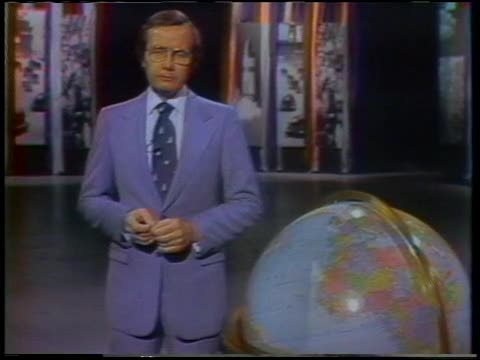
MOYERS: I'm Bill Moyers. It is within the power of the United States and the Soviet Union to incinerate this fragile globe. Each day, the U.S. adds three more nuclear warheads to its arsenal of almost 10,000. Every day, the Soviets American increase their stockpile. A U.S. government official said last week that by the end of the century any country on the face of the earth that wants the bomb will have the means to have it. In the next five years, you and I taxpayers will spend a trillion dollars on defense, a trillion dollars in the search for security. Some predict it will lead only to disaster. Meanwhile, in the presidential campaign, the economic and international consequences of the arms race are heartily debated. The alternative vision of arms control and building trade and cultural relations appears of little interest to the major candidates. So you wonder: is the 1980 campaign nourishing a new cold war that pushes us ever closer to doomsday? Is there no other choice? And shouldn't there be more public debate?
MOYERS: There's a poll today which illustrates our predicament. The ABC News-Harris survey reports that by 56 to 41 percent, a majority of likely voters say that President Carter's record does not justify another term. But by 49 to 46 percent, they think Ronald Reagan would be an even greater risk in the White House. You can hardly blame the voters for being in a negative mood, or for preferring on television a dramatization of 17th century Japanese politics to what passes for contemporary American politics. During a week in which the cost of feeding a family of four went up to a new high, the oil-producing nations announced another rise in the price of oil, and Congress agreed to spend up to $4 billion on preparations for chemical warfare. Carter accused Reagan of stirring racism, and Reagan accused Carter of hiding in the Rose Garden. It was that kind of week. Vice President Mondale ate sausage and pastry in New York, while promising that Ronald Reagan would eat humble pie in November. George Bush — remember George Bush? announced to the press that he intends to say nothing that might make headlines. leaving reporters puzzled as to how this represented a change. The president held a press conference yesterday to announce that everything is wonderful. Ronald Reagan and John Anderson will meet in a joint conference Sunday night to announce that the sky is falling. So it goes, a race that still has six weeks to go sinking beneath the accumulating weight of a mountain of irrelevancies. One of the most glaring irrelevancies of all is the way foreign policy is being discussed so far in the campaign, and that's the subject of this broadcast. It's possible, as one scholar wrote recently, that no question is more important in American politics today than how this country decides to view Soviet intentions. The on-again, off-again cold war is resuming, stirred by Afghanistan, Iran, and election year pressures. Detente seems dead, arms control abandoned, and East-West trade reduced to a trickle, with no serious debate by America's political leaders. Ronald Reagan says America's security lies in winning nuclear superiority; Jimmy Carter is retargeting the nation's missiles for a 'limited war option' which he says will preserve peace. Along with Reagan and Carter, John Anderson, who wanted the neutron bomb and the B-1 bomber, calls for more defense spending. Last Tuesday, Congress voted a record defense budget which included a new generation of nerve gas weapons, abandoning an 11-year-old moratorium on chemical warfare. Today, a Pentagon mission is leaving China, after two weeks of peddling electronic and military support gear to a Communist regime we hope will be an ally against another Communist regime in the Soviet Union. Yet except on the surface, the candidates are ignoring these issues. They deal us simplistic analyses and emotional appeals. presuming that this is all you and I can absorb. Here is Ronald Reagan, at the recent Veterans of Foreign Wars convention.
[Veterans of Foreign Wars convention, August 18, 1980]
RONALD REAGAN: Our government must stop pretending that it has a choice between promoting the general welfare and providing for the common defense, because today they are one and the same. Let our people- let our people be aware of the several objectives of Soviet strategy in this decade and the threat they represent to continued world peace. An attempt will be made to divide the NATO alliance, and to separate one at a time our allies and friends from the United States. Those efforts are clearly under way. Another objective I've already mentioned is an expansion of Soviet influence in the area of the Arabian Gulf and South Asia. Not much attention has been given to another move, and that is the attempt to encircle and neutralize the People's Republic of China. Much closer to home is Soviet-inspired trouble in the Caribbean; subversion and Cuban-trained guerrilla bands are targeted on Jamaica, Honduras, El Salvador and Guatemala. Leftist regimes have already taken over in Nicaragua and Granada. A central concern of the Kremlin will always be the Soviet ability to handle a direct confrontation with our military forces. In a recent address, Paul Nitze said, 'The Kremlin leaders do not want war. They want the world.' For that reason they put much of their military effort into strategic nuclear programs. Here the balance has been moving against us, and will continue to do so if we follow the course set by this administration. The Soviets want peace, and victory. We must understand this and what it means to us. They see a superiority and military strength that in the event of a confrontation would leave us with an unacceptable choice between submission or a conflict and defeat.
[Film of President Carter at Notre Dame commencement, May 22, 1977
]
MOYERS [voice-over]: Although now their views are closer, in the early days Jimmy Carter took a very different stance from Ronald Reagan. At the Notre Dame graduation ceremony back in 1977, Carter said the eagle and the bear should join forces to help the third world. Then, the president was trying to build on the arms control, trade and cultural exchange agreements President Nixon achieved in the early '70s. Despite Indochina and the Arab-Israeli war, detente was working then, and President Carter wanted to carry it forward.
PRESIDENT CARTER: We've moved to engage the Soviet Union in a joint effort to halt the strategic arms race. This race is not only dangerous, it's morally deplorable. We must put an end to it. I know it will not be easy to reach agreements; our goal is to be fair to both sides, to reduce reciprocal- to produce reciprocal stability, parity and security. We desire a freeze on further modernization and production of weapons, and a continuing substantial reduction of strategic nuclear weapons as well. We want a comprehensive ban on all nuclear testing, a prohibition against all chemical warfare, no attack capability against space satellites, and arms limitations in the Indian Ocean. We hope that we can take joint steps with all nations toward a final agreement eliminating nuclear weapons completely from our arsenals of death. We will persist in this effort. [Applause] Now, I believe in detente with the Soviet Union. To me it means progress toward peace. Cooperation also implies obligation. We hope that the Soviet Union will join with us and other nations in playing a larger role in aiding the developing world. For common aid efforts will help us build a bridge of mutual confidence in one another. Being confident of our own future, we are now free of that inordinate fear of Communism which once led us to embrace—
MOYERS [voice-over]: That was Carter then.
[Carter commercial - 1980]
CARTER: My number one responsibility is to defend this country, to maintain its security. And I put a strong defense — [applause] at the top of my priority list, and it's going to be maintained that way. [Applause]
MOYERS [voice-over]: This is Carter now. Jimmy Carter, military man, commander-in-chief. He has set the strategic arms talks aside. He has abandoned his own 1976 campaign promise to cut the defense budget. He is building the MX missile, organizing rapid deployment forces, and sailing the flag in the Indian Ocean. The Russians, whom he once saw as mortals like us, have been born again ten feet tall. There are reasons for the president's change of heart. He is undoubtedly faced with a turbulent world in which the U.S. no longer holds a privileged position or calls all the shots; and undoubtedly this gives leverage to the hardliners, who can't really conceive of the superpowers competing peacefully. The president, who once told me that he felt Kennedy and Johnson went into Vietnam because they were sensitive to charges that the Democrats were a party of appeasement, also faces a challenge in November from two men whose basic views of defense were shaped in Republican politics. He's determined not to be outflanked on the right when it comes to military affairs. So we have this year a one-note campaign: get tough with the Russians. Whatever its economic cost in the years ahead, it plays now among an electorate concerned about American power and American prestige.
ANNOUNCER: President Jimmy Carter, a military man, and a man of peace.
[American Security Council film]
MOYERS [voice-over]: This film is shown several times a day in the 100 top television markets. Its call to arms has been seen by millions. Hardline, peace-through-strength advocates, as they call themselves, buy or get public service time for these broadcasts. The film produced by the American Security Council, portrays America as dangerously weak, the Soviets as overwhelmingly strong, and calls arms treaties like SALT worthless. Though it has been termed misleading, untrue, and nonsense by the Pentagon, the CIA and the State Department, the film was shown 187 times on television last month; and others like it are also being broadcast.
ANNOUNCER: Since SALT I, the Communists have accelerated their takeover of other countries, without opposition from the United States. Communism has indeed been succeeding in its move toward world domination.
Gov. WILLIAM P. CLEMENTS, Jr., former Deputy Secretary of Defense: Every war since SALT I has been started by the Soviets in one way or another. It's been fought by their proxies, it's been protected by friendship treaty, or they have used their veto in the United Nations. When we had clear superiority, we forced them to back down in Cuba. Now that they are acquiring superiority, they will start to coerce us and our allies. [shot of U.S. carrier Constellation] During the Soviet-backed revolution in Iran, President Carter ordered the United States carrier Constellation to go to Iran to help stabilize the situation. But he had to back down and recall the carrier when the Soviets warned us not to intervene in Iran. The disruption of the flow of Iranian oil triggered our recent oil shortage. OPEC sees our power waning, and they, with strong Soviet encouragement, continued to increase oil prices exorbitantly. If SALT II is ratified without really major changes, we can expect greater coercion everywhere in the world.
ANNOUNCER: With only half the gross national product of the United States, the Soviets have outspent Americans on the military for many years, both in conventional and strategic weapons. Such a rapid and intense armament program has not occurred since Hitler's armament of Germany before World War II. The Soviets are spending three times more than the United States for strategic arms. But the United States began moving in the other direction in the 1960s, while Robert McNamara was Secretary of Defense.
ROBERT S. MCNAMARA, Secretary of Defense, 1961-1968: We think it's in our interest and theirs to limit the deployment of defensive weapons, and we're quite prepared to discuss possible limitations in the deployment of offensive strategic nuclear weapons as well.
ANNOUNCER: Secretary McNamara felt that the Soviets would not enter into an arms limitation agreement until they caught up to the United States. So he began to disarm. This established a pattern of unilateral disarmament which we call — the SALT syndrome.
[Conservative Caucus film]
ANNOUNCER: Can Soviet imperialism be halted? A special report to America by the Conservative Caucus and its national director, Howard Philips.
HOWARD PHILIPS: Last year the Conservative Caucus dispatched experts to all 50 states and alerted the American people to the lopsided SALT II treaty which, if ratified, would make the U.S. permanently inferior to the Soviet Union. The leader of that 50-state campaign was Brigadier General Albion Knight. Here is General Knight's recommendation for preventing nuclear war and avoiding nuclear blackmail by the Soviets.
Gen. ALBION KNIGHT: We must restore our strategic credibility, and we must do it fast. But we cannot do this as long as we are bound by the arms control agreements we have signed with the Soviet Union. If the United States releases itself from arms control agreements with the Soviet Union, we can, with imagination and innovation, by using today's weapons and today's technology, restore the strategic credibility which is so necessary to our survival as a free nation.
PHILIPS: If you want to help convert these proposals to action, call today to pledge your support for the Conservative Caucus' eight-point plan to save America and stop Soviet imperialism. ]
MOYERS: Michael Ledeen, whatever its distortions, that film does coincide with the growing public perception of a Soviet threat. You're a senior staff analyst at Georgetown Center for Strategic and International Studies, editor-in-chief of Washington Quarterly, and a respected foreign policy scholar-journalist. How do you view Soviet intentions? Are they preparing for a war?
MICHAEL LEDEEN: No, they don't want to fight a war against us, and they would rather not fight a war against anybody else. But I think that a serious president of the United States must act as if they were preparing for a war. MOYERS: Well, if we have to act as if they were preparing for a war, don't they have to act as if we're preparing for a war?
LEDEEN: No, because they at least have a demonstration that we are not preparing for war, because we generated an act of goodwill almost unique in the history of warfare. That is, we stopped the production of new strategic missile systems and let them catch up with us.
MOYERS: When was that?
LEDEEN: That was starting in the late '60s up through the mid-'70s, expecting, on the basis of a theory of arms control, that when they achieved parity with us they too would stop building and that we could thereby stop the arms race. And we have now discovered that they were not satisfied with parity, because they have gone ahead far beyond that.
MOYERS: So the arms race will go on because we will not allow them to excel, and they will not allow us to excel.
LEDEEN: No, I would put it differently. I would say that the Soviet military buildup will go on, because it has demonstrably continued regardless of American practice; when we have spent, they have spent, and when we have cut back, they have also continued to spend. So I think that we can now say with some confidence that they are going to build for their own purposes regardless of what we do; and whether or not there's to be a competition is the decision we have to make.
MOYERS: Congressman Les Aspen, a former Pentagon economist whom I am sure you probably know or know of, has made a study which disputes the thesis that the Soviet buildup is unparalleled, that it's unusual. He concludes that their military expansion has been steady, not dramatic, and that there's evidence that the Soviet military establish- ment spends far more of its budget for its internal security and defense than we do. Is it possible that you're misreading Soviet designs about the purpose of their military establishment?
LEDEEN: Well, there's no conflict between what Congressman Aspen says and what I have said. The only thing we're haggling about, according to what you've just said, is the purpose of that spending. Now, we all know that what constitutes internal security for the Soviet Union is the occupation of the East European satellites. And so when the Russians talk about internal security, they're talking about tanks in Poland and Czechoslovakia and Hungary and so forth. Now, from my point of view, that's not precisely internal security, that's occupation; and I would not consider that internal security in the sense that we would talk about internal security. Whether or not the Soviet buildup is unprecedented is something that one can quibble about. That it has been constant, at least since the mid-'60s, that it has continued to grow, that they are outspending us today in most significant areas, I think everyone now agrees with.
MOYERS: Well, let me ask you to put yourself in Soviet shoes for a moment, faced by a militarily powerful United States, an increasingly restive Eastern Europe, as we've seen in Poland, a NATO alliance being freshly rearmed, and a speedily militarizing China. Would you, as a member of the Kremlin, not advocate a buildup of military might over the last few years?
LEDEEN: Well, I as a leader of the Kremlin have successfully advocated a military buildup for a long time, so there's nothing new in that.
MOYERS: But is it possible that it comes from looking out on a world that in a sense encircles their borders and is hostile to them?
LEDEEN: Yes. In fact, the Russians have always been suspicious and fearful of everybody around their borders. And the fact that their borders have been expanding so successfully since the end of the Second World War just means that they border on increasing numbers of countries and therefore have more to be paranoiac about, and I suppose that if they expand it to another country or two they will then feel paranoid about the next country along the line. No, I think that that argument does not wash, because NATO and the United States have been spending an increasingly smaller proportion of the gross national product year in and year out for a long time now on defense, whereas the Soviets have been spending more. And as for China, at least today and for the foreseeable future, there is no serious military threat to the Soviet Union from China.
MOYERS: But what about an argument put forward by the Economist of London recently -- and that's no left-wing journal, as we know. It said in a recent editorial, 'Just when it needs it the most, the instruments of Soviet foreign policy are being blunted by forces outside its control. Its economy is in dismal shape at home and an unlikely model for other countries to emulate. The Russians have learned in Egypt that financial and military aid does not necessarily buy friends or influence people; Angola, Ethiopia and South Yemen need constant manipulation and support; the Cubans have run into problems at home which will make it hard for them to play Soviet substitute forever; the invasion of Afghanistan has not yet won even a local battle there. Even Soviet power,' the Economist concludes, ‘has its limitations.' Now, if that's the case, is an arms race really necessary?
LEDEEN: You mean, shouldn't we just sit and let the Soviet Union collapse of its own weight?
MOYERS: No. Shouldn't we, however, adopt a policy that assumes that the Soviet Union is going to have as much trouble sustaining an imperial presence in the world as Britain did and as we have?
LEDEEN: Why not make an even stronger case, the one that we have always made about imperial countries, and that is that the most dangerous moments for an imperial country is the moment of breakdown, the breakup of the empire. The Soviet empire is exceedingly unstable. The Soviet Union is a superpower only in the military field. Politically and economically it is a near basket case, as the Economist said. So that it must be in our interest to make sure that when the internal explosion comes within the Soviet empire, as it inevitably must, that it will be that explosion is not going to spill over and involve all of us.
MOYERS: What is your worst-case scenario for the kind of defense military, budget, and establishment - would need to be ready for?
LEDEEN: I don't think it's fair even to talk about numbers in this field, although it's clear that we're going to hav be spending considerably more on defense than we are. What we have to protect against is specific contingencies : have an armed force capable of fighting and winning the kinds of wars that we may have to face in the near future
MOYERS: The kinds of wars. More than one.
LEDEEN: Kinds of wars, yes.
MOYERS: Examples.
LEDEEN: We have to continue to protect against a general European war either by intention or by accident. Polish explosion comes and it starts to spill over into Germany, we may find ourselves willy-nilly involved in East-West conflict in Europe. And then we must be prepared to fight, obviously, for the survival of access to Mid Eastern oil.
MOYERS: Several wars.
LEDEEN: Several wars are possible.
MOYERS: Is it possible that we can't afford what's necessary to prepare for that worst-case scenario, for the various wars, that whatever 'security' Americans feel by having all this military power, by being able to fight t many wars, would in no time be undermined by the inflation, the poor economic performance and the balance payment problems that would follow from those kind of expenditures?
LEDEEN: It will certainly be costly, and it will certainly entail sacrifice. I think there's a considerable legitimacy the guns-and-butter argument; I don't think you can spend simultaneously on both and get away with it. On the ot hand, the alternative is even worse, because the alternative is that we shall find ourselves one day faced wit situation in which we'll have to choose between fighting a general war which we would probably lose because our weakness and simply accommodating to the desires of our enemies.
MOYERS: And you think those desires are—
LEDEEN: To exploit us for their own goals, however you care to play these scenarios out. But listen, in the last y and a half, Soviet leaders, from Ponomarev to Gromyko, have wandered around Western Europe. Gromyko wen Spain, and he said if Spain joins NATO, we shall have to target all these beautiful churches and cities with SS-20s, which we are now manufacturing at the rate of one a week, and to which there is as yet no NATO response. He went to Italy, and he said, 'If you, Italy, accept the American Pershings and Cruises, which are the response to Soviet SS-20s, we shall again have to start targeting your cities, your churches, your monuments, and this would i pity.' He said, 'Why don't you just keep the Americans out, don't defend yourselves, and we will then not retaliation: we will not take action against you?' Now, if this situation develops, if we do not respond to this kind of thre eventually the West Europeans will say to themselves, as they are beginning to say, “The Americans are not going defend us. We cannot defend ourselves. What is the point of fighting this Soviet power? Why don't we accommodate?' And then we will begin to simply give them under even more favorable terms all the technology. of the wealth, all of the talent that they need so desperately because they do not have it themselves, and permit th to continue their expansion unchallenged.
MOYERS: Do you, then, agree with your friend and colleague, Norman Podhoretz, the editor of Comment magazine and one of the leading polemicists and essayists for this view? In a recent essay he said, 'We sho overcome our articulated horror over the prospect of nuclear war.' Do you think we should?
LEDEEN: No. I don't think we should at all. In fact, I think that we should act in such a way that no one can conceive of conducting nuclear war against us and thereby force mankind into a general conflagration. The real danger, in my opinion, is that the West becomes so weak that the Soviets are tempted to start a nuclear war, in the conviction they might be able to get away with it; or threaten us with it, in the conviction that we would not respond.
MOYERS: Thank you very much, Michael Ledeen. For many new voters, the world doesn't seem to have reduced itself to us against them.' We talked with some students at Georgetown University and found inquiring, argumentative minds. Later, the students listened respectfully to a radical foreign policy vision presented by the Libertarian Party's presidential candidate.
[Exterior, Georgetown University campus]
FIRST STUDENT: People are are disgusted with the choices that we have this time around for presidency. I'm voting for the first time. I don't know yet who I'm going to be voting for. It—I doubt it will be either of the two political parties' candidates. Possibly a smaller third party or possibly independent, John Anderson. But I—I feel that the—both political parties are starting to represent a militarism view.
SECOND STUDENT: For 18-year-old kids and stuff, the draft is going to be a much more important issue than military. It's for us much more threatening than for a 45-year-old man saying we need more military. He's not going to go in there and fight. So I think if you look at the college students, they're going to be for a low-key military, since they're the ones that are going to get hurt the most by it.
THIRD STUDENT: Who's going to fight for us? I mean, I'm not for- I would say you gotta take the whole point, you know. You like freedom, you like to party, you like to drink a lot of beer and go to Georgetown, you know, and you've got to defend these rights by defending your country. I mean, do you enjoy freedom?
FOURTH STUDENT: What bothers me is that you can see the same thing. I mean, Johnson had the Tonkin Gulf come true in, you know, '64 or so. And what we were told then is that we were in a state of emergency. We went and fought in Vietnam because we were 'in a state of emergency.' People were willing to fight. And what we found out later is that we weren't, that we were at fault also. And what I'm afraid of is that we're going to be thrown in, and this draft is setting us up to be thrown into something that we don't know what we're fighting for. If there's a legitimate reason to fight, I think most kids and we think our own democracy is being threatened then I think a lot of people will be willing to fight.
FIFTH STUDENT: The Soviets are using their increased military strength as a political tool. They're going in for what they've called their adventurism: into Africa, into Asia, using Vietnam as a puppet, Afghanistan; and they've got the military might. Right now they are equal to the United States or even more; more powerful than the United States, and they've got the willingness to fight. They will go in and fight. And they're using this as a military tool. One by one the nations in Africa are falling, and the free world is falling, much like the domino theory.
THIRD STUDENT: The U.S. is in Africa also. Just like we were in Nicaragua, just like we were in Central America and- and just like we were in Vietnam, so. And you know, we all have this media, you know, where— all thrown out, the Soviet's bad, the Soviet's bad. But we were in Nicaragua once, we supported Somoza, then we supported the Sandinistas, you know. So you just can't say that, you know, that the Soviet's the only threat.
FIFTH STUDENT: They can run around the world, they dominate the United Nations.
SIXTH STUDENT: Pumping out more bombs is not going to solve the problem of- of Russian influence. It's not going to help.
FOURTH STUDENT: We're assuming right now that the people who live in Russia are not feeling the same kind of fears that we're feeling, as students. Right? And I've had friends who've gone over there, and they say that they're worried about what is going to happen, you know, what is going on with this nuclear arms race. And on both sides, people can make sense. Even in Soviet Russia, you know, they have had some social change, they are not that confined by their government. And I think they're just as afraid as we are. And I think we should start working on that; seeing that, say, people in our own age group are afraid, why don't we work on that basis and try to. you know, put some kind of pressure on, say, Reagan or Carter or whoever to realize that there's got to be alternatives. If so many people are afraid—
MOYERS [voice-over]: Like those students, millions of voters, young and old, are looking for an alternative foreign policy vision in this campaign. It may well only be coming from the minority parties like the Libertarian Party, the various Socialist and Communist parties, and the Citizens' Party. The Libertarian Party. the best organized, expects to be on the ballot in every state. It's running 500 candidates besides its presidential nominee, Ed Clark, an antitrust lawyer for the Atlantic Richfield Oil Company. Clark had an attentive audience at Georgetown University.
ED CLARK, presidential candidate, Libertarian Party: There are two competing views of American foreign policy in this election. There is the Libertarian view of peace, nonintervention, free trade, and lower military spending. And there is the view expressed by John Anderson, Jimmy Carter and Ronald Reagan. All three of these candidates play variations on the same foreign policy theme that has failed for the last three decades. There is no fundamental difference among them. Jimmy Carter's record is clear. He believes in intervention, confrontation, in the draft, and in higher spending. In all probability, he believes in a limited nuclear war. As for Ronald Reagan, I find his attitudes and proposals positively frightening, a clear-cut case for intervention, and unembellished by any trappings of moderation or by any realization that there are limits to the exercise of power. Our foreign policy must be reoriented to defending the United States. We cannot and should not attempt to be the world's policeman. Intervening around the world in a futile attempt at stability, or extending our power is wrong. The task of our government is to make the American people secure from the threat of war. We must begin to disengage ourselves from our alliances and overseas commitments, and do this with all deliberate speed. These commitments serve to involve us in local and regional conflicts, and make the whole world less stable because of the constant threat that such local conflicts may escalate to a U.S.-Soviet proxy war or to a nuclear war. Our commitment to Japan and South Korea costs us $25 billion a year. These nations are perfectly capable of defending themselves. Japan in particular is spending $87 per capita on military spending; the United States is spending $520 in military spending.
We have American army, navy, air force and marines in Japan to defend the Japanese. We think that Japanese products and cars are very competitive in the United States: we ought to look to our military policy as the cause, or one of the causes. In effect, General Motors and Ford are paying for the defense of Japan, and Datsun and Toyota are not. Today we spend about $83 billion a year on the defense of Western Europe. This is the second largest item in the federal budget, behind only Social Security. The defense of Europe costs us more than housing, more than Medicare, Medicaid, more than interest on the national debt, and more than the defense of the United States. Now, let's look at the consequences at home, because one of the most important points that I want to make in this campaign is that you cannot have a free society within the United States, you cannot be free at home, at the same time having massive military spending and massive intervention overseas. Some 30 percent of our scientists and engineers are engaged in military research. Is it any wonder that innovation and invention in other goods have dropped off sharply? In the field of political and civil liberties, the effect of our foreign policy has been just as negative. The demands of the military have shifted power away from the private sector and toward government, and particularly toward the executive branch. We see attempts to censor information about intelligence agencies and nuclear weapons while the administration leaks classified information to suit its own particular political purposes.
STUDENT: Mr. Clark, the Soviet Union since 1956 has invaded Hungary, Czechoslovakia and Afghanistan. They've got troops or surrogates in Cuba, Ethiopia, North Vietnam, Angola, Yemen. In light of this, how can you see them - the Soviets as anything less than an aggressive power? How can we have nothing less but a strong military, not only at home but abroad?
CLARK: If you look at the Soviet Union in its relations with other countries since World War II. you see that we are not the only country that has the insight to see that they are a brutal society. And we are not the only country that has the material means to stop them; that they were very instrumental in creating a People's Republic of China, and after 15 years the Chinese threw them out of their country and have massively armed themselves against the Russians, have developed nuclear weapons against the Russians, and almost all the increase in Russian military spending in the last ten years has been to offset the Chinese. So they have established for themselves by their own policies a buffer against their expansion in the East. Among the Eastern Europeans, that they certainly did something for when they freed them from the Nazis, which had to be a blessing, it takes massive troops to keep them under control. The countries that they occupied at the end of World War II, as shown by Czechoslovakia and Hungary and Poland and East Germany, in revolts that have existed there, are not docile countries, that if they have a chance they will resist; if there is a war, that will provide them with a chance, which
is a reason why the Russians won't risk a war. That the Western Europeans have never been more hostile to the Russians. That they have more than enough people to resist the Russians, they have twice the gross national product, they are led by the Germans, who, heaven knows, have shown us in World War I and World War II that they have a talent for military affairs; and that the Western Europeans are a huge, powerful, well-organized group of people that can defend themselves. In respect to the third world, the Russians have suffered both gains and losses. Their biggest loss was in China. With respect to Egypt and Somalia and Sudan, they were thrown out of there in recent years. And the countries that they have attracted have to be some of the most poor and hopeless societies on the earth. And if you look at the United States and the massive anti-American feeling around the world that our intervention has caused because we have had the CIA actively involved in Iran, in Jordan, where we supposedly are paying the King of Jordan $15 million a year, people all around the world look upon the United States and the Russians together as those people who are trying to intervene in their countries. And if we adopted a policy that says we are going to respect you, every other society of the world, we are going to not spy on you, we're not going to try to bribe your politicians or affect your elections, the effect of that, I think, would produce a third world that would throw the Russians out of their societies. Because they know the Russians can't do anything worthwhile, they know the Russians don't have a decent economy, they know the Russians don't know how to feed people.
[Exterior, Georgetown University-Clark with students]
STUDENT: Are there any military alliances that you will make at all?
CLARK: No, I would phase out on all of them. We would phase out of the NATO alliance with Western Europe, we would phase out of the alliances with Israel, we would phase out of the alliances with South Korea and Japan.
STUDENT: Your U.N. spokesman, would he side with the African countries? There's two distinctive sides; you have nations within the U.N. that support minority rule or that support their business investments. CLARK: My policy would be strict neutrality. As an individual, I favor majority rule as a principle, but I don't want to interfere in the internal affairs of any country: I don't want to interfere in Zimbabwe now that it has majority rule. I don't want to- and I would do the same thing in South Africa.
STUDENT: In that same aspect, if the Arabs gather enough strength and decide to roll the Israelis into the sea, then you're saying that America would remain neutral in that aspect, too.
CLARK: Yes, I would. I think we ought to phase out our aid to the Israelis as we phase out our aid to the Japanese and to the Western Europeans, that Israel has to come to peace with its neighbors; if it's going to live in that part of the world for centuries to come it has to find a way to live with its neighbors.
MOYERS: The Libertarian view must be a little incomprehensible to an internationalist like you, Samuel Pisar. As told so powerfully in your book, Of Blood and Hope, you were born in a small town in Poland 51 years ago, you miraculously survived the Nazis and a childhood in concentration camps; you may well have been the youngest survivor of Dachau, Auschwitz, Maidenek. Then you, after your rescue, went on to study at Harvard and the Sorbonne. You became a lawyer with clients all over the world. You're regarded very highly, I might say, as an expert on trade between the Soviet Union, the Eastern bloc and the West. And I'm wondering if the Libertarian message, which we just heard Ed Clark proclaim, has any appeal to you.
SAMUEL PISAR: Some of the things he said are interesting, and some are true. But the basic thesis I cannot accept; it seems to me naive. The United States cannot withdraw from the world. The United States cannot break alliances. We need those alliances for our own security; we need our allies as much as they need us. We also need to up its presence in various parts of the world because our prosperity depends on it also. The sea lanes, the oil supply to the United States, to Western Europe, to Japan; trade, raw materials, markets. We live today in a world that is becoming more and more united, more and more interdependent. We cannot withdraw into ourselves and expect that after that everything will fall into place and everything will be fine. No, that view I cannot accept.
MOYERS: Right now there is much discussion about the failure, if not the death, of detente. If what you say is so, that we have to keep our alliances, stay in the world, is it nonetheless true that detente is dead?
PISAR: No, I don't think detente is dead. Of course, the word has been abused a lot. but if by detente you mean two hostile societies looking for a way to move out of the shadow of thermonuclear confrontation into an arena of more peaceful competition, safer competition, then I think detente is alive and, perhaps when the election is over, we will have the spectacle of people calming down a little, the leaders changing their language and looking for what is the only way toward coexistence, existence itself. You see, the film you showed in the beginning of this program, the thermonuclear holocaust, to me this is not a fantasy: I have lived through a pilot project for the destruction of humanity, at Auschwitz. And I know that man is capable of the worst as he's capable of the best. And if we continue with the tensions that are building up at the present time, if we take our leaders in this election at face value - I mean the words they use - then what is the alternative? At best, we would have a world which is tense, two armed arsenals, two societies bleeding each other white, squandering their resources that are sorely needed elsewhere. At worst, it could become a global Auschwitz. To me, this is not an alternative; there is no hope in this for ourselves, there is no hope for our children, and we must look for a way and there are reasonable people on each side that want to have a different kind of a future. That is the big issue of our times.
MOYERS: If we must realize that man is capable of the worst, of great evil, as you have been a terrifying witness to. mustn't we in the United States assume the worst possible actions on the part of the Soviet Union?
PISAR: Well, we must be conscious of our security. I am not for disarmament. I have lived through a period of history where the democracies were weak; and because they were not prepared, they were tempting aggressors. Therefore I cannot - my life's experience teaches me — - that we cannot unilaterally disarm. But at the same time, I don't think that security can be equated with arms alone. Strength does not come only from arms. The confrontation with the Soviet Union is not the only front on which we must fight, there are other fronts. We have the economic front, we have inflation, we have unemployment; there is tremendous violence in the third world, there is an energy crisis, where facing the world is much less simple than it was in the 1930s and the 1940s. It is a much more complex affair.
MOYERS: Then how do we draw the poison out of relations between the Soviet Union and the United States? PISAR: Well, the relationship is poisoned, that is true. And it looked for a while as if that poison was subsiding. But I think that we are too mesmerized by the strength of the Soviet Union.
MOYERS: The military strength?
PISAR: The military strength. And let me tell you this. You mentioned the city where I was born, in Bialystok. That city was occupied first by the Soviets before it was occupied by the Nazis, and I was there, a kid of 11-year-old. When Hitler attacked Stalin, I saw the Red Army crumble almost like cheese under the first assault, and it crumbled not because it was not physically strong, it was; but because there was treason. The Ukranians and the Latvians and all kinds of minority groups looked on the Germans as liberators until the Soviet nation realized that Hitler was a greater monster than Stalin; and then they decided they would fight for Mother Russia, but they were not prepared — and I am testifying from my own experience to fight for the ideology. Now, we must accept today that the Red Army is strong. But look at Soviet weakness. Agriculturally, that country doesn't work. It cannot feed itself. When it has a bad harvest, it has to go to America, to Canada, to Australia, to Argentina to buy wheat. Its economy doesn't work. They are unable to meet their plan because the economic structure is such, the Communist doctrine, the system is so sterile, that 65 years after the revolution, almost, they have not been able to improve the standard of living for much of their people.
MOYERS: That's right. I think that is now generally accepted, that the economy in Russia is in a state of stagnation, that they may be in many respects weaker than it appears they are militarily. But still the question remains, for all of that: how do you get this thorn, this poisoned thorn between us, out? What's your prescription?
PISAR: Well, my own prescription is that we must develop a form of coexistence with them that leads to activities that are in the mutual interest.
MOYERS: Commerce? Trade?
PISAR: Commerce and trade most of all. I think we need it, I think they need it. I think there is an equation here for constructive coexistence. Look at the Soviet Union; it's an immense country, it's a continent. It has 250 million people, huge resources, mighty rivers, endless seacoasts. That country, if you look at— below the surface, below the ideological confrontations, needs to develop a system that would enable it to feed and clothe 250 million people living on the expanse of a continent.
MOYERS: So they need the West.
PISAR: Who has done that in history? The United States. You see, there is a tremendous affinity there, an affinity of skill. Now, they will not become capitalists, but they need the West, they need to get the raw materials, they need the oil that is locked up in Siberia in permafrost condition. And I'm not at all certain that it isn't in our national interest to help them get that oil, to sell them the technology with which to get it, because if they don't have enough oil - the CIA tells us that in the 1980s they will have an oil shortage for their industry and for the industry of their satellites - and they will go and get it from the Gulf. And this represents a tremendous danger for us, for Japan, for Western Europe; and I don't necessarily mean that they will get it with the Red Army. They will force the Arabs in the Gulf to sell them the oil they need, putting tremendous pressure on prices, on supply, and on the political soft spots of the Middle East. These are the sort of things we have to rethink. Now, the Soviet Union is unable to produce efficiently. I was there many times. I was there with some great American corporate executives, and I can tell you, I have seen Soviet engineers, technicians, scientists, managers look at audiovisual screens when their American counterparts were showing them how citrus fruit is grown in the swamps of Florida, or how cosmetics are manufactured in the industrial centers of New Jersey, or how tractors are operated in the prairies of Oklahoma, and I can tell you that I saw ideology fly out the window. These people were enthralled with this process of creation, admiringly looking at the screen. And I could almost hear them say, 'Why is it that we cannot do these things, what do we have to show other than a mighty Red Army so many decades after the Bolshevik Revolution?'
MOYERS: I can understand that, but what about the other argument, that if we trade with the Soviet Union we'll be strengthening a government that is repressive and authoritarian, and that we would be undermining the forces in Russia who would like to bring down that government? Solzhenitsyn, who suffered under the Stalin Gulag, says that we should isolate the Soviet Union, even confront the Soviet Union, in the name of liberty; and wouldn't trade reinforce that government at the expense of the thaw within it that could bring about a substantial change in it? PISAR: I do not think that trade is a one-sided thing. Trade does not reinforce them: I think that the trade we would do with them, the trade we started to do with them, is something that goes to their midriff and not to their biceps. Look at what happened in the last ten years, the effervescence in the Eastern bloc. The satellite countries have to some extent detached themselves from the Soviet Union. Hungary is almost a liberal kind of an economy, almost a market economy, not quite. Look at Poland, the effervescence that is going on there. I think that the reason Jewish immigration became possible is partly because there was this increase of human contacts, commercial contacts. Break it all off, and the borders will be sealed completely. The Iron Curtain will come down again. Now, you might say, so what? Let them stew in their own juice, they have problems; maybe they will explode. My fear is that if such an explosion were to happen in the Soviet Union innocent bystanders being totally protected from it. It would be a process that could quite easily engulf us in a if that empire were to crumble we would not just stand by as tremendous kind of a chaos and, God forbid, some kind of a thermonuclear contest. The trade is. in my view, a way of opening that society and helping it toward different kinds of aspirations, helping it be inner-oriented. If they know how to make motorcars. if you lead them in that direction, you are committing them to building roads and you teach building filling stations and Howard Johnson-type restaurants. You are helping to create a mobile society, a complex society, just as we have become complex and mobile. Leave them the way they are, and they will remain a military camp. paranoiac about security because they've had many holocausts in their history, and will force us will in turn force them and we to engage in nothing but a policy of increasing armament and the seeking of an impossible. an ephemeral military superiority.
MOYERS: But Mr. Ledeen says they've been arming anyway, that they're hell-bent for superiority.
PISAR: I don't know if they're hell-bent for superiority, but they are arming, and I don't think we can stop them from arming unless we negotiate the agreements and implement them that have been negotiated, like SALT, which was rejected, like trade, which was rejected. You see, detente has never been tried. Both sides Russia - have had constantly one foot on the brake and the other foot on the accelerator. The Russians are arming - America and because they have gone through a terrible holocaust, like my holocaust almost. They have been invaded many times in history, and the greatest invasion, the most murderous invasion, was Hitler. And the old people that are now running the Soviet Union, these very old men in the Kremlin, and the generals, are preoccupied with security: their slogan is almost the same as the Jewish slogan. 'never again. But a new generation is coming up, a generation of highly educated people: technicians. scientists, educators, engineers. These people, I think, are not ready to sacrifice on the altar of a sterile ideology, that has not really produced anything for the people, a chance at a better life and at a more secure life in the shadow of a thermonuclear holocaust. These people are the people with whom we have to develop a dialogue. And the best dialogue we can develop with them is by furthering trade, beginning jointly to take care of global issues, such as the energy problem, worldwide pollution, the arms race, and all of these crises and dramas and dangers that are in many respects the same for them as they are for us.
MOYERS: Thank you very much, Samuel Pisar, for another vision of the world, one that is not getting much discussion in this present political campaign. And thanks to you and Michael Ledeen both for coming early to tape these interviews before the Jewish holiday. Thank you very much.
PISAR: Thank you.
MOYERS: For those of us who have to apply all of this to the choice we make on November 4th, we face an excruciating moment. The issue is, which man do we want to manage relations with the Soviet Union? Among the leading candidates, the distinctions are well, quite frankly - insufficient for certainty. President Carter set out to hold the line against a new belligerency, but his chief advisor is a dedicated hardliner, and the president himself has steered a zigzag course, strewing contradictions and confusion among allies and adversaries alike. All we have by which to judge Reagan is a long, rhetorical crusade, bombastically slaying detente, arms control, military restraint, the kind of trade and activities Mr. Pisar was talking about. John Anderson has rejected the concept of limited nuclear war. He supports SALT and promises to rely on diplomacy. But so did Jimmy Carter four years ago, and Anderson today remains just as untested, inexperienced and unproven as Carter was then. I suppose your choice is easier if you believe the Soviet Union really is a military threat to the United States that must be met by a renewed arms race. But if you worry about what that race means to our economy, to prices, to civil liberties, and to social justice, and if you doubt that it's the answer to our problems with the Russians anyway, well, you're not going to have a very easy time of it in the voting booth.
[Visual of a nuclear doomsday clock]
MOYERS: The doomsday clock shows where we are in 1980: seven minutes away from the darkness of nuclear catastrophe. The doomsday clock is a warning devised by some of this nation's most distinguished scientists. With the recent collapse of the arms control talks, they moved the minute hand closer to midnight. Yet none of those who would lead this nation will debate that chilling finale foreseen by the scientists.
If there are no leaders among the politicians. what — except the force of public opinion can stay that hand?
I'm Bill Moyers.
\
- Series
- Bill Moyers Journal
- Episode Number
- 602
- Contributing Organization
- Public Affairs Television & Doctoroff Media Group (New York, New York)
- AAPB ID
- cpb-aacip-17a483eadae
If you have more information about this item than what is given here, or if you have concerns about this record, we want to know! Contact us, indicating the AAPB ID (cpb-aacip-17a483eadae).
- Description
- Episode Description
- Focusing on foreign policy as an issue in the 1980 election, Bill Moyers talks with Michael Leeden from the Georgetown Center for Strategic and International Studies; and Samuel Pisar, an expert on trade between the Soviet Union, the Eastern bloc and the West, and author of ON BLOOD AND HOPE.
- Series Description
- BILL MOYERS JOURNAL, a weekly current affairs program that covers a diverse range of topic including economics, history, literature, religion, philosophy, science, and politics.
- Broadcast Date
- 1980-09-19
- Asset type
- Episode
- Genres
- Talk Show
- Rights
- Copyright Holder: WNET
- Media type
- Moving Image
- Duration
- 01:00:41;14
- Credits
-
-
Editor: Moyers, Bill
Executive Producer: Konner, Joan
Producer: Levin, Alan
- AAPB Contributor Holdings
-
Public Affairs Television & Doctoroff Media Group
Identifier: cpb-aacip-11a87a677a8 (Filename)
Format: LTO-5
If you have a copy of this asset and would like us to add it to our catalog, please contact us.
- Citations
- Chicago: “Bill Moyers Journal; 602; Campaign Report #2: Foreign Policy,” 1980-09-19, Public Affairs Television & Doctoroff Media Group, American Archive of Public Broadcasting (GBH and the Library of Congress), Boston, MA and Washington, DC, accessed January 6, 2026, http://americanarchive.org/catalog/cpb-aacip-17a483eadae.
- MLA: “Bill Moyers Journal; 602; Campaign Report #2: Foreign Policy.” 1980-09-19. Public Affairs Television & Doctoroff Media Group, American Archive of Public Broadcasting (GBH and the Library of Congress), Boston, MA and Washington, DC. Web. January 6, 2026. <http://americanarchive.org/catalog/cpb-aacip-17a483eadae>.
- APA: Bill Moyers Journal; 602; Campaign Report #2: Foreign Policy. Boston, MA: Public Affairs Television & Doctoroff Media Group, American Archive of Public Broadcasting (GBH and the Library of Congress), Boston, MA and Washington, DC. Retrieved from http://americanarchive.org/catalog/cpb-aacip-17a483eadae
- Supplemental Materials