2001: Roger Ebert Interviews Arthur C. Clarke
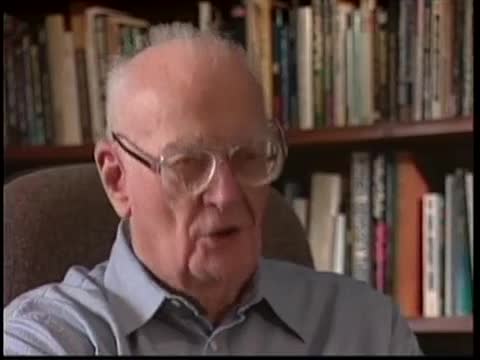
- Transcript
I'm not praying, I'm not praying, I'm not praying, I'm not praying. AT&T video phone. Mr. Clark. Good morning, all good afternoon as the case may be. Good morning, our afternoon for you with evening for us. I am fine looking forward to talking to you.
Well, you know, every parent is proud on the birthday of a child, and you must be very proud now that Hal's birthday is finally coming up so many years after 2001 was released. Well, of course there's a problem here because he has two birthdays. One in the book and one in the movie, and I never quite show which is which, or why we changed. I wanted to ask you about that because in the book he was born in 1997, and in the movie he was born in 1992. And Kubrick, of course, was very insistent on that, that he wasn't going to be fooled for a second, that the birthday was in 1997. How did that happen? I have no idea. Could it be in a fluff of the actor? I just had any ideas whatsoever. But, obviously, we've missed 92, so that's the most of 1997. Absolutely. In 1997 is, of course, what you wrote in the book, and you also mentioned it in the notes at the end of 2001, the final Odyssey, which is coming out this early next year, I believe.
I think in February of March, yes. February of March. I got the TypeScript of it in the mail today. Oh, excellent. I am very happy about it. I really think it's the best of the trilogy. I don't think any trilogy should have more than four volumes, so there won't be another one. I thought you were a little better at math than that. Let me ask you how you originally created how. We know, of course, the famous story of how Kubrick approached you, and you remember this short story that you had written called The Sentinel, but there were many, many steps between that first meeting and the screenplay and novel of 2001. What point did the idea of how begin to emerge? Well, you're trying to ask me to dredge up memories that are overlaid by many other
stratas of books and movies and things, but it's all began in 64. I can't really believe the date. When I was actually moonlighting at time life, and then, say, by an odd coincidence, the issue of time has just arrived today, it's got a letter in about 2001, how it anticipated the future. And Sandy contacted me. In fact, he contacted me before I went to New York to work on the time-life man and space project, and we sort of brainstormed together for quite a few days. And what I did, I went through my stories I'd written, and I made a list of about six, and said, do you hear some basic ideas? And I saw them all to stand. They were all six, and the only element he used, was from the Sentinel, a short story, about the discovery of an artifact on the moon. And then I bought back the ones he didn't use from Sandy,
and I hope one day I'll have the reason to sell them to somebody else. Now, who invented what? After all his length of time, I have no idea we were sort of bouncing ideas back and forth in like a table tennis match. Certainly at that time, you were much more optimistic about the possibilities of artificial intelligence than people are today. Oh, I don't think so. Artificial intelligence is roaring along. And in fact, I've just got a fact from Jet Propulsion Laboratory, and this is rather interesting. I'll just tell you what they're up to. I'm just reading from the letter from Dr. Richard Doyle, who is ahead of the autonomy technology program. And listen to this. We are holding in January, 1997 symposium on the topic of intelligent autonomous systems, for space, intelligent autonomous systems. Well, that's exactly what how it was. But it hasn't really developed artificial intelligence on the timetable that was suggested by 2001.
We seem to be about as far away today, don't you think from how, as we were then or not? Yes. Artificial intelligence is always even about 20 years in the future. When I saw you in 1958, you were speaking at the University of Illinois in Urbana. Did that visit have anything to do with friends you had there and did it lead to Hal being born in Urbana? Oh, very much so. Because my math professor at King's College London was George MacVitty, who later went to the University of Illinois and my placing Hal's birthday there was a radio tribute to George and who is indeed never many years. He was a leading cosmologist, incidentally as well as mathematician. And by an odd coincidence, the supercomputer center now is at Urbana. No, whether that's a coincidence, I don't know.
Let me ask you some questions about Hal that I'd really be interested in your opinion on. Do you believe that the problems that Hal experiences at the end of the movie are a programming error? Or is he jealous of the fact that humans want to usurp his role in the mission? In other words, has he had a human emotion or has he had a programming mistake? I think Hal's on that one, but remember the four books are not exactly sequels in parallel universes now, and I may have changed quite a few ideas. Some are forgotten, some are not relevant anymore, and some in fact clash with their developments. Obviously, the time scale is gone completely wrong. A 2001 story line can't happen before. The earliest, maybe 2030, because the whole space program is sort of on hold now, but it's hard to remember that when we worked on 2001,
from 1964 to 1968 roughly, NASA was seriously planning to put men on Mars in the 1980s. Well, now we haven't been back on the moon yet. One of the things that intrigues me in 2001, your new book is your idea of the sort of space elevator, a permanently orbiting ring above the Earth connected to Earth by a fabric made out of Buckminster Fullerine, which would allow a person to be lifted from the surface of the Earth up to this space station at a cost of only about $100 worth of electricity. That's true, and in fact $10 for the Ryland trip because you get most of the energy back when you return in the Earth's gravity field. Now, this is an idea I developed much further in another novel called The Foundings of Paradise,
where I described the building of the space elevator and sent me from a mountain in Sri Lanka. Now, that book was recently carried up in the space shuttle by the crew of Atlantis, when they did the tether experiment, and I have a wonderful photograph of Jeff Hoffman holding the Foundings of Paradise, floating in because in space and reside in with the Earth in the background. Now, that is a story. I'd love to see film one day. Another interesting fact, Buckminster Fullerine, the material that will make this possible, was it goes named after Bucky Fuller, who I lost in this very room. And a couple of weeks ago, the chemists who, on the code discovers of this material, got the Nobel Prize. So all these things are pointing in the direction one day. It will make the space elevator. And then the universe will open up. Another idea that you've come up with recently that I found fascinating is the sole catcher. The idea that a,
apparently a computer or computer like device could have enough complexity and memory that it could store and recreate a person, physically, emotionally, and spiritually. And you say in the notes at the end of 3,001, that the memory that it would take to do this is less than you originally thought. Well, it's about 10 to the 15th or so. But it is a thought that in short the one day we may be stored in something about this size. Not only our bodies, but our minds, our emotions, everything. I think it's a pretty scary idea, but I have developed it in the N30001. It's not really original. I mean, the idea of storing personalities goes back to science fiction and a number of people in the business now. I'll take it seriously. And working on the idea. Today we live in a time when the cyber culture has changed our lives so dramatically.
Could you have foreseen that at the time that you were writing about how 9,000? Did you think that computers of the power, for example, of the one on my desktop or on your desktop, would be in the hands of private citizens by 1996-97? No, I don't think anybody did. The chip revolution is a most remarkable human history. No one could ever have dreamed that something at the size of a house like the first computers, using tens of kilowatts of energy, it would be compressed into a thing about the size of your thumbnail. That is totally unexpected. And that changed society. A world changed society. You know, gone recognition. And I'm rather worried about some developments that may happen. Recently, I had an essay in the Asia Week magazine. And I've invented a new word, the coming cyber-clism, or the subtitle, the coming cyber-clism,
or who will change the light bulbs when they're all plugged into entertainment. You know, who's going to run the world? Let me ask you something that is an obvious question, I think, for any science fiction, writer, including the greatest of them all. What were your thoughts when you read about that rudimentary evidence that they might have been able to prove that there have been life on Mars? Well, of course, I was very interested. I think it's been rather overblown because we're, it's not proof. It's, I'd say, 80% or so evidence. But it does mean we should follow this up and look for a similar evidence, perhaps from Europa. In fact, a Freeman Dyson wrote to me the other day and said that we should look for meteorites that have been splashed off Europa. Because the oceans of Europa, as I said in 3,000 and 1,000 and 3,000 and 2,010, you know, maybe the other place where there's a lot of life in the solar system.
And what about these cities that you've found on Ganymede? Well, the, well, I describe in Ganymede, if you look at the images from the Galileo spacecraft, there's some extraordinary formations there. And the one I mentioned specifically, it does look like a city. It doesn't require much imagination to see that these are city streets. There are five kilometers or so wide as a minor detail. Do you think that there is any scientific invention or discovery that the man or woman who came up with it would be so alarmed by that they would feel it was necessary to suppress it or would all knowledge be useful and worth communicating in one way or another? There is one invention which I have discussed, I think many years ago, it must have been profiles in the future. And that is a time probe.
If we could ever invent something, it would reveal the past so you can see anything that never happened. When you think of the implication of that, they're pretty appalling and would human civilization survive such a thing. I just don't know. I don't think it's possible, but I can't root it out. And if a time probe was, it could be created that all the mysteries, all the secrets that ever happened will all be revealed, total transparency. And I think that's the most terrifying invention I can think of. So if you were to invent a time probe, you might want to seal up your notes or even burn them. I love that. One of the problems, of course, would be that if you did have a time probe, there would be so much time to probe that you would never live long enough to do it. You'd be a bit like the web. You've written a lot of great science fiction stories and novels. Do you think that there is one you've written that would make a great movie and you haven't been able to convince a producer or director of that?
What would be your favorite un-filmed project to film? Well, that's an easy one to answer. I think my best novel is the Songs of Distant Earth. And in any Michael Field is just on a beautiful suite based on it. And there's already sold over 100,000 copies. Well, the Songs of Distant Earth was, in fact, I think, yes, Michael Phillips, optioned at one time, but the option is LAPST. Meanwhile, I've got several of my stories on option. My meter impact story, the Hammer of God, Steven Spielberg has just renewed the option on that. So I hope that will go ahead. There's work on fall and moon dust. Childhood Zen has been sitting at Universal for about 40 years. And I'm a bit upset because the opening of Independence Day, which I've not yet seen, is identical with that of a child's end. And you sent me an email saying that oddly enough,
the ending of Independence Day, was an example of anticipatory plagiarism in which they stole the ending from your forthcoming novel before it was published. Before it even got round of thinking it. It's really synchronicity, I suppose. Yes, it's in fact, they can come to think of it at H.D. Wells beat us both. It was a virus that killed the invading Martians. Well, you know, 2001 is certainly the best science fiction movie ever made. And as you probably know, it was voted one of the greatest ten films of all time in that poll that's taken every ten years of the world's film critics, directors, producers, archivists, and so forth, by side and sound magazine in London. It's considered one of the top ten films of all time. But so many other science fiction films have not followed that lead. There has not been a film since 2001 with the same kind of vision or ambition in the science fiction genre.
No, perhaps not. Of course, 2001, I'm thinking films were about a decade until the technology caught up with it. And then we had Star Wars and so forth, which are, you know, space westerns. It's a great fun. I enjoy them. But you're perhaps right in saying that no one has ever attempted to follow the lead created by 2001. The whole third act of 2001 is such a visionary leap into the unknown. The feeling that the astronaut has arrived at a place totally beyond imagining, and although his physical environment seems to be a room, the room has apparently been created by some other race for its own purposes. The kind of ending that today, a studio wouldn't allow. The studios today would say the audience will be confused.
They won't understand it. It doesn't have a satisfactory resolution. It will be frustrating. How did you get away with that, you and Kubrick, in making a film with an ending that is so poetic and provocative and unconventional? Well, again, you must credit entirely. Stanley is an all-accredited for that. I just gave him some ideas and inputs. And the credit goes to Stanley and his amazing special effects team, led by Douglas Trumbull and Wally Veevers. And they deserve the credit. But then the notion of putting him in the bedroom, that must have contributed to that. And again, I can't remember Jack details. You see, there was feedback in both directions. I would write something, go to Stanley, and he'd say that's splendid about that. And I'd go back and rewrite it. And sometimes I had the extraordinary experience
of rewriting a piece after I'd seen the Stanley's version of it, you know, in the rushes. And so it was feedback in both directions. The star child, the last shot in the film, as the star child, or at least 2001 fans, now call it the star child. I don't know if that was really what you call it. But the star child turns and looks at the audience as if to put the ball back in our court, to ask us what we think our destiny is. And what do you think that question was and what do you think the answer is? What is the star child asking is and how can we respond? Well, I would say that the implication is that the future is wide open. It's up to us what we do about it. Our destiny is at least to some extent under our own control. But of course, at the time, a lot of people didn't get it. And one of the remarks I remember hearing
after the premiere, it was from a senior MGM executive saying, just apparently, well, that's the end of Stanley Kubrick. In your original short story, the Sentinel, you talk very dramatically of the impact on the minds and on the very identities of the people who see an artifact that is obviously the creation of a race other than the human race. Why is it, do you think, that we still haven't gotten any definite proof of intelligence for many where else? Wouldn't you think or hope that there might be some way that another race could make itself known or is the universe simply too large and is there too much time involved? Well, of course, this is the subject which has been debated endlessly and we don't know the answers. There are so many possibilities. Some scientists are coming around to the viewpoint
that we are maybe unique or that intelligence is very, very rare, a little perhaps life of some kind, maybe if had a common, that we have the other dichotomy that I think about 50 percent of the population in the United States believe that aliens are already here and are made contact with us. There's an extraordinary situation. I think it's part of the madness which occurs at the end of all millennia. You are not one of the people who believes in the UFOs are among us theory. I've seen too many UFOs that take them seriously. I've seen about six including the best one always standing Kubrick. It's all on record. And they all turned out to have very simple and often absurdly simple explanations. The one that you saw with Kubrick, how did you explain it? Okay, well, this is really incredible. You might think I'm making this up. But the very night we agreed to make 2001, we went out on the roof of Sandy's penthouse and coming up from the west was a brilliant star, rose right up the sky
and apparently stopped overhead. Well, in our first reaction it was an artificial satellite but artificial satellites can't stop motionless and then it continued on down to the east where we actually got checked with the New York Times to see if there was a satellite then and we got onto the pentagon and the explanation was absurd, really absurdly simple. It was a satellite. It was the echo satellite but there was a full moon at the time and it's very hard to judge the movement of something vertically overhead. If it's stationary, you may think it's moving. If it's moving, you may think it's stationary. It was the echo satellite but by some extraordinary coincidence the New York Times gave satellite crossings didn't give that particular one that particular night. Now you can even all kinds of conspiracy theories out of this one but we did see the echo satellite. We couldn't identify it. We eventually did. The other five or six that you saw did any of them look any more
puzzling than that one? Not really. The most striking one, I guess with a lot of brilliant sources flipping back and forth over the sunset and again the explanation turned out to be ridiculous. They were seagulls. You wouldn't believe this but birds at some angles reflect all the speculative like mirrors and you can't tell what they are if you're a long way away. The information at the end of 301 includes your speculations about the possibility of instant universal acceleration which would allow someone to move very quickly to another place without having to worry about the G forces and you seem to feel that that might be theoretically possible. Well, we know it is a gravity field just just this. If you were falling in the gravity field of a black dwarf or a neutron star, you could be accelerating at a million G and you wouldn't feel anything until you got so close
that the tidal forces tore you to pieces. So, you know, nature has provided a space drive in a way if we can ever control gravity and there are some hints that this might be possible then you would have a space drive. When you started as a science fiction writer, the genre was not very respectable. There were some good magazines. John Campbell, of course, that astounding was trying to do some very high-level stuff, but many of the magazines were pulps on the level of thrilling wonder stories and amazing stories. Today, science fiction is a genre with best sellers with professors with PhD research projects with books of criticism, conferences, symposiums. What are your thoughts about the development of this genre which you are certainly one of the small handful of grand masters and founding fathers of? Well, science fiction
was respectable before you got a label. I mean, the wells is scientific romances of whatever you would like and, you know, were quite high to regarded and most mainstream writers seemed to have written some science fiction, quite some surprising names. Roger Kippardin, for example, who's making a bit of a comeback note as you wrote stories about the future of aviation and Melville, or the robot story, it's not very well known, but Bruce Franklin put together a collection of such stories and so science fiction until Hugo Gernsback came along and launched the pulp magazines was fairly respectable so we don't know whether the bless or curse Hugo for making it maybe a popular but less respectable and I reminded of a remark made by one of my friends in the fields that science fiction should go back to the gutter where it belongs. It was fun when we were in the gutter. That was getting too respectable.
Your science fiction has always been written with a real kind of interesting combination of hard science and then science speculation and then kind of a visionary approach to the role of human beings in the universe. Some modern science fiction has criticized for being too fantastic to, frankly, oriented in the fantasy genre or to interior and not scientific enough. Do you think that's a legitimate criticism or is it just a distraction? Well, we're up against the old I, but what is science fiction? What is fantasy? And of course, there's a very fuzzy border between the two. I've attempted to find a science fiction in something that could possibly happen or hope it won't and fantasy, it's something that couldn't
possibly happen and often you wish it could. Well, I think that you're certainly deserving of congratulations for having given us how 9,000 so that we can celebrate Hal's birthday. Well, thank you very much. Nice talking to you, Roger. Bye-bye. Bye-bye. Bye-bye.
- Contributing Organization
- WILL Illinois Public Media (Urbana, Illinois)
- AAPB ID
- cpb-aacip-16-91fj72m0
If you have more information about this item than what is given here, or if you have concerns about this record, we want to know! Contact us, indicating the AAPB ID (cpb-aacip-16-91fj72m0).
- Description
- Description
- No description available
- Asset type
- Program
- Topics
- Literature
- Film and Television
- Science
- Media type
- Moving Image
- Duration
- 00:28:09
- Credits
-
- AAPB Contributor Holdings
-
Illinois Public Media (WILL)
Identifier: cpb-aacip-5ee1fc6cb57 (Filename)
Format: U-matic
Generation: Master
Duration: 00:27:31
-
Illinois Public Media (WILL)
Identifier: cpb-aacip-0f1d44200c4 (Filename)
Format: U-matic
Generation: Master
Duration: 00:27:31
If you have a copy of this asset and would like us to add it to our catalog, please contact us.
- Citations
- Chicago: “2001: Roger Ebert Interviews Arthur C. Clarke,” WILL Illinois Public Media, American Archive of Public Broadcasting (GBH and the Library of Congress), Boston, MA and Washington, DC, accessed September 20, 2026, http://americanarchive.org/catalog/cpb-aacip-16-91fj72m0.
- MLA: “2001: Roger Ebert Interviews Arthur C. Clarke.” WILL Illinois Public Media, American Archive of Public Broadcasting (GBH and the Library of Congress), Boston, MA and Washington, DC. Web. September 20, 2026. <http://americanarchive.org/catalog/cpb-aacip-16-91fj72m0>.
- APA: 2001: Roger Ebert Interviews Arthur C. Clarke. Boston, MA: WILL Illinois Public Media, American Archive of Public Broadcasting (GBH and the Library of Congress), Boston, MA and Washington, DC. Retrieved from http://americanarchive.org/catalog/cpb-aacip-16-91fj72m0