Talking Point; Television and Society
- Transcript
Talking Point is a local production of WIL-L-L-TV, Channel 12. We're good evening and welcome to Talking Point. Tonight we'll examine something familiar to almost everyone. The topic is television. The way it has entered our homes, our conversations are very way of life. Television that once fledgling technology of the 1930s has grown into one of the most dominant forces in American life. An entire generation of Americans have fond memories of growing up in front of that hypnotic
world. But today we're rethinking the role television plays in our daily lives, particularly how it affects the lives of our children. I think you can either use the television as a tool for your entertainment and your education and your enlightenment, or you can just sort of turn it on and let it wash over you. But I think you have to realize that the images that come out of this box are not filtered unless you're sitting there filtering them with your child. Television's golden age depicts America as a white middle-class culture. Minority representation was rare and when minorities were depicted, it was in stereotypes. Many minority groups feel that the media still stereotypes them and that television does not truly represent America's cultural diversity.
People of color are not in charge of how they're represented on television. It's white people in white establishments and institutions who come out and say, these are what black people are like. And they're also very comforting images whether and they range the extremes. Someone who's Chicano might be in a gang or else if you're Chicano, you're a maid. And that's really the extent of any kind of representation. For myself, I think it was also being a people that wasn't represented at all. And if you are, you're very homogenous. You come up with the words such as Hispanic, which means many different cultures. Whether it be Bolivian, Colombian, Cuban, Mexican, so many different cultures, but you show one brown person maybe as a lawyer and you don't focus on them ever. And you never look at the different struggles within the community. To me, that's no portrait at all. Another major charge leveled against television is that it uses violence as entertainment. But how does all of this television violence affect American society? People tend now to overemphasize the amount of violence in reality.
There is so much violence on TV that people tend to assume that in some way this is a reflection of the violence in real life. But most of the research suggests people think there's more violence than it actually is. People underemphasize the severity of violence. This used to be called desensitization. I'm not sure that's a good description. But the fact is that people today tend to see so much violence that they become accustomed to it. And the real horror and shock and devastation of violence tends to be related to what they've seen on television. And the third thing is certainly that for some people, and that's a very important limitation. For some people, television can contribute significantly to what I think some research is called a syndrome of aggressive behavior. That is, for some people, television can make them more violent.
We've been talking about violence as entertainment. But some of television's strongest images reflect the violence in real life, Vietnam. Oswald. Reagan. Images that stay with us throughout our entire lives. Television is contributing very importantly to the increasing commercialization of every aspect of American life. I think here, for example, the debates are focusing most importantly on children. I think one of the controversies that should be talked about more is the fact not only that television does not provide much educational work to children, but it involves children in enormously complex marketing strategies. Well, in some societies, there's no advertising to children.
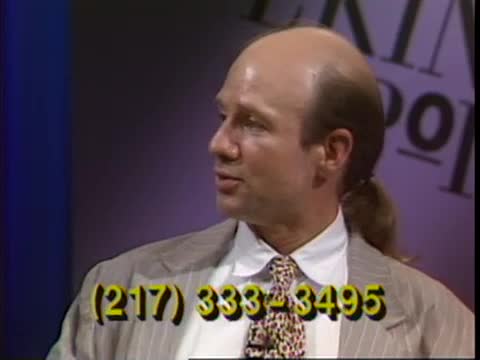
That's the law. You don't advertise to children on television. So, yes, I think we could make that kind of a decision. I would be in favor of that kind of a decision. The debates over television, which have focused often on content, seem to me misplaced. Television is clearly a force that is here. It is clearly one of the most powerful and potentially valuable forces in our society. And it is incredibly interesting that, in my mind, scary that we have allowed this incredible resource to be defined entirely by profit-making. Tonight, we have three guests. Ivy Glennon is an assistant professor of communication at Eastern Illinois University. Her specialty is media criticism, and her particular area of interest is entertainment programs and the stories they tell us. Dave Shaw, as the news director for W.C.I.A. Television, the CBS affiliate for Central Illinois. He's worked for W.C.I.A. since 1962 as a reporter, producer, and news anchor.
And he's been the news director there since 1980. And our third guest is James Hay from the University of Illinois, where he teaches television. As we talk, we hope that you will be thinking about the questions you would like to ask our guests, because a little bit later in the show will give you a chance to do just that. Well, thank you all very much for being here. I appreciate it. I don't want to get too theoretical just to start, but it was Jim Hay who suggested the point to start would be with asking the question, what is television? And I suppose television is a lot of things. It is this box that people are watching at home. It is the program that's coming out of it. It is culture both high and low. It is a very important force in society. It shapes values, teaches us things, not always things maybe we want to know. What is it? It is all those things. Well, it is all those things. It's also as Larry Grossberg was pointing out in the beginning of the introduction. An industry, to say it's an industry, often simplifies the fact that it's a very,
it's a changing, it's a complex set of relations between the networks and now other cable industries, between advertisers and sponsors and producers in Hollywood at one point in New York City of these shows. It's also a technology that has changed. Some would argue that we've now arrived at the end of the broadcast television era of the network era. And the television as a technology, as a form, has become so intertwined with other industries and other technologies and so on that is becoming almost impossible to kind of recognize it any longer. Certainly, we're at the historical threshold, I think, in many ways of a kind of so-called interactive technology of television that makes television that we see in the 50s, those images that you showed in your introduction, almost virtually obsolete. But let me just make one more point, and that is that we say that television can be many things, but it's often something that we don't even see.
And so on that we attempt to kind of adorn it in a way that makes it blend into even our most intimate and domestic places. Because you're interested in entertainment shows, looking very carefully at what is there, perhaps on the surface and then what is there on a deeper level. That's the question about what is, if there is, in fact, something there that we don't see, what is it? There that we don't see, well, there's nothing there we don't see, but there's a lot of things there that we don't think about that we sort of grasp on an intuitive level. This is the way things are. So, for instance, if you're talking about a police show, one of the most popular shows that's coming back on TV right now, it tells you how police people operate, what the law is supposed to be. If you aren't individually familiar with a police man or a police woman, you're not sure what it's supposed to be.
So television gives you that information. So, for instance, it tells you one thing is that all of our civil rights, for instance, are red tape. They get in the way of real law enforcement. That's a message. It doesn't mean that you necessarily agree with that message, but it's coming over a lot. Those kinds of messages. If you, maybe this is too difficult to question, but if you were to say, is there a single message or a kind of a dominant message that comes through programming, programming of different types? Is there such a thing? If you asked in a very flat sort of way, what does television say, tell us we are? Tell us about America. Could you answer a question like that? No. I couldn't answer that question because I don't think there is just one message. There's lots of messages competing. There are some that are relatively consistent across programs and over time. For instance, what I just mentioned, police are there to protect us and need all of our help.
But that's only one. There's lots of different messages. And then there's different people that talk about what these messages mean to them and think about it differently. So, no, there's not one. And I might add on that point too, that historically, I mean mentioning just a moment ago, television at the end of the broadcast era, that at a time when there was, when there were three networks, it's not to say that there was more consensus necessarily, but we also have to recognize that any kind of consensus, any kind of overlap and any the possibility of shared meanings and ideologies through television, have in some ways been changed significantly with the advent of cable, where we have different networks, MTV television for a particular demographic audience, black entertainment television, the Nashville network, Christian broadcasting network, each attempting to in some ways be arbiters of a particular kind of consensus in a particular shared way of looking at things. It's far too early to rule out the traditional network television, although at the point has been made that their shares have dropped to 65 to 70% instead of nearly 100%.
No one has stepped forward to get much more of the market. It's been fractionalized by cable, by all the different sources, by the narrow casting that we have now instead of broadcasting. And the network still dominate the viewership and lead to more viewing on cable, cable benefits by networks being on there. I want to make a point that when I was in grad school, my advisor was Professor Harry Scornia, who was a well-known critic of the Marshall television, and he used to make the point that we'd be better off and we'd just blew up the whole thing and started over again. But where would we come out and where would we start and what would we end up with? We may end up with the very same type of market-driven, viewer-driven type of system that depends on numbers of viewers for its success. And I think that might be where we'd still end up. Well, as you think about how television has changed just over the years that you've been involved in it as a way of making a living, what do you seem most important, or maybe most disturbing, things that maybe you don't like?
Well, I think I represent commercial television here tonight. I'm not here to defend it necessarily. I see the same things as a viewer that bother me as other people might. But certainly news in my areas become a much more important factor over the years, beginning with the early 60s. That news is the growth area in local television. News is the identity of local television. I think some things are going on. We'll probably head on later in local television around the country that don't please me. And as I look back, there's a new generation coming in that are making changes in local television. Some of it is better than it ever was, but some of it is as bad as it's been because of its excesses. And I think television is widely known for its excesses.
I want to talk a little bit about the issue of television violence just because it's been in the news recently because, first of all, in, I believe it was in June, the television networks agreed to put warnings on before programs that were particularly violent. And I guess that was at least in part, response to rumblings on Capitol Hill about Congress wanting to place some restrictions or wanting to get involved in regulating content. And, of course, just this week, the beginning of this week, whether it was a big meeting on the West Coast and Senator Simon addressed this meeting and said to them, you guys got 60 days to clean up your act or Congress is going to clean it up for you. Now, it could be that's just empty threats because Congress has talked that way before. But that's some fairly tough talk and the television networks need to be paying attention. So, first of all, is it possible to say with any assurance that we know something about the effect of watching violent programming on television? And is it as bad as some people say?
Yeah, there are some things that we can say about violence on programming. It's not my particular area, but the literature is filled with it. And the kind of things that Dr. Edmond talked about are clearly there. Children who watch a lot of violence on television are more violent. And you can see it just the other day, for instance, I was at a friend's home. Two little boys, once five years old, once 10 years old. They're watching violent shows on TV within an hour. They're fighting with each other. And you can see that again and again. I don't know if you have children, you might notice if you leave them alone with a violent show with each other quicker than any other time they start fighting. Of course they might do that any. Not quite so fast, maybe not quite so violent and not quite so many ideas about how to do that. And then there's other effects too, the ones that Dr. Grossberg talked about desensitization. You see violence again and again and again on TV. And you remove from it. So you're safe from it when you watch TV. So you get this sort of involvement and uninvolvement. And you feel kind of a shield between you and that violence. And it takes a minute to break through that shield.
So there's that effect for sure. I want to ask Dave Shaw, now I want to make sure people understand. We're not putting you in the position of defending commercial television. We asked you because you were a broadcast journalist and also someone who's involved in making television on a local level. So that's really the reason. But I would expect that you would not be happy about the idea of, say, congressional regulation of the content of progress. I think the dialogue is good, I think. I think the impetus must come from the people and the viewers to put pressure on stations to let us know when we do something that is offensive to them. So we can at least talk about it. Let me give you a good example. This week, a man committed suicide in Bloomington after a standoff. He committed his shot himself in front of lots of cameras, all the cameras are rolling. And the decision had to be made in covering the story what do you use and what don't you use. We didn't use that particular clip of him shooting himself.
We used up to that time. We gave it serious consideration as to what we're going to do and how we're going to do it. Yet in the program preceding our news program, there were several violent acts of people being shot and being died. The hood died. And five minutes later, we're into the reality and trying to make decisions on what we use. And we had a lot of good feedback on that as the way we handle that story. And I think that consideration must be given in the way those stories are played and thought given rather than to put him on. And I'm sure there's not universal agreement on how that story was covered. Somebody wouldn't want the story on it or others think and some stations didn't run the unedited version. Well, I think it's interesting because apparently some of the participants in this conference at the beginning of the week were knocking television news because they were saying, hey, some of the stuff that you see on television news is as violent or can be as graphic in its depiction of violence as entertainment programs. Now, people if they only watch television and champagne or banana, they won't see that, but big city television.
You will see that. Well, they'll see it. And when the networks might present that type of thing, they would see it on local television and such. But I think it's a matter of thought must be given to how we do it. And every story goes through an editing process. It's own type of censorship. So I think the important thing is that we are thinking about it. Coming on this conversation because I wonder if you're thinking that we're, is there a different way to look at it than this way of talking about violence? And what its effects are and are there any effects? Well, I think I'm not going to quibble with the notion that indeed there is violence on television, but there's also a difference between something violent that happens to you outside of this studio. And an image of violence on the television screen. The studies on television violence or on, for that matter, violence and broadcasting have been around in this country for decades. Back to the 1930s when there were early studies on the effects on children and adolescents by motion pictures in this country.
What's interesting, I think, about the most recent one is that in some ways the politicians who are talking about this are doing it. And the news is doing. It's all television. I mean, it's kind of television people talking about kind of what television should be. And I think it's just as important to recognize that politics itself has kind of moved to a historical moment where its relation to fiction programs and talk shows and call in shows and so on, that the relation between all of them ends up getting blurred and they end up talking about television. I don't want to trivialize because I think that in some respects the image of violence on television is an important one to consider, but I think just focusing on the issue of violence ends up simplifying a whole array of issues about the way in which we make sense of the world, the way that we see through those images on television. The world that we live in, and one of my chief complaints with those studies, I don't want to simply, I'll play the devil's advocate for a moment, but one of my concerns about many of those studies is that they often assume the television is only an insidious authoritative technology and that audiences end up being passive dupes imprinted with whatever it is the television.
And I think that at that sense it ends up assuming that kind of everybody watches television the same way and that certain kinds of programs that maybe are more violent than others don't target even a particular kind of audience, maybe male or female. One of the problems that came out of the conference this week is they were having a hard time defining what is violence or excessive violence and everybody has their own set of filters and they were having a hard time really defining what it was they're to discuss. That is really a problem deciding what violence is okay, what violence is not okay on television. And one distinction that Dr. He made is real important fiction versus news. I mean violence on the news and violence in a TV show, are they comparable?
And you say, well you can't have it on news, well that really happened, is that okay to put on. But we also have to recognize that films such as even taxi driver as violent as the ending of that film was or unforgiven with Clint Eastwood were widely recognized as in some ways interrogating a tradition of storytelling, a popular storytelling through film and television that was tended to be violent. I wonder if I could just raise a different question and that is this issue of activity, passivity, in viewing. Because I think that some of the people who have been most critical of television and I suppose the guy I think of is Jerry Mander who wrote this famous book some years back and I don't know if people still are.
I don't know if he's still a hot item, he wrote this book for, it is for us and it's for arguments for the elimination of television. One of the, he makes this argument in this book is that it's impossible for television to do anything good. You can't learn from watching television because the medium itself loves you into this sort of stupor that makes you, makes you this passive viewer and incapable of really interacting with it in a really active way so that you can, you know, so he would probably even say even channeled wealth. Has no redeeming virtue because it's because of the box itself and the way that it works on people. Well, sometimes you have to make an extreme argument to get people's attention. You know, that's the way I see that. That's an extreme argument to give people's attention. But certainly it's not true. A lot of people are very active in what we call in academics decoding television, trying to decide what this means to them. Nonetheless, having said that, and I believe that that people aren't just passive dupes, still the amount of violence gratuitous and otherwise does, if you watch a lot of television, have an effect.
I mean, even if you're actively watching it, you still have some kind of effect from it. It's not nothing. You know, you can't be so active that it doesn't affect you. So I think he's got a point that there's no way of getting away from it completely, but it's too extreme, certainly. There's a kind of nostalgia in that view that somehow in America, there is a moment that kind of before technology and before the invasion of our living rooms, right, when everything was okay. And that somehow this new technology and a kind of Orwellian 1984-ish kind of sense, you know, has responsible for all of our problems. And it's in that vein that I think that the focus, the emphasis on violence ends up simplifying. In some respects, the very sorts of things that the people who are interested in this issue want to kind of take on.
Dave, do you think when you are thinking about what you're going to put on your newscasts, at what sort of level are you thinking about the fact that people's idea of what the world is all about is in part the result of your newscast and a lot of other things that they see. And so, in some sense, whatever filters you have, personally, or as a journalist, are helping to shape the worldview of the people who are watching. Now that may be going a bit far. But in fact, it is true. Is it something that you think about? I think we think about it in certain instances when we relate, when in how to play a story that may have a large impact, a large number of people. I think we go about our daily duties and our daily news and routine news. But there are stories that come up that we do give extra consideration as how this is going to play, how this is going to be perceived.
I think fairness is a very important part of our, our medium is in the news medium. But, you know, I go back to, it scares me to hear someone say, I get all my news from television. We have television, we have radio, we have newspapers, we have books, we have magazines. And I think it is how you use our system of information that determines what you're going to get out of life. And not to get wedded to one source of information. That does bother me and scare me that we would have that kind of influence. I'd like to qualify that just a little bit. I agree with you, you can't just watch television. You know, you have to read, etc. But a lot of the studies we've looked at suggest that newspapers, television, magazines cover the same stories with a lot of the same frames. They look at it in particularly the same way. There's one going on right now, for instance. I read it in the newspapers, I see it on television, the deficit. You know, the way it's being framed, the way it's being cast is, win loose.
Clinton versus Congress, Clinton versus the Democrats, it's a locked-in race. Other issues are discussed, but they're always secondary to the race. And that's in all those different sources. So in a way, a lot of research, it's called the Gender Setting Research, has suggested that news, overall not just your station, gives people ways of framing big important events, and it's limiting in some ways. Yes, in the options, and in the way we play political horse races, I think trying to boil it down everything in a contest sort of way. And it's oversimplified, for sure. Let me just take a moment because I want to tell people who are watching that in a moment or two here, we'll begin taking your calls. So if you do have some questions for our guests, the number to call is 3-3-3-3-4-9-5, and if you're outside of the 2-1-7 code area, you may call collect, and you can start calling right now, and as soon as we get some people lined up, we will start taking calls. Just to make an abrupt change to a different topic, I'm wondering what you think about the new
television technologies, high definition television, the possibility that there's going to be more direct broadcast available to people, either with small dishes, or there's going to be an improved range of programming possibilities for people that would come through some kind of wire cable, fiber optic, something like that, and the possibility of there being more interaction using the television as a way to get information or exchange information. How do you think that's likely to change the landscape of television? I think how is it likely to change the landscape of television? Let me put it this way. I think that first of all, the screen in the home has already begun to take on a variety of functions. For video playback, you show your movies, home movies, maybe that you even made with your own video camera. You may be, in some instances, even can use the television screen as your monitor for your computer, for your word processing.
In some instances, in historically, in a certain sense, these various functions that share the same screen that the difference between them, the interaction between them, begins to blur, begins to change the identity and the historical use of each one up to this point. I also think that, in a certain respect, the notion of interactive television is somewhat of a misnomer because what exactly is one interacting with? And the second question is who, in some ways, is controlling that interaction. I mean, the illusion, of course, is that one can, by telephone or by computer, interact with other people, and one at the same time can easily forget that there are, in fact, industries that are jumping in in order to kind of manage and direct already with time beginning in Orlando and building a kind of electronic superhighway
that's supposed to compete with the one that Clinton and Gore have in mind that's going to unite the nation now. In a different way, supposedly, than broadcast television did in the 1950s, 60s and 70s. We want to try to get to some calls and we have somebody just some folks standing by. I just want to ask Dave Shaw real quick about if it really does come to pass that we have systems that are offering people, you know, 150, 200, 300, 500 channels, what does that mean, do you think, for the local stations? I think it all boils down to the service that is going to give the quality that people want. You can have 485 bad channels and 15 good ones. And I think, especially for local... I think people will still turn to what is their local station for local news and information. I think that's been one of the selling points of local television, certainly in the last few years and in the few years ahead. But I think it's still going to, you know, the quality is going to...
People are going to turn to the service that gives the quality that they want and provides the services that they want, even if you've got 500 systems out there. And also, you're talking about how television is being used. I was reading about television being used as radio because the screen giving you the tune that's being played and what's on right now. They're the digital audio and be offered on cable coming up. Well, why would we talk with some of the people who are watching? We have color and line number one. Hello, go ahead. Hello, my name is Eleanor. I'm from Springfield, Illinois. And what concerns me is that we would not let a young child go into a bar when there's possibility for violence, whether it's addiction, depression. And with violence coming into the TV, it's as if you've taken a place like that and just set it down in the middle of the house. And the uncontrollability of this is so unacceptable.
What's the potential for having blockers on TV for this? Do you think it's going to happen? Okay. Do you think something like that is... I don't know if it's going to happen. It could happen because historically television is different than print because of the very things the caller is talking about. It's right there in your living room. It's intrusive. If you have it on, you can't not listen to it or not hear it. So there might be a way in the future where people could turn it off. Over the objections of say people saying you can't sense their television because of course television is a resource, we need to have some control over. I wouldn't be against it. I suppose one possible response would be now obviously there are times when your kids are out of your site and you can't always control what they're up to. But there is one way of controlling television. It has a switch on it. You can turn it off. And I think one of the things that we encourage parents most strongly do is to watch with your children talk about what they see. And for you to say here are some programs that you can watch and that's it and try to exercise in control.
Now maybe that's naive. You can't completely control what they watch but you can have some control. Part of it isn't a part of it isn't. Just turning it off. That's not saying what you can turn to. You can say you should read a book. You should go play with your friends. Of course they should do that. But if they're going to watch TV there should be some kinds of alternatives to what you don't like your children watching on TV. It'd be nice if with 150 channels we'd have some decent alternatives to that. So that's you can't let children watch television. You might be able to control it somewhat in your house. The other part is absolutely true. Every study I've looked at, everything I've heard suggests that if you watch TV with your children your influence is greater than the television is. You talk about that's a good thing. That's a bad thing. That person got punished for doing that. If you do that then when the children leave the house and watch TV somewhere else they'll have those values to fall back on. But if you just sit there in front of TV you're going to have those problems.
And Dave if we get those 500 channels what are the chances that maybe one or two might be devoted to children's programming. And then as we get more this broader spectrum that there might be the possibility that they're just going to be programming there. I'm sure of that. One thing we haven't talked about is the evolution of the remote control. And I think former President of CBS News was in Champaign-Urbana. A few years ago it said people vote with their feet. They get up and they turn to dial. Now they just go through the remote control. This is influence program. No quiet moments, no dull moments in television because they're going to zap you out. And this has had a big influence on the way television has played out. But again it's back to how you use television and how you use it. And I think it would be nice if parents would exercise more control but we know that that isn't necessarily going to be realistic. Okay let's go on to another car. Line number two tell us what you're calling from tonight.
Right, go ahead. Okay, primitive men knew that being on a tom-tom would stimulate violence and aggressive activity. It looks like to me that television people know that printer, all of the programs that come on come on was banging bang bang bang. Someone beating on something in the background. I mean is does anybody realize that does stimulate violence? Well our television producer is purposely trying to stimulate people and trying to get involved. I think they probably say they're trying to get your attention but I don't know that they're looking with it to an eye to as a stimulant. I don't think so. I think the music does come on as an identifying thing that helps people know what is coming up. I think beyond that I don't know what the other uses. I think also it's important to kind of think about what's happened over the 1980s in the relationship between some of the emerging and most popular genres which have been the talk show.
And the hyper-realistic docu television shows reality reality shows what exactly I'm very suspicious of that term. But reality shows and the news and to think about in some ways the Dave and I were talking about before. The show this evening about a particular station in Miami that basically breaks in five minutes before each program in order to offer teasers for the news and the teasers run. But in some ways the teasers don't kind of seem out of place within the kind of flow of fiction that occurs right in the two or three hours before the news each evening. In television news there are some people who do have this philosophy that they're going to grab whatever the most sensational thing is that they've got and they're going to put it on because that's going to get that's going to make.
That's going to go back to the remote control where you have rating services now with metered markets where every minute is being recorded and you have the ratings the next day how that newscast performed and who was watching what and what minute of the program and what story was on. And I think this is at an influence on this and I don't think it's good and I think it's I think it may be cyclical I think that that's not S.I.C.K. but see why. I think it'll play out it has had some success but in other places the successes are somewhat tapered off so you know we'll see. Okay, we go on again line number three hello. I don't know what they call them teasers or previews or what but it pops in between the programs that you're watching. And during the week and they're telling you about all of the things that are going to be shown later and they choose the glorious and most violent and all of the killing and sexy and everything.
And you're subjected to that all week long whether you wouldn't watch the program or not. So how do you avoid that and that church children would see that in between other programs you're watching. That's a good point and the point is being made in discussions. You know you're talking about Senator Simon bringing up the issues. Not only the programming but the promotions of the programming and I think another place that we're seeing are movie. Movie promos for promoting our rated movies that are in the theaters and some of the violent scenes from there that make it on. That's a good point. I mean in many respects there's always since the late 1950s there's been this kind of contest between Hollywood film production and television production and movies that in some ways lampooned television is the kind of epitome of kind of mass culture and schlock and kitchen and television that becomes the place where movies advertise and offer audiences something that they can't see on television.
And in such a way that it promises something that they can't see on television. Okay I'd like to get back to you know just all the violence on television and what Mr. Shaw was saying. Yeah that's what gets the audience's that's the attention getter when you're zapping through I do that myself don't you? You know go through it. You wait for something that catches your eye and you put it on. The way television set up right now there's no incentive really not to put that on except for pressure groups from consumers. You know that saying I'm not going to watch this I'm not going to buy your products. I think Senator Simon has the right idea if the government can give some other incentive not to do this to help them be more responsible. You know the FCC you talk about the 1980s the FCC has gotten very weak in the 1980s and stations pretty much don't pay attention to it the way they used to.
They're not as worried about public interest if some mechanism comes back to provide an incentive to be more responsible that might help. Well why not why not though say that the mechanism to be responsible is the ratings and that if people don't like the programs don't watch. Because obviously then the program producers and the stations are going to look at that and they don't like losing money they like making money. So when people watch they're going to put on why should Congress come along and say to the networks this is what you should be doing when people in a sense could again vote with their remote controls. Well let's get back to the promos you don't vote for those promos you don't vote for that stuff between the shows coming on. You don't want necessarily that to be on there and let's get back to choice how much choices they're on television. I know that when I visited friends that have satellites with 150 not 500 stations they'll say there's nothing on. There's nothing on because it all looks the same you know there's very little other alternatives there.
So you watch what we call the LOP you know that the least objectionable program. Not the best program the least objectionable one. Well wait till we get those 500 channels. That's a sumo wrestling so far. Tokyo we have another call here line number one hello. Yes this is a follow-up statement. I feel like we need to get real about this we've got about 50% of our families that go through dysfunctional periods where things are out of control. These parents are both working some are single parents working to job. They do well to get their kids fed into bed and paid for and supported you know that way. They're not going to be able to control this stuff. Well what are maybe a question we can come back to is what is the possibility that some outside force Congress or some interest group would in fact lean on the networks enough to have them change the way they the kinds of programs that they present.
Well I don't know how much power Congress and the FCC could have but I know that before the 1980s there were some differences because of the presumed I don't want to say threat but control of the FCC I can take away your license if you don't operate in the public interest. So what happened at the station I worked out when I worked at a TV station is they control themselves show some responsibility because they knew that come licensed time there'd be some problems. So you just avoid that by being a little more responsible up front. It might help some I mean I don't have an answer to how to put that in. I just say it's very difficult to try to define what is the problem that you want to get rid of. What kind of violence if that is what you want to clean off the airwaves and everybody is going to have a different opinion. In our newsroom when we talk about stories we have different opinions on what should go on and what shouldn't go on or how the story should be treated.
And some of it's a generational thing I think younger people feel a little differently than older people. Well that's a good point to pick up number one that it is somewhat of a generational and parents have complained as much about the violence that their children are coming contact with on television as they have about rock and roll. On the other hand it's important to recognize that violence occurs within particular forms of television and they have traditionally been police and detective shows and now the kind of reality programs that have kind of built off of those. And the question becomes to what extent do audiences familiar with that kind of a story recognize in the kind of repetitive ways in which a detective story or a police story is told that the violence is in fact a kind of image that kids who go to horror movies. And you know that that becomes a ritual of dating almost that I'm not saying that it's right but in fact I think that because in some ways it's become so much so ritualized.
It's not that just that we get desensitized in a way but it becomes part of a kind of a story that we become very familiar with. And I think the people who focus just on the question of violence end up forgetting about against whom that violence is perpetrated and the way in which that film is part of a production of meanings and ideas and values and so on that aren't simply limited to the violence. And violence is a dramatic gesture that's been around for centuries through to Shakespeare and the classical theater. What we come seems that we come back to a practical question at least what what I hear from the people who are watching is they don't like it. They want to have some choice. What do they do and what do they do.
You're asking a question what is the individual viewer going to do about violence on television? This is a systematic thing that has to be addressed on a social level. One thing you can do is turn it off. Another thing you can do is go to alternative program. Another thing is page channels but those are all sort of limited kinds of choices if there is more available on television that has less violence. Then you have more choice. We don't have that much choice because most of it's there. I'd like to make one more distinction about violence here too. Really all violence is not alike. It's not all the same. There is I have to say good violence where some violent act is committed and punished and children in particular learn that that's a bad thing that when you do that you hurt people and when you do that people don't like you. That's not necessarily bad violence. More than one kind. But again I have to say there is so much and it's so hard to avoid it. Yes you can avoid the genres of police shows and detective shows that will help some.
But it's in a lot of different kinds of programming. Let's go on again and I'm sure we'll come back to align number four. My question is for the two professors. I'm curious if there's been any research done on the relationship between television and mental illness. It seems to me that you might be related. Mental illness. You mean in the sense that television promotes mental illness or causes mental illness or exacerbates mental illness? I'm not doing some research don't you. Do you know of any research? I am I don't know of any I'm sure there's some out there some psychology professors would probably know more about that than I would. I'm sorry that's probably about the best answer we can give to the question. Is he suggesting that everybody who watches television is crazy or I would not presume to say what he was suggesting? Maybe we'll go on again we'll go to another call and we'll go line five. Hello. Is there a call in there line five?
Well, yes go ahead. My name is Omar Armstrong from New Berlin Illinois. Yes I was on line two a while ago and I stated the fact that Premier League men you have a B on a term term to create violence and aggression activity. All of the programs that most of the program that you start off are introduced with a bang bang bang being on a drum or some musical instrument. Is there any reason for that? I think maybe we tried to respond to that before and I think maybe. Well Dave said maybe that was that was the case maybe they're just trying to get you. I think yeah I think identifying the program that is being on. Well I think he's talking specifically about the music to you know the music is is one of the conventions of television you do it to attract attention it's going to be hard to get rid of that. And I suppose that sometimes people complain a lot about the volume level of music on commercials as well. And I suppose that is indeed to get your attention because they want you to they want you to watch it.
I was not necessarily the volume but the quality of the tape of the sound that's coming across. And what we're talking about music what about the influence of music television MTV. I don't know we've really touched on that but certainly that is if the sitcoms of the 50s didn't portray a realistic picture of the 50s does MTV portray a realistic picture of the 90s. Is that a retort? What do you guys think about MTV? Well it certainly doesn't portray a realistic picture of the 90s and it's not trying to do that you know. It's trying to what is it trying to do it's it's trying to promote music it's trying to sell records and in the process of doing that we get a lot of drama we get a lot of little narratives we get a lot of very quick style the kind of thing that TV is so suited for. Very quick, very simple. You can turn it on between commercials my students they say that's how they use MTV in the most. What about violence and MTV do you see that in some of those?
I think MTV is a good example it was one of the early examples since it began. It was literally one of the first successful kind of cable networks in the early 80s that ends up promoting a kind of lifestyle through products, through music, through films, through particular kind of quiz shows and I think whatever violence you kind of pull out of that show ends up kind of missing the way in which in some ways to understand violence on that in that context you have to in some ways understand both the way in which that lifestyle is being constructed and presented and those people who watch it and imagine their own lifestyle through through television. Well it really isn't it isn't it really the if we say that one of the purposes of television is to promote consumption isn't MTV pushing that to its absolute extreme because that's really but it's not all about alone in that regard it's certainly not alone I mean I think that television in this country was founded unlike virtually every other nation in the world
the television was founded as a commercial medium in the late 1940s and it's not to say that other nations haven't in some ways attempted to kind of reorganize in Europe where they began with kind of state funded television that's now becoming commercial and all of these kind of complaints that we're hearing tonight and that one here is on television about about television are now being leveled in Europe kind of look what America in the form of all these American television programs that are coming over doing to our authentic culture. We are coming down to about our last five minutes I want to make sure we can maybe get one or two more callers in before we end up and about a time we'll go to line number two hello. Yes this is Marian Nichols from Kingdom Indiana and mine isn't exactly along the line of violence but the new shows that they put on during the summer trying to find out of people like them they have one out this year
a cartoon type show in prime time in the evening and to me the children are so rude and disrespectful to the parents and this is supposed to be something I suppose for children and I just really the other one that they started a couple years ago I kind of found the same way but usually I just turn the television off or go to PBS. I suppose we could talk about if we had a lot of time we could talk about animated programs that run in prime time that's a kind of interesting subject. What do you think about the idea of social relationships or manners and whether television leads or follows? I'm not sure I'm comfortable with the way you put the question leads or follows. It does both. It follows trends that are going on but it also spreads them out faster than any other possible way would spread them out
so in a sense it leads to those people that haven't been in touch with those trends yet. So those cartoons are troubling as much as I think she might have been referring to the Simpsons earlier too much as I enjoy that show as an adult it's a problem with kids you know if they see that kind of thing. But it's a show that continually kind of lampoons children watching violent cartoons on TV too. Yeah there's that and it's true. Well who is that show for? Is it it's not really for children is it? Or is it for adults or is it for anybody who finds it and finds that to be their program? I think it's for anybody who can't find themselves in any of the other TV families on TV. It's very popular with my students. They love that show not all of them but 80% of them love that show. When you know what they say to me about it they say it's real unlike the other shows on TV. It's more real like real life. The Simpsons is more like real life than the other shows.
I have a theory about why they say that. Why what's your theory? That is that all the other families on television are so sweet to each other all the time. You know and they're so nice to each other that the Simpsons are always yelling at each other. The students have experienced half of them are coming from broken homes. They say okay I recognize this. Well let's go on again. We got to be real quick line number six go ahead. Yes I'm calling for a fan up. I would like to know please how they do this measuring. What was being shown and what was making the broadcast all the measuring and checking. How does that go on? We unfortunately have a minute. Can you say a little bit of something about it? In the major markets in the country it's now a meter device which records every minute worth of viewing. In a market like ourselves we're the 75th market and smaller markets. It's still done by a diary method four times a year on a quarterly basis and people simply keep a diary of what they have seen. And that translates into how many people, 600 people representing the mass audience.
It's interesting that when we went from the paper diaries to the electronic monitoring there was a big change in the quality of information that was coming out of there. I think a lot of networks were not happy about the new information that they were getting. People tend to just draw a line across the half hour hour with the diary. The meter really measures what was on. And it wasn't telling them the networks what they really wanted. Probably not. Well unfortunately we're kind of at the point where we're going to have to wrap. And there are a lot of other things we could talk about. Obviously people have some very strong feelings about television. And we would encourage them to continue to watch and watch thoughtfully. And tell the local stations I guess that would be one good thing that they could do. Tell them what they think about the programs they see. Well we want to thank our guests for tonight. Ivy Glennon, she's an assistant professor at Speech Communication at Eastern Illinois University. Dave Shaw, he's the news director for WCIA Television in Champaign and James Hay from the University of Illinois. He teaches bot television.
Talking point, we'll return in two weeks on Thursday, August 19th. The topic will be the American prison system. Overcrowding a prison is a serious problem across the nation. And we'll talk about some proposals made by a task force here in Illinois that could ease crowding and make prisons function better. In the meantime, tune in for our radio talk show Focus 580 weekday mornings at 10 on AM 580. For now, thanks for watching and good night. To purchase a VHS copy of this program using Visa, MasterCard or Discover, call 1-800-528-7980. Please have the credit card number and expiration date ready.
To order by mail, send a check for 2495, payable to the U of I, WILL TV, to videotape sales, WILL TV, 1110 West Main Street, or Bana, Illinois 61801. Please allow three to four weeks for delivery.
- Series
- Talking Point
- Episode
- Television and Society
- Producing Organization
- WILL Illinois Public Media
- Contributing Organization
- WILL Illinois Public Media (Urbana, Illinois)
- AAPB ID
- cpb-aacip-16-26m0cm04
If you have more information about this item than what is given here, or if you have concerns about this record, we want to know! Contact us, indicating the AAPB ID (cpb-aacip-16-26m0cm04).
- Description
- Episode Description
- In this episode, host David Inge speaks with three guests about the impacts that watching television has on society. Guests include Eastern Illinois University assistant professor Ivy Glennon, news director of WCIA-TV David Shaul, and University of Illinois professor James Hay.
- Series Description
- Talking Point is a public affairs talk show featuring in-depth discussions with experts. The show also asks viewers to call-in with their own questions for the guests.
- Copyright Date
- 1993
- Asset type
- Episode
- Rights
- 1993 University of Illinois Board of Trustees
- Media type
- Moving Image
- Duration
- 00:58:46
- Credits
-
-
Director: Henry M. Radcliffe III
Guest: Ivy Glennon
Guest: David Shaul
Guest: James Hay
Host: David Inge
Producer: Tim Hartin
Producing Organization: WILL Illinois Public Media
Publisher: WILL TV
- AAPB Contributor Holdings
-
Illinois Public Media (WILL)
Identifier: cpb-aacip-99804d05ed4 (Filename)
Format: U-matic
Generation: Master
Duration: 01:00:00
If you have a copy of this asset and would like us to add it to our catalog, please contact us.
- Citations
- Chicago: “Talking Point; Television and Society,” 1993, WILL Illinois Public Media, American Archive of Public Broadcasting (GBH and the Library of Congress), Boston, MA and Washington, DC, accessed April 4, 2026, http://americanarchive.org/catalog/cpb-aacip-16-26m0cm04.
- MLA: “Talking Point; Television and Society.” 1993. WILL Illinois Public Media, American Archive of Public Broadcasting (GBH and the Library of Congress), Boston, MA and Washington, DC. Web. April 4, 2026. <http://americanarchive.org/catalog/cpb-aacip-16-26m0cm04>.
- APA: Talking Point; Television and Society. Boston, MA: WILL Illinois Public Media, American Archive of Public Broadcasting (GBH and the Library of Congress), Boston, MA and Washington, DC. Retrieved from http://americanarchive.org/catalog/cpb-aacip-16-26m0cm04