Talking Point; Gangs
- Transcript
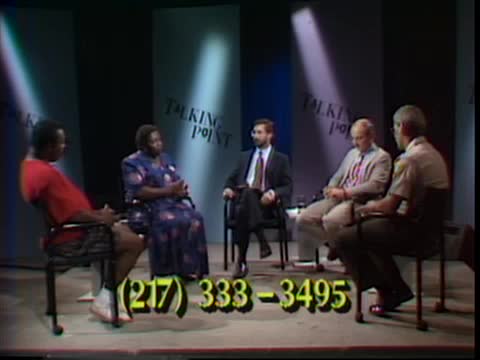
Thank you for watching. Good evening, and welcome to Talking Point. Tonight, our topic is gang activity in central Illinois. Now, while you may think of gangs as mostly big city problem, there are gangs operating in some smaller cities down state. They may keep a very low profile, but police departments in these communities do keep a close watch on what they do. Tonight, we'll try to get an idea of the extent of gang penetration in smaller communities and what might be done to keep the problem from growing. We have four guests, all of them, with strong opinions on the subject. John Lee Johnson is a community activist in Champaign.
He's been involved in politics in this area for many years and has been involved in many different organizations. Sergeant Scott Friedline is with the Champaign Police Department. He supervises a unit within the department concerned with gang-related crimes and street-level narcotics enforcement, among other things. Betsy Stockard is with the youth empowerment agency and decatur. She's the director of that organization. And we'll talk more about what they are all about. And our fourth guest is Mark Fleischer. He's an associate professor of criminal justice science at Illinois State University. He has over 20 years experience with prisons and criminals. In his forthcoming book, Beggerson Thieves and Ethnography of Urban Street Criminals, he looks at life experiences of chronic criminals, including youth gang members. And before joining the faculty at ISU, he was a senior regional administrator in the federal Bureau of Prisons. Now, as we all talk, you should be thinking about the questions you would like to put to our guests, and we will give you the chance to do that a little bit later in the program. Thank you all very much for being here.
What I thought I would do, since we have people who are drawn here now for three different communities, is to ask you to talk a little bit about what is happening in terms of gangs where you are. So we can get some sense of what is going on. And I thought that I would start with Betsy, simply because when you talk to people, some of the people we have talked to have said something like, well, we really don't have much of a problem in our community, but decatur, that's where they have the problem. So that is often said. And talk about what is going on in terms of decatur. Do you think that you have a serious gang youth gang problem there? I think we do. I think though that over the past few months, it's somewhat decreased. We still are going to have the problems. But with the work that we're trying to do as a community, I think I personally see those problems decreasing. Sometimes when you talk with people about what's going on with gangs, there are people who say, well, gangs who operate in larger cities
are looking to spread out their operations and recruit members in smaller communities. Do you think that has happened in decatur? Or are the people who are involved in youth gangs there? Are they local people? And they're sort of doing that without any assistance from anybody outside. The recruitment, I believe, is done in decatur. I do know that there are gang members that come from outside. Other cities, such as Chicago, St. Louis, Milwaukee, Detroit, and they have their operations. It influenced over the gang leaders there. And they have to do some of the things that they're asked to do. But the recruitment itself, I believe, from what I see is done in decatur, among the younger ones, anyway. So let me ask Professor Fleischer the same question. From what you know about what's going on in the Bloomington normal area, is there a gang activity there? And to what extent is that a problem? Well, that's a difficult question for me to answer. I've been on the campus at Old Line State for just nine months.
And we had a major gang conference there in April. And we had law enforcement in from all over the region. And they did identify a gang problem in town. I mean, now every now and then you hear about gang activity. But the issue from a research point of view is defining what a gang is, and then defining what is gang activity. Every town in America has a baseball team, but we have to know about that baseball team to know what these people are doing. I mean, we have to be able to distinguish between Little League and Babe Ruth League and semi-pro and the White Sox. And in many cases, the word gang has become a generic term. And so when people talk about gang activity, gang crime, we really don't know what the social issue associated with that crime is. I mean, there's a continuum in how we look at gangs. The gangs that I'm most familiar with, the ones that I studied personally in Seattle, Washington, were teenagers who were using drugs, who were alcoholic, who come from dysfunctional families,
who were themselves in many cases dysfunctional emotionally, who were truants, and who were engaged in some relatively minor criminal activity. That's a very different organization and a very different gang than the gang we think of when we think of adult criminal organizations composed of people who are 25 and 30 years old who've done prison time, and now are back on the streets, involved in systematic criminal activity. And as part of that, they exploit youngsters on the street. So when we asked the question about what is gang crime and how much gang crime is there, and how many gang members are there, that's a very different question to answer. Let me ask you again, same question, John Lee Johnson, and I know, and we're gonna get into talking about why the problem exists, and I know that's something that you have some strong feelings about, but from what you have been able to see Champaign-Urbana, what sort of problem is there, is there indeed a problem?
Well, we've had problems involving organized gang group, criminal activities in our community for over 30 years. Originally, this problem, the stem from kids who were born in the community, had their roots in the community. The problem was now the result of influences from our side of the community, which is for all the end, more violence, and more hardcore criminal activity. But I don't see the problem declining, I see the problem in the Champaign-Urbana area, getting worse. Search into a free line, would you agree with that? Yes, I agree with a lot of the things. I think the one point that John just made about the fact that gangs have been around for 30 years in this community, is true across the board. I think communities of the size of Champaign-Urbana of Decatur of Bloomington have had some kind of gang influence for a lot of years. I think the public has now become more aware of what's going on with gangs, and that brings about even more media attention and concern over the problem. I'm not saying it's not something we shouldn't be concerned
about very much so it is. I wouldn't be doing what I do. If it weren't something we had to be concerned about, the influence of the Chicago area, the Detroit area, St. Louis area, is there. It's very clearly there, and they do come in and they do try to take and control. But it goes beyond our communities as well. I grew up in a community of 2100 people, and that town currently has gang concerns. They're seeing the same kind of the gang graffiti that we see in our community now, and you see in Chicago and elsewhere. I would just come back just for a moment to the issue of the way media covers this subject. I think we have been criticized in some cases, just like for liking the sensational story, and this was one of those things that you can fasten on to and exploit, and you can get hot pictures. One, I guess wouldn't be surprised by that. Do you think that there are some ways in which the way the news media cover gangs is somehow misses the point? No, I mean, there's nothing worse in the world
than looking at a picture on TV or in the newspaper of a young child who's been gunned down in the street for no apparent reason other than, I'm about this, and he's about that, and that's not cool. And because of that, we're gonna take each other out. That's silly in all respects. It's something that shouldn't take place, and the more we are aware of that can bring about a positive influence. The solution is so complicated, though, because there's so many ways to look at it. We can always go back and point and say, well, this is the reason, or that's the reason. The thing I see is the almighty dollar speaks. It's hard to tell a youngster that if you go through life and do good and be right, that you're gonna be worse than something when they got somebody else laying lots of dollars in front of their face saying, hey, this is what you can do by doing this. This is what you can make. The real criticism of the media, I think, is that they haven't did this story well enough and consistent enough to alert the American people
and all of the communities in our country as to the threat that every community faces when they're young people do not have hope and something to do. Well, let's take that a little further. You're sort of saying that this is a symptom. What we need to do is talk about what's going on in American society at a much deeper level and then that's how we get around to doing something about it, too, to having some kind of creative solution. I think traditionally you've only had three elements of our communities in the broader sense, conservative problem. The professors, the police officers, and those who are being victimized by gang activities, that has been part of the problem. That's been why gangs have been allowed to grow and been allowed to do what they do, simply because the people who are victimized are powerless and the police department traditionally have simply been observers of the issues and of course those who are in the universities have studied it. The politicians, the city council members,
the cardboard members, the school board members, the state legislators, the people who can actually do something about this problem are now just getting around to getting to discuss what this issue is. I think if you pour black white or any color and gangs are in your community, you know that problem. You fill it, you live with it. How do you react to the sort of the charge that basically what you're doing is you're observing and, well, where are we reactive? I mean, police historically has been a reactive type of circumstance. Now with programs like community police and where you're taking more of a part in the neighborhood, I think they don't have a little bit bigger impact. A lot of what I see is that people outside of the communities or the neighborhoods that are victimized by the gang violence don't care or aren't that concerned because it's not in my backyard. If it's not in my backyard, it doesn't exist. We stay too much to ourselves and not enough to our area and our neighborhoods and our community
to say we got to do something about this. You know, these young people, we talk about the gang problem, we talk about different aspects of it. They're so much that occurs. We see movies about gangs and then you get a group of kids who want to emulate or imitate that movie or that gang or that situation because they think it's cool. They think it's neat. Yeah, I'd like to walk around with a gun in my pocket. Well, my profession, I do that. And I just soon leave it at home. If I could do my job without my gun, I would, OK. So you wind up developing different levels of gang activity. What I see is what has been termed as a pocket gang, which generally are local kids who want to emulate or imitate. And the problem is, we hear terms like want to be gang members. Well, if you're a want to be gang member, you're acting like a gang member. You're doing the same things that gang member would do. So there's no want to be to it. You're committing crime. So therefore, you're a gang member. The problem is, we don't define between one type of gang and another.
You've got a pocket gang, which is usually a smaller group. You have more powerful gangs who have more of an influence out of the larger communities where they've been there for a long time and well established. And that's what we end up seeing. You see that strong impression come in from the outside area and then the smaller groups, the pocket groups, trying to imitate what's going on. You're an academic criminologist, although I know that you have had personal experience in the corrections system. So you're not really observing this from the proverbial tower. I redire you have been in correctional institutions and worked in that setting. Let me ask you, what does the academy have to contribute to this debate? Well, the academy has a lot to contribute to debate. The academy is very concerned about defining this thing we call a gang and defining the demographics of the thing we call a gang. I mean, there are very good studies done by very good criminologists that define gangs, that define the demographics of gangs,
that tell us who belongs to gangs, the kinds of families they come from, the kinds of money they make when they deal drugs, how long they stay in gangs, and what we can do about them. But process is very difficult to get your hands on if you're an administrator designing a program to do something about gangs. In other words, gangs have been in America for hundreds of years. The gangs of the 90s are like the gangs of the 80s. They're like the gangs of the 70s, 60s, and 50s. The difference in gangs today, as compared to gangs 30 years ago, is guns and drugs. But other than that, the social processes that lead kids, boys, and girls, to gangs are the same today as they were 30 years ago. And that's not a sensational story. That's a tragic story that nobody pays attention to, because it's very difficult to control, very difficult to contain. There are all gang members are delinquents, but not all delinquents become gang members. We know this from very good research. We know that delinquent kids join gangs and then the amount of crime they commit increases.
And then when they leave gangs, they commit less crime. Where they go, when they leave gangs, we're not sure about what they were doing before they joined a gang. We're still not sure about. And what we can do about this, we're still not sure about. There was a gang is not an entity, and we tend to describe it as an entity. And the media describes it as an entity. The police react to it. I mean, that's their mission. Their mission is to react to crime. But a gang, if you think of it, as a bundle of integrated social processes. There's political process in it, family process, psychological process, cognitive process, emotional process, cultural process, neighborhood process, economic process, it all comes together at one tragic point when boys and girls get together and become very delinquent children. But professor, there are some obvious indicators. I think when we look at the conditions of our public housing complexes, when we look at the high numbers
of young kids who are not doing well in our public schools, look at the levels of unemployment for the certain areas of our community. When you look at the disproportionate use of resources in communities, then you're breathing in bringing and nurturing these conditions, which bring the gangs together. Right, of course you both are. I think I want to. Yeah, go ahead. I think I want the man to be quiet for a moment. I keep hearing different things. And I guess being an indicator where we're out there in the community working with the gangs themselves, I see a lot of things changing. Even the word gang, they're no longer using that term in our city. They're trying to change their image. And even though they're out there doing negative things, they're trying to change. And when I hear organizations instead of gangs, but then when I hear about the research, I know that I think that's one of our problems. I'm sorry. I think that's one of our problems. I know we need the research, but I think that's why we have the gang problem,
because there's been so much research and not enough on the street doing something about it. And that's the same, I don't know. When I'm out there talking with a gang leader or talking with some of the people that are members of their organization, I get a whole different perspective than I had before I started doing this. And everyone that's a part of the organization is no longer a delinquent. You have people that are part of the organization now. They're actually working on jobs. And they're in there, maybe go on to the parties. They're in there maybe just to have fun with a bunch of people because most of their friends are affiliated. But it doesn't mean that they're all delinquents. And one of the misconceptions, I think, that everyone has in America. And even though I hear people talking about it, I don't really feel that it's genuine. All members are not poor.
They're not delinquent. They're not true. They come from good families. They come, they're black, they're white. That's just the way it is. And I think before I started out on the streets just directly with them, I had a lot of these same conceptions about gangs, but it's changing and shifting. I think the point is that the, you're right, there are many children who are not poor, there are many children who are not high school dropouts. But those are children who have been caught up into the net of the gangs. When you look at, you know, these kids who were the conditions began, which breed gangs, I think it has many of the social conditions that the professor is talking about. I don't think the problem is that we don't need these statistical data. The problem is that it doesn't get to the mayor's office. It's not in the city manager's office. The council is not using it. And in some cases, the police department is not translating that data publicly, allowing people to know that you're not making good decisions. If we can start getting our police departments
to stand up and say to the public that we can't defend you, we can't stop this onslaught. And if you say to the public aid department, you can't solve this problem. Other things are going to have to be done, then we're going to get the kind of basic concern that those people who are the power players in the community can bring the resources together and bring them to bear. I've been trying to alert my community for over 30 years about the conditions and problems of gain. And if I can ever get a police officer to walk in and say to a city council that the conditions that you are allowing to exist in public housing will threaten every kid in the public schools. And your child could get killed. If you don't do something, I think that will have more impact in that council person making a decision than all the John Lee Johnson's which exist in Champaign. And I'm not going to say we don't need the statistics. I don't mean we don't need it. But what I'm seeing is for too long, America has set back and did statistics and not got out there and did some things. And you're right.
If the politicians, the city council people and the people that are controlling the laws and if they were get out there, it's just like a indicator. We encourage them to get out there and walk with them. And they are doing that. And I see that as a step forward. Because until everybody takes charge of the problem, the problem will always be there. Can you imagine yourself going in front of the Champaign City Council and speaking those words that John Lee Johnson just did, or would you think that that would not be the role for the police? I think you're seeing the role of police department changed dramatically. And what John Lee is proposing is not that out of line. Simply for one reason. What he said about the police cannot handle the crime problem is very true. We are one small entity. There's basically one cop for 1,000 residents on the street working at any given time. How do you really control that kind of population? We can't do it. That's one reason why we have community oriented policing programs going on now where we're
trying to get into the neighborhood saying, listen, we can't do it by ourselves. We have to count on everyone. You have to police your own neighborhood. You have to help control the people in your particular area. We can't do it by ourselves. We need your help. So when you got a part district officials who are not cognizant of this problem, and they may be using part district resources away from the very problem that he's trying to address. When you've got school board officials who only see the problem in hallways and not in the communities that he's dealing with, do you have resources going in opposite directions, which gives the opportunity for the gang to go bigger? How do you have a more unified kind of approach? Well, the unified approach is this one. I mean, one of the reasons we did the gang comments we did at ISU this spring was to get people together from diverse backgrounds. We had prison people. We had law enforcement represented. We had community activists represented. We had research represented because rarely in this problem of gangs gang violence, you rarely
find a group like this getting together and talking about it and sharing your insights and your observations. Very rarely, do you get government people involved in it? And I think you're right on a money with that. You rarely do that. And if the problem is going to be or if the social issue of gangs is going to be remedied, it's got to be remedied in an interdisciplinary way. And I think community activists and police can play an extremely important role in this because one of the things you find through research is that kids who are members of gangs know very few people who aren't members of gangs. And you said that yourself. The issue is if you're going to divert a kid and get them off the street into a job and into paying taxes like everyone else, then he's got to, or she, has got to have connections to the legitimate world. And in many cases, and there's something that research I did on the street in Seattle showed was that gang cops played a very important role in this
because in many cases, the youngsters I studied were Crypt's Bloods Gangster Disciples 12, 13, 14 years old had one legitimate social connection in a neighborhood that was the gang cop. But what I see is, you know, and I'm not knocking the interdisciplinary approach. I think that's good. But what I'm seeing is, got to go a step further. Game members, when they get out there, if it's drugs they're dealing, they do not have, they do not have strategic plans. They say, this is what I have, here it is, go do it. And I see us, I see us as a nation sitting down in lots and lots of meetings. I'm on last job, I went to meetings, more than I did anything, I think. And nothing was being accomplished, you know? And I think that I keep saying this, you know, I think you have to eventually get to the point, where you say, this is it. This is what we have to do. And it doesn't take a major game plan. It takes some organization, it takes some planning. But I know that we sit down and meetings all the time
and we plan to plan, and while we're doing that, they're already at the next step. And some of that has to be cut out. It's just got to it. I need to just pause for just a second here, because I want to tell people who are watching that in a minute or two, we'll begin taking your calls. So if you do have questions for our guests, the number of calls is 3-3-3-3-4-9-5. And if you're outside the 2-1-7 code area, you may call collect. Now, one other thing I would also like to mention, next month, talking point, this program will be returning to Thursday nights. And so our next show will be seen on Thursday, July 7th, and we'll be talking about media coverage of politics. So I hope that you can tune in for a couple of shows. I think people like ourselves, though there's us who are out here working in a community, what we need are guaranteed governmental backups, the willingness for the government to sit down quickly here what we see are rapidly moving problems and be willing to move resources to address those problems. We need to be making a declaration of supporting our law
enforcement agency, allowing gang members to know that one, we do not tolerate violence, and we want the cost to prosecute them. This is all working this process together. But at the same time, government works slowly. It works in a very slow process. What we don't have is that we don't have our local units of governments standing shoulder to shoulder with people who are out there in the field. Many communities, historically our relationships with the police departments, have never been good. The police departments have always been used as the frontline instrument to maintain segregation, racism, and all of that. So we're breaking new ground here. We have to become a partner where historically we're never partners. And we have to work through a lot of problems. Many blacks will not trust the police, no matter what the conditions are in our communities. So we've got to find new ground. But a part of finding this new ground, I think it's for the greater community to recognize this danger, as well as for the community that is faced with this problem.
But we need that support. He needs our support. We must have his support. We must have government support. We must have the greater communities. All picking in here and working with us. Yeah, I think that's a very important point, particularly if you look at this issue from a correctional point of view. The real tragedy of the criminal justice system is that you need to be arrested and go to jail in order to get social services. Because once you're in prison, you can get drug counseling, you can get a classroom education, you can get community college. In some cases, you can get college, you can get your health care taken care of, and you live in conditions much better than those in public housing. But you need to be a convicted felon to get it. And that is indeed the nature of the problem. And the problem you run into to get to that level, there's so many crimes that have to be permitted. I mean, it's not just a simple, I'm going to go out and do something. You're talking about people who've been arrested multiple times over and over again. They go into the prison system, they come out. If they don't take advantage of the program, he's talking about, we wind up hearing about him again. And in a lot of cases, I work with the Department of Corrections.
I get release information. Prior to my getting release information compiled, they're out committing another crime again. You know, we've found an issue locally here. We have a part of the black community where we have concentrated low-income housing, where there's roughly, I would say, around 2,000 families that may live within this area. When we look at the total numbers of calls for emergency services into this area to the Champagne Police Department, that we're spending, the people of Champagne are spending more money to police these areas than we're spending to police the University of Illinois and almost the whole city. It would be formal cost-effective. I mean, we could buy everybody in public housing in a brand new house with three car garage and a swimming pool. If you would aggregate out the amount of money that is costing the people of Champagne to constantly send, attack team, and a squad car, five departments, and backup services to our public housing projects.
And yet, we cannot, as politicians and concern people, redirect those resources and spend this money to improve these young people's lives that we will not have this level of violence. How do we get ourselves to this times of discussions? And the only reason that I'm here tonight is I'm hoping that this kind of discussion here will continue to enlighten people. And hopefully, the politicians of the Twin Cities and whatever community's watching this program will start looking at what these expenditures are and how best we could begin to put a curve on how we're using our local resources to attack this problem. And we do have some people watching who want to join the conversation. So let's do that. We'll go to line number one for our first caller. Hello. Hello, this is me. Yes, sir. OK, Betsy, this is Noel. I'm calling from the Kater Illinois, and I've marked with Betsy on one occasion. I wish it could have been more. But she just skimmed around part of a problem here at the Kater, and I don't think that you have really hit up on it. It's that five years ago when we really found out
we had a problem here at the Kater. We approached our city government on these problems. We tried to get more officers on the street. We tried to get organizations started so that we could start handling our youth problem. And at that time, we were not calling it really gang related. But unfortunately, unless you have a degree behind your name or you have got a police badge over your heart, they pay no attention to you. Their answer to our crime problem here in the Kater five years ago was one man by the who they named as Public Safety Director, and was hoping that that would stem the problem. Well, it didn't. He is no longer here. The problem is still with us. And I agree that the problem is diminishing somewhat. But to face the problem directly, our elected officials are not living up to their obligation to the public. They are not providing the skills, the money, the officers that we need.
They even ignore their own report here in the Kater, where they say they need 17 new officers. We've known this for 20 years. Let's get to, I'm interested in what Ms. Dr. Des, say particularly, I guess about the question of whether elected officials are going to really listen to citizens, unless they did. Yeah, OK, real quick, and then we want to get on. Real quick, we need to turn these kids away from this type of involvement, but we need to get other people involved, such as our organized churches. And we fail to do that. I think, here in the Kater, it is beginning to open up a little bit, but we need to get more people involved, especially in the industrial sector, because these are the future workers that they will be depending on 10, 15 years down the road, and they won't be there to help them. So we all lose. Thank you. Thanks for the call. Thanks, Noah. No, you're right. More city officials do need to be involved.
I was going to mention the fact that we do have some city council people that are out there that walk with us a lot. They have taken a stand, and they want to show the community that they support joining a grassroots effort and trying to do something about it, as far as the industry is concerned, I really do think that that's important. Also, there was a speaker in Springfield at a conference just a couple of weeks ago, and he was saying that it would be good if people just use car salesman, for example. If the drug dealer can push drugs really, as well as they do, what a great car salesman they could be also. And I think that businesses and industries they need to take a look at that. And instead of we don't want to send anyone to them and say, look, I'm a gang member, please hire me. But give some thought to hiring more people in whatever industry that you're in. And if it's known that they are a gang member, then just let them do their work and encourage other businesses
to do some hiring like that also. It wouldn't be bad if businesses would make a joint effort to say, look, if you really want to change, this is what we have here to offer you. We had police officers along with city council members, the state's attorney in our community. In fact, at what time we had 90% of our city council walking around our low income housing complexes as the dope deal is made dope deals. And I oppose that. I said in open council floor that I wanted my generals to be doing what the generals should do and not necessarily doing what I expected the private out in the field to do. Although those council members walked around the low income housing complexes, they never passed one policy. They never passed one resolution. Every time that the housing authorities submitted their annual performance report, they signed off on it. They never at one time alerted the federal government that they saw a problem in public housing. They never said anything.
What I've always told people is what we need. I need to walk to show the community that I, as John Lee Johnson, am in support of a strong law enforcement program. I need to walk to say to the state's attorney that I'm in favor of an aggressive policy by the state's attorney. But I want my city council people making policies that will aid all of us. Not simply saying I walked in there for, I'm in favor of what you don't want to get to. I think that, pardon me, just saying, as I would say, wanted to get to a surgeon. Free line and also tell people that we're going to try to get so many calls so we can't, because I understand the lines are all full, but I don't know if you really want to take care of them. Yeah, there's two things. One is in what he's saying, and my biggest frustration in seeing the walking things take place, was that it started good, and then it wound up being city council members and politicians, and the residents gave up on it. And that's what we can't have. In order to make it work, we have to have the residents saying, this is my neighborhood, you've got to get out. As far as the concern about the police
and the colors come in about, when we need more police, we went and asked for 17 more police officers. The problem you run into is, there's got to be a dollar line somewhere that says, we can no longer afford, or we have to do with what we have. I would like to see a police department in our community double the size we have. The problem you'll run into is, will the community tolerate that kind of money? I'm a taxpayer as well, okay? What Johnny says about going into and the vast majority of our funds being spent in certain areas of the community is very true. We spend, we have our very first community and policing group, a pair of officers working in a community, and that's all they do, is they walk in that community, they work in that community, and that's it. We can continue to put money into those types of programs and I think we should, but it has to be a combination of things. It can't be one or the other, and more police, I don't think, are necessarily going to be the answer. Let's, if you'll indulge me, let's get on to another caller. We'll go to line number two. Hello?
I've got a couple different comments. First off, I'm from around the Springfield area community and then there's a way of a project called the Hayes Homes. There's a proposal right now that's been $16 billion on that area. Currently, almost half of those departments are boarded up. I think it'd be a lot better to take that $16 million and spread the people that are in public housing around, make them responsible about their own places that if they don't keep it up, fine, they're out. For X number of years, you cannot qualify for another public housing place. And then secondly, I have a question for all your panelists. I was in a restaurant not too long ago, and as we all know, a lot of the gangs had to do with how they were they had. I walked in about three of their employees, they're wearing their heads, cock away to the side or backwards and everything. I went up to the manager and I said, hey, I've got five people here to eat, and we're leaving if this is what you're going to allow your employees to do. I think it'd be nice to have a little symbol at the door of most of your retail locations about gang-free and some rules and regulations
in those places that, hey, we expect you to do this if you're coming into our place. Okay, well, we'll come back to Sergeant Friedland. When I asked the professor, because you were the one who talked about the difficulty in defining what was a gang. I mean, what's to say that those people just didn't get up the morning side of where they're at their way, that they were involved in. That's right, that's right, what's to say that? I mean, there are some fraternities that cause just as much trouble as gang. Clearly, and we can't have people take off their sweatshirts. What's going on is that it used to be that if you wore certain colors, you wore certain clothes, certain starter jackets, that you were a gang member. That cannot be. We cannot go in with an approach of, well, this guy's wearing this kind of coat, so by golly, he's got to be a gang member, okay? We have to go and behavioral things. Wearing a hatcock is no longer an identifier as far as a gang member goes. It's a more of a fashion statement. And people wear fashion statements. They're going to continue to wear fashion statements. You know, the old bell bottom pants
might've meant something to somebody way back when, okay? That was a fashion statement, leisure suits. You know, all those wonderful things that we've experienced over the history of our country, you know, have an impact somewhere down the line. Just because we wear a hat sideways doesn't mean a thing. You see, but that's an important indicator, because that's what the public sees. And the public sees hats and colors, and blue and red rags, and all that other stuff, and the graffiti, but they don't see the social problem. And so if they don't see the social problem easily see it because they don't go where the social problem is. And if they don't go to where the social problem is, and if they don't have any concepts, which enable them to understand what they're seeing, it goes unresolved. And I wanna say to the caller that he's right to oppose that development. But then there's a fine line to the availability of land, cost of housing development. If we're not providing multifamily condensed housing, and providing all the amenities,
and ensuring that the people who live within are empowered to cope with that environment, that we're doing our communities, grave harm, to build these multilayered community, high rise of very dense housing complexes, which are inhabited primarily by low income citizens of any color. We just can't put people in housing, no matter how much we paid, subsidize and rent, and walk away from them. And then turn back on and say, you're your own problem. People need support to survive. And if we're not willing to give that, and if you guys are spraying fuel, we're not willing to see that the people have that, then you're right to oppose it. You should go to City Hall and fight it, and you should ensure that the money will be spent on scatter sites, and not allow that development to take place. Let us go on a talk with somebody else. This will be line number three. Hello? Yes, my question is for Ms. Dockard. She said that meetings are not enough simple planning and then actions.
So I wondered if you could describe a type of basic organization you recommend for persons interested in taking action to help the games. Let me get that going, because I wanted to give you the chance to talk a little bit more about what you are doing to get yourself. Well, let's go to neighborhoods first, because I think that the neighborhood is the first, they are the ones that are going to have to do the changing. If you don't have neighborhood organizations in your city, then I suggest the first that would be to contact someone on the city level and say this is what you want. If you do have them and you're not a part of them, then I suggest that would be another place to start form your own neighborhood organization where you live, get a group of people together, talk about the concerns and problems of your neighborhood. We've taken that a step further in the youth empowerment agency. We made some very basic plans and we set up some very basic committees and we've decided that yes, we will go out there, yes, we will talk to the gang members, yes, we will talk to the gang leaders, we will basically we decided we would listen more than anything. And a lot of people have disagreements with that,
but it's just like your child at home, people want to know why do young people join gangs? They join them because they haven't been listened to at home, they join them because they don't have a sense of belonging, they've joined them because it's something else to do and basically because they're listened to. So if they want to be listened to, I figure they should be listened to by some role models that are truly interested in helping them. What we did is to form the youth empowerment agency and I'm pretty quick to weed people out that I really don't think are interested. To be a part of that organization, you have to show that you are genuinely interested because in my former counseling days, clients would often detect when counselors weren't true and what they were trying to do. You have to show a sincerity and that's the way I would take, that's the way we've taken it. Very basic, we have components that are set up
to help in education, employment, support groups and we do a lot of listening. So that's what I would suggest. Well, I would simply say that in Champaign-Urbana, the problems of gangs are basically in the low-income African-American community and for those people who are listening to this program who happen not to be black, then I would suggest that you call ministers who are representing churches within these neighborhoods and offer your support and even your resources to help them address this problem. I think that in the cases of black America and other communities of color where they're faced with problems of gangs, they need to be pushed by the greater community. Now, what we need to do is awaken the greater community to the fact that they need to push us and that we can begin to address this problem. But the same kinds of coalition that brought about the civil rights movement, we're gonna need those kinds of coalitions to tackle the problems of gangs
and the economic problems in the cities and rural areas of our communities. We don't have partnerships. We don't have people reaching out and joining hands with each other to create the barriers in which gangs cannot come across. I'd like to take a step further on the religion from the religious aspect because this is one of the problems that we've had in Decatur. So I would urge anyone that is with a church to try to get to the leadership of that church, ministers, elders, deacons, whoever it might be and encourage them to take part in their community. We talk about the politicians and we talk about the media, but church ministers have a big audience and they have it every week, sometimes two or three times a week. A lot of times I feel like they don't even recognize or else they're in denial that they have a drug problem in their congregation or a gang problem in their congregation. I think that churches need to take a greater stand on what's going on in their community.
Let's go on and again, talk with someone else. This will be on line number five. Hello. Good evening. I'm somewhat shocked and somewhat tall. I've been dealing with this problem since the 1960s and I went back to look at statistical data concerning the correctional system from that time period and what is going on now. The same thing was going on then that is going on now. The gangs were there then. Billy Graham loaded. I'm team buzzes and took vice-lords and Latin kings and other gangs into a stadium to speak with him. And so I started looking at this as who are the winners who are the losers. I see law enforcement and other not-for-profit corporate entities as the winners in this. There is money being thrown at this and you're going to find that nothing is going to change. You constantly talk about the kids.
You must start with the adults. You cannot separate the kids from the adults that they live with on a daily basis. They have more influence on the kids than any other organization. I appreciate the comments of the call. I'm interested in, let me, I'll come back to John. But especially these two guys who are sort of our law enforcement side of the equation here. What do you think about with college? Well, this gets back to the original point about definitions. We can talk about a gang as a delinquent youth group. It's one thing. We can talk about a gang as a social network of delinquent youth who have parents or other relatives who are also members of that same network. That is a very different problem. And that, indeed, is the definition of gang that I subscribe to and others. Because you do find that gang membership doesn't pass between generations as your last name passes between generations.
But there are many people. You see, who are insane in their mid-teens, whose mothers were gang members, whose fathers were gang members and it's being passed from generation and a family, a generation of family. That's a very different problem. And indeed, research does show that that is an issue in children's decision to join gangs. The other issue that has even more power than delinquent parents is delinquent peer group. So that if kids have criminal parents and they don't have a delinquent peer group, the likelihood is much less that they're going to be a member of a gang than if they have delinquent parents and a delinquent peer group. Let me ask you, the police officer. I would definitely want you to respond to the comment that somehow we have more crime. It, in a sense, benefits the police because that means more resources will be going. That seems a lot. I can't picture a police being winners any time you have to go.
I mean, the thing that I don't like to see, and I've been there many a time where you have to go to the scene and you have to mop up the blood and the hurt. Or as Johnny talked about, you have all these people condensed in a one-small area. That's a real frustration for me. I agree with experimenting out. You concentrate so many people and you become victims yourself just by being there. Your mere presence makes you a victim. I see so many times that you have a young female who has a child or a couple of children. And the next thing you know, you have a gang member knocking in a door saying, we're going to sell drugs out of your house. And either you can take money for it, or we're just going to do it. You have that option. And they can't fight them. How can one person fight a couple, three, four, five, six people who want to do something in that area? We don't win because we put more resources up there. Those resources are at risk.
I don't know how we can consider that winning when it's our dollars going into doing something that, in essence, it's everybody's responsibility. I do want to call it, Mr. Fact, that the emphasis of putting money into police is the one-sided policy. And hopefully our society will get away from that, realizing that with stronger law enforcement, you've got to have stronger social programs to address the problems that the professor is talking about. The other thing is that unless you change the basic social, structural policies of our nation, the non-profit groups, churches, or whatever, are basically going to alter the patterns of gangs in America. It's about jobs. It's about economics. It's about education. It's about racism. It's about geographic areas in which people live. These are the root causes of being the problems, as well as the dynamics which goes on in the families. But if we don't see communities changing the basic economic policies of that community, they're not really addressing the problems of gangs. I don't know how many police they hire. How do you make, for people who don't live in the neighborhoods
where there is crime, where they're gangs operating? I mean, it's easy for those people to say, well, that's not my problem. That's somebody else's problem, because it doesn't come down my street. I mean, how do you persuade those people that it is indeed their problem? And they need somehow to do it like Noah did it. You preach the sermon. At the same time, you do it as she's doing it. You try to do something practical. And hopefully, the greater community will wake up and get in there and help. But it's going to really change rapidly with police officers under the community policing who will go into the board meetings, into the staff meetings, and into the city councils, and tell them what they're actually seeing and experiencing out on the streets. It's going to begin with the professors whose reports and papers and studies and books are being read by not only the academician of the community, but those people who are really facing the problem. And you know what I see, what I'm sorry, what I see out there is similar to what you're against a little bit, what you're saying. But anyway, those people that you say it
doesn't affect what we've seen in our days of marching. I think we're on like 62 days now. The people that aren't being affected are the ones that are out there. And we have a good mix now. We're moving toward half and half. But for a while there, it was the people that weren't actually affected. They were out there taking a stand and not being afraid to take a risk. We went down the street the other day, and this man said, good job. A lot of people say, good job, keep walking. And we say, come on and join us. And it's like, we don't have a problem, but yet in still there is shooting two blocks away within the last month or two, two shootings. But it's not their problem, because it's not on their doorstep. So people, that's just what I've seen. A lot of people that in areas, they live in areas where it hasn't affected them, but they're out there showing the other part of the community. And hey, we are willing to do something. Our time was really moving very quickly. And I wanted to try to get a couple more calls. You want to make a quick point, just for people in the shipping. Because I can't answer for the other police departments.
If you really want to see, the police department has a way of you going with the police officer, writing along for a night, and seeing what's happening. There's no better way than first-hand experience. And I would say, if you want to see, come down to the police station, ask about a write-along program, and go and see what the police in the community has to experience. I think it'll give you a whole different perspective on a lot of enforcement. Let's talk with someone else. This will be line number four. Good evening. Hello. Yes. I don't want a peer to be naive, but seems to me you're talking now a problem of structure within us, society and my own people. I'm an older person. There was what we call the draft. I was wondering why we don't start a compulsory arrow PC program in the high schools, which would occur after school was over in which the military discipline that exists in the service is incorporated
in the daily experiences of these young people. And if they could start at the age of the under high school and carry them through till their 18 years old, it would seem to be very practical just how do you feel about that? OK. If you're starting to pose a discipline of children when they're 14 and enter high school, we're about 12 years too late. And this is exactly what boot camps do. They try to impose discipline on young offenders. And 90 days later, they're supposed to get citizens. Well, we're not getting citizens. We're just getting offenders who are in far better physical condition than anywhere 90 days before. I mean, nothing else in their lives has changed except they don't know how to salute and do push-ups. What need more than that? What would you think about maybe some kind of public, some kind of institutionalized public service program, from time to time, people have talked about that
as a way to occupy young people, give them some purpose, something to do, and the broader sense. I don't agree with specifics. But I think that the solutions are going to be mini. And I think what the caller is suggesting is that we must begin to turn over every stone to save these children. And we're going to have to rethink our social approach to our young people. And this is not going to be merely an issue between the family. It's going to become the family and the community. It'll be quite a broad policy that's going to affect all children. Something's already being done along those lines, too, when you have now police in the schools doing something other than taking somebody to jail. Where you're having police officers teaching classes on drug abuse, and they do teach about gangs. And they're starting at an earlier age than what the caller proposes. Most of the time when we see a youth who's entering the high school, he's already hardcore.
He's already into the mix. And he's already very difficult to change. He's a sentence opinionist. Let me give you an example. I would wonder if the housing authorities that are in the Kayter's Champagne cakey, he's Springfield, Bloomington, Chicago, if they've studied and understood the issues, the family, dynamics that bring about gangs, and if so, what specific plans of these housing authorities develop to support these dysfunctional families? That's a problem that the professor is talking about. And I think ultimately what that caller is talking about is that, why aren't we using our gray matter? I mean, if we have all of our young women, 19, 21, with children living in public housing by themselves, we don't recognize what that problem is. I think I'd like to speak about the Kayter because I know what they're doing. I'm really proud of the fact that they are. They've been a model for, they've been asked, they've been over in Poland trying to teach that country how to do things, but they have a very good plan where they have mental health right in the housing complex. They have the on-site, they have the off duty police officers
that work there who put on programs in the summer so that the kids can get to know them, so that the parents will get to know them and teach their children a different size of the police officer. So I think when you start to put mental health services into a complex like that and you're teaching parenting and family planning and budgeting and all these computer skills and GED courses and things, we have that indicator. We also have our police officers who do go out on the walks and things and they're doing a lot of prevention. I think the trend, you know, police officers are protected and served, but I see the trend going to prevention and I see our community really taking hold of that and I'm quite proud of that also. You know, I'll have that in our community. Come over and talk to us. I'll have an example for other countries even. Well, this doesn't require, you don't have to be Einstein to know if you got an 18-year-old girl with a baby
and she's living by herself the problems that that's going to produce. I mean, school officials should not be surprised that if they're dropping out of school and they can't read, then what are the options out of society that doesn't take a scientist to figure out what the issues aren't, how we should be spending our monies and why we're sitting on this program tonight talking about this problem. We unfortunately, as happens with this program, the time goes very quickly and we're just about the point that we're going to have to stop. And really, I must apologize to people that we have kept hanging. We have not been able to take your calls. Sorry about that, but that is truly where we will have to leave it tonight. And we would like to go around and say thanks to our guests and they include John Lee Johnson, the Champagne Community Activist, Sergeant Scott Friedlein from the Champagne Police Department, Betsy Stockard from the Youth Empowerment Agency Indicator and also Professor Mark Fleischer, Associate Professor of Criminal Justice Science at Illinois State University. Now next month, this program talking point
will be returning to Thursday nights. The next show will be broadcast on Thursday, July 7th, same time, 8 p.m. The topic will be the role the news media plays in politics. So we hope that you will join us then. And in the meantime, if you can, tune in for our radio talk show, Focus 580 on WILO Radio AM 580. That's weekday mornings at 10. For now, thanks for watching, and good night. Thank you again. This program was produced by WILL Urbana and made possible by the financial support of the
friends of WILL. To purchase a VHS copy of this program using Visa, MasterCard or Discover, call 1-800-528-798-0. Please have the credit card number and expiration date ready. To order by mail, send a check for 2495, pay a will to the U of I, WILL TV, to videotape sales, WILL TV, 1110 West Main Street, Urbana, Illinois 61801. Please allow 3-4 weeks for delivery.
- Series
- Talking Point
- Episode
- Gangs
- Producing Organization
- WILL Illinois Public Media
- Contributing Organization
- WILL Illinois Public Media (Urbana, Illinois)
- AAPB ID
- cpb-aacip-16-214mwcqk
If you have more information about this item than what is given here, or if you have concerns about this record, we want to know! Contact us, indicating the AAPB ID (cpb-aacip-16-214mwcqk).
- Description
- Episode Description
- In this episode, host David Inge speaks with four guests about gang-related activity in smaller cities throughout Illinois. Guests include civil rights activist John Lee Johnson, police sergeant Scott Friedlein, director of a youth empowerment agency Betsy Stockard, and criminologist from the University of Illinois Mark Fleisher.
- Description
- Talking Point is a public affairs talk show featuring in-depth discussions with experts. The show also asks viewers to call-in with their own questions for the guests.
- Copyright Date
- 1994
- Asset type
- Episode
- Rights
- 1994 University of Illinois Board of Trustees
- Media type
- Moving Image
- Duration
- 00:58:39
- Credits
-
-
Director: Henry Radcliffe III
Guest: John Lee Johnson
Guest: Scott Friedlein
Guest: Betsy Stockard
Guest: Mark Fleisher
Host: David Inge
Producer: Tim Hartin
Producing Organization: WILL Illinois Public Media
Publisher: WILL TV
- AAPB Contributor Holdings
-
Illinois Public Media (WILL)
Identifier: cpb-aacip-107509978fc (Filename)
Format: U-matic
Generation: Master
Duration: 00:30:00
If you have a copy of this asset and would like us to add it to our catalog, please contact us.
- Citations
- Chicago: “Talking Point; Gangs,” 1994, WILL Illinois Public Media, American Archive of Public Broadcasting (GBH and the Library of Congress), Boston, MA and Washington, DC, accessed April 2, 2026, http://americanarchive.org/catalog/cpb-aacip-16-214mwcqk.
- MLA: “Talking Point; Gangs.” 1994. WILL Illinois Public Media, American Archive of Public Broadcasting (GBH and the Library of Congress), Boston, MA and Washington, DC. Web. April 2, 2026. <http://americanarchive.org/catalog/cpb-aacip-16-214mwcqk>.
- APA: Talking Point; Gangs. Boston, MA: WILL Illinois Public Media, American Archive of Public Broadcasting (GBH and the Library of Congress), Boston, MA and Washington, DC. Retrieved from http://americanarchive.org/catalog/cpb-aacip-16-214mwcqk