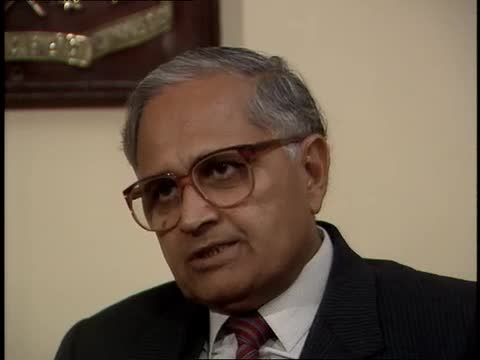
War and Peace in the Nuclear Age; Interview with Munir Khan
- Transcript
You learned some of this for me the atmosphere at the time busy India's nuclear explosion had a tremendous impact on Pakistan India staged the explosion and we paid the price because the supplier States decided to go back on the supply agreements with Pakistan and get every gate you need laterally the existing buy after all agreements are go over that again. India's nuclear explosion had a tremendous technical impact on our program. India staged the explosion. We ended up paying the price. The supplier States decided to go back on their contracts and unilaterally abrogate the agreement with Pakistan to begin with
Canada in December 1976 decided to cut off. All supply for Canada a reactor which was a safeguard. Then Frost decided not to honor. The agreement for the reprocessing plant. Pakistan had to pay a very heavy price for India's nuclear explosion. The supplier States. Decided to cut off. Nuclear supplies to Pakistan and unilaterally abrogated did it pretty much. Canada decided to cut off supplies for Japan. So India after. Fraus decided not to honor the agreement for the supply of forces of blood and from these things
we concluded. That. Pakistan had to be on its own. We had to be self-reliant and we could not depend upon outside splice. This one last time. But without getting into the Canadian and the French in detail just overall. OK granted a one off one of your last hour. Pakistan had to pay a heavy price for the Indian nuclear explosion. The suppliers decided not to honor that agreements for Pakistan with Pakistan again today. Pakistan had to pay a heavy price for the Indian nuclear explosion. The supplier states like Canada and France decided not to honor their bilateral agreements with Pakistan.
So we concluded that Pakistan had no other option but to see self-sufficiency in nuclear technology. Do you. Did you experience some disappointment. The reaction in the superpowers to that explosion in the test. We were disappointed at the reaction of the nuclear weapons states to the Indian nuclear explosion. As you may recall France sent a gun regulator e message to India. US has echoed BSD in that test. The United States government did not launch any official. Protest. It was only. The press and the
public opinion throughout the world. Which. Again. That best we concluded therefore that the nuclear weapons states were tolerating India's entry into the nuclear. Again the London supply is free. Did you have any sort of reaction to what they did this particular time they were discussing restricting nuclear experts. This was sort of a US backed thing. Anything you need to be. The lender supplies growth the question you the expert. Well I got I got I can actually feel badly that affected me there.
But the the learner's suppliers group was formed as a reaction to India's nuclear test. We were very much affected by the rules of the learned Suppliers Group restricting the supply of equipment and technology though the restrictions slowed down our program. Even though ready to accept save guards on all the facilities and the splice. Yet. Those were denied us. Because of the suspicion that these supplies could be used for other than peaceful purposes what do you really recollections of the meeting means national fuel cycle evaluation. Do you feel a competition literally. U.S. interest in making in my opinion was a great idea. I did a stiff of the United States.
If there was design to determine what was the optimum strategy for the nuclear fuel cycle. However the United States did not. Wait for the outcome of inf say and passed the nuclear nonproliferation act in March of nineteen seventy eight. But I am putting the conclusions of in. How would you summarize Carter's no liberation policy. Has it affected Pakistan. I think Carter's nuclear nonproliferation policy was on balance counter productive. It was the policy of denial
rather than cooperation. We quote further the cause of nonproliferation through international cooperation under Agency safeguards and not by the best of domestic legislation which would undermine all existing international agreements. This policy of denial did not work. In effect it can means to all the recipient states that the only way for them was to see it measure of self-sufficiency in nuclear supplies nuclear fuel cycle and nuclear technology. Since the passage of that and the non nuclear proliferation act. More countries have become self-sufficient in nuclear technology.
Then they had been anticipating it provided they'd scented the political justification for the countries to go ahead. We just go to the end of the mass I think you said to me immediately incursion into Turkey and I think that we did. He just. Did not need to number for a ship. That's kind of what this many times the recipient countries. OK. The nuclear nonproliferation act of March 1970 8 passed by the U.S. Congress. Let me just I just got I ask. Yeah THAT YEAH YEAH YEAH YEAH YEAH YEAH YEAH YEAH YEAH. In my view President Carter's policy on
nonproliferation was counterproductive. It was a policy based on denial and restriction rather than cooperation instead of furthering the cause of nonproliferation. It can means the recipient states that they had no other choice but to seek autarky in nuclear technology and nuclear fuel cycle. It also saw isolate give the United States the United States with due and lost influence in the international trade. And the purpose of that act was not so. We're a different country dance to develop bones that will do so anyway regardless. Could you just express that.
You see does he in our country to go to care is basically political. The technology for making a nuclear device is available in any country with intermediate level of development get acquired that technology. If there is a political will to do so. So the way to further the cause of nonproliferation is not to stress our denial of technology. But to create the political climate in which there is an understanding that nuclear weapons do not add to the security of countries. I'm jumping ahead here but they've they've been called it coming would you agree. You see what is occurring.
If you. Think the state has to have a nuclear weapon for any kind of general personal opinion you might. Yes I can. At one stage it was parked there. The acquisition of a nuclear weapon would confer special privileges and prestige on a country. But I think this is no longer so because nuclear weapons capability is within the reach of a number of countries. It is no longer something unique. What is becoming very clear now that the acquisition of nuclear weapons by
small countries do not add to the skeptic. It does not enhance this to get it. It poses enormous economic and political burden. Therefore I do not think that today nuclear weapons capability. Is that much a symbol. A prestigious and achievement at it as it was back struck years ago. I don't get this deliberate ambiguity policy of ambiguity. You want me to comment. But you see that brings us into conflict with the United States. Live right now. Because. We're
going to. Deal with this. It's alright it's alright. OK. Now in the end he did this thing really cool. It's Many people have talked about Pakistan moving closer to Libya. Was there any kind of nuclear cooperation between the two countries in the early period. Between August and you know I just will say that. I made up. As far as Libya has never had any nuclear cooperation with Libya and all the allegations industry Gart are totally unfounded and
misplaced. Can you explain what's behind that to me why why it's impossible why it would be unproductive Hunka counterproductive I think you said earlier that that Bush turned to Gadhafi would quite close in the period after the 71 war because Pakistan you know was looking for close friends and support at the time that the question of nuclear cooperation was out of the question and why. But he was here after the 1971 war. Pakistan wanted support at the international level and from other Muslim countries. This led to the 1974 summit conference of Muslim countries at the heart. So at that time
Pakistan felt close to a number of Islamic countries including Libya. However we have never had any nuclear cooperation with Libya at that time or since that was the notion we have used. Why no one is going to suggest. I think the concept of an Islamic bomb was. No let me begin. I believe that the concept of an Islamic wall is a pure fabrication. There has never been cooperation among the Muslim countries. For.
Such a venture or an idea as far as Pakistan is concerned it has never had any collaboration with any other Muslim country for pursuing such an idea. If you want this just stop it. Let me. Put it. Up. I think that Islamic bomb has been trying to reflect the prejudices associated with the Crusades. To associate the name of a religion with a destructive weapons like a nuclear bomb is religious I think is outrageous because nobody has attached the name of religion
to a bomb in the United States or the Soviet Union or as yet Mr. Boucher made a statement the remark about how the you know the different civilization but he did not see the ball. He did not say Hindu god. He didn't say. Communist draw. No. I think he never used this word. Actually I can make that. Yeah. The word Islamic law is if publication of some journalist from the west. Nobody in Pakistan much less Mr. Bhutto if the word Islamic bomb or the need for making an Islamic bomb. OK let's get away.
- Raw Footage
- Interview with Munir Khan
- Producing Organization
- WGBH Educational Foundation
- AAPB ID
- cpb-aacip-15-b27pn8xg7f
If you have more information about this item than what is given here, or if you have concerns about this record, we want to know! Contact us, indicating the AAPB ID (cpb-aacip-15-b27pn8xg7f).
- Description
- Raw Footage Description
- Dr. Munir Ahmad Khan was a nuclear engineer, who chaired the Pakistan Atomic Energy Commission from 1972-1991. The interview opens with his background and the early years of Pakistan's nuclear program. He recalls the period around the Atoms for Peace speech and the 1950s generally as an "era of great expectations." Proliferation, he notes, was not an issue then or in the early 1960s, until the Chinese test. Even more significant was India's test in 1974, which came as a shock and which, he remarks, destroyed the trust between suppliers and recipient states. This had a major impact on the Pakistani program because suppliers began to renege on existing agreements. Further pressure came in 1976 when Kissinger and Ford prevailed on France to cut off its agreement to assist Pakistan's program. Canada also decided to curtail its assistance. International entities such as the London Suppliers Group and the International Fuel Cycle Evaluation Group made their mark on Pakistan, as did Jimmy Carter's non-proliferation policy. The last, in his view, was wholly counterproductive. He denies there has been any nuclear cooperation with Libya or with any other Moslem state, calling the concept of an Islamic bomb a pure fabrication. He describes the uranium enrichment project as part of an effort to gain a measure of self-sufficiency, noting that Pakistan remains dependent on outside countries for assistance in certain areas. There has been no cooperation with China, he states, commenting that China is not very advanced in the field. He insists Pakistan has no interest in acquiring a bomb.
- Created Date
- 1987-02-08
- Asset type
- Raw Footage
- Media type
- Moving Image
- Duration
- 00:18:48
- Credits
-
-
Interviewee: Khan, Munir Ahmad, 1926-1999
Producing Organization: WGBH Educational Foundation
- AAPB Contributor Holdings
-
Identifier: cpb-aacip-43e6c3fe96e (unknown)
Format: video/quicktime
Duration: 00:18:48
-
Identifier: cpb-aacip-088776383f4 (unknown)
Format: video/mp4
Generation: Proxy
Duration: 00:18:48
-
Identifier: cpb-aacip-5ef9e222e7e (unknown)
Format: video/quicktime
Duration: 00:00:00
If you have a copy of this asset and would like us to add it to our catalog, please contact us.
- Citations
- Chicago: “War and Peace in the Nuclear Age; Interview with Munir Khan,” 1987-02-08, American Archive of Public Broadcasting (GBH and the Library of Congress), Boston, MA and Washington, DC, accessed April 1, 2026, http://americanarchive.org/catalog/cpb-aacip-15-b27pn8xg7f.
- MLA: “War and Peace in the Nuclear Age; Interview with Munir Khan.” 1987-02-08. American Archive of Public Broadcasting (GBH and the Library of Congress), Boston, MA and Washington, DC. Web. April 1, 2026. <http://americanarchive.org/catalog/cpb-aacip-15-b27pn8xg7f>.
- APA: War and Peace in the Nuclear Age; Interview with Munir Khan. Boston, MA: American Archive of Public Broadcasting (GBH and the Library of Congress), Boston, MA and Washington, DC. Retrieved from http://americanarchive.org/catalog/cpb-aacip-15-b27pn8xg7f