Vietnam: A Television History; Interview with Cao Xuan Nghia, 1981
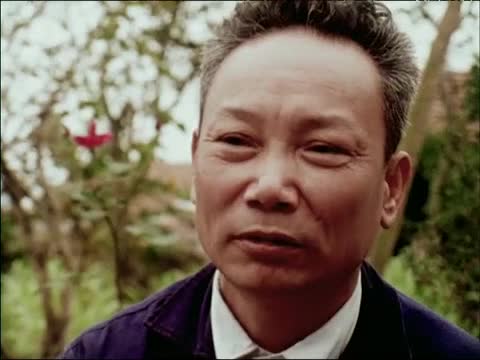
- Transcript
Interviewer: Please tell us of your life as a young worker in the mines and why your father died of starvation. Cao Xuan Nghia: During the French colonial period, my father was only a peasant. But as my father told me afterwards, he was exploited by the landlords and the imperialists to the extent that he could not find the money to pay for his head tax. So he took the whole family to the mines. Cao Xuan Nghia: He arrived at the mine before 1930 . As a miner, he went to work at the Deo Nai mine (deep in the interior of North Vietnam ) as it was being opened up. Cao Xuan Nghia: And I was born there. My parents gave birth to four children, and I was the eldest. By the time I was twelve years of age, I had to go up to the Deo Nai mine to work there. My job was to collect and carry coal out of the mines. Cao Xuan Nghia: Now, I recall that around 1943 and 1944 the Viet Minh movement was calling on us. I was still very young at that time and did not know very much about politics. But in 1945 the Japanese came and attacked this place. So the mine owners ran away. Cao Xuan Nghia: At that time, the famine also came about. My father, who had been terribly weakened, was now without food and medicine and yet he was still made to work very hard. As a result, he got sick and died. Cao Xuan Nghia: After my father died, my family fell into a very desperate situation. But when the Viet Minh and the Vietnam Communist Party called on us, I joined the revolution. Interviewer: Could you describe in more detail your father's death? Cao Xuan Nghia: I have to say frankly that as a miner my father only had gruel to eat. In 1945 , I recall that as miners we were given only a couple of hundred grams of pudding made out of the flour they used to treat coke with. I remember that our whole family got beri-beri as a result. Our bodies were all swollen up. Cao Xuan Nghia: Then my father got sick and died. While my father was dying he felt kind of outraged because of all the suffering. After that, his co-workers came by and buried him. I was only thirteen or fourteen at the time.
Interviewer: When did you hear of the Viet Minh ? Why did you join them, and when did you join them? Cao Xuan Nghia: I heard about the Viet Minh in early 1944 when the movement spread to this place. At that time life was extremely desperate here. Wherever I went, I saw my brothers and sisters, my fellow countrymen, died in droves. And there was little work in the mines. We were even more exploited at the time. Cao Xuan Nghia: So when we saw that the Viet Minh movement started to fight the French and took over the mines from them, I because very enthused. When I first saw the red banner and Chairman Ho , I joined the revolution right away. Cao Xuan Nghia: We provided support for the Viet Minh armed units which came to liberate the mine area. As miners, we stuck with the mines and defended it for a long time after that. But, as I recall, around December 1946 the French turned on us and attacked us. Cao Xuan Nghia: Therefore, I left my family and the mine area and joined the Resistance forces. And I became a Resistance fighter on the 31st of December, 1946 . I joined the army to fight the French until 1957 when I came back here to Deo Nai to become a worker again.
Interviewer: Please describe the march to Dien Bien Phu . When did it begin, what was it like, what did you carry with you, how did you sleep, and how long did it take to get there? Cao Xuan Nghia: As an army man, I fought in many battles and had the honor to participate in the Dien Bien Phu Campaign . In order to get to Dien Bien Phu from here, we had to cross the jungle and mountain areas of Thai Nguyen , then Phu Tho , Yen Bai , and Tay Bac . From Tay Bac we took the Dong-do route to Dien Bien Phu . Cao Xuan Nghia: From Thai Nguyen , which is Viet Bac, it took us about forty-five days. We marched at night and rested during the day. Sometimes we just slept on the roadsides if there were no shelters around. But many times we had to dig our individual foxholes first before we could go to sleep in case of enemy bombing. We usually marched from 5:00 p.m. until 6:00 the next morning when we could rest. Cao Xuan Nghia: In this manner, we marched to Dien Bien Phu . I don't remember exactly how many days it took us, but I think somewhere between forty and forty-five days and nights. Depending on the situation and the weather and other conditions, sometimes we rested in huts we made, sometimes we slept in the homes of the minority people.
Interviewer: What were you carrying? Were your packs very heavy? Please give us more details. Cao Xuan Nghia: It was during the monsoon season when we marched. It was in June and July . The rain was very heavy, and sometimes we were drenched. Each of us carried with us a week's supply of rice. When the week's supply ran out, it was also time when we would arrive at the next rice supply post. Cao Xuan Nghia: In our knapsacks each of us just had a blanket, a mosquito net and a set of clothes. The main things we carried was ammunition such as rifle bullets and hand grenades. My unit was an infantry company. We had been used to marching, and so we just went on. Cao Xuan Nghia: As for viands, we sometimes had meat, but not very much. We had to pick bamboo shoots and greens from the forest. The great bulk of our food supplements came from the local people. They really supported us. Cao Xuan Nghia: We arrived in Dien Bien Phu around the end of 1953 . I don't remember exactly in what month. But it was at the beginning of the cold season.
Interviewer: Could you describe the battle of Doc Lap hill? Cao Xuan Nghia: It was a fort on a hilltop which we had to attack. And the terrain around the area was extremely treacherous, not very suitable for our purpose at all. We used a platoon against the fort. Cao Xuan Nghia: We had some units with explosive charges which preceded us in order to open holes in the perimeter and the walls. The explosive charges were about this long. We attached them to the fence and then set them off, opening up holes in the perimeter. And then the rest of us charged in through the holes. Cao Xuan Nghia: When I rushed into the fort with my squad I was carrying a Remington which I had captured from the French in the Dong Bac area. My squad was commanded by Mr. Nhan who died in that battle. He was killed by a 12.7 millimeter gun located in a bunker. So I ran to the bunker with an explosive charge to silence the gun and succeeded in doing so. Cao Xuan Nghia: I was very angry at the time because I really loved Brother Nhan. Before he died he told me to remember to tell his mother that he had sacrificed himself. I buried him later on on the side of the hill next to the fort. Cao Xuan Nghia: We fought from 11:30 p.m. til 5:00 a.m. Then my own unit withdrew to the outside to consolidate our position. But other units stayed on to complete the job. The battle was a successful one. It was a significant battle not only in terms of proving how high our morale was but also because it was the first battle which opened the Dien Bien Phu Campaign . Cao Xuan Nghia: The next battle was the battle of Hien Lam. But it was another division, not mine, which fought there.
Interviewer: You fought against the French . Two of your children fought against the Americans. And now you have a son fighting against the Chinese . What are your feelings on this? Cao Xuan Nghia: We miners, our families, and our people have all contributed to the defense of the country and the rebuilding of the country. My hope now is how to have peace so that we can work to rebuild the country, to consolidate peace and to build successfully a socialist country. Cao Xuan Nghia: But at the present time the Chinese are bent on attacking us and killing us, especially us people here in this mining area. At the present time we have to maintain production and fight at the same time. Cao Xuan Nghia: So my hope is how to successfully build a socialist system in my country to bring happiness to my people and, most importantly, to keep our country intact. Intact. Intact. Not only in my own lifetime that my country has to be maintained intact, but also in the lives of my children, my grandchildren, and their children after them. We will never allow any country, no matter how powerful, to encroach upon our country.
- Raw Footage
- Interview with Cao Xuan Nghia, 1981
- Producing Organization
- WGBH Educational Foundation
- Contributing Organization
- WGBH (Boston, Massachusetts)
- AAPB ID
- cpb-aacip-15-7w6736m59w
If you have more information about this item than what is given here, or if you have concerns about this record, we want to know! Contact us, indicating the AAPB ID (cpb-aacip-15-7w6736m59w).
- Description
- Episode Description
- Cao Xuan Nghia was a mineworker whose father died of starvation due to the poor working conditions and famine brought by the Japanese Occupation. As a result and out of desperation, Cao Xuan Nghia joined the Viet Minh in 1944. Cao Xuan Nghia became a resistance fighter in 1946 and stayed until 1957. Cao Xuan Nghia recounts his participation in the march to Dien Bien Phu at this time and the battle of Doc Lap Hill.
- Date
- 1981-03-09
- Date
- 1981-03-09
- Asset type
- Raw Footage
- Topics
- Global Affairs
- War and Conflict
- Subjects
- Vietnam War, 1961-1975--Personal narratives, North Vietnamese; Colonization; France; Communism; Imperialism; Viet Nam doc lap dong minh hoi; Food poisoning; economic development; Revolutionaries; Coal mines and mining; Sino-Vietnamese Conflict, 1979; Vietnam--Politics and government; France--History, Military--20th century; Nationalism and communism; France--Colonies--Asia; Vietnam--History--1945-1975; Vietnam (Democratic Republic); Vietnam (Republic); miners; Mines and mineral resources; Indochinese War, 1946-1954
- Rights
- Rights Note:1) No materials may be re-used without references to appearance releases and WGBH/UMass Boston contract. 2) It is the liability of a production to investigate and re-clear all rights before re-use in any project.,Rights:,Rights Credit:WGBH Educational Foundation,Rights Type:,Rights Coverage:,Rights Holder:WGBH Educational Foundation
- Media type
- Moving Image
- Duration
- 00:13:30
- Credits
-
-
Interviewee2: Cao, Xuan Nghia
Producing Organization: WGBH Educational Foundation
Publisher: WGBH Educational Foundation
- AAPB Contributor Holdings
-
WGBH
Identifier: cpb-aacip-debd76a9d9d (unknown)
Format: video/quicktime
Color: Color
Duration: 00:13:29:05
If you have a copy of this asset and would like us to add it to our catalog, please contact us.
- Citations
- Chicago: “Vietnam: A Television History; Interview with Cao Xuan Nghia, 1981,” 1981-03-09, WGBH, American Archive of Public Broadcasting (GBH and the Library of Congress), Boston, MA and Washington, DC, accessed April 3, 2026, http://americanarchive.org/catalog/cpb-aacip-15-7w6736m59w.
- MLA: “Vietnam: A Television History; Interview with Cao Xuan Nghia, 1981.” 1981-03-09. WGBH, American Archive of Public Broadcasting (GBH and the Library of Congress), Boston, MA and Washington, DC. Web. April 3, 2026. <http://americanarchive.org/catalog/cpb-aacip-15-7w6736m59w>.
- APA: Vietnam: A Television History; Interview with Cao Xuan Nghia, 1981. Boston, MA: WGBH, American Archive of Public Broadcasting (GBH and the Library of Congress), Boston, MA and Washington, DC. Retrieved from http://americanarchive.org/catalog/cpb-aacip-15-7w6736m59w