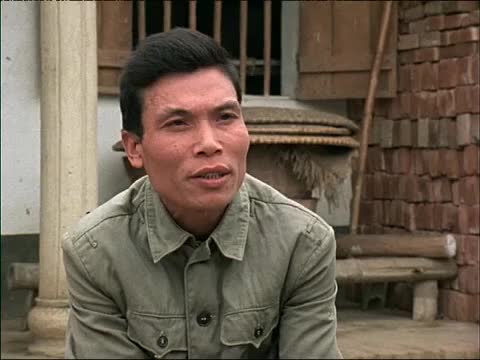
Vietnam: A Television History; Interview with Nguyen Van Nghi, 1981
- Transcript
Interviewer: When did you go South, and how long did you remain there? And how did you feel going South. Nguyen Van Nghi: I went to the South in 1967 and stayed there for 9 years. My feeling was to go there in order to help liberate the South, drive away the imperialists, and regain independence and freedom for the nation. Interviewer: How often did you get news from your family? Nguyen Van Nghi: I arrived in the South in 1967 , but it was not until 1969 that I received the first letter from my family. Interviewer: How often? How many times a month or a year?
Nguyen Van Nghi: From 1969 to 1975 I received letters regularly. Interviewer: When you went South, did you feel you were going into another country? Nguyen Van Nghi: When I went to the southern front I could hardly feel any difference. The North and the South were one country to me. This is different that going to another country. When you go to a foreign country you can see racial differences. But when you go from North to South, you see the same race of people so there was no problem at all. Interviewer: Could you describe what you did during the Tet Offensive of 1968 ?
Nguyen Van Nghi: In 1968 I was with an artillery unit which was stationed in the Quan Nam and Da Nang area. Interviewer: Could you be more specific? Could you tell us whether you participated in some battle or something like that? Nguyen Van Nghi: I participated in the campaign to stop the enemy from carrying out their search-and-destroy ooperations in Dai Loc , Quan Nam , Da Nang . I was a radio operator. Interviewer: Could you describe how you got wounded during the Tet Offensive ? Nguyen Van Nghi: I got wounded in December 1968 . It was during a battle against the search-and-destroy operations. The Americans went to a certain area to destroy it. So we gathered our forces there to confront them, to stop their search-and-destroy operations. This was in Dai Loc district in Quan Nam , Da Nang province. This was when I got wounded. Nguyen Van Nghi: During this search-and-destroy operation they concentrated their artillery shells on a village in Dai Loc district. We fought the Americans for three days continuously. We were constantly on the move during this battle, but were able to defend this village for three days. The American forces then attacked us fiercely with rockets and shells and bombs. While we were mounting our defense, the Americans came with their airplanes and bombed our positions. I was operating a radio in a shelter then, and got a direct hit by a bomb. I got wounded as a result. After I got wounded, I was carried to hospital no. 78 in the district town of Dai Loc for treatment.
Interviewer: What did you expect the Tet Offensive of 1968 to achieve and how did you feel when the 1968 Tet Offensive did not liberate the South?
Nguyen Van Nghi: In 1968 I understood that the military campaign was going to be a big one. As it turned out, it was fierce alright because the Americans expended with so many bombs and shells. But the objective of the Tet Offensive of 1968 was to liberate the South early, to regain independence and freedom for the nation and to help free the people in the South from the yoke of the American imperialists and their puppets. Interviewer: When the Tet Offensive did not liberate the South, how did you feel? Nguyen Van Nghi: After the 1968 Offensive , although th revolution did not succeed then because of concrete conditions, I still strongly believed in the leadership of the Party and in the revolution. I always had complete trust. The Offensive to me was just another trial in the fight between our forces and the imperial forces. Of course there were times when we could not achieve our objectives completely. Nguyen Van Nghi: But I always had profound trust in the leadership of the Party, in the revolution and in the National Liberation Front of South Vietnam. I always believed in the fact that total victory would finally come. This was because of the strength created by the unity and unanimity of the entire people, the experiences of an army which had been well-tried and which had created the necessary tactics and strategies enabling final victory to come about. Therefore I personally always believed in inevitable victory for us.
Interviewer: What did you think of the way the Americans fought?
Nguyen Van Nghi: After having fought with the American troops many times, I can conclude that they had a lot of bombs and shells, that they were very powerful as far as war materials were concerned. But they did not fight very well at all. They were very slow in moving around, they were really not that mobile. In combat you have to be quick physically and mentally. But in combat the Americans were not very quick. They reacted very slowly. Interviewer: What about Thieu soldiers? How did they fight? Nguyen Van Nghi: Thieu ’s solders were also Vietnamese, so they knew how to use guerrilla tactics and they were also very quick in moving about. And although they did not have as much bombs and shells as the Americans did, they were sometimes more difficult to fight with because they also used guerrilla tactics, because they fought in small groups and because they were quite quick.
Interviewer: Could you tell us what the cell was like? How many people there was in it? What was the purpose of the cell in combat? The relationship of the people in the cell? How your friends in the cell got killed? And what your feelings were when this happened? Nguyen Van Nghi: The cell was composed of three persons. In combat we had complete solidarity and unanimity based on comradeship and personal friendship. I think the three-man cell contributed to the victory over the Americans. We were both quick and creative in combat. When confronted by difficulties and hardships, the members of th 3-man cell functioned like one person and loved each other. When one of the members died, the remaining members suffered terribly and this caused us to hate the imperialists even more. we hated the American imperialists very much. Nguyen Van Nghi: But we always had love for our comrades, always remembered them. This was a combination of comradeship and brotherly love. Hence, pain created by the death of a cell member only made our anger and our hatred of the enemy that much greater, giving us renewed strength for our combat in the hope of wiping out the enemy to achieve increasing victories. When a member of a three-man cell died, we were filled with a sense of outrage. Interviewer: At one point you mentioned that a member of your own three-man cell was killed. Could you tell us how he was killed and what your reactions were then?
Nguyen Van Nghi: In a three-man cell each member had many jobs to do. In my particular cell, one comrade was killed by an American ambush when he was sent out on a mission. It was very painful to me. But I was able to turn this pain into a driving force for battling the enemy. I think this feeling created by the three-man cell contributed to the final victory of the Vietnamese revolution. Interviewer: Could you describe the liberation of Da Nang in 1975 ? What you did then? What happened to you? And what your impressions were? Nguyen Van Nghi: When the Spring Offensive of 1975 started, I was told that it was going to be a very big offensive and that it might liberate the country. I was very gratified personally. This was because I had been fighting for a long time, and when I heard that this was going to be a big offensive which would defeat the American imperialists and bring about unification of the country then I could not be but overwhelmed with joy. After March 12, 1975 a coordinated offensive in the whole of southern Vietnam was mounted. Nguyen Van Nghi: When this happened, I participated in the battle for Quan Nam and Da Nang . The first shots which signaled the beginning of the coordinated offensive were on March 12, 1975 . I was operating a radio at that time, and, together with other units, advanced toward Da Nang from our base areas. By the 28th of March we achieved complete victory. Nguyen Van Nghi: And I myself took part in the administration of Da Nang city. The inhabitants of the city enthusiastically welcomed us. They treated us as if we were their own victorious sons coming home to them. I was filled with joy. I had to ensure a lot of hardship for 9 years on the battlefields. And when victory came, I just felt so good. On the whole, the people overwhelmed us with their welcome.
Interviewer: In 1975 , when the Thieu armed forces just disintegrated like that, what were your reactions? Was it more difficult or less difficult for you to go on fighting?
Nguyen Van Nghi: Because Thieu ’s troops had been severely defeated in the battles of the Central Highland and then on the battles of Binh Tri Thien , it became really quite easy for us to fight the puppet forces since they had lost their morale. Sometimes we did not have to use our weapons at all. They just simply went to pieces and ran away in droves. The fighting was not very fierce then. Interviewer: If the American troops were still there, do you think there would be a difference? Do you think it would have been more difficult to fight the puppet troops? Nguyen Van Nghi: Now, the Americans had withdrawn. This was an indication that they had been defeated. Although the Americans continued to pour weapons in to help Thieu ’s troops, the amounts were in no way compared with what the American forces used to have. If the Americans had not been able to defeat us, what hope was there for their puppet troops? It was then easy for us to fight the puppet troops. Nguyen Van Nghi: They had less weapons than the Americans used to have, their morale was hurt by the various severe trouncings at the hands of the revolutionary forces, and they were confronted with a revolutionary army which had become much stronger with increased supplies from the North. All these created the quick and dramatic victory in the spring of 1975 .
Interviewer: What kind of relationship did you have with the people in the villages around Da Nang ? Did they support your units? Did you sometimes have problems with the villagers? Did you sometime get food from the villagers? Or did you have to get food supplies from somewhere else? Nguyen Van Nghi: The Quan Nam and Da Nang battlefront was an extremely fierce battlefront. We lived with the people and were protected and loved by them. They fed us and took care of us. We were confronted by a very difficult situation at that time and we were not supplied by the North at that time in terms of foodstuff. It was because we lived with the people, fed by them, protected by them, that we managed to continue fighting. Nguyen Van Nghi: You can say that our relationship at the time was just like the relationship of fish and water. The people in the villages supplied us with everything from food to other daily necessities. There was complete unity between the revolutionary forces and the people. Without the people we would not have survived, we would have never been able to defeat the Americans. The revolutionary forces and the villagers were of the same hearts and the same minds. The people supplied us amply with food and other necessary items in order to live and to fight.
Interviewer: How did you know which village was supportive and which was not? And if a certain village treated you well, then what would the Thieu ’s forces do to that village afterwards?
Nguyen Van Nghi: When the villagers supplied the revolutionary forces with ample food supplies and other necessities to enable them to fight, they did this mostly in a secret manner. Therefore, there was no way for the enemy to find out and to terrorize the people for that. If and when the enemy knew, however, they usually carried out terrible repression. When they found out that the villagers supported the revolutionary forces, they burnt down the villages, razed everything and killed the inhabitants. Interviewer: Who told you which was a supportive village and which was not? Nguyen Van Nghi: When we arrived in a certain village, the support given by the people, the food bestowed on us and the reports of local comrades all indicated to us how the inhabitants of the area felt toward us. Through the local comrades we knew which village had supported the revolution the most and which the least. But in general, in any place where we lived with the people the people came to support the revolution enthusiastically. Nguyen Van Nghi: In their support, the local population, population gathered foodstuff secretly and brought it to us in our base area. There were times when these activities by the local population were exposed and the enemy would them come to destroy the area and kill the people in that locality. They also used rockets on these people. But in spite of the destruction and the repression carried out by the enemy, the village people continued to support the revolutionary forces and to supply us with enough food to live on and to fight.
Interviewer: You were separated from your family for nine years. How did you feel? Did you miss your family and your village? And when you came home finally, what was our feelings? Nguyen Van Nghi: It was a long nine years in the South. During this period in the battlefront in the South, emotionally speaking, I really missed my wife and children, my relatives and other loved ones. I missed them a lot. But I managed to turn this emotion into a driving force for the struggle. But in spite of 9 long years, when liberation came about in the spring of 1975 I was personally overwhelmed by jubilation. First of all, the country was liberated. And secondly, I was now able to go home to see my wife and children, my neighbors and my native village. Nguyen Van Nghi: When I arrived home, I was very moved because my relatives, my neighbors and my co-villagers gave me a very warm welcome. I was extremely moved to see my wife more matured and my children grown up. I had accomplished the job placed on me by the army. And now, as far as my own personal emotional side is concerned, to be able to be with my wife and my family again after nine years was a great joy. I was also happy to have the support of the people in my native village. This means a lot to me.
- Raw Footage
- Interview with Nguyen Van Nghi, 1981
- Producing Organization
- WGBH Educational Foundation
- Contributing Organization
- WGBH (Boston, Massachusetts)
- AAPB ID
- cpb-aacip-15-599z02z61q
If you have more information about this item than what is given here, or if you have concerns about this record, we want to know! Contact us, indicating the AAPB ID (cpb-aacip-15-599z02z61q).
- Description
- Episode Description
- Nguyen Van Nghi served as a soldier in the National Liberation Front in South Vietnam. He describes events during the Tet Offensive, the three-man cell formation of combat during the war, and the support of South Vietnamese villagers for NLF troops. Finally, he comments on his reunion with his family at the end of the war after a 9-year absence.
- Date
- 1981-02-10
- Date
- 1981-02-10
- Asset type
- Raw Footage
- Topics
- Global Affairs
- War and Conflict
- Subjects
- morale; Vietnam; United States; Vietnam (Republic); Vietnam (Democratic Republic); Vietnam War, 1961-1975--Personal narratives, Vietnamese; Vietnam--History--1945-1975; National liberation movements; Vietnam--Politics and government; United States--Politics and government; United States--History--1945-; Vietnam War, 1961-1975; logistics; Tet Offensive, 1968; War and family
- Rights
- Rights Note:1) No materials may be re-used without references to appearance releases and WGBH/UMass Boston contract. 2) It is the responsibility of a production to investigate and re-clear all rights before re-use in any project.,Rights:,Rights Credit:WGBH Educational Foundation,Rights Type:,Rights Coverage:,Rights Holder:WGBH Educational Foundation
- Media type
- Moving Image
- Duration
- 00:29:25
- Credits
-
-
Interviewee2: Nguyen, Van Nghi
Producing Organization: WGBH Educational Foundation
Publisher: WGBH Educational Foundation
- AAPB Contributor Holdings
-
WGBH
Identifier: cpb-aacip-3416cfc0f99 (unknown)
Format: video/quicktime
Color: Color
Duration: 00:29:23:11
If you have a copy of this asset and would like us to add it to our catalog, please contact us.
- Citations
- Chicago: “Vietnam: A Television History; Interview with Nguyen Van Nghi, 1981,” 1981-02-10, WGBH, American Archive of Public Broadcasting (GBH and the Library of Congress), Boston, MA and Washington, DC, accessed April 2, 2026, http://americanarchive.org/catalog/cpb-aacip-15-599z02z61q.
- MLA: “Vietnam: A Television History; Interview with Nguyen Van Nghi, 1981.” 1981-02-10. WGBH, American Archive of Public Broadcasting (GBH and the Library of Congress), Boston, MA and Washington, DC. Web. April 2, 2026. <http://americanarchive.org/catalog/cpb-aacip-15-599z02z61q>.
- APA: Vietnam: A Television History; Interview with Nguyen Van Nghi, 1981. Boston, MA: WGBH, American Archive of Public Broadcasting (GBH and the Library of Congress), Boston, MA and Washington, DC. Retrieved from http://americanarchive.org/catalog/cpb-aacip-15-599z02z61q