Bill Moyers Journal; 704; Reflections On The Presidency
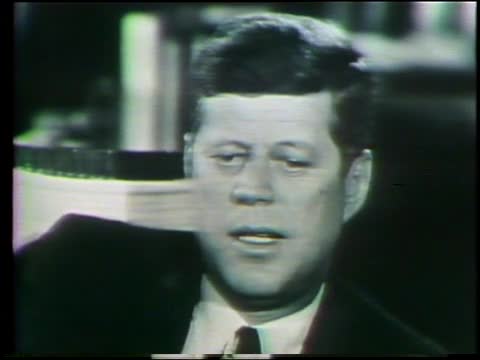
- Transcript
BILL MOYERS' JOURNAL
Reflections On The Presidency
November 28, 1980
FRANKLIN D. ROOSEVELT: I, Franklin Delano Roosevelt, do solemnly swear-
HARRY S. TRUMAN: I, Harry S. Truman, do solemnly swear-
DWIGHT D. EISENHOWER: I, Dwight D. Eisenhower, do solemnly swear-
JOHN F. KENNEDY: I, John Fitzgerald Kennedy, do solemnly swear-
LYNDON B. JOHNSON: I. Lyndon Baines Johnson. do solemnly swear-
RICHARD M. NIXON: I, Richard Milhous Nixon, do solemnly swear-
JIMMY CARTER: I, Jimmy Carter, do solemnly swear-
Chief Justice WARREN BURGER:-that I will faithfully execute-
CARTER: that I will faithfully execute-
BURGER: the office of President of the United States
CARTER: --the office of President of the United States-
BURGER: -and will, to the best of my ability—
CARTER: --and will, to the best of my ability—
BURGER: -preserve, protect and defend—
CARTER: -preserve, protect and defend—
BURGER: the Constitution of the United States-
CARTER: -the Constitution of the United States—
BURGER: —so help me God.
CARTER: -so help me God.
BILL MOYERS [voice-over]: Now, it's Ronald Reagan's turn. But what has happened to the office to which he has just been elected? Does the American presidency work? We'll discuss those questions tonight.
I'm Bill Moyers.
MOYERS: Does the American presidency work? Many people think not. They point to the fact that not since Dwight Eisenhower left office in 1960 has a president completed two terms in office and retired with the affection of the country. Death or grief or defeat awaited the five who followed him. And some think that the disorder that swirls around the Presidency is symptomatic of the disorders in the country at large. First, some comments on the office from some men who have held it.
[Film montage — separate interviews with past presidents]
JOHN F. KENNEDY: There's a lot of satisfactions to the presidency because, particularly, as I say, we're all concerned as citizens and as parents and all the rest, with all the problems we've been talking about tonight. They're all the problems which, if I wasn't president, I'd be concerned about as a father or as a citizen. So at least you have an opportunity to do something about them. And if what you do is useful and successful, then, of course, that's great satisfaction. When, as a result of a decision of yours, failure comes or you're unsuccessful, of course, that's a great setback. But, I must say, after being here for two years and having the experience of the presidency I must say that I have a good deal of hope for the United States.
- and there's no experience you can get that can possibly prepare you adequately for the presidency
LYNDON B. JOHNSON: President Nixon said to me, "How did you feel when you weren't president anymore?" And I said, "I don't know whether you'll understand this now or not, but you certainly will later. I sat there on that platform and waited for you to stand up and raise your right hand and take the oath of office. And I think the most pleasant words that I ever--that ever came into my ears was, 'So help me God' that you repeated after that oath." Because at that time, I no longer had the fear that I was the man that could make the mistake of involving the world in war, that I was no longer the man that would have to carry the terrifying responsibility of protecting the lives of this country and maybe the entire world, unleashing the horrors of some of our great power if I felt it— that it was required.
RICHARD M. NIXON: When you come into office, the presidency, one has ideas as to what he can accomplish. And he believes he can accomplish a great deal even though he may have a Congress that is not part of his own party. And then after he gets in, he finds that what he had hoped, in terms of achieving goals, will not be as great as the actual performance turns out to be. So I would say that, in terms of how I have changed, it is in realizing that while we must set high goals and always seek them, that we must not become impatient. And we must plow forward, recognizing that in the end, we're going to make some progress if not all the progress that we had hoped.
GERALD FORD: The president today is seen more in his daily operations. Television, particularly, gives that impact. And the net result is, because a president works on a problem, the public expects he's going to solve that problem. Unfortunately, it isn't as easy as our fellow citizens think it ought to be. You don't turn a switch and end unemployment. You don't turn a switch and decrease the inflation problems we have today. It takes consistent policy decision-making and implementation.
CARTER: I think the president ought to be - and the nation's best served by a president aggressive and innovative and sensitive, working with a Congress that's strong, independent, in harmony, for a change, with mutual respect for a change. There's only one person in this nation that can speak with a clear voice to the American people. There's only one person that can set a standard of ethics and morality and excellence and greatness or call on the American people to make a sacrifice and explain the purpose of the sacrifice or answer difficult questions or propose and carry out bold programs or to provide for a defense posture that would make us feel secure, a foreign policy to make us proud once again. And that's the president.
MOYERS: There's a new book on the American presidency, written by an old friend of mine from England, Godfrey Hodgson. He has looked at the presidency for a long time through a very special lens: as a student of American politics and a reporter at the White House for British television as well as the London Observer and the London Sunday Times. Godfrey came by the Journal recently and I asked him about All Things to All Men and why he had chosen as the subtitle for his book, The False Promise of the American Presidency.
GODFREY HODGSON: What I had in mind was that the presidency as an institution was perceived in Roosevelt's time as a great, central instrument or engine which would solve the problems of the society. And that, since FDR died, no president has really been able to make that engine work to fulfill the expectations of the people or, indeed, his own expectations. As a matter of fact, a few years ago, in the time of Kennedy and Johnson, as you know, I think the expectations were gigantic. It wasn't just a question of solving humdrum, down-to-earth problems. There was a feeling that the president could make it rain, if he wanted to. I think those expectations have been diminished. But they're still very considerably in excess of the real ability of a president to deliver.
MOYERS: Yet you say in All Things to All Men very boldly and without any hesitation, the presidency as an institution does not work. That's a rather flat assertion of a failure.
HODGSON: Well, I think it doesn't work to put it no higher, it doesn't work to fulfill the expectations of the man who is operating the institution. I think one indication of that is that one thing you can say of all presidents is at least they're trying to work for re-election. They have not been able to make the institution operate even to fulfill their own personal goals, let alone to tackle major social problems or to achieve change.
MOYERS: What should one expect of a president?
HODGSON: Leadership. I think, above all, a president must be a teacher. I think, above all, he must organize coalitions in the country to carry out what he sees as the will of the majority. I think, therefore, it follows that he must be in tune with the feelings of the country. I think one of the problems of the modern presidency in fact the overwhelming problem of the modern presidency is that the president is cut off from the life of what the French called "the real country," what people here sometimes call "out there." I think that presidents do not have access to—well, first of all, they can be isolated, as George Reedy pointed out of Lyndon Johnson. They can be isolated in the literal sense that people won't tell them what's really happening. But then more significantly, they are isolated in the sense that they don't really have very good sources of information coming up from the life of the country. saying what are people's real priorities. I mean, sure, people want lower taxes but also they want certain services from government. I think the isolation is most noticeable when it comes to action—that when a president turns to try to act upon the life of the country, and the rest of the political system, then he's truly isolated. And my analysis is for what it's worth-that Roosevelt relied on four main instruments to be an effective president, one of which was a new relationship with the Congress that he made the president for the first time, really, effectively the leader of Congress, that he proposed an agenda for Congress and organized coalitions behind his program. Sometimes he won, sometimes he lost. But at least he had that new row. Secondly, for the first time. he equipped the president with a modern bureaucracy. Thirdly, he had— he organized a new party coalition which brought new groups in American life into the political process in an effective sort of way. And lastly, he had a new concept of how you could use the media to reach over the heads of obstructions or of other power centers and sort of call up the energy of the people to reinforce his position. Now, I would argue that it's just those four instruments that have broken in the hands of recent presidents.
MOYERS: Why? What accounts for the collapse of those instruments which Roosevelt used so brilliantly?
HODGSON: Well, I think the starting point has to be the decline of party. I think what happened was that the old political parties ceased to correspond with the way Americans lived. I think that showed first of all in California. as very often social trends seem to start there. It's newer. People are moving around. People had left behind their identities as southerners or as Lutherans or as blue collar workers or as ethnic associations. So that the—and that they were physically mobile as well as being sort of socially mobile. So the politicians thought the only way to get to them was through the media - through advertising and through direct news media. And so there grew up a new style of campaigning which did without party organization and party structure. That, I think. led in turn to the fragmentation of the new style Congress, though of course there's another very important factor there which was reform. People felt that the old Congress was conservative, oligarchic, that it was a club. And many of the best people in Congress worked very hard to change it and in the process, ironically, they ended up with a Congress which even they find less satisfactory. And that has made it more difficult for the president to supply leadership there. And finally I think the media have backfired on the president. I say it's rather like the deal which Faust did with Mephistopheles. You know, it was a good deal from Faust's point of view if you leave out the dimension of time. Mephistopheles really does take Faust up on the mountaintop and shows him the kingdoms of the earth. And he makes him wise and attractive to women and wealthy and capable of working all sorts of magic. But then, he comes along and he says. "All right, your time is up." And I think that the media have done that for presidents. They've enabled presidents to achieve instant influence, tremendous impact. But over time, the media collectively I'm not talking about some clique of wicked men in skyscrapers on Sixth Avenue, I'm just saying that the process has come back and claimed its pound of flesh. What happens is that people— greater exposure does not lead to greater influence, that people get turned off. I think that has happened within the life of individual administrations. And, more importantly, I suspect it's beginning to happen to the presidency as a whole that it no longer inspires the kind of excitement that it did inspire, shall we say, in 1960. And that presidents are finding that they need to do more and more to achieve less and less. You see, I think that the key idea of the modern presidency was one which probably Teddy Roosevelt first developed, though Lincoln used the phrase, too, I believe, which was the president alone is president of all the people. And, of course, that's an ambiguous phrase, really. I mean of course it is literally true that he and the vice president are the only two officials who are actually elected by the whole electorate. But is he really the president of all the people? On the one hand, he's the symbolic national leader, if you like. He replaces the monarch of European tradition. And in that sense, yes, he is the leader and symbol of the American people as a whole. But he's also — is he not a political leader who has been elected to win some battles, to win some battles against certain people, to make some enemies, to be tough. And so there flows from that ambiguous conception of the presidency a great ambiguity also about what people really want him to be. Do they want him to be above the battle-taking the high road, as they say — noble and a little bland, as perhaps in some ways people perceived Eisenhower as being? Or do they want him to be commitive and feisty and activist and effective? Sure, they want him to be both those things. But in concrete circumstances, it's not always possible to be those two things at the same time.
MOYERS: So the failure of the presidency that everyone has been talking about the last few years is built into the institution and not intrinsically into the men who occupy it.
HODGSON: That's my very strong instinct, yes. First of all, I don't think that the men who have occupied the presidency have been feeble or feeble-minded men. You've had a succession of very strong men. Joseph Conrad has a wonderful concept of ability in the abstract, and I think his definition is the man who has a boat in the abstract is a man who can subdue a boatload of infuriated Malay boatman, navigate the boat to port on his own and sell the cargo at a profit. By those standards, I think most modern presidents would have done pretty well, as a matter of fact. John Kennedy did have an experience more or less of that kind. Lyndon Johnson, I think, I would trust to get the better of most Malay boatmen. And Harry Truman, again, is a man of that stamp. And I think Richard Nixon, too. So, it's not a lack of individual ability. I think it is that the institution, at the moment, is very, very hard to operate. And I think the breakdown of the connections between the presidency and the rest of the system are part of the problem. But I'm suggesting that there may be something that goes deeper into the roots of the founding fathers' conception of this dual presidency which is both the command post of executive leadership and also the throne of symbolic representation.
MOYERS: What can be done, if anything, to correct these deficiencies? Or is it too late for this institution?
HODGSON: I think it's too early. I think that———
MOYERS: Too early?
HODGSON:-things have got to go wrong and to be seen to be going wrong a little longer. In other words, I think things have to get a little worse before they can get better.
MOYERS: You think they can get worse?
HODGSON: Yes, I do. Because I think that we're talking about perceptions- I think that if you talk to people who, like yourself, have worked in the White House, I think that you basically know in general terms that what I'm saying is so that the institution does not work as it's supposed to do. But if you go and talk to people around the country to a radio reporter on a black station in Nashville who he was quite shocked when he said— he was shocked by my book. He said, "But, I mean, how do you mean the presidency doesn't work? But that's, you know, that's our most important institution." You could talk to a banker in Birmingham, Alabama, who's a very nice man but couldn't really believe that it was true that the institution didn't work.
MOYERS: God is not dead.
HODGSON: That's right. People do not want to believe that. And I think, you see, there's a second strand coming in here, which is that a lot of conservatives and Republicans now believe, "So what if the presidency doesn't work. That's been the cause of our problems. We need less government- not more. If we have an ineffective government, well, maybe that's great. Maybe that will leave people greater freedom and that the market will take care of economic problems and that people just folks — will take care of social problems." Now, I happen to believe that that's not so. But I think they're going to have to have at least an attempt to do it their way.
[End of taped interview]
MOYERS: Whether the institution of the presidency is working or not is a question I'll put to my guests, this evening, all of whom have firsthand experience in the White House. Maxwell Rabb was a presidential assistant and secretary to the Cabinet during the Eisenhower administration. He now practices law in New York. Theodore Sorensen was special counsel to President John F. Kennedy. He, too, is a New York attorney. Richard Cheney, congressman from Wyoming, was Gerald Ford's chief of staff. And Anne Wexler is an assistant to President Jimmy Carter and was a member of his 1976 transition team. Anne, let's begin with you. Godfrey Hodgson says, and I quote, "Carter has been sorely but not uniquely tested. All modern presidents have been frustrated by the inability to do anything about fundamental problems." Is the problem in the men we elect? Or is it in the office?
-
ANNE WEXLER: Well, I think, first of all, that people tend to confuse the power of the country -the power of the United States-with the power of the presidency. And that sets a climate where perhaps expectations are higher than they ought to be.
MOYERS: You mean, if a president fails, we think the country has failed?
WEXLER: Well, I think in some cases, if a president fails - and I think that that has certainly been demonstrated in the Carter administration that sometimes when a president fails, people think a country has failed. When we did not ratify the SALT treaty, people think of us as being weak. Or when the hostages were taken in Iran or the Soviet Union invaded Afghanistan, it was translated into the weakness of the United States, not necessarily a true statement in any sense of the word. But that's part of the problem. The other problem is that I think the president has the power to teach and to negotiate and to compromise and to persuade and to deal with different constituencies and different groups in the country. And if he succeeds, it increases his power. But that power only lasts, I think, as long as the success lasts. Power decreases as a failure comes up. And each issue, I think, has to be dealt with separately. That's part of contemporary politics, I think. I don't think it has always been thus, but I think it is definitely the situation today.
MOYERS: Is the failure, Congressman Cheney, that Godfrey Hodgson talks about, to which Anne alluded when she talked about a president who failed loses power is it in your experience built into the institution or is it peculiar to the men who occupy it? Are we electing men who are not capable of exercising that power?
Rep. RICHARD CHENEY: I think there's a lot to say about for the institutional weakness. the theory of institutional weakness. I think it's in my mind, in part – comes from the way we've treated the institution in recent years. You know, we've let the dialogue and the debate over the presidency in the last 10 or 15 years be dominated by concerns for the so-called "abuse of presidential power." We've seen our concern about Watergate and Vietnam and how we got into those circumstances create the myth of the so-called "imperial presidency." So that each time we alter the relationship-for example, between the White House and the Congress in recent years - we've done so in a way that weakens and undermines the authority of the president. Budget Impoundment and Control Act, War Powers Act limitations and restraints that we've placed upon the president's capacity to perform.
MOYERS: You think we have, in a sense, like Gulliver, wound him around with restrictions to his powers so that he's tied down in the office?
CHENEY: To some extent, I think so. I think if you look at the academic debate over the presidency in the '30s and the '40s and even up 'til President Kennedy's time, there was a strong belief in the need for a strong central president. The solution of the nation's problems was to be found in strong executive power. Those same basic sources of wisdom in recent years have tended to focus far more on finding ways to make certain that future presidents didn't abuse power in the future the way that some are alleged to have done so in the past.
MOYERS: What about that, Ted Sorensen? Did John Kennedy think he had too much or too little power?
THEODORE SORENSEN: He was well aware of the constraints on the presidency. He once remarked to me that when he had served so many years in the House and Senate, he felt all the power was in the White House. But once he was in the White House, he realized how much power Congress had. But I don't agree with the general indictment of the presidency that has been put forward here, that the institution has failed. On the contrary, taking a longer view, I believe all of the modern presidents have made some significant contribution. They have accomplished one or more of their major objectives. In doing so, of course, they spent popularity. They increased their unpopularity. But that's what the presidency's for. A president who finished his term with as much popularity as that which he possessed at the beginning of his term would be a true failure.
MOYERS: But how do you account for this disorder that seems to swirl around the presidency, for a constant succession of one-term presidents in the last 20 years?
SORENSEN: I think that, given the lack of political party strength, given the immediate dissatisfaction which people raised on television have, given the new balance of power between the Congress and the presidency, given the intractability of the modern problems such as inflation. It is not surprising that people tire of presidents rather quickly and use them up and turn 'em out.
MOYERS: Of course, that's not unprecedented because in the last quarter of the previous century, we had a series of one-term presidents. And in fact, I think that there have only been seven two-term presidents in the history of the presidency which says something about that myth of the presidency. [To Rabb] Your president, Dwight Eisenhower, was the last president to serve two terms in the White House. Do you think he felt he had too little or too much power? MAXWELL RABB: Well, he thought that the power was distributed quite well. You've got to remember that he probably was the last, the only president in recent days, to have excellent relationships with the Congress of the United States, even though the Senate and the House during both or one of his terms were not held by members of his party. That seems to have gone by the board. Now, that may— I think that demonstrates a point that the man may very well have something to do with molding the chain of events, rather than that the institution is altogether weak. And I just want to pick up on that point. I agree with Ted Sorensen on his statement that a sweeping indictment such as Mr. Hodgson has made about the failure of the institution is not quite correct. Of course, it's an imperfect institution that we have, the presidency. It isn't right in all its aspects. But it's by far the best thing that we have.
MOYERS: What about President Eisenhower's style of performing? Some people said that he was successful as a president because he appeared to be above the battle, that he delegated responsibility down through the Cabinet secretary, Maxwell Rabb, and the Cabinet- and the agencies of government. He didn't draw as much lightning to him as John Kennedy did, or Lyndon Johnson, or Gerry Ford with the pardon of Richard Nixon, or Jimmy Carter. What about that?
RABB: He simply delegated. And I hope very much- and I think it will be the case - that the next president of the United States is going to use that system of delegating. There is no way in which to handle the complex problems of the presidency without having a real delegation of authority right down the line and headed up in such a way that it can be checked. I know that Dick Cheney, over here, did an excellent job. I used to follow him very, very closely on the way in which he tied everything together. I think it's possible to bring things to a point and have delegation be practiced in a way that will bring efficiency and effectiveness to government.
MOYERS [to Cheney]: And yet, President Ford lost, despite your ability to tie the ends together, as Max said. When you look back at those years you spent in the White House with President Ford, can you identify any single source of frustration in the way the office worked that you'd like to see changed?
CHENEY: Well, I think one of our great frustrations, frankly, was the Congress. And it was always a little bit surprising for me at the outset because President Ford was, himself, a product of the Congress, had spent a quarter of a quarter of a century in the House. But behind the closed door of the Oval Office, there were times when even this very gentle, mild man could express great anger and frustration at his former colleagues. And I think, in part, it goes to the heart of something Max touched on earlier, that Eisenhower was able to deal with the Congress as an institution. And that no longer is possible. There have been changes within the Congress itself that make it impossible for the Speaker, for example, to commit the House.
MOYERS: Dwight Eisenhower could call Speaker Rayburn and Majority Leader Johnson to the White House and they could make a deal and they could go back and, in effect, deliver Congress.
CHENEY: It doesn't happen any more because the power within the House itself has been fragmented and diffused within the organization. It used to be that Wilbur Mills was chairman of Ways and Means. There were no subcommittees. Everything was handled by Wilbur Mills personally. Now, Ways and Means has subcommittees. The members on the floor feel free to challenge the work of any committee that comes to the floor. There are no strong speakers any more, in part because of the reforms that we thought at one point were valuable, such as weakening the seniority system. That was one of the goals of the reformers for years. Well, we've done that, now. But we find, having done that, that it makes it far more difficult for the Congress to come together and produce coherent policy and therefore respond to a president in any kind of understandable or predictable fashion.
MOYERS [to Wexler]: Did Jimmy Carter feel this? Dick Cheney said a minute ago that many of the reforms in the aftermath of Vietnam and Watergate have served to instead of limiting an imperial president frustrate an unimperial president. Did Jimmy Carter feel this?
WEXLER: Well, yes, to a certain degree, I think he learned very early that there were competing centers of power in Washington. And there was not only the White House, but there was also the Congress and certainly there was, to a degree, the bureaucracy and also that very large accretion of interest groups on the outside, all of whom are competing in the same arena to accomplish their goals. And sometimes their goals were contradictory. So, it became, I think, apparent to the president quite early, that in order for him to be successful, he was going to have to start from scratch every single time to build a consensus in order to get his legislation passed, and that the same group who helped him on one piece of legislation would not, in fact, be interested in helping him on the next. So, it's a far more difficult job now than it was. And I think the president - this president, at least — has always understood that.
MOYERS: I wonder if that's really so or if that's our perception.
[To Rabb] Do you think it's genuinely harder to be president in 1980 than it was in 1960 or in 1954?
RABB: I must confess that I think it is more difficult to be a president at this present time. We've got a wild-eyed world outside a Third World that we never faced before, emerging nations insofar as strength is concerned, others with ideas about expressing their will through terrorism and all the rest of it. And what we have is a strange situation. But I still think that a simplified government can, in a sense, and take care of problems least deal with them. And also that an excessively burdened government will not achieve that.
not take care of them but at
CHENEY: Bill, I think you have to be a little careful, don't you, to make the judgment that somehow the job is more difficult today than it used to be. Think about Lincoln and Lincoln's presidency. No president has ever faced what he faced and what he successfully dealt with as president, in terms of civil war and ultimately binding up the nation's wounds. I can't think of a modern analogue to what Lincoln faced in the 1860s.
MOYERS: And yet, he did—
SORENSEN: I would venture to suggest that the potential nuclear confrontation over Cuba had some similarities—
CHENEY: Perhaps.
SORENSEN: -which President Kennedy faced in 1962. But I don't believe what Max is talking about is confined to the magnitude of the problems. The fact is that in 1980 indeed, all the presidents after Vietnam and Watergate - there is almost an automatic suspicion and skepticism of whoever is in the White House and whatever he has to say skepticism from the Congress, from the press, even from the general public. There used to be an automatic deference. You gave the president the benefit of the doubt.
MOYERS: What's been the consequence of that skepticism?
SORENSEN: It is more difficult for the president to govern effectively.
WEXLER: Also, the time span is shorter. I don't believe that presidents have as long a honeymoon as they used to. I truly believe that there is going to be a great expectation, now, for President-elect Reagan in terms, especially, of the things that he will or will not be able to do in the economy. And those goals are, in some cases, inconsistent. There- it's going to be extraordinarily difficult to balance the budget and increase defense spending and cut taxes all at the same time and still keep a lid on inflation.
MOYERS: The question to you, Dick Cheney, in response to what Anne just said: Ronald Reagan is coming to office, a president of your party — and your party, Max - and he has as one of his paramount goals the cutting of the budget. Now, is he going to be able to do that?
CHENEY: He's going to find it very difficult. I think there are areas where the budget can be cut. I think it's important to talk in terms of reducing the rate of increase, because that's really what's involved here. You're not going to see a reduction below the level of spending of last year, certainly.
MOYERS: But the moment he proposes cutting this or that program, what's going to happen?
CHENEY: Well, he's going to have difficulty, depending upon which program he selects, depending upon the attachment of a particular constituency in the country to that particular program that particular governmental activity. But I think there are things that can be done to reduce the level of cost. I would cite such things as eliminating the state portion of revenue sharing. Every state in the country has a surplus in its state treasury.
MOYERS: But who's going to be angry at that?
CHENEY: Well, governors, obviously. But everybody will be angry about something. And it seems to me we've reached the point perhaps maybe what the 1980 election was all about is a recognition on the part of the American people — and only time will tell whether or not this is a correct interpretation -- but a recognition that the thing that's even more devastating than losing your government benefit is to have inflation to continue to run at 15 or 16 or 17 percent a year, that self-interest requires not only a concern about maintaining that flow of benefits from government but also that collectively, we've got to find some way to solve that problem and that the level of pain's gotten great enough now so that everybody's willing to put up with a certain amount of pain that goes with it. It's obviously going to be a major challenge. And it's the unanswered question of the Reagan administration.
MOYERS: Ted Sorensen, does a president have the power to solve the inflation problem?
SORENSEN: First of all, I'm not sure anyone has the— knows what the answer to our inflation problem is. The Democrats and the Republicans have both made stabs at it and both have failed. To the extent we have some broad notion of how to attack the problem, the difficulty with the presidency is that it cannot be attacked in a four-year frame. It's going to be a ten-year answer at least in which we change the basic economic structure of this country in order to get productivity up at a level that investment exceeds the rate of consumption. That's going to require sacrifice by workers and by consumers and by businessmen and by taxpayers. And unless we have a president who's not only willing to ask for that sacrifice but able to get it from all those groups, and get it over a sustained period of time rather than between now and the next election, I don't think inflation can be licked.
MOYERS: This requires a president, I guess, who would conform to Godfrey Hodgson's definition of the office as "a teacher." Is that right?
SORENSEN: Teaching is part of it. But he also has to be a leader who can get the people to not only learn but follow.
MOYERS: What do you all think about the proposal that has been increasingly mentioned in discussion of the last few years for a six-year term for the presidency?
SORENSEN: I testified against that when it was before the House Judiciary Committee.
MOYERS: Why?
SORENSEN: Several reasons. First of all, I think six years is too long a term for a bad president and too short a term for a good president. I think to put a man or woman in office and on the first day that he or she takes office, say to them, "Never again will you be subject to review by the American people,” is a very dangerous move.
MOYERS: But wouldn't this at the same time mean that he would not have to calculate into his decisions on inflation, for example, the pain he's inflicting upon the constituencies that Dick Cheney was talking about?
SORENSEN: Yes. But this is government by the consent of the governed.
WEXLER: That's right. It doesn't change the pain. It's a decision that a leader has to make.
MOYERS: Is there no one here who is for the six-year term?
RABB: I'm for the four-year term for the very reason that I believe that this—that the presidency and our institutions are not failed institutions. Here we have a chance to vote somebody out who does not meet the requirements of the electorate.
WEXLER: Really, what Ted says is right. Richard Neustadt wrote it, when he has written wrote about presidential power. He said that—
MOYERS: He's a professor at Harvard and one of the leading experts on the presidency.
WEXLER: And he has written a marvelous book about presidential power. But he says that the power of the presidency is the power to persuade. And that, in effect, is what Ted is talking about. I mean, if you are going to deal with inflation which takes more than four years you've got to take the country with you. And that is a very difficult job. But it involves all of the things that we were talking about.
MOYERS: Why, then, did President Carter - – and I'm sorry to put you on the spot but he is still president did President Carter fail to persuade us on inflation? Why?
WEXLER: Well, I think he tried. And I wish the next president as much good fortune in this realm as he can possibly have. I think-
MOYERS: Well, why do you think he failed?
WEXLER: I think because the American people wanted to fight inflation but they also wanted higher wages. I think that they wanted to save energy but at the same time, they didn't want to pay more for gasoline. I think there were a lot of inconsistencies in the challenges that were placed before the American people. And I think it's going to take longer than we were able to have to persuade people of a) what the problem was, and b) how to deal with it, and c) what its complexities are. We tried. But we were not successful totally, at any rate.
CHENEY: Anne. I think it would be inappropriate to leave the impression that nobody has ever succeeded at it. I mean, the fact is and I don't mean to 'toot a partisan horn, Bill but during the four years, we did go from 12 percent inflation in August of '74 to less than five percent at the end of President Ford's term in office, by December of '76. We had rising energy prices and food prices and all those other things, as well. But he did pursue a policy that I think will be similar to the one that Governor Reagan will pursue. And it did, in fact, produce results. We did reduce the rate of inflation-
MOYERS: And yet, in line with what Ted said a minute ago, he didn't have a chance to continue those policies. He got thrown out of office, to put it inelegantly.
CHENEY: In a very close election, and most of our elections are close.
MOYERS: It just takes one vote.
WEXLER: But then, again, the reason probably- more than any other—that he did not get re-elected was because unemployment was almost nine percent. And people just didn't want to wait any longer for a change. And which is very much the situation that happened this time, as well. People were impatient and not satisfied and wanted a change because they thought that the other guy might do better.
MOYERS: But it seems to me both of you have just confirmed Godfrey Hodgson's point. You [to Wexler] are saying what should be done to deal, for example, with the central problem of inflation. Dick Cheney says we did that in the last two years in the main two years- the last two years of the Nixon administration and the two years of the Ford administration. And Ford got got beat and he couldn't do it.
WEXLER: Yeah.
MOYERS [to Cheney]: And so are you confirming? Are you shaking your head yes, that you agree with Godfrey Hodgson?
CHENEY: No, I think in that case, in an election that close a few hundred thousand votes
- you can find 200 things that made the difference, whether it was unemployment or the pardon of 21⁄2 years before. Risky to make those kinds of judgments. But I think that to suggest that the powers of the presidency are insufficient to achieve a particular goal or objective isn't true. If you're going to base it simply on- success on the notion that you get re-elected, well, then it seems to me we are in difficulty. But I don't think that's the only objective presidents have.
MOYERS: Does this call for a new kind of perception of the presidency on the part of the American people — and a new kind of maturity on our part? That is, a president is often elected to do the unpopular thing that will guarantee him only one term in office — whether it's the Panama Canal, or the economy, or the Test Ban Treaty, or civil rights playing off
with Lyndon Johnson in 1964, `65. '66 with the civil rights legislation. Dwight Eisenhower sending troops to Little Rock to enforce the Supreme Court decision. Maybe we ought to look at the presidency as an office something you [Sorensen] said a minute ago where a president may be politically unsuccessful but govern- mentally successful. Is that possible?
RABB: Well, I think the American people elect the president on the basis of their regard for him, their hopes for his success. They want him to succeed. And they know there are hard and difficult problems facing the president but they're not thinking about that. The president is expected to show a degree of leadership that will overcome all problems. And obviously, in a difficult world, it's just not going to work out that way. I do think that the man has something to do with it. The times and the atmosphere and the way people are thinking. It strikes me that at this particular time, what the United States wants is a change, a different approach, an opportunity to find out if a new way or even if basically, the thinking is not that different. But nevertheless, the feeling that there is a change in the air. That. I think, is what is desired and required by the American people. And the institution will go along on that basis.
MOYERS: But if Godfrey Hodgson is correct, they won't give him very long to bring about that change. And in 1984, he's likely to be just as vulnerable as Jimmy Carter was in 1980.
RABB: Well, I think you've been taking the last several years when we have an extraordinary situation. We now. a country, have been accustomed to tremendous changes in the world. We know that the United States can dip insofar as regard by other nations is concerned, that it doesn't have just the same standing that it had before, that we have enemies outside. Before, we were invincible. And it was a different feeling. But in that period that I'm talking about, we had an assassination, we had the Vietnam War, we had Watergate, we've had any number of disturbing elements. I think what they want today is the opportunity to have the United States find itself, to once again be which obviously it is, in substance — but in appearance and image, it acclaimed the greatest nation in the world - wants that also.
MOYERS: As you talk. I think of something that Godfrey Hodgson wrote when he said. “One of the problems of the presidency is that Americans want all of their presidents to be like Franklin Delano Roosevelt." And I get that image of Roosevelt as you talk. And, in fact, your candidate. Ronald Reagan. quoted Franklin Roosevelt more than Truman, Kennedy and Johnson together, I think, in the last three years. Is that true that we want a president like F.D.R.?
RABB: Obviously, we want a strong president. But I think we ought to examine that because the professor [Hodgson] had said this — and this struck me as being quite extraordinary — he said that Roosevelt was exactly what they wanted. But let's remember that Roosevelt came in when we had two wars, when all the power could be concentrated in the president of the United States. No one would question. What are the two wars? One was the war on a very severe depression, the likes of which we have not seen for scores and scores of years. And the other was the World War itself. So to have a president who was strong, who was commander-in-chief of the armies, who didn't have to worry about a Congress, who could do what he wanted to do at that time, is not quite the fair basis for comparison with the subsequent presidents who have come along on the scene.
CHENEY: Could you suggest, Bill, that maybe even Millard Fillmore, under those circumstances, would have been or at least has had the strength in the past — of a great president and that the institution does have the strength - rising to the occasion, when we really do face a major national crisis of the proportions of the Depression or World War II?
SORENSEN: No.
CHENEY: It has responded.
SORENSEN: No. I would say that it requires a president who knows how to make the most of a crisis—
CHENEY: Certainly that's a part of it.
SORENSEN: -to take advantage of that opportunity. With a little Monday morning quarterbacking. I would have suggested that had Jimmy Carter. the day after the hostages were seized, gone to Congress in a special session, and asked for a Khomeini tax on petroleum imports, and he would have gotten his whole energy program through in a matter of weeks. Or a year ago last summer, when the gas lines were getting longer and longer and people were getting angrier and angrier, maybe we shouldn't have solved that problem quite so soon. A few more weeks in those gas lines and people would have realized the energy crisis facing this country and they would have accepted a more far-reaching energy program.
MOYERS: What does this say about the man in the White House? How do you know how to use that power? There is no school that trains a president. There's no school that trains White House assistants. You learn on the job. How does a president learn to use that power that you're talking about?
SORENSEN: I think it frankly— that it helps if a president has had long experience in Washington, dealing with national and international affairs. I think—
MOYERS: Lyndon Johnson had that. So did Richard Nixon. And look what happened to their presidencies.
WEXLER: So did Gerald Ford.
SORENSEN: I think Johnson and Nixon both accomplished a great deal in their presidencies. It's unfortunate what else Nixon accomplished. But you can't say that—
MOYERS: Lyndon Johnson and the war in Vietnam which brought the country asunder. I mean, they offset those gains you were talking about.
SORENSEN: Yes, they offset their gains tragically. But both of them, I think. used their experience to good stead.
MOYERS: Let me ask this personal question of each of you: What did you discover about the White House that you didn't know when you arrived there?
RABB: I realized that obscure as you might think you are and hope to be, that there is a focus on— the spotlight is on you. And sometimes the smallest little items about you are either ferreted out or distorted and you do have to worry about how your friends feel about you. I can remember, for example, with Drew Pearson, for a long period of time, I received wonderful write ups from Drew Pearson. I said nothing to him. I never gave him any stories. I never told him a thing. I was secretary of the Cabinet and if I've ever adhered to anything, it was a good closed mouth. But after a while, an occasional article would come out pounding me to pieces. How I cherished those. How I marched those around the White House. I just thought it was great.
MOYERS: To prove that you didn't you weren't leaking to them.
RABB: that I wasn't leaking. [laughter]
CHENEY: Evans and Novak did a piece---
MOYERS: Anonymity, that was your discovery of the desirable posture.
RABB: Yeah, anonymity is very, very difficult to achieve in the White House.
MOYERS: What did you discover, Ted?
SORENSEN: You realize very soon that the world looks very different from the White House looking out than it does from the outside looking in.
MOYERS: Give me some examples.
SORENSEN: I had worked for eight years with John F. Kennedy in the Senate and throughout the campaign. It's really quite easy to make a mark in the Senate or in the campaign—by making a good speech, by pointing with alarm to some disaster that's coming, by questioning some hapless witnesses before you on the committee. None of that's worth a darn in the White House. You have to come up with solutions. You have to be able to run the show.
MOYERS: Congressman Cheney, what did you learn?
CHENEY: Two things come immediately to mind because I think I had the experience Ted and Max and others have had. Before you get to the White House, you look at it as a place where very powerful people do important things, where presidents and the people around them wield great power and influence. And, of course, once you get there, whatever it is that the president wants to achieve. Your mindset changes somehow as you look at that. The second thing that I found surprising in its impact was the extent to which people do not level with the president. You know, you can read all-
MOYERS: People being-?
CHENEY: Anybody.
RABB: Anybody.
SORENSEN: Anybody.
WEXLER: Anybody. That's right.
CHENEY: Talking about the public, Congress, old and dear friends of the president who have known him for 25 or 30 years. Gerry Ford was if we've had a truly nice man in the White House in recent years. I think everybody would agree Gerry Ford is basically a very non-threatening personality — a very warm, likable, friendly individual, in private as well as public. And yet I would find that men who served in the Cabinet or had served in the Cabinet in the past, who had known him for 25 or 30 years, who were, in their own right, viewed as very powerful individuals. would come in and ask for time to see him. I would arrange to get them into the Oval Office. I would take them into the Oval Office and then leave and go back to my desk. And shortly they'd be back at my door and I would know that while they'd been in the Oval Office, they'd talked about the weather; they'd talked about the golf games; they'd talked about whatever was on this individual's mind. But then he'd come down to my desk and he'd say, “Now look, I didn't have a chance, but here's what you have to tell the president." There was an inability on their parts to deal directly with him.
MOYERS: Why is that?
CHENEY: I think it's the aura of the office itself. You cannot go into the Oval Office and sit down on that chair next to the desk and talk to the president of the United States even after you've been there for some period of time - and not have a sense of the enormous importance of the place.
MOYERS: And yet, this was the same Gerry Ford that they were drinking with and playing golf with and gossiping with just a few months before.
CHENEY: Sure. And but there's that element of it. Secondly, there's self-interest. Everyone wants a good relationship with the president. Nobody wants to have a bad personal relationship with the president of the United States. If you're fortunate enough to be able to get into the Oval Office, you want to make certain you get back. And I think there is a concern on the part of a lot of people that if they really give it to him—tell it to him like it is—that that may, in fact, reduce access in the future.
MOYERS: What did you learn in the White House, Anne?
WEXLER: Well, I think I would like to affirm what the other three have said in terms of the fish bowl syndrome. The other thing is almost the obverse of what Congressman Cheney was talking about, and that is fighting the isolation for the president. And that's an ongoing job that you have to do virtually every day.
MOYERS: Do you think presidents do tend to get isolated?
WEXLER: I do believe that presidents tend to get isolated.
MOYERS: Did Jimmy Carter?
WEXLER: Yes, he did. It's a combination of people once getting in the Oval Office and not saying what's really on their mind. It's fighting the schedule, giving the president the time that he needs to talk to people that he needs in order to be sure he knows what he needs to know. It's a constant struggle to be sure that a president stays in touch. And I think that that's something that one can't possibly understand until you get in there.
MOYERS: If the president called the president-elect called you up and said, “Now, don't give me your political science theories, give me some counsel on the basis of your own hard experience in the White House. Give me a memo saying what you think I should do, learning from the grief or experiences each of you had," what, briefly, would you advise incoming President Reagan on the way to run the office, from your own experience? Anne?
WEXLER: Well, very briefly. I would tell him to do the tough things early. to lay out what his priorities are so the entire country can know and to tackle the tough issues first. Because they take the longest and they require the most work. But the most important thing. I think, is for the country to understand where he's going and how he intends to get there, and to make it clear that the list is short rather than long and that, as I said, the tough things need to be addressed immediately.
MOYERS [to Cheney]: What would your memo say?
CHENEY: I suppose the most important advice you could give an incoming president is to really focus on two or three or four major things that are his responsibility, war and peace, and the status of the nation's defenses, the situation with respect to the economy · and that he be absolutely brutal in terms of how he allocates his time. That it is not as important. for example, to see the Michigan Apple Queen as it is to decide what our strategic nuclear policy's going to be. But all too often in recent years, the country and the press and the other politicians demand that he allocate his time in an unwise fashion. And that if he will do make that basic decision about what his objectives are, and keep it very narrow in scope and delegate authority over other responsibilities to others, select and choose good people, but really focus on what it is he wants to achieve in his administration - that that will go a long way towards guaranteeing success.
MOYERS: Ted?
SORENSEN: I would stress two points in my memorandum. The first is that the personnel decisions he makes between now and Inauguration Day may be as important or more important than any decision he makes in the next four years. He has got to appoint the best people for the job, regardless of what the newspapers are saying. regardless of what his various factions in the party and the various ideological pressure groups and so on are saying. He's got to have people upon whom he can depend to make the right decisions.
MOYERS: How do you define best? How do you find those people?
SORENSEN: In my opinion, it's people who have more ability and experience and vision than having them coming from the right political wing of the party or even having the right reputation. Ability and reputation are rarely identical.
MOYERS: And a big president will appoint men sometimes bigger than he is. That's point number—
SORENSEN: Absolutely. Absolutely. And if he's got confidence - and I think Mr. Reagan does — he won't be worried about anyone in the Cabinet outshining him.
MOYERS: The second point in your memo.
SORENSEN: The second point is to be careful. A new president, particularly one who has been elected by a landslide is moving into a very heady atmosphere where he thinks he can do no wrong. Everyone is bowing down to him. It's the honeymoon period with the Congress and the press. He thinks he has a magic touch. And there's a temptation during that period to stumble into a Bay of Pigs, or cancel lend-lease, as Truman did, or come out with a bold, new disarmament program as Carter did. Those are--that's a dangerous time- those first that first hundred days.
MOYERS: Max. What would you practically advise President Reagan?
RABB: Well, I seem to see the outlines developing over here with Ed Meese as the counselor to the president and really having an overall control on policy matters - or not control, but liaison on policy matters with the Cabinet and with the rest of the government in a very large sense and having Cabinet rank, he does stand in a position to take the Cabinet people along the line that makes certain that there is no real tugging and hauling between them. It has always been said that the Cabinet is the enemy of the president. In fact, it is not. What the problem is is that the president sees the country as a whole and the Cabinet members opt for their own departments and for their own departments' welfare. But that can all be brought together if there is a reasonable Cabinet structure and I see that an executive committee attached to the Cabinet will be there without abolishing the Cabinet as such. And I think that the full force of that can be- can realize something quite good for the United States. I do remember that one problem in the Nixon administration was the absolute failure of members of the Cabinet to see Nixon. I had two or three of them who had served in other capacities undersecretaries and others in the Eisenhower period come to me and say, "Please talk to the president," and, "How can we get in there? We can't see him. We can't do anything with him." I think a system which permits easy access to the president and not so easy, in the final analysis. unless they have something to say, will be very effective.
MOYERS: Our equivalent of the one term has come to a close. And I want to thank you. Anne Wexler, Congressman Cheney. Ted Sorensen and Maxwell Rabb for joining me. I'll answer my own question to you by saying, if I were writing a memorandum to Ronald Reagan, it would be to remember that the two recent presidents who won by margins much greater than his came to grief in the next election; that the party that came to power by large, overwhelming margins in 1964 and in 1972 were out of office the next four years around. And that. perhaps. says a lot about the predicament of the presidency.
I'm Bill Moyers. Good night.
- Series
- Bill Moyers Journal
- Episode Number
- 704
- Episode
- Reflections On The Presidency
- Contributing Organization
- Public Affairs Television & Doctoroff Media Group (New York, New York)
- AAPB ID
- cpb-aacip-0f80359ada5
If you have more information about this item than what is given here, or if you have concerns about this record, we want to know! Contact us, indicating the AAPB ID (cpb-aacip-0f80359ada5).
- Description
- Episode Description
- Bill Moyers discusses the question, "Does the American Presidency work?" with Godfrey Hodgson, writer for THE LONDON OBSERVER, THE LONDON SUNDAY TIMES and author of the book ALL THINGS TO ALL MEN: THE FALSE PROMISE OF THE AMERICAN PRESIDENCY. Later in the program, a discussion of the state of the presidency with presidential assistants: Maxwell Rabb (Eisenhower); Theodore Sorenson (Kennedy); Richard Cheney (Ford); and Anna Wexler (Carter).
- Series Description
- BILL MOYERS JOURNAL, a weekly current affairs program that covers a diverse range of topic including economics, history, literature, religion, philosophy, science, and politics.
- Broadcast Date
- 1980-11-28
- Asset type
- Episode
- Genres
- Talk Show
- Rights
- Copyright Holder: WNET
- Media type
- Moving Image
- Duration
- 01:01:41;28
- Credits
-
-
Editor: Moyers, Bill
Executive Producer: Konner, Joan
Producer: McCarthy, Betsy
- AAPB Contributor Holdings
-
Public Affairs Television & Doctoroff Media Group
Identifier: cpb-aacip-f1efe0434f4 (Filename)
Format: LTO-5
If you have a copy of this asset and would like us to add it to our catalog, please contact us.
- Citations
- Chicago: “Bill Moyers Journal; 704; Reflections On The Presidency,” 1980-11-28, Public Affairs Television & Doctoroff Media Group, American Archive of Public Broadcasting (GBH and the Library of Congress), Boston, MA and Washington, DC, accessed January 6, 2026, http://americanarchive.org/catalog/cpb-aacip-0f80359ada5.
- MLA: “Bill Moyers Journal; 704; Reflections On The Presidency.” 1980-11-28. Public Affairs Television & Doctoroff Media Group, American Archive of Public Broadcasting (GBH and the Library of Congress), Boston, MA and Washington, DC. Web. January 6, 2026. <http://americanarchive.org/catalog/cpb-aacip-0f80359ada5>.
- APA: Bill Moyers Journal; 704; Reflections On The Presidency. Boston, MA: Public Affairs Television & Doctoroff Media Group, American Archive of Public Broadcasting (GBH and the Library of Congress), Boston, MA and Washington, DC. Retrieved from http://americanarchive.org/catalog/cpb-aacip-0f80359ada5
- Supplemental Materials