On Assignment; 223; Blast from the Past and Kindergarten TV
- Transcript
For several reasons, one, because we've added sugar cubes to the mixture, and the sugar cubes burned. And two, we've added a little, of course, the most of it was the ammonium dichromate, which is an orange chemical, and most of you are familiar with. But in addition to that, we've got our volcano burning. So to put out our volcano, all we have to do is pour some of the carbon dioxide over the top of it, and that ought to put it out in the hurry. It takes a minute, doesn't it? You know why? Because it's underneath. It's underneath the ash that results, and that's the reason it's smolder is a little longer than ordinary.
This volcano was made very quickly, very easily, by using newspapers. Let me get my, oh, this is when you felt it, bring over the fire extinguisher, and we're sure you had to really put this thing out. Oh, there it is down here. You know we never do a program without having a fire extinguisher on the set, and by golly, you can just blow the thing apart there. Now we just say, wow, and stay out. Now that we have the volcano exposed, you can see how it was made. Use a coffee can down on the inside, wrap paper around it, and then in the top
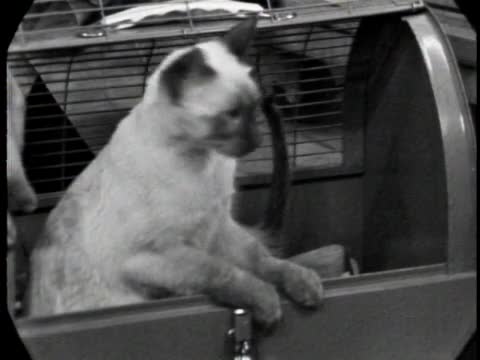
you, mama cat down here, excuse me, and, hey, what's the matter? Come on out here in a front. Look who I've got for you. Look who I have here for you. That doesn't open up any more than that, does it? Oh, I know, I love you too, but there's your mama right with you, and mama, and mama, oh, where are you going? What are you doing down there, little kitten? Hey, hey, hey, come back here. Hey, there's a kitten who's hungry over here. Oh, and there goes that kitten after her mama, and you know what she's going over there for. Oh, boy, boy. By golly, you know what that was? That was a mama cat with her kitten. Now yourself, let me see, maybe I better put you in the cage and leave the mama cat out. 5, 5, 5, here
back in your cage. Get going. Come on inside. Inside, my goodness. Oh, well, what did we learn there? We, it's about one and three quarter ounce. All right, Ms. McCollum will get these measured, and you started this on our way, and each week from now on, we will measure them and run our own experiment. Okay, adios, moochachos, moochachas, agones, psiquiziazis. All over the state, people saying, has north on this side and south on this side. This says south, and this says north. Let's see what happens when we bring it in here. You know
what's going to happen? You know what's going to happen? Watch. I'll bring it down. Oh, my goodness. Look at there. Oh, by golly, come on up. Well, let's see, the side that said north was attracted to the side that has south. And the side that has, check it out, south is attracted to the side that says north. What was the law of the magnets? On likes attract. The south is attracted to the north and the north to the south. On likes attract. Do you suppose we could turn this around? Let's turn it around now and try to bring the north down next to the north side. All right? Boy. Oh. Sorry, Dave. End of program. It sure didn't work. Look at that. I see once I brought it down and the field of force
on this one was so strong that it pulled it out and immediately it reversed the direction of the one in here. Now when you hold it up here, it's all right. Bring it around, turn it around, and bring it down. It's so reverses until it gets down. And now it's reversed. Now it's reversed itself. Good afternoon, out there, fans. Today we are going to demonstrate that. Let me introduce you. With an interesting group of plastics, a family of foaming groups called the urethanes. This is one left over from last year. I want to do the same thing
again this year. Come back. Boy, it's very light. All right. Now I've got my scale set up and we're going to put in first of all the first bit. Let's see. Now we're going to need 54 grams of this. And I've got it set on here. And as soon as this comes up to 54, oh boy, it's too heavy already. Well, bless my soul. Here it is on 200. Doc, we got something. We got real troubles with this one, old buddy. Can I imagine what? 200 and 54.
I'm fifty-four. I sure hope we don't save this. We're about to back. Channel five has produced music for in cooperation with the Albuquerque Public Schools and the State Department of the Education. This is a KNME presentation. In your head, would you like to have a taste of my butter?
You come close now and take a good taste of this creamy butter that we made on Kindergarten TV. It looks so very, very wonderful. Let's sing the song about the little red calf again one more time, shall we? Do you remember it? He sang it while I was churning away. Maybe you didn't hear it too well. The little red calf is cute as can be. I visit the farm and he winks at me. He thinks he is talking. I really do. For when he says ma, his mother says, move. It's really quite interesting. You know what I'd like for you to do today is to take a piece of paper and we'll draw a cow right in the middle of the paper. Perhaps we'll even cut her out and put her on to another piece of paper.
This is Marin's going to have a problem here. I have little pieces of butter all over my desk and cream. That wasn't going to be good for my work. Usually when you work at home, we don't do our cooking where we do our work and do it. So I'll wipe this just a little bit. There. I can put this down rather safely. I'm going to draw a big beautiful cow. And you know, from the picture, they have a fairly strong back. Their head's right about here and then their back sort of slopes down. And then comes the back part of them. Of course, you know, special kinds of cattle are raised for meat. But today we've been primarily talking about the milk cow, haven't we? She's very heavy here. And comes down here and for her front legs are smaller than her back legs. This is a very heavy leg here. Comes out and here's her back feet.
Of course, now I'm just drawing her on the side, aren't I? Here's her eyes. Here's her little ears. Let's give this cow just a small horn. She's a very gentle cow and her tight didn't have to be dehorned. Now here, perhaps she's chewing her cud. The toe and the toe. Now the front of the cow is relatively low and it comes on back this way a bit. Remember, we talked about the udder being back here. So you might draw this udder because you should know that this is where the milk comes from. There are four teats on an udder, but we can only see two legs on this cow. So perhaps the other two are hidden. Mrs. Marin forgot the cow's tail. How in the world is she going to swat at the flies that can bother her in the field without this tail showing? I think perhaps it would be fun to have a spotted cow, don't you? Some cows aren't spotted.
It's fun to make spots, so let's do that. And what is her baby called? A calf. They're special names for boy calves and boy calves and girl calves. And what is the father of the calf called? A bull. Now after you've made your cow, perhaps you can cut her out. You know something else I'd like for you to do to draw and cut out the various things we get from the cow. A nice glass of fresh milk. Some butter like you and I just made. Perhaps even some ice cream, some cheese. We forgot all about what you call a cottage cheese, too, didn't we? Can you think of other things? Mrs. Marin hasn't even mentioned cream, whipping cream, skim milk. Oh, there are many, many things that we use from this wonderful animal. Besides, too, we had talking about the dairy cattle. So meat cattle, and you like to have roast, don't you? And hamburger? And oh, can you think of the many other things?
Well, you think of all these things and put them near your picture of the cow. Tell mother about it. And tell her, too, how we made the butter and ask her some day special. If you can have some whipping cream and egg beater and try to make some butter for yourself. Would you like to do that? It's very interesting. Kindergarten's owner. I hope that you've had fun. We work and sing and even play. We'll be Kindergarten day. Bye. A mischievous donkey named Odo, a magic talking tree and a storyteller from Fairyland,
and entertain preschool youngsters on donkey tails. Is there a bear? Grizzly bear for a couple of three times. All right, let's see how well you listened and how well you learned. Would you stand again by the sides of your desk? And you and I are going to do the responses to grizzly bear. We'll do it in the same way as we did to Long John. We'll let the soloist on the record take the solo. And you and I will respond and let's sing again on the syncopation. All right, let's try it. First. Tell me who was the grizzly. Grizzly bear. Tell me who was the grizzly. Grizzly bear.
Who? Grizzly bear. Who was the grizzly bear? Grizzly bear. Who was the grizzly bear? Grizzly bear. All right. You may be seated. Sometimes you want to jump the gun. Don't you? At least I do on the sinking process. All right. So we've talked about syncopation, call and response, and I hope you'll enjoy singing. There's a meeting here tonight. Next time, we're going to have a competition. In other words, a contest. And I'm going to ask you to divide right now into two groups. The ones we usually do. Group one and two.
Group one will be team one. Group two will be team two. Group one, be thinking about this question. Look at your music and see what you think the form is of this song. There's a meeting here tonight. Is it A, B, A, B, B? Whatever you think. Team two. You, let's see now. I've lost what I was going to ask you to do. Well, let's just forget about it. It's gone out the window now. So I'll tell you what. We'll talk about it next time. We'll have the competition. And I'll see you then. Goodbye for now. I really do. See you next time. Bye. Get you ready. There's a meeting here tonight. Come along. There's a meeting here tonight. I know. Music six with Nancy Johnson is produced in cooperation with the Albuquerque Public Schools and the New Mexico State Department of Education. This has been a K-N-M-E television presentation. There's a meeting here tonight. Get you ready. There's a meeting. And by the way, when you're playing a rhythm instrument,
I'm sure you're probably already doing this, as you try to draw the sound out of the instrument, not drive it in, and you can create the same sound with your hands by trying to draw the sound out. That's one way of expressing yourself in the rhythm. You feel. And another way is the way musical directors, let me get this chair moved here, so we don't have to worry about him anymore. Another way of expressing yourself in the rhythm you feel is the way musical directors create a pattern with their hands and arms, which corresponds with the beat or meter, which they feel in the music. There's an accent that was strongly felt. What song was it? Well, it was Eerie Canal, of course. And I'm sure you were able to tell that. I'm going to dog gun it. I'm hung up on this chair just a minute here. You know, that's one thing about having a microphone on.
If you get wound up in a chair, you're done. Now I'm back. We've been talking about rhythm and ways to express rhythm, ways that you can respond to rhythm. We've used our hands, we've used our voice, we've used our almost our entire body. I know. Tuesday. This is an example of a sincane, which came from Mrs. Hamilton's room at Montezuma School. And we do hear another sound on the recording because her tape recording is completely erased, and you'll hear another song in the background. But here's a sincane set to music by one of the students at Montezuma School. I'm going to play it. I'm going to play it. I'm going to play it. I'm going to play it. I'm going to play it. Well, anyway, we tried Montezuma School.
It was a problem with the microphones and so forth. There are some other things that I wanted to share with you. And I want you to take a look here, the state of Hawaii. Oh, you might have guessed some other island. The end of the bamboo is open, and there are pieces of material here to hold on to, and then this end is closed. These are used in the islands for rhythms, and can you also detect a pitch? Let me change it over here. I really scared a camera man there, because I made up a little tune he's getting married soon. Then he's getting married. And you can make up some of your own tunes to these. Now, can you tell me, was I playing a beat, or was I playing some sort of short and long pattern? Was it just a steady beat? What do you think?
Or a short and long pattern? Come on, what do you think? All right, it was... The beat with your hands this way. You hold the sound in your hand. All right, let's see if you can do that with me, and we'll keep the beat to a Hawaiian song. Here is your pitch, ready, sing. Look at me, sheep on show. Fancy me, sheep on show. Strutton down the street. Shapo caught on one song. Well, that's not a Hawaiian song, is it? I'll give Mr. Gonzalez a chance to reach out to you. Gonzalez a chance to recue that tape, and then we'll try it here. These are a fun instrument if you want to try to make your own. See if you can find some big pieces of bamboo. Okay, here we go.
Feel the beat. Two. One. Two. One. Two. One. I wish you take a look at this.
- Series
- On Assignment
- Episode Number
- 223
- Raw Footage
- Blast from the Past and Kindergarten TV
- Producing Organization
- KNME-TV (Television station : Albuquerque, N.M.)
- Contributing Organization
- New Mexico PBS (Albuquerque, New Mexico)
- AAPB ID
- cpb-aacip-0da83e5c304
If you have more information about this item than what is given here, or if you have concerns about this record, we want to know! Contact us, indicating the AAPB ID (cpb-aacip-0da83e5c304).
- Description
- Raw Footage Description
- This file contains raw Library Footage of Blast from the Past (Black and white with color burst added for playback). Featuring George Fischbeck demonstrating a handmade volcano, playing with cats, demonstrating magnetism, and experimenting with urethane. From 08:58 to the end of the file, Channell five has produced music for the Albuquerque Public Schools and with the State Department of Education. Featuring Kindergarten TV, Kathleen McVicker, Joyce Marron, and Nancy Johnson all share musical lessons.
- Asset type
- Raw Footage
- Genres
- Unedited
- Media type
- Moving Image
- Duration
- 00:22:36.823
- Credits
-
Producing Organization: KNME-TV (Television station : Albuquerque, N.M.)
- AAPB Contributor Holdings
-
KNME
Identifier: cpb-aacip-e9de6472c01 (Filename)
Format: U-matic
If you have a copy of this asset and would like us to add it to our catalog, please contact us.
- Citations
- Chicago: “On Assignment; 223; Blast from the Past and Kindergarten TV,” New Mexico PBS, American Archive of Public Broadcasting (GBH and the Library of Congress), Boston, MA and Washington, DC, accessed September 22, 2026, http://americanarchive.org/catalog/cpb-aacip-0da83e5c304.
- MLA: “On Assignment; 223; Blast from the Past and Kindergarten TV.” New Mexico PBS, American Archive of Public Broadcasting (GBH and the Library of Congress), Boston, MA and Washington, DC. Web. September 22, 2026. <http://americanarchive.org/catalog/cpb-aacip-0da83e5c304>.
- APA: On Assignment; 223; Blast from the Past and Kindergarten TV. Boston, MA: New Mexico PBS, American Archive of Public Broadcasting (GBH and the Library of Congress), Boston, MA and Washington, DC. Retrieved from http://americanarchive.org/catalog/cpb-aacip-0da83e5c304