Briefing Session; 515; Plight of Migrant Workers
- Transcript
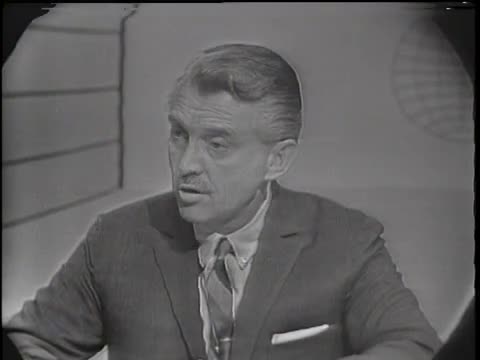
From New York City, National Educational Television, presents briefing session, the facts behind the issues in the world today, funds for the production of this program have been provided equally by the AFL CIO and the National Educational Television and Radio Center. Your host, the noted Washington correspondent of the American Broadcasting Company, Edward P. Morgan. Welcome to another edition of briefing session. This time we're going to examine a painful and controversial problem. Our subject is migrant labor which according to the Labor Department's Bureau of Employment Security, involves a million adult workers, more or less, and an uncounted number of children,
roving from farm to farm and crop to crop. It's probably fair to say that Edward R. Murrow's television program entitled Harvest of Shame, broadcast last November, has made a great many more Americans aware of migratory workers and that these workers are down toward the very bottom of America's standard of living. As of now, what measures can or should be taken to improve their lot? To probe these and other questions, we have with us two knowledgeable and experienced guests, the Honorable Harrison A. Williams Jr., US Senator from New Jersey, and Chairman of the Special Senate Subcommittee on Migrant Workers, and Mr. Matt Triggs, the Assistant Legislative Director and Labor Expert of the American Farm Bureau Federation. Gentlemen, let's start with a fairly basic question. Is there a need for federal legislation to regulate and improve the condition of these migratory workers? Mr. Triggs, what's your
opinion? Well, thank you, Mr. Morgan. We do favor a variety of measures for state action on the migratory labor problem. I would not necessarily oppose to all federal legislation in this field, nor even to all of the 11 farm labor bills that Senator Williams has introduced, but we are very much opposed to some of these bills, particularly to the bill providing for compulsory collective bargaining and agriculture, and to any legislation which would unduly limit the opportunity of farm boys to obtain jobs to work for a neighbor in the area. Senator Williams, your opinion. In my judgment, after two years of intensive study of the problems of our migrant farm families, the only way we will bring to these families a minimum of decency is through a comprehensive program of national legislation. Obviously, gentlemen, we've already touched a
point of major controversy, but before we pursue the question, let's hear from briefing session's news analyst, John McBain. A few weeks ago, a witness before the Senate subcommittee on migratory labor opened with this statement. I do not know of any problem in our national life, he said, that has been studied so intensively over so long a time in such a sympathetic spirit and with such negligible results. Migratory farm labor is a product of byproduct of industrial farming. Only half a century ago, the typical American farm was a family operation. A third of our people lived in such farms. The workers were mom and pop, the boys and perhaps a hired man. Then came specialization, consolidation, mechanization, and migrants. Today's typical farm is much bigger. It produces not a variety of crops according to the season, but one or two best suited to its soil employment. There's a hectic planting season, a hectic harvest season, and
relative leisure at other periods. Only the unreasonably nostalgic would argue that this is all bad. We Americans get more food and greater variety than ever before. All the food and fiber needed by 180 million of us today can be produced by two thirds. The number of workers required to meet the needs of 130 million Americans 20 years ago. Yet this new kind of farming is also changed the nature of farm labor. The demand for manpower is short-lived and season. Thus the migrants, men and women who are constantly on the move, south to north, crop to crop for the season advances. About half a million of these workers are American citizens. An equal number come from outside our borders, mostly from Mexico. They are not a regional phenomenon. They travel into 40 of our 50 states. They're more numerous in Michigan than in Florida. More in New Jersey than North Carolina. While they're invisible to most permanent residents, they're almost everywhere. It is not seriously disputed that these migrants comprise the lowest economic
class in our society. Their average earnings are less than $1,000 a year. They are excluded from protection of the federal wage hour law. They're right to organize for collective bargaining is not legally recognized. In most states, they are denied coverage under Wickman's compensation on employment insurance and the safety and sanitary codes. They're generally barred by residence requirements from the last recourse of the desperate public relief. There's no question either that migrant workers are often transported from place to place under unsafe and inhuman conditions. That the housing provided by their employers is sometimes primitive or worse. That the crew leaders or agents who recruit groups of migrants have been known to cheat them out of their poultry earnings. Even in the absence of outright abuses such as these, migrant workers seldom have access to adequate medical care. Their children seldom see the inside of a school. Those who oppose federal action to assist migrant workers acknowledge that conditions have been bad but insist that they're getting
better. One place where this is unquestionably true is New Jersey. For the last two years, more than half of New Jersey's 20,000 migratory workers have been Puerto Ricans. Adult males brought in from the Commonwealth on the strict and specific terms. This Jersey of these farmers try to get the same permanent personnel back year after year. This Jersey farmer is typical of many employing imported workers. As far as the 300 acres and all, about 150 asparagus and rest of them are made as peppers. We have 21 Puerto Ricans that come in from Puerto Rico. The average weight is 80 cents for hour and the housing is supplied, hot water, heating, bonks, refrigeration. Last year Puerto Rican workers averaged 14 weeks in the New Jersey fields. They averaged more than $46 a week in wages. They were adequately housed. Each migrant camp is equipped with first aid facilities. The men were protected by the state
workman's compensation law and by group insurance for which they paid 87 cents a week. A Puerto Rican woman cooked their meals in a clean kitchen with modern facilities. While they had to pay their own transportation at $52 for the round trip, they had far more to show for their labor after three and a half months than many other migrants. New Jersey also is acted to help domestic migrants. For example, in 1959 it operated three summer schools for the children of migrants. Last year there were four. The goal this year is six. If enough local school boards can be induced to lend their buildings for the purpose. Yet those who operate the New Jersey program are among the most odd and advocates of federal action. And this brings us back to Ed Morgan and our guests. And that brings us back to the preliminary question we started with. Senator Williams, there seems to be a cleavage between you and Mr. Triggs on the amount of federal legislation needed.
If any, do you want to explore that a little deeper? Well, I know there is a cleavage. We in our subcommittee have had hearings now for a year and a half and we've been all over the country in nine to ten states. We've had hearings in Washington. And most hearings have had a negative, we've had a negative reaction to our legislative program from the Farm Bureau, which Mr. Triggs is spokesman for. And we, our legislative program is comprehensive. It deals with most of the human problems we've seen. The folks we're talking about, the American Farm family, particularly the migrant farm family, have the most wretched lives of any Americans. And we try to deal with this wretchedness and bring just a minimum standard of decency and education, health services, wages and all of the other aspects of the program. This is by regulation that is not now in existence, more or less. Exactly. The farm, migrant farmers, farm workers
have been excluded from all of the social and economic legislation with the exception of social security. And I will say that it's a rare farm worker that is in fact covered. We need legislation. And following that, of course, will come regulation. But first and foremost, we need a national program, legislative program to deal with a multitude of problems facing the farm worker. Mr. Triggs, I remember your opening remarks. You emphasized that we didn't need federal legislation or at least in much less extent than Senator Williams holds. We would feel that some of the measures that he has proposed with the undesirable. I think we have to appreciate that this problem is primarily fundamentally a social problem. Most of the migratory workers are people who lack skills, capacity, ambition, people who have handicaps that have prevented them from finding
permanent jobs settling down in a permanent resident. Now, we call them migratory farm workers because such limited amount of employment as they're able to get is generally on farms. But they do work in other occupations as well when they can find it. And if there were no work on farms, the same people would be there with very much the same problems except that they would be worse. Now, I think this distinction is important. But let me interrupt you just to ask you a question, Mr. Triggs, to clarify something. You're not implying. Are you that what the farmers are doing now with these people is offering in a sort of a charity? No, not at all. But I think that if there were no farm employment, the same people would be there with the same problems. It's basically a social problem of people that need additional training, education, changing attitude to fit in for the modern economy so that they can find permanent jobs
either in agriculture or elsewhere. Now, you both agree there is a problem. Senator Williams says that it should be dealt with largely by more legislation and you say not. You want to just take a sentence or two and say what on the positive side? Well, part of this is the need to improve the productivity of workers. Despite the technological revolution in agriculture, there are some kinds of work, particularly the kinds that the migrant workers are engaged in. They hand harvest of fruits and vegetables and cotton in which productivity has not increased is not increasing and is about the same as it was some decades ago. And we feel that the best prospects and the ones that will really improve their prospects most in the long run are the major breakthroughs in harvest technology that are on the way in many respects. I could go into a lot of detail
on this. Senator, in terms of your reaction to what Mr. Triggs is saying, you get the same inference that I do that you could eliminate to a degree the problem by more mechanization of the farms, but does this mean that you would also eliminate the worker? The problem of the worker I mean, the sociological problem of the worker. It's very difficult for families to have a whole some life when they are temporary residents up the line of planting in harvest. It's a very difficult way of life for all concern. We certainly hope the day will come when we won't have migrant farm workers traveling with the crops that mechanization will help together with stabilization of the workforce. But the fact is now we need these folks because of the nature of planting in harvest. They are only needed for brief periods in any one point. We
don't have the mechanization necessary to plant and harvest the various fruit and vegetable crops. Therefore, these hands are needed now and these lives are wretched lives. Certainly these people are handicapped, they lack skills and we deal with that. We have a legislative program that would bring education to the adults as they travel north from the south and we have a program of education for the kids. So the young people who are migrant farm kids today won't be handicapped adults tomorrow. These are the things we're dealing with and we hope that this program will run itself out in 10 years and that we won't need a program because we will have stability in these folks won't be traveling with the crops. Mr. Triggs, if I have my facts correct, some of the foreign workers, the Mexican bracerals and the British West Indies workers, in point of fact, have more protection in their jobs than some of our American domestic workers. This
seems to be a gross inconsistency. What do you think about it? The domestic worker has a protection that the Mexican worker would be fortunate to have. He has the protection that any time he doesn't like the work he's on, he can leave the employer and seek work elsewhere. Now, this protection of competition, if you will, is more important, has greater value than the protection of regulation. You said earlier, Mr. Triggs, excuse the interruption that these people had only a limited facility and that this kind of work in effect was pretty much all they could do. Well, this is right, but this doesn't mean that migratory workers don't move around from farm to farm as they choose. Now, I want to comment on this education thing. I think some of the opening comments by Mr. McBain that the migratory work children seldom see the inside of a school. Well, we're all concerned with respect to the education of migratory children,
but that is overstating it. Most migratory children do go to school. They don't go as much as we'd like them to. Many of them graduate from grammar school. Many of them graduate from high school. Some of them even go on to college. Certainly, Senator Williams-Bill on education is rather basic. It is of course correct that we should favor this approach to what is basically a social problem. The issue is really whether or not federal aid to education is necessary. I think this is the problem that's before the Congress. Well, could I comment there and we know that there are states New Jersey was mentioned as one of the leading states in a program of education for these youngsters. There are four or five schools. Well, you know, this is just a beginning and our people in New Jersey know that it's only a beginning and they come to me and support our national program of federal assistance.
It's assistance that would be brought in on a matching basis. The federal government would supply part of the operating money, the community, the other part. The fact is that we've got to stimulate the states to action and we can all say that it's well for the states to do it, but as a matter of fact, the states are burdened with so many problems. They have to be stimulated and it would be no good to have a perfect system of education for the migrant youngster who's six weeks in New Jersey and then have him go on to another state where there isn't any program you see. There has to be a continuity in that connection, Senator. There is another point of controversy here and that is, as I understand it, that there has been a great deal of opposition on the part of individual farmers and individual and general farm organizations, notably yours, Mr. Trigg, against the efforts of the Labor Department in the Eisenhower administration, indeed, to force the farmers to comply with the federally
supported state employment agencies. This in terms of standards of hauling people from orchard to orchard and so forth. What about this? Oh, Mr. Morgan, this is a little bit outside of the subject perhaps, but the issue here is not whether or not the federal government should do it. The issue here is that if the federal government is to do it, Congress should affirmatively decide by legislative action that it should be done and the fact of the matter is that Congress has never by affirmative legislative action said that the Department of Labor should require any criteria with respect to bringing workers and farmers together for the purpose of providing employment. We think farmers have a right to have legislative review and consideration and action in this matter. You agree with that, Senator? No, I don't because the employment
services are used by growers. They go to the employment service and ask the assistance of the employment service and finding workers. All the Secretary of Labor has suggested he should do is require of any grower coming to the federal government for assistance and recruitment that that grower pay to the worker recruited, prevailing wages in the area, provide decent housing and provide decent transportation. Now, good gracious, I would think that no one would suggest that our government should be party to any recruitment where this was not done and that's all that is done by regulation. But this only scratches the surface of the need here. Much more legislative power and authority must be given to the Department of Labor and to other departments of government so that they can go right into the into the center of the problem of pregnancy and get at education, welfare, health services, better wages, decent
standards of work and living. Do the farmers object to paying the prevailing wage and generally accepted high standards? This was not the issue in this situation that the senator has been describing. We say it's a basic issue who's going to write the laws of the country. Are they going to be written by Congress? Or are they going to be written by administrative officials? We think this is important not only in connection with this specific issue but outside. Now, well now if we could pause before we get off to it on another point, I'm heartened to hear Mr. Trigg say that it is a legislative matter and Congress should make the decision and should enact the law exactly what we are attempting to do. You see we have 11 point legislative program and I gather that your statement is it is implied that there will be farm bureau support for much of it. Are you saying, excuse me Mr. Trigg, I want you to take right up there with this
interjected question. Are you saying also a senator that up to now many farm organizations have held back against even clarifying legislation on the matter? I can't respond to that. We've felt that there wasn't any clarifying legislation necessary. We thought the Wagner Pyser Act was clear enough in that the secretary labor has ample authority under that act for the minimum regulation he's now exercising. I'm going beyond that to the need for legislative authority in the cross the board areas of grave need. Let me comment on the senator's statement. It's quite correct what he says that we are in full accord with the procedure that the senator and the migratory labor center committee is following. They're holding investigations, they're making field trips, they're hearing witnesses and out of it some
legislation is going to come. We favor this procedure even though we may not necessarily favor what is enacted but we do feel that we've had an opportunity to be heard. Now before we get away too far I want to be sure in this discussion that I talk about that so-called child labor bill. We think this is one of the important bills that the senator has introduced in most rural communities, most farm boys, rural boys, small town boys work on farms during the summer vacation and they generally start this at the age of 11, 12 or 13 and those who get jobs think they're right fortunate. I know this isn't true in the community that I was raised in and we would just have regarded with open mild amazement the suggestion that we needed protection against employment or that we were exploited in any way. I've never known a man who worked on a farm as a boy who felt in after use that it harmed him. Now we're happy that senator's
senator Williams Bill has been I understand revised senator to permit the employment of boys 14 or older. We would hope you'd go a little further than that. We think that boys of 12 or 13 who wish to work on a neighbor's farm to milk a cow to do chores to pick strawberries to helping build fences or any one of the hundreds of other jobs that kids do on neighbor's farms. But it is important to preserve the opportunity of boys to to get jobs of this kind that this is an important part of the educational process. It inculcates responsibility or reliance and all the things that we hope to get on. This was seen to be a excuse me this was seen to be a very human approach but senator the charge has been made that one of the one of the false of the farm bureau federation and others from the point of view of you people is that they
have not taken the human approach throughout and that these injustices and that sort of thing have prevailed therefore. Would you say that that was a fair charge? Yeah in a way I would say that within the last few months we've gotten a greater degree of cooperation from the representatives of growers through their associations they our mission is certainly not to to make it impossible for a grower to plant harvest this crop and make a profit. What we're trying to do is improve the lot of the people he must employ and more and more we're getting cooperation from the the growers in their community now on child labor there was a time not too long ago there would have been a blanket opposition to any any child labor a new child labor legislation well now we know that there is agreement that there should be some legislation we're refining it we we feel that perhaps 14 years should be the cutoff maybe in
hazardous employment the secretary should have regular regulatory authority beyond that we certainly are not dealing with the bucolic idle that mr. trig suggests of the happy farm boy we're going to the kid who's stooping all day in the hot sun or in the dangerous work time has come to collect our thoughts and you have 60 seconds to recap yours mr. Triggs I just get started in 60 seconds but in many discussions of this issue runs the refrain here's a problem that's been with us a long time and nothing's ever done about it it's time we did something the moderator made some comments and this like this in the initial opening comment now this is just not true and let me summarize briefly a few of the things that have been done first farm wages have increased 46% since 1950 now isn't this an exceptional accomplishment for an employer group whose own net incomes have declined
during this period in recent years legislation has been enacted to authorize regulation of interstate transportation and a number of states are now enacting supplementary legislation I'm sorry mr. Triggs you did just get started yeah the William 62nd the catalog of the misery of the migrant farm worker is complete the youngsters who aren't getting anywhere near an adequate education non-existent health facilities wretched housing impossibly low wages this is a complete story of misery that the migrant farm worker is is exposed to all Americans have a minimum of security through spare labor standard minimum wages all the other protections these two million or so Americans have been totally left out it is our feeling that it is now long overdue for these folks to have just a minimum opportunity for a decent life an opportunity in our country thank you both gentlemen as I was listening to
this discussion the thought struck me somewhat encouragingly that progress the mechanization further of farms will help to absorb part of this problem but we still have the sociological problem of what to do with these people a million two million or whatever they are and it's important that we approach the question on the basis of not having a substance for another novel such as John Steinbeck wrote called the grapes of rap if you'd like a transcript of this program address a postcard to briefing session box 3536 Grand Central Station New York 17 New York I'll repeat that briefing session box 3536 Grand Central Station New York 17 New York next week briefing session will concern itself with the area of our nation's greatest tax expenditure national
defense and whether we are getting our money's worth in security we hope to see you there briefing session was produced by Joel O'Brien Associate Producer Joan Seever film supervisor Bill Buckley production assistant Barbara Schumann our guests today were the honorable Harrison A Williams Jr. US Senator from New Jersey and Mr. Matt Triggs of the American Farm Bureau Federation your host Ed would be Morgan of ABC and news analyst John McVane funds for the production of this program have been provided equally by the AFL CIO and the National Educational Television and Radio Center this is NET National Educational Television
- Series
- Briefing Session
- Episode Number
- 515
- Episode
- Plight of Migrant Workers
- Producing Organization
- National Educational Television and Radio Center
- AFL-CIO
- Contributing Organization
- Library of Congress (Washington, District of Columbia)
- Thirteen WNET (New York, New York)
- AAPB ID
- cpb-aacip-75-76f1vr82
- NOLA Code
- BRSN
If you have more information about this item than what is given here, or if you have concerns about this record, we want to know! Contact us, indicating the AAPB ID (cpb-aacip-75-76f1vr82).
- Description
- Series Description
- Briefing Session is a public affairs series.
- Broadcast Date
- 1961
- Asset type
- Program
- Genres
- Talk Show
- News Report
- News
- Topics
- News
- Economics
- News
- Public Affairs
- Employment
- Media type
- Moving Image
- Duration
- 00:29:21
- Credits
-
-
Producing Organization:
National Educational Television and Radio Center
Producing Organization: AFL-CIO
- AAPB Contributor Holdings
-
Library of Congress
Identifier: cpb-aacip-ac55fa4c3ac (Filename)
Format: 16mm film
Generation: Copy: Access
Color: B&W
-
Thirteen - New York Public Media (WNET)
Identifier: cpb-aacip-9272886d945 (Filename)
Format: 2 inch videotape
-
Library of Congress
Identifier: cpb-aacip-486fab15037 (Filename)
Format: 16mm film
Generation: Copy: Access
Color: B&W
-
Library of Congress
Identifier: cpb-aacip-a1b3496a785 (Filename)
Format: 16mm film
Generation: Copy: Access
Color: B&W
-
Library of Congress
Identifier: cpb-aacip-7dee87e75c8 (Filename)
Format: 16mm film
Generation: Copy: Access
Color: B&W
-
Thirteen - New York Public Media (WNET)
Identifier: cpb-aacip-e0a57d1c74a (Filename)
Format: 2 inch videotape
If you have a copy of this asset and would like us to add it to our catalog, please contact us.
- Citations
- Chicago: “Briefing Session; 515; Plight of Migrant Workers,” 1961, Library of Congress, Thirteen WNET, American Archive of Public Broadcasting (GBH and the Library of Congress), Boston, MA and Washington, DC, accessed July 1, 2026, http://americanarchive.org/catalog/cpb-aacip-75-76f1vr82.
- MLA: “Briefing Session; 515; Plight of Migrant Workers.” 1961. Library of Congress, Thirteen WNET, American Archive of Public Broadcasting (GBH and the Library of Congress), Boston, MA and Washington, DC. Web. July 1, 2026. <http://americanarchive.org/catalog/cpb-aacip-75-76f1vr82>.
- APA: Briefing Session; 515; Plight of Migrant Workers. Boston, MA: Library of Congress, Thirteen WNET, American Archive of Public Broadcasting (GBH and the Library of Congress), Boston, MA and Washington, DC. Retrieved from http://americanarchive.org/catalog/cpb-aacip-75-76f1vr82