New York Voices; 315; Health Special: Domestic Violence
- Transcript
Beep I saw my mother beaten regularly and um I together with her were victims of the insensitive society. The police response in those days was to walk my father around the block uh maybe I let him drop off to the local gin mill to have a beer and he'd come back more violent. [Woman] perhaps he threatened to kill her perhaps he threatened to kill himself if she leaves and many women know that the most dangerous time for women is when they attempt to leave violent relationships. [Woman] I've met young people who were abused physically pushed against a wall and thought it was love you know so education reallyis a powerful tool. {man} New York New York Voices special edition. New York Voices is made
possible by the members of Thirteen. Additional funding provided by the Horace W. Goldsmith Foundation and the Norman and Rosita Winston Foundation. I am Raphael Pi Roman and this is a New York Voices special on domesticof violence in New York City. In 2001 the city's Domestic Violence Hotline took more than 130,000 calls. That's about 12,000 calls each month. New York City Police Department made 22,694 family related arrest in 2001 and the department has more than 300 officers dedicated to domestic violence prevention and investigation. I recently spoke with Brooklyn D.A. Charles J. Hines and others about the city's efforts to fight domestic violence. We'll have that interview in a moment but first if you need help now here's where to begin. [Music] With me now is Brooklyn District Attorney Charles Hynes and Brooklyn Executive Assistant District Attorney for
domestic violence ?Juan D??? Thank you both very much for being here with us. Thank you thank you Mr. Hines when you first took over as Brooklyn D.A. you promised to put emphasis on domestic violence issues, why. [Hines] The principal reason why is I uh grew up in that environment. I saw my mother beaten regularly and um I together with her were victims of uh an insensitive society, the police, the Brooklyn district attorrney' soffice and we I grew up in Brooklyn. And Iuh often thought if I ever had the opportunity to do something about the plight of domestic violence victims and their survivors I would do that. And I I started this as a domestic violence bureau. It was important to have a bureau sized response to this crime so people inside the office as well as outside knew that I thought that the the crime of domestic violence was at the same level as crimes prosecuted by other bureaus like homicide or fraud or rackets. [Roman] And your experience was when you were a young man that nobody paid attention to it when you complained.
[Himes] It was quite the contrary they were totally insensitive. The police response in those days was to walk my father around the block. Uh maybe I let him drop off to the local gin mill to have a beer and he'd come back more violent. And that was the way it was and we went to court I remember an assistant district attorney telling my mother you know if you weren't so upset about your old man having a few beers maybe you would'nt have this problem Meanwhile he was beating her on a regular basis. And so it was that kind of insensitivity that I remember over the years and then when I was fortunate to be elected and let me take off as I committed myself to have as my first act was the creation of this bureau. [Roman] Now Ms. ?Lucibelo? What's happened since you started this bureau. [Lucibelo] Since the bureau began um and with the mandatory arrest laws being passed women became more involved in the criminal justice system in reporting domestic violence and we saw an initial tremendous increase in the number sometimes over a hundred and fifty percent over previous years.
And what that did was it created an environment for the development of specialized courts to hear domestic violence. The district attorney added counselors and social workers which is a critical part of helping a woman through the court process and through the whole safety process. So that's been a critical part of this. And with that federal grants money to put into place special programs to reach women who would otherwise never enter the criminal justice system such as immigrant women and women with disabilities. Having a specialized bureau creates the focal point to really bring in resources and to have courts and and prosecutors develop an expertise in handling this kind of these kinds of cases which I think is really really important. [Roman] Miss ?Lutebella? you mentioned the mandatory arrest law.
What is it and is it effective. [Lutebella?] in New York State the mandatory arrest law requires the police upon a call of domestic violence to make an arrest when they respond. Unless it's a misdemeanor case and the victim on her own says that she does not want the police to make an arrest provided that there's no order of protection in place. It's effective because it provides for victims a predictable police response and it allows the victims to have an entree to services that they might not otherwise get. So in that I think it's very significant because the 911 call and the police responding is a very very powerful message I think to the perpetrator, to the victim, and to society as a whole. [Roman] And you see that and you've seen it has an impact. [Lucibella?] I think it definitely has an impact. [Roman] We have about a minute left. What what needs to be done still in Brooklyn or anywhere. [Hines] For me I'd like to know whether we can develop the data as we are in our
specialized domestic violence courts to figure out why there's a cycle of violence in domestic violence typically. My father was a drunk and a wife beater. His father was his grandfather was his great grandfather. I became the first in that male line uh to break the cycle. I suppose anecdotally it was because my maternal grandfather uh raised me. But I think we have we have the ability through our therapy sessions and the data we'll collect to at long last figure out what it is we can as a society can do to prevent this horrific nightmare. [Roman] thank you very much. Thank you both. Thank you thank you. Joining me now is Lucia Davis Rayford. She's the Director of the Domestic Violence unit of the New York City Police Department. Thank you very much for joining us today. [Rayford] Thank you for having me. Now what is the Domestic
Violence Unit. The Domestic Violence Unit is a 20 person headquarters unit at the New York City Police Department that advises the police commissioner and the chief of department on emerging issues in domestic violence ,policy development, procedure development. We monitor field operations. We are supported by about 500 domestic violence specialists in the various precincts.[Roman] H w long has it been in existence.[Rayford] since 1995.[Roman] And what are its goals? [Rayford] Well certainly the goals of the unit are to improve our response to domestic crime and to constantly remind ourselves that it is an evolving process as we learn more about what domestic violence is, how families respond to it, what the criminal justice needs are and the demands on our own system. It's essentially to make sure that we are responsive to our true clients the crime victims. [Roman] Now what happens if I hear my neighbors fighting and I call the police.
What happens then, what do the the police do. [Rayford] Well you should expect that the police will respond, they will knock on the door. They will ask what's going on. You can also expect that the parties would be separated, that they would be interviewed separately so as to not allow the batterer to overpower the victim. You can also expect that if a felony has been committed that the police department must make an arrest. [Roman] What if the woman says you know it's OK we're just we're just arguing there's no problem. Do the police still have to make an arrest? Do they have to walk away? No the police can only make an arrest if there's probable cause to believe that a crime has been committed. [Roman] So if So if they think that a crime has been committed even though she says there's no problem they make an arrest. [Rayford] If it's a felony absolutely the police officers have to determine probable cause based on a lot of things they assess the credibility of the parties they're trained to look at the scene look at the home. Uh certainly they're looking for bruises upturned furniture and other
indicators of whether or not a violent incident has happened.[Roman] What makes it a felony that its that they think a violent incident is [Rayford] Well there are certain type crimes that are felonies, rape is a felony. There's a high level of assault, felony assault ,robbery burglary. There are great categories of crime that are felonies and they of course are the most serious crimes. The most frequently reported domestic crimes however are in the misdemeanor category and in violations category. That is not necessarily a misdemeanor or felony. And in the circumstance of misdemeanor the police officers have some discretion as to whether or not to make an arrest. And that would depend on whether or not the victim wants it or if the police determine that to leave that victim would leave her in danger. [Roman] What's been the effect of the unit in the city?. [Rayford] Well arrests have increased by about 74 percent in domestic cases since we created the unit. We have developed a
means for tracking domestic crimes and monitoring domestic crime victims and their offenders. We've developed intricate means of post incident contact in victim support because we know that domestic violence is repetitive and cyclical. So we maintain contact with the victims and their families for follow up services as well as the ongoing policing individual. We think it's had a very positive impact on the city in a [Roman] in certain reducing domestic violence [Rayford] Well in improving our response to domestic violence we still believe that domestic violence is under reported. [Roman] What does the unit mean to you personally? When has it meant to you personally? [Rayford] While I've had both the pleasure and the burden of creating the unit. and so certainly professionally to see um an ability to affect institutional change and how the department responds to a particular crime mission has been rewarded. But also it affects me personally in that I was a victim of domestic violence. I am a
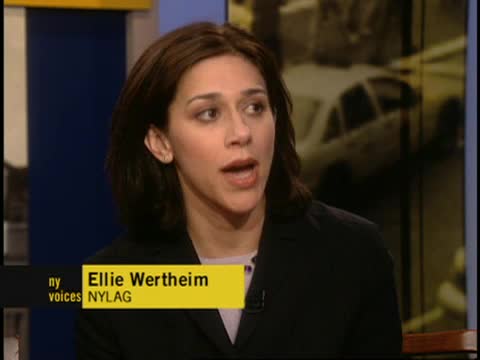
survivor of domestic violence and so for the police programs that we implement I always view them from the vantage point of a former consumer of the very service that we are trying to affect and we typically try to keep in mind in developing our policies and procedures what impact it might have on victims. [Roman] Thank you very much. [Rayford] My pleasure. [Music] [Roman[ And with me now are Kim Susser, Supervisor of the Domestic Violence Clinic and Ellie Wortheim Staff Attorney in the Family Law unit both from the New York legal system group. Thank you both very much for joining us. Ellie what is the New York Legal Assistance Group? [Ellie] It's a not for profit legal services agency that provides civil legal services to low income New Yorkers in a variety of civil legal matters.Um in particular in our Family Law unit we provide assistance to and priority to domestic violence victims and because
our whole agency is not federally funded we are able to accept cases for people who would not otherwise qualify for free legal services in New York. [Roman] Now Kim we just saw hour after hour of uh criminal and civil proceedings in Florida. Uh s that the same way it is here in New York City? [Kim} There are many similarities but the major difference that struck both of us we were watching was the lack of legal representation in both the criminal and civil matters. Here in New York you would automatically always get appointed an attorney for a criminal case and even in civil matters such as those in family court you do have the right to court appointed counsel for both the victim and the batterer. [Roman] Um ujm interesting. [Roman] Now, you know, it seems like every time, Ellie you can answer this if you could, if you would every time that there's a high profile domestic violence case in the media one of the questions that seems to pop up right away is why did she stay. Why didn't she leave? What's the answer to that? [Ellie]
I think you're right that is a very commonly asked question I think in a lot of ways it's a false question because the real question is why do batterers continue to batter. Um many of the reasons why women continue to stay in violent relationships are economic reasons why they love this man they have children with this man and children is a huge reason why women stay pressure from children pressure from clergy and in many ways fear perhaps he's threatened to kill her perhaps he's threatened to kill himself if she leaves. And many women know that the most dangerous time for women is when they attempt to leave violent relationships. [Roman] Do you think have anything to dd to that? [Ellie] Well I think that children is is a primary cause that we should emphasize I think it's the reason why women stay it's also why the reason why women leave. Um initially they might stay because the pressure from the children a good example is around Christmas time she may not want to let him into the house, she might have an order of protection. But there the kids are pulling out her apron saying mommy let daddy in it's Christmas I'd love to see him. It's very hard to deny your children a parent in that way. Um in the same vein that's also why many women leave because they realize that their safety of the children is that
is at stake. Sometimes the children are learning behavior she might notice that children are starting to act out in those kinds of ways and she might say OK enough and that's the same reason she leaves. [Roman] And I guess when you say love that also implies hope hope that this person will change. How likely is that? [Ellie] at this point there are no longitudinal studies that show that any of the therapeutic or educational batterer's programs are effective in any way. In fact women should know that just because their husband or their boyfriend has gone through a batterer accountability program or a therapeutic program does not mean that they're cured and if [Roman] even then[Ellie] even nonviolent [Roman] it's really not without that intervention. [Ellie] Well certainly not. But even with that it's unclear that there's any effective means for making a violent person nonviolent particularly in a short term program. [Kim} These these interventions are primarily used in the criminal court and the reason that they're used is not because judges think that they're successful because as Ellie said there's no studies to prove that. But
because of accountability purposes and so probation may monitor their compliance with it and then if there is no compliance it's a way to get them back into court. [Roman] All right well thank you both very much. We'll be back in a moment. And with me once again are Kim Susser supervisor of the domestic violence clinic and Ellie Wertheim Staff Attorney in the Family Law Unit both from the New Yor kLegal Assistance Group. By the way Kim you know when I asked the question why does she stay why doesn't she leave. I said she I assumed it was a she. Is that a correct assumption? [Kim] It really is. Most of the time it's 85 percent of the time women are the victims of intimate violence rather than me. [Roman] And to the question why doesn't she leave. You said Ellie that one reason is because that at the beginning of the departure that's when
it's most dangerous. Could you elaborate that poin? [Ellie] Sure um he is losing control. She's about to leave him and a mean dynamic of domestic violence is power and control. And that's a time when he's about to lose his grip on her and likely the children if she's taking the children with her. Um and it's a time when it's the most dangerous for her and when she needs to make sure that she is the most safe so if that means moving documents to a safe location in preparation for leaving making sure that there's an extra set of keys for her, um Finding a place where she can stay whether it's a shelter or a friend's house and making those preparations in advance. [Roman] so the fact that when you first leave is the most dangerous time should impeach somebody from leaving that has to leave they just have to be prepared. [Ellie] Well they have to be prepared in safety planning is important but most of the time we think that women know when it's safe to go and when they might need to stay. Most women, most homicides from intimate violence occur at the point that she leaves. [Roman]
What should a woman do to start a legal procedure. Uh the legal process of dealing with domestic violence. [Ellie] I think it's important for women to know that they can proceed in both family court and criminal court at the same time. So if they call the police and the case proceeds in criminal court through the district attorney where she would only be a witness she's also entitled to go to family court and start a criminal proceeding. However in family court, whereas in criminal court, they have jurisdiction over all crimes, in family court people have to be legally related either by blood or marriage so intimate partner cases either they have children in common or their spouses or former spouses. [Roman] Now you know uh something that one often hears is that charges of domestic violence is is a tactic a manouver that women sometimes use when they're filing for divorce or something like that. Is there any truth to that? [Ellie] Absolutely not in fact the American Psychological Association has done studies that show that any kinds of false allegations are used equally, actually by whether you're a victim of domestic violence or not, so we're not saying that there aren't false allegations but
there is nothing to support the fact that domestic violence victims use that as a tactic any more than anyone else. [Roman] And Kim what kind of relierf do you get from Civil Court and what kind of relief you get from the criminal courts? [Kim] Well some of them provide differently for example criminal court you can pay somebody in jail whereas in the civil court you can't. However one of the things that is an important tool for women to know about is that she can get an order of protection or what's called a restraining order from both of those courts from either court or from both of them at the same time. These orders are good from one state to another. They can last anywhere from one to three years in New York. But in New Jersey, for example, they can last for a lifetime and they provide certain injunctive relief, they stop behaviors, they order the batterer to stay away from her place of employment, to not email her, to not contact her in any way, to stay away from the children's school, and even to possibly exclude them from her home. [Roman] Ellie we have less than 30 seconds, if a woman knows that it's that she has to leave what is the first thing that she must do?
[Ellie] If she's in immediate danger she needs to call 911. If she has some time and she would like to get some legal advice she's welcome to call us at the New York Legal Assistance group. [Roman] OK. Well thank you both very much. Thank you [music] [Roman] Judith Kahan is the Executive Director of the Center Against Domestic Violence. Judith thank you so much for joining us today. [Kahan] Thank you. [Roman] First of all what services does the Center provide? [Kahan] The Center has shelters, we operate the oldest shelter in New York State over 26 years. years. We plan to open up another shelter. We also have counseling, we do crime victims work. The program we are particularly proud of one that's funded by HRA is our rap program which addresses the issue of teenagers and teen dating violence. [Roman] Now who is at risk of dating abuse? [Kahan] Teen Dating and anyone and everyone, [Roman[ really across the class divide across the ethnic and [Kahan] absolutely. [Roman] How about boys and girls equally.
[Kahan] Well of course the statistics are very high of the abuse being directed at girls very very high although men young boys are starting to come forth and indicate that they are also abused. [Roman] Now what are the signs that are that a teenage boy or teenage girl uh should notice to realize that they are in a troubled relationship? [Kahan] Well one is that the abuser really tries to take control of the other person's life so it is usually extreme jealousy blaming the person for everything that's happening to them. They also tend to become isolated. So one day the young person is no longer relating to their friends, to their family, and it really is under the control of another person. [Roman] So this happens little by little. [Kahan] It's a progression. It starts from emotional to physical and it doesn't always necessarily get to physical. [Roman] Now what should a parent be looking out for what kind of signs should they look at to see if their child is in a troubled relationship? [Kahan] Right.
Well the parents should really uh look for there's the usual things such as bruises. You know that's the most obvious but that which is their teenager being friendly with the children, are they all by themselves or are they always on the phone 10, 15 times every hour with somebody who's basically the same person with the same person they seem to be losing their friends all of a sudden they have no one but this one, usually a young man in their life.[Roman] Now is it easier for a teenager to leave an abusive relationship than is for an adult. [Kahan] I think it's much uh harder for a teenager [Roman] Really? leave.[Roman] and why is that? Well they are locked in socially they don't have a source of income uh they don't get to shelters. There are no shelters really for teenagers and so they uh and they usually love these other people and they might not have the insight of an adult as to the issues of their abusers. [Roman] but don't they have the parents to help them if they want if they want out?
[Kahan] Right. If their parents should be involved the parents should really see that the young person does not spend time with the abusive partner because there might be an effort to reunite with the person. And of course teenagers don't always seek the advice of an adult which we all know and uh but there are in our program we feel that the strength of the program is opening up teenagers eyes as to what are the issues and we feel that education of young people so that they begin to realize. I mean I've met young people who were abused physically pushed against the wall and thought it was love. You know so education really is a powerful tool. And parents also have to become educated. [Roman] Now what if the parents are not there to help them because as you told me off camera some of these kids are uh their parents are abusive.[Kahan] Right. [Roman] Where do they g.o? [Kahan] Well this is one of the real problems. So if you can come to a social worker or a teacher or one of our what we call rap coordinators who are all social workers within the
school at least they can design a safety program for the uh young person and uh one of our young people came forward and both the mother and the teenager came to our shelter so that there are options for families.[Roman] Very good. Judith thank you very much. [Kahan] Thank you. [Roman] This has been a New York Voices special on domestic violence. If you need help here's where to begin. New York Voices is made possible by the members of Thirteen. Additional funding provided by the Horace W. Goldsmith Foundation and the Norman and Rosita Winston foundation.
- Series
- New York Voices
- Episode Number
- 315
- Producing Organization
- Thirteen WNET
- Contributing Organization
- Thirteen WNET (New York, New York)
- AAPB ID
- cpb-aacip-75-085hqfwj
If you have more information about this item than what is given here, or if you have concerns about this record, we want to know! Contact us, indicating the AAPB ID (cpb-aacip-75-085hqfwj).
- Description
- Series Description
- New York Voices is a news magazine made up of segments featuring profiles and interviews with New Yorkers talking about the issues affecting New York.
- Description
- Host Rafael Pi Roman interviews local experts about treatment programs and support systems available to victims of domestic violence.
- Broadcast Date
- 2003-03-18
- Asset type
- Episode
- Topics
- News
- Local Communities
- Media type
- Moving Image
- Duration
- 00:25:21
- Credits
-
-
Producing Organization:
Thirteen WNET
- AAPB Contributor Holdings
-
Thirteen - New York Public Media (WNET)
Identifier: cpb-aacip-7e81fc6fb8f (Filename)
Format: Digital Betacam
Generation: Master
If you have a copy of this asset and would like us to add it to our catalog, please contact us.
- Citations
- Chicago: “New York Voices; 315; Health Special: Domestic Violence,” 2003-03-18, Thirteen WNET, American Archive of Public Broadcasting (GBH and the Library of Congress), Boston, MA and Washington, DC, accessed June 3, 2026, http://americanarchive.org/catalog/cpb-aacip-75-085hqfwj.
- MLA: “New York Voices; 315; Health Special: Domestic Violence.” 2003-03-18. Thirteen WNET, American Archive of Public Broadcasting (GBH and the Library of Congress), Boston, MA and Washington, DC. Web. June 3, 2026. <http://americanarchive.org/catalog/cpb-aacip-75-085hqfwj>.
- APA: New York Voices; 315; Health Special: Domestic Violence. Boston, MA: Thirteen WNET, American Archive of Public Broadcasting (GBH and the Library of Congress), Boston, MA and Washington, DC. Retrieved from http://americanarchive.org/catalog/cpb-aacip-75-085hqfwj