Growing a Business; 206; White Flower Farms
- Transcript
Wow. Inside of every city dweller who lives in a stink about being a farmer by getting out of the land and fussing around with seeds and lawn mowers and weather and growing things and. I have I guess the worst case of that than most people. I like to go do something I feel like it's done and be able to see it. That's probably true of all small companies that you can actually leave your mark. This company just adds in the out of doors in a statically pleasing product. Bought a tractor very agreeable and. Growing a business is made possible by a grant from Computerland stores across the country. The retail computer specialist that had been helping growing businesses. Hi I'm Paul Hawken and welcome to growing a business. Two of the most complex and
difficult enterprises I know of are the nursery business and the mail order catalog business. Both depend on external forces over which there is no control. The weather changing consumer tastes and the Post Office combining the two requires an individual who is either courageous or naive or maybe even a little of both. White flower farm is just such a business. It was started 30 years ago by a couple of expatriate New York writers who wanted to spend more time at their weekend home in Litchfield Connecticut. It succeeded as a retreat but just scrape by as a business. And in 1978 it was sold to another New Yorker who also wanted to escape the city. This time an investment banker named L. It was worth L Its goal was to preserve the standards and rural image of the original business while applying sound business principles to expand the operation. Elliot Wadsworth describes a wide flower farm as a place where everyone wants to live. The farm contains three hundred
acres of ground. Large greenhouses filled year round with world class flowers and trial gardens where new species are given a chance to adapt to the ever changing New England climate. Wadsworth lives half the year in this we stored clapboard house just yards away from his office. As a business white flower farm has grown to more than 200 employees during peak season. Total revenue has now surpassed 10 million dollars. Most of the money comes from sales generated by the garden book. White flower farms feign'd and literate catalog that is written and edited by Wadsworth under the pen name in this pet until. A mythical New England gardener of almost legendary fame created entirely inhouse the garden book is considered perhaps the most area diet and best written of any mail order catalogue in America photographed by Michael dodge research horticulturalist. It goes out to more than 200000 awaiting gardeners every spring and fall in a good year. More than 20 percent will
respond to the beautiful pictures the wry commentary and the first come first serve opportunity to have everything the going is today the lilies growing in their gardens by the next season. These orders come into their trying to facility where their sophisticated computer system coordinates requests and planting times to ensure that each plant arrives healthy and ready to take root. When I first came to a flower farm the operation was owned by a man named William Harris and when he agreed to sell me the business he told me that it really wasn't a business that it was more of a way of life. Coming from a. Background with a business degree and some investment banking experience I thought I could tell a business when I saw one. And I went to work here and applied all the conventional accounting tools and management tools that I was familiar with. And had some
successes in doing that. But at the same time what I began to find out was that his generalization about it being a way of life. Was actually not so much of a generalization as I had originally thought. Yes it was a way of life in the sense that it provided. This sort of view of a manufacturing facility. But the other side of the equation is that in any given year regardless of how careful I am in watching the numbers and planning the inventory and projecting my marketing programs to a new segment of the population these plants behind me could be killed by a storm and my entire production crop is gone and along with it most of the marketing investment in the catalog and everything else so that over time. You find yourself getting cautious farmers get cautious each of us here involved in the management feels that a part of our job is to make sure we don't overreach that we don't extend ourselves to the point where we are compelled to cut corners to survive. And that's a tricky equation.
We discussed growth all the time. There's real questions among the managers as to whether it's a good thing or not. Many of us view that its growth is good because it provides more opportunities it gives the managers a chance to get more responsibility. It gives us a chance to hire more year round people which will make a difference in the operation. At the same time its real hard to do because we have to grow in such large chunks we can't just growing mentally. You can't put in another five feet of green house you have to put in another whole greenhouses so instead of being a small investment it's a very very major investment and you're compelled to fill the greenhouse as fast as you can. At the same time it's a lot harder handling 100000 orders than it is twenty or thirty thousand dollars to make it work right it's a lot harder handling 135 people and shipping than just 20 or 30 ladies that you know very well and you can rely on. It's quite a different challenge. How did this salmon. It's nice and cheery for Christmas.
That's why I started here as a much smaller company eight years ago than it is right now. I'd say in the past couple of years we started focusing a lot more on productivity and efficiency. Now we're trying to balance the two off that. Yes you should stop and take the time make sure it's done right. And I'm trying to bring that emphasis back. It's just important to get it out the door and to make sure it's right when it goes up and take the time to do it right and you'll be 10 steps ahead of the game when you're all time rather than behind you. Maintaining the level of quality over the 34 years that I've been here has been my prime. Object. And that has been mainly done by teaching training older newcomers and just giving them the idea that I was better than all the other issues. Maybe at least we tried to be that
focus. These tend to drop off when they get to the stage just pinch them off and that keeps the floured going. The compromise when we articulated and when we face it clearly always comes out to be the same thing. In order to get big we're going to have to compromise our standards and the group of people who work here have no interest in doing that they're mainly here because they can tell a good plant from a bad one and likely good ones and don't much like the bad ones. So in a way we're mired. Pleasantly mired but nonetheless mired at whatever size it is that we can run this business to the kind of standards that suit us and we figure if we can suit our own standards most of our customers will be happy. And so far it's worked just fine. The fencing company says we can save a thousand bucks if we will pull the existing fencing out of the ground ourselves. That looks like a. Running a business like this is astonishingly capital intensive. And it's capital intensive
because it's seasonal. We need to have green houses which are basically out of use in the summer irrigated fields that are basically out of use in the winter. Big refrigerators to store the dormant plants over the winter which are out of use in the summer. We have to have air conditioned. Shipping facilities which are basically out of use in June July and August. So. We are constantly investing. In assets which are used occasionally. We've been very successful up at the fulfillment center in capturing the capital budget for the last couple of years. Sooner or later that's going to go away in the farm and get it put some new green houses up. But I've been able to get it and I've used that money to go ahead put a new computer in to go ahead and put a new software in to run on that computer to get a new telephone in to do major repairs to the building. In doing that we found that the shortage of
qualified people to really strain us. We're putting in a day care sent out to try to increase the pool of people we can hire we think that there's a number of women at home that would really like to get out work for five hours a day. And we're trying to provide them an alternative with that increased pool of labor available we expect to get a lot of educated people that can handle the introduction of a lot of this new technology and that should make a real difference. So it's an information intensive business we can't walk in here and the effect of shipping plans if you don't have any idea or plan so I think that that is probably less true if you're shipping rubber boots or toothbrushes. When I got here with a dozen full time employees it was very distinctly a family feel. And of course because we were working in a small space we operated on the same principle I guess as an ant hill. Maybe you know that ants if you step on the top
of an ant hill. The way the ant at the bottom. Finds out from the answer at the top that there's a problem is that all the answers of touch each other serially and they communicate through some kind of chemical. Everybody in the nursery at that stage of the game talked to everybody else in the nursery three or four or five times a day and as a continuous exchange of information and problems and changes and whether a customer demands or some surprise with a crop that communicated to everybody in the place instantaneously. It maybe helped put on what it also did was encourage suckers around Anax. And were having a lot of plants that are actually have two branches and we can't vote on them because you're just going to get suckers and no matter how they keep coming back. And where their healing was particularly high we actually get the large number of plants because of suckers down that we couldn't even use them.
What it turned out was happening. It was that we were essentially trying to make the anti principle. Work to force it to work by meetings and endless memos. I didn't have the wit to realize that we were trying to apply a small company culture to a business that was getting a little too big and a little too complicated to do that. What we have done is to become war and war reliant ironically enough on computers. In the final analysis. It seemed to us that the only way to have all the data on hand and available to all the people who needed to look at it. A common understanding of where crops were how many of them there were saleable grade was recorded in a perfect memory attached to a high speed printer. I guess that the reality is that if this company continues to expand that we may have to work still harder on the shape in the form of the organization. Right now we're doing it we're doing it by juggling and we haven't dropped anything yet. The act is not
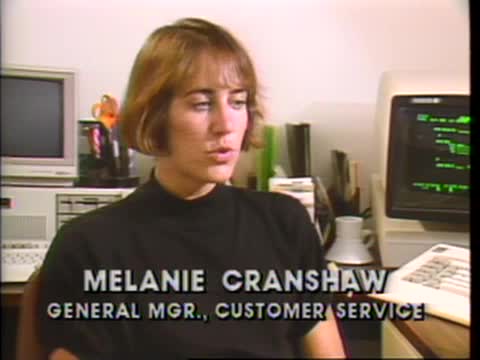
always perfectly polished but it's pretty good and we're juggling porcupines here so it's a pretty interesting game. Torrington facility is our fulfillment operation and it houses all our order takers our customer service people and all the folks that handle the plants from when they come out of the field until there are a pair for shipment wrapped and sent on out to the customers. It's just like any other mail order company. Right now we get the products from the farm but we could just as soon as well be getting them from a toy manufacturer a clothing manufacturer. In that aspect it's just the same as any other mail order company. There's been a real substantial changes taking place there in just the last few years. We've gone from a very simple little phone system to one that has a large computer and it we've also gone from a very small computer that had essentially no more horsepower than a modern personal computer to a very large mid-range
computer that handles all our orders. We've also substantially upgraded all the software on that. We feel it's going to give us an edge over our competitors because. We're going to have a. Horticultural product knowledge everything that we know about that product it's going to be able to be entered into the computer. If a customer says to us. My daughter is getting married in June she's going to be married in my backyard. I want. Pink all shades of pink flowers blooming in my backyard and I want short ones under the shade tree and I want one against the house and it's going to be beautiful. We can keep in certain categories of plants we can say pink. We can say very sure require shade and a list of the products that we're offering in our current catalog that customer will be able to buy that will be blooming in June in her area. And to me. That the main thing we've always in the past had to rely on one of the senior horticulturists
knowledge to get that and now we tried to encode much of their knowledge in the computer so that just an average telephone operator with a few weeks training can get out there and answer an awful lot of horticultural questions for the customer. That's something that we just dreamed of as recently as one year ago. But at the beginning of the shipping line it's technology that was used a hundred years ago to prepare plants. It's all manual. The plants are pulled apart by hand cutter divisions are taken by hand. They're wrapped up like a giant have an a cigar on an old. Meatpacking table with plastic and that technology is very old. We go to great lengths to hand wrap and prepare every single plant. And to varying degrees some of our competitors do that but we generally use better materials and go a little further than they do. And we think that all translates to quality at the customers garden. And that's really what we're all about.
What you believe have a point. Sounds like California Chrome. Landing Winchesters our staff or culturists. And his entire job is to just be there available to the customers to answer tough horticultural problems that no one else can handle. I particularly like the fact that there's a lot of human interest involved. See I'm a little bit different from most horticulturist. I think most of my colleagues from my observation think appliance is important. And. From the time I started out I really couldn't. Because to me if you isolate one of these white fluff on peonies and put it in a mountain valley where no one ever enters what good is it. You couldn't even feed a car on it. You've got to have a person first and it's a person that really gives the importance to the plants not just from the standpoint that people pay for the clients but a plant is nothing without the person behind it.
Fundamentally we view ourselves as plants and we think that what we are doing and the critical skill in the company is our enthusiasm for and experience with and continued interest in plants. That's basically what we have to offer the customers all the hours that all the people here have spent working with plants. Now having once produced a single plant the process of producing a lot of that same kind of plant is more akin to manufacturing than it would appear to be walking out of the fields and looking at them. There are standard. Production techniques there are standard maintenance techniques we try to adhere to a rigorous schedule relative to the weather. We try to have grades that we have here to for each product and shipment schedule and cultural instructions fundamentally it's a combination of weather and all of our energy. Having produced the plants. We then move to a very different part of the business. We sell these plans through the mail and in
order to do that we produce a catalog. The objective of which is to communicate some of our knowledge and some of our enthusiasm in some of the unique characteristics of the plants themselves to the customer. It seems to me that every spring everybody. Has some urge to get out in the soil in the garden. And so unlike some mail order businesses. We're not really faced with the problem of making people want to. Garden. A You need to make people want to buy a new sweater or buy cashews or something. Our problem is. As gardeners is to communicate to folks. What it is we've got to accommodate this kind of. Primal urge to garden has been our choice to try to make the catalogues consistent with the way we think about the nursery in the sense that since we are growers we feel that our catalogue should reflect as much of our knowledge about the plants as we can. The catalogue starts with the projection process that I am anticipating several
years down the road what we're going to list in any particular season in any particular catalog. Then the production department takes those projection numbers and tries to convert them into real plans and then they come back to me and tell me we've succeeded. We had a crop failure. We weren't able to buy the seed the cuttings didn't root so we're not going to be able lease that one even though you wanted to. When I have done the projection and I haven't got a photograph then I go out and attempt to get a photograph and usually I do that myself. Up until the day the catalog is actually printed we can make changes very expansively in the last week but we can make changes and it happens we've had crop failures and or plans have suddenly come into bloom at the wrong season and that being the wrong variety. Take a long time to make their own roots from cuttings this way you have a good root system already as soon as it begins to grow in the spring.
Cleaning so you get an ice cream. Everything is. Fixed. This past year we suffered through the operation from the technical very. Technical I think give us people credit for doing it. And overwintering and they know a whole bunch of those. That was this year's crop going in for next spring's catalogue all the week and year ago we lost quite a few to the same kind of
things. Lots of customer frustration and have beautiful photographs and then they call two weeks after it's out and the product's gone. The thing to keep in mind is that all our products are alive and they're just out there constantly trying to die on us and we have to spend a lot of time and energy keeping them alive and nourishing them. And then all that has to be in the context of getting them out to the customers on some sort of organized schedule that the customers can count on. I don't know where the name of spending bill came up last but that was cooked up after a strong drink but nonetheless Mr. Harris created this person. Who started first signing and intensifying the catalog as far as I'm concerned he's a necessity around here. In my mind's eye he's about the age and shape. That Harris was when I first met him which puts him you know kind of tall and lanky upper 70s pipe smoking. And I guess everybody has a different face on it
now. A lot of the customers. In the early days. Believed that there was a gent walking around here with a name. I guess that there are a fair number of people who still believe that. I had a group. OPEN HOUSE. And this old Jed when you came in he was from Chicago Illinois and it was a very very hot day and he came up to me and he said and I said you know I haven't seen him around all day but I bet he's around some way or other and this gentleman went away. Still looking over the place and making sure that everything was fine. Yeah he's always looking over your shoulder. So this. Is. Your friendly one. You can enjoy the product that you work with. That's why I like it here and. And that hole in the catalog and get a certain feeling and I guess I feel when you work you should be getting that same feeling as well that in doing something for that you can be proud of in the
end. And I think that's what a mess is on my shoulder. They're saying you know it's most of the best. Remember when we were small and used to take the time to do it one piece at a time. A question can do that in a business and you've got it always try to find a way to make it happen quickly. Yet only the anus quality there. We don't have a pricing strategy. And that's probably not a very intelligent admission. What we have is a product strategy in the product strategy is to try to be the quality supplier of plants now. We actually do have some fairly clear ideas about how much profit we ought to make. And it doesn't define itself so much in percentages of sales or in the return on invested capital. Basically what we're trying to do is to make enough money number one to be a people commensurate with their efforts basically to permit us to
attract and retain. Smart motivated people and to keep them around here long enough that they acquire the necessary skills. And number two to have funds available so that we can invest for the future. I think the drive for Growth comes mostly from within. It's a lot of fun to try to do more of it do bigger and still maintain the same quality that's a real hard thing to do. And so there's a lot of intellectual challenge in there. Also if we grow we can afford better systems we can afford this big new fancy computer that allows us to have all the information at our fingertips. We couldn't do that when we were a little smaller. So we also get to serve the customer better in some ways. To a significant degree the job that I have here is to try to weave together all the forces that are involved with farming it's the weather and it's the soil conditions and it's the heavy equipment and it's the bugs and the hailstorm on the one hand and make those jive more or less effectively
with a large computerized mailing list and a relatively sophisticated space advertising program with the needs and and requirements of a will to do an affluent customer group who expect a lot from us we encourage them to expect that because they do they require that we be perfect and we encourage them to expect that and then turn ourselves inside out to make it happen. When the product is out there thinking about dying all the time. The seasons are different every year. It's a real handful to take you primitive or essentially primitive farming operation and dove tail it with a computerized marketing thing and have a compatible result and you just have to roll with the punches when you're doing your initial business there's always something different. I don't know what's going to happen this week. So you have to be flexible otherwise you wouldn't survive it. But that's also part of the fun of it. Frankly the rural setting was real nice was a lot more appealing than being in Manhattan all week that a
lot of my classmates from business school went to Manhattan and dreamed of the day they could buy a home up here. They come on weekends. I'm here year round. Younger people coming to the farm are enthusiastic about growth it means for them more opportunity and more responsibility and more income. And the old gaffers such as myself are mainly trying to stay out of the clutches of the banks all the time and between the two we strike a balance trying not to lose track of the fact that if we can continue to produce plants that look like this on a reliable basis every spring God will turn up with a warm day in the middle of March and the customers will be moved to garden and will be saved once again from our own devices. Next time I will look at Henderson industries and inspiring story of how one black man. Created one of the most successful in America. Business.
Business is. Growing a business book written by Paul Hawken is available through this toll free number published by Simon and Schuster. It contains valuable insights and information for anyone running their own business or thinking of starting one. To order call 1 800 4 4 1 3000 the hardbound volume is $16 95 cents plus handling and please have your credit card ready when you call.
- Series
- Growing a Business
- Episode Number
- 206
- Episode
- White Flower Farms
- Producing Organization
- KQED-TV (Television station : San Francisco, Calif.)
- Contributing Organization
- KQED (San Francisco, California)
- AAPB ID
- cpb-aacip-55-93ttfvqr
If you have more information about this item than what is given here, or if you have concerns about this record, we want to know! Contact us, indicating the AAPB ID (cpb-aacip-55-93ttfvqr).
- Description
- Series Description
- "Growing a Business is a documentary series exploring behind the scenes of nine diverse, mostly small businesses. "
- Description
- White Flower Farms: is in the nursery business and earns most revenues through mail order. They live up to their central marketing theme, "White Flower Farms is a real place, run by real people"
- Broadcast Date
- 1988-06-02
- Asset type
- Episode
- Genres
- Documentary
- Topics
- Business
- Media type
- Moving Image
- Duration
- 00:29:29
- Credits
-
-
Producing Organization:
KQED-TV (Television station : San Francisco, Calif.)
- AAPB Contributor Holdings
-
KQED
Identifier: cpb-aacip-8b98ee3c19a (Filename)
Format: U-matic
Generation: Master
Duration: 00:28:51
If you have a copy of this asset and would like us to add it to our catalog, please contact us.
- Citations
- Chicago: “Growing a Business; 206; White Flower Farms,” 1988-06-02, KQED, American Archive of Public Broadcasting (GBH and the Library of Congress), Boston, MA and Washington, DC, accessed April 30, 2026, http://americanarchive.org/catalog/cpb-aacip-55-93ttfvqr.
- MLA: “Growing a Business; 206; White Flower Farms.” 1988-06-02. KQED, American Archive of Public Broadcasting (GBH and the Library of Congress), Boston, MA and Washington, DC. Web. April 30, 2026. <http://americanarchive.org/catalog/cpb-aacip-55-93ttfvqr>.
- APA: Growing a Business; 206; White Flower Farms. Boston, MA: KQED, American Archive of Public Broadcasting (GBH and the Library of Congress), Boston, MA and Washington, DC. Retrieved from http://americanarchive.org/catalog/cpb-aacip-55-93ttfvqr