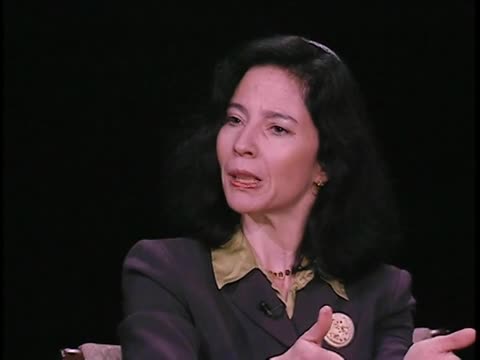
Jewish Women In America; Rabbi Chava Koster, Temple of Greenwich Village
- Transcript
This show was made possible by a grant from the Jewish Women's Foundation of New York. If dush, dill, I'm here to love, who we take, gave you to my favorite love. I'll love, share, and be the kind of one that we are all alive and loved. Welcome to Jewish Women in America, a television series that celebrates the contributions of Jewish women to U.S. society. I'm Blanche Wiesen Cook, and my guest today is Rabbi Haba Costa, of the Village Temple in New York City, and the first woman from the Netherlands to be ordained, a rabbi in the U.S. Welcome, Rabbi Costa.
Pleasure to be here. I'm so glad you're here. You're one of the great forces in this city and this country and this world for justice and for humanitarian issues and for women. And I feel just very privileged to be with you today, to be with you today. And it was at your temple that I celebrated with my mother, her last Passover Seder, a feminist seder, which was such a wonderful cross-generational, fabulous seder, like many women of almost 90. She was always so angry at Seder time. Women weren't allowed to participate. They were only allowed to cook. And she really felt that one terrible Passover time. She broke all the dishes. Well, I see you come by your temperament from your mother's side.
That's wonderful. So tell me how you come by your temperament. How do you come by your vision and the work you do? How did you become a rabbi? And here you are. You're a major rabbi in the conservative and post-denominational tradition. It's a long story. I think it goes back to having been raised in a post-Holocaust family. A family that had joined the war had gone into hiding. And I'm not sure if after the war they actually really came, truly came out of hiding. And so being Jewish after the war was really hard. And for them it was something that the one hand were very proud of. And the other hand did not want to be reminded of. Well, I don't think they counted on a very willful, intense child. Where were you? They were hiding in Amsterdam. They were hiding in Amsterdam. And so I think I was very young, age of seven, when I really officially discovered that we were Jewish.
I had really not a real clue. And when I found out I had a very close connection to my great-grandfather, who called me the questioner. Because I always wanted to know why I still do. I asked any of my good friends and they'll say, the second word out of her mouth is why. Explain to me why. And he really taught me what it meant to be a Jew. And I think the most profound experience I had with him when I was... It was the year he actually passed away. Just like you talked about your mother. I was a member of a youth group. A very fervently Zionist and very anti-German. My great-grandfather decided it was time for me to go on an exchange program between Germans and German Jews and Dutch Jews and Dutch. And I kicked and screamed and said, I wasn't going to do that. And he said, it's now up to you, you're going. So I went and had a wonderful time. I had a wonderful four days with all sorts of people.
And coming back on the train from Germany into Amsterdam, which was very symbolic. And waiting for my great-grandfather to stand there with his fedora to pick me up. I was very guilty. I felt very guilty. How could I possibly like these people? And I'll never get used to it there. And he said, so no, how was it? And I shared with him. I said, I felt rather guilty. And he said, if I had allowed you to grow a neo-Nazi in your heart, he said, then Hitler would have won. And he said, I did not raise a great-granddaughter to do that. And so I think that was very pivotal. I knew from the age of 16 that I wanted to be a rabbi. And I was always told, not possible, not possible. And I said, well, watch me. So eventually I saw an article that was talking about Sally Presan and her ordination. And I thought, like, well, if she can do it, then I had Sally Presan reform movement, first female reform rabbi. And what you're going on was the early 70s.
And I felt like if she could do it, I could. And eventually that brought me to this country to go to rabbinical school here. And where did you know? I went to the Academy for Jewish Religion and the Jewish Theological Seminary. And so he was, did you study with Heschel? No. Heschel was who he was dead by then. No, he wasn't, actually. He might have retired. I think he in the 70s were not. No, no, no. After that. OK. The 90s, 91. OK. So no, he was, he was dead by the past away. But I met his daughter. That's right. Very powerful. Very powerful. So yes, that wasn't. And you know, they didn't allow her to say cottage. She went into a synagogue to say cottage for her father. She writes about this. Yes. And I imagine Abraham Heschel's daughter. He's told that women can't say cottage for the dead, for the prayer for the dead. Well, they're sitting. Rabbi, so would still say that to this day. I disagree. Well, we're very grateful to you for making it possible for all of us
to worship again. Well, I think there's many women on whose shoulders I stand. And particularly, I think most people don't know that the first female lab I ever to be ordained was ordained in, in 38 in Germany. Really? And her name was Regina Jonas. She's actually very famous. And a few years ago, I took my youth group on an exchange program with German Jews and Germans. I think history repeated itself in a way for me. And we stood in the first reform congregation in the Iranian boogers in Agoger. And there she was, a large photograph of her. At the year of her ordination, she had a private ordination by Rabbi Max DeNeman. And it always makes me think, had there not been a Shoah reform movement or progressive Judaism, as we now know, it would have probably taken off tremendously in Europe. It started in Europe.
It stopped due to the war. And it is, to this day, hasn't recovered. And if you can think of standing on the shoulders of many, many women who probably would have become rabbis, would have become cantors, and due to history taking a crazy turn, having been stopped, and now looking back to the development of reform or progressive Judaism in Europe, it's been thrown back 100 years, which is really sad. Is it building up again? It is building up. But there is also a great deal of resistance. You see that there is a first female rabbi in France, pulling bed. There is one in Germany, bear violet. And then there is another Dutch one in London right now. And it is still an enormous amount of opposition against it. Uncomfortable for people. I think change in and of itself to begin with, for European Jewry is difficult. Because I think there was so much lost,
and so little to hold on to that, it became a real issue for them. But it's interesting that instead of sharing essentially power and vision with women, the insistence has been to keep women out, which is so when one thinks of the issues of justice and the vision. I think it goes against what Judaism really stands for, the pursuit of justice. And to always look for new venues, to connect Jews to their Judaism. But also I think we have a very important spiritual role to fulfill in this world. And not every Jew is connected to, per se, religion. But they might be connected to social action, which is really important within Judaism. They might be connected through the arts or literature. And I think if anything, we have an obligation to possibly create a synagogue where people can find doorways, can find entrances into a synagogue, where they can go through eventually one of those gates, those openings.
And at the end of the day, they'll find it all leads to the center of what we talk about, whether you believe that to be spiritually given to God to the Jews or written down by people inspired by God. I think all of those elements of a braid, whether it's social action or religion or art, all of those things eventually tie together and forms Judaism and its core. And to say it can only be one thing is, it's a pity if we say that. Well, it's very limited. And it would also, it would also, I think, cut off too many people. What is your, you do a lot of social action in the village temple, and you personally are involved with this extraordinary, global movement. Could you talk a little bit about, in 2000, that was, the world summit of religious leaders, which was in New York, and it was very exciting. And some of the organizers, the UN,
and Rudra Finn came to the conclusion once again that, yes, even though it had been an amazing week of being almost able to walk into a lexicon of religion, and to see all sorts of people who shinto his priests and Buddhists and Jews and imams and rabbis and indigenous peoples, and we came to the conclusion that a lot of women had not been invited, simply either because they don't hold positions in the upper echelons, or because they were purposely left out. And so we decided that we were going to have a global peace initiative of women, clergy and women's spiritual leaders, and we actually kicked off in 202, in Geneva, where a big peace initiative, and that has now developed into all sorts of programs that we do. We have done, let me repeat that, because it's so exciting, really, a global peace initiative of women,
clergy, and women's spiritual leaders. That is spectacular. So what we've taken on is, look at problem areas in the world and say, okay, we're going to focus on this. We're going to create either a business component, a spiritual component, and also trying to bring this out to the world. So we started a project with peace baskets in Rwanda, which basically helped part of the world, which was devastated by hatred and terrible atrocities, to come up with something that they already were making, and then give it the message of peace. And it has actually a great success. We've brought computers to Afghanistan, and at the moment we're focusing on the Middle East, that is probably the biggest conflict area that we have at the moment, really the epicenter of this. So we're working on a conference in June that will focus on tolerance, peace, and diversity within the faith traditions,
but specifically focused on Palestinian and Jewish scholarship. But this time it's going to be a conference in Jerusalem, and the scholars are only going to be female scholars from both fields, which is very exciting, because that's the first time that has ever happened, and we hope that the UN will sponsor a series of papers on the topic. And we hope to also invite all the grassroots peace movements from both Palestinian, as well as Israeli side, to be part of the conference. So they are also lifted up from being somewhat unknown, or marginalized, I would say, at the moment very marginalized by the politics. But you've been there at this meeting in Jerusalem before and to set the groundwork that we had a planning meeting in December, and it was the first time that I walked through a checkpoint in my life, and actually was in Ramallah. I think it changes your perspective.
It's one thing to read about it, or to see a one-sided publicity on television in the news media, but to actually physically walk through a checkpoint with several reverence, a Buddhist monk, representatives of the Palestinian Authority, talk to the members of the Knesset, and walk through and realize what this does, and we were there a day when it was only what 63 degrees. I can imagine what it would be in the middle of the summer when it's hot, and it's a boilerplate that's standing there, and it is a very distancing and hard thing to do. Now this was a checkpoint in addition to the wall. Now this is normally all the, if you go from Israel into Palestine, you will have to go through a checkpoint. A checkpoint? It's a red-guinish telephone. You have to do that. You have to do that. When we did it that day, it was fairly quick, and it was fairly cool, literally, otherwise.
So that was fascinating, but also difficult to realize it's basically you're going through a stone cord or basically, and you are heard it in, and people go through one by one. You have to show you identification papers. So for folks who are trying to go to school or to work or to... It could take anywhere from an hour to a daily humiliation. It's a daily humiliation. It's one thing reading about it. It's another thing to really walk through and realize how that makes you feel. The other part is, of course, the wall that is now going up the security wall, which I've seen, and it really cuts through villages. It cuts through the heart of small villages. I also think it cuts through people. People heart people, just people, for simple reasons that if you talk to your average Israeli and your average Palestinian on both sides,
both of them have been terribly affected by the political situation. Both are affected by terrorism. Both are affected by the fact that the economy is in the tank. Gone. It is hard on both sides to make a living, and it's equally hard on both sides to know where your children are if you're not sure if they're on this side of the fence, or the other side of the fence. One of the most hard-wrenching stories I heard is of a father who actually sent his child to an international school, Palestinian father, Palestinian child. He sits every day with Israelis in his classroom, people who are his best friends, and now it has to take him three hours to get to school. Does they, you can't always cross over this fence or over this wall? And I think what most people don't realize it keeps the Palestinians quote-unquote out. It keeps the Israelis in. So there's not... I don't think there is a winner or loser in this situation. I think we both lose everybody. I think we both lose.
Everybody loses. And so that's something that I have worked very hard for. I think it's important that we get to know each other face-to-face. I would say to people, if you see the other person as bearing the imprint of God's thumbs, then it becomes really hard to hate a person that you have made eye contact with and to let you know and that you've spoken with with respect. With respect. And I think one of the reasons why we still do this is that in order to understand, you also have to embrace each other's narratives and stories. And so know that for one freedom fighter for the other side is a terrorist. And their our need for security might be their need or they feel it as oppression. And so to sit in a room with members of the Palestinian Authority, with members of the Knesset, and have these discussions and sit there even when it becomes personally painful. I think has been a very moving experience for me.
And you come away from these meetings with hope. I think so. I think at the end of the day, we can still meet in Jerusalem and we still can sit in Ramallah. However, difficult that has been to organize and sit face to face and have a conversation. Even if we don't agree, the fact that there is space between us, I would say almost a holy space, a spiritual place where we can sit and talk. That means at the end of the day, that person will have a different opinion about another Jew. And I might have another opinion about a Palestinian and that's where we have to start. It's very simple. I don't think it's going to come from politicians. I think they really work with fear, and we work with, as I said, holy space and understanding, and it takes a great deal more courage, like Dr. King taught us. Right. And if I want to stand in any kind of tradition, I think it should be that. We need more Dr. King's. People who stand up. We need activists who have courage. As Eleanor Roosevelt always said,
courage can be as contagious as fear. Right. And you know, it's so bitter to think about the wall when you think about all the walls in Europe and all the walls against Jews. And it's really what he'll, you know, the man who was known in the US is Peter Bergson, who is Hillel Cook in Israel, and who always wanted Israel to have a constitution and to define its borders, which Israel had refused to do, and then he left the Knesset. And he said, I don't want this country to become a ghetto with an army. Right. And the building of the wall, just, it's really heartbreaking. Well, we also know from history that it doesn't work. It doesn't work. It doesn't work. They come down eventually. That's the good news. Right. A great deal of human agony at the cost of that. Do you think, I mean, I'm interested that you say politicians won't do it. Well, they won't do it without the kind of movement and the pressure that leaders of, you know, really great peace and spiritual tradition bring on them.
But ultimately, do you not think the US has to be part of what... Well, I think this is no, I think it needs to be a global issue. Not just the US. At the UN. Yes. I think it needs to be the UN, European community, Israel, Palestine. And I think we really need to make a push to say that in order for us to make any kind of opening, we need global support. We need a great deal of courage to go there. And everybody's talking about globalism as if it's just about money. When, in fact, it's about the human community and we're on this tiny little planet all of us together. Right. And we need a global movement. Well, I think Pope said it correctly, he said, we have enough religion to hate each other, but not enough to love each other. And so I think in any kind of political situation, I think religious leaders need to be at the table, helping people to make decisions. Because at the end of the day, if we are talking about globalization, the flip side of that is that we...
I think we lose our spiritual anchors very much so. Globalization also, I think, forces people to lose a sense of self. In olden days, it was very easy to identify, it was us against them. And we had tribal situations, tribal connections. Nowadays, in globalization, it becomes really, really hard to do so. So I think in order to have any kind of opening within the Middle East, I think we cannot neglect the fact that religion has to be at the table. And not just, I would say, the extreme right-wing, but people who can actually build bridges. And so, of course, that really is happening with, you know, I mean, you had Yale, Diane, at the village temple. And there is Gosh Shalom, and there are all of these movements. I'm very partial to a movement in Israel, in addition to the women in black, and the women in men in black, who are all of these. There's really a tremendous activist movement.
There's something called dirty laundry. Which is amazing. It's gay and lesbian, bisexual, and Jews, and Palestinians. Jews and Arab Israelis. And they have been leading the marches. And I think it's really important. Well, I think it's doubly brave. I have to stand out twice. They stand out twice. And they call themselves dirty laundry as in your grandmother told you not to hang out to do dirty laundry. I think that's wonderful. But I think one of the things we lack, and we should do, is that we need to galvanize all these groups. And the fact that we're all standing on street corners, making the same plea or request, and that we don't have a unifying force to really organize us and to say, and now it's enough. I think that's one of the things we're hoping to organize through the conference to also let people know that they're not alone and their voices are heard. Which I think is important since the overall, I would say the spiritual state of both Palestinians
and Israelis are. I would say is rather depressed. People are having very gloom thoughts, gloomy thoughts about ever coming out of this situation. And so I think it is up to the international community to say, you're not alone. And look at Ireland when they were thought that would happen. And it did happen. And the war came down in Berlin. And it would do it ahead of us. It doesn't matter. We'll get there. Not in my day. But it did happen. But it did happen. It did happen. And you can't just erase that and simply say, I think it's so important, Rabbi Koster, that you as a spiritual leader, you're so loved and respected. It's very brave and courageous of you to be doing this. Folks don't agree. But you're taking risks. What happens when you invite somebody like Yale, Diane, who is after all the daughter of Moshe Diane, but is a very vigorous outspoken piece leader. What happens when she arrives at your temple?
Well, I think people having a hard time. I think most of the time, most Jews that I know of, even in a liberal progressive community as the village and the village temple. Our first reaction is when someone attacks. So it says, we're not doing it the right way is to go on a defensive. It's a human response. If I wouldn't pay attention to my own feelings constantly and my own thoughts, my thoughts on that matter, I probably would do the same thing. Yale, Diane was hard to take for most people, even though they don't put it into context that she is. In many ways, Moshe Diane's daughter, who also took a very forceful action and all stood up for what he believed in. But she talks from the ground. She talks about the situation and what really is going on and not just the hype we get in the media. She talks about the situation economically. Children below poverty level. Really?
Starving. Starving. Starving. Starving. Her work as a government person on the ground in Tel Aviv. The fact that, yes, there is no necessity really for this wall that this is more of a political statement that if we were talking about the necessity of a wall, it should at least follow the demarcation of the green line, which is not. She talks about very openly that a wall like that keeps Palestinians, quote unquote, out and Israelis in. But she also talks about the fact that any person on a donkey can smuggle in God knows once. So eventually a wall is not going to keep people from plotting a terrorist attack. Neither is a Muslim, neither is a checkpoint. So eventually she has spoken about how important it is to keep at this, meet Palestinians, talk to Palestinians, let them know you, let them see who we are on the other side and to find out that we're not so different.
Right. I mean, this whole war against terrorism is so crazy when really the bottom line is young people have to have more to live for than to die for. This is the legacy we're passing. That's right. Very poor legacy. But we know that folks have to have more to live for than to die for. We've got to create a world where that is possible. And I just think that a global peace and initiative of clergy and spiritual leaders at this time working through the UN actually meeting is really fabulous. I think it's fabulous. I have one very personal question. When you left Amsterdam, how was your mother? How did she react to your one and maybe a rabbi? Actually, my grandmother, I would say. I was raised by my grandmother and not my mother. I think my grandmother was someone had she been given the tools to follow her dream she would have. She wasn't. She hadn't. She missed their opportunity. So on the one hand, you have a granddaughter
who stands on the barricades and becomes the first female rabbi and you have the hand is something that on one hand fills her with pride in the other hand, makes her a little embarrassed. Which I think is a nice reaction. It's both. I think in retrospect, I think the prideful part, one. As it should. As it should. As it should. You talked about other social justice issues. There's so much homelessness in New York. The village temple has outreach. We have outreach to homeless. We have a soup kitchen that feeds unshobless, 150 people and we take a great pride in that. I'm working with a coalition of closure downtown that works on Planned Parenthood but also rights of immigrant workers because we have more and more situations in downtown that we have people without below a certain level. Grab by Coster. We are out of time.
The village temple is a great center of learning and spirituality and social justice for anybody out there wants to be in touch with you. I hope they will. Thank you again, Rabbi. Have a custer for talking with us today for Jewish women in America. I'm glad to be in Cook. Thank you very much. Thank you. Thank you very much. Thank you very much. Thank you very much.
- Series
- Jewish Women In America
- Contributing Organization
- CUNY TV (New York, New York)
- AAPB ID
- cpb-aacip/522-db7vm43v0t
- NOLA Code
- JWIA 000008
If you have more information about this item than what is given here, or if you have concerns about this record, we want to know! Contact us, indicating the AAPB ID (cpb-aacip/522-db7vm43v0t).
- Description
- Episode Description
- Rabbi Chava Koster, rabbi at the Village Temple in Greenwich Village, talks about being a female rabbi. Hosted by Blanche Wiesen Cook. Original tape date: March 10, 2004.
- Created Date
- 2004-03-10
- Asset type
- Episode
- Media type
- Moving Image
- Duration
- 00:29:09
- Credits
-
- AAPB Contributor Holdings
-
CUNY TV
Identifier: 14581 (li_serial)
Duration: 00:29:07:10
If you have a copy of this asset and would like us to add it to our catalog, please contact us.
- Citations
- Chicago: “Jewish Women In America; Rabbi Chava Koster, Temple of Greenwich Village,” 2004-03-10, CUNY TV, American Archive of Public Broadcasting (GBH and the Library of Congress), Boston, MA and Washington, DC, accessed June 4, 2026, http://americanarchive.org/catalog/cpb-aacip-522-db7vm43v0t.
- MLA: “Jewish Women In America; Rabbi Chava Koster, Temple of Greenwich Village.” 2004-03-10. CUNY TV, American Archive of Public Broadcasting (GBH and the Library of Congress), Boston, MA and Washington, DC. Web. June 4, 2026. <http://americanarchive.org/catalog/cpb-aacip-522-db7vm43v0t>.
- APA: Jewish Women In America; Rabbi Chava Koster, Temple of Greenwich Village. Boston, MA: CUNY TV, American Archive of Public Broadcasting (GBH and the Library of Congress), Boston, MA and Washington, DC. Retrieved from http://americanarchive.org/catalog/cpb-aacip-522-db7vm43v0t