Science Reporter; 62; Wallops Island Launch Facility
- Transcript
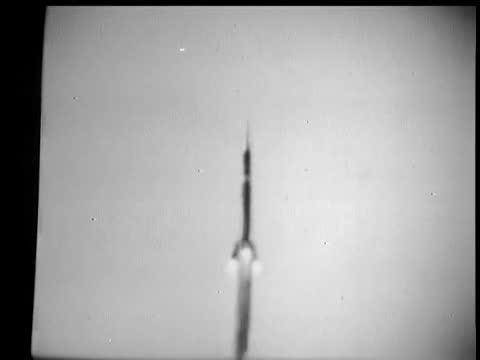
The following program is from NET, the National Educational Television Network. On the 18th of August 1965 off the coast of Virginia, a scout rocket with a payload of 370 pounds left its launch pad at dawn. After following a nearly vertical trajectory to an altitude of 130 miles, it hovered for a moment, then plummeted back to earth. No headlines were made, reporters weren't even present, but the mission was recorded and unqualified success. Healthy sounding rockets are assembled and launched and how meaningful information is gathered from their experimental payloads is our story today on Science Reporter. Hello, I'm John Fitch, MIT Science reporter. Today we're out
at Wallops Island on the eastern shore of Virginia, where the National Aeronautics and Space Administration has its main launch site for its small rockets and scientific payloads. You know 20 years ago nothing as big as a baseball could be launched without the whole world's undivided attention, but today we seem to have transformed that mysterious void at least its nearer reaches into our own private backyard laboratory. Out there at the rate of almost one a day, scientists launched the minor experiments that test and measure the world about us, but it is in fact their results when gathered together that formed the real launch pad of any major space achievement. From this very grandstand area scientists, technicians, and even just idle observers have had a chance to watch space history in the making. The sounding rockets launched quite routinely from this barren
shore, varying size from the six foot hasp to the 72 foot scout. They can send hundreds of pounds of instrumentation as much as 3 ,500 miles into space. Since the end of World War II, these work courses have sent back valuable information about the composition and characteristics of our upper atmosphere. From heights above the ionosphere, they've also been able to return information about stars and galaxies. With the bigger rockets, Wallops Station has had a hand in major orbital launches too. In 1959, they began a two -year series of tests on the Mercury spacecraft that included the renowned flight of two recess monkeys, Sam and Miss Sam. During these same years, they launched and inflated the trial series of plastic spheres that preceded the Echo Communications satellite. Currently, as part of our International Cooperation Project, Wallops is also orbiting satellites like the Canadian Ariel
that have been developed in other countries. For an introduction to Wallops Island and of the kinds of research going on here, we talked first to Mr. Robert Krieger, Director of Wallops Station. At the end of World War II, there was a need for research in flight in guided missile aerodynamic and particularly in the transonic aerodynamic region. Is it going through the speed of sound, breaking the sound there? Going through the speed of sound. There were wind tunnels that could do research at subsonic speeds, as blow the speed of sound, and there were some wind tunnels that could do work above the speed of sound there in the supersonic region. But there was no way to obtain valid research data at transonic speeds or the speed of sound, like number one. Better to use a rocket than to build a wind tunnel that would go through this area? You didn't know how to build a wind tunnel that would go through this area at that time. So Wallops was established with these ideas in mind to do research in
these areas. We were established in 1945. As far as we know, this makes us the first establishment that engaged in research by means of rocket -propelled test vehicle. We are a civilian agency and also as far as I know, we're the only rocket shooting range that's completely managed and operated by a civilian personnel. And what kinds of rockets? What kinds of experiments take place at Wallops? Primarily, sounding rockets, space probes. These would be things to go up and then fall back down again? Let's go up more than one Earth -ready and come back Earth suborbital flight. And finally, small scientific satellite. The small scientific satellites are fired on scout, which is the vehicle that the performance curves are shown here from a firing a few months ago. They do put satellites into orbit. Oh yes, we have about nine satellites in orbit by now. What do you do this work for? Oh, we work for, of course, the other NESA centers. We do
experiments for the more scientific groups and in the earlier arms, the United States government, the Defense Department, the Bureau standards, the sort of thing. More recently, we have been doing a good deal of work with foreign governments who are trying to get into space research by training them and assisting them technically with their early firing. With the hope that they'd be able to go back home and set up their own ranges. I see. Most of our experiments, or at least a large percentage of them, are from the University, the University Sciences, brings his payload here to Wallops. And we apply our know -how in our facilities to put his experiment into the right environment in space. This is Blockhouse number two on Wallops Island. Experiments from across the country and around the world are brought here to be assembled into rocket payloads. During its final stages, no one other than the technicians working on it are allowed in the room. To learn about an experiment using what is called a mother -daughter payload, we talked with Dr. John S. Nisbet of the Ionosphere Research
Laboratory of Penn State University. Well, tonight we're going to fire this payload up into the ionosphere and try and measure some of the properties of the ionosphere and find out what controls them. No, that's what is the ionosphere. The ionosphere is a region above the Earth. It starts about 60 miles above the Earth and goes way on out about 1 ,000 to 2 ,000 miles. And it is controlled by the Sun. The Sun's radiation comes in and splits up the atoms of the air. It breaks off the electrons from the atoms and they're able to float around freely in this upper region. Does that actually affect us here on Earth? Oh, yes, it affects us in lots of different ways because all the relations between the Sun and the atmosphere affect us. In particular, of course, the ionosphere affects radio waves, which are important. Well, now, why do you need a rocket to do this experiment? Well, of course, you never fire a rocket if you can
do it and experiment any other way. It's very much easier to do experiments with ground -based methods because the effort you have to put to get a successful rocket experiment for the amount of data is quite enormous. But there are some things you can only do with a rocket and those things are mainly the kind of experiment where you want to study something in a lot of detail. You want to be able to investigate things in a vertical line above the Earth. You want to study the vertical gradient or perhaps you want to be able to measure particles that just don't get down to the surface of the Earth. You only do this is the only way to do it. What about using a satellite? Satellites are very nice because they last for a long time. You can get experiment over a year or so. But the trouble with them is that you get variations in the local time, you get variations with altitude, you get variations with the latitude,
longitude, all these things then affect your measurements. It's very difficult to start out the result of a satellite. Now, this experiment we're doing tonight. We want to measure one particular time. We're looking for one particular effect and the only way to do it properly is with the rocket. What if you tell us how your payload is put together? Yes, I put a diagram over here. Now, when the rocket goes up, all these bits here are assembled. You have the main rocket mounted onto here and then this bit sits on top here and this bit sits on top here. Now, once the thing gets up into the upper atmosphere, up into the ionosphere, we break the whole payload up. We separate all these sections. The first bit to go is the main rocket in this section here. Then we're left with these two bits sort of floating freely up in the upper atmosphere. Then finally, we split this part from this part. This is the key experiment. This is the transmitter section. It's got three radio
transmitters, just like a normal radio station. It sends radio waves back to this section here. Now, what we're going to do then is measure the wavelength of the radio waves in the ionosphere. The wavelength is controlled by the electron density in the ionosphere. We've got a whole lot of other gauges up here that are going to tell us things about the incoming photoelectrons and the electrons that we have up there. We're going to put all this data together and then we're going to transmit it back from a telemetry transmitter in here right back to Wallops Island. You now know, of course, how to assemble the fins, how to target different items into place, but let me impress on you that the most important point is to be assured that you have a proper rotation in the vehicle so that you have a proper roll, which gives you good trajectory. What we're going to do is to lift experiments into the upper atmosphere. Wallops Station can call on a whole family
of rockets ranging in size from a six -foot arches to a 72 -foot scout, capable of putting satellites in orbit. Some of these rockets are put together here in assembly shop one. Engineers from a number of countries come to Wallops to receive training in rocket assembly and launch as part of NASA's program in international cooperation. Here, Project Leader Jack Hurdle explains a rocket alignment procedure to Mr. Ricardo Valenzuela of Argentina and Mr. Iban Miranda of Brazil. Earlier, we talked with Mr. Valenzuela about his country's space program. Mr. Valenzuela, what kind of space program does Argentina have? Well, Argentina space program came from five years ago when the people in Argentina launched their first vehicle made in Argentina. Really? Well, what was this for? What was the purpose of the rocket? Well, the purpose of this rocket was to make some measurements in the atmosphere and the first principle purpose of the first one
was the ballistics determinations in the flight trajectory. Where do you launch these from? We launched this rocket from Chamikol. Chamikol is an old -fashioned Air Force base. We put in shape for this purpose. Is it on the edge of the water or do these? No, the Chamikol bases in just in the middle of the country. So when they fall down, they fall down and land? Yes, we fire against salt lake. Well, what brings you to the United States and to Wallops? Well, the purpose was to be an Argentine member in the Exomet net program. What is that? Well, this is an experimental inter -American rocket network program. What is it to do? What is it for? It is for made some meteorological measurements in the upper atmosphere from 30 to 60 kilometers. And who is participating in this? The
countries who participate in this program are the United States of America, Brazil and Argentina. And you will all be firing rockets at the same time? Yes, we will perform a launching operation together in the same time. Well, then what are you learning here at Wallops? Well, I'm learning the standardization procedures for this particular operation. Well, I see so that all these rockets will be the same. The experiments will be the same in these three countries. Yes, we use the same rockets. I wish you tell us about what you think will be the future of the space program in your country. Well, as our space agency says, we are going to make some special launchings, scientific launchings and meteorological area, but perhaps someday we can put a satellite into orbit. After an experiment and its rocket have been assembled on the launch pad,
the center of attention shifts to the control room, miles away at the main base. These men are monitoring the many parts of the picture, which must all be successfully pieced together before the launch can take place. Among those who must be satisfied that all is in readiness is the range safety officer, Mr. Lloyd Parker. John, most of our work takes place weeks and months before each launch. However, during the launch operation, one of our major concern is shipping in the area in front of us. Now, here is a local map of Wall Obstation. I'm sure that we face on the broad Atlantic Ocean. We are some 150 miles south of Washington, DC and some 90 miles north of North of Virginia. Well, I see you fire out over the Atlantic then. Yes, and these rockets actually land in the water. Right, and our impacts occur. We have a multi -stage vehicle, so we have impacts which occur at various ranges out in the ocean. Now, we surveil for these ships by means of an aircraft, which is flying overhead and looking
at these ships with radar. He calls their position back to our radio operator and then they are plotted upon the board so that we can evaluate the hazard to these ships. As you see here, we have a ship which is entering the hazard area. Now, in order to protect this ship, we must either hold up the launch operation or move the impact to an area where there is no longer a hazard to this ship. Now, how can you move the place where the booster falls back in the water? Well, these vehicles are launched from a launcher which is sterable and we can actually point these vehicles in any direction we desire. Now, this is necessary because of winds. These vehicles correct into the wind, so therefore we must compensate for wind. In the same procedure, we can also move this impact to any point we so desire. Did you ever hit one of these ships? No, thank goodness. Why couldn't you just send a radio message and ask him not to go into that area? Well, it so happens that we have no communications with
these people and they are tankers and commercial vessels and also fishermen. If they were to find an area which is large enough to contain the hazard area of the booster and it is clear of ships, we can then successfully complete our launch. Although there are many people like the range safety officer who can say no, there's only one man who can say go. He is the flight director Mr. Robert Duffy who is supervised nearly 2 ,000 rocket launches at Wallops. We asked him to describe a typical launch for us. All of the activities which are required to conduct a countdown, launching, tracking, or recovery operation or coordinated for this room. Each of the smaller operations which fit together to make the overall operation have personal representatives in this room. So you mean there might be somebody here who is sole responsibility
to make sure the payload sitting on top of the rocket is still orange? Yes, that's right. In fact this fellow over here is in contact with people in the block house who switched the payload and by reading instruments are able to tell a condition of the payload and he even talks to another fellow in a telemetry dog who is monitoring the radio signal which the payload is putting out. I see the payload sitting on the rocket is sending out radio signals just as it will when it goes up. That's right and he's able to tell you the condition of it right through launch. Fell over here is talking to the launch vehicle or preparation people. They're working in the block house and on the pad preparing the launch vehicle. He keeps us advised in their status and also them advised to the status of other operations. The Wallops project engineer here is kind of our local expert on the job. He has been with this project
since it was decided to be launched at this range. So he knows all the little details in the special requirements which are required to make this a successful experiment. So he really acts in as the assistant test director in this case. Down on the other end we have the man who takes care of the details of the countdown. He makes the countdown notices. He keeps the everyone advised of any schedule changes. He takes care of frequency coordination and enters telephone and takes care of the real detail. Now what about you as a test director? Where do you fit into this? I occupy this position here. So you really have the apex of a tremendous pyramid of people. I imagine that people out in the field and they have their representatives here and they all in turn report to you. Is that the way it works? Yes that's right. How many people would be involved in a typical launch? Well depending upon a complexity from 100 to 150 people. So you're quite a job just sort of keeping in communication with all these people? Yes it
is. It's easy to see that we use a elaborate setup of communications. We rely on the telephone, intercom, radio or any other means that we can dream up to accomplish this. What about the television and monitors in several places here? Yes we have closed circuit television. We have cameras that strategic locations are able to control them and observe what's going on in the different areas. Some of our other systems too such as programming and timing keeps the camp going and ties all the records together. The displays up here come from a computer which is able to take digital information from the radars or other sources and make different computations and give you displays such as you need to run an operation. Well now assuming that none of the 100 to 150 people are involved have said no go then what happens next? Well if everyone is satisfied we launch the rocket and once it's in the air we get information back by
telemetry which sends data down by a radio link and also we track with radar which tells us the position of the rocket during a different periods of flight. I would like to show you one of our radar plot boards. On these radar plot boards we have pre -plotted a trajectory which we expect this rocket to fly. This view shows altitude and range. The rocket takes off from here moves up along this trajectory kind of a side view. See that's already there and then a pen will actually follow what it is flying along the same path. The view over here is kind of a top view. It's a next white block shows the trace across your surface which the rocket eject remains. In this case it's going to fly due east. The other lines on here are used to determine that the rocket's flying
on a safe as well. The northern limits here are used to protect landmasses to the north such as New York Boston etc. The southern lines and take care of the southern U .S. Caribbean islands and South America. Well then normally the vehicle would be flying right along here but what happens if it does deviate sharply off to one side? It becomes an unsafe flight then it's determined to be dangerous then the rain safety people would have to take action. From this console they are able to send the commands directly to the launch vehicle and they would send an arm command and they destruct or if you'll cut off as it would be required for the case. They either can blow it up or cut it off and just let it drop back into the ocean. Does that have to be done very often? Well in in over 5 ,000 launches we've had to take destruct action
less than a half dozen times. Well assuming everything is proceeding normally what what happens while it's on its way up? Well when a rocket is in flight we are usually receiving experimental data then by means of telemetry. This is the telemetry building where information from rockets and satellites is received and recorded. I'd like to have you meet telemetry systems engineer Mr. Frank Boykin. John telemetry systems receiving begin with our antennas. These are located outside on the roof and in different places let me show you a couple of these. I don't see you have closed -circuit television to watch them. Close -circuit TV so we can slew it in and take a look at the different antennas so we can tell just how they're functioning during an operation. Let me move over here and I'll show you how the controls work. We have a manual control of this antenna which we can move it around as you see this way. Let me focus over here a little closer to us. But now you wouldn't try to follow a
rocket that was blasting off? No we actually would be pretty hard to follow one manually. So these antennas have capability of automatically tracking a signal. That is once they acquire a signal they will lock onto the signal and follow it. And we also have another method, a program method such as we would use on our Tyros weather satellite. We know it's pre -described orbit so we set up a program and then slave the antenna to this program and allow the antenna to track on through the program. Bob would you start the program for us? Here you can see the antenna is following one. This is a simulated type pass. It could be a Tyros pass or it could be an actual launch from the island. Now what kind of a signal do you receive on these antennas? Well we have a receiver here. Let's see what it would sound like. There's the noise you would hear. Let's see if I continue to get a signal.
Sort of a singing sound. Yes there is your signal mixed in with some noise. It would be a weak signal. Also we have a visual display of the signal on this oscilloscope. It doesn't look like much more than noise. No actually this is actually a telemetry signal with the individual data channels on a composite carrier signal. Well you might be measuring a lot of things simultaneously and it's all put together on one single channel. Yes much like your TV system where you have the picture and the audio on a common channel. Except we have many more channels than you would on just the two on TV. We take our signals from this location and we run them through a receiver and then the signals are piped into our redite room. Would you like to step over and we'll tour through our redite room. These signals are brought into the redite room and used in two forms. We have one form we record on these tape recorders which you see right
over here. Right. And we also process our data in real time. We take the signal you saw in the other room and composite signal and we feed it into these discriminators. These will separate the individual channels of data out so that we can further reduce and display each individual channel. We might see you mean actually you might have temperature coming out of one and pressure out of something or different experiments. Over here we have our plot board display which is actually a display of some signals. We have one running right now of one of the old skate vehicles we fired. You can see here the first stage is firing and going up this is a plot of acceleration. Here the first stage is stop thrusting and acceleration is dropping off. And down here we have a pitch program which is showing us that our vehicle is pitching properly. Of course it
changes it's course. These things are forcing real time on an actual operation and we feed this data to a range safety officer. Who uses this along with the plot board data from the radars which you saw a little while ago to determine if the vehicle is flying properly. But what about the experiment though? Well the experiment we have displayed over here on some oscillographs. This is a plot of a bioscience project we had some time ago where we shot a wrap in the space to see from a biological standpoint how he would do. Here you can see these little pips represent his heartbeat. Well what happened to the rad? Old rad is back in living fine. We recovered him, sent a chip out and recovered him. Here is actually a picture of the rad and this is the reduction of the data
from the telemetry that has been formed by the experimenter and this is his results. So that's sort of the end product. Yes this would be the end product and here are some other ones which show different projects we've done. Now some of these may take this telemetry data and further reduce them in a computer. They would smooth the data and reduce it out in a computer form. These would be the various experiments having gone back to their universities or to their NASA laboratories. Yes. Worked on the information and finally come up with what they wanted the finished report. This would be an example of the raw data before it is actually processed. Thank you very much Mr. Boykin. This has been extremely interesting. Today we've been visiting Wallops Station at Wallops Island, Virginia to learn more about NASA's program for rockets and small satellites. I'm John Fitch, MIT Science Reporter. This is NET, the National Educational
Television Network.
- Series
- Science Reporter
- Episode Number
- 62
- Episode
- Wallops Island Launch Facility
- Producing Organization
- United States. National Aeronautics and Space Administration
- WGBH Educational Foundation
- Contributing Organization
- Library of Congress (Washington, District of Columbia)
- AAPB ID
- cpb-aacip-512-t727941z42
- NOLA Code
- SRPT
If you have more information about this item than what is given here, or if you have concerns about this record, we want to know! Contact us, indicating the AAPB ID (cpb-aacip-512-t727941z42).
- Description
- Episode Description
- This episode focuses on NASAs Wallops Station and its international science training program and research payload launching projects. John Fitch is host on location at Wallops Island, Virginia. At Wallops Station scientists from the United Sates and fifty other nations are assembling and launching research payloads at a rate of almost one a day. Wallops Station Director Robert Krieger explains the role of Wallops in NASAs over-all space program and describes the history of the Station. Reporter John Fitch then talks to Dr. John Nisbet in Blockhouse Two about the payload of the Javelin Mother-Daughter rocket which they are assembling. Next, Wallops program for training foreign scientists and engineers is outlined by Riccardo Valenzuela of Argentina. Then, in the Wallops Station control room, Robert Duffy, Assistant chief of the Flight Test Division and Lloyd Parker, Head of the Range Safety Branch, discusses launch-firing and radar-tracing processes. And finally, Frank Boykin shows john Fitch how telemetry-receiving equipment tracks satellites and sounding rockets. Science Reporter: Wallops Island Launch Facility is a presentation of National Educational Television, produced by the National Aeronautics and Space Administration and of WGBH, Boston. (Description adapted from documents in the NET Microfiche)
- Series Description
- Science Reporter is a regularly recurring report on the latest development in all fields of science. It deals with everything from archaeology to space flight. Episodes were prepared at various locations throughout the country with special emphasis on the U.S. space program. The host is John T. Fitch, who was born in Shanghai. His father was YMCA Secretary in China. John entered this country in 1937 and a few years later enrolled at MIT. He volunteered for the Navy in 1944 and was discharged in China where he worked for the Armed Forces Radio Service. In Nanking, he built and operated his own radio station. He returned to the United States in 1949 and earned a degree in electrical engineering at MIT. While attending college, he was host for a number of radio jazz series and continued with WHDH until 1961. He was host for Science Reporter on WGBH-TV beginning in January of 1962. This series was originally recorded in black and white on videotape. (Description adapted from documents in the NET Microfiche)
- Broadcast Date
- 1966-07-24
- Asset type
- Episode
- Genres
- Talk Show
- Topics
- Technology
- Science
- Media type
- Moving Image
- Duration
- 00:29:34.039
- Credits
-
-
Director:
Morash, Russell
Guest: Valenzuela, Riccardo
Guest: Krieger, Robert
Guest: Duffy, Robert
Guest: Boykin, Frank
Guest: Nisbet, John
Host: Fitch, John T.
Producer: Morash, Russell
Producer: Fouser, Don
Producing Organization: United States. National Aeronautics and Space Administration
Producing Organization: WGBH Educational Foundation
- AAPB Contributor Holdings
-
Library of Congress
Identifier: cpb-aacip-89d906289f4 (Filename)
Format: 2 inch videotape
Generation: Master
If you have a copy of this asset and would like us to add it to our catalog, please contact us.
- Citations
- Chicago: “Science Reporter; 62; Wallops Island Launch Facility,” 1966-07-24, Library of Congress, American Archive of Public Broadcasting (GBH and the Library of Congress), Boston, MA and Washington, DC, accessed June 20, 2026, http://americanarchive.org/catalog/cpb-aacip-512-t727941z42.
- MLA: “Science Reporter; 62; Wallops Island Launch Facility.” 1966-07-24. Library of Congress, American Archive of Public Broadcasting (GBH and the Library of Congress), Boston, MA and Washington, DC. Web. June 20, 2026. <http://americanarchive.org/catalog/cpb-aacip-512-t727941z42>.
- APA: Science Reporter; 62; Wallops Island Launch Facility. Boston, MA: Library of Congress, American Archive of Public Broadcasting (GBH and the Library of Congress), Boston, MA and Washington, DC. Retrieved from http://americanarchive.org/catalog/cpb-aacip-512-t727941z42