Food for Life; 2; The Meaning of an Adequate Diet
- Transcript
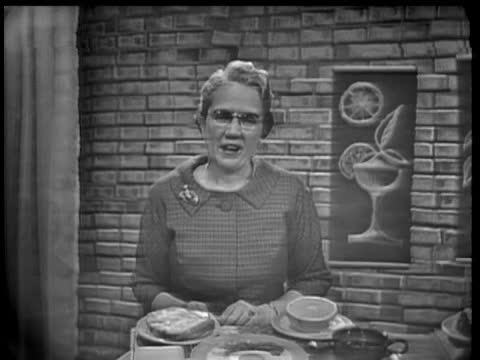
The science of nutrition, new in this century, helps people live better by applying the findings of research to the everyday business of selecting food for life. Dr. Dina Cedarquist, nationally known nutritionist and director of the Department of Foods and Nutrition and the College of Home Economics at Michigan State University. Dr. Cedarquist. Did you have an adequate diet yesterday? Or do you know what an adequate diet really means? Let's take a little time today to talk about adequate diets and what they mean and how we plan to meet our own needs. Now before we begin this discussion of an adequate diet, I'd like to have you take a look with me at some of the foods we have out here on this table. I'm going to call the first grouping of foods exhibit A and I have here in exhibit A a breakfast
with a half grapefruit, bacon and eggs, and buttered toast and coffee. I have a lunch, a vegetable soup, a toasted peanut butter sandwich, and some crackers with the soup, a of cake, and a glass of milk. And for the dinner, a quarter pound of lean ground beef broiled, a baked potato, some green lime of beans and carrot curls, a roll and butter, and a piece of apple pie and a cup of coffee. Now all of these foods taken together, I am referring to as exhibit A. Exhibit B, a much simpler display of food, a quart plus a glass of milk, a pound loaf of bread, two tomatoes, and four tablespoons of butter. Now which ones of these would represent an adequate intake
of food? Well, I can hear one of you saying, I believe exhibit A, because I've heard that we ought to have three or four servings fruits and vegetables, and we ought to have milk and meat, and we ought to have cereals in our diet. And so I believe exhibit A would be called an adequate diet. Well, is it? Let's talk about an adequate diet, and then you can decide for yourself whether A is better than B or whether they are alike. Now my definition of an adequate diet may be somewhat different from one you have heard before, but you go along and listen to what I have to say and see if you can agree with this, and if you can evaluate your own food intake relative to its adequacy. And you know I can almost hear one of you saying, but when you talk about an adequate diet, don't you have to talk about a specific
person and how right you are? And so we're going to talk about some general ideas first, and then we're going to apply these ideas first of all to apply them to myself because I know myself better than anyone else, and then give you a clue as to how you might apply this information to yourself. Okay, let's go back to my definition of an adequate diet. Now an adequate diet is one which furnishes the essential nutrients, proteans, fats, carbohydrates, minerals, vitamins, and water. Now these nutrients really are broken down into the body into simpler components. And so I'd like to go one step further with you. I would say an adequate diet is one which is made up of 41 essential nutrients or items or components, whatever term you would like to apply to these. Now I don't expect you to remember these names, but I'd like
to go over them with you so that when you read about them in the newspapers and see them in magazines, you'll know what the writers are talking about, for these words are becoming more and more familiar to us in our everyday usage. So let's take a look at proteans. Proteans are the sources of eight essential amino acids known as isoleucine, leucine, methionine, phenylalanine, lysine, threonine, tryptophan, and valine. Now remember we said we also needed fats and fats are the sources of the two essential fatty acids, linoleic and linoleic acid. Carbohydrates are the source of glucose and then of course we have water. Now we have 15 essential minerals. And remember I do not expect you to recall these or be able to name them. Actually I couldn't name them and that's why I have them on a chart. Calcium and chlorine and cobalt and copper
and fluorine and iodine and iron. Magnesium, manganese, molybdenum, phosphorus, potassium, sodium, sulfur, and zinc. And then we have 15 essential vitamins. Vitamin A, vitamin D, vitamin E which is known as tocopherol, vitamin K known as menadion, ascorbic acid or vitamin C, biotin, choline, and I prefer just to say B12. Tyroglutamic acid, inositol, niacin, panathentic acid, pyridoxine, riboflavin, and thiamine. Now in summary what I've said so far, well I have said that an adequate diet is made up of eight essential amino acids, two fatty acids,
one sugar or glucose, 15 essential minerals, and 15 essential vitamins. And if we total these items we will come out with 41 components or nutrients if you would like to call them as necessary if we are going to have an adequate diet. Now you say my goodness do you sit down and calculate every day whether or not you are getting these 41 essential nutrients in your diet? And of course my answer to this is no for who would have time to do this kind of work. Now
you may be asking the question how do you know how much of each one, if you had the time to calculate this how do you know how much of each one of these 41 essential nutrients do you need? Well I'll let you in on a secret nobody knows this really with respect to any one given individual. But some of you in the viewing audience are old enough to remember the Second World War and do you remember at that time we were responsible for not only feeding the soldiers who were fighting for us but as each country was liberated we were also responsible for for seeing that these people were adequately fed. And how was anyone to know how much food needed to go along with the soldiers and needed to go into a country to care for the individuals there? Well no one really knew this so the National Research Council sent out a call. Now the National Research Council is made up of a group of scientists who
contribute their time and know how for some of these things that are so essential for us to know. The National Research Council sent out a call to all the research laboratories across the country and they said in essence please send to us everything you know about the food needs of individuals. Well now here at Michigan State for example we had been studying the food needs of college age women so we could make our contribution relative to protean needs of these young women and calcium and phosphorus and so forth. Dr. W. C. Rose at the University of Illinois had been working with adult young men and he could contribute the information he had and so laboratories all over the country sent in to this group of scientists all the information they had relative to the food needs of the individuals with whom they had been working. Now this group of scientists took this information and put it together in what we now know as recommended dietary allowances and I'm going to repeat those words because they
are so often misunderstood recommended dietary allowances and what do they tell us? Well these recommended dietary allowances tell us that if our diets are adequate with respect to the nutrients listed in the quantities listed they will tend to meet the food needs of the individuals that are so described in these recommended dietary allowances. Now the recommended dietary allowances have one group of listing for young men 25 middle aged men older people young women children and so forth there is a separate listing and remember I am saying recommended dietary allowances these do not say exactly what you and I need but only a sort of an average or a goal toward which we might work. Now you say well did they do this for all 41 essential
nutrients and the answer again is no. For with working in working with foods they discovered that if the diet was adequate with respect to these things I'm going to list on the board if my diet is adequate with respect to calories and protein and calcium and iron and vitamin A and thiamine riboflavin niacin and vitamin C. If my diet is adequate with respect to these nine nutrients then it tends to be adequate with respect to the other 32 nutrients. Now let me tell you this if I were to go to the
drug store or to a pharmaceutical house and buy pure protein pure calcium pure iron pure vitamin A and these things are available pure thiamine and riboflavin and so forth if I were to buy these at the drug store or the pharmaceutical house in pure form and mix them up with water or something and drink them then obviously my diet would not be adequate with respect to the other 31 32 nutrients. So the point I'm trying to make is this that the National Research Council in simplifying the job that they had to do they were able to determine that if a diet was adequate with respect to these nine nutrients from food not from pills or potions but from food then the diet tended to be adequate with respect to the other 32 nutrients. Okay now should we go back and take another look at exhibits A and B and find
out something about the nutritive value of these remember exhibit A is made up of a breakfast grapefruit toast bacon and eggs a lunch soup sandwich crackers cake and milk a dinner of meat potato vegetable bread and butter pie and coffee now how many of these nine nutrients do we find actually in this selection of foods and actually we haven't calculated nine we've only calculated seven today well exhibit A furnishes 2 ,544 calories 81 grams of protean 838 milligrams of calcium a little more than 5 ,000 international units of vitamin A a little less than one milligram of thiamine about a milligram and a half of
riboflavin and vitamin C now actually we have not calculated iron and niacin and someday maybe I'll have time to tell you all about that actually a diet that is adequate in protean tends to be adequate in iron also and so we often do not do this particular calculation and so we see that that we have very generous portions of these nutrients allowed in exhibit A but how do they stack up with exhibit B well remember now exhibit B milk bread tomatoes and fat almost the same in calories higher in protean higher in calcium higher in vitamin A higher in thiamine more riboflavin and just a little less vitamin C so when we're talking about nutrients alone
we find that it isn't the variety of food particularly but it's the selection of food that makes the difference relative to the nutrients that are found in any combination of food now you say so what does this mean with respect to me well what does it mean with respect to me this is easier for me to answer for the national research council has set up recommended dietary allowances based now on age and sex and activity or in my case it turns out to be lack of activity and the national research council says that I well actually the recommended dietary allowances say I ought to have about 2 ,200 calories a day but when I eat 2 ,200 calories I gain weight so that I know from experience my recommended allowance is about 1 ,800 calories a day I need 60 grams of protean 800 milligrams of calcium 5 ,000 international units of A about a
milligram of thiamine one and a half milligrams of riboflavin and 70 milligrams of vitamin C and I heard myself say I need and this is a mistake the recommended dietary allowances suggest that this is what I should eat in one day now I think it's very simple for us to see that with respect to exhibit A I will have met my needs for protean my recommended needs for protean calcium vitamin A this is such a small difference we can say I met it for thiamine and riboflavin and vitamin C and I would exceed it with respect to calories and I would have to make some adjustment in this particular selection of food if I were not going to gain weight now with respect to exhibit B more than meet my recommended allowances with respect to everything and it's a little bit lower in calories now I thought you might like to take a look at someone who is younger than I am
taller than I am and considerably more active than I am and so I've asked Tom if he'll step in beside me here so you can take a look at us now it's obvious that Tom is younger than I am and that he is taller and fortunately for me he's a little heavier so Tom says he weighs about a hundred and sixty five pounds and because he is a young person and is more active and larger than I am let's take a look at Tom's needs with respect to these same nutrients we've been talking about now we'll set these up right side by side so you can take a good look at them where I need 1800 calories Tom needs 3200 where I need 60 grams of protean Tom needs 80 we've had this about the same recommended dietary allowances for vitamin A
now you'll notice that his recommended intake of thiamine and riboflavin and vitamin C are greater than our mind and this is true because thiamine and riboflavin are somehow concerned with the release of energy from food and so the higher calorie intakes we have the which is recommended that we have higher intakes of thiamine and of riboflavin and because Tom is larger than I am he has a greater need for protean and he also has a greater need for vitamin C now let's go back to exhibit A again and see how well this would meet Tom's needs and you see the three meals that we had out on display are low in calories 2544 calories and Tom needs 3200 but adequate with respect to protean and calcium and thiamine vitamin A and thiamine and riboflavin and
vitamin C so if Tom were to select these three meals that we looked at then he would have to add to this some other source of calories and you know as I watched people working around over here and over at the university the kind of things that are picked up to eat between meals would more than make up the number of calories that this young man needs so I think we need not worry about his calorie intake so long as his diet would be adequate with respect to these other nutrients we've talked about and then if we take a look at exhibit B again you remember just the bread and the butter and the tomatoes and the milk we find that exhibit B more than meets his need for the recommended nutrient intake for this young man for a day except again low in calories and if you remember there was so little uh butter over there to use with that whole loaf of bread that I think it would be perfectly safe for us to assume
that Tom would look for something else to put on his bread and it wouldn't make any difference if it were butter or if it were jam so uh what am I trying to say well I'm trying to say that there is more than one way of meeting food needs of individuals and you're saying but you still haven't answered our question must I have a food table must I calculate the nutritive value of foods with respect to even seven items every day and this leads me to my next point and that is that the food and nutrition board along with many the work of many other individuals have come up with what they call the basic four now I have sort of saved this to the last because well for several reasons and you'll see in a minute why I say this knowing that most of us do not have time to calculate the nutritive value of everything that we eat every day we've taken a look at our national food supply
and on the basis of what is available to most of us over this country of ours we have had devised for us the basic four now the basic four tells us this that we have we can classify some of our foods as dairy foods and obviously this includes milk and cheese cottage cheese ice cream all things made from milk and the basic four tells us that we should as adults we should select two or more servings from the milk group now by a serving I would mean a full glass of milk so two or more servings would be two glasses of milk or it's equivalent in cheese or ice cream or something made from milk then we have the meat group and this includes meat and fish and eggs high protein foods and our basic four
tells us that we should select two servings from the fruit from the meat group now this could be a serving of meat for dinner or an egg for breakfast as we had in exhibit a it could mean that we could have some high protein foods such as baked beans or something of this sort but two servings from the meat group then we have grouped together fruits and vegetables and the suggestion is that we have from this grouping four servings a day one of these should be a dark green kale spinach something of this sort or a deep yellow carrots or yams out of the four servings of fruits and vegetables one dark green or yellow and one a good source of vitamin c to most of us this to most of us listening this suggests citrus fruits now actually I could tell you some other
things like broccoli that are good sources of vitamin c broccoli is a nice dark green vegetable so it would fill in bill in two respects wouldn't it but at least one green and yellow one vitamin c rich and then any two other fruit and vegetables that we would like and our fourth grouping we have bread and cereal and we the basic four suggests that we have four servings of our breads and cereals now let me go over this again two servings of dairy foods two servings of food from the meat group four servings of fruit and vegetables and four servings of cereal and you say does this mean I have to eat cereal three times a no it means the cereal group and I'm making a point of this because some of us forget that macaroni and spaghetti and noodles and hominy and rice are cereals just as well as
the traditional oatmeal and corn flakes that we know so well so we have then the recommended dietary allowances uh sort of converted into or put into a form that easy for us to use and that if we use the basic four in planning and our everyday diets we are apt to get all of the 41 essential nutrients and I can't stress this too much because my definition of an adequate diet still holds as far as I'm concerned it is made up of 41 essential nutrients these are all available in a pure form today did you know that these are all available in a pure form and you could go to a pharmaceutical house and buy these things in a pure form you could buy pure amino acids and pure minerals and pure vitamins and glucose
and so forth and you could weigh out the quantity you need each day and you could this would be an adequate diet for you and it wouldn't have any food in it at all this isn't the way I like to eat I still like to eat meat and potatoes and vegetables and salads and so forth and recognizing the fact that even if we had the information available not one of us has time to calculate the exact nutrient content of everything we eat every day and so we have this basic four which might serve as a guide for us but do you still remember exhibit A and B remember exhibit B had only four items in it it had the milk all right and it had no meat or or eggs it had one fruit or vegetable however you would like to call a tomato and it had butterfat in it you say this doesn't meet the basic four and yet it is an adequate diet
well this leads me to my conclusion for the day and this is it we all know I trust you know this now and are willing to accept it that an adequate diet is made up of essential nutrients these are available to us from a wide variety of foods and the more we know about our own food needs and the more we know about the sources of these nutrients there just is no end to the ways in which we can put together an adequate diet now this information is available to you as well as to me I mean information about your food needs and the sources of these nutrients and all I'm asking you to do is to turn to a reliable source for this kind of information state agricultural colleges
the united states department of agriculture textbooks have in them the information that you need relative to sources of all of these nutrients and the more you know about this and the more you know about your food needs then you there is no end to the way in which you can put together adequate diets and this means that you can plan adequate diets around food likes regional foods you can plan them around the religious restrictions that might be placed on your food intakes and most of all you can plan them around the things that are interesting for you to eat and for your family to eat and so I hope that it's going to be possible for you to plan with greater confidence now for yourself and for your family adequate diets that you'll all like to eat food for life has been presented by the college of home
economics of michigan state university to help you live better by applying the findings of nutrition research to the everyday business of selecting food for life this is national educational television you
- Series
- Food for Life
- Episode Number
- 2
- Episode
- The Meaning of an Adequate Diet
- Producing Organization
- WMSB
- Contributing Organization
- Library of Congress (Washington, District of Columbia)
- AAPB ID
- cpb-aacip-512-7w6736mx33
- NOLA Code
- FDLF
If you have more information about this item than what is given here, or if you have concerns about this record, we want to know! Contact us, indicating the AAPB ID (cpb-aacip-512-7w6736mx33).
- Description
- Episode Description
- An adequate diet is one that supplies the essential nutrients of which there are forty-one. Dr. Cederquist presents two sample menus and analyzes the nutritive content of each. She discusses the forty-one nutrients and explains how we can be sure that we get a proper amount of each. She points out that different people need different quantities of food, and she gives some suggestions for planning means that will be attractive to look at, good to eat and nutritious. Running Time: 28:52 (Description adapted from documents in the NET Microfiche)
- Series Description
- In twenty-two episodes, Dr. Dena Cederquist, internationally recognized authority on nutrition, goes from appetizers to zabaglione (a delicious and fattening Italian dessert), pointing out some little-known but fascinating and important facts about the food we eat - or don't eat. This series deals with nutrition. It explains how foods sustain life, how different kinds of foods produce different effects, and how the housewife can plan meals that are nutritious, economical, and yet delicious. But Food For Life will interest not only the housewife; it also will give her husband and children some valuable tips about midnight snacks and picnic lunches. Dr. Cederquist illustrates her lecture with demonstration, laboratory experiments, charts, and diagrams, and, of course, present some sample meals. Dr. Dena Cederquist, the host for this series, has been head of the department of foods and nutrition in Michigan State University's College of Home Economics since 1956. She joined the Michigan State faculty in 1944. Dr. Cederquist is a member of various dietetic and nutritional societies, and has worked closely with the US Department of Agriculture. She also is the author of many scientific articles on nutrition. This series was produced by WMSB, East Lansing, Michigan. The producer-director was Leslie Harcus and the program associate was Lois Korslund, extension television editor for home economics at Michigan State University. It was originally recorded on videotape. (Description adapted from documents in the NET Microfiche)
- Broadcast Date
- 1961-06-04
- Asset type
- Episode
- Topics
- Education
- Food and Cooking
- Health
- Science
- Media type
- Moving Image
- Duration
- 00:29:20.759
- Credits
-
-
Producing Organization:
WMSB
- AAPB Contributor Holdings
-
Library of Congress
Identifier: cpb-aacip-cb220ce920e (Filename)
Format: 2 inch videotape
Generation: Master
If you have a copy of this asset and would like us to add it to our catalog, please contact us.
- Citations
- Chicago: “Food for Life; 2; The Meaning of an Adequate Diet,” 1961-06-04, Library of Congress, American Archive of Public Broadcasting (GBH and the Library of Congress), Boston, MA and Washington, DC, accessed May 28, 2026, http://americanarchive.org/catalog/cpb-aacip-512-7w6736mx33.
- MLA: “Food for Life; 2; The Meaning of an Adequate Diet.” 1961-06-04. Library of Congress, American Archive of Public Broadcasting (GBH and the Library of Congress), Boston, MA and Washington, DC. Web. May 28, 2026. <http://americanarchive.org/catalog/cpb-aacip-512-7w6736mx33>.
- APA: Food for Life; 2; The Meaning of an Adequate Diet. Boston, MA: Library of Congress, American Archive of Public Broadcasting (GBH and the Library of Congress), Boston, MA and Washington, DC. Retrieved from http://americanarchive.org/catalog/cpb-aacip-512-7w6736mx33