Community of the Condemned; 4; Prison Inmates' Code
- Transcript
How do the inmates in a penitentiary control the life of the other inmates in it? Well, it's hard to say like I was saying about St. Quentin. There's things that go on and happen in there that the outside people would... I don't believe they would believe. This is the community of the condemned. The story of the forgotten ones in the world in which they live, the jails and prisons of America. What are they like? Here is the story as told by leading prison authorities and by the prisoners themselves. Produced for the educational television and radio center and featuring Joseph D. Lohman, eminent sociologist and for four years Sheriff of Cook County Illinois.
Wherever men live in groups, they develop a common social life with common understandings. And as a consequence, a common social code. This is as true of a prison as it is of a neighborhood, a community or a total society. Many of jails are unable to maintain discipline, to establish its own rules and regulations because of the failure of the authorities to recognize this general principle about human affairs and the fact that men do associate and do develop such interests and such common understandings. An inmate population, a jail population has its own principles of right conduct, its own moral leadership, its own sense of right and what is wrong. And the failure to recognize this has been the source of much of the conflict that has arisen between prisoners and the authorities. It is generally assumed and too often asserted that what happens in a jail is a direct consequence of how it is administered by the warden and the guards.
It should be understood that it is forcefully true that what happens in a jail to the inmates is as much a consequence of what goes on amongst the prisoners themselves and the relationship of the prisoners to the administration as is set down by the jail authorities. Failure to recognize this is what has been responsible for much of the misapprehension and unfortunate development in the administration of jails and penitentiaries in this country. Inside this cell behind these bars is the world foreign and strange to the guards, even stranger to the conventional community. They communicate, cooperate, give each other favors and information. Their confidences are each to themselves and the guard as he comes by is held outside their circle and their world. They make life tolerable by cooperating and developing a code by having understandings and using every available opportunity even the chapel as one inside of which they can communicate
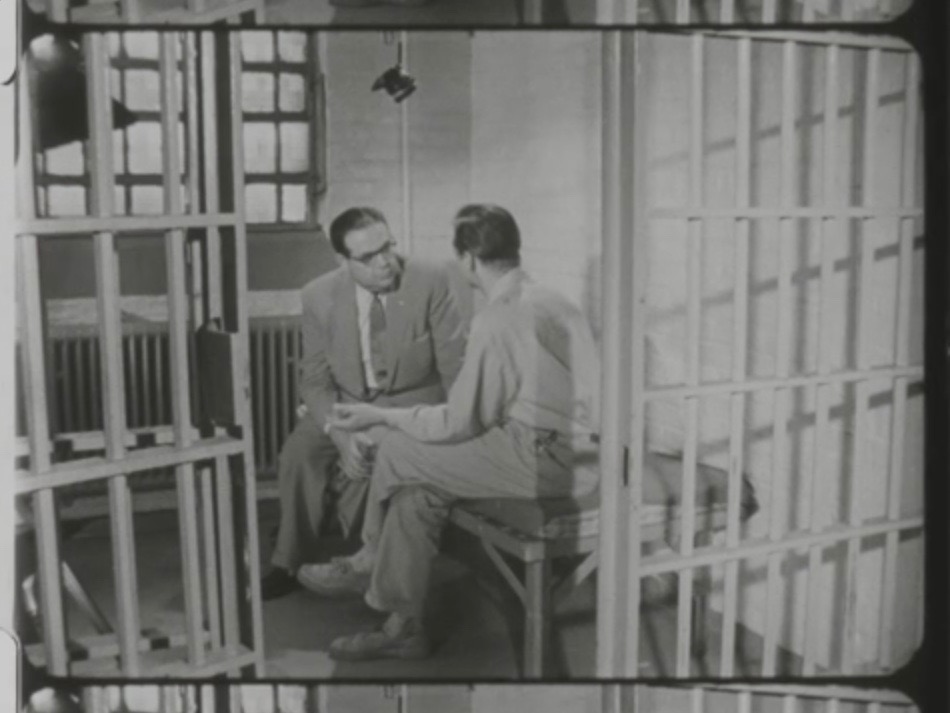
and say the things they do not want to have meet the eye or the ear of the administration. As a result of this there is built up a code, a set of customs and traditions which orders the life of the men and each man communicates it to the other as this one does by sign language and devices which do not meet the eye and are not understood by the administration. This is the code of the inmates and this is what runs the institution. These are the places inside of which the law is written for the inmates. Here we are in a cell inside of one of America's largest penal institutions. Let's talk to one who has served time not only in this one but in many others across the United States and knows the life that has lived there. John, you have the education to spend a good report on your life behind bars attitude. How long have you been in this place?
St. Clinton, California, Fort Madison, Iowa, Statesville, ride well here in Chicago, Mars Island, North America, number of places to come. All together about how much time would you say you put in 1718 years? 17 or 18 years of your life you spent behind prison walls. So you've got occasion to live with and experience what we might call the prison community. Now people speak about a code which the inmates have developed themselves as a means of making life livable and communicating with one another. Is that a reality? That's right. There it is. Well now how do men in a prison communicate with one another? Well you have fellows on different jobs that we say they're runners. They have ways to carry notes back and forth. And obviously in a place where you'd be in a locker, where you'd be in the hole like if you do something real bad, you get in the hole.
And you could still find out what's going on outside. You might be able to, like the only one occasion where I come up one time, I got stabbed. And there's a long time ago and I was in what we call the hole. Now it's called isolation, but here's a code that was a hole. And well I want to find out what was happening to this character that cut me. And I got messages like that because by the man that was in charge of the hole. And that's just one of the ways. Of course, but still there's every job that's always wasting means to get to know what's going on. Even though there the prison is run presumably by the warden with his rules and regulations, the inmates have ways of secretly carrying on themselves. I would say, I would say that at prisons, during my, during my experiences, I'd say that of course you have wardens and officers in the prisons, but the prisons are run by the inmates.
They are the ones that have to control, you know, they're in control of the place. And like I say, if a man first comes in and he has a thing that way they call it, you gain all from the right foot, unless you get off the right foot where you're going to get yourself in wrong with the inmates. And you see my experiences while you can't afford to get off with the inmates, you know, you've got to go along with their program. Although you've got to obey the rules and every prison has a different set of rules. Well, now that's interesting. You say you can't get off on the wrong foot with the inmates. Well, how can they control and how do they control the inmates? Well, they're like, like when you go in, you go in as a, when you first come in, regardless of how much time you did, you are known as a face. In other words, you're new and some guy has been in her maybe years, so he'll approach it. And more and more, how much time you're going to set together, what kind of work you do and, you know, kind of pull your own some job.
Well, now, you can go for that, which I don't, I myself, I never did go for it, but still at all, I had to go along with a certain amount of the inmates program. You know, like, now, like if I wanted to job one time, one time I got on the, when I got down to New York, I'm a crook on Taylor. I learned always, just in case it's work in jail, you know, a carpenter, electrician, plumber. Now, I want to job in a kitchen, where I, where I figure I'm always living off from my stone, where I get something to eat. And now, the guy gets me in the kitchen. Now, I got to go along with what he says. Otherwise, I get busted off my job. In other words, then it's the men that have been there before, the older fellas who take the young fellas in hand, they take advantage of the young man.
The young man that comes in, if the old fellas, it's, it's been in the jails, like, I'm not talking about these, like, which they, you know, security prisons, these are massive security prisons, where you've got, fellas, it's doing 99, 199, 30, 50 years. Now, some of them fellas have been here for 10, 15, 20, 25 years. Now, them are the fellas that control their human problems, population. Now, you, the, the speak of this code, then, is something that every man makes to his peace with when he comes into the administration. Is this a part from, and in opposition to what the administration says up, has the rules and regulations? That's right, that's right. Well, I suppose they're in conflict, which way must the man go? Well, not even. You've got the, when you come in, you're given a night, you go in, and most of that kind of entry, you, they're either, they to give you a book, what we call a rule book, or they have a list that's in each cell upon the wall that's based on the wall. Now, they're, you're instructed to read these rules. Now, there's some of them rules on there that, like, like, you're not supposed to talk in the line.
You're not supposed to talk in the dining room. Of course, that was here, that's years ago, at what we call a silence system. But nowadays, they, it's different, but, well, or, I don't know, it's not like Sam went. A year ago, I was in Santa Quentin, and in 1927, in America, I got one there, or one to 14 to 14. Now, it was completely a silence system. You had no rules, you had no, no, no, a way to getting magazines or books, or newspapers on the outside. But still, we got them. And so, you had your own code, your own rules, your own regulations, which we decontrolled in mega. That's right. And not like, like I was saying about the Santa Quentin. Now, Santa Quentin is, the way I understand it now, it's a different, this is different kind of thing that it used to be. Back in 30 years ago, well, my goodness, it was, well, I wouldn't, I wouldn't know how to describe it. Not, of course, I would have did time in recent years, like downstate though.
I state that one of the most modern countries I've ever seen or heard of. But, like, Santa Quentin, it was, I saw colors that, oh, I don't know, there's, well, people outside wouldn't believe it's the same type of thing. It's the same type of thing that's happening in a country like that. And it's all by, uh, by, uh, in opposition to the, uh, somebody going against, uh, inmate rules, you know. Well, thank you very much, Mel, for this picture of the uniform and consistent pattern of rules and regulations, which it is, no matter what the difference is between the penitentiaries, which apparently control the lives of these men. And as effectively as the war can in the garden walls. We've had one man that was his viewpoint on the secret life and cold of the inmate population.
Let's hear from another about this mysterious world with the prisoners, apart from that, with the guards and the administration. Jim, you've been in a number of institutions and all told you to spend a number of years behind Christian bars, haven't you? How many years has that been over five years? Was that a recall you suggested to me that you spent some time in a rather strict and heavily guarded prison like this? And, uh, the other extreme one in which it was a good deal more permissible to be freed in that. Now, in those two situations, you had, of course, experience with inmates and you together talked about isotopes and acted against or with different particular administrations. Not sure. Now, let me ask you this, in those experiences, what extent is there a common right, a common experience, a common cold, if you please, on the part of the inmates irrespective of the character of the administration? Well, it's a common, the most, I should say, the main thing in the code is not to think or be a stool pitch, not to follow man.
I mean, we have to have some sort of defense against the administration and preserve our own identity, so the only way we can do that is living apart. It's the screws here and the cons here. And, uh, if any, if there's any in-between, the man is ostracized and sometimes beaten once in a while killed. Well, the sort of extreme thing here is suggesting that never the twain shall meet, so that's about the size of it. But there is a difference, isn't there, between an institution where the guards take a cooperative and have a more permissive attitude towards the population than in one which is constantly wiping down? Yes, there's a great difference. And the reason for that is, when there's cooperation and understanding between the administration and the inmates, they don't have to have any defense like that. It isn't necessary. Like, I wasn't one institution where the warden said that if I can't find it out myself, it is worthwhile knowing, I don't want to know it.
In another institution, they used a common expression, shot men through the grease, had them bust and thrown in the whole merely on hearsay because some rat or stool pigeon went to the warden or the officers and said that man is doing something. The man had a grudge against me for something. And wanted to get rid of me. He didn't like me and he'd go write a anonymous letter or else see the man a person and say that I was doing so and so. And that's the all they need to put me in the hole and then bust me and the other institution, they didn't pay any attention to people like that. So, consequently, the defense wasn't needed and they didn't have anything like kangaroo courts and you could fraternize with the officers and the other institution it was. We're frowned on to keep and spoke to them in the day from the time of day. And since then, you're inferring that every inmate that comes into an institution is at the mercy of the organization of the inmates themselves.
Particularly if the institution is pressing down hard on all the inmates. That's right. In other words, do they, would you say direct things in such a way as to penalize through the agency of the warden and the guards. The man they want penalized, certainly that's the only device they have. So they use it to use you for their own devices. Who are the people that do this? Who are the people that talk amongst the inmates under the circumstance? Well, there are leaders in the course and I couldn't say it's any particular type or class of man. It's just, it happens on one of us serve the self more than another and he'll become the leader. It'll be his law. Well, to what extent do they keep this whole thing secret from or unknown to the administration? Is there a special language of the inmates? Well, there's sign language. You can talk in front of a guard through sign language. For example, A and B and C, D, E. They have done frequently in the prison, often, from tear to tear, much less man to man.
What about passing information along from sections of the prison to another? How was that done? Through kites, which are letters, secret it, it just everywhere. In other words, they're able to get around the rules and regulations. They are. And they substitute their own rules and regulations. They'll get around them in spite of the administration. The administration is understanding if they don't have to go way out in the left field and do things like that. It doesn't become necessary. They don't do it and it functions better. But they're going to do it anyway unless you keep them all in solitary like a devil's island or something possibly they wouldn't. Well, Jim, what's the measure of how much of this goes on? Can the attitude or the character of the administration influence the amount of this private organization of the prisoner? Very much, for example, Sheriff, I was in this very institution eight or nine years ago. And the situation was very much different then. There was a lot of conniving, a lot of kangaroo courts. There was a lot of dealing as we call it under tears and everywhere else.
And that was a defense against administration against poor management against defense against political spoil system. And now the president administration, your administration, your hiring people that have got some true qualifications, they're qualified to hold a job that isn't necessarily their political qualifications that seem to hire them. People like FreeCatville, Mike Harvey, athletic director, and they're understanding. They're sympathetic. And people of the men in the institution appreciate things like that. I believe that they're going along with the program. Well, thank you, Jim, for this cogent look into the picture of the human population and how it relates its organization to the way in which the administration acts. Let us turn to one now who has examined these inmate codes, the social structure of the American prison and the jail, which grows up informally.
And sometimes without the knowledge of the prison administration itself, we had with us today Mr. John H. Gagnon, chief classification officer of the Cook County jail, a research criminologist who has for years studied the development of these codes. And has had occasion to deal with them, the standpoint of the classification of the prisoner within the prison and the development of appropriate administrative arrangements. Mr. Gagnon, just what is it that gives us reason to believe that this inmate code is of any significance or any importance? Does it affect the administration of a prison or a jail? Very seriously, Sheriff, in every prison, in every training school, in every institution of any consequence in the United States, the inmates have gathered together and formed a code. This I believe in large measures due to the techniques of incarceration under which they are held.
The prison administrator is afraid of riot, is afraid of escape, is afraid of collusion among inmates. Thus, this leads him to make rules to be afraid of this kind of collusion and therefore to isolate inmates. The inmates in there to meet need for social expression, develop a code of values which is a defense against this drive to isolate them by the administration of the institution. Well, is it always directed toward the administration? Is it necessarily something that's set up against the warden or against the guards? I would say by and large in the majority of our institutions, it is always set up against the guards. There is always conflict between the inmates and the guards in the institution. In other words, then, this is a way in which the men themselves get around this heavy influence of the administration over them and attempt to deprive them of what they regard as their necessary rights and privileges and opportunities to do for themselves the thing they think ought to be done. That's very true.
Well, now, how does this inform a kind of a social grouping structure grow up? Just doesn't happen. Well, it grows in two ways. I think it is partially natural to the prison and partially brought in from the outside community. The delinquent of the criminal in the community forms a defense against the police. He restricts his social behavior to other delinquents. In this process, they develop a liking for each other and a hatred for those who would betray them, the stool pigeon. When convicted of a fence, they are put into a prison where they tend to view the guard and the administration and the same role the police had in the community. Well, now, who gives a leadership or direction? Does any old individual or person decide to become the leader under a circumstance of this kind? And say, this is it. This is what goes in the studies of most prisons and studies of prison leadership directly. The people who seem to be the leadership group in prison are the most delinquent, the people who have been in crime the longest, the people who know how to get along in prison, the good con. And these people lead the inmate clique and direct inmate activities.
In other words, then, if a man comes into the institution, he finds this structure preceding him and he is inducted into it by proper means and procedures and he has to accept it as being there before him. He must do this and there is another consequence of this is just quite important. That is, if he does not accept the inmate values, he is isolated from everybody and he has no social contact with any person. The guards do not associate with him. If the inmates do not, then he is a lost person in the institution. Would you think it were possible for a group of inmates to be so organized as to bring about a situation in which no such informal structure would develop? I do not think so. In other words, in a certain degree, the very weight of the prison environment itself and the restrictive influence of the guards and the fact that life is ordered according to the terms and conditions which are set down by the administration makes it necessary for the prisoners in their own mind to seek a way to get around it. Well, if a man has no way of determining his own future, he will grasp small ways to define his role and his status and his social relationships with other men.
Well, suppose he does that. How does he affect communication with his friends? How does he speak to others when it is not allowed? Well, in the history of prisons we have had the silent system, we have had solitary confinement for all offenders, even in these prisons, men communicated with each other by wrapping on the walls, by learning to speak out of the sides of their mouths. Today, when these things, when these kinds of the silent system no longer obtains, men send kites to each other by mobile inmates. They empty out their toilets and talk down the drains. They talk up the ventilators. They use any kind of technique in some of them very sophisticated and clever in order to establish a consensus to let the news travel through. Well, what is this code like? What is its content? What, for example, would they work off as a set of rules that would reflect their interests? Well, I have a set of rules here which was established in a Southern institution. Now, some of these rules are good evidence to the fact that the administration and the institution are probably fairly irresponsible in their handling the institution itself.
You see, these rules here. Any man found guilty of breaking into this jail without consent of the inmates will be fined $2. Every man entering this tank must keep clean and properly dressed. Every man must wash his face and hands before handling food even his own. Any man found guilty spitting will voluntarily duck his head and slop bucket else have it ducked. Each man using toilet must flush. Don't draw dirty pictures. Any man caught stealing off another criminal will be punished as this court sees fit. No fighting unless ordered by this court. Well, some of those seem to be quite acceptable rules. Well, these are the rules the inmates form when the administration doesn't take care of its duties. If it doesn't handle discipline, the inmates will handle discipline directing who fights and who does not. Doesn't handle cleaning this, the inmates decide who cleans and who does not. Or some of them also seem to suggest the interest on the part of the inmates in telling the newcomer whose boss and that they're not just to listen to the warden of the administration alone and if they don't listen to them, they're in trouble.
This is pervasive in an institution. The inmates want to let every newcomer know. This is where you stand. You stand with us or you stand with no one. Well, that means that in a struggle between the inmates and an unsympathetic and a wardener administration which doesn't understand, you can get a truly exploitive situation on the part of some inmates over all the others. Then an inmate in a prison will exploit any other inmate if he is allowed to by a laxist on the part of the authorities. Well, how does this code or this condition of the existence of one relate to the problem of prison administration? Well, I think it relates in two ways. One is the warden must be cognizant that this code exists and knowing that exists must deal with it directly and intelligently. He must know that inmates need some form of self-expression and that if he does not take cognizance of it and deal with it, inmates will deal with it in their own way. Well, thank you, Mr. Gagnon, for these insights into the working of the penitentiary system through the agency of the inmates themselves and their informal social code.
We've just had with us Mr. John H. Gagnon, chief classification officer at the Cook County Jail, a research criminologist who has been concerned with the development of just such inmate codes. As we have learned from our two prison inmates, there is a social life in the prison as there is in any group of men. Out of this social life there grows a set of values and norms that governs the behavior of men in prison. These values and norms of the inmates often become more important than the rules set down by the administration or the directives of the warden. To develop this social code, the inmates communicate, select an informal leadership, develop agreements, and set up social standards in which men are ranked by the degree of their adherence to the criminal code. The significance of the inmate code is that if it is allowed to dominate the life of the inmates carrying within it the code of criminality, the social pressures of the prison were forced most of the inmates to adhere to the code.
And leave the prison more a meshed in criminality than when they entered it. This has been community of the condemned, the story of the jails and prisons of America. Produced for the educational television and radio center, featuring Joseph D. Lohman, eminent sociologist, and for four years, Sheriff of Cook County, Illinois. This is National Educational Television.
Thank you.
- Series
- Community of the Condemned
- Episode Number
- 4
- Episode
- Prison Inmates' Code
- Producing Organization
- WTTW (Television station : Chicago, Ill.)
- Contributing Organization
- Library of Congress (Washington, District of Columbia)
- AAPB ID
- cpb-aacip/512-639k35n534
- NOLA Code
- CEDD
If you have more information about this item than what is given here, or if you have concerns about this record, we want to know! Contact us, indicating the AAPB ID (cpb-aacip/512-639k35n534).
- Description
- Episode Description
- The special guest this episode is John H. Gagnon. Mr. Gagnon is the chief classification officer for the Cook County Jail in Chicago. The clandestine system of communication and standards operating in many penal institutions is examined by criminologist Joseph D. Lohman, and is illustrated with film clips of inmates passing information to each other without the administration's knowledge. One inmate describes how the prisoners' credo is established and maintained. Lohman and Gagnon discuss the "Grapevine," the verbal contact of prisoners, and explain "kangaroo court," used by the prisoners to maintain "law and order," as they see it. Lohman points out that these things must be recognized as existing if administrators are to operate efficiently. (Description adapted from documents in the NET Microfiche)
- Series Description
- Community of the Condemned brings to the public a searching study of penal institutions and correctional systems and their inmates, indicating the damage done by outmoded penal practices which follow upon lack of understanding, inadequate information and public apathy. In each case, nationally-known criminologist Joseph D. Lohman discusses the problem with a group of guest experts. On-location filmed prison scenes and direct interviews with actual prison inmates are seen. Various differences in prisoners are investigated along with the multiple kinds of institutions, often too all-equipped to allow beneficial results. The dramatic need for new procedures, new kinds of institutions and correctional programs, and professional, well-trained staffs to administer them is indicated during the series. Joseph D. Lohman, nationally-known criminologist and Sheriff of Cook County, Illinois since 1954, is the host for this series. Lohman is Consultant on Juvenile Delinquency to the Ford Foundation and has been a member of the staff of the University of Chicago since 1947. He was chairman of the Division of Corrections of the State of Illinois from 1949-1952, and chairman, Parole and Pardon Board of the State of Illinois from1952-1953. He has been a director of the American Prison Association and a director and past president of the Illinois Academy of Criminology. Lohman received his B.A. degree from the University of Denver and his M.A. degree from the University of Wisconsin in 1931. The 26 half-hour episodes comprising the series were originally recorded on videotape. (Description adapted from documents in the NET Microfiche)
- Broadcast Date
- 1958-00-00
- Asset type
- Episode
- Genres
- Talk Show
- Topics
- Social Issues
- Rights
- Published Work: This work was offered for sale and/or rent in 1960.
- Media type
- Moving Image
- Duration
- 00:29:29
- Credits
-
-
Guest:
Gagnon, John H.
Host: Lohman, Joseph D.
Producing Organization: WTTW (Television station : Chicago, Ill.)
- AAPB Contributor Holdings
-
Library of Congress
Identifier: 2302372-1 (MAVIS Item ID)
Format: 16mm film
Generation: Copy: Access
Color: B&W
-
Library of Congress
Identifier: 2302372-2 (MAVIS Item ID)
Format: 16mm film
Generation: Copy: Access
Color: B&W
-
Indiana University Libraries Moving Image Archive
Identifier: [request film based on title] (Indiana University)
Format: 16mm film
-
Identifier: cpb-aacip-512-639k35n534.mp4 (mediainfo)
Format: video/mp4
Generation: Proxy
Duration: 00:29:29
If you have a copy of this asset and would like us to add it to our catalog, please contact us.
- Citations
- Chicago: “Community of the Condemned; 4; Prison Inmates' Code,” 1958-00-00, Library of Congress, American Archive of Public Broadcasting (GBH and the Library of Congress), Boston, MA and Washington, DC, accessed May 21, 2026, http://americanarchive.org/catalog/cpb-aacip-512-639k35n534.
- MLA: “Community of the Condemned; 4; Prison Inmates' Code.” 1958-00-00. Library of Congress, American Archive of Public Broadcasting (GBH and the Library of Congress), Boston, MA and Washington, DC. Web. May 21, 2026. <http://americanarchive.org/catalog/cpb-aacip-512-639k35n534>.
- APA: Community of the Condemned; 4; Prison Inmates' Code. Boston, MA: Library of Congress, American Archive of Public Broadcasting (GBH and the Library of Congress), Boston, MA and Washington, DC. Retrieved from http://americanarchive.org/catalog/cpb-aacip-512-639k35n534