Turn of the Century; 14; Saloon
- Transcript
I'm sorry...
We're closed, Terry. I know that. Oh, well... How you do me a favor? Get rid of that music. Gentlemen, tonight go home! No more on, Harry. Good night, gentlemen. One good term deserves another. I guess so. Oh, sorry, we have nothing. It's not in the house. We're closed. No charge to friends,
especially drunk friends. Drunk? Ridiculous. I've only been here for four hours. I'm gonna possibly get drunk on this rotten booze. Harry, we both know the reason you're never real drunk is because you're always half drunk. That's what I like about you, though. You never change. You don't get mad. You don't break up the furniture or the customers. You are a philosophical drunk. Incorrect. I am a philosophical fellow who drinks too much. I have it, you are awake. I may not have it my way much longer. Meaning what? The dries. Oh, that. Hamilton Colley went dry last week, my friend. They voted three to one to go dry. Harry, I know all about the temperance people and I know about the vote down in Hamilton. I know the dries are winning. What do you expect me to do? My apologies. I'd be right the wrong man. You're on a good place here. No gambling, no girls. Clean floors.
Every saloon could say the same and be no case pro -abish. Then you'd be happy. Then I'd be happy. As a saloonkeeper, you should know, Drunks are always happy. Harry, I am not a philosopher. I sell booze. I sell booze for a living. Sometimes you make me feel like it's all my fault, guys, like you. You messed up your life, not me. Oh, true. If I closed up tomorrow at 10 o 'clock, at 10 -15, you'd be down at Kelly's, or the Greeks. And you know it. I find you difficult, if not intractable this evening. It isn't evening. It's after two in the morning and I'd like to get this place cleaned up and go home. Oh, I'm just sticking around, Harry. No, let us not let the conversation get more. All right. With that in mind, I continue a discussion of the temperance movement. This is hardly the place. Well, what better place? Now, let's see what the opposition is up to.
They are confident, you see. There was a speaker at Union Hall as an itemist, Mr. Thomas H. Barker, as they are confident. Listen. The signs of the times are full of promise, and readily with hope. The battles of the last 50 years have been victorious advances. The temperance reformation is a movement which cannot go backward. It is from the people, by the people, and for the people. Such a movement cannot, but eventually succeed. That's typical of what the dries. The advocates of temperance were saying around 1910. What happened to Harry? No, no, no. He didn't pass out. He just couldn't summon the kinetic energy to move with me into the present, so he elected to remain in his cups somewhere in the vicinity of the turn of the century. It's just as well. The subject of this visit to turn of the century America is not Harry's cup of tea. It's considerably stronger. It's alcohol, and the
institution known as the saloon, and the campaign called the temperance movement. Now, this is no dead issue from the past, but a subject on which people continue lively prejudices and opinions. In short, a hot potato. Everybody has an opinion about liquor. Or should have. We'll try to just walk the fence and capture a bit of the spirit of those turn of the century years, when millions of Americans were working to bring about the downfall of the saloon. The saloon was the real villain, you know. More than alcohol itself. So let's start by examining the myth of the old -fashioned saloon. We can launch the examination with a song, since all self -respecting history, mythology even turned up in song in those days. Ernest Ball wrote this one. Certainly after prohibition went into effect. He also wrote Mother McCree, when Irish eyes are smiling, a lot of fine songs. Mr. Ball was known also to take an occasional glass, and therefore brought all his composing gifts to bear on this musical tribute, thinking I suppose with
wet eye, but dry throat, that it might be a last farewell to a loyal friend. I've been looking through the dictionary for a word that is running through my mind. Though I love the name of brother, I am searching for another. Though I must admit that word that I cannot find, can it be that all its glories are forgotten and buried with the language of the Greek? If it is a leverlinger in my memory as the first word that I heard my daddy speak, saloon, saloon, saloon, it runs to my brain like a tomb. I don't like cafes, I hate cabarets, I mention saloon, my cares fade away, it brings back a fond recollection of a little old, low
-seasoned room, with a bar and a rail, and a dime and a pale saloon, saloon, saloon. Well, now that old song sort of epitomizes a nostalgic myth that's grown up since the turn of the century, that the old -time saloon was a warm and cheery place where all good fellows got together, Josh with the jovial saloon keeper and got stoned in quiet dignity as a gentleman should. By 1900, the average American saloon was a real dumb. Herbert Asbury describes it in his book, The Great Illusion, and especially fine book, by the way, because it's impartial and getting an impartial book on the subject of liquor, is kind of like getting an unbiased viewpoint a roast beef out of a vegetarian. Anyway, asbury says, the saloon was a blight and a stench. It was dingy and dirty, a place of offensive smells, battered furniture, fly -blown mirrors, and glassware,
appalling sanitary facilities. It encouraged drunkenness. Few bartenders hesitated to serve children, idiots, and known drunkenness. Well, the saloon was the last stage of decay of the ends and taverns of an earlier America, the result, I guess, of mass -produced alcohol, immigration, industrial life, crooked politics, just about anything else Earth -shaking you can think of that came along with the 19th century. The temperance clamor increased in direct ratio to the noise from the saloon. When and how did the temperance movement first start? Well, going way back to colonial times, everybody drank. Alcohol was called the good creature of God if you didn't drink, you were a little bit square. They drank rum, mostly anything. The result, as you might guess, was a lot of drunks. Early temperance movements were a logical reaction against these very real excesses. And in the 1840s and 50s, quite a bit of headway was made and several tools of the
temperance movement were forged that became trademarks of the movement at the turn of the century. I'm talking about a novel, a song, and a play. Now, as works of art, they were grotesque, but they got results. The novel was called Ten Nights in a Bar Room. Many of the men signed the pledge after he read it or heard a lecture based on it, illustrated with these vivid lantern slides. As the story opens, we enter a tidy new tavern, the sickle and chief. It's peaceful now, but not for long. Every night, little Mary, daughter of town drunk Joe Morgan, begs her father to come home. Simon Slade, the landlord, losing his temper, throws a tumbler at Joe. Hits little Mary instead. At home with Mary at death's door, Joe has a fit of delirium trimmings. Little Mary dies. Joe Morgan swears off, but the debaucheth the sickle and chief goes on. Frank Slade, the landlord's son, has become a wild young waste rule, thanks to tending bars since the age of 12. And
Willie Hammond, an upstanding young squire, has been led astray by Harvey Green, itinerant Sharpie. Willie is drunk. Harvey pulls an ace out of his sleeve. They fight. Willie gets stabbed, dies. Meanwhile, the landlord Slade is going to pot. Gets an argument with his son, Frank. Frank ends the argument with a well -aimed pinch bottle. Slade expires. What's more, the town people, most of them drunk. Catch gambler Harvey Green and they murder him. It's a cherry story, which ends happily with the closing of the sickle and chief. That the fade out, Joe Morgan, now a pillar of society says, I know now how much of the great sea of human crime and want and woe pours through the slender channel of that one word drunkard. Well, the song I spoke of was often inserted into
dramatized productions of Ten Nights in the Bar Room. It was written in 1864, but it and the book continued great favorites at the turn of the century. Father, dear father, come home with me now. The clock in the steeple strikes one. You said you were coming straight home from the shop, as soon as your days were passed on. Our fire has gone out, our house is all dark, and mother is waiting for you. Poor little brother, so sick in her arms, without you or what can she do. Come home, come home. Please, father, dear father, come home. Here the sweet voice of your own little child, as
she tearfully begs you to come. Who can resist this most pitiful plea? Please, father, dear father, come home. Well, easily the best -known remnant of that early burst of temperance activity before the Civil War was the play, the drunkard, first produced in Boston in 1844. It has become a stand by sort of the Uncle Tom's cabin of the temperance movement. Often burlesque today, it's hard to believe the drunkard was once a serious piece of theater, but many's the topper went on the wagon after he saw it years ago. In Act 2, the hero Edward Middleton realizes that he's a helpless victim of the drink habit and his soliloquy makes for quite a shocker. If you can seat yourself for just a moment amidst a serious theater audience anywhere in the 19th century. Is this to be the issue of my life?
Oh, must I ever yield to the failed tempter and like a weak bull rush bending to the blast, still bow my manhood lower than the brute? Why have I not eyes to see and hands to work feet to walk and rain to think? Yet these best of heaven's gifts I abuse and lay aside her bounties and with my own hand willingly put out the light of reason. I recollect my mother said, my dear dying mother, they were the last words I ever heard her utter, who lifts his fallen brother, his greater father than the conqueror of the world. Oh, my poor brain burns, my hands tremble, my knees shake beneath me. I cannot, I will not face them thus a little, a very
little will arrive and strengthen me. Now, once he is the arch cunning of the drunken. It revives and strengthens me. Oh, glorious liquor! Why did I ever rail against thee? Gone, all gone, of what used the casket when the jewels are gone. I can face them now. After the Civil War came a new upswing in an ebriation on top of that the federal government got into the act, slapped attacks on liquor. This temporary wartime measure is now going into its second century
and temperance workers ever since have blamed Uncle Sam for the rise in drinking that followed the Civil War because a large part of federal revenues now depended on the sale of liquor. President Lincoln approved the tax reluctantly, he wanted to get the government out of the liquor business as soon as possible, an advocate of temperance. Lincoln has been quoted as saying that with slavery abolished the next snarl to straighten out would be the liquor question. And just ten years later, to straighten it out and know the reason why arose the new champions of temperance, the women of America, the women's Christian temperance union was founded in 1874. The WCTU, or the We See To You, as its detractors called it, brought several new elements to the crusade, full use of the press, an organization nationwide, and discipline, and a campaign to reach the children. Through the efforts of the WCTU, every state in the union passed the so -called scientific instruction laws, education, or propaganda, depends on your point of view, about the awful effects of alcohol
on the mind and body. Little boys signed lifetime pledges of abstinence and war -blue temperance ribbons while little girls recited, no matter what anyone says, no matter what anyone thinks, if you want to be happy the rest of your life, don't marry a man if he drinks. Libraries and lecturers were supplied with material for all occasions, and these things were delivered with a straight face. I don't mean to be condescending about that, the fact that these were given and received without a smile, I think, shows the dedication back of the movement. Here's one of the favorites. Sweet, beautiful water. Its foam brings not madness and murder, no pale and starving orphans sweep burning tears into its clear depths, bestow but a cup of it, on the famishing traveler in the sun -parts desert, and how gladly will he return it with overflowing gold. Sweet,
beautiful water, brewed in the running brook, in the sparkling dew drop, brewed on yonder mountain top, which glitters like gold bathed in the morning sun. Sounds like a beer commercial, doesn't it? Now for the other side of the story, even on the merits of water, there were two sides. Harold fits Gerald and Mabel von Binks, sat at her restaurant table. The dinner was served, but no drinks were observed, so I jumped little Mabel. I'm thirsty, said she orders something for me. Here wait her ice water for to order tea, which made Mabel sigh and an anger reply. Water, water, why? What good is water, when you're dry, dry,
dry? When the temperature of your thirst is high, high, high, a barrel or style, or a small glass will do, a hand -houser but wiser, any old brew, but what good is water, when you're dry, dry, dry? By the time that song is popular in 1910, the most powerful and effective of all the dry organizations was already 15 years old. The anti -Saloon League, founded by the men of the Temperance Movement in 1895. Now by then, the Temperance Movement was strongly religious, and the anti -Saloon League was loosely associated with the Protestant churches. It was non -partisan but highly political, and backed with money and effort, any candidate of either party, so long as you voted dry. The anti -Saloon League was high -powered, widely supported, and well organized, which brings us to another myth. You know, I think a lot of Americans have a vague impression of the Temperance Movement as a kind of
cockeyed comic opera people by self -righteous old Fuddy Deadies, who somehow, through some kind of chicanery, foisted on the rest of America, they're ridiculous and narrow -minded dream of prohibition. And while it's tempting to stereotype the whole movement with a blurry image of Kerry Nation busting up a Kansas Saloon with a hand axe, it just won't wash. To quote Herbert Asbury again, it seems clear that Americans wanted prohibition and were bound to give it a try. Meaning, of course, the majority wanted it. The minority included a tippler from Tin Pan Alley by the name of Percival Delansi, who turned up in song in 1909. The original lantern slide illustrations to go with this song take its inside a high -class saloon. ["The Lansi"] Young Percival Delansi has captured great freedom. He's just about the best -long distance drinker in this town when other men have ordered, and say, now boys,
goodbye, young Percival's upon his heels, and then begins to sigh, yo ho, my lad, yo ho, now what's before we go? And let us have just one more little drink, and then we'll all go home. I'd like to try a little ride, but I can't drink all alone, down in the sun, where you soon will have two more. So let us have just one more little drink, and then we'll all go home. What were the drys doing? The distillers, the brewers, the saloon keepers, two little and two late. They formed organizations and squabbled amongst themselves, while the anti -saloon league tricked and beat them at every turn. The league was skilled and
untiring and not above trickery. Their crusade and their view was born of God, and the end therefore justified the memes. On the other hand, there isn't any question, but what the liquor traffic had American politics by the throat, at least on the city level. According to historian Mark Sullivan, the anti -saloon league in the WCTU arose as a reaction, against the powerful political ruthlessly and arrogantly supplied efforts of the organized liquor interests. Well, state after state went dry, and in the general elections of 1912, the great strength of the movement became obvious, the decision came to make national prohibition, the gold, target date, 1920. By the end of the second decade, song titles echoed resignation, if not desperation. How are you going to wet your whistle, when the whole darn world goes dry? What are you going to do in the morning, when you need a nip to open up your eye, and what are the weddings and the
christenings, and the wakes when dear friends die? How are you going to wet your whistle, when the whole darn world goes dry? Well, the final steps leading to constitutional prohibition are clouded and complicated by various wartime prohibition laws, but the fact is that late in 1917, Congress voted to amend the Constitution of the United States, and that takes a two -thirds majority, you know? Prohibition, the 18th Amendment was then submitted to the states, and in just a year, the required three -fourths of the states ratified it. It would go into effect at the stroke of midnight, January 16th, 1920. Another myth. The fact that several million Americans were overseas at the time, had nothing to do with prohibition becoming the law on the land. It was a cinch after the general elections of 1916. Herbert Asbury says that in every contest in 1916, prohibition was the principal issue, and our boys had just as much chance to vote as anybody else. Also, scratch off the idea
that women did it. They worked hard for it, yeah, but they didn't vote for it. They couldn't. They didn't get the vote until 1920. One woman's dissenting opinion was registered in a delightful, but long -lost song written by Irving Berlin for the Siegfield Follies 1919. Girl, this song is a shimmy dancer. Far she's concerned, prohibition is going to mean inhibition. It is a sad, sad day, says she this day of lemonade and tea, when all her dancing aspirations haven't got a chance. In the Harlem cabaret, she used to spend her nights and days for taking off her favorite indoor sport, the Siegme dance. On the day they introduced those prohibition laws. They just went and ruined the greatest shimmy dancer because you cannot make your shimmy shake on tea. It
simply can't be done. You'll find your shake and they ain't taken. Unless you have the proper jazz, that only comes with such drinks as green river, eight of eight, and Tennessee. Way out inside of a pond of pale Chinese, there's nothing finer than good old Chinathees. But then you never saw a Chinaman shaking his shimmies. No, you cannot make your shimmy shake on tea. Well, as it turned out, she didn't need to worry. The saloon did disappear, but the shimmy shakers and the bootleggers joined millions of other Americans in a new home, away from home, the speakeasy. Well, when you read of the zeal and dedication back of the temperance movement that led to prohibition, you wonder
what happened. What went wrong? Why didn't it work? This noble experiment, as it came to be called. Frederick Louis Allen, in his book The Big Change, sums it up very well, abruptly, he said, the impulse to make over the nation and the world was discovered to have faded away. A people who had had enough of high causes and noble sacrifices to last them a long time decided to take things easy and enjoy themselves. The revolt of the American conscience was over. But that's hindsight. If you could return to that America on the night of January 16, 1920. Read the newspapers, as you say for your last legal drink. You could learn of the utopian civilization just ahead in a non -alcoholic America where, of course, the letter of the new law would be obeyed. Even as the bootleggers planned their first hijacks, you could read the glowing prophecies. The reign of tears is over. The slums will soon be
only a memory. We will turn our prisons into factories, our jails into corn cribs and storehouses. Our men will walk up right now. Our women will smile and our little children will laugh. Hell will be forever rents. Well, fools have taken over. Hell will be forever rents. These knitwits believe that just because they're precious law went into effective midnight that the nature of man changes the clock struck me hour. Why don't you say something? They just put you out of business. I know that, Harry. Are you honestly going to close? I am honestly going to close. Aren't you going to have a side door? Everybody else in town's got a side door. Those pig pens down the street aren't going to close for good. You can be sure of that. Harry, I think you've always liked this place because it was honest. Apart from it didn't smell
and there wasn't too much water in the booze, I've stayed clean. I've obeyed the laws. I'm obeying this one. I'm closing. How are you going to make a living? Helping convert jails into corn cramps? Oh, don't kid me. You'll be back in the booze business. It's all going to be too easy. You leaving? No. Just speaking to the orchestra leader. Music. They help celebrate the death of John Barley. Barley. Music.
Music. This is NET National Educational Television.
- Series
- Turn of the Century
- Episode Number
- 14
- Episode
- Saloon
- Producing Organization
- KRMA-TV (Television station : Denver, Colo.)
- Contributing Organization
- Library of Congress (Washington, District of Columbia)
- AAPB ID
- cpb-aacip-512-5x2599zv8g
- NOLA Code
- TRNC
If you have more information about this item than what is given here, or if you have concerns about this record, we want to know! Contact us, indicating the AAPB ID (cpb-aacip-512-5x2599zv8g).
- Description
- Episode Description
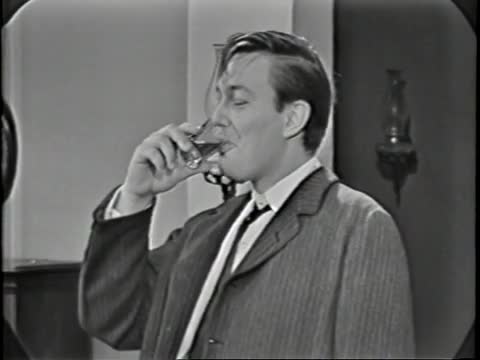
- The nostalgic myth that the saloon was a warm, cheery place where all good fellows got together and drank in quiet dignity is shown to be only a myth in this episode. Max Morath portrays a saloon keeper and Robert Benson is seen as a philosophical fellow who drinks too much. Through the use of slides and music, Morath shows many of the comic and serious aspects of the temperance movement and the beginning of prohibition.?Music:?"Barcelona"?"Saloon"?"Background Theme #1"?"Come Home Father"?"What Good Is Water When You're Dry"?"Then We'll All Go Home"?"How Are You Going to Wet Your Whistle"?"You Cannot Make Your Shimmy Shake on Tea" (Description adapted from documents in the NET Microfiche)
- Series Description
- Turn of the Century is a turn back to a time when life was perhaps a bit gayer. The United States was at peace, the industrial revolution had brought more leisure time to millions, and movies were the latest rage. Silent, of course, but engulfed in the melodrama of a romantic age. With his usual good humor, Max Morath, National Educational Television's "ragtime Leonard Bernstein," takes an informal look at this nation's changing tastes, growing sophistication, and popular idols from 1890 to 1900. Each episode is devoted to a different facet of life at the turn of the century: transportation, courtship, communications, early recording techniques, silent movies, temperance-prohibition, humor, education, and that great institution called the Barber Shop. Morath and his supporting actor, Robert Benson, appear as characters of the day, and, although the series is not strictly musical, the two enliven each episode with a variety of songs from the era. They present such classics as "When a Fellow's on the Level with a Girl That's on the Square," "Everything That Father Did Was Right," and "In the Good Old Summertime." The series is filled with many other songs. In addition, slides, old movie film clips, recording devices, old family albums, player pianos, and exquisite sets are combined to recreate the naive but memorable United States of sixty years ago. Robert Benson, who plays supporting roles throughout the series, enjoys a wide and varied background in acting. He has previously appeared in two National Educational Television series, Self-Encounter and Cowboy's West. Turn of the Century is produced by KRMA-TV, Denver. The 15 half-hour episodes that comprise this series were originally recorded on videotape. (Description adapted from documents in the NET Microfiche)
- Broadcast Date
- 1962
- Asset type
- Episode
- Media type
- Moving Image
- Duration
- 00:30:41.140
- Credits
-
-
Art Director:
Allen, Don
Director: Case, James
Host: Morath, Max
Performer: Benson, Robert
Performer: Morath, Max
Producer: Schlaefle, Jack
Producing Organization: KRMA-TV (Television station : Denver, Colo.)
Set Designer: Hansen, Howard
Writer: Morath, Max
- AAPB Contributor Holdings
-
Library of Congress
Identifier: cpb-aacip-5aceb484ff3 (Filename)
Format: 2 inch videotape
Generation: Master
If you have a copy of this asset and would like us to add it to our catalog, please contact us.
- Citations
- Chicago: “Turn of the Century; 14; Saloon,” 1962, Library of Congress, American Archive of Public Broadcasting (GBH and the Library of Congress), Boston, MA and Washington, DC, accessed June 1, 2026, http://americanarchive.org/catalog/cpb-aacip-512-5x2599zv8g.
- MLA: “Turn of the Century; 14; Saloon.” 1962. Library of Congress, American Archive of Public Broadcasting (GBH and the Library of Congress), Boston, MA and Washington, DC. Web. June 1, 2026. <http://americanarchive.org/catalog/cpb-aacip-512-5x2599zv8g>.
- APA: Turn of the Century; 14; Saloon. Boston, MA: Library of Congress, American Archive of Public Broadcasting (GBH and the Library of Congress), Boston, MA and Washington, DC. Retrieved from http://americanarchive.org/catalog/cpb-aacip-512-5x2599zv8g