Jazz Casual; 8; Dave Brubeck Quartet
- Transcript
a as beakman the piece both it's
bad is bad is because it's been it's been as beans beans it's
broken ms bee it's both it's been it's been
said it's b fb
is bad this is jazz casual ralph gleason we've been listening to the music of a very vivid portrait paul desmond on the alto saxophone jim wright on bass and joe morello drums and dave brubeck npr about ten years ago dave brubeck signed up and coming young musician will not gone down beat magazine which we discuss the future of jazz so many of the things that you thought we might expect in the ensuing decade from jazz music and we have him on the program now and i hope there are going to be able to find that dave the cia were just talking about the article that you did and downbeat
about ten years ago in which to discuss the future of jazz music has it worked out like you thought it would well it's coming along very well i think the two things i stressed at that time are the two things that i would stress today and the two things i worked the hardest on in ensuing ten years well i brought up until now that we should be using more adventurous harmonic changes and one good way to do that jazz law which offered the musician much leverage being without breaking the fundamental rules of jazz was to keep the basic chord progressions of any standard to say a countess would play in this came in one hand but in this van plant in the uk vote differently and he'd be getting always all records that way and yet he would be throwing his bass player because a savanna the bass players know worked with
would be drawing the other musicians too much and yet he could become very adventurous now rhythmically i talked in terms then of doing things falling rhythmically in the harmonic approach was volatile mouth and rhythmically i wanted to do things paul or rhythmically because i thought and jazz was much too tame that and the way i wanted to set up the group was the drummer would be playing one rhythm the base where another them all and i could play in either of those rhythms are no rhythm and now we've done this and we were doing a better now than we did ten years ago and now the album time out was the first album we took all series of time signatures different than we're used to playing in and they next out and turnout in his call time further out you know you just had
the uaw take five from from time out and it's very interesting to see that that is now being accepted by the public well how do you use this in and take five reasons which are just finished playing ah well we recorded that about two years ago and it's a tune written by paul desmond and that was forward anything different time signatures and unusual chance now the idea was that jazz used to challenge the public and making them think in terms more advanced rhythmically in there were used to thinking in the twenties it was hard to get a group of people to clap on yet to one four one two three four this was difficult or we haven't gone much further the public is ready for something new because everybody listens to jazz thing i want to run for at this period that thirty years is long enough to be stuck they're still
the jazz musicians take up their original role of leading the public into a more adventurous rhythm and you think this is what is now going to take place while their take five has proven after all the media the kids are tied a rock n roll film and yet they can dance and five four time well you're doing isn't any other way with other numbers that your that you've written in the cheerio his plan we have where the only group that i know we complain entire concert they're not play in fourth quarter even in three four and most jazz is is is played in four four time most jazz is and more more than getting the jazz waltzes but we have for things in five four time things like that will run our turkeys and ninety eight i think all of the square dance that's in seven four time and there's another thing and sim for this very difficult to plan three to get ready for gold with the idea using two bars or three four followed by two bars of four for
how many troops do these things and they play the first course that way in the pentagon to four for non group if we set up this pattern we're going to stay in the difficult time signature throughout and improvise just like you heard paul just now he was in five four time he can probably play in five four better than any musician in the world maybe as a as a one man in roles that is so that was a drama when it shows some of these different rhythmic things that you're going to do what the tunes would you play for us now our auditing call already walls and on the right with the first written form jams and they used to play one to three against four over here but we're going to start with the idea we're going to play or walls and what once you on this side and i will combine the rag and the waltz now we might get into temples of
three or four or two were free to do anything we want as long as we don't break like the basic idea ok well lilith likely take years ago elevator it was dave brubeck quartet and i urge you all to listen and watch closely and see in some of the things that they just describe to us china and his turn as the dave brubeck quartet plays right he was it's b it's been it's both
it's b it's
b it's b as bell as bell he's
back it's
big speaker's bill it's been disbarred the bikes the idea when you get into two or more temples at the same time because i came off unlike album schroeder hope that it will if you're counting which we weren't because you can't count out
here you know what's going on or not all you want to do is come up with the downbeat together now we'd like to do another thing in five four time this is called the civilian clothes then if we hadn't played other towns in five four we'd have a lot of trouble playing this time signature was because we've done the time around out and that we can do the time further out out on because of that out and we can do an album that will be on the body and a half full time and space where i've written the thing and ten for all her nothing in eleven four now these drones are like always a point of departure for something that we ought to be more natural forests and you're forced to do a later date the skull to
stay in it's been fb it's big
it's b it has been it's been
it's been it's both it's b it's better to pay the patients it's
been in the past does bill to pay it's been it's been to pittsburgh that's because the pound is
bad it's b he's been a loud five four three more we do simply be of
wanted to get away from the four for the jazz fusion explaining this particular tree for going around these days and we have one of the like the political walls live from a ballet i'm doing for the girl loses her ballet slipper she starts to let the corda ballet follows around living they created the dance to pass
by we used a nine a time but i like to demonstrate that because it's quite different than most jazz you count one two one two one two one two three which totals nine it's a turkish rhythm that was the people in turkey have no more trouble with and we have a rock n roller scholar rondo alla tour it's b one i think that we have a need worry about jazz in the future being dull etcetera never going to be dull as long as we have bright provocative and courageous musicians like dave you like dave brubeck were willing to take
chances and to experiment because experimentation has always been and always will be a major part of jazz music you're the most interesting things about the back down through the years have been his willingness to experiment unlike some musicians who aren't conservative as there've been more successful brubeck has always been willing to take chances and he remains today a very provocative experimental and interesting musician and i hope we can hear more from right now it's been
tough but this is at national
educational television fb
- Series
- Jazz Casual
- Episode Number
- 8
- Episode
- Dave Brubeck Quartet
- Producing Organization
- Connecticut Public Broadcasting Network
- KQED-TV (Television station : San Francisco, Calif.)
- Contributing Organization
- Connecticut Public Broadcasting Network (Hartford, Connecticut)
- Library of Congress (Washington, District of Columbia)
- AAPB ID
- cpb-aacip/398-45cc2pfq
- NOLA Code
- JZCL
If you have more information about this item than what is given here, or if you have concerns about this record, we want to know! Contact us, indicating the AAPB ID (cpb-aacip/398-45cc2pfq).
- Description
- Episode Description
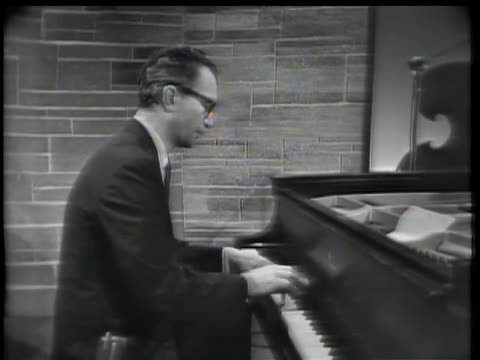
- Dave Brubeck, one of the most widely-known jazzmen, explains how his group has experimented with various time signatures - for instance, five-four and seven-four - and then demonstrates with examples of his music in these signatures from the Quartet's repertory. He discusses his own role and that of other musicians in the development of jazz. The Brubeck Quartet - Brubeck, piano; Joe Morello, drums; Eugene Wright, bass; Paul Desmond, alto saxophone - has appeared with Leonard Bernstein at Carnegie Hall, with other symphony groups, and on State Department tours in Poland and India as U.S. representatives. The songs performed are Take Five, It's a Raggy Waltz, Castilian Blues, Waltz Limp, and Blue Rondo a la Turk. (Description adapted from documents in the NET Microfiche)
- Series Description
- Jazz, an exciting and very personal American art form, is discussed, dissected, and played during Jazz Casual. Jazz began to be created in New Orleans during and after the Civil War. The simple melodies created then can still be heard in both jazz and popular music. From Turk Murphy who is devoted to the preservation of rare old jazz tunes to Dave Brubeck and his avant garde work with rhythm, Jazz Casual presents a panorama of jazz as it exists today and existed yesterday. Throughout the series, outstanding musicians in the field of jazz play and interpret the music they improvise. Although classical music through the early nineteenth century used improvisation, jazz is the only musical form since to use this unique form of composition. Because jazz is not written, it has many variations and shadings depending upon the temperament of the performer. Therefore, each group included in this series represents a different attitude toward the requirements of jazz style. (Style is basically that quality which gives distinctive character to a particular performers work or to a particular kind of music.) Each episode is devoted to a well known jazz performer or group and includes an actual jazz session as well as a brief, informal interview with the featured personality. Guest performers include Sonny Rollins and Company, Turk Murphys San Francisco Jazz Band, Jimmy Witherspoon, Ben Webster, The Modern Jazz Quartet, the Dizzy Gillespie Quintet, the Julian Cannonball Adderly Quartet, Carmen McRae and the Dave Brubeck Quartet. Host and producer for this series is Ralph J. Gleason, whose syndicated column on jazz appears in such papers as the San Francisco Chronicle, Boston Globe, Milwaukee Journal, New York Journal American, Cleveland Press, Des Moines Register, and Salt Lake City Desert News. Of the series Gleason says, The aim of the program is to present jazz in as natural a way as possible. To this end, the selection of the music and its programming has been left entirely in the hands of the musicians themselves. In other words, on JAZZ CASUAL, the music director each week is the leader of the group. The musicians are encouraged to set and arrange themselves informally in a manner most natural to them and every attempt is made to make them feel thoroughly at home. The program is only as good as the music. Jazz Casual is produced by KQED, San Francisco. This series of 24 half-hour episodes was originally recorded on videotape. (Description adapted from documents in the NET Microfiche)
- Broadcast Date
- 1963-04-24
- Asset type
- Episode
- Genres
- Talk Show
- Performance
- Topics
- Music
- Media type
- Moving Image
- Duration
- 00:29:41
- Credits
-
-
Director:
Christian, Richard
Guest: Brubeck, Dave
Host: Gleason, Ralph J.
Performer: Brubeck, Dave
Performer: Desmond, Paul
Performer: Wright, Gene
Performer: Morello, Joe
Producer: Christian, Richard
Producer: Gleason, Ralph J.
Producing Organization: Connecticut Public Broadcasting Network
Producing Organization: KQED-TV (Television station : San Francisco, Calif.)
- AAPB Contributor Holdings
-
Connecticut Public Broadcasting
Identifier: A20494 (Connecticut Public Broadcasting Network)
Format: Betacam: SP
Generation: Dub
Duration: 00:30:00?
-
Library of Congress
Identifier: 1429286-1 (MAVIS Item ID)
Format: 1 inch videotape: SMPTE Type C
Generation: Master
Color: B&W
Duration: 0:29:02
-
Library of Congress
Identifier: 1429286-6 (MAVIS Item ID)
Format: 2 inch videotape
Generation: Master
Color: B&W
Duration: 0:29:02
-
Library of Congress
Identifier: 1429286-2 (MAVIS Item ID)
Format: U-matic
Generation: Copy: Access
Color: B&W
Duration: 0:29:02
-
Library of Congress
Identifier: 1429286-9 (MAVIS Item ID)
Format: Betacam: SP
Generation: Master
Color: B&W
Duration: 0:30:00
-
Library of Congress
Identifier: 1429286-7 (MAVIS Item ID)
Format: VHS
Generation: Copy: Access
Color: B&W
Duration: 0:30:00
-
Library of Congress
Identifier: 1429286-8 (MAVIS Item ID)
Format: Digital Betacam
Generation: Copy: Access
Color: B&W
Duration: 0:30:00
-
Library of Congress
Identifier: 1429286-4 (MAVIS Item ID)
Generation: Copy: Access
Color: Color
-
Library of Congress
Identifier: 1429286-5 (MAVIS Item ID)
Generation: Copy: Access
Color: Color
-
Library of Congress
Identifier: 1429286-3 (MAVIS Item ID)
Generation: Master
Color: Color
If you have a copy of this asset and would like us to add it to our catalog, please contact us.
- Citations
- Chicago: “Jazz Casual; 8; Dave Brubeck Quartet,” 1963-04-24, Connecticut Public Broadcasting Network, Library of Congress, American Archive of Public Broadcasting (GBH and the Library of Congress), Boston, MA and Washington, DC, accessed June 7, 2026, http://americanarchive.org/catalog/cpb-aacip-398-45cc2pfq.
- MLA: “Jazz Casual; 8; Dave Brubeck Quartet.” 1963-04-24. Connecticut Public Broadcasting Network, Library of Congress, American Archive of Public Broadcasting (GBH and the Library of Congress), Boston, MA and Washington, DC. Web. June 7, 2026. <http://americanarchive.org/catalog/cpb-aacip-398-45cc2pfq>.
- APA: Jazz Casual; 8; Dave Brubeck Quartet. Boston, MA: Connecticut Public Broadcasting Network, Library of Congress, American Archive of Public Broadcasting (GBH and the Library of Congress), Boston, MA and Washington, DC. Retrieved from http://americanarchive.org/catalog/cpb-aacip-398-45cc2pfq