Maryland State of Mind; Caesarea: A Jewel in Herod?s Crown
- Transcript
Funding for this program is provided by the 13 institutions of the University of Maryland system. In the time of the agents near the cradle of civilization. A king was building an empire. Blood and sweat were his mortar politics his motive. Ingenuity his home Mark. Today his treasures are being honored and they reveal as much about us as they do about him. We assume that these people didn't have a lot of technology that there was there was a bit of a backwards to that and it simply isn't true. For he was King Herod and this. Is century a Jewish inheritance. From. Us.
The Mediterranean Sea crashes against the shores. It has shaped over the millennia. For here on the coast of Israel lie the remains of a vision a vision of a king two thousand years ago. King Herod of Judea had a penchant for building new cities. Here he would create a shipping port for the world's great fleets. He commanded his legions of workers to build a city where none had stood. Connected with great roads and fed by vast Lockwood's that meandered across the. Shrewd and coming. Harrod would dedicate this new metropolis to his patron
the Emperor Caesar Augustus in Rome. And it would become known. As sensorium mammoth says area on the sea. It became a commercial hub known for its pottery and glassware. And it was a city of great beauty and art. But it was also a city known for its history. For it was here that pontious pilot was stationed as Roman Procurator. It was here that the Apostle Paul was imprisoned and it was here legend has it that the Crusaders found the holy grail. For over a thousand years says orea maritima flourished under a variety of rulers. After several centuries of Roman
rule. It reached its zenith under the Byzantines. In the seventh century. It came under Muslim control. Only to be conquered by the Crusaders. In 11 0 1 A.D. finally after losing its usefulness it was abandoned in the 13th century. Only to be consumed by the very sand upon which it stood. But the sand of time is being pushed back once again this time by the sweat and energy of hundreds of dedicated volunteers from around the world compelled to honor the past which may lie just inches beneath their trials. Mostly college students from the US and particularly the University of Maryland College Park. These kids pay their own way to dig their hearts out in this mystery so so it.
Kenneth home I'm a historian at the University of Maryland College Park is one of several directors of the combined sensory expeditions there. There's lots of learning going. On. And it's a wonderful social experience in many ways. For young people and for some who are not so young anymore to work together and. Learn about how society we're. Very close. And from that environment like that. So like. When I got here that was all covered not just in the past three weeks he did. A close encounter with history often makes a powerful impression on his students. I think the experience when I arrived here seven weeks ago.
I've had a stumble around the Rands in a daze for about two days and just took it all in because it was really it was kind of moving. I mean I know I a pilot problem was right up there and right here. It's. I mean I really feel when I look at these buildings or what's left of these structures I feel they all come alive. Rising each day at 4:45. You know the students move slowly to the dig sites. They work in the cool of the morning till just past noon. Then they turn the desert back over to the blazing sun. The harbor is the focus of this city. For it is here that Herod was determined
to conquer even the powers of nature. There was no natural harbor. So Herod commanded his Roman engineers to build one. After assembling huge wooden forms on the beaches. They floated them offshore and filled them with stones. Then fused them with underwater hydraulic cement made from Italian volcanic ash. When the break waters rose above the waves loading docks and warehouses were constructed around this watery courtyard which protected the ships from storms. The harbor of Israel was the most advanced and most sophisticated. A marine engineering ever attempted during the ancient time anyway. Not even within the realm of. Each summer marine archaeologists all student volunteers study
Herods Harbor up close as they unearth the past under 35 feet of swirling Mediterranean Sea. The Roman ruins have taken on a second life as an artificial reef. Using caissons to hold back the sand. They vacuumed back the silt from the millennium to reveal this engineering marvel. Has the 2000 year old Roman timbers come into
view. One wonders how Herods harbour might compare with more contemporary engineering feats. There is a famous case of what they call red Bradley Qasem. It's an attempt made late 19th century by the American Navy of the harbor of Floyd attempting to build a freestanding seawall. In the water based on wooden form case. Was filled with bricks. Street times. They tried to install it as sweet and they failed. So they face Zayn in what Herod did as a matter of routine. At the crest of the hill overlooking the harbour Harrod paid homage to his patron. He built a magnificent temple to Roma and Augustus. To the Goddess Roma and to Augustus the emperor as a god the Jewish king devoted
a temple to these two deities. As an expression of loyalty to row. This building was also a major took. Josephus tells us that it was a kind of beacon. We could see it far out to see. The ship captains use for a. Guide to find the area to find the temple's platform its foundation became an almost holy quest for the students as they move through tons of debris sometimes delicately sometimes forcefully. Their zeal heightened by their proximity to greatness. The excitement became almost palpable. Finally an edge was discovered let out a big yell at me. And so we sort of weave we figured it was going to be here just again based on what was found to the south of us. But it's just it's just exciting to actually find you know part of it here and to be able to see that it's here. And it's going to be even more exciting if
we find the. Time in the northwest corner here. That'll be that'll probably be the biggest prize if we do find that. Good. Luck. Finding. Work. Proud. Of. My work. Not surprisingly today's archaeologists are aided by modern technology where pen and paper once were the only record of every stone and relic. Now computer aided design allows the instant pinpointing of every antiquity by layer depth and access. But these computer graphics still start with a pencil in space and it will take this drawing and put it on a tablet which is use to digitize will take a mouse or a pop and will calibrate this drawing to one on his computer screen and will basically just trace it and from there we love
code. All of these stones with different layers according to altitudes and elevation and by what they may be like a well will be a different color than a paving stone. This would be a different color from a wall and that helps us to phase the architecture strata graphically which means by you know the order of what it rests in the earth. These computer assisted drawings not only reduce the burden of cataloguing the past they facilitate the hypothesis an essential tool in archaeology. One of the interesting things is that if you take the center of the temple platform and its longitude latitude and you also take the. Longitude latitude of Rome itself. You find that you can draw a line between says orea and Rome. And curiously enough it follows this axial line. Now this temple was dedicated to Caesar Augustus maybe the Roman engineers knew enough about navigation. They certainly
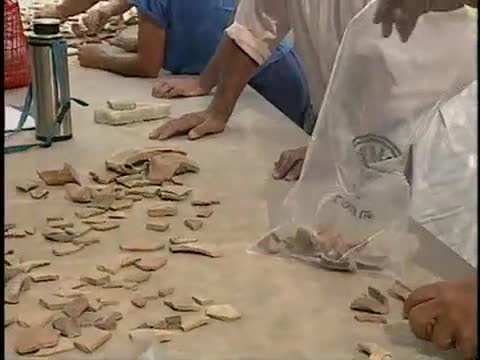
sailed. They knew how to get from here to Rome. That maybe they calculated that well let's let's orient this temple towards Rome. That could be very significant and maybe you will orient to the city in that direction. We don't know for sure. But it's certainly a hypothesis. We're in the late. 13 as well. And yet for all of the wizardry of today's technology it is often the simple things that reveal more of the past than anything else. Each day hundreds of pottery shards for is the archaeologist prefer to call them shirts are examined every afternoon after the day's digging is done and a shower and a nap is had. The pottery is analyzed for the secrets each might hold. For. Now. I'm on. The
road with him. Here in this mail. Is where he's always coming pretty is so articulate. So this is all. Things that. Come. And when enough pieces of a vessel are found the tedious process of restoration begins. And sometimes. The past. Becomes whole. Once more. Coins also revealed the past. In their own beautiful way.
Many are just shadows of their past corroded by a dozen centuries. Yet others seem as new as the day they bought an amphora of wine. One can only imagine the excitement a few years ago when the volunteers discovered someone's life savings. Ninety nine gold coins hidden in a block of stone. Which reveal the splendor of another. As the. City says is all for you. It was planned city Herod built it on the side of the of tower which was in ruins. And was able to lay out a city the way a city should be laid out. The city with. Streets at right angles to one another. The first century historian Josephus. Jewish the story the story of the Jewish War.
Tells us that. Herod devoted as much time to the sewers beneath the streets as much expenditure to. The sewers beneath the streets as he did for the streets themselves. The part of a well-planned up to date city in this period. Two decades of excavation have yielded some remarkable finds. The archaeologists are currently unearthing a series of large vaults along the sea. They speculate that this was the heart of censorious business and government center. This entire area turned out to two continuous years of excavation to be a provincial thieve and the commercial center of the area mainly during the Byzantine period in this period. Area was the capital of the
province of Palestina Prema. One surprising find was Christian icons on the walls of one vault. These are significant because the frescoes survived several hundred years of Muslim occupation when all foreign religious references were removed or destroyed. Archaeologists have also discovered other fascinating aspects of Roman and Byzantine life a pub says Aria's thirsty sailors complete with benches on the sides and a recliner for the weary. The remains of a Roman public bath. Complete with indoor plumbing. With running water and public toilets.
Large storage rooms for containers of wine and olive oil with sloping floors to catch the spills in a central jar. And the archaeologists have found mosaic floors everywhere still reflecting their pastel patterns from the days when Sandal's trod upon them quietly. The abundance of censorious treasures is simply amazing to behold. For it truly is a treasure trove from the past. To.
Know the volunteers and students are frequently in awe of the significance of this archaeological site. I remember holding a Roman play and it was there were two shirts that were good enough size that I had to use my two hands and I said my God I'm holding this plate that somebody in the first century A.D. ate off. And spine tingling is fine. I pulled them out of the sand in the harbor and I looked under the handles of the amphora and I saw thumbprints or fingerprints. And I held it to myself and I said there's life here and this life is a part of my life. I mean to be able to understand our our present and our future we have to understand our past and it was
such an incredible feeling to hold something that I knew had life. It's it's hard to describe but it's really a great feeling. I think there's a tendency for us to feel very superior about our own culture to think that we're at the pinnacle of human civilization and yet when you visit a site like this you see these massive works that were constructed and we can learn a lot about modern how it works and how to construct them from examining the physical remains that exist here. Teener and I saw a mosaic in the middle of the road on the way to the back door that no one has seen before and we poured water over it. So beautiful colors and things and. It's a humbling experience I think to know that there were people. Extant 2000 years ago who enjoyed art and culture and and the society of friends and companionship and good food and
and to know that our society is as transitory as that and that we shouldn't take our own society for granted. We're talking about the technology of pouring concrete under water. Some of the some of the things that that we come up with we don't immediately understand. Largely because it's our own cultural arrogance that says you know we could have done this better. But the effort the real effort is attempting to understand how the ancients with their resources and technology could have come up with some ingenious way of accomplishing what they needed to. That's always been a problem is that we assume that these people didn't have a lot of
technology that there was a there was a bit of a backwardness to that and it simply isn't true. I mean these were highly intelligent very technical people we would find in the harbor barges that were built with mortising 10 and jointing and hydraulic concrete like you mentioned two things that you never expected to find when the truth is is that that they were very very intelligent they had a lot of technology and they knew what to do with it they knew how to use it. And those kinds of things help us understand ourselves and help us understand where we are now and hopefully our future. Is.
In the summer of 1995. The archaeologists to great fanfare. Did find the edges and dimensions of Herod's temple platform. And the students are learning that these discoveries hold great fascination for the rest of us. We'll. Find out. I'm sure you can. Most of the time it's found sifting. I did.
Thing. Or. We did this story. Today. What's it like what. We actually get out of here about 5:30 in the morning. We're hot. Hot. Now we're sweating by that. For these crumbling ruins. Reveal more than just the lives of the ancients who created them. They unlock a door to the human past so that we might hear. And understand. Where we have come from. And who we are. On.
Our. Own. For more information on the combined Cesaria expeditions contact
the Department of History. The University of Maryland College Park Maryland 2 0 0 7 4 2. Or telephone 3 0 1 4 0 5 4 3 5 3. Funding for this program is provided by the 13 institutions of the University of Maryland system
- Series
- Maryland State of Mind
- Producing Organization
- Maryland Public Television
- Contributing Organization
- Maryland Public Television (Owings Mills, Maryland)
- AAPB ID
- cpb-aacip/394-94hmh4rn
If you have more information about this item than what is given here, or if you have concerns about this record, we want to know! Contact us, indicating the AAPB ID (cpb-aacip/394-94hmh4rn).
- Description
- Episode Description
- This episode of "Maryland State of Mind" describes the history, as well as the features, of the ancient city of Caesarea Maritima. The archaeological efforts and activities of students from the University of Maryland, in addition to their reactions, are also shown.
- Series Description
- Maryland State of Mind is a magazine series showcasing the work of faculty and students at the thirteen schools in the University System of Maryland.
- Created Date
- 1996-03-15
- Created Date
- 1996-03-21
- Asset type
- Episode
- Genres
- Documentary
- Special
- Topics
- History
- Rights
- Copyright 1996 Maryland Public Television, University of Maryland System
- Media type
- Moving Image
- Duration
- 00:28:44
- Credits
-
-
Associate Producer: Hileman, Scott Benjamin
Co-Producer: University System of Maryland
Copyright Holder: University System of Maryland
Director: Day, Ken
Interviewee: Holum, Kenneth G.
Interviewee: Raban, Avner
Interviewee: Sachs, Stephen F.
Interviewee: Patrich, Joseph
Narrator: Pengra, Mike
Producer: Day, Ken
Producing Organization: Maryland Public Television
Writer: Day, Ken
- AAPB Contributor Holdings
-
Maryland Public Television
Identifier: 40674 (MPT)
Format: Betacam
Generation: Master
Duration: 00:30:00?
If you have a copy of this asset and would like us to add it to our catalog, please contact us.
- Citations
- Chicago: “Maryland State of Mind; Caesarea: A Jewel in Herod?s Crown,” 1996-03-15, Maryland Public Television, American Archive of Public Broadcasting (GBH and the Library of Congress), Boston, MA and Washington, DC, accessed April 1, 2026, http://americanarchive.org/catalog/cpb-aacip-394-94hmh4rn.
- MLA: “Maryland State of Mind; Caesarea: A Jewel in Herod?s Crown.” 1996-03-15. Maryland Public Television, American Archive of Public Broadcasting (GBH and the Library of Congress), Boston, MA and Washington, DC. Web. April 1, 2026. <http://americanarchive.org/catalog/cpb-aacip-394-94hmh4rn>.
- APA: Maryland State of Mind; Caesarea: A Jewel in Herod?s Crown. Boston, MA: Maryland Public Television, American Archive of Public Broadcasting (GBH and the Library of Congress), Boston, MA and Washington, DC. Retrieved from http://americanarchive.org/catalog/cpb-aacip-394-94hmh4rn