Idaho Reports; 1982 Election Analysis
- Transcript
Campaign 82 is history. And here in Idaho Republicans and Democrats are claiming some big victories. Mark Johnson tonight a special one hour edition of Idaho reports examines the outcome of the election. Our guest the big winner is John Evans. Larry Craig George Hanson join us for that half hour from now. See that. Also. The funding for this program is provided by the Corporation for Public Broadcasting and the friends of four 10 and 12 we predicted way last spring that it would be a horse race. But I didn't realize I was going to be on behind it until the final stretch. But it really feels good to be able to hit that wire first. I'll tell you that one.
Democrat John Edwards holds the governorship while Republicans keep the congressional seats. Tonight with the top three winners a look at the election outcome. Good evening. It was national Republican Party chairman Richard Richards who offered perhaps the best analysis of the outcome of campaign 82. Richards called the results a mixed bag. He was talking of course about the national totals but it would seem that that analysis would apply to Idaho politics as well. Republicans can clearly claim after yesterday that they have mounted some major victories in this state. But Democrats can claim their share of victories as well. Certainly the biggest win for Democrats retaining the governorship. The two parties split the other four statewide elected officials and Idaho retains all of its its all GOP congressional delegation
tonight in an expanded one hour edition of this broadcast we will talk to the top three winners in the election. And later on from Pocatello Moscow and Boise journalists will join us for their analysis of the outcome. First tonight the governor's race where Democratic incumbent John Evans who trailed until almost the very end of the vote counting finally pulled out a narrow victory over Republican Lieutenant Governor Phil bad. Here are the final unofficial figures. Look at this hour. The governor with 51 percent of the total. One hundred and sixty four thousand eight hundred fifty one votes statewide. They're back with 49 percent of the total. A hundred and sixty one thousand 274 statewide just over 3500 votes. The margin of John Evans is victory. The governor is with us tonight. The governor earlier today called his victory slim but satisfied. Congratulations sir. Thank you very much Mark. Do you see the election outcome in Idaho a triumph for the Democrats. Well just to hold the seat in this kind of an election and this kind of a turn out is a
substantial triumph for the Democratic Party on the efforts of my campaign staff and my volunteers throughout the state to put it together and get the vote out. What what made the difference. Well I think it was the effort that we put forth. We we put forth a plan way last spring to to put a campaign together that was going to speak to the issues speak to my record my opponent's record. And we were going to continue to maintain that high integrity type campaign in spite of anything our opposition did and we did that. We carried it right on through until the end. I'm very proud of that. Governor you were you were one of a number of Democratic governors elected or re-elected yesterday your party captured a total of seven new governorships statewide nationally. A lot of those governors in one way or another were attacking Reaganomics. You did not. Was that good strategy as you look back on it. Well absolutely. You know we we have a polling process that we followed
President Reagan is very very popular in Idaho and in spite of the problems associated with the national recession he's not really identified with that national recession in the Idaho citizens mind. So it was best in our strategy of developing our campaign that we really not attacked. We could see that we were just going to be getting into trouble by attacking the president in Idaho. It was a lot of talk in the last days of the campaign by your opponent about right to work. Did that make any difference as you've looked at the result. Well it certainly did on both sides. There was a substantial effort on the part of the Freedom to Work Committee to to bring forth issues of the comic book the signs of Brimstone the fire fire committee all of those efforts were put forward by the Freedom to Work Committee in relation to the right to work issue. And unfortunately my opponent did not recognize some of the negro negative aspects of that particular campaigning effort. And in some
ways I'm sure it hurts him how bad it hurt him very difficult to say or how bad it helped me or hurt me it's difficult to say but it certainly was one of those issues that got the votes out on both sides of the issue. Did organized labor play a big big role in your election. Yes very very much so not only organized labor but all of the working people the state of Idaho recognize the importance of not having the right to work bill in the state of Idaho. And so they were dedicated to get the votes out and and defeat that effort. The Freedom to Work Committee. I think if I understand it correctly you talked to the lieutenant governor earlier today. He called you is that right. Yes he called me first thing this morning and then I went over to his office when we both were in the Capitol building and we had a long visit about the race and the future and he offered me his full support to my governorship and I accepted that support and I appreciate his efforts to continue to serve the people of Idaho.
Finally Governor let me ask you about what your plans are immediately here. The state's financial difficulties of course were a major issue in the campaign. You've talked about a special session. Have you thought more about that now is that something that we still do still in the planning stages Mark. We'll be reviewing the October statistics in relation to the fiscal picture. Hopefully we'll see some still see some more recovery. We'll be getting together with the legislative leaders or potential legislative leaders within the next couple of weeks briefing them completely on the status of the fiscal picture and then getting their counsel and advice and cooperation to solve the problem of funding for our public schools. That's the issue of greatest concern to me and the people of the state of Idaho. I have not held back the 22 million dollars of our public school monies because it would automatically have triggered an increase in property taxes. So we've got to address that issue. I don't think the people of I don't want to see their property taxes increased. I don't. And so if we can find some alternative ways
of financing our public school program we should do so possibly at a special session the first of December. Well thank you sir. We'll come back in few minutes. Nationally Democrats after yesterday stand to gain about 25 seats in the House of Representatives. That is if they close races are that are leaning in one way or another state. Basically the way they are at the moment. Democrats as you might expect are calling that a big win. Republicans including the president today say it's about what they had expected. Both of Idaho's incumbent Republican congressman won rather easily as it turns out. Let's take a look at the figures first in the First Congressional District where incumbent Republican Larry Craig garnered 54 percent of the vote defeating the incumbent or the Democratic challenger Larry Morocco who had 46 percent of the vote. Congressman Craig's totals at least percentage wise about what they were two years ago when he first sought that job in the Second Congressional District. Republican incumbent George Hansen the second district of course largely eastern Idaho and a part of Ayda County. Congressman Hansen with 52 percent of the vote over Democratic challenger Richard
Stallings 48 percent Congressman Craig is with us tonight in Boise. And second district Congressman George Hansen is with us tonight from the studios of public steller television station KSTU in Pocatello. Congressman credit let me go to you first and ask you what made the difference in your election victory sir and congratulations. Thank you very much Mark. I suspect a combination of things. Certainly a tough hard campaign and a very aggressive campaign on my part. And my opponent's part no question about that. That in combination with the kind of work that I've been involved in over the last 22 months and serving the people of the first district and then those tied together with the general feeling across the state and clearly in the first district is that a majority of the people wanted to see the programs and policies that we are working with in Washington right now continued associated of course with the Reagan administration and those programs recognizing the problems of the deficit
the austerity that is necessary in Washington at this time to bring that deficit down and to bring some of those budgets in line. All of that tied together. I was standing on the right side of those issues as I have over the last 22 months. And I think that's what brought the vote. Congressman Hessen in Pocatello give me your thumbnail sketch sir of your triumph fair and congratulations to you. Thank you very much. So it's just a case of hard work and maybe having the right body good for the people and I have to say that. Aggression competition just like Larry did and and we feel that the issues pretty much were represented. And in a year when it was tough I suppose being pregnant whether you're a Democrat or Republican because of the concerns people have with various problems we feel very fortunate that we were able to win and continue on. Congressman the president asked the American people to stay the course with him on his economic policies is
that the message that Idaho voters said yesterday do you think. Well I think partly I think they are very supportive of the president personally. And I think they feel that he's doing what is necessary to take care of the problems of the nation he inherited two very serious problems high interest rates high inflation rates an awful lot of red tape and regulations and high unemployment and he's done I think a very good job of getting most of those problems addressed. The interesting inflation is way down the red tape has been kept to quite a degree. And and we're right now trying to deal with the unemployment problem but it's difficult to get people back to work if you have interest rates. Nobody wants to put money into some kind of capital development. So I think we have to take care of first things first and it's moving along. So I think that the people of Idaho were responsive in a patients sort of way there and then of course there's the individual things that we do in our service work and the bread and butter issues of Idaho. And I think that a lot of the decision was made on how well we
perform there and apparently we had a passing mark on a report card. Obviously you did Congressman Craig stay the course. Is that the message. Well I think in a general sense it is clearly a majority of the people of Idaho and I think our governor spoke to it. I believe in the president and what he's trying to do now that doesn't mean they're going to agree with every cross to t and to die. And I think Congressman Hansen and I have demonstrated that kind of independence as it relates to Idaho over the last 22 months. But we recognize the problems as a nation. I think we recognize him clearly as a state we do the large deficits the high interest rates that were a part of that over the last three years. The need now to struggle and work hard to keep those interest rates down and to get this economy moving in a more accelerated way than it is moving at this time. That will solve the unemployment problem in large part. But that's number one and has to remain number one on the agenda along with of course all of
those budget battles that are part of that in the next several months. Let me ask you about something that that your leader in the house Bob Michael who withstood a real stiff challenge and won a very narrow victory in his in his district. He was quoted early this morning as saying that there would perhaps be required some slight modifications as he put it in an economic plan. He was not specific beyond that. But do you see do you see some some change of direction even albeit not major. Well I think there will be some limited changes. Clearly I have argued throughout the course of the campaign. In looking at that overall budget picture that there was still some flexibility in that budget toward cuts and that I think we have to sit down with our president and talk about the defense spending levels as it relates to give and take with entitlement levels. I don't think the American public wants another tax increase after the one that they received last summer. You have to as I recognize we've got a budget that's nearly a hundred billion
dollars larger than when I went into office some 22 months ago. There is room for some reductions now. How many how much. Isn't necessarily the key at this point as it is a Congress and president that's willing to work together to hold that budget in line sending the proper messages to the financial community to recognize that we're not going to move right back into a very heavy amount of spending which could spur inflation and therefore drive interest rates up again. Congressman Hansen Come in come back in here and join us on this question of whether there'll be some some modification some changes in the president's basic economic approach do you see that as a result of this. Well I think that we're going to have to evaluate what the president's base of support is as far as I can tell. We will support basically who's still there and some of the seats the last are some of those of the so-called gypsey my persuasion which weren't terribly supportive of him in the first place so it may be that his base has not voted generally as much as some people believe.
So you think he can keep that coalition of Republicans and the conservative Southern Democrats that pass so much of his economic program. Well I think that's what we're going to have to look at to see what part of that remains and what the possibilities are and then I think that's something that will be measured on any given issue. There have been times like when Congressman Gregg and I voted against the president and Tip O'Neill and Ralph Nader on a tax increase that that girlishness won't necessarily work together so there'll be times when you're going to have a selective application. But I might mention that there are places as Congressman Gregg has suggested that we're going to have to look at this thing. I think with a much more intense microscope we have in the past. Let me let me let me give you a couple of specifics that are already being talked about and certainly were talked about before yesterday's vote. The third year of the tax cut. Do you see any any chance that that will be changed. I think the public pressure is going to be that they're going to have to go forward with that tax cut. I just don't
see any change there. But I do think that the people of the country want tax reform I think they're tired of unpaid taxes they're tired of an unfair application of tax collection methods by the Internal Revenue Service. And I do invasion the fact that we may have a reform and collection methods similar to my Taxpayer Protection Act legislation that has 140 co-sponsors and perhaps a new type of tax structure along the line of the single or flat rate tax so I think there are some real possibilities that are emerging that we might have to address ourselves to in order to get the revenue for government operation that we're lacking right now. Congressman Craig How about the third year of the tax cut. Well I think that Congressman Hansen has put it very clear. The president is extremely strong on that point. I sense that the votes are there in Congress to sustain the action of the summer of 81 in in providing that third year tax cut. Certainly my feeling here in this state is that people want to sustain that initial tax program that went into place.
There is a tremendous amount of flexibility in that whole taxing structure and the thing that I think most of us here. Nearly all of the time is a concern for fairness and equity when we see that basically that middle income group of Americans and Idahoans paying a very very large tax. Whereas on the upper spectrum because of a variety of advantages there is less tax paid in fairness and equity factor must be built into that tax base that we've lost over the years as different interest groups have applied and received their particular advantages. Gentlemen let me ask you both quickly and then we'll bring Governor Evans back into this discussion Congressman Hansen the lame duck session of the Congress. Do you see it taking up the Social Security issue. We're going to have our hands full with appropriations bills. We have a whole lot that have been put off and we've been riding on continuing resolutions for a long time so that's going to be a crying matter. I don't know if they can resist bringing up the social security matter not because of course
the report is due about that time and we'll get into it. I'm not sure that we can ever finish the debate on Social Security and probably that will continue on into the new session after the first of the year. It was suggested in some of the analysis yesterday that this election and a lot of congressional districts perhaps turned on that issue even within the economy perhaps. Did you feel a lot of people talking to you about Social Security worrying about its future. No they were. There were some but I I think the people of Idaho were apparently more stable on things like that. Even though there were something that got rather emotional. But I think they're more stable in some areas of the country where it seems like they run on emotional politics a lot more than we do. Congressman Craig How about the Social Security issue in the next month. Well I have to agree with Congressman Pence and the amount of work that's to be done in the next month is voluminous. And to take on an issue like Social Security in that time frame is going to be very very difficult. But Congress can't dodge that issue. We've got to deal with it. I think the figures are on the
books that show there have to be some corrections so that we can assure that the elderly in this country continue to receive basic security checks. It is very much a legal and moral obligation that this nation has taken on with its own. And that has to be assured. And we know now we're beyond the stage of demagoguery we're beyond the stage of somebody pointing the finger at someone else that went on in the last three months. Now we've got to get to work and bring some solutions to that problem that just simply means larger every day. Governor even if I may ask you to put on your national political analysis hat for a moment and comment on whether you see it in this election and its national implications a referendum on anything Reaganomics or whatever do you see a message in this election nationally. Well I think there's some deterioration of support particularly in those industrial states of the East and Midwest deterioration in support for the president and his programs the Reaganomics
to many of the unemployed and those it's just not working. We saw some landslide victories in some of those Eastern and Midwestern states swinging from the Republican ranks to the Democratic ranks. And I think it was principally that particular reason that did it. Congressman Hansen would you would you concede at least that there is some deterioration as the governor suggests and the president's support nationally as a result of this election. Well we can gather is that he personally is pipe that are but on given issues those things can be held up of course in an emotional way to the point that people make decisions on those issues quite separate from their feelings about the president himself. And I think the governor certainly has developed that these are his property and some of those areas where you have people concentration problems in areas such as Social Security. And I think that the administration defended itself well in certain areas and other way in other areas
they just didn't have the people who would stand with them and articulate property. And in those cases they took a bath. How is it how is it possible for people to continue to divorce the president's personal popularity from the policies that apparently a good many people don't like either. Well I think I think it's just gradually deteriorating. I think that these first two years his popularity has maintained very high to a high degree. But I think that is if if our economy doesn't turn around and recover soon then then his popularity also will suffer as a consequence. Congressman correct. Well it's not a unique phenomenon that you can have a president very very popular while some of his programs may be in strong question. We look back a good many years to Franklin Delano Roosevelt who obviously history records is a very popular president with the people but seven years after he was in office we still had 17 percent unemployment there were still a tremendous number of people hurting coming out of that depression.
And yet the man himself remained very popular. I think that is in part the kind of situation we have with our president today. A very popular man individually. Now his programs and his policies will receive more question as we go into the night to Congress and analyze them on a program by program basis. Mark. Yes sir it may be true that people don't really perceive some of these problem areas such as Social Security is a problem because the problem's been there for a long time and there were proposals that popped out of various people in the administration. But I think they were never adapter's as a Reagan platform or a Reagan position. And so I think it's it's a misperception on the part of the public as to what Mr. Reagan really stands for in some of these areas. And so that's why I think you get that dichotomy as to his personal appeal as opposed to certain issues in a general sense Congress Congressman have Democrats put themselves in a better position nationally as a result of this election. Looking ahead to
1984. Well I think that that's again mixed. I think the president as I took him out did well on such things as inflation and interest rates and cutting regulations and getting in BASIC in driving up this type of thing. And I think that the Democrats this election and in certain select areas were able to maybe take the bat away from the administration because they perceive the fact that if the administration is that should have done something about some of these things and say they took the battery and certain issues such as unemployment. You know Congressman Jack Kemp at the Republican National Convention said that this election in 1980 was a watershed in American politics that we'd had a sea change in terms of our political way of looking at things that Republicans were going to be dominant and dominant for a long time. Does this election say that that really wasn't true. Well I don't know. Maybe physically Republicans will be dominant but I think that
it was a real change in the direction that even the Democrats are having to deal with and adjust to. So I do think that the election of 1980. Is getting me dead in the sense of getting things around to a point that the Republicans seem to be having a position in changing the course of direction economically and in other ways. The country was going to pursue but that didn't necessarily mean that Republicans would remain dominant as the direction moved around. I think Democrats have a tendency to jump in and take it from there. In certain instances and I think this election is a case where they were able to do that in certain instances as the as the pendulum swung back Governor. Oh absolutely. I don't think there's any question about it. Our congressmen are talking about the issues of the economy and Social Security. How about the balanced budget. Where are we going to be there is the Congress and the president's responsibility to to accomplish that particular goal. It's going to be a very difficult goal to to succeed in.
But if the president isn't successful in that he can't get the Congress to go along. And the president is probably going to suffer as a result of that. Congressman. Well I have to differ a little with our governor on the balanced budget issue. It's our party who supports it and it's his party who denies it. And clearly the vote on the balanced budget in the house about a month ago was denied. The American public not by Republicans in general but by Democrats who simply don't want that kind of control on the Congress and its ability to spend. And I think that that is symbolic in people reacting on an individual basis on a collective basis because when you look at the polls going into this election although the president remained popular the culprits with the Congress and. People perceive that it was Congress in large part that had not been responsive or as responsive as they should have been to some of the president's programs and in general had created a lot of the problems that we're now experiencing. And I think
the balanced budget issue if we wish to talk about that is a good example of a Republican Senate that passed overwhelmingly and a Democratic controlled House and simply said no we're going to deny the American public that level of control. But let me just say I'm not talking about the balanced budget amendment I'm talking about balancing the budget itself. We have the largest deficit. And I and in this last year that we've we've ever had. And when we start talking in terms of having to have increased our taxation program at the federal level in order to avoid an astronomical deficit I think that's the issue that the Democrats are going to be talking about because we've got to get that budget balanced not necessarily getting the balanced budget amendment passed in and of itself. Mark. Yes sir. I don't want to play two on one here. That's right the governor is a big fellow. He can take care of himself. We'll see if he gets a chance to go ahead. But. I think in fairness to all sides one of the reasons the governor is having difficulty.
And the state agencies are having difficulty with their budget because the economy went down and we've had the same problem at the local level same bribe at the federal level. We've had severe and balancing of the budget lousily because the anticipated revenues didn't come in. And this has not been good at any one state of government so I think we have to look at that for what it is and understand that we're going to have to deal with that. And for one party or the other to get into this I had to say and particularly that the Republicans in control of the government in Washington right now are talking about a balanced budget but growing in the wrong direction. You'd have to put the same tire on the brush and do it at the state local level. So so very frankly we have a problem getting the economy up there producing the revenue for the government that raid on and when we have that we're going to be able to deal realistically with a balanced budget problem and I think we're coming. That's why we're trying to get those inflation rates down. Final word on that governor. Well there's obviously quite a difference between the federal government and state
government in relation to balancing budgets. We're required to balance a budget the state level but more than that it's the federal government the Federal Reserve Board that really controls the interest rates. And that's a responsibility of this administration using their influence that they can use over the Federal Reserve Board and their activities. I mean just a quick note Mike I just have to say that the Federal Reserve chairman was appointed by Jimmy Carter So let's watch that kind of thing. Let's. Well I think we have a good good illustration of some of the differences here. Let me go quickly around the table and see whether you can all agree on something governor. Ronald Reagan it was said before this election might look at the results yesterday and determine whether he would be a president who would try for a second term. Knowing what you know about him and his popularity I think he it's likely that he will. I presume that he'll probably run for a second term congressman. Our president is now 72. He will be 74 at the time that he would stand for re-election. I think that has to be a factor in the
overall consideration that he must make. I don't know at this time when his choice will be and I don't really know that anyone in Washington knows except maybe President Reagan and Nancy. Jim Baker chief of staff quoted on British television yesterday saying that he thought the president would for what that's worth Congressman Pence good news. How about that. I think for an incumbent to remain viable he has to at least give the impression that he certainly is going to be a continuing incumbent not a lame duck. So whether the president decides to run or not I think it's going to be one of those matters that remain his secret for a considerable period of time. And I guess under those circumstances you have to assume that an incumbent will run again unless he tells you he won't. Well Congressman Hansen and Pocatello again congratulations and thank you very much for joining us tonight. Thank you very much Mark. And Congressman Craig and Governor John Evans congratulations to you gentlemen. Thank you very much for joining us tonight as well. Thanks Mark. We'll turn now from the politicians political analysis of this election to the journalists political analysis.
But before we do that a quick look because we think it says a lot about this election at where John Evans patched together the votes he needed to defeat feel that the arguments can and will be made that John Evans won the election in the traditionally Democratic northern strongholds. He took nine of the 10 far northern counties his vote total here was nearly 14000 more than fill that in heavily Democratic Nez Perce County the Lewiston area Evans dumped the Republican by a better than two to one margin. Evans also won big in unemployment ravaged Shoshone County the scene of major news in the last few days concerning the bunker Hill company sale in the Southwest filled bought one overall but not by much. Evans carried by about 700 votes the traditionally Republican county ADA and several nominally Republican counties including Washington Payette and jam bat ran over all his toughest in the east. But Evans his big win came in bannock County a 2 to 1 Democratic margin in the Pocatello
area was another major reason why John Evans was re-elected. Last Friday we had a group of journalists here to analyze this campaign and to predict how it might turn out. And to give credit where credit is due we must say that they all did fairly well for a original perspective on the outcome of this election. We go now to Jim Fisher who covers politics for the Lewiston Tribune in Lewiston. Jim is with us tonight at public station KQED in Moscow. With us in Boise right grammar the city editor of The Idaho Statesman newspaper. And Randy Staples the Boise bureau chief and political reporter for the Idaho State Journal and in Pocatello John Dillon who covers politics in the eastern end of the state. Also for the Idaho State Journal Rob grammar. Let me begin with you. What made the difference for John Edwards. Mark I think there were probably three things that did it. I think the right to work issue I hope Devons it was clear that the two key labor counties Bennett County and Naspers County he won those big. The other thing is that.
He did quite well in Canyon County that didn't do as well as he needed to there. So that's one country. His home country one of the reasons I speculate about is that perhaps Terry Riley who won a Democratic seat over there in the state Senate helped Devons some coattail effect there. And the third place is that back didn't do as well in the two counties as he needed to the very Republican county and returned several Republicans the single legislature. Randy Staples what's what's your analysis of why John Evans was able to pull that one out. Well I think that was a large part of it I think that may have to some extent taken Canyon County for granted. I think a combination of some of that of some of his kind of setting unexpected strengths in those areas while pushing instead in such areas as Bonneville and leaving some of the other ones alone that kind of left a kind of back door that some of the Evans troops could go and mobilized through. I think the other thing that that the Evins troops did very heavily was to work with labor forces particularly in Bennett
County and and in northern Idaho to produce those kind of margins. Democrats usually get pretty good margins in those kind of areas but not like that. The margins that they got and bannock county in this race in the other statewide races in the legislative races were all out of proportion to the usual margins that Democrats get in those places and you attribute that largely to the Labor vote mostly not entirely but but I think the labor perceive that this was the year that they had to get out the vote. I think they must have perceived that if they lost either the governor or if they were if they kept the governor and and lost as much as one Senate member that they would have a right to work bill and repeal a little Davis-Bacon Act. They must have known that their backs were against the wall and I think they they worked as a result. Jim Fisher in Moscow both of these guys are saying the Labor vote was it was a big factor. How do you read it. Where John Evans did very very well in the north.
I suspect that's true also. It was interesting. Watching during the course of the evening as I feel bad led to court. Of course most of the night and then when the returns from northern Idaho which of course is in a different time zone started to come in then the tables started to turn in Shoshoni County bunker hill country. Evans not only did well claiming a fifteen hundred vote margin to feel bad but the county voted solidly Democratic more democratic than it has in years in fact throwing out it's only incumbent legislator but two terms of experience. How is labor able to get the vote out if they in fact did. Well I'm not so sure in at least in Shoshoni County that it was so much labor getting the vote out as unemployed laborers getting their own votes out. With Phil bad emphasizing the right to work so much late in the campaign. I think that may have gotten some unemployed people to the
polls that may not otherwise have gone. John David in Pocatello let me bring you into this and ask you about the labor impact as you read it from from your part of the state. I'm sorry. Gentlemen I have to interrupt you. We've lost your audio for just a second. We'll come back to you in just a second. Randy staples you you've followed this right to work story a lot of his name were able to get out the vote. What did they do to bring this to vote for for John Edwards. Well it simply comes down to mobilizing all the troops you've got and convincing them that they have got to go out and do it this time. I don't think they were able to do that in the past few elections. I don't think they ever felt our backs against them along the way they did this time and I think there was real desperation in it. Now they must have realized that the heavens were gone there
would not be a single really sympathetic. Certainly not a single Democratic official left in the state. But we had a lot of telephone calls and a lot of a lot of telephone calls a lot of the same things that other people do that that the Republicans do and in telephone trees and simply mobilizing car car troops to it to get people out to the polls all those kinds of things simply ensuring that try and ensure as best you can that each member of the of the organization gets out and does their thing. It just comes down to working very hard and organizing yourself very thoroughly and that was something that they've gotten out of the practice of doing for a long time. Roger you agree. I agree. Mark. Right to Work has always been the issue that could kill Republicans in the state of 1958. The last time was a major issue the Democrats took the legislature two years ago. James McClure warned the Republicans to stay away from the issue. Feel bad embrace
it and and I think it hurt and I think we may be seeing a little bit of a chain of events there. I think that a lot of Republicans may have felt that after right to work I suddenly had their in and I suddenly felt that aha here is something that is something that we can point to and say that if we had tried to work in place that this might not have happened. But I don't think enough people want jobs and in particular I think we've got your microphone back. Do you want to get in here on the discussion of the labor vote and how it played in the Pocatello Bennett County area. The. As far as organized labor they. Made it. Nine. Weeks ago. That they're about to register its membership. In fact they registered 95 percent of their 7000 members in this Vanney county region. And that credit card and they were very proud of that. In addition a coalition of organized labor and educators in this area got together and created what they called
a landslide turnout. We read the state police was talking about just the hard work the telephoning the sort of the basic organizational work that you see a lot of that in Vatican City a lot of telephoning a lot of phoning the day and the day the day before the day of the election to make sure those registered voters indeed did get out and vote. And it's apparent that they did by looking at the results not only with the Evans race but also some of the local races. We'll get to those local races in just a minute Jim. Jim fishier in Moscow. Let me ask you about the we were talking here last Friday about the about the best strategy of bringing right to work right to the front burner for the last three weeks in the campaign. Are you confident enough in the outcome of this to say that that maybe cost in this election. This is a question I was just going to raise. We have a we have kind of a problem here we're suggesting that his his reliance on the right to work issue hurt him and yet at the same
time we're faced with a very close race. I think last week or Friday we all tended to agree that bat was trying to close the gap between him and Governor Evans. And I'm just curious what what the other. People here think was the momentum in this in the final days of the campaign was that still closing the gap or was the gap actually widening maybe maybe that had been ahead at one time. What do you think. Good question. I wish I would have thought of it. Rob what's your analysis of that. Well my speculation is that he was closing the gap. Perhaps he was ahead. Jim I don't know. But yes I think that the right to work issue perhaps was a negative because it mobilized labor against him. And even if he was closing the gap I think there was a point there where it turned against him. Randi I agree. I think he was actually doing both at the same time at the same time he was and at the same time he was talking about about mobilizing the right to work forces and therefore encouraging his supporters in certain areas particularly in some of the rural areas
and in and building up his vote margins to levels that he might not otherwise have gotten. At the same time he was he was providing more and more incentive for some of the labor vote to get out. So at the same time that he's building up his vote in some of the rural counties I think that he he was at the same time encouraging a greater turnout in places like mantic in his purse. John Dillon what's your what's your view of what the momentum question was in the last few days of the campaign. I think both candidates recognize that Evans had a lead but it was a fast lead and that people sent a lot of signals out in the last week or two. And in book voters telling voters that that gap could be narrowed. And indeed it was the governor seemed to suggest John and the first part of this program that the negative campaigning as he called it assuming he was referring directly to the comic book that maybe more than anybody thought it would.
Do you buy that the comic book definitely had a negative impact on that in this area. Senator Semmes made a big issue of it here a couple of appearances it left a very sour taste among the Democrats in this area. Let me let me turn your attention gentlemen to the two congressional races and let's start in the second district where I started at one point earlier in the program and asked George handson something that I heard a Democrat say last night but I'll ask you instead John and the Democrats said that as much as he hated to admit it maybe George Hansen really was unbeatable in the second district. Well Richard stylize doesn't seem to think so. But his he and his campaign staff say that Hansen is beatable. It's just that skyline's was not the right man to do it. It takes someone to go after George Hansen's personality his character. And Richard wasn't willing to do that. He claims
so. Are you saying that that story is played to kid glove with heads should he have been should have been a little rougher. That's what he indicates and. Possibly so I don't know what it takes to get the voters up and get voters to support Democrats in the Snake River Valley. But they sure didn't support Richard Starling's and definitely didn't support him in Madison County and that's the home counties. It's interesting. Randy Staples what about you. You've watched George has it as long as anyone around this table. Well I don't think anybody has come up with an answer on how you beat George Hansen. Obviously nobody's nobody is not yet in that district but if I were Richard Stallings I think I would be very encouraged by the results partly because he came so close I would seriously or I would think that he could very seriously consider running again and he probably couldn't be the right person to be George has and when you look at where his votes were. Well you know that's what they said in 1976 about Stan Kress who ran such a tight good
race against George has just got clobbered two years. But there are some differences this time staying crass came out of the 1976 race bloodied embittered with all kinds of political scars all over him. It was a very difficult race for both of the candidates and especially for KRAS. He went into the next one with. He went into the next one to start with with a difficult primary after having after having had a difficult primary in the first one. And when you look at the areas that the press took the first time and took the second time you see that in the areas that he took the first time were not very solid ones that he hadn't made good inroads. Stallings did this time was to take majorities only in the traditional Democratic counties. But what might know an onlooker and looked at or and noticed is that he is that he worked out very sizable percentages in a lot of areas where Democrats have traditionally cut well below 40 percent. He got very nice percentages in a lot of counties that
Democrats usually don't get them that he in his own county. So you're saying the shorthand is that you're saying that even though he didn't win he did pretty darn well against Georgia. He did quite well 48 percent very respectable. A comment about George Hansens invincibility. Well the last time that the Democrats succeed in getting rid of George Hanson they got him to run against Frank Church for the U.S. Senate and I think that you may have to see something like that to getting my starting to believe that George just isn't beatable mainly because he votes and he represents the people second district until the makeup of the second district changes perhaps through redistricting or something like that. We just may never see George NC. This is a funny thing though. Every election the immediately following one of these wins by Hansen. We hear the vast majority of observers of these races say that George Hansen is unbeatable and then comes six months prior to the next election. We see the same people flipping around and saying of course he's beatable for all he's extreme. I just think
I'm just going to try and be 18 months ahead of myself. I think that this could be the candidate to do it conceivably if he ran it right and started early. Right. Every approach has been tried we had stand quaffs really going after George's personality his financial problems things like that we've had Richard saw these kind of soft peddling that stuff every approach has been tried and I just think that George represents that district first district race. Larry Craig about the same percentage Jim that he was able to win in 80. I think that shows the increasing power of a Republican incumbency in the first district. Steve Simmons always rant ran well even in some of the Democratic areas in the north. He always did very well in Shoshoni County until he was matched against Frank Church. Although Larry Craig did not carry some of the heavy labor counties like Shoshoni Nez Perce he still ran well. And if he can run well against the kind of
campaign that Larry Rocco commanded a well-financed well thought out long well organized campaign I think he's going to be very hard to knock out. Did Iraq make a mistake a strategic mistake in placing so much emphasis on the economy as an issue. I don't know. It the problem with with with that campaign is if he didn't talk about the economy what was he going to talk about. He started to get into the public lands issue. I don't know whether that really caught off with the with the people or not. What about the bunker Hill factor. The sale on Monday I did it. Did it affect anything. Well that's hard to say. You know there's a possibility that it may have helped. Craig there's a possibility it may have hurt him. There's also the question of what it may have done in the governor's race here with John Evans who is being accused of keeping Bunker Hill closed and the day before he's up for re-election the purchase is an ounce. Hard to read. Final thoughts anyone on the First District race Randy.
Well I'd like to ask you a question. And it seems that two people down here have a rock ran on ran an almost perfect grace starting early and lots of money. You did a lot of things right. Why didn't you do any better than he did or are in other words why did crank wind up when it was our own shorthand answer to that. I think you can come close to it just by looking at the way the some of the Northern Counties are voting now as opposed to the way that they used to vote. I think a key county there might be Kootenai County at one time considered in the Democratic column. Now voting predominantly Republican in the Lerato Craig race for example. Akutan he gave Larry Craig a ten thousand eight hundred sixty three votes to LA Rocco's eight thousand six hundred forty eight. That's more conservative district than it used to be. Indeed. Let's shift gears here gentlemen and go on to the legislature and I'll ask each of you in just a second to size up the outcomes in your respective regions. Democrats were able yesterday to add to their numbers in state legislative races but those numbers were awfully small to begin with and it might not make a
great deal of difference. But let's look at the numbers anyway as they now stand in the state Senate Democrats picked up two seats. The 21:14 split will allow them to sustain it. John Evans veto and that was important if you remember last year and the year before a key race in the Senate was the defeat in Canyon County of nine term veteran Leon Swensen a Republican who lost to Terry Riley of nipa the first Democrat elected to the Senate from Canton County since the early 1940s. Democrats gained a total of five seats in the Idaho house. Incumbents lost Cameron's former post fans Bill Lidell in Pinehurst. Jean Edwards and Mlodinow Isaacs in the home they were Republicans. But as you can see the Republicans still have overwhelming numbers in the Idaho House of Representatives. I want to go first to John Denver in Pocatello and ask you about what maybe for all four Democrats is a really big success story and that is going to go into three very contested Senate seats and Bennett County surprisingly local officials both sides are saying that these races are going to be
close and then that turn out just flip flop. That all the estimates are around and we ended up with landslides in nearly all of the races. You factor in the labor vote again to get the labor vote. All right. Tell me what happened there. You have all Democrats with right down right down the Democrats and sending a load of legislators there. They took over the courthouse. I think they will be partying for a couple of weeks in this corner. Jim Fisher What's the outlook in the legislature and in the north against some some Democratic victories up there. Yes. Perhaps the one that surprised most people is back in Shoshoni County the fourth district. Bill Lidell who was the first Republican sent to the legislature from the district in 25 years. That's four years ago was defeated by Dorothy McKann a former legislator who didn't wage all that strong a campaign. That's a difficult one to explain. If you look at the right to work issue again
Lidell cast contradictory votes in the legislature last year on right to work. He voted for the right to work bill saying he was supporting his constituency in the mail that he received. And then when it came time to override the governor's veto he did not vote that way. He voted to sustain the veto. Tell me about that race between Ron Bydel Spyker and Jim Higgins. Biden sparker an incumbent Democrat and Higgens and incumbent Republican House member who challenged him that was a district that was changed a lot on reapportionment by the Spyker came out on top right. Higgins said that he had twenty thousand new people to meet. Former district nine House member found him that woke up one morning and found himself in District 8 took on vital sparker ran ran a pretty good campaign had that had a good gimmick in Burma-Shave type signs. Anybody who drove highway 95 through Idaho County saw the Burma-Shave signs that said Protect your dog and vote for Higgens. But he did not meet 20000
new people and Abidal Spyker held his seat. That's my favorite campaign slogan of the entire election. Let's look at the southeast right or the Southwest I should say. Whereas I mentioned Leon Swensen last He's a long time very very powerful member of the legislature or former chairman of the state affairs committee. That's one of the major upsets of the night. Mark Democrat as you pointed out hasn't been elected there for 40 years and Terry Riley has come close in the past and did it last night and he's going to make a major addition to the Senate in the county legislative district 17. Gail brézé a Democrat held onto the only Democratic seat in every county in the legislature. One forgets what we're seeing. Democrats have to be pleased with that keeping that seat. That's a major victory for them. The most expensive legislative race in the state legislature and a lot of different faces Randi but maybe not so much in terms of the balance of power.
Well it. There will be some changes in some of the legislators who have been considered some of the more extreme members of legislature will not be there this time. Rusty Barlow and Myron Jones from over in eastern Idaho were taken out of the Senate races. Legislator former legislator who was expected to return from over in that country count Walker narrowly didn't make it back. Cameron farmer from northern Idaho didn't make it back. Several knocked out that way several nearly knocked out over in Canyon County. Interesting why is it possible to say no invite any of you to answer this question is it possible to say that the legislature is more conservative. Is it more moderate as a result of this election. Maybe a shade a shade more moderate. No more than that Rob. I think you're going to see a very conservative legislature perhaps the same kind of stalemate between Governor and the legislature. The only thing that's going to determine whether the state can govern or not is the perhaps the new leadership that will be elected next month. And that's going to be the telling point because there was quite a
change over one just like in the legislative leadership. Jim Fisher What's your view of that. Any way to analyze how this legislation is going to look philosophically. Well it would be a lot of new faces as well because all the new kid on the block in Boise this year I would prefer to turn that around and ask Randy veteran what he thinks is going to happen in the. Leadership races. Well I think I think I think the leadership races will determine an awful lot of which way the legislature goes. From what I can tell from what little I can tell and just glancing over the results Offhand I would guess not long. Little would probably have an in in the speaker's race in the house and if that were so if he hadn't been in the speaker's race instead of instead of Twin Falls Representative Tom Stivers who is considerably more conservative that may lead toward slightly more moderate direction for the house and again that's that's kind of it's very small degrees but a slightly different direction in the House and the Senate
I don't think will be much. Not much change what John Della in Pocatello I think you were one of the last people last reporters in the state to talk to John Evans before the election about the financial state of things in Idaho. You heard him say earlier in the program that he's still thinking about a special session is he rather than thinking do you think. Is he is he in a way committed to that perhaps already. I think he's moving right into a special session. I think he wants that that school money problem taken care of he does not want to raise property taxes. He's made that very clear and he's made it clear to the legislators that they're going to have to stand with him and look at some other alternatives or side against them and not do anything and trigger the property tax increase. How would legislators in your area John feel about a special session and dealing with that issue before Christmas. They favor that. I would have to say
they would favor going in there. I think the Democrats in this area have been carping about alternatives. Prior to the election. The Republicans were not talking alternatives they were talking about voluntary prayer improving public schools they were talking about possible cuts before we even begin to think about funding alternatives. But the rhetoric has passed and it's time to deal with the problems. Jim Fisher Do you think a special session is likely. I talked to the governor on Saturday and I got the same impression that John did. I have also talked to legislators from North Central Idaho and I get mixed reactions to the idea of a special session and that and they don't fall necessarily along party lines want to raise one final issue in the minute that remains. Randi let me ask you about it. First the 50 50 initiative passed fairly easily yesterday.
Is that something the legislature is going to play around with you think oh I played around quite a bit with the 1 percent initiative I expect given the powerful pressures I'll be put on them on about this. I'll play around with it quite a bit. Won't they be afraid to touch it in the same way though that they were the 1 percent initiative. They were afraid but it didn't stop them then. Jim Fisher What's your view of that 50 50 initiative and how it might play in the legislature. I don't know that was fairly unpopular in the north. It was unpopular with educators. It was especially unpopular in the Silver Valley where even the initiatives proponents agreed. School districts will be hurt by the initiative because of the. Monstrous decline in my net profits tax revenues. Well you've got the last word. Jim thank you for joining us tonight in Moscow Jim Fisher and John Delon. Thank you for joining us in Pocatello tonight right grammar. And Randy Staples thank you gentlemen for being here with us in Boise. That's all for tonight. We'll be back tomorrow night with a look at another issue that was on a great many ballots across the country yesterday the nuclear freeze question. That's all for tonight. I'm Mark Johnson.
This program is produced by the Idaho educational public broadcasting system which is solely responsible for its content. The funding for this program is provided by the Corporation for Public Broadcasting and the friends of four 10 and 12
- Series
- Idaho Reports
- Episode
- 1982 Election Analysis
- Producing Organization
- Idaho Public Television
- Contributing Organization
- Idaho Public Television (Boise, Idaho)
- AAPB ID
- cpb-aacip/328-8279cx8r
If you have more information about this item than what is given here, or if you have concerns about this record, we want to know! Contact us, indicating the AAPB ID (cpb-aacip/328-8279cx8r).
- Description
- Episode Description
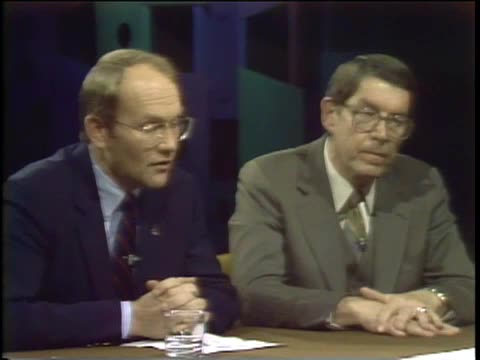
- This edition of Idaho Reports looks at the local results from the 1982 midterm elections. Marc Johnson interviews multiple winning candidates including Gov. John Evans, Rep. Larry Craig, Rep. George Hansen. In the second half of the show Johnson interviews political reporters about the election results. The journalists interviewed were: Randy Stapilus, Jim Fisher, Rod Gramer, and John Dilin Jr.
- Series Description
- Idaho Reports is a talk show featuring conversations with panels of experts about Idaho state politics.
- Copyright Date
- 1982-01-01
- Date
- 1969-00-00
- Date
- 1979-00-00
- Asset type
- Episode
- Genres
- Talk Show
- Rights
- Copyright 1982
- Media type
- Moving Image
- Duration
- 00:59:36
- Credits
-
-
Director:
Sterrett, Douglas
Director: Rye, Clayton
Director: Morgese, James
Executive Producer: McNeil, Jean
Guest: Evans, John
Guest: Craig, Larry
Guest: Hansen, George
Guest: Staplus, Randy
Guest: Gramer, Rod
Guest: Fisher, Jim
Guest: Dilin Jr., John
Host: Johnson, Marc
Producer: Malone, Eric
Producer: Wissel, Paula.
Producing Organization: Idaho Public Television
- AAPB Contributor Holdings
-
Idaho Public Television
Identifier: 22.0 (Idaho PTV Tape #)
Format: U-matic
Duration: 01:00:00?
If you have a copy of this asset and would like us to add it to our catalog, please contact us.
- Citations
- Chicago: “Idaho Reports; 1982 Election Analysis,” 1982-01-01, Idaho Public Television, American Archive of Public Broadcasting (GBH and the Library of Congress), Boston, MA and Washington, DC, accessed May 2, 2026, http://americanarchive.org/catalog/cpb-aacip-328-8279cx8r.
- MLA: “Idaho Reports; 1982 Election Analysis.” 1982-01-01. Idaho Public Television, American Archive of Public Broadcasting (GBH and the Library of Congress), Boston, MA and Washington, DC. Web. May 2, 2026. <http://americanarchive.org/catalog/cpb-aacip-328-8279cx8r>.
- APA: Idaho Reports; 1982 Election Analysis. Boston, MA: Idaho Public Television, American Archive of Public Broadcasting (GBH and the Library of Congress), Boston, MA and Washington, DC. Retrieved from http://americanarchive.org/catalog/cpb-aacip-328-8279cx8r