The Rochester I Know; 308; Jerre Mangione (Update)
- Transcript
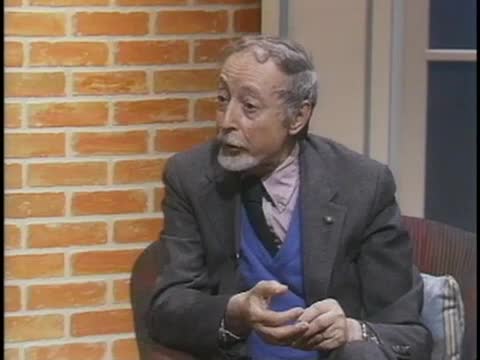
Hi I'm Bill Paris welcome to the Rochester I know. We're very happy to have as our guest today Jerry Mann Joni hasn't been here since well last time and it was about 1983 Jerry's back in town today to attend the opening among other things of the play model a growing Jeeva theater based on his book written in one thousand forty two Allegro Jerry Mann Joni welcome. You have certainly accomplished a great deal since 1942. We'll never get to everything. We're going to try to cover two things in this half hour. Your latest book your eleventh book Life Story five centuries of a talian immigration in the United States. And we're going to try to talk a little bit about model they grow in the play based on your book. Model they grow. Jerry welcome again. My last story is just published is it. Yes yes in September. September 27 to be exact. I won't pretend that I've read it but I've read the reviews and they are all
outstanding. And it has to be selling. Tell us a little bit about it and what it actually says. Well when I started to think of writing this book at first I told a publisher who wanted me to do it that it would be impossible and that they couldn't possibly pay him enough money to have a large enough research staff to for me to utilize for purposes of this broad and at that time the purpose wasn't that broad. I thought I was going to do a hundred cheers of the Italian-American experience. And the more I delved into the subject. Oh by the way I did get to research grants and so I had no alibi. I had to go on. You were committed and I was committed. The National Endowment for the Humanities gave me two consecutive grants to do the research and I had a staff of students who did a good a great deal of it. How many years did you spend on this theory. I would say about 11 years and here's the bibliography is
extensive. So the research just has to be incredible. It was is this is just a kind of a definitive work on the Internet you know there's never been any work as comprehensive and a subject published in English and I don't believe in any other language. Now you say 500 years from the discovery of America 500 years ago to today but the concentration is really what in that period between 1880 and nineteen twenty. Well it's right up to date you might say it's from Columbus to quote more Madonna if you will. Two outstanding from two and outstanding character characters by the way I had an award only last week from Governor Cuomo of the Columbus Award for lifetime achievement and that was very pleasing of course coming from the governor. I read that he also gave this very high review but didn't quite get it in the book or in the end. Yeah I'm.
Yes that's right. Well I was glad to get it anyway and maybe hope the publishers will do some advertising and incorporated less story it is just out it's been out a couple months here we are we're in late October and it's being now sold in bookstores all over the country I presume. Yes Harper Collins Well it's already gone out of the first printing and there will be a second printing within a week or so. The Italian immigration in LA Story is primarily from southern Italy Southern Italy 80 percent of all the immigrants who came to this country came from southern Italy. Now why. Well there were a number of reasons and this is why this book which originally started it with the concept of a hundred year history turned out to be 500 years. I realized as I went into the research that you could possibly explain the answer to that question why. Why would a people
who had difficulty getting to the next town or had little desire to do any traveling. Why would they suddenly leave the country. To which they had been attached and their ancestors had been attached for centuries and cross an ocean to go to a land where they encountered hostility where there was another language and certainly the more I realize that you had to have some explanation of that the more I understood that I had to start from the very beginning. The reason the main reasons were that the marriage between the north and south was in the attempt to unify Italy you know Italy for a long time after the Roman period for a long time was not a nation. For example Columbus was not born in an Italy that existed as a nation. Neither were the other explorers.
So John who became John Abbott. So this was a country of several different states. If I remember a little bit from history was a Garibaldi who try to write it tried to hold it together. They're going to straighten me out sure garble they had a great deal to do with the military aspect of bringing it together but I think the basic thing to remember is that north of Rome all these regions except one from which came McGovern of the Cold War. And King Emmanuel. All these other states were under foreign domination. Austrian Air France the south below Rome was first under a Spanish tyranny and then followed by Bourbon tyranny where people weren't able to travel at all where they were
really treated as a feudalistic part of a feudalistic society. Done alone comes the Mazzini the great philosopher the man who had the idea that Italy should be united. In fact it should be the leading nation in Europe he's very ambitious for Italy and it it it was a movement called a resource you meant to resurgence you know of it as a nation. And so the poor man became an exile very quickly of course he got kicked out of the country and in danger Garibaldi also had the same aspiration. He was against a monarchy at first but he realized toward the end that without the help of Piedmont it would be very difficult to have a united Italy. So finally I won't go into all the details because there are too many of them but they are described very well very vividly and in the book. Finally we became partially united in 1861.
It's easy to remember that year because of it. President Lincoln offered. Garibaldi commission in the army. He wanted him to be a general but he was in exile and he was in Staten Island. So he went to St.. That's a little known part of the civil war there that come to the fore. Well anyway it was waiting of course for the resorts to start action. And that's where that's the kind of action he wanted to see because if he was set on the idea of course of trying to unite Italy into a nation in eighteen sixty one. This was after Gover Bali had invaded Sicily thrown out the Bourbons with just a small army but a great deal of local support from all kinds of elements you might say including sometimes Brigance who who were you know who felt that enough of
the bourbon a tyranny that Italy that we ought to be one nation and to have a certain for all the freedoms that go with a democratic nation. So that Garibaldi succeeded. He and his army practically had to walk right up to Naples and Naples he was met by the King of Italy humano Ali who declared. It really to be a nation even though they were still in Rome was still to be taken to Papal States. The rest of northern Italy. Italy became a nation and the king Emmanuel was the was the chief was the monarch and are very very intelligent
in a way Machiavelian a prime minister became the prime The prime. Well he was the prime minister but he was really a primary source. Then what started D-Day in the migration and in the 1880s began a large crush about migration. Yes in 1870 not to 1871. Oh I must tell you that within weeks after Italy had become partially United it within weeks there started in the south the same country that they thought he had more or less conquered. There started a series of peasant revolts. And the idea behind this present result revolts which was financed both by the the papal authorities and also by the bourbon king who wanted to go get back on the
throne. This this movement to create chaos enough chaos so that it would become evident that it wasn't going to work this unification. When continued for five years it was brutal. There was an army of a hundred thousand Northern soldiers trying to put a stop to it. It took them five years to put a stop to it. These were the same people who had accepted Garibaldi and were now fighting for the for the bourbon King and for the papacy. Anyway this is Syrians were the only ones who didn't join in that endeavor. They were damned if they were going to fight for the Bourbons. I mean there was that so much hatred for the for the bourbon rule. So. So finally there came the unification of Italy but it was a
unification in name only. I mean there was still a great deal of grievances were a great deal of grievances in the south. For one thing. It was sort of thrown aside as he put it like a lemon peel that's been. And he went he went into some Arlen where he lived and and made a few attempts to get back into the action but was not allowed to. In fact he was fired upon by the very same people who had the Senate who had supported the mission of trying to get rid of conquering the south. That's a fascinating history Jerry and I'm sure it's a history that's going to be new to many of us. The story is really the history isn't it or the story is what it means the story of the Italian word for history and story. For example if you if you told me a joke I would say well tell me another story. You don't think about it also your parents came from that southern part of Italy where just
migration from Sicily. When when did that take place. Well the day came and the early part of this century. My mother came first to join her. Her brothers two brothers here and also her for her father. I barely knew my grandfather. I just remember him on the day of his funeral but my mother came. In order to join the rest of her family which was already here and they had left for the same reasons that many of my other relatives and many other southern Italians had left the South was being used as it was being treated as colonial as a colony. The they were paying more taxes there they were expected to give to send their sons into the army. People these people had no sense that they this was one nation that
they should be fighting for a country called Tali. Some of them thought it was the name of some northern town in Queen. They didn't realise that that was the whole country. There was a great deal of disparagement of the Southerners. There were. An internationally known psychologist who claimed that the Southerners were inferior to the northerners by the measurements of their foreheads alum but also was that it is a great book. But what was the promise in America and was it with a promise whether it's a obvious weather salesman in southern Italy to say you know come on over we got this for with those two. And this this was an exploitation they were this. This was called the padrone a system where somebody somebody would come over and usually applies how know in a village and talk these people into into leaving their families going to the country which of course exaggerated the
wealth that would come to them. Some of those people actually believe that there was gold in the streets and it is only up to them to go there and pick it up. It was it was crazy that the kind of salesmanship that was used to alert these people over there and they came because as a as a relative of mine told me years ago an old man. He said. He said in order to keep our families alive we would have had to steel that was the only way to get along. The economy was no good. The northern government had taken away what little industry that they had. And the South is not is not a great place for agriculture I mean it lacks waterways and so on and so it was a time to either star or else leave. And there were a number of things that
contributed to there were academics epidemics in the south there were earthquakes famous. Terrible earthquakes here you just convince me that I'm sure this is all in the story it's all in gotta go through but we've gotta get to Mt Allegro we've got to get to to Rochester New York. Family came at the turn of the century. You were born here about 19 0 9. That's exactly it. Every day I recall because I was a first born and you were and you grew up in an area that's now occupied by a soft drink plant Coca-Cola bottling plant with a barbed wire fence around it and a few yards away is where my father used to make his wine and share it with his son. What now what this is all going to be in the play that it is opening at a theater here in Rochester model they grow. Will this be the story in the play of your boyhood and growing up in model they grow. Well Martin Rochester Well to some extent but of course it can't
emphasize that aspect but the the man who plays who who plays the part of the narrator is myself. I think you know an actor plays you and they grow. Yeah yeah. He's the narrator and and then I think I am more than one person there is get older of course it takes an older person to personify me you haven't see the play but you were a consultant to the play model a great yes. Yes I read the script and what do you think. You often and often writers look at a script. I'm thinking primarily of Hollywood movies I say well you know they didn't do it by the book or by work. Well I had another experience early on when Allegro was published and there was a script written. I thought it was terrible and I said so even though there was a producer ready to produce it. But I thought it was terrible. This is
another study. I mean that the Rochester study I read the script and I I think it has great possibilities and I hope to see them realize Saturday when I see the place you and other members of the main Jony family are we're going to go opening night too. Oh yes he is are yes yes and yes I think all the members of the man joining family will be there. Do you remember the street you grew up on or the street you were born on here in Rochester Of course it was cold street seal well is it still there and it's it was between Lowell and Clinton Street. It's only really where Clinton is. The streets are all gone the Clintons you know what's left in your neighborhood. Well in the old model a groat which was the name you gave to your neighborhood No where did mine Allegro come from where where did that name come from.
Well it came from liking the sound of Mount Allegro which happened to be a small town on the outskirts of the the places where my parents came from. There's a small town near our bridge and two months allegro and I like the sound of it and the publishers had one call in various names which I thought were terrible. The unholy three was one of the titles they suggested the unholy The Young and an occasional force. Who was that these were the three cronies my father and two of my uncles and they used to play cards all the time and exchange all kinds of stories and that's where I first really acquired a sense of narrative model a gro wasn't entirely in Italian community was it. No no no thank God was not like I think I was fortunate in that MT Allegro was of mixed
ethnic. Population there were first of all most of them were Jewish. Next came the polls. And next came the surgeons. Many of which were my relatives. And this constituted it was a wonderful ethnic mix. I think it's the best thing that could have happened. When my parents moved away from a little along Saio street that was a little Italy an enclave and the Irish and and some of the other and some Anglo Saxons. Many Anglo Saxons in the area that became MT Allegro could not stand the invasion of these foreign elements and the Jews and Italians. So they were moving out and real estate prices went down so far down that my father felt courageous enough to buy a house in that area and
help him. Jerry your mother and father could not speak English not at first know my father of course got out into the American world and picked up English pretty well enough English at one point to tell his boss what he thought of him and got fired. You're the son of a comparatively poor Italian immigrants. You went on to become for the lack of a better word unintellectual in high school. You know I know you were the editor of a high school paper you went on to become a intellectual at Syracuse University and graduate school. How does how does something like that happen. How did it happen. Well it happened because I was a mess as a child I was I was pathetically shot. I was I was I was afraid of everything I was sickly. My mother told me a number of times after I had passed that stage that she was rubbing me with custard raw not olive oil. CASTRO
I think it was castor oil that may have been allied with castor oil that's right some. I was I was I was a weakling in every sense of the word. Well I also realize that being a weakling. I was outside the general group the family would go out to a party and gerrymander would would be at home reading books. I devoured books any kinds of books. It didn't matter what they were. I mean children's books intellectual treatises all sorts of books. I was I was fascinated of course but the books that were told in narrative style. And that narrative style was augmented by the narrative starlight heard orally from my relatives. I don't want to give away everything that happened to you and model a girl because the play A diva is now on model they grow and I guess you're the central
character in it. It's taken 50 years for the play to come about. You wrote the book in 1942. It is 50 years later the play finally comes to fruition. I want to congratulate you. Thank you before we leave the last story yet. JERRY Yes. Is there a story in here that that appeals to you. You know it's a pretty serious book about immigration. You know in those days it was impossible for a woman to make a living on a row nor support a family. Well in this case let's call them Giovanni I can't remember his exact name went off to the United States and he had a hell of a time sending back money back you know to take care of him so. But he also had to take care of his family back there and so he would send money orders. As often as he could his wife was demanding more money orders because it wasn't quite enough. So finally he wrote a letter in which he said this is all I can send you and things are tough
here I'm having a rough time making money and that's all that's all that's all. He had picked up enough English to come as happened to many of the immigrants here to combine English with with a tag and he assumed that this was an English word. So the word appears in this letter that went with the money order. The wife takes the money order to get to the post office. I think it was to have that cash and the clerk gives her the money. The money for the money order and she thanks and then she said but where's my song. He said there is no help. She said there is an I have a letter here my husband such So that's all it says so in the letter. And she's very persistent and finally he says well he says if you will step into my office so she
steps into his office and he makes love to her. And so then she when she realizes that she had become pregnant while later she writes her letter and she writes a letter to her husband. She says I need more money she said but don't send me that song. We have enough children. That story of the book Love Story a spiral that marvelous story and Love Story is your eleventh book you're being honored for at present here in Rochester. Finally you know a dramatization of everything Monica let me know home of last week. My guest today is Jerry Mentone. See you next time. If you'd like a copy of this program send 1095 to WXXI post
office box 21 Rochester New York 1 4 6 0 1.
- Series
- The Rochester I Know
- Episode Number
- 308
- Episode
- Jerre Mangione (Update)
- Contributing Organization
- WXXI Public Broadcasting (Rochester, New York)
- AAPB ID
- cpb-aacip/189-89r22j0z
If you have more information about this item than what is given here, or if you have concerns about this record, we want to know! Contact us, indicating the AAPB ID (cpb-aacip/189-89r22j0z).
- Description
- Series Description
- "The Rochester I Know is a talk show featuring in-depth conversations with local Rochester figures, who share their recollections of the Rochester community. "
- Created Date
- 1998-08-20
- Genres
- Talk Show
- Topics
- Local Communities
- Media type
- Moving Image
- Duration
- 00:28:41
- Credits
-
-
Interviewee: Mangione, Jerre
Interviewer: Pearce, Bill
- AAPB Contributor Holdings
-
WXXI Public Broadcasting (WXXI-TV)
Identifier: LAC-1030 (WXXI)
Format: Betacam: SP
Duration: 1680.0
If you have a copy of this asset and would like us to add it to our catalog, please contact us.
- Citations
- Chicago: “The Rochester I Know; 308; Jerre Mangione (Update),” 1998-08-20, WXXI Public Broadcasting, American Archive of Public Broadcasting (GBH and the Library of Congress), Boston, MA and Washington, DC, accessed April 4, 2026, http://americanarchive.org/catalog/cpb-aacip-189-89r22j0z.
- MLA: “The Rochester I Know; 308; Jerre Mangione (Update).” 1998-08-20. WXXI Public Broadcasting, American Archive of Public Broadcasting (GBH and the Library of Congress), Boston, MA and Washington, DC. Web. April 4, 2026. <http://americanarchive.org/catalog/cpb-aacip-189-89r22j0z>.
- APA: The Rochester I Know; 308; Jerre Mangione (Update). Boston, MA: WXXI Public Broadcasting, American Archive of Public Broadcasting (GBH and the Library of Congress), Boston, MA and Washington, DC. Retrieved from http://americanarchive.org/catalog/cpb-aacip-189-89r22j0z