Speaking of Rochester; 121; Eric Pell
- Transcript
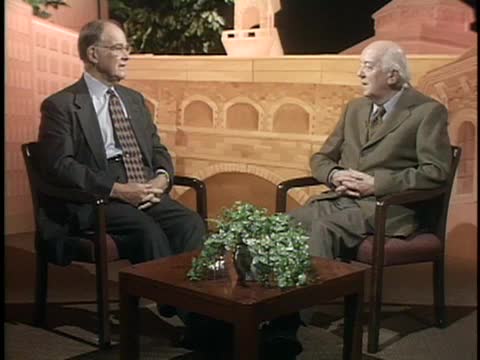
How do you do ladies and gentlemen. I'm Barbara Connell and this program is called Speaking of Rochester. In the course of this program we'll talk to one of the pillars of our community about Rochester's past its present perhaps its future. We will be talking about greater Rochester and I guess today as a man who lives in Webster. He's an old longstanding friend of mine. Eric Pell who has been in research management at the Xerox Corporation. For approximately twenty eight years. He has recently written a book mostly for personality and Xerox but it may be published in bar generally. But the history of Xerox and I thought it might be interesting to talk about this tremendously important corporation tremendously important from the point of view of the Rochester area. Eric welcome to the program. Thank you Barbara. Let's get through some vital
statistics first you were born in Sweden. Yes. You came at a very early age to Milwaukee 80 years old. Yes. Eight years old. And you then I. Prospered in the Milwaukee School system apparently because you were take it into an interesting educational experiment called Deep Springs junior college in California correct. Which was for a particularly gifted students. Your your education was interrupted by the war right by World War 2. And you went into the Navy and studied in the naval training courses in colleges at Marquette University in particular in my hometown which was lucky. Oh yes that was lucky. And there you are you. You study chemistry. Nope electrical engineer Oh well used were. Did you start in chemical engineering. Deep Springs that was my interest. Oh I can't seem to be much stronger in electrical engineering
so I switched and after that you went to Cornell. That's right after the war was over. Well I first went to Cornell to midshipman school and then through the radar training program and then I went back to Cornell after the war right. All right well so you had a you had a good start in technical issues already. But there you are you acquired a Ph.D. in solid state physics. Is that correct. And study you took your degree under Robert Sproing later as a correction at the University of Rochester Yes. Yes and a member of not only of Deep Springs but of the Telluride association where you and I first met exactly both members of that another educational experiment that a scholarship group that was that was particularly interesting because of the careers of the various people it seemed to have followed thereafter. Yes that's right as well. Then you went to work for General Electric for 10 years after you had your
Ph.D. in solid state physics. I suppose assumed doing research in either my real research that's right and following that you came in 1961 to Xerox. Now that must have been an exciting time in Xerox. That was the most exciting time and all of Xerox is history really that's what. When they were when you moved from a small company to a very national giant success was just arriving with the 914 the 914 was a copier. Yes. Very famous copier. I said sure everyone in your Rochester audience knows all about it. Well there's been a lot of famous copiers that have come out of Xerox and after a period of. The difficulty they are now back on the top of the world again I notice the stock is doing very well and I assume that you are able to compete anywhere including in
Japan. Well I hope that their latest machine their docu tech machine will be used to publish my book because it is a marvelous way to publish a book. Very well Eric. I'd like to go over it with you. The early history of Xerox and how it came to be formed. We all have heard names to conjure with like Chester Carlson and Joe Wilson. And these men apparently were important elements in the early conception of xerography as a means of reproducing documents. Well Barbara it's such a fascinating story really it's I don't think there have been many stories like it in the world's history when it comes to technological histories. The elements that needed to come together the very unusual inventors Chester Carlson.
Unusual as an inventor because he was not your typical inventor by a long shot he was more a visionary wasn't visionary. He was a superb patent lawyer as an inventor. He conceived of this remarkable invention because in large part he had a need for this himself he his youth was very difficult. We could spend half an hour just talking about about how his remarkable ability to rise from extreme poverty and a father who had spinal arthritis as well as tuberculosis and a mother who died early in his life leaving him to support his arthritic father in spite of that he managed to make his way through the California Institute of Technology and graduate in the upper quarter of his class. Just at the beginning of the Depression. I mean it was virtually impossible to find a job. He wrote to 80 companies trying to get a job
all with negative responses. Now remember he had a bachelor's degree in physics which is not an easy. Diploma to market in under any circumstances but nevertheless. They're finally arrived some visitors from Bell Laboratories. And they hired him. The job they gave him which was to test microphones and do rather technician kinds of tasks didn't appeal to him. And when one of their patent lawyers came around to describe what the patent department was doing he said that's for me. I want to get out of this humdrum laboratory work. And he switched to two patent department he was not an attorney but he became very skilled in the use and development of patents is that correct. Yes and in the writing of patents and writing in particular writing his own. In his in his youth he spent a great deal of time analyzing himself trying to figure out when to be good at 20 and not be good at his
notebooks are full of this. He meant various periods of his youth. He didn't think very much of himself he thought he'd never succeed he was too quiet he wasn't socially well-adjusted and he couldn't use his hands well he couldn't do this he couldn't do that. But he knew that he had a great brain great mind and he thought he might be able to do something say in theoretical physics possibly. But he also kept always call back toward invention of something that he wanted to do and how he didn't actually invent the elements of the xerography did he. Oh it depends what you mean by the elements. He invented the concept you knew that he wanted to use electricity somehow you knew that he didn't want to use photography because he his feeling was if there was anything there to make a new copier out of Kodak would already have done it and I was I was crazy to try to do something in photography. He thought that electricity hadn't been exploited. Properly and that there might
be some way to make a copy or using something elect electrical phenomena. Now you have to remember that. He himself had a great need for a copier because he worked was arthritic. After he left Bell Labs. This is the depression the job didn't last. He joined a law company as a matter of fact after after Bell Labs. That job didn't last either. You know ultimately join PR Malory and their patent department and you'll stay there for 10 years and ultimately became head of the patent Department. But in this period of his life. He was also trying to earn a law degree. You can be a patent lawyer but you couldn't be a patent attorney. So you wanted to. So he went to night school for that. He also wanted to invent something this was a driving passion and his own work as a patent lawyer and trying to to his attorney's degree he had to use the library a lot and with his arthritic hands the copiers were next to impossible to use if he wanted to copy
diagrams had to be done by foot offset anything else had to be done with carbon paper. When he found he felt from his own users of the world really needed a better way to make copies. That's why he was driven to this and he read a lot about how you might do this and learn something about food or conductivity because he knew that he wanted to use electricity somehow and somehow to reach this this concept that you could take some kind of food or receptor and charge it. And then discharge it with light with some sort of an image on it and used the letters to still retain charge to retain some kind of dust or dirt that you could float over the plate. Somehow you could transfer that to a piece of paper paper and fuse it. He didn't know how to do those steps. He just knew those steps had to be in it. And he wrote an absolutely superb patent that covered all of these elements in his patent where his invention and had a patent and invention but something that
really did. He couldn't sell to anyone he couldn't sell to anyone and there wasn't any mechanism that could be made out of this that would do it. He had to hire somebody to make the mechanism is that it. Well he first hired somebody to reduce his to practice. He wrote a patent before reducing it to practice because he knew how it ought to work. In other words he was a visionary it was a vision is very much a visionary and he hired I took or night to reduce his to part of corn I k o r and is that right. Yes and and he was a scientist also more of a technician you did not you grew to become a very highly respected engineer. But initially he was sort of a technician he knew how to use his hands he was clever. Now the two of them together then made something up that it was not immediately successful. No they didn't know and I know after he had made it. Went somewhere else.
Yes they made an image and said ten twenty two thousand nine hundred thirty eight. Astoria. And this was the reduction to practice. But Otto knew how he had made this I manage and looked at the quality of the image and shook his head and said This is not for me and left for another job. Well then. Then Chester Carlson went to the Battelle Institute and while he didn't go to the battell Institute he was he was still working for PR Mallory. And Battelle hired him and were hired Mallory and the consultant capacity in connection with some sort of a patent that one of their customers wanted to get through the patent Department. Well if they were in other words because he was in the patent department there that's right. That's how I got the association with battell. That's right and one of Patel's men came down and spent the day with him and there was an hour left over before his train left and and Chester said.
By the way does Patel ever handle anybody else's patents and the man said No we don't do that. And so he pulls this patent out of his drawer and you said Well you showed it to dismantle. Do you think I'd be interested in this and he said well let me take it back to Patel and see if they might be interested. And he did. That's how it was a research institute in southern Ohio Ohio I was a research for hire and they had just started a new division for the graphic arts. They were initially in the metallurgy the iron and steel kind of business. That's that's where I gained their money and initially. But they started this new division because in connection with some new knowledge they had regarding copper they learned how to make a much better copper offset plate. So there's I well maybe this is a good line of research to get into. So they
hired a man by the name of Shefford to start this department he was an expert and also said you know how do we get from there to the Halo company. Well you're not quite there yet. But. But I was very interested in this because because. The towel was not interested in making a product Patel's marketplace was for ideas that showed great promise but needed a hell of a lot of development work before they would come to fruition. They were selling development work that was that was their their their their business especially. That's right. And here was a concept that was just brilliant I mean if this succeeded it would change the world obviously. But there was no way to make it work with what Carlson brought to them. But this group already had in it some really brilliant scientists who took a look at the Carlson's patent and what it needed and they had some ideas of their own
the. And they said well we'll spend six months at this and we'll see if it has any promise. And in that six months they nearly solved most of the basic process steps of Carlson's improve them enormously so that it really had promise and. On the basis of that. There was generated an article in a radio news magazine which Kodak now get to how Hillary got involved in it. Kodak had an excellent patent abstract service that John Deseret had a halo I was following because you know it was making what then. Here I was making photo off study equipment photo nonsense especially papers and photo offset. They had combined with a company called recta graph that made it very specialized for the last machine. My head spinning with all these there were no different organizations getting involved. That's right it was just that's what makes history so fascinating and all of these started
in 1996 Chester Carlson was born the year Lloyd company was formed the rector Graff company was formed in Oklahoma City and all of these now came together around. The late 1930s early 1940s because Chester Colonel. John does Star saw this article in radio news about this new process that Patel had. And he went down to see this process and he thought well this is maybe what what he Lloyd needs to launch a new business to get them. He's gone through the depression making photo offset equipment for the U.S. government. There was a big market for that or making photo offset paper that the government uses and after the war that market plummeted and Japan started invading their market with photo offset papers they were a lot less costly than here Lloyd's. So they needed some sort of they were going to fail if they didn't get something better. They needed something is true and Halo. Company
included Joe Wilson is that correct. Yes yes. And Joe and Carlson got together and where else and encourage them to go to see if they could get a license. Well does Howard told Wilson about it and Wilson had they were had a sort of a semi partnership with another small firm in New York City. So they asked one of the scientists there to go talk to Carlson to look at this process and Carlson still had the basic patent under license to do that though. Yes and as a result of that this this man said it looked promising so does our visited to tell. Then he came back with Wilson and Wilson and does our book became quite excited about this. And another another visit they brought salt when it's learned in the woods alone. So although there was the lawyer here from Harris beach that's right. Etc. etc.. That's right yes. Then a witch wasn't that excited about it. They showed him the same demonstration that had so
excited Wilson and thus far he looked and he said that's it. I can understand if you are a little confused it sounds like well a whole lot of small pieces coming together and a lot of coincidences and personalities that were involved. That's true. That's right. But but hey Lloyd then got a license from Patel and started to manufacture xerography. Not quite. There had to be a lot of development work there was first this very brilliant work at Mattel the most brilliant part of which was the invention or the discovery of a new food receptor amorphous selenium that made all the difference. I don't don't get off and morph Well I'm not going to tell you that I mean what mislead it made it made a big difference. It was still enormously sensitive. Whereas before to make a zero graphic image you had to put the original on the plate and shine a bright light on the paper had to be a contact exposure.
With this much more sensitive material the more for selenium you could now use a projection image. You could make a copy of either side of an original and you could do it fast. And as time went on faster and faster and faster. You know I had something that that could really make was the beginning of a copier and it was this promise that that is a matter of fact Kodak site about the same time. Now what was all this this was in the early late 40s early 50s or early 40s early 40s. Well when did halo I didn't become Xerox until six thousand nine hundred sixty. That's right. But during the 50s then they were they were testing the product and market beginning to market it. Well they didn't know how to make a copy here. They made this very cumbersome thing called the flat plate copyright something like thirty eight process steps to make a copy. Nobody wanted to use it. They tried to market this machine
where you had to go through all these steps to make a copy. People just shook their heads and said no we'll take very facts we will take thermal fax of copier techniques that were available everywhere almost out of time here. It sounds to me as if we've we've we've seen a picture of the American genius at work. Yes. And probably the single minded. Drive behind it came more from Chet Carlson than anyone else did it. Although many many people made major contributions to the generation of his era it was Carlson the tell played an enormous role and they Lloyd played an enormous role. Joe Wilson was tremendously important for the management and promotion of it. That's right. Well tell us how big a Xerox at this point. I can tell you the number. It's huge it's worldwide it's the xerography is one of the major reproduction methods ways of putting black marks on paper in the world today
changed our whole world. And and. But do you have any idea how many employees there are here in the Rochester area. You know several thousand many thousand. Many thousands I would think because this is the major manufacturing. Part of Xerox. Well I'm probably not that they're manufacturing segments as large in Japan and England and I guess now in France or Belgium also so it's the world wide operation worldwide out originally staged out of Rochester right. Yes yes yes. And and I'm sure the wages there are very good. I hope so. Contribute well and contribute just contributes very heavily to the Rochester economy and Xerox. Oh yes I thought you meant worldwide. Oh no but but here in Rochester. Oh yes. And and it contributes very heavily to the reality that Rochester at the Rochester area on a per capita basis is one of the largest export ng.
I think it probably is the per capita the largest exporting community in the United States. That's right. Both Kodak and Xerox do that but Xerox makes a major contribution because it is a worldwide operation. Oh yes very much so. And all this is developed since the 50s in the 60s when when all these various people you talked about were ironing out the bugs. That's right. And trying to find some way of putting it all together in a hard on that it machine automatic useful machine. And I was the big problem. Yes this is part of the genius of America isn't it. It is that we're able to have the kind of society where people can get together and resolve problems and and generate things that will improve the quality of life for people everywhere. And it took in one enormous cooperation between between between inventors and the tile. And he lied. And between businesspeople to tell people he lied people and then
worldwide the rank organization as you know became a big the writing organization was important in it why am I going to head this all ultimately operating to the significant benefit of the Rochester area. Exactly. It has well it's also one of the reasons that so many find. Scientific minds have come here including yourself. And have created a labor force that has made Rochester something of an oasis in the vast wasteland of western New York. That's true that's true. Well that's something worth preserving. It is something worth preserving in its AIDS obviously. Obviously it did not arrive full blown it had to be manufactured by brilliant minds and by people of constant purpose like like Chester Carlson. And it's always in some danger of disappearing always in danger it is very you have to make
constantly progress don't you. That's right. Well thank you very much for explaining this complicated process of development to us as you can see to take another hour they get another hour to go through all of this. Ladies and gentlemen our guest today has been Eric Powell who has been in research management at Xerox since 1961. He retired in 1909 now lives in Webster New York. We are most grateful to you for the description of your the substance of your book and for the discussion of Xerox as a force here in the Rochester area. Thank you thank you thank you ladies and gentlemen for being with us today. And speaking of Rochester I'm Barbara Kopple. If you'd like a copy of this program send one thousand ninety five dollars 50 cents shipping and
handling Post Office Box twenty one to New York.
- Series
- Speaking of Rochester
- Episode Number
- 121
- Episode
- Eric Pell
- Contributing Organization
- WXXI Public Broadcasting (Rochester, New York)
- AAPB ID
- cpb-aacip/189-881jx2qq
If you have more information about this item than what is given here, or if you have concerns about this record, we want to know! Contact us, indicating the AAPB ID (cpb-aacip/189-881jx2qq).
- Description
- Series Description
- "Speaking of Rochester is a talk show featuring in-depth conversations with local Rochester figures, who discuss the past, present, and future of the Rochester community, as well as their personal experiences. "
- Copyright Date
- 1998-00-00
- Genres
- Talk Show
- Topics
- Local Communities
- Media type
- Moving Image
- Duration
- 00:27:14
- Credits
-
- AAPB Contributor Holdings
-
WXXI Public Broadcasting (WXXI-TV)
Identifier: LAC-836 (WXXI)
Format: Betacam: SP
Generation: Master
Duration: 1606.0
If you have a copy of this asset and would like us to add it to our catalog, please contact us.
- Citations
- Chicago: “Speaking of Rochester; 121; Eric Pell,” 1998-00-00, WXXI Public Broadcasting, American Archive of Public Broadcasting (GBH and the Library of Congress), Boston, MA and Washington, DC, accessed April 2, 2026, http://americanarchive.org/catalog/cpb-aacip-189-881jx2qq.
- MLA: “Speaking of Rochester; 121; Eric Pell.” 1998-00-00. WXXI Public Broadcasting, American Archive of Public Broadcasting (GBH and the Library of Congress), Boston, MA and Washington, DC. Web. April 2, 2026. <http://americanarchive.org/catalog/cpb-aacip-189-881jx2qq>.
- APA: Speaking of Rochester; 121; Eric Pell. Boston, MA: WXXI Public Broadcasting, American Archive of Public Broadcasting (GBH and the Library of Congress), Boston, MA and Washington, DC. Retrieved from http://americanarchive.org/catalog/cpb-aacip-189-881jx2qq