The Rochester I Know; 411; Irving Mann
- Transcript
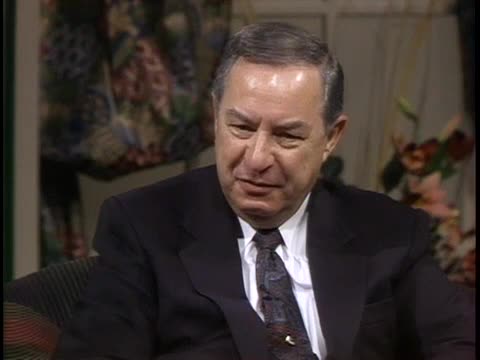
(Opening Music) He is the product of eight generations of jewelers. As a teenager he spent weekends and summers in the shop of Al the watch doctor which was nice since Al just happened to be his father. Upon graduation he was drafted into the army and landed in Europe on D-Day plus one. After being wounded in combat he returned to Rochester, took courses on watchmaking,and opened his own business. With the help of a ninth generation of jewelers, he carries today the largest variety of watches and jewelry in western New York. Today Bill Pearce talks with Irv Mann about the Rochester he knows.
Hi I'm Bill Pearce. Welcome to the Rochester I Know. My guest today is Irving Mann who's had a remarkable career in Rochester for most of his life even though Irving you grew up in in Buffalo,New York, I have to ( garbled ). So we've got something in common. Started up with something about that Buffalo weather maybe. But Irving Mann welcome and thank you. We know we see you on television quite a bit, all sorts of channels, talking about your business and we'll let you get a plug in for your business later on. Thank you. But not right now. Now we want to talk about you. Where did you grow up. Well actually I was born in Buffalo, New York but at about three years old we've had some tragedies in our family. My grandfather had a jewelry store in Buffalo, New York with my father. And when my grandfather passed away, and we had some, and my uncle passed away who was in the business of the time. Your uncle and your father and your grandfather all had the same business right. What was what was the business called. Louis
Mann and Son. Louis Mann and Son but unfortunately we had over a period of about 18 months, grandfather,uncle and grandmother all died. My father was devastated. Terrible. Closed up the store and then came to Rochester. Why did he decide to come to Rochester? Did he ever tell you? Actually he looked around in this entire area. He'd gone to Owego and Oswego, and places and finally decided Rochester would be a good place to live. That was his impression. He also had some relatives here and which made it even easier. And so he opened up, eventually opened up a little store right at the corner of North and Main called Al the Watch Doctor. Your dad's name Al? His name was Al. And Alexander Mann and he opened up the store at that time 1930. Now this is right next to Sibleys? Right across the street from Sibleys. Where Sibleys department store that used to be there and it was a triangle building there which used to be which is now the liberty pole and the liberty pole
marks the spot where your dad's jewelry store was right. Right there was a triangular building there that housed a few businesses and he was one of them. And he was there from 1930 to 1960 . And during that period of course after school and on weekends and summers. That was my training ground. Your dad is there 30 years. He was there 30 years, right. And where did you live. Well we lived in Wilton street in Rochester and I had gone to Number 26 school It was my elementary school which eventually was changed to Paul Revere I think and then to Washington High School which was changed Edison tech. Can you remember anything about your elementary school days? At school 26 now Paul Revere or was. I remember a lot of the people there but it was a nice neighborhood, it was a nice place to live. People there were ethnically mixed. So we had a pretty good grounding in getting along with people of all types. And it
was just a wonderful place to grow up in. And I remember it with great fondness. And then we moved to and, and then unfortunately Washington High School was closed. I don't think because of me or whatever. But what did you do at Washington High or what were you interested in it. Well writing as a matter of fact. That was my hobby. Short story writing and I thought as a matter of fact I was convinced that at some time I was going to be a writer and would try to follow that through with the liberal arts and that sort of thing. And but in the background of course was the training of the family. And we've gone back so many generations in the watch repair and jewelry field. That you helped your dad. Right. What did you do. Well I watched him fix watches and I tried to fix them and he gave me some instructions. And it wasn't the same type of intensive training that you get in the school. But it was hands on type of thing. And talking with people and getting to converse with them and getting a one on one relationship with, with individuals
and I found I liked it and that was always I guess in the back of my mind. But my mother was convinced that she didn't want me sitting at that bench fixing watches like my father. So she thought that you know college and whatever career I took. Medicine of course would be wonderful. Now after your graduate from Washington High. Well I didn't graduate from Washington because Washington closed up and they moved a number of us with some of us went to Monroe with some of us went to Franklin. I was one of those for Franklin. So I was at Franklin and graduated from there in 1943. Oh boy. It's an auspicious year to graduate. It was. They handed us the diploma with one hand and the draft notice with the other. Were you just 18. Just 18 at that time. I immediately went to basic training. Infantry training. Where did you go? Well first I went and ended up at Camp (...dor), Mississippi. Well that's a different culture shock from Rochester. A shock. That was something I would never want to go through again. You were a
foot soldier. Yeah right. Just combat infantry and a rifle there right over you know then what if and then from there they shipped us to England where we prepared for our D-Day training. And eventually we boarded the ships and we landed during that event at Omaha Beach as a matter of fact it was originally was a 63 division then shifted later on to the 90th Infantry Division. [host] I'm not sure when this program is going to air exactly Irving but this is the 50th year of the of the anniversary I know you know it very well that was your first combat experience. That was the first combat experience and I lasted for about six months and the um [host] it was pretty good. [guest] Yeah it was for a rifleman. I was one of the last in my platoon as a matter of fact. There was only one other left at the same time that hadn't been wounded or killed. So I feel very very fortunate that I made it. And after after that I went back to limited duty and learned how to walk again and went back. [host] So now you were wounded where? [guest] In the leg but as far as the
location. [host] Where was the place. [guest] The place would be crossing the Saar River in a rubber boat. We got hit with mortar and artillery and machine gun fire and whatever hit me I do to this day have no idea but it took a good chunk out of my leg and so it took some months to learn how to walk again. [host] Where did you do this recovery? [guest] In England a place called .... which was a convalescent hospital for GIs and so we (were) there I was there for about four months and then they gave me the opportunity to either take a two week pass to France to Paris and of course I'd already been to Paris because we sort of liberated Paris. And so I'd been there so or to take a six week college course at the Biarritz American University in Biarritz France. And that would give me college credit and I already had my sights set on that. So I took the Biarritz situation. This is while you're in England. Right so we went down to Biarritz so I take this course.
And that was a six week course and it was an intensive course but it was also very interesting because they had the professors from all the colleges in the United States had come to give GIs instruction and I found it to be fascinating. So what kind of courses would you would you take. I took English and I think one math course. Took I think there were three courses at the time. Short story writing was another one and I got college credit for those. Which was which was good. And then I got a term one terms of credit, one term of credit. And then I was shipped back to do some limited duty until final discharge. Then was shipped back from from England to back to the States and was discharged in February forty six. So that was my military career. Very very auspicious. All right now how do you get into the business that you're in today. Where did you start.
Well I started by attending college right away as soon as I got back to the States. States I was able to get into the U of R. You were going to school on the G.I. Bill GI Bill. Of course that was the way to go. Yeah. And but after taking a couple of years of college. I found that the course that I wanted to complete which turned out to be medicine I decided to take that route. Looked like it was going to be too far away. Ten years of training. I guess I felt I'd wasted too much time already. [host] Spent three years in the service. [guest] Right so I felt the thing to do was to possibly go back to the family business. [host] now your dad is still has his place on the North Street. [guest] Right. [host]But any pressure there. [guest] No no he uh he didn't. Whatever you want to do so however I decided that unfortunately at the time I should say that I began looking around for training in watch repair. I saw that the training that was being given to the GIs was very, it seemed to me, to be
very elementary and really not is as intensive as I would have liked. I wanted to approach things in more logical sense. And we found I had relatives who graduated from a (muffled ---logical) Institute that's a watchmaking college. in Canada and found that they had graduated and done very very well and they were fascinated with the way in which they were taught. And they convinced me that that was a place to go. [host] Now this isn't in Toronto. [guest] In Toronto. And I still had credit GI bill credit coming [host] and they accepted it in Canada? They didn't know what to do with me at first. I had to go to the American consulate and make arrangements but eventually I got in. And it's a two year course,very intensive. They didn't even let you touch a watch for six months. It was a combination of drafting and theory and drafting and theory and it was really brought to our brought to us in a very specific and logical way so that you understand the entire workings of a watch mechanism.
mechanism. I'm very satisfied with where that went. And so. it was as I say it was. Let me interrupt there. Are watches still made the same way today when we took you know it's been so many changes and (garbled) Well it was the quartz then, the quartz revolution of course took place but for the first few years that I was in business, I sat at that bench and fixed watches for seven years years as a way of earning my bread so to speak. And until the store began to branch out into into jewelry so watches yes watches are still being made today in the mechanical concept. The same way the quartz, the quartz didn't change it. Didn't change it. There are fewer of the mechanicals out. But now there's a renaissance right now. As a matter of fact just this past couple of years the entire industry is having a turnaround and we're having people who are purists who say we want the mechanicals back again. They may not be as perfectly accurate as a quartz may be but they like the idea of having the wheels.
Best watch I ever owned I mean I to digress was something called an Omega An Omega Sea Master, which was a self winding watch. We sell them today. Which I lost one time when I was on a trip and that I was crushed. That was the best watch I ever owned. Very very fine piece. I could go on and on and on but now wait let's get you you started here in Rochester because this is the Rochester I Know. Right. Well we when I graduated. In fact I just should digress for just a minute and say that On a double blind date I met my wife when I was in Canada. Was this is in Toronto. I was in school. She was running an import export company at that time period. She was very very (garbled). Already in a business. She was working for a British firm. And so I met her and I figured well here's a girl who can support me in the style I'd like to become accustomed. So I decided to marry her and I met her
in I think it was February and we were married in August. Before I began my second year. And so then she supported me the second year that I was there and soon upon completion we came right to Rochester. And I worked for my father for a very short time, a couple of months. She had no misgivings about leaving Toronto. No, no. Living in the States. No and in fact I had to bring her over as a war bride as a matter of fact to get around all the red tape. But I brought her over and she worked and got a job immediately and she worked at her job while I opened up a store over at 158 South Clinton Avenue next to the Rochester Business Institute that existed at that time. Oh RBI used to be there across from St. Mary's. Across from St. Mary's Church, opposite the park. Opposite the park. Right we used to What is there now? Right now it's the Rochester Telephone Company. That's right there's a new telephone company. Right. So that's where you're.... So that's where I started. That was my first store. And what was the building you were in. I think it was an apartment house as a matter of fact. And the owner had a, was
very aggressive in terms of how he and inventive I should say. Because it was the lobby of the apartment house and he decided that his tenants didn't have to go through the front. They could easily go through the side. So he rented you the lobby. The lobby which was 10 by 10. 10 feet by 10 feet. You had to go up the three little stairs that you normally would have to do to go into a regular hotel lobby and then you press a buzzer so you remove that buzzer door and then from that point on the store extended 10 feet straight out and 10 feet wide and I set up a bench at the top of the stairs and one showcase and one wall case and that's how Mann's Jewelers began. And with that my wife worked around the corner and she'd come and relieve me. Just put a sign out there. And was that your first Mann's Jewelry sign. That was the first one right. It was the very first one at that time. My father of course was still in business and so we ran our business concurrently. He ran his business while I ran mine. This was in 19--. A little competition there. No as a matter of fact it was a big help because I wasn't taking in enough work
to keep us alive to start with. So he gave me extra work to do so I helped him with some of his work until my volume built up and then eventually of course within a very short time I was taking in enough work and having enough customers so that I was able to be self-sufficient. But it was a very good step up having having my father there. It's in many ways and of course he had a reputation in town. His store name was Al the Watch Doctor. And as Al the Watch Doctor he was the most prominent watch repairman in the city of Rochester. Well he was certainly centrally located there and he knew all the, knew all the Rochester notaries, I should say celebrities we had Eddie Bean. He ran his shop until 1960. He ran it until 1960. In 1960 because of a medical condition he retired. And we closed up his shop and he came in with me so it was a reverse case. So you were both over in your place. Right he came to join me. In your little ten by ten.
Well by that time I had pushed out the walls of the first apartment and took over an apartment that was behind my current door. And eventually extended it to where we had one hundred fifty square feet instead of a hundred square feet. Then we added another apartment and made it two hundred fifty square feet. So by the time I moved out of there in 1971 at the request of HUD the urban renewal people came in and kicked me out. Which at the time was quite traumatic. Here I built up a business for 20 years. They literally HUD really actually kicked you out. Urban renewal destroyed all those streets over in that area and over around where the Strong Museum is too. Right exactly. Now I suppose you've got you've probably had a lot of walk in trade then because those were streets with houses on them. Well they did have but unfortunately what happened is that with the urban renewal concept we had about twenty five hundred families living in and around that area. Pearl Street, Griffith Street, Manhattan street. Those were my customers. Those were the people. Plus the RBI students and the U of R
students and those were the people who kept us going and suddenly they packed up these people and said out you go and they moved them out of that area so it eliminated the walk-in traffic. And that in my opinion was the beginning of the end for downtown Rochester. You saw what? Business diminish immediately. Immediately. As soon as you eliminate the walk-in traffic. Then of course the automotive traffic was cut back because they made driving on Clinton Avenue one way. People at first could park on both sides of the street and then only on one side of the street. This is 1971. It started with 1971. A little over 20 years ago. Who are some of the people that you remember in the city? I mean you must come in touch with government because I'm sure that wasn't very satisfactory. I can't remember names. I do remember that I ran to the SBA Small Business Administration to see what they're going to do for me and I do remember speaking to a number of people at the various agencies
to see how things were going to go. Names was I think it was a man named Pine at the time and that was involved with that. But maybe it's a mental block I have. You don't want to. I didn't want to remember these people because here they took a business that was very viable, that was doing very well and suddenly said get out. That's happened a few times in the city. What so where did you go? Well we looked around and looked around and of course at that time new plaza's were being built extensively and there was one that was as a matter of fact at Todd Mart plaza that was just starting to to complete its construction. And I thought that's possibly where I'd go. But the mall concept really didn't appeal to me in any kind of a mall because I wanted to be an independent, always been an independent. We'd always been independents. And my wife came across a shoe store that was going out of business and she came back and said you know you really ought to look into that. So I said well all right let's go take a look. And there was nothing around at that time and
this little strip plaza. Pittsford Plaza didn't exist. There were no stores around and very few people had confidence in that particular area at that time. It's on Monroe. Monroe Avenue, Monroe and Clover. So as a matter of fact. It's a busy intersection. It is now but a little anecdote there was that I went to my bank. So that I still do business with as a matter of fact and I've been doing business with them for many years and I said now I have an opportunity to take this store over but it's going to require some money, more than I have, to get this rebuilt. It's a shoe store now and I'd like to make a jewelry store out of it and these are my plans and this is what I'd like to do. And I gave them a regular business plan and they looked it over and they said well let's we'll let you know. And about three or four days later they called me into the office and they said well Mr. Mann we're going to have to turn you down. And I said
I've always repaid all notes. I've always repaid. How on what basis? Well our people have looked that place over and let me tell you Mr.Mann there was a Beckers High Boy that was there and that went out of business. There was another store and that went out of business. There was another store and that went out of business and now the fourth store is going out of business. And then this gentleman looked me right in the eye and shook his finger and said and what makes you think that you're going to make a success of it. So we have to turn you down on that basis. And I said well to answer your question I said of course I've got 23 years of experience behind me. I have checked the demographics. I feel that a lot of my customers live in this area and I feel that there is a need. But but this is the way. This is where I want to go. Why don't you go here and why don't you go there? I said no. That's where I want to go. Well so I went back and the wife and I discussed it and we took all of our assets and we gave them a
tremendous amount of collateral. Everything we own, insurance policies on them. This is the story of so many successful businesses. I mean you have the faith. And we gambled. My wife was willing to gamble and I was willing to gamble and we didn't have any children at that time. So. We yes we did. But anyhow we took a gamble and we we were right. It started started right off the bat the minute we opened up the neighborhood people started to come in. They required service work which is what I specialized in. Watch repairs, jewelry repairs on the premises everything being done there. I added more personnel and then added more personnel after that. I started out with four. Now your family is involved. Well my my wife and myself eventually always came full time with me of course and then then as my as my daughter completed college she
came into the business and now today my son when he graduated he comes in the business. So my daughter is our merchandise manager and and designer etc. and my son is a graduate gemologist who selects all the gems and passes on all the gems I go into our jewelry. Well you have gone far beyond watch repair. Well that's gone quite a bit beyond. As a matter of fact I hate to have to sit at the bench today. You lose the touch. But I do have some very qualified. We have 35 employees most of whom are in the service end of the business: the watchmakers, the jewelers, the gemologists, the (garbled). We have the last hand engraver in this area. Now at the beginning of this program and at opening it mentioned you're the largest operation of your type in western New York. In western New York. Right. It is amazing. Does that include Buffalo? It includes Buffalo, New York and in all of Rochester. Amazing.Yep. From a 10 by 10 operation down on
Clinton. Well that's 40 years plus. So that's a long time. It didn't happen overnight. A lot of hard work and a lot of luck and a lot of good people working with me. And that I think that's probably. Did you ever get back to those bankers who turned you down? As a matter of fact they invite me to come and visit with them about once a year. Now they want your business and what can we do for you Mr. Mann. Is there do you need the money? And usually there is there's a young vice president around who they will then introduce to me. And usually the comment is well Mr. Mann how could you miss? It's a natural location and I say wait do I have a story to tell you. Everybody knew it was a natural location. After the fact it's always easy to say. It's wonderful. As you now if you look over the all the years you've spent in developing Mann's Jewelers now you had some help along the way besides your family. Do any or are there any people stand out because of course the uh eventually the people at the bank were helpful and they've they've been very um
generous at this particular point. But um you learn a great deal from in our business and I guess in most businesses from the people who serve you your vendors who teach you um what's going on in the industry what's going to happen etc. but these aren't Rochesterians. The Rochesterian that really helped at the time were some of the people who were in the business originally at the time um at the time I started. um They were our suppliers. Unfortunately none of them exist any longer. But they supplied us with our parts and materials etc.. You know these half hours go so fast. Can you believe it? You're just getting on good with this story. Irving Mann this has been a wonderful discussion with you. Telling us some marvelous stories about your career. Thank you very much for, for coming by. It's been a pleasure. Talking with us today. I'm Bill Pierce this is "The Rochester I Know". Thank you for tuning in. Thank Irving Mann. And see you next time. So long for now. For a VHS copy of this program send $19.95 plus $3.50 shipping and
handling to the Rochester I Know tape offer. Post Office Box 21 Rochester, New York 1 4 6 0 1. Include a note with the name of our guest and the program number shown at the bottom of the screen.
- Series
- The Rochester I Know
- Episode Number
- 411
- Episode
- Irving Mann
- Producing Organization
- WXXI (Television station : Rochester, N.Y.)
- Contributing Organization
- WXXI Public Broadcasting (Rochester, New York)
- AAPB ID
- cpb-aacip/189-55z617r8
If you have more information about this item than what is given here, or if you have concerns about this record, we want to know! Contact us, indicating the AAPB ID (cpb-aacip/189-55z617r8).
- Description
- Episode Description
- This episode contains an interview with Irving Mann, the owner of Mann's Jewelers. Mann discusses his family business and the influences of the previous generations in his family. He also talks about his time serving the US Army during World War II, as well as starting his own business upon his return to Rochester after the war.
- Series Description
- "The Rochester I Know is a talk show featuring in-depth conversations with local Rochester figures, who share their recollections of the Rochester community. "
- Copyright Date
- 1994-00-00
- Asset type
- Episode
- Genres
- Talk Show
- Topics
- Local Communities
- Rights
- Copyright 1994 All Rights Reserved
- Media type
- Moving Image
- Duration
- 00:28:26
- Credits
-
-
Director:
Olcott, Paul J., Jr.
Guest: Mann, Irving
Host: Pearce, William J.
Producer: Olcott, Paul J., Jr.
Producing Organization: WXXI (Television station : Rochester, N.Y.)
- AAPB Contributor Holdings
-
WXXI Public Broadcasting (WXXI-TV)
Identifier: LAC-1059/1 (WXXI)
Format: Betacam: SP
Generation: Master
Duration: 1660.0
If you have a copy of this asset and would like us to add it to our catalog, please contact us.
- Citations
- Chicago: “The Rochester I Know; 411; Irving Mann ,” 1994-00-00, WXXI Public Broadcasting, American Archive of Public Broadcasting (GBH and the Library of Congress), Boston, MA and Washington, DC, accessed June 25, 2026, http://americanarchive.org/catalog/cpb-aacip-189-55z617r8.
- MLA: “The Rochester I Know; 411; Irving Mann .” 1994-00-00. WXXI Public Broadcasting, American Archive of Public Broadcasting (GBH and the Library of Congress), Boston, MA and Washington, DC. Web. June 25, 2026. <http://americanarchive.org/catalog/cpb-aacip-189-55z617r8>.
- APA: The Rochester I Know; 411; Irving Mann . Boston, MA: WXXI Public Broadcasting, American Archive of Public Broadcasting (GBH and the Library of Congress), Boston, MA and Washington, DC. Retrieved from http://americanarchive.org/catalog/cpb-aacip-189-55z617r8