In and About New York State History; 102; A Woman's Place
- Transcript
Tone Whoa. The following program is made possible by the Traveler's Insurance Company serving all insurance needs through local independent agents. Singing - Unintelligible Singing - Unintelligible For centuries women have been assigned submissive roles in society. Roles
which have been reinforced in music, literature and other art forms. But time has begun to erode the sentiments of sexual repression and women's submissive role has been replaced by a more equitable one. Singing - I am woman, hear me roar Singing - In numbers too big to (song continues and dips below dialogue) Women from all over the world met in Houston Texas in 1977 as part of the International Women's Year. The convention brought women with diverse political social and economic views together for a frank discussion of sexual inequality. Policies and opinions that would mold the future of the women's movement were formulated. Houston, the Space Age city became a sexual frontier city. (Song lyrics - "I am woman" in the background) But Houston was not the first outpost on the sexual frontier. One-hundred
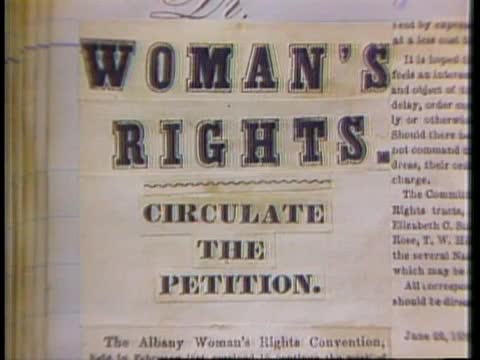
thirty years earlier, a village in the wilds of New York hosted a meeting that brought the idea of women's rights to the fore. Seneca Falls, a town of several hundred played a somewhat reluctant host to the first women's rights convention on July 19th and 20th 1848. Some 300 men and women from the upstate New York area traveled to the Wesleyan Chapel that summer morning in response to an announcement in the Seneca County Courier. Some came because they were interested in reform for women. Others in attendance were undoubtedly intrigued by the radical idea of women meeting together and expressing their opinions in public. For women were not allowed such a forum for expression. Over 200 years of American society had seen to that. When the first women settlers arrived in the American colonies in 1608 they found a harsh, brutal life which showed no favoritism between the sexes as each partner depended on the other for survival. A new system arose. Survival demanded
equality. But time and hard work tamed the land and the role of the colonial woman reverted to one of inferiority. Two revolutions changed all that. The Revolutionary War led to freedom and new frontiers. While the booming industrial age offered women their first taste of economic independence. For the first time in history women were being rewarded for their skills. Unfortunately the laws of the time turned all of the married woman's wages and property over to her husband. Women had no right to own land, make investments, write a will, or go to court making some women quite rightly feel that they were little more than slaves. And this was an era of slavery. The auctioneer's hammer that condemned the first slaves of the new world began an institution that eventually ripped America apart. In this self-proclaimed land of the free - Only white males knew true liberty. Not until the growth of a moral and social conscience, did America face up to its hypocrisy.
The abolitionist movement led by leaders of various religious sects rose to challenge slavery with a unified voice, a voice that welcomed women. Contrary to the traditions of the day, women were allowed to assert their views at public meetings. Courageous groups like the National Female Anti-slavery League faced up to the slavery issue and frequently faced down the pro-slavery mobs who attacked their gatherings. But a far more potent obstacle to the women abolitionists were the negative feelings of their coworkers within the movement. (Bells chiming) London of 1840 was, in many ways, a city of consciousness for the entire world. Many social and economic reform movements were sired in the public meeting halls of the home of the Empire. But the American women delegates who arrived in London in June of 1840 for the first world anti-slavery convention found the English mind as fiercely sexist as any other. For when eight women
all accredited delegates to the convention were denied their seats, a great debate arose. "The chair recognizes Reverend Burnett." "My fellow delegates, and especially the esteemed American ladies, I entreat you to do honor to this august gathering and the higher traditions of English custom and withdraw your credentials. Our work is much too important, our task far too noble to be mired in petty squabblings." "Gentlemen what we have here is not only a matter of custom but for those of us in the clergy, it's a matter of religion. I'm Reverend Harvey of Glasgow and I must say that if I were to give a vote in favor of females sitting and deliberating in such an assembly as this, I should be acting in opposition to the plain teaching of the Word of God." "The chair recognizes our colleague George Bradburn of Massachusetts." "Thank you. We are told that it would be outraging the customs of England to allow women to sit in this convention and I have great respect for the customs of old
England. But what a misnomer to call this a world convention of abolitionists when some of the oldest and most thoroughgoing abolitionists in the world are denied the right to be represented in it." Sadly the combined forces of false piety and misplaced tradition were overwhelming. The Convention voted to bar the women from participating in the meeting and banished them to sit in silence in the gallery. This rejection would probably have faded into obscurity as yet another in a series of slights to women, had it not been for Lucretia Mott, one of the bar delegates and Elizabeth Cady Stanton, the wife of delegate Henry Stanton. As the day's events concluded, the two disheartened women strolled back to their hotel forming a radical idea: a convention to discuss women's rights. But time conspired to delay their grandiose plans. Mrs. Stanton returned to Boston with her husband and became enmeshed in the world of life in the intellectual center of New England. Days of stimulating conversation in the study with friends, servants at hand,
cast a haze over Stanton's memory of the inequities of an average woman's life. Only when her husband's failing health forced the family to move to rural New York, did she confront the drudgery of life as an average housewife. Gone were the stimulating conversations and social occasions. In their place were housework and monotony. As her restlessness grew, the memory of London of eight years earlier returned. "I now fully understood the practical difficulties that most women had to contend with living in the isolated household. The general discontent I felt with a woman's position as wife, mother, housekeeper, physician and spiritual guide. The anxious, worried look of the majority of women impressed me with the strong feeling that some active measures should be taken to remedy the wrongs of society in general and of women in particular. My experiences in the world anti-slavery convention, all the books I've read on the legal status
of women, the oppression I saw everywhere swept across my soul intensified behind my own personal experiences. It seemed as if all these elements had conspired to impel me to some onward step. But I didn't know what to do or where to begin. My only thought was a public meeting of protest and discussion." Lucretia Mott had become a famous lecturer and during one tour through Upstate New York she stopped to visit her sister in the village of Waterloo. Mrs. Stanton seized the moment to resurrect the idea of a convention. Meeting with other friends at the home of Quaker Jane Hunt, the decision was made to hold the first women's rights convention the following week. A notice was placed in the next day's issue of the Seneca County Courier and the five women set about the task of preparing for the meeting. "We felt as helpless and as hopeless as if someone had suddenly asked us to construct a steam engine.
None of us had any experience at running a meeting and we were unsure of just exactly what we wanted to say. But then as I began to read in to paraphrase the Declaration of Independence the past became clear. We hold these truths to be self-evident that all men and women are created equal. That they are endowed by their Creator with certain inalienable rights. That among these are Life, Liberty and the pursuit of happiness." The balance of the women's proclamation was primarily social rhetoric and would probably have gone unnoticed but for one resolution championed by Stanton. "Resolved: that is the duty of the women of this country to secure for themselves their sacred right to the elective franchise." Never before had the radical idea of women's suffrage been mentioned in public. "Well. The thought of women acquiring the vote shocked my husband, the other women and even prompted Mrs. Mott to caution me saying 'Thou don't make
us ridiculous. We must go slowly.' " But with a pledge to support a black abolitionist, Frederick Douglass, Mrs. Stanton held firm. The resolution remained. Those who would attend the meeting in the Wesleyan Chapel the following week were due for a surprise. 300 strong coming by coach and by foot. The committed, the curious and the cynical arrived in Seneca Falls early on the morning of July 19th to find the chapel doors locked and the minister conspicuously absent. But an open window was found. A nephew of Mrs. Stanton was lifted through and the last physical barrier to a free exchange of thought for women was pushed aside. Although novices, the organizers of the convention soon warmed to the task of conducting a public meeting. They reversed their previous stance against allowing men to participate and quickly established rules and procedures. Then Mrs. Stanton rose to speak.
"I should feel extremely diffident to be here today having never before spoken in public. Right [unintelligible] my sense of right and duty. Did I not think that the time had come for the question of women's wrongs to be laid before the public, did I not believe that women herself must do the work; For women alone can understand the lenght, the depth, the height and breadth of her degradation." Other speeches followed but paled in comparison to the eloquence of Mrs. Stanton's. When the resolutions were presented to the congregation lively discussion sprang up, especially when the demand for suffrage was made. Many felt the idea was too controversial, too radical, But the measure passed by a narrow margin. Upon the conclusion of the convention 100 people, 68 women and 32 men, signed to the full declaration of principles. Little did they know that a struggle lasting nearly
three quarters of a century had begun. Surprisingly there was a great reaction. Most of it negative to the reports of the convention that a meeting in the wilds of New York attended by a mere 300 people and supported by only a third of those present could generate such an uproar is remarkable. In fact if it had not been for the vitriolic editorial outrage by the press, the activities of the convention might well have gone unnoticed. "This gathering witnessed a mass of corruption, heresies, ridiculous nonsense and reeking vulgarities, which a vile group of bad women vomited for it." Of the major papers only the New York Tribune led by Horace Greeley offered any support to the blossoming movement. "It is the assertion of a natural right and as such must be conceded." In subsequent months, convention after convention, first regional, then national, spread the gospel of sexual equality. Yet not until a chance meeting in
1851 was the women's movement forged into a cohesive political force. Susan B. Anthony, the daughter of a Quaker farmer, cared little for the women's rights struggles of the late 1840s. Her cause was temperance. A dedicated worker, Susan rose to an officers position in several temperance societies, only to encounter sexual prejudice from her fellow activists. Disillusioned, she abandoned temperance and turned to abolition. One day in Seneca Falls after attending a speech by two prominent abolitionists, she was introduced to Elizabeth Stanton. The two women formed an immediate bond. A bond that would eventually mold the strategies of the women's movement. The two women complimented each other perfectly. Stanton was radical, controversial, philosophical. Anthony was practical, dedicated and highly organized. Together they created and implemented the early theory and ideology of the movement. As Mrs. Stanton once said, "I forged the thunderbolts and Susan fired them."
The first thunderbolt was aimed at helping married women acquire freedom from wage and property restrictions. Committees set up by Susan Anthony presented 6000 signatures in support of married women's rights. And this grassroots support compelled the New York legislature to allow Mrs. Stanton to address them. This in itself was a landmark and although the measure was voted down the movement had gained credibility and political savvy that proved invaluable. Never one to turn away from a challenge, Miss Anthony set out again in the winter of 1855 to try to rally even more support for the legislation. Yet all this dedication brought was derision. The New York State Assembly replied to the next series of petitions. "If there is any inequity or oppression, the gentlemen are the sufferers. They however presented no petitions for redress." The women's persistence paid off. Finally, in 1860 the New York legislature passed the most comprehensive women's rights legislation to date.
A six year battle for women's rights had ended just as a mighty war for human rights had begun. [Sound of cannon fire.] The cannon fire at Fort Sumter split a nation and stopped cold the burgeoning women's rights movement. The 1861 National Women's Rights Convention was canceled. The membership preferring to concentrate on the war and their favorite cause: abolition. The lone dissenter was Susan B. Anthony who maintained that activism should continue as fervently as before. Virtually alone, she carried the movement until a letter from Henry Stanton summoned her to Washington. "Susan, many in the government have pretty much given up the struggle. You have no idea how dark is the cloud which hangs over us. Here there is work for you. Put on your armor and go forth." Susan's armor was the newly formed National Women's Loyal League, which set as its goal the rallying of support for both the war and an anti-slavery constitutional amendment.
The women of this organization believed that their quest for equality would ride the coattails of emancipation as a reward for service to the union. They were sadly mistaken. The 13th Amendment abolished slavery and was followed soon after by the 14th Amendment, which assured the Negro the vote and other rights. But bureaucrats and politicians declared the time as the Negro's hour and systematically excluded women from any reform legislation. Upon reading the amendment and noting the frequent use of the word "male", Mrs. Stanton was prompted to write, "If that word "male" is inserted, it will take us a century at least to get it out." "Elizabeth, I concur. And I will cut off this right arm of mine before I will ever work for, or demand the ballot for, the Negro and not the woman." Yet all petition efforts were to no avail. The amendment became law in July, 1868. Having failed on the federal level, the suffragists
turned their attention to the individual state constitutions. The first battle was fought in Kansas where a referendum proposed dropping the words "right" and "male" from the state election laws. Both Stanton and Anthony led the crusade traveling the entire state lecturing on the need for women's suffrage. The final result was a moral victory as the women's referendum polled more support than expected. A far greater effect from that effort came about from the bond that formed between Anthony and Stanton and an eccentric radical Englishman, George Francis Train. Feelings toward Train were extreme. Some viewed him as a racist charlatan who turned the Kansas campaign into a farce. Others saw him as a source of inspirational influence. To Anthony and Stanton he provided their first opportunity to broadcast their ideas in the Train established newspaper, "The Revolution". Emblazoned with the motto "Principle not policy, justice, not favors, men, their rights and
nothing more, women, their rights and nothing less." The revolution was, as Anthony put it, a paper through which we can make our claim in our own way and time. The paper proved to be as appropriately revolutionary as its title. Radical issues such as divorce, sex education, birth control and labor unionism were but a few of the paper's topics. If a story had relevance to women it had a home in The Revolution. But political and social rhetoric does not pay for newsprint. After two and a half years of pioneering, The Revolution printed its last issue in May, 1870. For the next six years Susan Anthony toured and lectured to personally repay the various debts of the paper that she had guided and nourished, proclaiming as the last bill was settled that her day of jubilee had come. Jubilee had come. But three years earlier there had been another day in Anthony's life. A day of judgment. On November 1st,
1872 Miss Anthony led 50 Rochester, New York women to the polls to register to vote, citing the 14th Amendment as legal grounds. On Election Day, although her supporters had dwindled in number, an undaunted Miss Anthony cast her ballot only to be arrested two weeks later by federal election officers. More than six months of controversy, speech making and legal maneuvering passed before Miss Anthony came to trial. But not to a trial by jury. For the presiding judge, Ward Hunt, turned to the jury and read a prepared statement which concluded, "The result on your part must be a verdict of guilty. The prisoner will stand. Has the prisoner anything to say why sentence shall not be pronounced?" "Yes, Your Honor. I have [unintelligible] things to say. For in you have ordered verdict of guilty, you have trampled under foot every vital principle of our government. My natural rights, My, my
civil rights, my political rights, are all alike, ignored. Robbed of the fundamental privilege of citizenship, I am degraded from the status of a citizen to that of the subject. Not only myself, individually, but all of my sex are, by Your Honor's verdict, doomed to political subjection under this so-called "Republican" government." "The court can allow the prisoner to go on." "But your honor will not deny me this one and only poor privilege of protest against this high handed outrage upon my citizen's rights. May it please the court to remember that since the day of my arrest last November, this is the first time that either myself, or any person of my disenfranchised class, has been allowed a word of defense before a judge or a jury." "The court must insist. The prisoner has been tried according to the established forms of law." "Yes, Your Honor.
But forms of law are made by men, interpreted by men, administered by men in favor of men and against women. And hence, Your Honor's ordered verdict of guilty against a United States citizen, for the exercise of that citizen's right to vote. Simply because that citizen is a woman and not a man." "The court orders the prisoner to sit down. It will not allow another word." "When I was brought before Your Honor for trial, I hoped for a broad and liberal interpretation of the Constitution and its recent amendments that should declare every United States citizen under its protecting aegis. That should declare equality of rights, a national guarantee to every person born or naturalized in the United States. But, failing even to get a trial by a jury, not of my peers, I ask not leniency at your hands
but rather the full rigors of the law." "The court must insist. The prisoner will stand up. The sentence of the court is that you pay a fine of $100 and the costs of the prosecution." "May it please Your Honor, I shall never pay a dollar of your unjust penalty. All the stock in trade I possess, is a ten thousand dollar debt incurred by publishing my paper The Revolution. Four years ago the sole object of which was to educate all women to do precisely as I have done. Rebel against your man-made, unjust, unconstitutional forms of law that tax, fine, imprison and hang women while they deny them the right of representation in the government. And I shall work on with might and main to pay every dollar of that
honest debt. But not one penny shall go to this unjust claim. And I shall earnestly and persistently continue to urge all women to the practical application of the whole revolutionary magnum that resistance to tyranny is obedience to God." Judge Hunt's reply was to order that Miss Anthony not be jailed until her fine was paid thereby preventing any manner of judicial appeal. The outrage over the conduct of the trial probably did as much for the women's suffrage movement as any of their previous protests or conventions. One newspaper complained "The judge violated the Constitution of the United States more in convicting Susan Anthony of illegal voting than she did by voting." Public opinion, the true motivator of change, began to slowly shift toward the women. Yet total suffrage was a concept that the entire nation was still unwilling to accept. For
as the movement grew, so did its opponents. In every year from 1878 to 1920 a women's suffrage amendment better known as the Susan B. Anthony amendment was presented in Congress and either tabled, defeated or mired down in the limbo of congressional committees. The will of the people stood no chance against the whims of politics. As the calendar changed to a new century, new leaders of the women's rights movement emerged to carry the gauntlet of suffrage. Elizabeth Cady Stanton had moved on from suffrage to social philosophy. And Susan B. Anthony found that the rigors of political activism exhausting for an 80 year old woman. Both women remained in the public eye, but more as revered vanguards of the movement than as fully active participants. Both women were able to look back at a half century of struggle with pride. On her 80th birthday Mrs. Stanton recalled Seneca Falls and the warnings of her friends. " 'You have made a great mistake,' they said to me. 'You will be laughed at
from Maine to Texas and across the sea. God has set the bounds of a woman's fear and she should be satisfied with her position.' We were unsparingly ridiculed by press and prophet, but now many conventions are held each year. Social customs have changed. Laws have been modified. Municipal suffrage has been granted to women in England. School suffrage to women in half our states. Municipal suffrage in Kansas. And full suffrage in four states of our union. Thus that principle first scouted in 1848 has slowly progressed. That first convention, once considered a grand mistake in 1848, is now considered a grand step in progress." Five years later Susan B. Anthony bade her farewell as president of the Suffrage Association by noting that "Once I was the most hated and reviled of
women. Now it seems as if everybody loves me. But our fight must not cease. You must see to it that it does not stop. Failure is impossible." Neither Elizabeth Cady Stanton nor Susan B. Anthony lived to see the full fruits of their labors. But their movement, began at first as a protest, grew to a worldwide force that overcame political obstinacy, social indifference and institutional hostility to permanently change a sex and a world. But while women were finally granted full suffrage in 1920 the struggle for equality continues today. Like the suffrage movement, the drive for the Equal Rights Amendment has encountered deep rooted conservative opposition from men, who fear a loss of power, and women, who fear a loss of identity. Both movements have sought legislative support at the state level when federal law became neutralized by special interest groups
to an expanding role of women in the workforce and society. Both have battled prejudice with persistence, distortion with dedication, ignorance with idealism. The future for equal rights is unclear. But as Elizabeth Stanton once wrote "We were the stone that started the ripple. But our successes are the ripples that will soon cover the whole pond." Singing. Singing. Singing. Singing. Singing.
Singing. Singing. The preceding program was made possible by the Travelers Insurance Company serving all insurance needs through local independent agents.
- Episode Number
- 102
- Episode
- A Woman's Place
- Producing Organization
- WXXI (Television station : Rochester, N.Y.)
- Contributing Organization
- WXXI Public Broadcasting (Rochester, New York)
- AAPB ID
- cpb-aacip/189-48ffbmkt
If you have more information about this item than what is given here, or if you have concerns about this record, we want to know! Contact us, indicating the AAPB ID (cpb-aacip/189-48ffbmkt).
- Description
- Episode Description
- This episode detailed the Women's Rights Movement centered in Seneca Falls, NY in the 1840s. It tells the story of the relationship between Elizabeth Cady Stanton and Susan B. Anthony, and their work for women's rights through the second half of the 19th century.
- Series Description
- In and About New York State History is a documentary series highlighing New York communities and history.
- Broadcast Date
- 1981-08-20
- Asset type
- Episode
- Genres
- Documentary
- Rights
- Copyright 1981 RAETA, Inc.
- Media type
- Moving Image
- Duration
- 00:29:52
- Credits
-
-
Director: Gee, Tom
Host: Lewis, Patti
Producer: Gee, Tom
Producing Organization: WXXI (Television station : Rochester, N.Y.)
Writer: Gee, Tom
- AAPB Contributor Holdings
-
WXXI Public Broadcasting (WXXI-TV)
Identifier: LAC-1133/1 (WXXI)
Format: U-matic
Duration: 1752.9999999999998
If you have a copy of this asset and would like us to add it to our catalog, please contact us.
- Citations
- Chicago: “In and About New York State History; 102; A Woman's Place,” 1981-08-20, WXXI Public Broadcasting, American Archive of Public Broadcasting (GBH and the Library of Congress), Boston, MA and Washington, DC, accessed April 2, 2026, http://americanarchive.org/catalog/cpb-aacip-189-48ffbmkt.
- MLA: “In and About New York State History; 102; A Woman's Place.” 1981-08-20. WXXI Public Broadcasting, American Archive of Public Broadcasting (GBH and the Library of Congress), Boston, MA and Washington, DC. Web. April 2, 2026. <http://americanarchive.org/catalog/cpb-aacip-189-48ffbmkt>.
- APA: In and About New York State History; 102; A Woman's Place. Boston, MA: WXXI Public Broadcasting, American Archive of Public Broadcasting (GBH and the Library of Congress), Boston, MA and Washington, DC. Retrieved from http://americanarchive.org/catalog/cpb-aacip-189-48ffbmkt